1
CRM TECNHOLOGY IMPLEMENTATION:
Mutual Adaptation of Technology and Organization
Ana Filipa Moutinho Oliveira
Master in Innovation Economics and Management
Dissertation
Supervisor:
Professor José Coelho Rodrigues
Professor João Claro
September 2017
ii
Biographical Note
Filipa Oliveira was born in Porto, Portugal on the July 29th, 1993.
She graduated in Economy at the School of Economics and Management at University of Porto in 2014.
In 2015 she enrolled the Master in Innovation Economics and Management program at University of Porto School of Economics and Management, whose accomplishment she is currently pursuing.
Since 2014, she has been pursuing a career as a Microsoft Dynamics CRM Applications Consultant.
iii
Acknowledgments
I am most grateful to my supervisor José Coelho Rodrigues. Thank you for the patience to assist me in embracing this new challenge and the guidance to help me see it through. Without your guidance and calm and careful advice, this work would not have been possible. And, more importantly, I would have not been able to learn and systematize the knowledge I have acquired about this topic, which is of such interest to me, both academically and professionally.
I am also extremely grateful to Prof. João Claro, whose advice and guidance were most appreciated and helped structure the analyses into this dissertation.
I am grateful to my parents for always pushing to explore further and improve myself.
I am most grateful to my friends for the always believing in me with endless patience and support.
iv
Resumo
Esta tese é motivada pela importância de analisar as implementações de tecnologias de CRM (Customer Relationship Management) em organizações, originando implementações com rotinização e assimilação efetiva da tecnologia, de forma a explorar o pleno potencial dos benefícios da tecnologia. O foco de investigação é o processo de implementação, utilizando uma perspetiva de mútua adaptação entre a tecnologia e a organização adotante. O principal objetivo da tese é melhorar o conhecimento disponível sobre projetos de implementação de tecnologias de CRM, e as dinâmicas e influências que ocorrem durante o processo de mútua adaptação, respondendo concretamente às seguintes questões de investigação: De que forma a flexibilidade de adaptação entre a tecnologia e a organização adotante influencia o sucesso do processo de implementação? De que forma podem as estratégias de gestão ser aplicadas de forma utilizar a flexibilidade existente para contribuir para o sucesso do processo de implementação?
A análise desta tese dividiu-se em duas partes. Numa primeira parte, foi realizada uma revisão sistemática da literatura sobre dinâmicas de mútua adaptação em implementações de tecnologia (Capítulo 2). Numa segunda parte, foram analisados cinco estudos de caso de implementações de tecnologia CRM, seguindo o alinhamento traçado pela revisão da literatura. A análise de estudos de caso incluiu esquemas propostos para a classificação de desalinhamentos e ciclos de adaptação, e o uso da flexibilidade disponível por gestores para alcançar uma implementação efetiva com melhoria de performance operacional.
Esta tese contribui para a área de investigação da gestão da tecnologia, ao confirmar que as implicações apresentadas na revisão da literatura são aplicáveis às implementações de tecnologias CRM, e ao lançar desafios para investigações futuras.
Palavras-chave: Processo de Implementação de Tecnologias; Mútua Adaptação;
Adaptação Tecnológica; Adaptação Organizacional; Desalinhamentos; Ciclos de Adaptação
v
Abstract
This dissertation was motivated by the importance of analyzing implementations of CRM (Customer Relationship Management) technologies within organizations, culminating in the effective routinization and assimilation of the technologies, to fully explore the potential benefits of the technology. The focus of the research was on the implementation process, using a mutual adaptation perspective between the technology and the adopter. The main goal of the dissertation was to improve the current understanding about the dynamics and influences of CRM technology implementations, and the dynamics and influences that take place during mutual adaptation process, specifically by answering the following research questions: In which way does adaptation flexibility between the organization and the CRM technology contribute to implementation success? How can managerial strategies make use of the available flexibility to contribute to the implementation success?
To achieve this goal, the research was divided in two parts. In a first part, a comprehensive literature review was conducted to establish the current knowledge base about mutual adaptation dynamics in technology implementations (Chapter 2). In the second part a multiple case study with five cases of implementations of a CRM technology was conducted, framed by the results of the literature review (Chapter 4). The case study analyses included schemes of identified misalignments and adaptation cycles, and the use of the available adaptation flexibility by managers to lead the mutual adaptation process into an effective implementation with performance enhancement.
This work results in the confirmation of the application of literature constructs to the implementation process of CRM technologies, thus, hoping to contribute to the technology management literature, provide some insights for implementation practitioners and raising questions to be analyzed in future research.
Key words: Technology Implementation Process; Mutual Adaptation; Technological
vi
Index
Biographical Note ... ii Acknowledgments ... iii Resumo ... iv Abstract ... v Index ... viTable Index ... viii
Figure Index ... x
1. Introduction ... 1
2. Literature Review ... 3
2.1 Technology Implementation... 3
i. Process of Technology Implementation ... 4
ii. Implementation Factors ... 5
iii. Implementation Success ... 15
2.2 Implementation as a Mutual Adaptation Process ... 19
i. Managing Implementation ... 28
2.3 Previous Studies about CRM implementations ... 32
3 Method ... 35
3.1 Introduction ... 35
3.2 The CRM technology ... 35
3.3 Research Design and Sampling ... 36
3.4 Data Collection ... 37
3.5 Data Analysis ... 39
4. Data Analysis ... 41
4.1 Introduction ... 41
i. Technology Characteristics ... 41
ii. Implementation Actors ... 42
iii. Implementation Process Structure ... 43
iv. Misalignments Types ... 44
v. Managerial Strategies ... 45
vi. Outcome Indicators ... 46
vii. Introduction to the Case Studies ... 46
4.2 Case Study A ... 48
i. Introduction ... 48
ii. Misalignments & Adaptation Cycles ... 48
iii. Managerial Strategies ... 53
iv. Implementation Outcome ... 55
vii
i. Introduction ... 58
ii. Misalignments & Adaptation Cycles ... 58
iii. Managerial Strategies ... 63
iv. Implementation Outcome ... 64
4.4 Case Study C ... 67
i. Introduction ... 67
ii. Misalignments & Adaptation Cycles ... 67
iii. Managerial Strategies ... 71
iv. Implementation Outcome ... 73
4.5 Case Study D ... 75
i. Introduction ... 75
ii. Misalignments & Adaptation Cycles ... 76
iii. Managerial Strategies ... 79
iv. Implementation Outcome ... 81
4.6 Case Study E ... 83
i. Introduction ... 83
ii. Misalignments & Adaptation Cycles ... 84
iii. Managerial Strategies ... 88
iv. Implementation Outcome ... 89
4.7 Cross-case Analysis ... 91
i. Adaptation Flexibility ... 91
ii. Managerial Strategies ... 95
5. Conclusion ... 98
5.1 Main results and contribution of the study ... 98
5.2 Limitations of the study... 99
5.3 Paths for future research ... 100
6. References ... 101
7. Appendix ... 104
7.1 Appendix A - Protocol Used in the Case Research (in Portuguese) ... 105
7.2 Appendix B – Informed Consent (in Portuguese) ... 109
7.3 Appendix C – Interview Guides (in Portuguese)... 111
7.4 Appendix D – Interview Transcriptions (in Portuguese) ... 117
i. Adopter A ... 117
ii. Adopter B ... 147
iii. Adopter C ... 176
iv. Adopter D ... 201
viii
Table Index
Table 1 - Description of Case Studies ... 37
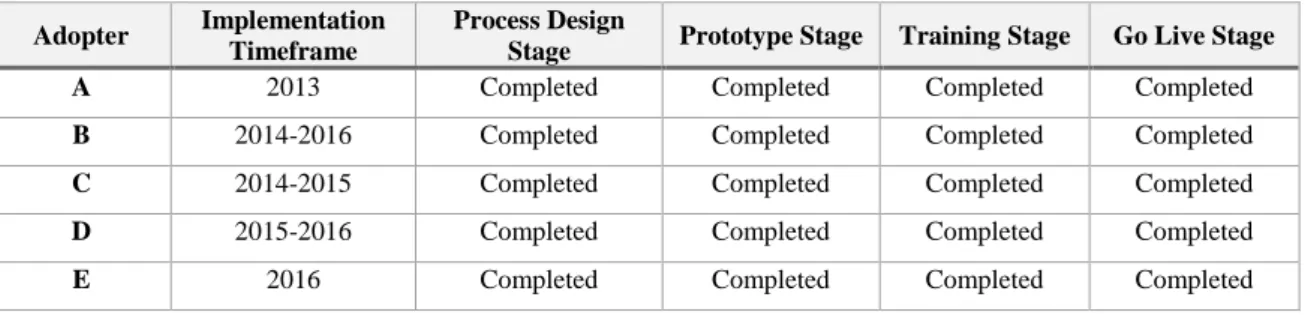
Table 2 - Implementation timeframe and stages per case study... 47
Table 3 - Interviews detail per case study ... 47
Table 4 - Documentation detail per case study ... 48
Table 5 - Adopter A - Process Design Stage - Identified Misalignments and Adaptation Cycles ... 50
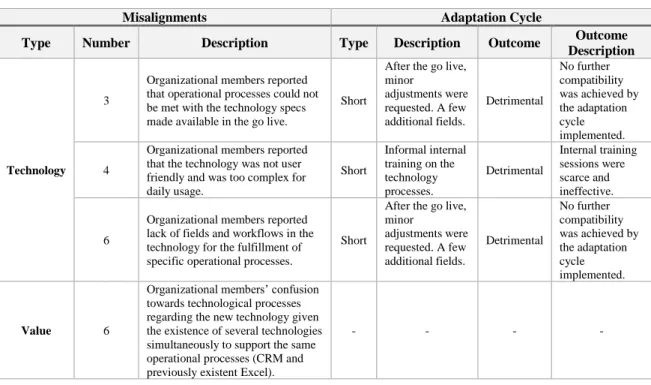
Table 6 - Adopter A - Prototype Stage - Identified Misalignments and Adaptation Cycles ... 51
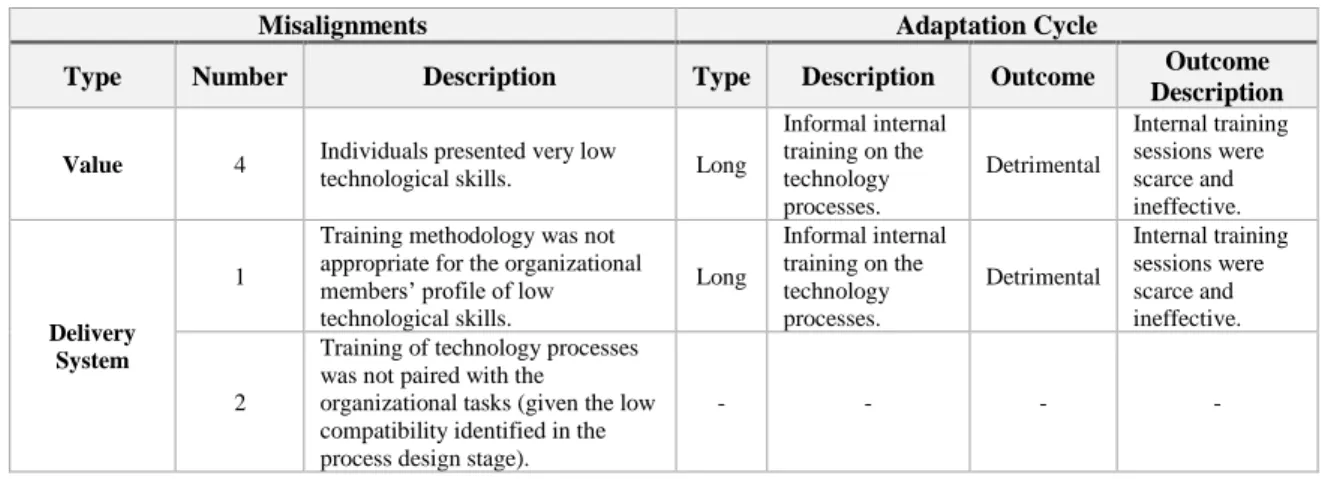
Table 7 - Adopter A - Training Stage - Identified Misalignments and Adaptation Cycles ... 51
Table 8 - Adopter A – Go Live Stage - Identified Misalignments and Adaptation Cycles ... 52
Table 9 - Adopter A - Misalignment vs. Adaptation Comparison ... 53
Table 10 - Adopter A - Linton (2002) Implementation Outcome Indicators ... 56
Table 11 - Adopter A - Linton (2002) Implementation Outcome Impact Dimensions ... 56
Table 12 - Adopter A - Implementation Indicators ... 56
Table 13 - Adopter B - Prototype Stage - Identified Misalignments and Adaptation Cycles ... 60
Table 14 - Adopter B - Training Stage - Identified Misalignments and Adaptation Cycles ... 60
Table 15 - Adopter B – Go Live Stage - Identified Misalignments and Adaptation Cycles ... 61
Table 16 - Adopter B – Go Live Stage (2) - Identified Misalignments and Adaptation Cycles ... 62
Table 17 - Adopter B - Misalignment vs. Adaptation Comparison ... 62
Table 18 - Adopter B - Linton (2002) Implementation Outcome Indicators ... 65
Table 19 - Adopter B - Linton (2002) Implementation Outcome Impact Dimensions ... 65
Table 20 - Adopter B - Implementation Indicators ... 66
Table 21 - Adopter C – Process Design Stage - Identified Misalignments and Adaptation Cycles ... 69
Table 22 - Adopter C – Prototype Stage - Identified Misalignments and Adaptation Cycles... 69
Table 23 - Adopter C – Prototype Stage (2) - Identified Misalignments and Adaptation Cycles ... 70
Table 24 - Adopter C – Training Stage - Identified Misalignments and Adaptation Cycles ... 70
Table 25 - Adopter C – Go Live Stage - Identified Misalignments and Adaptation Cycles ... 70
Table 26 - Adopter C - Misalignment vs. Adaptation Comparison ... 71
Table 27 - Adopter C - Linton (2002) Implementation Outcome Indicators ... 73
Table 28 - Adopter C - Linton (2002) Implementation Outcome Impact Dimensions ... 73
Table 29 - Adopter C - Implementation Indicators ... 74
Table 30 - Adopter D – Prototype Stage - Identified Misalignments and Adaptation Cycles ... 78
Table 31 - Adopter D – Go Live Stage - Identified Misalignments and Adaptation Cycles ... 78
Table 32 - Adopter C - Misalignment vs. Adaptation Comparison ... 79
Table 33 - Adopter D - Linton (2002) Implementation Outcome Indicators ... 81
Table 34 - Adopter D - Linton (2002) Implementation Outcome Impact Dimensions ... 82
Table 35 - Adopter D - Implementation Indicators ... 82
ix
Table 37 - Adopter E – Prototype Stage - Identified Misalignments and Adaptation Cycles ... 86
Table 38 - Adopter E - Training Stage - Identified Misalignments and Adaptation Cycles ... 86
Table 39 - Adopter E – Go Live (PT) Stage - Identified Misalignments and Adaptation Cycles ... 87
Table 40 - Adopter E – Go Live (ES) Stage - Identified Misalignments and Adaptation Cycles ... 87
Table 41 - Adopter E - Misalignment vs. Adaptation Comparison... 88
Table 42 - Adopter E - Linton (2002) Implementation Outcome Indicators ... 89
Table 43 - Adopter E - Linton (2002) Implementation Outcome Impact Dimensions ... 90
x
Figure Index
Figure 1 – Factors that influence the Implementation Process ... 15
Figure 2 - Technology Adaptation Cycles (Adapted from Leonard-Barton (1988a)) ... 24
Figure 3 - Performance Criteria Adaptation Cycles (Adapted from (Leonard-Barton, 1988a)) ... 25
Figure 4 - Delivery System Adaptation Cycles (Adapted from (Leonard-Barton, 1988a)) ... 25
Figure 5 - Adaptation Cycles Outcome (Adapted from Leonard-Barton (1988a)) ... 28
Figure 6 - Research Process ... 37
Figure 7 - Data Collection and Analyses Scheme ... 39
Figure 8 - MAXQDA Coding Analysis (sample) ... 40
Figure 9 - Implementation Process ... 44
Figure 10 - Adopter A - Implementation Process Timeline ... 49
Figure 11 - Adopter A - Flexibility Matrix ... 57
Figure 12 - Adopter B - Implementation Process Timeline ... 59
Figure 13 - Adopter B - Flexibility Matrix ... 66
Figure 14 - Adopter C - Implementation Process Timeline ... 68
Figure 15 - Adopter C - Flexibility Matrix ... 75
Figure 16 - Adopter D - Implementation Process Timeline ... 77
Figure 17 - Adopter D - Flexibility Matrix ... 83
Figure 18 - Adopter E - Implementation Process Timeline ... 85
Figure 19 - Adopter E - Flexibility Matrix ... 91
Figure 20 - Adaptation Flexibility vs. Implementation Success ... 94
1
1. Introduction
Implementation of technologies creates moments of tension amongst organizational forces that strive to adjust to change (Leonard-Barton, 1988a). For adopters it is time and resource consuming to introduce a technology whose benefits of implementation are collective and long-term whilst the costs are immediate and frequently perceived as individual by organizational members (Hsiao-Lan, Wang, & Pei-Hung, 2005; Leonard-Barton, 1987). Moreover, implementation is only successful if the technology is routinized and assimilated by the organizational members (Rogers, 2003). Thus, an effective implementation is one that also improves organizational performance (Klein & Sorra, 1996).
Assimilation and routinization cannot be achieved without undergoing a process of mutual adaptation between the technology, its intrinsic characteristics, and the organization and its members (Choi & Moon, 2013; Leonard-Barton, 1988a). Only through a process of mutual adaptation can the full potential of performance enhancement, brought by the introduction of the technology, be unleashed (Leonard-Barton, 1988a).
Managerial strategies are the actions chosen to manage the resources available in one organization, with the purpose of achieving specific objectives (Leonard-Barton, 1988b). Strategies such as defining the level of user involvement in the implementation process, identifying sponsors and champions for the implementation project, and others, further discussed below, impact directly the implementation process. Particularly, the managerial strategies focused on making use of the flexibility of the adopter and the technology to mutually adapt, define the outcome of the implementation process, because the capacity to achieve a high degree of compatibility between technology and adopter will define that outcome (Basoglu, Daim, & Kerimoglu, 2007; Leonard-Barton, 1988b).
In the past decade CRM software implementations have been growing exponentially due to the recognition of CRM methodologies as tools to underpin organizational performance improvement through customer retention and relationship management (Al-Ajlam, 2006). However, to the best of current knowledge, studies that address such implementations using a conceptual framework of mutual adaptation between CRM technologies and their adopters are still scarce. Since every technology
2 has its own specificities (Hameed, Counsell, & Swift, 2012) and, even though there are considerable implementation guidelines that can be useful when followed (Al-Ajlam, 2006; Hameed et al., 2012; Leonard-Barton, 1987; Linton, 2002; Rogers, 2003), there is an opportunity to analyze the implementation of CRM technologies in the perspective of implementation as a mutual adaptation process.
The purpose of this study is to analyze the relationship between the flexibility of the technology and of the organization to be mutually adapted and the success of the implementation and assimilation of the technology within the adopter organization; analyze the role of this flexibility in achieving compatibility of the technology with the adopter; and, analyze the influence of managerial strategies in the success of the implementation. This thesis aims to answer to the following research questions: In which way does adaptation flexibility between the organization and the CRM technology contribute to implementation success? How can managerial strategies make use of the available flexibility to contribute to the implementation success?
For this purpose, a multiple case research of CRM technology implementation processes, with five case studies, was conducted. These implementations took place in Portugal, between 2013 and 2016. They were considered an appropriate setting for this study because the CRM technology was implemented by medium sized enterprises that used it to support their organizational operations.
After this introductory overview of this thesis, the second chapter revises the literature about implementations of technologies, focusing on the perspective of mutual adaptation and on the implementation management. The third chapter presents the research objectives proposed for this dissertation, the related research questions, and the methodology used. Chapter 4 consists of the analyses of the data collected from the five case studies included in this dissertation and which implications can be drawn from them. On chapter 5 the conclusions of this study are presented.
3
2. Literature Review
2.1
Technology Implementation
Innovation literature is frequently focused on the decision of adopting innovations by organizations, in order to establish a rate of innovation in organizations (Leonard-Barton & Deschamps, 1988). However, the selection and adoption of a technology is just the beginning of the process of implementing a technology in an organization (Leonard-Barton & Deschamps, 1988; Rogers, 2003). The implementation process of a technology is defined by Rogers (2003, p. 434) as “all events, actions, and decisions involved in putting an innovation into use”. The implementation process may be lengthy: starting with the adoption decision, going through efforts for matching the organization with the technology, and having routinization as the culmination of a successful implementation (Klein & Sorra, 1996; Rogers, 2003).
Managerial decisions during the implementation process considerably impact the acceptance and diffusion of a technology within an organization. The quality of matching and adaptation between the technology and the adopter, and of communication during the early stages of the implementation (adoption decision) will define the potential of the innovation to be perceived as useful among its targeted users (innovation response) (Basoglu et al., 2007; Leonard-Barton, 1988b).
When studying implementations of technologies, it is fundamental to understand that those are not structured and inflexible processes to be followed swiftly from day one until the go live of the implementation project (Leonard-Barton, 1988a). The technology will require changes in the organization’s routine. Moreover, throughout the process of implementation adjustments to the technology might also be necessary to ensure that previously ill-mapped or unpredicted requirements are taken into consideration, to guarantee a well-adjusted fit between parties (Leonard-Barton, 1988a; Leonard-Barton & Sinha, 1993). Therefore, the implementation of a new technology must be understood as a staged and adaptive process (Leonard-Barton, 1988a; Rogers, 2003).
To further understand the adaptive process of technology implementation, this literature review is divided into 3 sections. The first section analyzes the technology implementation process, considering the stages of the implementation process, the
4 implementation factors that directly impact the success of the implementation process and the indicators that measure success. On the second section the implementation process is analyzed under a mutual adaptation perspective, focusing on the misalignments of the technology, the adopter or both and the cycles of single or mutual adaptation alignment that follow these misalignments. This section also considers how managers can strategize to make use of the available flexibility to contribute to the implementation success. The third section presents reasoning for the importance of conducting a study using the mutual adaptation perspective on a CRM implementation process and an analysis on the extent and depth of existing research studies on the CRM technology implementation process.
i. Process of Technology Implementation
Technology Implementation literature widely accepts the process of implementation of new technologies as a process that can be aggregated into a three-staged process (Greenhalgh, 2004; Hameed et al., 2012; Linton, 2002). The nomenclature for these stages varies in a cross-author analysis, however can be summed up into: adoption, implementation and assimilation (also referred to as routinization, or lack of it – failure to implement) (Greenhalgh, 2004; Linton, 2002).
Adoption ranges from the recognition of the need for a process change requiring a
technology to sustain it and the research activities that provide awareness about the technologies available, to choosing a suitable technology (Hameed et al., 2012; Linton, 2002). It also includes, after the selection of the technology, the analysis of the organization needs in comparison to what the technology offers, to assess the fit between them as well as the technological gap that needs to be filled (Rogers, 2003).
Implementation entails the steps that follow after acquiring the most adequate
technology (Hameed et al., 2012), comprising efforts to include the technology in the organizational process (Rogers, 2003). These efforts include a series of iterations and adaptations of both technology and operational processes: changing the technology to fulfill the identified organizational needs (Hameed et al., 2012; Linton, 2002); and, assessing whether specific operational processes need to be changed in order to adequately accommodate the technology (Rogers, 2003). After this successive misalignments and alignments identification, a trial run (pilot) of the technology is
5 performed, in an environment with a small group of pioneer key users, in order to test the technology’s acceptance in loco and its actual suitability for the operational processes it is meant to support (Hameed et al., 2012; Rogers, 2003). Following a successful pilot, the technology is rolled-out and implemented throughout the full extent of the organization (Rogers, 2003).
The assimilation stage of the implementation overlaps the implementation stage, as it starts usually with the acceptance of the technology by key users usually during the pilot, and continues with an increasing incorporation of the technology in the routines of the users throughout the rest of the implementation process (Hameed et al., 2012). It is the least linear stage of the three (Greenhalgh, 2004) and concludes when the technology and the technological processes surrounding it become widely accepted by the users individually and at the organizational level, by completely routinizing them (Hameed et al., 2012; Linton, 2002). The end of the assimilation stage occurs when the innovation loses its separate identity and becomes part of the organizational identity as a cohesive whole (Linton, 2002; Rogers, 2003). If the implementation process is successful, the technology becomes part of the organization’s routine (Rogers, 2003). On the other hand, if the technology fails to be routinized into the organizational routine, the technology is ultimately abandoned (Rogers, 2003).
ii. Implementation Factors
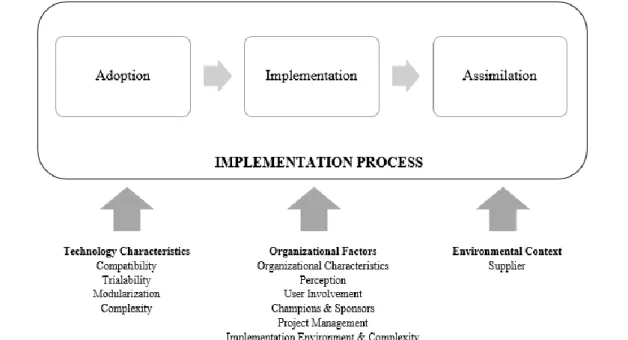
Implementation projects differ considerably according to several conditions that shape them as processes (Choi & Moon, 2013; Leonard-Barton, 1988b). Such conditions can be grouped into three main categories: technology characteristics; organizational factors; and the social context surrounding the organization adopting the technology (Choi & Moon, 2013). The technology characteristics include the specifications and limitations of the technology and are strongly influenced by the supplier of the technology (Choi & Moon, 2013; Leonard-Barton, 1988a). The organizational factors influencing the implementation process include perceived usefulness of the technology for the members of the organization and therefore their attitudes towards change, the presence of sponsors and champions, the resistance to the implementation process, among others further detailed below. (Choi & Moon, 2013). The context in which the organization operates will influence considerably the
6 implementation process, because it is the interaction gateway between the technology and the organization (Choi & Moon, 2013).
Technology Characteristics
It is widely argued that a technology in its standard form (with no customizations to meet customer additional requirements) is hardly enough for a successful implementation, requiring adaptation of the technology to customer specific needs (Hsiao-Lan et al., 2005; Leonard-Barton, 1988a). Despite the need for adaptation throughout the technology implementation process, the intrinsic characteristics of a technology are crucial during the adoption stage to help the organization segment and ultimately select the right technology to adopt, in order to have the best initial fit between technology and organization (Hsiao-Lan et al., 2005; Klein & Sorra, 1996; Leonard-Barton, 1988a). Not only are the technological intrinsic characteristics important for the success of the implementation process, but also the perception of such characteristics by the targeted users: a system may be an extremely efficient alternative (to prior processes) in performing a task but only if it is widely accepted by the organization’s members will its full potential be unveiled (Basoglu et al., 2007). The success of the implementation will be determined, not linearly by the specifications of the technology, but by such specifications in conjunction with the perception of its characteristics (Rogers, 2003).
One of the fundamental characteristics of a technology is its compatibility with the requirements identified during the adoption decision process and with the organizational cultural values (Basoglu et al., 2007; Hsiao-Lan et al., 2005; Rogers, 2003). The need for a detailed mapping and adaptation process between the technology and the organizational operational processes is frequently accepted, however, the disturbances it brings to the organizational balance are considerably reduced if most of the specifications of the technology are aligned with the requirements, culture, beliefs and values of the adopter (Basoglu et al., 2007; Rogers, 2003). Leonard-Barton (1988b) has found empirically that such alignment compatibility is high, the communicability of the technology (ease of dissemination to organizational members) is also high. Hence, it is easier to transmit the technology to the targeted users, given that the underlying
7 operational premises are fundamentally like what the users are already familiar with (Leonard-Barton, 1988b; Rogers, 2003). Consequently, compatibility also facilitates the acceptance of change for organizational members (Leonard-Barton, 1988b). Moreover, per Rogers (2003) the perceived compatibility has a direct impact on adoption rate: a higher level of compatibility between technology and organization has a positive impact on the success of the implementation, whilst low compatibility negatively impacts the outcome of the implementation process.
Trialability defines the ability of the adopter to test the technology, thus showing
the degree to which it has proved its feasibility within a controlled but real-like scenario (Leonard-Barton, 1988b; Rogers, 2003). If the adopter is able to test the technology prior to its go live within the organization, and moreover confirm its compatibility, the adopter will consequently have a higher degree of trust in the final product (Rogers, 2003). Thus, accepting more easily the burdens of the implementation process, which, as stated previously, can be a lengthy, time and resource consuming process (Rogers, 2003). Trialability is also interconnected with the degree of modularization of the technology, i.e., if a technology is easily separated into modules that deliver different benefits and that can be implemented individually, it is far easier to test those segments prior to go live (Leonard-Barton, 1988b), therefore, making it more trustworthy for the adopter (Rogers, 2003).
As mentioned above, triability is greatly influenced by the ability to divide a technology implementation into several smaller and less complex segments, to be orderly implemented until reaching complete implementation of the technology (Hameed et al., 2012; Leonard-Barton, 1988b; Rogers, 2003). Leonard-Barton (1988b) defined modularization of a technology as the ability to partition a technology into smaller segments that will provide benefits even when implemented individually. The degree of modularization of a technology impacts the implementation process in several ways:
• Modularization increases trialability. Hence, it provides the organization a smaller level of commitment, reassuring that it will be easier to roll back the
8 implementation (partially of fully) if the desired compatibility is not reached at a particular trial run (Leonard-Barton, 1988b);
• It stages the implementation phase into several smaller parts, therefore providing opportunities for intermediate feedback from key-users (Leonard-Barton, 1988b) and increasing the chances of achieving final compatibility between the organization and the technology (Rogers, 2003);
• Ultimately, if the technology has a degree of modularization high enough to reach individualization, users will be further motivated to provide feedback and engage in improvements of the technology design and implementation strategy, since they are able to foresee their own individual benefits (Choi & Moon, 2013). – Individualization is reached when individuals perceived potential benefits of the implementation process for themselves, independently from the aggregated output of the implementation process (Choi & Moon, 2013; Leonard-Barton, 1988b).
Therefore, modularity allows for increasingly higher certainty concerning the outcome of the implementation and, therefore, can be seen as an enabler of a risk-reduction for implementation strategy (Linton, 2002).
The definition of technology complexity has been the object of analysis by many authors (Linton, 2002; Rogers, 2003), however the concept of technology complexity is far from being consensual and Rogers (2003) was one of the few authors to provide a definition of the concept. Rogers (2003) proposes to define technology complexity as the extent to which a technology is perceived as challenging to learn and use by its targeted users, which is the definition used in this work. Technology complexity is negatively connected to adoption rate (Rogers, 2003). It is harder to implement technologies with extensive and/or complex procedures to be learnt (Rogers, 2003), although it becomes less difficult to implement complex technologies when existing technical competences of organizational members are advanced (Linton, 2002) or when prior knowledge of the technology or similar technologies exists within the organization (Linton, 2002). Complexity also relates to other technological characteristics, since more complexity is often connected to a lower degree of divisibility (modularity) and,
9 therefore, a lower degree of trialability, thus, increasing the risk of implementation failure (Leonard-Barton, 1988b; Linton, 2002; Rogers, 2003).
Organizational Factors
Both organizational characteristics and organizational members (technology users) characteristics have an important influence in the implementation process (Basoglu et al., 2007; Rogers, 2003), thus, being factors widely studied in the literature (Hameed et al., 2012). The ultimate goal of the implementation process is to guarantee that complete or, at least, wide user acceptance and routine use of the technology within an organization is achieved (Leonard-Barton, 1988b). However, user acceptance ought to be analyzed not only as an individual measure, but also in the perspective of an integrated organization (Hameed et al., 2012), since it results from the combination of several interconnected factors, such as: organizational characteristics, organizational members’ perception of the technological benefits, user involvement throughout the implementation process, the existence of sponsors and champions of the technology within the organization, the project management strategies, and the implementation environment and complexity (Basoglu et al., 2007; Hameed et al., 2012; Leonard-Barton, 1988b; Linton, 2002).
Each organization has its specific identity, which is a by-product of its structure, resources, managerial practices and culture (Basoglu et al., 2007; Linton, 2002). The
organizational characteristics shape the implementation process (Linton, 2002).
Hence, understanding the operational setting of the implementation process is crucial to understand the potential outcome of the implementation of the technology. The operational setting of the implementation process entails the underlying operational processes (or routines), the basis of set of skills the organization possesses and the technologies it already has (Linton, 2002). For instance, a technology implementation in procedure-oriented organizations will differ considerably from an implementation in result-oriented organizations. Result-oriented organizations are usually more receptive to dynamic implementations, i.e., the implementations taking place in these organizations do not need to be as bureaucratic and mechanic, given that these
10 organizations have a risk-taking profile and are more prone to change (Basoglu et al., 2007). Hence, these organizations are able to better sustain a period of uncertainty, trial and error based, until achieving a successful implementation (Basoglu et al., 2007). Also, technology implementation processes in organizations that already own the set of skills necessary to operate the new technology, will have smoother and faster implementations, when compared to organizations where all skills need to be developed during the implementation process (Linton, 2002).
The operational setting also affects the implementation complexity. The
Implementation complexity shapes directly the implementation process and is
measured by the targeted users’ responses to the technology, a by-product of a combination of the organizational span and scope (Choi & Moon, 2013; Leonard-Barton, 1988b). The organizational span refers to the number of individuals targeted by the implementation, whilst the organizational scope refers to number of different business units covered by the technology within the organization (Choi & Moon, 2013). If the span is large there is potential to elicit a higher number of different reactions to the technology, both positive and negative, which are harder to manage (Choi & Moon, 2013; Leonard-Barton, 1988b). When implementing a broad-scoped, generic technology, the large organizational span may cause the organizational members to not recognized their specific organizational tasks in the technology, which may cause either positive or negative reactions: some organizational members may choose to accommodate the technology, adapting and customizing it to their specific needs; while others may reject the technology and abandon its usage as it does not fulfill their needs (Choi & Moon, 2013). If the organizational scope is large, there will be different business roles within the organization to be considered, and these have different focuses and priorities, presenting a great challenge to be able to design, architecture and satisfy all business units’ requirements within a single implementation without sacrificing any business units’ goals (Choi & Moon, 2013; Leonard-Barton, 1988b). Even though, both span and scope present a sizable challenge to management and managerial strategies, a broad organizational scope presents a bigger control and management challenge than a large organizational span, as it is significantly more difficult to adjust a technology to
11 several business areas than it is to routinize it through less business areas, despite a larger number of users (Leonard-Barton, 1988b).
The right implementation environment is also a strong defining factor of the outcome of the implementation process (Choi & Moon, 2013). A positive implementation environment is the product of ensuring that organizational members have acquired the required set of skills to operate the technology and that usage is recognized and prized; whilst simultaneously identifying and removing obstacles to the assimilation of the technology (Choi & Moon, 2013). However, there are risks in the excessive recognition of organizational members for pioneering the usage of the technology, this can lead to individualism, thus creating a negative implementation environment, where creativity is institutionalized and only a few are prized for it, leading to a less uniform engagement with the technology (Choi & Moon, 2013).
As observed above, the implementation of the technology is shaped by the operational setting of the organization. However, such implementation process will change the operational processes, will introduce new skills and tasks and will ultimately introduce a new technology to the previous technological system. Thus, the technology implementation process is not only shaped by the operational setting, if it is successful and the technology is routinized, it will also create a new operational setting.
Perception is a key component of analyzing user related implementation process
factors. Opinions regarding a new technology’s usefulness, usability (ease of use), as well as the satisfaction with the results obtained, are always subjective (Hameed et al., 2012). Even though, organizational members’ perception of the technology is subjective, its impact on the outcome of the implementation process is not to be overlooked or dismissed: the perception of the technological benefits will determine the degree of routinization achieved and, hence, the success of the implementation process (Rogers, 2003).
Perception is influenced by organizational members’ individual characteristics, which will shape their attitudes towards the technology. The organizational members’ set of skill, risk taking attitude and the gap between their skills and those required to use the technology will influence greatly the need, quantity and extent of activities carried
12 out to ensure the user accepts and uses the technology (Basoglu et al., 2007; Leonard-Barton, 1987).
Managing organizational members’ perception of the technological benefits throughout the length of the implementation process is crucial to avoid the development of user resistance towards the technology (Leonard-Barton, 1987). User resistance is the ultimate challenge to overcome when implementing innovations (Basoglu et al., 2007; Choi & Moon, 2013; Leonard-Barton, 1987). Basoglu et al. (2007) argued that the key to lower user resistance lies in breaking down barriers for knowledge sharing: if each user understands the purpose of the technology and how their jobs fit into the new operational setting, instead of being stuck in a micro perspective of their own task within the new technology, the feeling of inclusion and understanding of the technology’s usefulness (perceived usefulness) will play a crucial role in getting their individual support (Basoglu et al., 2007; Hameed et al., 2012). Therefore, information sharing, effective communication and a proper training adjusted to both individual characteristics and organizational culture are imperative for ensuring that every targeted user knows their tasks and the operational processes they are a part of, while simultaneously knowing conceptually the new system to be implemented (Basoglu et al., 2007).
Implementation factors relating to organizational members (users) will always be dependent of subjective interpretation, and must, therefore, be measured on average within an organization, gathered from individual evaluations and generalized (Basoglu et al., 2007; Hameed et al., 2012; Leonard-Barton, 1987). The benefits of any technology implementation process lie in its effective usage combined with user perceived satisfaction. Even if usage is mandatory (assuring effective usage), efficient usage will always depend on the degree of perceived individual benefits the users recognize in the usage (Basoglu et al., 2007).
Key user involvement in the process of design and implementation of a
technology is deemed as a great force to minimize user resistance (Basoglu et al., 2007; Leonard-Barton, 1988b; Leonard-Barton & Sinha, 1993). The involvement of key users is not only beneficial because it correlates to a better constructed technology (Leonard-Barton & Sinha, 1993) but also because it contributes to user satisfaction and effective
13 usage of the technology (Leonard-Barton, 1988b; Leonard-Barton & Sinha, 1993). Moreover, success of an implementation has been found to be positively related, not only to the involvement of users in the process of building the technology, but more specifically to the inclusion of people from different functional areas (Linton, 2002). Involving people from different functional areas raises awareness about the needs of different roles that the technology covers and simplifies the task of meeting the expectations of those people (Linton, 2002). However, involving users from all the areas that the technology covers may prove to be problematic if the organizational scope is large (Leonard-Barton, 1988b). Moreover, if the range of roles covered by the technology is extensive, each role representative will focus on the needs of their own role (Leonard-Barton, 1988b). Thus, the existence of several roles to be considered simultaneously creates a need to negotiate, in order to create a technology suitable for all roles involved (Hellström, Johnsson, & Norrman, 2011). Therefore, user representatives must be selected based on key perspectives for the implementation (for the use of the technology within the organization), whilst ensuring the group of key users remains small (Leonard-Barton, 1988b).
Within the organization, there are some roles particularly relevant to the implementation process given their capacity to influence most users targeted perception of the technology being implemented (Hameed et al., 2012; Leonard-Barton, 1988b). Since they possess some kind of authority over organizational members, the behavior of this set of people sends a positive, trustworthy message of confidence regarding the technology (Choi & Moon, 2013). Hence, it can produce a following trend throughout the remaining users (Choi & Moon, 2013). Implementation success has been linked with a positive correlation to the existence of Sponsors (organizational members with political influence and access to resources) and Champions (evangelists and enthusiasts who can sell the technology internally) within the organization (Leonard-Barton, 1988b; Trott, Cordey-Hayes, & Seaton, 1995). These actors play a crucial role in the assimilation stage of the implementation process: by using their resources and influence to persuade the organizational members to experiment and invest time in learning the set of skills necessary to work with the technology (Leonard-Barton, 1987, 1988b; Trott et al., 1995). On the other hand, sponsors are also vital given their influence and access
14 to resources, which allows them to negotiate, to some extent, adjustments in the technology design, if unthought-of requirements arise (Leonard-Barton, 1988b).
Project management is a very important factor that influences the
implementation and outcome of the technology implementation process, because of the impact of managerial strategies (Choi & Moon, 2013), i.e., their capability to make the technology and the organization compatible with each other (Basoglu et al., 2007). Project Management should include activities such as definition of goals, modularization of the technology and time framing of each implementation stage, budgeting and resource allocation, and success evaluation indicators and measurement (Basoglu et al., 2007; Linton, 2002). The ability to effectively make successful use of these different managerial activities and strategies depends not only on personal characteristics of the project manager, but also on organizational factors (Choi & Moon, 2013; Linton, 2002). Organizational factors can restrict the range of action of project managers, such as: organizational strategy may boost freedom of managerial strategies or force them to be aligned with the global goal; if the organizational culture is one of conformity and opposition to change, project management strategies may cause little impact (Choi & Moon, 2013).
Context of implementation
The technology implementation process is also shaped by external forces, that influence, directly or indirectly, the relationship between the technology and the organization (Hameed et al., 2012). These forces are difficult to manage since they cannot be directly controlled neither by organization nor by the technology (Hameed et al., 2012).
One of the main influences is the technology supplier, i.e., the company selling the technology to the adopter and responsible for the parallel process of attempting to make it as compatible to the organizational values and culture as technically possible (Leonard-Barton, 1988a). Suppliers are specialized in the technology and rely on the success of the implementation as word-of-mouth publicity in the industry, therefore, are
15
Figure 1 – Factors that influence the Implementation Process
frequently an interested part in adjusting and adapting the technology to fit the organization (Linton, 2002). They may provide support throughout the implementation process, by guiding the client from the design stage until the assimilation stage, by providing customization of the technology, training, or help desk services (Greenhalgh, 2004). A positive correlation was observed between the perceived degree of supplier commitment by the organizational members and their own perception of risk, thereby reducing change resistance (Leonard-Barton, 1987; Linton, 2002).
iii. Implementation Success
The high level of complexity of the technology implementation process and the wide range factors that influence the implementation justifies the great importance of monitoring the process of implementation and evaluating its success. The decision to adopt a technological innovation within an organization does not guarantee its implementation (Klein & Sorra, 1996). The implementation of innovations, technological or not, is associated with considerable risks of failure, particularly if the organization has no previous experience in dealing with such or similar innovations (Linton, 2002). Therefore, it is important to monitor the results of the implementation
16 since its beginning (Klein & Sorra, 1996). However, there is no standard way to measure the success of an implementation (Linton, 2002), and several authors have proposed different methods of evaluation. Leonard-Barton (1988b) stated that in order for the implementation to be considered successful, the technology must be accepted by a considerably large number of the targeted users, eliciting a positive ratio of reactions. This success is influenced by a combination of factors, such as implementation complexity, characteristics and managerial strategies (Leonard-Barton, 1988b).
Given the degree of unreliability and subjectivity in measuring these impacts, Linton (2002) compiled indicators that ought to be able to measure implementation outcomes satisfactorily and to be applicable to implementation research: routinization; incorporation; implementation time; management satisfaction; goal attainment; and, payback (Linton, 2002).
Routinization follows the implementation stage of the technology
implementation process, and comprehends the inclusion of the technology in the organizational routines and, therefore, its acceptance by the organizational members (Linton, 2002). If routinization has not been achieved at the end of implementation, either the implementation process is not complete or it has failed – hence, routinization is an accurate measure of the extent to which the implementation is concluded and its outcome (Linton, 2002).
Incorporation indicates whether the technological benefits are being explored to
their full potential or not, i.e., if the organization is retaining all potential benefits from the implementation (Linton, 2002).
Implementation Time is a proxy indicator of implementation efficiency (Linton,
2002). A short implementation means that the organization will shortly be able to benefit from the technological benefits and fewer resources will be consumed (Linton, 2002).
Management satisfaction reflects the leadership’s perception of the
implementation success (Linton, 2002).
Goal attainment measures whether the technology met the expectations of the
17
Payback calculations can indicate success, however it should be used after the
implementation ends, carefully calculated and analyzed while considering the context of the implementation, not as a single indicator. (Linton, 2002).
Implementation only produces the desired benefits if it has a positive outcome (Linton, 2002). Linton (2002) compiled the previous indicators to measure the outcomes of the technology implementation. However, the implementation’s outcome is multidimensional and these indicators must be measured taking into consideration their impact in four main dimensions of the adopter: how tasks are performed; organizational structure or relationships; economic performance of the organization; and, operational effectiveness improvement (Linton, 2002). Although, each of these dimensions may be impacted by the implementation of a new technology, the mere introduction of a technology does not guarantee that all of them will be changed (Linton, 2002).
Not only is it important to understand the indicators with which the outcome of an implementation process can be evaluated, as it is vital to classify those outcomes into defined categories. Several authors have studied the outcome of implementation processes, including Klein and Sorra (1996), who have identified three possible outcomes for the aftermath of implementation: effective implementation that improves organizational performance; effective implementation with no performance enhancement; failed implementation (Klein & Sorra, 1996). Effective implementation refers to full completion of the implementation process, culminating with the assimilation and routinization of the technology into the organization’s processes and tasks (Rogers, 2003; Trott et al., 1995); whilst the performance enhancement is achieved when the work method is positively affected and/or the organizational relationships structure is changed (Linton, 2002), ultimately allowing the organization to collect performance benefits from the technology implementation (Trott et al., 1995). Combining the possible outcomes of an implementation proposed by Klein and Sorra (1996) with the indicators of the outcome of an implementation proposed by Linton (2002), an effective implementation that improves organizational performance impacts positively at least one dimension and is often seen as an improvement in tasks performance, frequently paired with operational effectiveness improvement, leading to
18 economic performance enhancement of the organization. In this scenario, routinization is most likely achieved by most of the organizational members, which potentiates a positive measure of incorporation, i.e., the organization takes advantage of the implementation and is using its benefits close to their full potential. Hence, the goal attainment indicator is high, since having attained global performance enhancement will match up with the overall goal of the implementation, even if smaller and more specific goals are not accomplished. Management satisfaction with the implementation process is most probably influenced by goal attainment, routinization and incorporation, since they reflect the success of the management practices, so it is likely to be the highest when these indicators are positive.
In an effective implementation with no performance enhancement it is unlikely that the implementation positively impacted the dimensions mentioned above, despite mixing positive and negative indicators. In an effective implementation one may be looking at positive indicators such as routinization and incorporation, whilst looking at a lesser management satisfaction if there is no performance enhancement regarding task performance, operational effectiveness or overall organizational performance. Thus, it is possible to successfully implement a new technology, achieving those indicators, whilst being incapable of benefiting from any performance enhancements, thus not meeting the implementation goals.
In a failed implementation, ultimately none of the four dimensions will be impacted, and routinization and incorporation will not be achieved, thus failed the goal attainment indicator and, consequently, the management satisfaction. Such implementations carry no benefit to the adopter and may even be prejudicial towards organizational members and processes.
These outcomes are built throughout the implementation process and greatly influenced by the managerial decisions and the previously reviewed factors during the implementation: when the technology design fits well with the organizational characteristics, organizational members recognize the potential fit of the technology with their own individual goals and their confidence and support of the technology is strengthened (Klein & Sorra, 1996). Consequently, helping to increase the global fit of the technology with the organization and improving its chances of becoming a
19 performance enhancing tool, which is only achievable with through assimilation (Klein & Sorra, 1996).
This thesis will analyze five case studies of CRM implementation projects by combining both Linton (2002) and Klein and Sorra (1996) outcome evaluation indicators, resulting as a conclusion of a series of individual interviews with the implementation team and analysis of project documentation. The implementation outcome will be measured by three category model proposed by Klein and Sorra (1996), assessing whether or not there was an effective implementation and, if so, whether there was also a perceived performance enhancement as a consequence of the technology implementation. The effectiveness of the implementation will be measured using some of Linton (2002) indicators: routinization, incorporation, implementation time, management satisfaction and goal attainment. Performance enhancement will be measured following Linton (2002) guideline of impact in four main dimensions of the adopter: how tasks are performed; organizational structure or relationships; economic performance of the organization; and, operational effectiveness improvement.
2.2
Implementation as a Mutual Adaptation Process
As mentioned previously, the implementation of a technology includes efforts to adapt the technology to the organization and its processes (Hameed et al., 2012; Linton, 2002), and also the assessment of the need for operational processes and values to change in order to accommodate the technology (Rogers, 2003). This process is referred to in the literature as mutual adaptation (Ansari, Fiss, & Zajac, 2010; Choi & Moon, 2013; Leonard-Barton, 1988a). Mutual adaptation occurs when technology suppliers and organizational members attempt to design the technology so that it reflects the organizational environment (Leonard-Barton, 1988a). Moreover, mutual adaptation also entails task and knowledge adaptation to successfully introduce a new technology in an organization, which may lead to work allocation reshaping within the organization, in light of the new knowledge/task paradigm (Alin, Maunula, Taylor, & Smeds, 2013). Furthermore, the study conducted by Alin et al. (2013) concluded that knowledge, task sequence and work allocation of the organization need to be addressed and rethought of
20 in order to successfully adapt the operational processes within the organization throughout the technology implementation process (Alin et al., 2013).Thus, allowing to benefit from the technology in its full potential (Leonard-Barton, 1988a).
Not all technology implementations entail a process of mutual adaptation, some are simpler, called mechanical implementations, where adopters use a standard technology, with minimal change to the technology or to operational processes (Choi & Moon, 2013). Mutual adaptation implementations, on the other hand, are far more complex, given that they involve changes in both the technology and the organization (Choi & Moon, 2013).
Therefore, mutual adaptation implementations cannot be implemented based on preprogrammed plans. Instead, they integrate a dynamic, synchronous, reciprocal, interactive process of alignment, until equilibrium is found between them (Ansari et al., 2010; Choi & Moon, 2013; Hsiao-Lan et al., 2005). This process of adaptation transforms the beginning of the implementation stage in an extension of the invention process (Leonard-Barton, 1988a), resulting in a long lasting impact and reshape of the technology according to and reflecting the power dynamics amongst organizational relationships, possibly resulting in the redistribution of roles amongst members (Choi & Moon, 2013).
Technology adaptation can be defined as the changes in the original technology to suit organizational members’ needs or to put it into uses that differ from its original purpose (Leonard-Barton, 1988a). As previously discussed, user involvement in this process of adaptation can be key to both user satisfaction (and hence user acceptance) and the quality of the final product (Leonard-Barton, 1988b; Leonard-Barton & Sinha, 1993). An important factor to be considered to have a successful adaptation is also the adopter’s intrinsic technology capability (technical skills and resources) and propensity to use it, given that the organization itself will contribute to the dynamic process of shaping the technology (Leonard-Barton, 1988a).
Leonard-Barton (1988a) extensively researched the process of mutual adaptation between organizations and technologies, and two main implications emerged from her work: standard technologies rarely fit perfectly into the organization, therefore, the adaptation process is necessary to ensure a good alignment (Ansari et al., 2010; Leonard-Barton, 1988a); the misfits, or misalignments, can be corrected by reinventing
21 the technology, altering the organizational environment or equally effective combinations of both (Leonard-Barton, 1988a).
Such misalignments constitute a lack of compatibility between the technology and the adopter, and therefore must be resolved for the implementation to succeed (Klein & Sorra, 1996; Leonard-Barton, 1988a). Moreover, the cost of overcoming these misalignments increases with delays in their discovery and resolution (Hsiao-Lan et al., 2005). Misalignments can have three main sources: the technical specifications of the technology; the organizational delivery system through which the technology is delivered to the users; and, the impact on user or organizational performance (misalignments related with value – performance criteria) (Leonard-Barton, 1988a).
A technology is rarely implemented as an out-of-box product (Ansari et al., 2010). Adaptation of the technology and of the operational processes are more likely a rule than an exception (Ansari et al., 2010). However, despite all efforts to ensure the compatibility of the technology and the adopter, it is frequent to identify misalignments throughout the implementation process (Ansari et al., 2010).
Technical misalignments may be caused by: miscalculations during the design
process; scale-up effects not foreseen, given that some technologies present considerably distinct behaviors from the prototype to the productive environment - for instance, software can crash due to system overload when all modules are integrated; or, by purposeful design, in order to bring order to a previously chaotic production system (Leonard-Barton, 1988a).
The delivery system comprises the methods through which the knowledge about the technology is transmitted to the targeted users, either by training, user manuals, amongst other methods, and the infrastructures used to deliver the knowledge, such as the available hardware (Leonard-Barton, 1988a). Delivery system misalignments make it harder for organizational members to distinguish if the technological characteristics do not match their needs or if they were only not properly communicated. Consequently, unjustified resistance to an otherwise helpful technology frequently emerges (Leonard-Barton, 1988a). For instance, when introducing a new software, users associate slowness immediately with the program rather than with the obsolete technical characteristics of the hardware available (Leonard-Barton, 1988a).
22
Misalignments related with value (performance criteria) are the most frequent
type of misalignment and occur when management cannot consider specific changes that need to occur in the organizational environment to accommodate the technology (Hsiao-Lan et al., 2005; Leonard-Barton, 1988a), particularly when measuring the organizational members’ performance. Therefore, technical, cultural, and political elements must frequently be subject to negotiation and adaptation during the implementation process (Ansari et al., 2010).
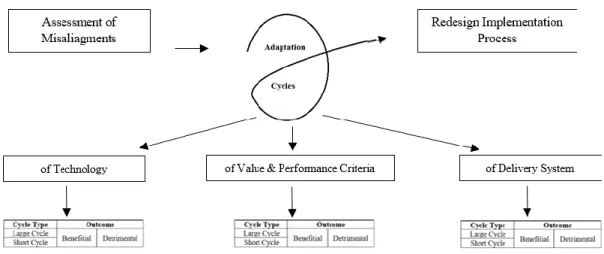
The process of overcoming misalignments, or aligning the technology with the organization, aims to improve the compatibility between them. The process of realignment requires an adaptive response (Leonard-Barton, 1988a). This process is iterative, requiring the step back to previous stages of the implementation process and reevaluation of both technology and underlying operational processes (Leonard-Barton, 1988a). Given that this iterative process entails taking a step back and revisiting a decision, such as reopening the technical design and changing the technology, revisiting the delivery system or reexamining organizational routines, it follows spirals of reassessments that create new path branches in the implementation process (Ansari et al., 2010; Leonard-Barton, 1988a). Leonard-Barton (1988a) coined these as mutual adaptation recursive cycles. These cycles can be classified as small or large cycles depending on how fundamental and impactful change is (Leonard-Barton, 1988a). Both small and large cycles can be related to any of the three categories of misalignments identified: technical misalignments, delivery system misalignments and misalignments related with value (performance criteria) (Leonard-Barton, 1988a).
A large cycle of adaptation is caused by a group of misalignments that, in order to be realigned, entail a set of changes that are of significant impact (Leonard-Barton, 1988a). This considerable impact can be due to their large scope, including transversally several technological functionalities or organizational roles; or by causing a break with the current paradigm of the implementation process, creating a completely new path (Leonard-Barton, 1988a). These changes can sometimes relate predominantly to one of the categories above (technical, delivery system, performance criteria), however, large cycles usually entail changes that are transversal to all three of these misalignment spheres (Leonard-Barton, 1988a).
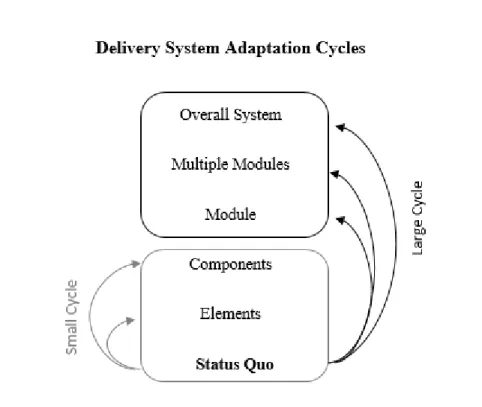
23 Large cycle of technological alignments usually require technology suppliers and organizational members to move backwards to the early stages of technology compatibility design, capturing requirements that could only be identified through practical experience (learning by doing), as expressed in Figure 2 (Leonard-Barton, 1988a).Sometimes, these new requirements are only identified very late during the implementation process and ultimately they may only be identified when the technology is already in the production environment. Thus, technical large cycles are both time and resource consuming, given that returning to the technology design stage to redesign features or even include features that were not previously identify, forces the implementation process to restart and go again through all stages identified in Figure 2. Large cycles of performance criteria alignments (Figure 3) can be, for instances, a redesign of performance evaluation indicators shaped around the implemented technology (Leonard-Barton, 1988a). If during the implementation process the need arises to reevaluate the work allocation structure of the organizational, or reassess deeply the knowledge base or task alignment, at department or business functions levels, this also consists of a large cycle adaptation, requirement great time and resources to change the organizational structure in order to best fit the implementation process (Alin et al., 2013). As illustrated in Figure 4 - Delivery System Adaptation Cycles (Adapted from (Leonard-Barton, 1988a)), large cycle of delivery system alignments require a redesign of the infrastructure used to operate the new technology or of the knowledge transmission process to organizational members, which may entail, respectively, a major equipment upgrade or contracting further training from the technology supplier, that is always associated in a large outlay of capital (Leonard-Barton, 1988a).
Given the considerable effort required to enforce a large cycle adaptation processes, these are always costly processes, both monetarily and in terms of human resources, since they break up ties with the current setting to create new ones (Leonard-Barton, 1988a). Large adaptive cycle changes can create a rupture between parties, dissolving structural relationships of the implementation process, having severe impact in the implementation process and in the organization (Leonard-Barton, 1988a). For instance, technology suppliers may refuse to reshape the structure of the technology and abandon the project (Leonard-Barton, 1988a). This is a highly costly setback in the