Start-up Learning
Process in Accelerator
Programs
Giorgi Gviniashvili
Dissertation written under the supervision of Cláudia Costa
Dissertation submitted in partial fulfilment of requirements for the MSc in
Business, at the Universidade Católica Portuguesa, April 2017.
ABSTRACT
Title of the dissertation: Start-up Learning Process in Accelerator Programs Author: Giorgi Gviniashvili
The modern world is shaped by rapid innovation and disruptive ideas. Start-ups are drivers of these innovations. They replace incumbent technologies, existent business models and in sum make the world a better place to live. However, nascent ventures still have a tendency to fail often due early stage challenges and problems. In order to help newly founded ventures to overcome early stage obstacles, in last decade accelerator programs were created. Accelerators provide entrepreneurship education to ventures’ founding teams and help them to transform their ideas into successful businesses. Despite the rapid proliferation of these programs worldwide, pervious literature is still descriptive of main features of accelerators and little is known which are main mechanisms to accelerate start-ups. This dissertation aims to explore if accelerators accelerate the learning process of participant ventures, and how and which mechanisms of accelerator programs impact the learning process. Data was collected through semi-structured interviews, from eleven participant ventures in one single Portuguese accelerator program, Building Global Innovators (BGI). The results suggest that accelerators in fact impact learning process of participant ventures. Therefore, the learning process is affected by time compression of accelerator programs and through two main mechanisms: through accelerator support and through cohort role, which consequently comprise two learning vehicles and one learning facilitator, each. Alongside several empirical implications, this study contributes to the advance of research about accelerator programs.
Keywords: Accelerators, accelerator programs, entrepreneurship, entrepreneurial learning, business knowledge, incubation model, start-up.
SUMÁRIO
O mundo moderno é moldado por rápidas inovações e ideias novas. Os startups são os motores dessa mesma inovação. Eles substituem as tecnologias e os modelos de negócios existentes, tornando o mundo num lugar melhor. No entanto, as empresas empreendedoras tendem a falhar, muitas vezes, devido á problemas iniciais. De modo a auxiliar os startups a superar os obstáculos iniciais, foram criados os aceleradores, na década passada. Os aceleradores fornecem uma educação sobre o empreendedorismo às equipas fundadoras dos startups, e os ajudam-nas a transformar as suas ideias em negócios bem-sucedidos. Apesar da rápida proliferação desses programas em todo o mundo, a literatura existente ainda é meramente descritiva no que conta ás características dos aceleradores, e pouco se sabe quais são os mecanismos que aceleram os startups. A presente dissertação visa explorar se os aceleradores aceleram o processo de aprendizagem dos startups, e quais os mecanismos que o fazem. A informação foi recolhida através de entrevistas semi-estruturadas, de onze startups participantes num programa de aceleração, Building Global
Innovators (BGI). Os resultados obtidos sugerem que os aceleradores, têm impacto no
processo de aprendizagem dos startups, e esse processo é afetado pela compressão temporal dos programas, através de dois mecanismos principais: o apoio do acelerador e o papel do cohort, que, consequentemente, compreendem dois veículos de aprendizagem e um facilitador de aprendizagem, cada um. Ao lado de várias implicações empíricas, este estudo contribui para o avanço da literatura no que concerne aos aceleradores.
Palavras-chave: Aceleradores de empresas, programas de aceleração, empreendedorismo, aprendizagem empresarial, mecanismos de incubação, startup.
ACKNOWLEDGEMENTS
First of all, I would like to thank my thesis advisor, Professor Cláudia Costa, for providing crucial support and comments throughout the work. Moreover, I also would like to thank the group of “The Entrepreneurial Opportunity” seminar.
Secondly, I am thankful of BGI accelerator program for providing the help in connecting with portfolio companies. Moreover, I am grateful of start-up founders and CEOs took their precious time to share with me their experiences in the accelerator program.
Furthermore, I would like to acknowledge all my friends who supported me during my academic career, from Nova to Católica, as well as friends and family in Georgia.
Finally, I would like to express my gratitude to my family for giving me constant support and opportunities in my whole life.
TABLE OF CONTENTS
CHAPTER 1: INTRODUCTION ...7
CHAPTER 2: LITERATURE REVIEW ...10
1. Incubation mechanisms ...10
1.1. Evolution of Incubation Mechanisms ...10
1.2. Accelerators ...11
1.3 Incubation models differences ...13
2. Entrepreneurial learning ...15
2.1 Entrepreneurial Learning Types ...16
2.2 Learning from others ...17
3. Accelerators and Entrepreneurial Learning ...18
CHAPTER 3: METHODOLOGY ...19
1. Research Design ...19
2. Sampling ...19
3. Data Collection ...22
4. Data Analysis ...23
CHAPTER 4: RESULT AND DISCUSSION ...24
1. Accelerators: Time-compressed Educational Programs ...24
2. Accelerator role ...26
2.1 Mentors and Guest Speakers ...27
2.2 Program Directors ...29 2.3 Safe Environment ...30 3.Cohort Role ...32 3.1 Competitive environment ...32 3.2 Creation of Synergies ...33 3.3 Promotion of a Proximity...34 4. Discussion ...36 CHAPTER 5: CONCLUSION ...41 1. Conclusion ...41 1.1 Theoretical Implications ...41 1.1 Empirical Implications ...42
2. Limitations and Future Research Directions ...43
REFERENCES: ...45
APPENDICES ...53
Appendix 1: Interview Guide ...53
Appendix 2: Start-up Overview ...54
Appendix 3: Interview Data ...55
Appendix 4: Evidences from Interviews ...56
Appendix 4.2: Mentors and Guest Speakers ...57
Appendix 4.3: Program Directors ...58
Appendix 4.4: Safe Environment ...59
Appendix 4.5: Competitive Environment ...60
Appendix 4.6: Creation of Synergies ...61
CHAPTER 1: INTRODUCTION
The world is living a real technology revolution. Products and technologies that are used today, 20 years from now will look very different. In this modern world, innovation and disruptive ideas are major drivers not just of improved quality of life of millions of people, but also of economic growth. Consequently, entrepreneurship is widely acknowledged as one of the most important forces to shape the changes in the world and in the economic landscape (Birch, 1979; Acs, Carlsson, and Karlsson, 1999).
Start-ups are drivers of these innovations. They replace incumbent technologies, existing business models and in sum make the world a better place to live (Kolher, 2016). Although a significant fall of costs of experimentation and time related to launch a new product that have facilitated starting a new venture (Clarysse, Wright, and Hove, 2015), nascent firms still have a tendency to fail often (Laitinen, 1992). Due to lack of experience (Gruber, MacMillan, and Thompson, 2008) and difficulty to analyze adequately opportunities (Ambos and Birkinshaw, 2010), entrepreneurs have difficulties to deal with key challenges faced by startups. These challenges generally are related with the struggle of entrepreneurs to acquire sufficient financial and mentoring resources decisive to successfully advance beyond idea stage (Smith and Hanningan, 2015).
In order to help newly founded firms to overcome early stage obstacles, incubation mechanisms started to emerge in a second half of 20th century (Pauwels, Clarysse, Wright, and Hove, 2016; Hochberg, 2016). Their main goal is to provide support to nascent ventures in order to overcome early stage problems and help them to develop their idea in a disruptive technology (Schwartz, 2013). Incubation mechanisms vary in their models. They can be emerged from private or public sector initiative, from universities, large corporations or research institutes (Pauwels et. al., 2016). Start-up incubators and angel investors, are mainly acknowledged incubation mechanisms by extant literature (Cohen, 2013). However, in order adapt to new necessities of start-ups, in last decade started to emerge a “new generation incubation models: accelerators” (Pauwels et. at., 2016).
The first and most successful accelerator, Y-Combinator was founded in 2005, by Paul Graham. As a successful example, Y-Combinator has received huge attention from media, policy makers and researchers (Malek, Maine, and McCarthy, 2013). Consequently, similar programs started to emerge worldwide (Cohen, 2013). Accelerator programs assist
batches of new ventures in an early-stage business development. Accelerators provide entrepreneurship education to ventures’ founding teams and help them to transform their idea into successful business. After completing highly competitive selection process, batches of ventures enter and exit intensive limited-duration program (three to six months) together, where they have an opportunity to network, connect and access resources from several investors, venture capitalists and angel investors (Cohen, 2013; Cohen and Hochberg, 2014). It is evident, that many accelerators’ features, such as mentorship and entrepreneurship education, are knowledge intensive supports and are related to the learning process of ventures. Thus, it is acknowledged by literature that learning process impacts entrepreneurial activities of ventures (Minniti and Bygrave, 2001).
Accelerators are rapidly proliferating worldwide. However, in extant literature there is limited theoretical and empirical research available to understand how these programs affect participant ventures (Pauwels et.al., 2016). A big part of previous research focus on highlighting accelerator programs main features (Cohen and Hochberg, 2014; Miller and Bond, 2011; Pauwels et.al., 2016), or differentiating them from existing incubation models, such as start-up incubators and angel investors (Barrehag, Fornell, Larsson, Mårdström, Westergård, and Wrackefeldt, 2012; Cohen, 2013; Pauwels, et. al., 2016). A few studies were conducted in order to asses an impact of accelerators on ventures. These studies found that accelerator programs increase speed of ventures in raising capital and financing (Hallen, Bingham, and Cohen, 2014; Smith and Hannigan, 2015). Additionally, Hallen and colleagues (2014) found that ventures which took part in accelerator programs generally are faster in getting costumer traction, while networking opportunities provided by accelerator programs are extremely important for the development of a firm (Hallen, Bingham, and Cohen, 2014). However, depict exactly what and how accelerator programs accelerate in nascent ventures still remains an under researched question (Clarysse, et al., 2015).
Extant literature relates entrepreneurship and learning concepts (Minniti and Bygrave, 2001). Although considering accelerators as entrepreneurship educational programs, literature does not provide exact explanation how accelerator programs affect learning process of start-ups. Consequently, through using multiple-case study approach of accelerated ventures from one Portuguese accelerator program (Building Global Innovators), present dissertation aims to fill this gap and explore how accelerator programs impact the learning process of participant ventures, specifically along the following
research question:
RQ1: Do new ventures perceive learning in accelerator programs?
RQ2: How accelerator programs accelerate learning process of participant ventures? RQ3: Which mechanisms of accelerator programs impact learning process of participant ventures?
In order to address aforementioned research questions, in this dissertation was adopted multiple-case study approach (Yin, 2009). Due to lack of extant theory to explain phenomena, we used an inductive method (Eisenhardt, 1989). Data was collected through semi-structured interviews, from eleven participant ventures in one single Portuguese accelerator program, Building Global Innovators (BGI). For confidentiality reasons identity of ventures is protected. Interviews were conducted with founders of ventures, CEOs or COOs. Data was analyzed through Thematic Analysis method (Braun and Clarke, 2006), which lead us to draw relevant conclusions.
This study has several implications on theoretical and empirical levels. At the theoretical level this work fills the gap of accelerator literature by providing conceptual framework on how accelerators accelerate entrepreneurial learning of participant ventures. While on empirical level, this dissertation provides relevant contributions to accelerators, entrepreneurs and policy makers.
This dissertation is structured as follows: Chapter 2 reviews literature on incubation mechanisms, accelerators and entrepreneurial learning. Chapter 3 describes the research method, data collection and data analysis methods used to address the research questions. Chapter 4 summarizes and discusses the main findings. Finally, chapter 5 draws conclusions, limitations and directions for the future research on accelerator programs.
CHAPTER 2: LITERATURE REVIEW
This chapter reviews the literature on incubation mechanisms, accelerators and entrepreneurial learning.
1. Incubation mechanisms
Startups bring new ideas to life, change the way an economy is organized, introduce disrupting innovations and challenge established social order (Clarysse et al., 2015). These newly formed small ventures are vital in generating economic growth, employment and innovation (Birch, 1979; Kirchhof, 1994; Wong, Ho and Autio 2005).
However, it is a well-known fact that starting a new firm is a complex and chaotic task. On one hand, a vital challenge faced by entrepreneurs is to cope with limited financial (Cassar, 2004), mentoring (Smith and Haningan, 2015) and human resources (Zott and Huy, 2007), crucial to the development of a nascent venture. On the other hand, founding team’s lack of experience (Gruber, MacMillan and Thompson, 2008) and difficulty in understanding and analyzing adequately opportunities (Ambos and Birkinshaw, 2010), is considered as a big challenge. Dealing with these problems, requires huge efforts and costs that Stinchcombe (1965) labeled as “liability of newness”. Thus, the author argued that due to liabilities of newness, the risk of failure is higher in newly formed organizations than in older ones (Stinchcombe, 1965). Alongside, literature highlights that mortality rate among new nascent ventures is high (Laitinen, 1992; Timmons, 1999).
Nowadays, scholars and several policymakers recognize that incubation mechanisms assist entrepreneurs in new ventures development and help them to overcome liabilities of newness (Aernoudt, 2004; Barbero, Casillas, Ramos and Guitar, 2012). Thus, extant literature point out the importance to take into consideration the heterogeneity of different incubation models (Barbero, Casillas, Wright and Garcia, 2014). Accelerators, Incubators and Angel Investors are three main incubation mechanisms, having as a main goal to support nascent ventures in the first years of business development (Cohen, 2013).
1.1. Evolution of Incubation Mechanisms
Previous research emphasizes the evolution of incubation models over decades and considers shifts between generations of incubation models, in order to adapt necessities of participant start-ups (Bruneel, Rarinho, Clarysse, and Groen, 2012; Grimaldi and Grandi, 2005). First generation of incubation models, were introduced in second half of 20th
century: incubators. Incubators had a duration between 1 to 5 years and mainly focused in providing basic co-working space and financial support to nascent high potential firms (Phan, Siegel, and Wright, 2005). Second generation incubation models provided opportunity for ventures to access more intangible services, alongside physical and financial resource support (Clarysse and Bruneel, 2007; Soetanto and Jack, 2013). However, first and second generation incubation models were criticized and accused to merely trying to keep tenant firms alive in order to secure fees and rents from them (Pauwels et al. 2016).
In a mid-2000, as a response to shortcomings of previous generation incubation models, literature highlight shift to most recent generation incubation model: the accelerator (Pauwels et al., 2016). Accelerator programs move away from offering mostly rental services to participant ventures and provide more intangible and knowledge intensive support. Thus, in accelerators participant startups are called “portfolio” companies, in detriment of “tenant” ventures of previous incubation models. An advance in technology, significant fall of costs of experimentation and time related to launch new startups, contributed to the rise of accelerator programs (Clarysse, Wright, and Hove, 2015; Kerr, Nanda, and Rhodes-Kropf, 2014).
The first accelerator, Y-Combinator was founded in 2005 in Silicon Valley. This program provided to startups, a small amount of seed investment money, in exchange for minor equity. It also offered them three-month programs of networking and mentorship from experienced entrepreneurs (Kohler, 2016). Y-Combinator received great attention from media, policy makers and researchers. As a consequence, other investors started to imitate this successful program (Cohen, 2013). Afterward, Techstars (in 2006), was one of the largest programs emerged.
Nowadays there are more than thousand accelerators in six continents and verifies tendency of proliferation (Cohen, 2013; Cohen and Hochberg, 2014). In Portugal, operating accelerators are Building Global Innovators, Startup Braga, Beta-I and Fábrica de Startups.
1.2. Accelerators
Accelerators are a rapidly growing phenomenon, with an ever-increased number of active programs worldwide. However, given the newness of accelerator phenomena and limited
ventures (Pauwels et. al., 2016). The extant of this newness lies in the absence of a formal definition of what an accelerator is (Cohen and Hochberg, 2014; Hochberg 2015). Consensual is the broad definition that an accelerator is an organization, which aims to assist new venture founding teams in early-stage business development, providing them entrepreneurship education, mentorship and networking opportunities, in an intensive short-term (lasting about three to six months) cohort-based program, that culminates in a public pitch, “demo-day”, where graduated ventures pitch their businesses to qualified investors (Cohen, 2013; Cohen and Hochberg, 2014; Hochberg 2015).
Previous research identified main features of accelerator programs (Cohen, 2013; Cohen and Hochberg, 2014; Hochberg, 2016; Miller and Bound, 2011). Firstly, accelerator programs make very rigorous and highly competitive, multi-staged selection process which is open to the public (Miller and Bound, 2011). Secondly, beside mentorship, educational programs, networking opportunities and other services, accelerators usually provide co-working space and small amount of seed investment (up to $150,000) to participant start-ups, in exchange for 5-7% equity (Hochberg, 2016). Thirdly, they generally focus on small teams, rather than on individual founders (Cohen, 2013; Miller and Bound, 2011). Fourthly, this programs offer time-limited intensive mentorship in high-pressure environment to drive fast progress of ventures (Miller and Bound, 2011). Last but not least, one of the biggest differentiate factor of accelerator programs, is that instead of accepting individual companies in ongoing basis, they only accept batches or cohorts of startups which start and finish program at the same time (Miller and Bound, 2011). In practice, accelerators offer to entrepreneurs a broad range of services that previously were difficult, costly and time consuming to find and obtain (Hochberg, 2016). It is evident, that many of these features, such as mentorship and entrepreneurship education are knowledge intensive supports, which are related to the learning process of ventures. Thus, it is acknowledged by literature that learning process impacts entrepreneurial activities of ventures (Minniti and Bygrave, 2001).
Regarding organizational structure accelerator programs, they can vary from accelerator to accelerator. Programs have pre-determined length, which can differ between three to six months (Smith and Hannigan, 2015). Cohort size can vary from five to hundreds of startups in a batch (Cohen, 2013). Some programs offer co-working space, while others not (Barrehag, Fornell, Larsson, Mårdström, Westergård, and Wrackefeldt, 2012). Some accelerators offer grants or prize money to the winning group, while amount of seed
investment and equity stake also varies between the programs (Cohen, 2013). In what concerns the industries, while some accelerators are more generalist, others only focus vertically – mainly on software ventures. Some programs focus on strategically defined geographical areas, rather than being active globally (Hochberg, 2016). Regarding selection process, some accelerators only accept early stage ventures, while others are more generalist and consider teams that they perceive as most potential firms in industry (Pauwels et. al., 2016).
Finally, accelerators can differ in a type of program. Recent findings contribute greatly to the accelerators literature by distinguishing three types of accelerators (Pauwels et al., 2016). Most common programs are privately owned accelerators, which are mainly created by angel investors. Private accelerators aim to identify “promising investment
opportunities for investors” (Pauwels et al., 2016) and in exchange for seed investment,
they take equity stake in participant start-ups (Cohen, 2013; Pauwels et al., 2016). There are also public accelerators, being a government a main stakeholder. Publicly owned accelerators aim to support economic growth of some region or support activity of new ventures (Pauwels et al., 2016). The most recent trend, is an emergence of corporate accelerators (Kohler, 2016). Large corporations create their own programs to embrace innovation and develop ecosystem around the company (Kohler, 2016; Pauwels et al., 2016).
1.3 Incubation models differences
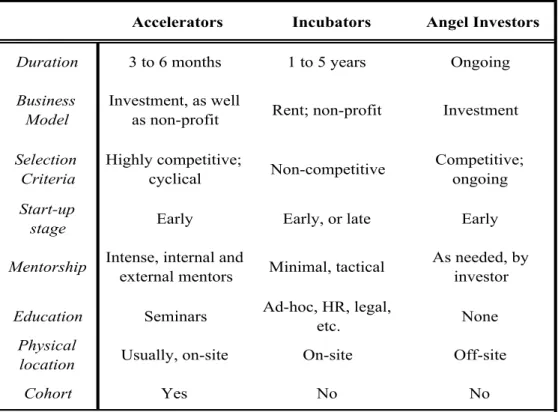
Alongside defining accelerators as a new generation incubation models (Pauwels et al., 2016), a big part of literature focus on distinguishing accelerator programs from other incubation models, such as business incubators and angel investors, as they are often jumbled by researchers, the media and policy makers (Cohen and Hochberg, 2014). To avoid misunderstandings and to study appropriately accelerators, it is essential to understand and distinguish correctly accelerator programs from other incubation mechanisms. Incubation models can differ in duration, business model, selection criteria, start-up stage, education, mentorship, physical location and focus on cohort (Cohen, 2013). These differences are summarized in table 1.
One of the most defining feature of Accelerators is the limited duration of these programs, ranging between three to six months (Miller and Bond, 2011). Whereas literature highlights that start-ups usually graduate from business incubators from one to five years
(Hochberg 2016); while angel investors offer support on an ongoing basis (Cohen, 2013).
Regarding the business model, accelerators are generally privately owned (Pauwels et al, 2016). In exchange for seed investment, they take equity stake in participant start-ups; then angel investors support ventures with capital investment. On the other hand, incubators are publicly owned and typically do not have investment funds. Their main revenue source is rents and fees paid by participant ventures (Cohen, 2013; Hackett and Dilts, 2004).
Table 1: Summary of differences between Accelerators, Incubators and Angel Investors
Adapted from Cohen (2013): What Do Accelerators Do? Insight from Incubators and Angels
As accelerators are short programs with pre-determined cohort size and duration, a selection process is highly competitive and cyclical (Cohen, 2013; Miller and Bond, 2011). Angel investors similarly are very selective in admissions, while they select ventures on an ongoing basis. On the other hand, incubator models do not focus on competitive selection process (Cohen, 2013; Cohen and Hochberg, 2014). When selecting ventures, both accelerators and angel investors focus on early-stage high potential ventures, whereas business incubators use more generalist approach (Cohen, 2013).
With regard to education and mentorship, they are critical pillars of accelerator programs. Accelerators Incubators Angel Investors
Duration 3 to 6 months 1 to 5 years Ongoing
Business Model
Investment, as well
as non-profit Rent; non-profit Investment
Selection Criteria Highly competitive; cyclical Non-competitive Competitive; ongoing Start-up
stage Early Early, or late Early
Mentorship Intense, internal and
external mentors Minimal, tactical
As needed, by investor
Education Seminars Ad-hoc, HR, legal,
etc. None
Physical
location Usually, on-site On-site Off-site
Seminars and intense mentorship are offered by program directors, intentionally invited mentors or speakers (Cohen and Hochberg, 2014). Seminars and mentorship are generally focused on a broad specter of themes related to entrepreneurship (Cohen, 2013; Cohen and Hochberg, 2014). Conversely, in business incubators, mentorship and education is minimal and is offered by fee-based processionals (Hackett and Dilts, 2004). Angel investors do not offer education, while they mentor portfolio firms themselves (Cohen, 2013).
In what concerns to the facilities, accelerators usually operate on-site, nerveless there are some accelerators that offer off-site services. On the other hand, incubators generally offer co-working space; whereas ventures tied with angel investors, run off site (Clarysse et al., 2015; Cohen, 2013).
As a final point, the presence of a cohort differentiates accelerators from other incubation mechanisms. Accelerators are the unique incubation model where batches of ventures enter and exit the program together (Cohen, 2013). This cohort of ventures “learn in tandem” (Smith and Hannigan, 2015), support each other in solving common problems and share feedback (Barrehag et al., 2012; Miller and Bond, 2011).
2. Entrepreneurial learning
Learning is the process by which individuals acquire new knowledge, skills, values or abilities, from direct experience or through observation of others, and reinforce, modify or assimilate it with prior knowledge (Anderson, 1982). Learning has been widely studied both on individual and organizational level (Argyris and Schön, 1978; Kolb, 1984; March, 1991). Furthermore, in last decade scholars have emphasized that learning concept is strongly related with entrepreneurship (Minniti and Bygrave, 2001).
Previous literature argue that entrepreneurs generally lack experience, skills, abilities (Gruber, MacMillan and Thompson, 2008; Sexton, Upton, Wacholtz and McDougall, 1997) and mentoring resources (Smith and Haningan, 2015), to successfully lead nascent venture to expansion or even guarantee their survival (Sullivan and Marvel, 2011; Sullivan, 2000). Thus, literature considers that successful entrepreneurs are outstanding learners, as they are able to learn from everything that surrounds them (Smilor, 1997). However, it is important to perceive better how and when entrepreneurs learn (Cope, 2005).
Entrepreneurial Learning (EL) has emerged as a critical concept in order to understand relation between learning and the entrepreneurial context (Harrison and Leitch, 2005). EL
can be broadly defined as a learning that takes place “in the entrepreneurial process” (Holcomb, Holmes Jr and Hitt, 2009). The entrepreneurial process is “a process by which
individuals – either on their own or inside organizations – pursue opportunities without regard to the resources they currently control” (Stevenson and Jarillo, 1990). EL is often
described as a constant process of acquiring new and necessary knowledge to effectively manage and start new ventures (Holcomb et al., 2009; Politis, 2005).
Although, EL concept has attracted considerable scholarly attention over last decade (Wang and Chugh, 2014), EL literature is very fragmented and in academic community there is still limited understanding and consensus on what EL, since still does not exist clear definition of this concept (Harrison and Leitch, 2005; Macpherson, 2009; Wang and Chugh, 2014). Moreover, relation between learning and entrepreneurship has not been thoroughly investigated (Rae and Carswell, 2001; Ravasi, Turati, Marchisio, and Ruta, 2004). Consequently, alongside exploring role of learning in entrepreneurial process, understanding how and when learning occurs in entrepreneurial context (Wang and Chugh, 2014), requires further research (Blackburn and Kovalainen 2009).
2.1 Entrepreneurial Learning Types
As referred previously, Entrepreneurial learning (EL) literature is fragmented and individualistic, as different authors provide different approaches and definitions of EL (Harrison and Leitch, 2005; Macpherson, 2009). Indeed, there are different types of entrepreneurial learning, which aim to relate learning with entrepreneurial context.
Firstly, to explore how learning can occur in entrepreneurial context, a vast part of literature is drawn from individual and organizational learning literature. Individual learning focuses on several studies such as learning from others (Bandura, 1977) and experiential learning (Kolb, 1984), which is broadly analyzed and depicted in learning-by-doing (Cope, 2003; Argote, 1999), trial-and-error learning (Lant and Mezias, 1990), learning by experimentation (Pisano, 1994), learning from past experience (Minniti and Bygrave, 2001), learning from failure (Cope, 2011) and learning from the experience of others or participation (Lévesque, Minniti, and Shepherd, 2009). On the other hand, organizational learning studies, include single-loop and double-loop learning (Argyris and Schön, 1978) and high-level and lower-level learning (Fiol and Lyles, 1985). However, in order to understand how entrepreneurs learn, individual and organizational learning literature face a huge challenge: align individual and organizational opportunity-seeking
behaviors (Hitt, Ireland, Camp and Sexton, 2001), as entrepreneurs are highly individualistic by nature (Wang and Chugh, 2014). Individual learning takes place when individuals acquire knowledge, information or skill (Wang and Chugh, 2014), while collective learning is defined as “social process of cumulative knowledge” (Capello, 1999).
Secondly, some EL research, focus on understanding the processes of opportunity exploration and exploitation (Stevenson and Jarillo, 1990). In order to depict this processes, March (1991) provided exploratory and exploitative learnings (March, 1991). Exploratory learning focuses on developing and discovering new knowledge (Kreiser, 2011; Zhao, Li and Chen, 2011), while exploitative learning, aims to assimilate and implement existing knowledge (Kreiser, 2011; Zhao, Li and Chen, 2011).
Regarding to the emergence of entrepreneurial opportunities, they can come about through identification or creation (Wang and Chugh, 2014). Sensing learning refers about learning by knowing facts, by having physical and sensational contacts with surroundings, while intuitive learning focus on learning by understanding relationship of facts through discovering new opportunities (Felder and Silverman, 1988).
These types of learning in sum define how learning can occur in entrepreneurial context. In order to provide entrepreneurship education to start-ups (Cohen and Hochberg, 2014), it is relevant for accelerator programs to align different types of learning with programs’ main objectives.
2.2 Learning from others
Individuals can learn from direct experience or through observation of others (Anderson, 1982). In the accelerator context, learning from others (Haunschild and Miner, 1997; Haunschild, 1993) is important process due to main features of these programs. Indeed, intensive mentorship enables ventures to learn from broad experience of mentors (Swap, Leonard and Shields, 2001), while working in a cohort during three to six months, start-ups might learn through observing industry peers (Zuckerman and Sgourev, 2006).
Previous research highlights that ventures can learn by observing others (Haunschild and Miner, 1997), such as alliance partners (Brown and Eisenhardt, 1997) and industry peers (Zuckerman and Sgourev, 2006), or they learn from others, by assimilating knowledge transferred from mentors (Swap, Leonard and Shields, 2001). Learning from others can be
beneficial for ventures’ learning process, as ventures can learn from increasingly available information (Baum, Li, and Usher, 2000). Furthermore, by observing know-how of other firms, they can learn even before the start of production (Argote, 1996), without the need to accumulate years of experience (Ingram, 2002). Consequently, this type of learning is relatively inexpensive (Ingram, 2002). Additionally, ventures can observe simultaneously various firms. Therefore, by doing so, they are able to gather heterogeneous information (Bingham and Davis, 2012), that consequently leads to better performance (Beckam and Haunschild, 2002). Alongside, literature highlights that when a learning from others is intentionally planned, it improves learning process of ventures (Hamel, 1991).
3. Accelerators and Entrepreneurial Learning
Accelerator programs are strongly related with a learning concept, as their main goal is to educate early stage startups (Cohen, 2013). Indeed, Extant literature describes accelerator programs as entrepreneurship educational programs (Cohen and Hochberg, 2014). Moreover, main features of accelerator programs are strongly related with EL concept. As mentioned above, intense mentorship as well as working in a cohort, enables participant start-ups to learn from others in accelerator programs (Haunschild and Miner, 1997; Haunschild, 1993) by observing experience of others (Ingrame, 2002) or by obtaining simultaneously heterogeneous information from other firms (Bingham and Davis, 2012).
However, extant literature is mainly descriptive of the main features of accelerator programs (Cohen, 2013; Cohen and Hochberg, 2014; Miller and Bond, 2011). Literature highlights that accelerators are time limited programs (Miller and Bond, 2011), whereas emphasizes importance of cohort presence in accelerator programs (Cohen, 2013), but lacks explanation if these features somehow effect participant ventures. In addition, extant literature considers education and mentorship offered by accelerators as pillars of these programs (Cohen, 2013; Cohen and Hochberg, 2014), but vaguely refers of their role and importance in ventures’ learning process (Cohen and Hochberg, 2014; Miller and Bond, 2011). Some studies assess performance of accelerators (Hochberg and Kamath, 2012) or measures it in terms of “success” or “survival” (Lall, Bowles and Baird, 2013), while others investigate impact of accelerator programs in speed of rising capital and financing by participant ventures. However, literature is scarce in what concerns to evidences on how accelerator programs accelerate learning process of participating startups. In the present dissertation, we will explain these processes, by providing explanative framework of main mechanisms of accelerator programs impacting learning process of participant ventures.
CHAPTER 3: METHODOLOGY
Chapter 3 describes the research method, sampling process, data collection and data analysis methods used in this study.
1. Research Design
The research design adopted in the present dissertation is a multiple-case study research. A case study research strategy aims to build theory from one or more cases and is used in new research fields with scarce extant theory (Eisenhardt, 1989). Moreover, it is suggested that this is the best strategy to approach “how” and “why” questions, when researcher cannot control or maneuver actual behavioral events in a contemporary circumstance (Yin, 2009). Despite lack of control researcher has over the events, in a case study approach researcher is able to directly observe and interview (Yin, 2009).
Case study research can be developed either as a single or multiple-case study approach (Yin, 1984). Comparing both approaches, while single-case studies can detail occurrence of a phenomenon (Siggelkow, 2007), multiple-case studies generally can provide solid base to build a theory (Yin, 1994). Moreover, multiple-case studies allow researchers to investigate differences and analogies across cases (Yin, 2003), and in addition use replication logic to confirm or disconfirm theory elaborated from each case (Yin, 2009). Thus, these reasons make multiple-case study adequate approach for the present dissertation. As suggested by Yin (2003), a case study research method follows three main steps of sampling, data collection and data analysis. Below, these steps are described in detail.
2. Sampling
Basing on a multiple-case study approach requires careful selection of cases, as findings produced can be either similar or contrasting ones (Yin, 2003). To explore if participating in accelerator programs, contributes to founding teams of nascent venture to acquire entrepreneurial knowledge, we focused on eleven startups participated in one Portuguese accelerator program: Building Global Innovators.
Recently, Portugal has been investing strongly in promoting entrepreneurship. The clear example of this is a realization of the Web summit in Lisbon (2016). Portuguese entrepreneurial ecosystem has been evolving. Accelerators are one of the most important
Portugal as well. European Accelerator report, reports and ranks accelerators and number of start-ups accelerated by them in the whole Europe. European Accelerator report of 2015, reports four accelerator programs in Portugal, with a total of 156 startups accelerated and 327,000$ invested. In this report, in spite of Portugal occupying fourth place in the accelerated startups ranking (total number of accelerated ventures by country), it not even appears in the top-10 of investment ranking (total amount of investment in accelerated ventures). Based on European Accelerator report of 2015, top Portuguese four accelerators are: Beta-I, Fábrica de Startups, Building Global Innovators (BGI) and Startup Braga. In the present study, we focus on Building Global Innovators (BGI), as it is present in European Accelerator reports of both 2014 and 2015 years, being unique Portuguese accelerator in the top-20 ranking, with investment in cash (2014). Furthermore, Hot Topics designated BGI as one of the most influential accelerators in the world (2015). Finally, BGI clearly fits in definition of accelerator provided above.
Building Global Innovators program is global accelerator, based both in Lisbon and Cambridge (Massachusetts, USA). It was founded in 2010, with the main purpose to identify and accelerate technology-based startups and university spinouts under five years old. From then on, were held 7 editions (7th ongoing) and 127 startups were accelerated, 85 of which are active, having great survival rate 66,9%. In its overall existence, program received about 1000 applications from 54 countries. About 51% of the participant companies secured more than 78 million euros venture financing. Moreover, BGI has vast networks and partnerships, such as Caixa Capital.
Startups and spinouts under five years old can apply in BGI from any part of the world without a need to relocate. The program focuses on the four following market verticals: (i) Medical devices & Health IT, (ii) Enterprise IT & Smart Data, (iii) Smart Cities & Industrial 4.0, (iv) Water Economy. In what concerns on application process, it is free and open to the public, but very competitive. Each edition has average number of 19 ventures per cohort. In addition, organizing committee strongly encourages small founding teams in detriment to individual founders. The program runs once a year and offers expert mentoring, as well as uniquely designed bootcamps in Lisbon and in Cambridge to participating startups and spinouts. Selected teams have opportunity to benefit from continued support from accelerator up to five years after graduation.
capital by Caixa Capital, while other teams have the opportunity to raise financing during the Demoday, as they pitch to broad range of investors. Participation in the program is free for every selected venture. However, if one venture raise venture financing with a post-money of at least 2 million euros or succeed as a business, BGI expects to receive back 3% post-money shareholding.
BGI program can be divided in three main parts: two acceleration phases, in Lisbon and in Cambridge consecutively, and final “Venture Phase”. Selection takes place during June and ends in July with announcement of a batch. Startups are analyzed and interviewed by panel of three to five experts and up to maximum of 21 startups are accepted on average from 100 applications.
First phase of the BGI program starts in July with first “bootcamp” and ends up to February. In this stage, ventures participate in two bootcamps in Lisbon (July and November), with duration of one to two weeks. Bootcamps are intensive training periods, which serves to educate entrepreneurs and company founders on decision making processes, market knowledge and effective communication. Between August and October, a mentor is assigned to the ventures who meets with them on a weekly basis both in structured and unstructured meetings. To conclude this first phase of acceleration, BGI realizes two Demodays, first in November and second in February. Here startups have the opportunity to put in practice what they learnt, pitch for the investors and present their business to the public.
Second stage takes place in May. In this phase a bootcamp is hold in Camridge MIT, with the aim to enable startups adapt different ecosystem. Besides, ventures have an opportunity to pitch for different public and investors, as well as establish new network of contacts. In a final “venture phase”, BGI offers ad-hoc support to chosen twelve alumni. Unlike any other accelerator in the world, this period of assistance and tutoring can last up to five year after graduation. To have a better understand of BGI acceleration program, we summarized it in Figure 1.
The main aim of the present research was to reach as many startups as possible from BGI alumni list. With the purpose to get an interview from startup founder or CEO at acceleration time, we contacted ventures via e-mail, phone calls (when possible) and LinkedIn.
The sample is composed by the eleven startups what took part of the BGI acceleration program in any of the seven editions. Ventures stage and age at the time of the application varied significantly. Startups must operate in any of four market-verticals detailed above and they can be from different countries. Furthermore, founding teams ranged in size from two to five, with an average of 3,5 founders per team. In our sample were majorly interviewed CEO’s of the ventures, from which nearly 91% are man. Finally, our sample was selected in a similar competitive application process and participated in similar program of three main phases. The sample characteristics are summarized in appendix 2: Start-up overview.
Figure 1: BGI Accelerator Program
3. Data Collection
Data was collected mainly from the interviews, furthermore retrospective information was analyzed to complement the study (Eisenhardt and Graebner, 2007; Yin, 2009). The main data source were semi-structured interviews, conducted by group of five master students, including the author of the present dissertation. In order to gather more insightful data, among interviewees only founders, CEO’s and CFO’s of the eleven startups (which compose our sample) were interviewed. Moreover, when conducting interviews researcher can focus directly on the pretended topic. Additionally, researchers consider interviews as extremely efficient strategy to collectempirical data (Eisenhardt and Graebner, 2007), but the most important source of information when case study method is employed (Yin, 2009).
July August - October November November February
I Bootcamp (Lisbon)
Mentoring meetings
II Bootcamp
(Lisbon) I Demo Day II Demo Day
Batch announcement (July)
Acceleration Phase I
Acceleration Phase II
Ad-hoc support for BGI alumni
5 years after graduation
Venture Phase
III Bootcamp (Cambridge MIT)
The interviews were conducted via Skype, phone calls and face-to-face meetings. They lasted between 16 and 60 minutes, with an average of 30 minutes. The semi-structured approach covered four main topics: (i) organizational factors; (ii) interaction between
startups and the accelerator and how it supports entrepreneurial learning; (iii) interaction at the cohort level; and (iv) personal information (Appendix 1: Interview Guide) and we
closed them by asking if there was anything else that the interviewee would like to share. To reduce bias confidentiality was guaranteed to the participants. Additionally, all of the interviews were recorded and transcribed.
After interviews, in order to reach more detailed information about startups some further research took place. For example, e-mail correspondence were made, while LinkedIn and startups websites were checked. Additionally, to interpret information more precisely from interviews, magazine articles, blogs or media reports were analyzed.
4. Data Analysis
Thematic analysis method was employed to analyze the data. This method was introduced
by Braun and Clarke (2006) and aims to identify, evaluate and report patterns from obtained information. Authors highlight two forms of thematic analysis. First one is inductive, referred as “bottom up” approach, while other is deductive or “bottom down” one. In the present study, I focus on inductive thematic analysis as there did not exist any defined framework or theories to fit codded data. The data analysis was conducted over several steps, which are described below.
First, in order to become more familiar with the data, the transcripts have been re-readed multiple times (Braun and Clarke, 2006). In order to assure confidentiality to participants, letters were assigned to startups. Secondly, data was coded and organized in clusters and topics, in order to better understand transmitted ideas by interviewees. Then, we started to identify some initial trends and framed data in identified topics. Third, topics were reviewed and compared in order to identify main themes and subthemes. Two main themes were emerged. One is Accelerator support, while other is Cohort support. Within identified themes emerged some categories. Afterward, identified themes and sub-categories were reviewed and compared across cases, to prove evidence of phenomenon. Finally, both themes and subthemes were described and a conceptual framework was emerged.
CHAPTER 4: RESULT AND DISCUSSION
This chapter presents themes emerged through thematic data analysis and afterward discusses the presented results. Detailed case evidence is summarized in Appendix 4: Evidences.
1. Accelerators: Time-compressed Educational Programs
As argued above, extant literature describes accelerator programs as limited-duration, start-up educational programs, that generally last from three to six months. (Cohen, 2013; Cohen and Hochberg, 2014; Miller and Bond, 2011). Moreover, literature highlights that the biggest aim of accelerator programs is to provide educational components to nascent ventures (Cohen and Hochberg, 2014).
In line with this observation, the data shows the evidence that taking part in BGI accelerator program, resulted in gained knowledge of participant start-ups. The data suggest that the BGI program, in fact boosted the learning process of participant ventures. In interviews entrepreneurs emphasized that “the business knowledge learnt” (E) in the program was vital for the future course of their ventures.
B: "For us, the most important part was definitely learning how to create and
finance a company."
C: "It (BGI program) helped us in connecting and learning about how to structure
and grow a business."
E: "We would not have grown same without the accelerator. They made us go one
way and that influences everything onwards. The business knowledge learnt was crucial though."
H: “It (BGI program) was the most useful, because not only learnt a lot there, but
above all, it allowed me to develop with my business and to move forward with my idea.”
Thus, it is important to depict how learning process of ventures is affected and boosted by accelerator programs and which mechanisms lead start-ups in accelerators acquire such an important knowledge.
Like other accelerators, BGI accelerator program has limited duration. BGI program has duration of six months. Regarding to the program duration, some entrepreneurs described it as “adequate” (K), while others highlighted that “a shorter program would push more” (E).
A: "Another beneficial aspect were the tasks that had to be delivered every week.
Since the program already set then no time is wasted to have to define what to do, saving time"
C: “I believe this length is useful, or it can be even shorter.”
E: "A shorter program would push more (e.g. 3 months), (…) if you are an
entrepreneur, you should give all you have."
Moreover, the data analysis shows an interesting observation, as several ventures associated duration of the program with the learning process of the program. Venture B explains:
"I think it was very important to learn in a relatively short period of time. I will not say that there wasn’t the opportunity to get be at this point without the program but would not have been in so short time." (B)
Similarly, start-up A highlights:
"Also certainly it would take much longer to reach the level where we are today because it would be much more difficult to get valuable contacts or even enrich our value proposition without BGI support." (A)
This observation lead us to relate limited duration of accelerator programs with time compression economies (Hallen et al., 2014). According to this theory, time pressure lead to improved performance, including economic value (Schoonhoven, Eisenhardt, and Lyman, 1990), quality (Kessler and Bierly, 2002) and revenue (Markman, Gianiodis, Phan, and Balkin, 2005). Time compression in accelerators has crucial effect on learning process of participants, as it affects all the acceleration mechanisms of the program and in sum
“shortens the journey of start-ups, resulting in either quicker growth or quicker failure”
(Pauwels et al., 2016). Consequently, the data shows evidence that BGI accelerator program’s outcome is improved learning process of participant ventures, while the limited duration of the program has positive effect on the whole process of the program.
In order to gain better understanding how accelerator programs impact learning process of participant ventures, more detailed analysis was conducted. Two main explicators of the learning process were emerged: role of accelerator support and role of working in a
cohort. These two mechanisms integrate all learning vehicles and learning facilitators,
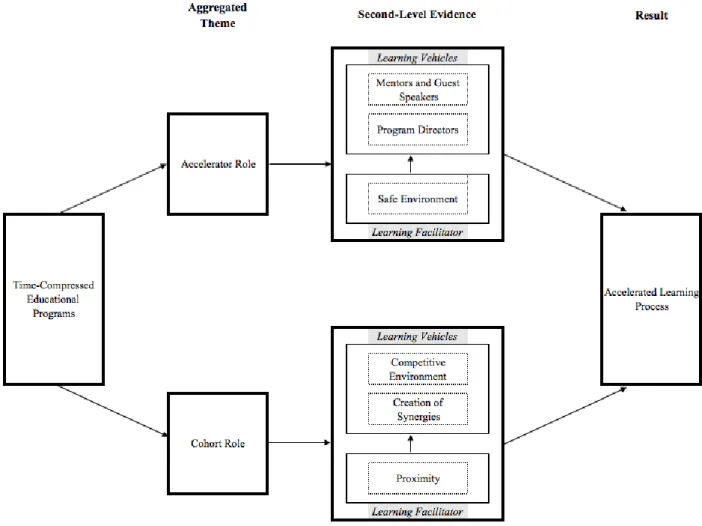
which helps us to explain how accelerator programs impact learning process of participant ventures. However, it is important to consider that these mechanisms are affected by time-compression of the program, being this character important differentiating factor of accelerators from other incubation mechanisms (Cohen, 2013; Miller and Bound, 2011). Role of accelerator support and role of working in a cohort, in the frame of limited duration of accelerator programs, leads to the final outcome, what is accelerated learning process of participant ventures. The figure 2 describes two main themes emerged from the data.
Figure 2: Main themes emerged from data analysis.
2. Accelerator role
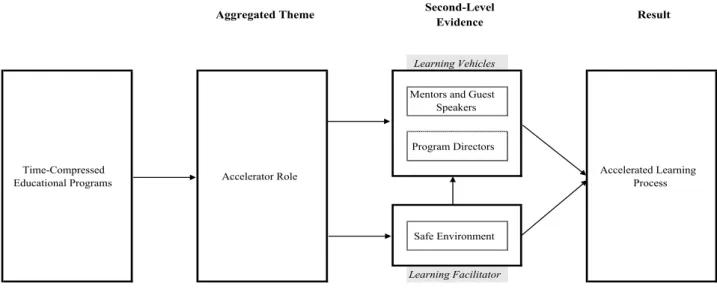
The first theme, “Accelerator role”, emerged among all cases as a main contributor in a learning process of the ventures. “Accelerator role” theme comprises three dimensions, which together under time compression effect, provide more exact understanding how accelerator program’s support affects leaning process of ventures. One the one hand, support of mentors and guest speakers’ and program directors’ help is a learning vehicle, while safe environment provided by the accelerator facilitates learning process of ventures within a program. The figure 3 shows conceptual framework, how accelerators accelerate learning process of nascent ventures.
Time-Compressed Educational Programs
Cohort Role
Accelerator Role
Figure 3: Accelerator Role in Learning Process of Ventures
2.1 Mentors and Guest Speakers
Intense mentorship is considered a cornerstone of accelerator programs (Cohen, 2013; Cohen and Hochberg, 2014; Miller and Bond, 2011). In order to educate participant ventures and help them in defining their business model, accelerators generally connect start-up founders with successful entrepreneurs, investors, venture capitalists, or even program graduates, who are invited to mentor and coach cohort of start-ups during the program (Cohen and Hochberg, 2014).
J: “And the truth is that they have good mentors and people with unbelievable
résumés with whom it would have been impossible to get in touch and get their opinion.”
Previous literature highlights a role of mentor as someone with a broad knowledge base to guide and teach, being important tool of knowledge transfer (Swap, Leonard and Shields, 2001). Findings from the data is in line with this idea. Indeed, analysis of the sample shows that a big majority of cases considered mentorship as a “big benefit” of the program and emphasized that they “learnt” with help of mentors. Mentors helped start-ups to cope with challenges and problems. Consequently, with their guidance, entrepreneurs “managed to
define go-to-market plan” (A), design business models, or as suggested by K: “Mentoring helped us to structure our ideas”.
B: “We had to elaborate the business plan and answer questions from mentors in order to ensure that it was well done. I think is the great benefit of this program is
Aggregated Theme Second-Level
Evidence Result
Learning Vehicles
Mentors and Guest Speakers Program Directors Safe Environment Learning Facilitator Accelerator Role Time-Compressed Educational Programs Accelerated Learning Process
the mentoring received.”
C: “In the weekly meetings we got assigned a really good mentor designed a
business plan with us. we learnt how to structure everything...”
G: “At the time there were five mentors divided by all the companies. That gave a
different perspective to the company and we learned a lot.”
Furthermore, mentoring relationships have influence on mentees learning process, as several studies suggest that what a mentee learns is a result of his/her relationship with a mentor (Barrett, 2006; Hezlett, 2005; Wanberg, Welsh and Hezlett, 2003). Our data, demonstrate evidence of a close relationship between mentors and start-up founders. Although do not having strong evidences of direct effect of these relationships in learning process of ventures, we believe that this boosted a learning process of start-ups during accelerator program.
C: “We had a very good relationship with our advisor/tutor, whom we are still
contacting often to ask for information. It is overall a close and intimate relationship.”
D: “We had a mentor who was always there for us and this permanent interaction
boosted the development of our idea and our business plan. This made a lot of difference.”
Besides emphasizing important role of mentors, start-up founders highlighted that “master
classes and the workshops provided, by specialized people” (H), was as important as
mentorship. These “specialized people” are generally experienced entrepreneurs, investors and venture capitalists, invited as guest speakers in BGI accelerator program. Although previous literature highlighted challenges to transfer tacit-knowledge (Von Hippel, 1994), mainly in nascent ventures which lacks organizational routines and problem-solving experience (Cohen and Levinthal, 1990), our data suggest that guest speakers contributed positively with their valuable seminars and experience to the learning process of participant ventures. Guest speakers delivered several seminars and workshops about important business topics and transferred their experience to nascent ventures. On the one hand, start-ups could learn from their experience without directly observing it, on the other hand ventures gained a business knowledge after assisting seminars and workshops of
A: "Beside the mentorship, seminars and workshops BGI also brings in
entrepreneurs to discuss several topics such as negotiation tips, how to pitch, how to being on stage with the startups."
D: “BGI invited a lot of people with experience in the industry, and they interacted
with the startups. It ended up to add a lot value to our venture because basically they gave testimonies and talked about their experiences – from people that have been working in this industry for a lot of years.”
I: “I liked to learn from the entrepreneurs. These people were experienced.”
J: “Investors taught us what they are looking for and always think global. They also
made us develop a strategy in order to achieve the results we wanted. they made us think about some specific questions."
Overall, support offered by mentors and guest speakers can be considered important learning vehicle. Mentorship and seminars from guest speakers are formal mechanisms, which are intentionally integrated in accelerators to boost learning process of ventures. The data shows that role of mentors and guest speakers affected positively future development of ventures and somehow it affected their learning process.
2.2 Program Directors
In interviews, entrepreneurs emphasized their “very good relationship with the accelerator
founders” (G). Venture B declares that their “relationship (with BGI) was excellent. Still remains excellent particularly with the director of BGI."
Ventures were able to create strong bonds with BGI program directors, due to director’s continuous support and commitment to help entrepreneurs during, or even after the program. The support, feedback and advise offered by directors, “added some value” (F) to ventures. We believe that it also boosted learning process of start-ups, as advise influences learners’ problem-solving behavior and contributes to knowledge acquisition and skill development of learners (Hayes-Roth, Klahr and Mostow, 1981).
E: "Very good relationship with the accelerator founders, even now we are in contact
and I could ask for advice if I wanted. They were open and always available.”
J: “I speak with the program director every week. What happens is that when I speak
to him, he gives me feedback. They have corrected important things."
In addition, program directors connected entrepreneurs to investors and venture capitalists, also they gave “right directions” to ventures. Thus, they provided valuable networks and contacts to entrepreneurs, that venture founders emphasized in their interviews. This networking opportunities are essential to rise funds and to get valuable advice for the future development of their businesses.
H: “If we need to get an investment account and if the accelerator can provide me
with important contacts, I know they will help me.”
I: “I am still in contact with program director and he connects us with people that
could be useful.”
K: "Program director knows a lot of people and has a lot of contacts. He gave us a
direction to follow, provided some contacts and basically helped us in networking."
The data suggests that accelerator program directors are second learning vehicle in accelerator support. Although this support is less formal, unlike mentorship and guest speakers, we believe that this comparatively informal help and background provided by program directors is essential to the learning process of participant ventures. Observation of the data suggest that their role is twofold. On the one hand, they give important support and advise to entrepreneurs, while on the other hand, they connect ventures to broad range of valuable contacts and networks.
2.3 Safe Environment
Alongside providing several learning vehicles, such as mentorship, coaching and support of program directors’, the program creates environment that facilitates learning process. The data shows that in order to accelerate learning process of ventures, the accelerator program provides a safe environment to start-ups, where ventures feel comfortable to share knowledge, to pitch several times and in overall where they are full-time focused on development of their business.
Creation of a safe environment, ends up to be important facilitator of the learning process, as in safe environment learners feel comfortable to express themselves freely, to share their ideas and ask questions (Porter, 1997). Additionally, in a safe environment learners might
feel free to fail and try again (Chen, 1997; Spitzer, 1998). Indeed, secure environment is a relevant facilitator which helped start-ups to feel comfortable to practice their pitches, to ask questions freely to program directors and mentors and to share knowledge.
D: “We had support in everything we needed. They (BGI) were putting a lot of effort and the interaction was constant.”
G: "Were really drilled, especially doing the pitch. We had no experience in this...
My first pitch was really bad. After that, with the group's help, the teachers... everything... helped me improve. The last pitch was really good.”
Moreover, the accelerator planned and organized several events and bootcamps, where ventures had networking opportunities, a chance to connect with investors and ventures capitalists and also to tests their product. This environment boosted confidence of entrepreneurs to pitch, to practice how to approach investors and to get market feedback. We believe that all this interactions and practise ended up to be crucial to the learning process, as entrepreneurs learned by doing. Literature suggests that learning by doing is important tool of entrepreneurial knowledge (Cope, 2003; Argote, 1999).
A: “I believe that all validation meetings with clients and mentors were essential to
diversify our product from what already exists in the market and achieve a competitive advantage.”
B: "The program flight helped the company to test whether the technology worked in
a real situation."
J: "Going to Boston and NY, was an interesting experience to understand the
American context and be able to validate our product. We spoke to many companies with similar products, spoke with many mentors who have gone through the whole cycle more than once."
I: “Market feedback was good as we were able to meet with charities and fund
raisers in the US and they taught us how we could make our product work in the US (...)We could also talk to potential clients within the last bootcamp. We could also connect to VCs there.”
In sum, the data suggest that accelerator program itself creates important conditions to learning process to take place. On the one hand, in order to support start-ups, it provides
two important learning vehicles: mentorship, guest speakers and program directors. On the other hand, safe environment created by the program affects positively these two learning vehicles, as it facilitates interaction and knowledge sharing process in the program (Porter, 1997). Moreover, this intentionally created safe environment provides opportunity to start-ups reach several investors and pitch to them, that consequently facilitates development of the learning by doing process of ventures (Argote, 1999; Cope, 2003). Under time compression effect, these three mechanisms lead to the important outcome of the accelerator programs: accelerated learning process. Without integrating accelerator, ventures might acquire these services, however this process would be very tiring, time-consuming and costly (Hochberg, 2016).
3.Cohort Role
As mentioned above, accelerators are the unique incubation model where group of ventures enter and exit program together: cohort (Cohen, 2013). Cohort is one of the biggest differentiating feature of accelerator programs (Miller and Bond, 2011). Literature suggest that working in a group have positive affect in a productivity, as well as on learning process (Falk and Ichino, 2006). Alongside support provided by accelerator itself, cohort presence under time compression effect impacts learning process of ventures in accelerator programs. Similarly to the role of accelerator, cohort is composed by two learning vehicles: competition between ventures and creation of synergies, while physical proximity between start-ups is main facilitator of learning process in a cohort. Moreover, proximity affects positively other learning vehicles. These three main mechanisms, which are under time pressure of the program, explain how cohort presence affects the learning process in the BGI accelerator program. Figure 4 depicts how cohort presence in accelerators, affects the learning process of start-ups.
3.1 Competitive environment
The data showed evidence of a competitive environment at a cohort level. A competition was drove primarily by financial factors. Indeed, BGI program offers a prize money to the best teams. This, ended up to put pressure on teams and fomented rivalry among ventures, as all of them wanted to acquire limited financing. Furthermore, teams were competing with each other to gain attention of investors and venture capitalists during the bootcamps and in the Demo Day. Indeed, in the interviews, some ventures referred about this competitive environment. Talking about a cohort, D declares that ventures were “somehow