The Impact of Machine Learning on the
efficiency of the B2B Sales Service in
Pharmaceutical Companies
Tobias Brengel
Dissertation written under the supervision of
André Pinho
Dissertation submitted in partial fulfilment of requirements for the MSc in
Management with specialization in Strategy and Entrepreneurship, at the
ABSTRACT
Title: The Impact of Machine Learning on the Efficiency of the B2B Sales Service in Pharmaceutical Companies
Author: Tobias Brengel
Keywords: Artificial Intelligence, Machine Learning, Process Optimization, B2B Pharma The explanatory study examines the possible value of Machine Learning in the B2B sales process in pharmaceutical companies. Sales representatives accounting for a wide range of activities, suffering from time consuming and repetitive tasks. This study investigates the potential of Machine Learning applications for B2B sales in order to facilitate sales representative’s daily tasks and enhance the entire sales process. The results have been obtained through qualitative research based on 8 interviews with AI-experts, pharma consultants and sales representatives as well as secondary data in form of academic articles and reports. The findings reveal that, compared to other departments, ML-applications in B2B sales are less applied at the current stage, but mostly in the customer service process. The interviews have shown that the usage of ML-applications is possible within all steps of the sales process and enhances its overall efficiency and effectivity in terms of time, costs and quality. Furthermore, tasks which increase the efficiency of the sales department through ML applications are outlined. By applying ML within the B2B sales process, the daily work of sales representatives can be facilitated, which ultimately could not only have a positive impact on customer satisfaction, but also on employee commitment leading to competitive advantage in the price intense environment of the pharmaceutical industry.
SUMÁRIO
Título: O Impacto da Aprendizagem Automática na eficiencia do serviço de vendas B2B em Empresas Farmacêuticas
Autor: Tobias Brengel
Palavras- Inteligência Artificial, Aprendizagem Automática, otimização de Processo, B2B chave: Pharma
O presente estudo foca-se na possível importância da Aprendizagem Automática no serviço de vendas B2B em Empresas Farmacêuticas. Representantes de vendas responsáveis por uma grande variedade de actividades, afectados pelas demoradas e longas tarefas.
Esta dissertação examina o potêncial da Aprendizagem Automática nas vendas B2B a fim de facilitar as tarefas diárias dos representantes de vendas, e de melhorar ainda todo o processo de vendas. Os resultados são obtidos através de uma pesquisa qualitativa baseada em 10 entrevistas com AI-experts, consultantes farmacêuticos e representantes de vendas, assim como fichas de dados provenientes de artigos e relatórios.
Os resultados revelam que, em comparação com outros departamentos, a aplicação da Aprendizagem Automática em vendas B2B são actualmente menos aplicadas, sobretudo no que diz respeito ao atendimento ao cliente. As entrevistas mostraram que o uso da Aprendizagem Automática é possível em todas as fases do processo de vendas sendo que melhora toda a sua eficiência e efetividade em termos de tempo, custos e qualidade. Posteriormente, as tarefas de vendas mais eficientes dentro das farmácias estão estabelecidas; pelo que, a introdução da Aprendizagem Automática dentro do processo de vendas B2B poderá facilitar e, inclusive, melhorar o trabalho dos representantes de vendas, sendo que esta otimazação poderá, por conseguinte, não só ter um impacto positivo na satisfação do cliente como também no compromisso dos empregados originando, desta forma, uma vantagem competitiva face ao intenso ambiente de preços na industria farmacêutica.
ACKNOWLEDGEMENTS
Throughout the writing of the underlying dissertation I have received an amazing deal of support and assistance. I would first like to thank my supervisor, Mr André Pinho, whose expertise was invaluable in guiding me through the entire research process, helping me with his extensive knowledge in the subject to formulate my research question in particular. I would like to acknowledge my interview partners for their collaboration and support even most of the time they were under time-pressure. You supported me greatly and allowed me to gather valuable insights into the Machine Learning and the pharmaceutical industry. I would particularly like to single out my family, I want to thank you for your excellent support, backup and your sympathetic ear. You made it possible that I could study in all parts of the world and you always backed up my decisions. I would also like to thank my flatmates, for their understanding that I sometimes blocked the kitchen all day and night long. You provided me with the right atmosphere that I needed to choose the right direction and successfully complete my dissertation. Finally, there are my other friends, who were of great support in debating over our problems and findings, as well as providing happy distraction to rest my mind outside of my research.
TABLE OF CONTENT
Abstract……….II Sumário………... III Acknowledgements……….IV List of Figures……… VII List of Tables………. VII Glossary……… VIII
1 Chapter 1: Introduction………... 9
1.1 Relevance and Problem Statement... 9
1.2 Objective and Research Question………... 10
1.3 Outline………...10
2 Chapter II: Literature Review………... 12
2.1 Machine Learning………. 12
2.1.1 The basic concept of ML ordinated from AI……… 12
2.1.2 Machine Learning adds value to the company’s overall performance…………. 14
2.1.3 Machine learning capabilities………... 14
2.1.4 Machine Learning enabled functions and applications………. 15
2.2 Pharmaceutical Industry………... 18
2.2.1 Market Structure and market size……… 18
2.2.2 Challenges of the pharmaceutical industry………... 18
2.3 Sales in Pharmaceutical Companies……….19
2.3.1 The sales process and its activities………19
2.3.2 Sales key performance indicators………. 21
2.4 Machine Learning in Pharmaceutical Companies………... 21
2.4.1 An efficient sales process………..22
2.4.2 An efficient ML process………... 22
2.4.3 The use cases of ML within pharma’s……….. 23
2.4.4 Challenges and risk of ML applications in sales………...24
3 ChapterIII:Methodology……… 26
3.1 Research Method and Strategy………. 26
4.1 The sales within Pharmaceutical Companies………... 29
4.1.1 The main challenges within pharma’s are diversified……….. 29
4.1.2 The main challenge of sales representatives is to reach individual performance goals……….. 30
4.1.3 Sales steps and operations in pharmaceutical companies are inconsistent……... 31
4.2 Machine Learning Potentials and Challenges... 35
4.2.1 The state-of-the-art technology ML has not reached its full potential in pharma’s yet……….. 35
4.2.2 Data Management as the key challenge of ML applications……… 36
4.2.3 Success factors for an efficient usage of ML enabled applications……….. 38
4.2.4 Predictions and forecasts as the leading functions of ML……… 39
4.2.5 Low hanging fruits can be identified in different sales phases………. 40
4.2.6 RPA has a high potential to enhance various sales activities………... 43
4.2.7 ML technologies foster an efficient sales process……… 45
4.2.8 Managerial Implications to maximize the value within pharma’s sales department..………...49
5 Chapter V: Results……….. 51
6 Chapter VI: Limitations and Implications for Future Research………... 52 7 References………. A 8 Appendix….……….. H
8.1 Appendix 1: Interview Guide………. H
8.2 Appendix 2: Interview Guideline……….J
LIST OF FIGURES
Figure 1: Classification of ML within the field of data science ... 13
Figure 2: The sales process in seven steps ... 20
Figure 3: Overview for an efficient data management process for ML applications ... 23
Figure 4: Overview research strategy ... 26
Figure 5: The sales process in pharma's ... 31
Figure 6: Lead and planning phase with related activities ... 32
Figure 7: Offering phase with related activities ... 32
Figure 8: Closing phase with related activities ... 33
Figure 9: After sales with related activities ... 34
Figure 10: Data management with related ongoing activities ... 34
Figure 11: Relationship management with related ongoing activities ... 35
Figure 12: ML challenges within pharma’s ... 37
Figure 13: Success factors of ML applications ... 39
Figure 14: Classification of sales activities according to repetitiveness and complexity ... 42
Figure 15: Classification of sales activities according to an additional time dimensions ... 42
Figure 16: Average of the overall efficiency/ effectivity ratio of ML technologies throughout all sales tasks ... 47
Figure 17: Number of sales tasks matched with the particular ML technology ... 47
Figure 18: Overall efficiency/ effectivity evaluation scale per sales phase across appropriate ML technologies ... 48
Figure 19: The impact of ML applications on the efficiency/effectivity of sales tasks ... 49
LIST OF TABLES
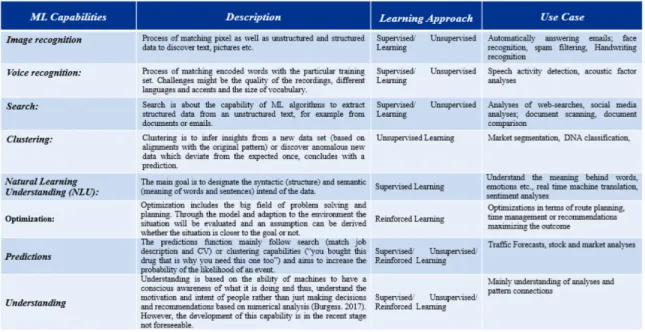
Table 1: Overview of ML algorithms with particular techniques ... 13Table 2: Overview of ML capabilities ... 15
Table 3: Overview of interviewees ... 28
Table 4: Overview of the most useful ML applications/ functions by ML-experts ... 39
Table 5: Overview of sales tasks matching particular ML applications/ functions ... 44
GLOSSARY
AI Artificial Intelligence
AR Augmented Reality
B2B Business-to-Business
B2C Business-to-Consumer
CRM Customer Relationship Management
ERP Enterprise Resource Planning
IoT Internet of Things
KPI Key Performance Indicator
Lhf Low Hanging Fruits
1 CHAPTER 1: INTRODUCTION
1.1 Relevance and problem statement
In the recent advent of emerging technologies and a highly competitive environment, digital transformation and disruptive technologies are often significant game-changer (Saar-Tsechansky, 2015). Concurrently, Internet of Things- (IoT), Artificial Intelligence- (AI), Augmented Reality- (AR), cloud-computing- or robotics – applications gather incredible amounts of data within a company.
Thus, an effective information system, including the storing and processing of the data as well as the derivation of new value-added business models, are the real game-changer for enterprises. Nowadays, new technologies might outperform humans in the sense that they analyse data much faster. Given that fact, they gather more information and derive a way more results and models from it than a human can do (Bhardwaj et al., 2017). One of these techniques is Machine Learning (ML) utilizing structured and unstructured data to elucidate how to generate hidden insights and prediction models (George et al., 2016).
By that, it focuses on the study of organizations, properties, and data analytics and their role in inference (Dhar, 2013). ML is no longer subject to the creativity and imagination of the media industry. Nowadays, it is one of the “hottest topics” in the technology sector evolving from an out-of-favour sub-discipline to a leading-edge frontier of research (Lewis and Denning, 2018). When Google’s Alpha Go algorithm beat the Go world champion in 2016, it became apparent that ML will shape the future. Looking at today`s voice or image recognition software like Alexa and Siri, it is evident which significant impact ML self-learning capabilities will have on people’s future daily lives. From a business perspective, ML applications can be implemented throughout the entire value chain within a company. Especially in highly competitive industries as pharma’s, ML application might facilitate the procedures of particular business units significantly on the one-hand side but might also create competitive advantage through process optimization (Burgess, 2017).
Given the fact that a various researches deal with the improvement of ML algorithms from a technical point of view, less academic literature investigates ML from a business point of view. By evaluating the impact of ML enabled technologies on sales activities within pharmaceutical companies (pharma’s), the underlying study intendeds to evaluate ML-enabled technologies within respective business units in pharma’s.
1.2 Objective and research question
The underlying dissertation deals with the late-breaking technology ML. The purpose of the study is to contribute to the stream of research on ML, especially on the impact on the B2B sales process in pharma’s. Hence, implications of how and where to implement ML within the sales operations may be derived. By evaluating the developed solutions, results will be generated so that statements about the degree of efficiency enhancements through ML can be obtained. Hence, the following research question was derived:
Furthermore, the research question intends to provide an insight into which fields of the B2B sales service may be affected by ML and thus influencing the business operation process. By matching Ml enabled technologies with respective sales tasks an indication will be derived which estimates the sales activities with the highest impact on the efficiency ratio increase within the sales department, supported by ML technologies. Moreover, the study enables a future outlook on how to use ML applications in order to maximize the outcome of the sales process. However, the scope of the thesis is restricted to ML in pharma’s, from a sales point of view. Accordingly, the generated insights will be applicable for managers analysing which processes have the highest potential to be enhanced by ML. That is why, in this dissertation, strategic implications from ML will be more significant than the technical deployment of ML. 1.3 Outline
Fundamental education on ML, its concepts, challenges, and risks are covered in the first part of the dissertation. This section provides the reader with a deeper understanding of ML and its enabled applications/ functions. Besides, investigations on the pharmaceutical industry and its challenges are made aiming to understand the market conditions and the pharmaceutical environment. Afterward, a definition of sales, the sales process, and KPI’s are associated with identifying first interfaces between ML and sales. Subsequently, the reader will be able to answer the following questions after the first chapter:
• What are the capabilities of ML?
• Which functions and technologies may be enabled by ML through these capabilities? • What are the characteristics of the pharmaceutical industry?
Research Question:
How can Machine Learning-enabled functions and applications maximize the efficiency and effectiveness of the B2B sales process for Pharmaceutical Companies in the future?
• What are the main tasks of sales representatives, and how is the sales process structured? • What are the KPI’s which determine an efficient sales process?
• Where are ML technologies implemented within pharma’s?
The second part of the dissertation is mainly based on in-depth interviews with ML experts and sales experts. The purpose of the interviews with sales representatives is to identify the decisive challenges in the current B2B sales process as well as getting an overview of primary responsibilities and performance indicators. The interviews with ML experts intend to identify the potential of ML-enabled functions and technologies. Thus, at the end of the dissertation, significant possibilities for efficient sales process optimizations through ML-enabled applications and features may be derived.
2 CHAPTER II: LITERATURE REVIEW
This chapter provides a review of existing literature on the primary research field: Machine learning and gathers information about the pharmaceutical industry and sales operations. 2.1 Machine Learning
The subsequent chapter aims to define and classify ML in the field of data science. Moreover, ML-capabilities and enabled functions/ applications will be summarized.
2.1.1 The basic concept of ML ordinated from AI
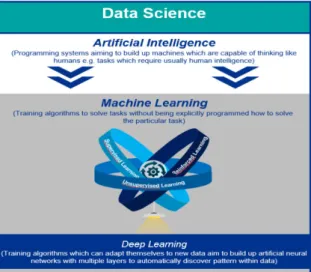
ML is a subcategory of AI, allocated in the field of data science (Puranam et al., 2018). The first coined definition of ML was established in 1959 by Arthur Samuel (1959) defining ML as the ability of computers to learn independently without being explicitly programmed. In that sense, ML is a mathematical computer-based method enabling machines to learn for themselves while executing tasks (Cui. et al., 2006) and gain valuable insides on essential data (Akerkar, 2014). To do so, ML requires an algorithm to extract useful insights from data focusing on adjust, retain, and update the algorithm based on gathered experiences (Cooper, 2018). The outcome of the learning process may be measured as the comparison between past and current behaviours rather than on real knowledge generated (Willens et al., 2016). ML applications are commonly used when structured, and unstructured data are too complicated for humans to describe analytically, but enough sample data - such as sensor data, pictures, or texts - is available. In that sense, ML may support computer models to identify patterns, shapes or designs in these existing data and thus, utilize these pattern to determine predictions and interferences to support the decision-making process in companies, even without human guidance and explicit reprogramming of the algorithm in future (Teodorescu, 2017). ML can be divided into three types of learning, namely, supervised (Cooper, 2018), unsupervised- (Luckert and Kehnert, 2016), and reinforced learning (Dey, 2013).
Supervised learning is a learning process that consists of a training dataset containing input
variables and a given number of correct output variables. Input variables are external information in the form of attribute variables or metadata, while output values might be specific labels of class attributes (Luckert and Kehnert, 2016). An algorithm analyses the training data and produces an inferred function identifying errors and predict which label to give to unlabelled data (Kotsiantis et al., 2007). An example of supervised learning are regressions, where the algorithm receives input and predicts the value of the output.
In comparison to supervised learning, unsupervised learning tries to discover hidden structures in unlabelled data (Das et al., 2015). Access to output variables and therefore, the machine needs to discover the data individually trying to find structures and patterns on their own. (Bhardwaj et al., 2017). Thus, the experience is not necessary (Luckert and Kehnert, 2016).
Reinforced learning follows a trial and error approach ought to take actions in an environment
to maximize a notion of long-term reward (Das et al., 2015). The algorithm behind learns from negative feedback and is only provided with positive or negative reward values for training (Portugal et al., 2018).
Table 1: Overview of ML algorithms with particular techniques (adapted from Luckert and Kehnert, 2016).
Even the three types of learning are beneficial for structuring ML in this paper; they overlap e.g., semi-supervised learning which uses unlabelled data to complement labelled data (Jordan and Mitchell, 2015). Deep learning (figure 1) encompasses all three described learning-types of ML (Skansi, 2018). By exposing multi-layered artificial neural networks algorithms to vast amounts of data, DL provides more precise and complex pattern discovery and feature learning and thereby represents a scalable version of ML (Long et al., 2018).
2.1.2 Machine Learning adds value to the company’s overall performance
Despite the high interest in ML applications in magazines and online forums, primarily investigations in ML applications/ features evaluations from a business point of view are not established topics in the academic literature. A high amount of researches deal with the development and testing of new ML-algorithms (Long et at., 2019). The purpose of these studies is to enhance the algorithm's preciseness and accuracy. Fewer papers focus on the connection between ML technologies and their efficiency process outcomes for particular business units. However, studies reveal that ML-enabled technologies have to potential to support the overall outcome of companies (Provost and Fawcett, 2013). Interestingly, companies using ML strategies in their operations are on average 5% more productive and 6% more profitable than their competitors (McAfee and Brynjolfsson, 2012; Brynjolfsson et al., 2011), mainly through cutting costs in data collection and analyses accuracy (Teodorescu, 2017). Thus, ML capabilities magnify the company's operational processes in terms of efficiency and effectiveness (Rudin and Ustun, 2018). Subsequently, from a business perspective, the main benefits of ML applications can be divided into three different value areas (Cui et al., 2006; Burgess, 2017).
1) Customer satisfaction/ centricity elevates customer service and thus enhances profit streams
2) The enhancement and development of processes and operations within a company lead to cost- reductions, -avoidance, and -compliance
3) Valuable insights into data lead to risk & loss mitigation as well as revenue leakage mitigation
In order to achieve the superior company objects, aptitudes of ML have to be identified. 2.1.3 Machine learning capabilities
In the academic literature can be found eight different capabilities (Akerkar, 2014; Burgess, 2017) of ML (see table two). The first four capabilities are related to capturing information. The focus is on the transformation of unstructured data (picture of a drug) into structured data (drugs name). Thus, patterns and relations in massive data sets consisting of hundreds of variables can be recognized. NLU, prediction, and optimization endeavour to understand consequences analysing what the client wants to say (Burgess, 2017).
Table 2: Overview of ML capabilities (own representation adapted from Burgess, 2017).
As illustrated in table 2, no clear affiliation of the particular ML capability with the appropriate ML approach exists. Mostly it depends on the individual objective, and the way data are selected. Based on the capabilities of ML, the following four applications are mainly discussed within the academic literature, namely Robotic Process Automation, Prediction and Forecasting, Natural Language Processing, as well as Robotics and bots (Burgess, 2017). 2.1.4 Machine Learning enabled functions and applications
Based on the described capabilities, this study centres on the four designated applications for ML-algorithms because they have seen as the applications with the highest potential for implementation within the sales unit. In general, ML-capabilities cannot be assigned to one particular ML-function. However, within an organization, ML-functions and applications can enhance the entire data management process by intelligently preparing cleaning and joining data from different sources (Zhou, 2017). Furthermore, it enables real-time decision making. By that, possessing information anytime available on all devices is guaranteed (Forbes, 2017). 2.1.4.1 Robotic Process Automatization (RPA)
Robotic process automatization mainly follows the ML-capability of optimization and utilizes
software to automate rule-based tasks at a scale that was performed by humans before (Accenture, 2016). It evolved from undertaking a repetitive duty like checking invoices and travel expenses of single users to automate business rules and orchestra robots to address large volumes of work (Hallikainen et al., 2018). Thus, it simplifies an operational scaling within a company by enhancing speed (process cycle time), quality while simultaneously decreasing
complexity and error susceptibility (less transactional errors) (Hallokainen et al., 2018; Accenture, 2016). Due to low implementation costs and a high expected return on investment (ROI), it can be seen as an effective and inexpensive way of process automatization enhancing profit streams and customer service (Willcocks et al., 2017). RPA can be assessed as the underlying technology for predictions, NLP, and robotics/ bot functions.
2.1.4.2 Prediction and Forecasting
Prediction and Forecasting functions mainly follow search or clustering capabilities (see table
two). From a company's point of view predictions can be used to give an overview over sales demands, individual actions of customers or employees, customer choices but also to forecasts the likelihood of events (George and Haas, 2014). Even rare event modelling is uncommon in management researches ML enables, for instance, organizational responses to disasters, mapping probability of failure, or assuming risk behaviour. These results can be displayed in apps or computer software (Van der Vegt et al., 2015). Through the self-training of the algorithm, ML methods can produce superior predictive accuracy compared to traditional methods like linear regression or logit models (Baiari et al., 2016). The recent challenge of prediction and forecasting functions is to maximize the accuracy, determine missing variables (features) and consistencies of the model (Puranam et al., 2018). Thus, it will be an essential function for businesses in order to position themselves in the market and ensures safety and precise long term planning.
2.1.4.3 Natural language processing (NLP)
NLP utilizes many different techniques for interpreting and understanding human language, ranging from ML to DL (Akerkar, 2014). It is mainly divided into image-/ and voice- recognition capabilities (Burgess, 2017). Ideally, the algorithm behind analyses large amount of texts and words, understand them intending to reply to questions automatically. By speech-to-text as well as text-to-speech extractions discussions with human beings might be enabled (Nugues, 2006). Hence, NLP can identify emotions behind words and expressions. Thus, in future responses related to the contemporary behaviour of customers can be made and triggers for positive buying decisions might be identified (sentiment analysis).
2.1.4.4 Robotics and Bots
Robots becoming more and more discussed topics in modern times. Robots use input data from different sensors and combining their voice, image, NLP and optimization capabilities in order to come up with the most appropriate response to the action by continuously improving its
algorithm (Burgess, 2017). For that sake, the robot requires unstructured data, and thus, ML capabilities like search or text identification are transforming the data well-structured to the robot. Despite the fact, that the technology can overhaul transactional work at a 50% lower cost (compared to humans), it also can enable businesses to operate 24 hours per day for 356 days per year (Accenture, 2016).
Furthermore, the robot can execute the tasks independent from vacations or unforeseeable diseases (Burgess, 2017). Applications of these robots/ bots already exist in various fields like autonomous driving, manufacturing robots, game bots, or service bots (Torralba et al., 2008). Especially the latter one in from of catboats aiming to greet and review customer requests can be a significant trend in the field of sales and customer service.
A more in-depth insight into the value and usage of ML-applications within the pharmaceutical industry will be given in 2.4.
2.2 Pharmaceutical Industry
The subsequent section will provide an overview of the pharmaceutical industry, its challenges as well as the typical sales process within pharma’s.
2.2.1 Market Structure and Market Size
Pharma’s represent a firm that is involved in R&D, manufacturing, marketing/sales of drugs, and biologicals (International Trading Administration, 2010). Traditionally, pharma's core business was the development of new drugs (e.g., generics, orphans, prescription drugs) to treat diseases and make a substernal revenue out of (Denoon and Vollebregt, 2010). Nowadays, pharma's shift the focus toward the development of affordable medicine (applied budget limits that deny patients access to innovative therapies) and technological changes in, e.g., drug discovery and the integration of new digital tools in the business model (Capo et al., 2014). According to the estimates of the Pharma Market research report (2018), the global pharmaceutical market will be set up to grow at 6,5% per year (CAGR), reaching $1,06trn by 2022. Not only the orphan drug-market is to almost double until 2022 up to $209bn, but also generics and other prescription drugs contribute $112bn and $739bn in 2022 to the overall growth (Deloitte, 2018). Drivers for the high pharmaceutical consumption are legal, technological, environmental as well as economic changes in the environment e.g. faster routes to markets, compelling market access value proposition, rapid global population aging, anticipated growth in chronic disease, urbanization, income raise, higher governmental expenditures in pharmaceutical industry and utilization of disruptive technology as AI, or IoT (ITA, 2016; Pharma research Report, 2018; McKinsey, 2018). Nevertheless, the industry remains a low concentrated market, although highly competitive. Considering the fact that a market entry requires huge investments, e.g., for drug discovery, entry barriers are high. Consequently, the market is dominated by large multinational enterprises as Roche, Novartis, Pfizer (Boldrin and Levin, 2005). Moreover, these companies understand how to commercialize so-called "high-value blockbuster drugs" by a strong workforce that established powerful customer relationships (Raja and Sambandan, 2015). In that sense, the sales and marketing department is crucial within pharma's in order to stay competitive and guarantee a solid base for future revenues.
2.2.2 Challenges of the Pharmaceutical Industry
The most important challenges pharma's are facing are the competitive environment, reduced drug pipelines, the expiration of multiple patents as well as changes in customer preferences
(Wenzel, 2014). Particularly, the expiration of many patens started in 2010 is remembered as "patent cliff" phenomena punishing pharma's heavily (DeRuiter, 2012). For instance, famous blockbuster drugs, e.g., Rituxan, Humira, and Avastin lost their rights and patent status between 2014-2019, diminishing profits, and setting price pressures on pharma's (Fernandez et al., 2012). The development of new drugs requires a good understanding of the environment, the customer, as well as the facilitation of patient access (McKinsey, 2018). The second challenge is the decline in R&D productivity so-called "productivity paradox" (Litinski, 2010) based on the adherence to old discovering and developing processes (Syrovatka, 2011). Expositions in the availability of healthcare data and software & hardware enhancements presuppose the implementation of an ML strategy fostering productivity concerns (BCG, 2019). Thus, within the pharma's obsolete management culture, mental methods, and strategies have to be overcome, implementing new ways of doing business (PWC, 2019). A new mind-set is unavoidable in order to foster the synthesis of new technologies and digital business models. Given the fact that the industry has remained oddly unaffected by digital transformation, also the B2B market lacks behind in terms of automatization (Asare et al., 2016). Price competition triggered through the development of new drugs is another challenge the industry is facing (Deloitte, 2018). In that sense, smart and automated marketing and sales strategies need to be realized in order to intensify customer service, satisfy and retain the clients. Along with this come regional/ governmental restrictions in terms of drug advertisement, pricing, and promotion, which require strong personal customer interaction.
2.3 Sales in pharmaceutical companies
The subsequent section deals with the B2B sales process within pharma’s and its activities. 2.3.1 The sales process and its activities
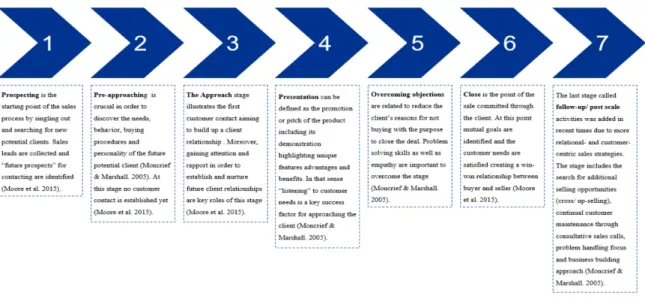
Although several authors investigated researches in the field of sales, there is no clear conceptualization of the sales process and its related tasks in general (Williams and Plouffe, 2007). However, the most widely accepted paradigm in the sales disciplines until today evolved by Dubinsky (1980/1981) consisting of seven different sales steps that apply to pharma's (Moore et al., 2015). These stages are illustrated in figure 2.
Figure 2: The sales process in seven steps (adapted from Moncrief and Marshall, 2005; Moore et al, 2015).
Pharma’s operate in both markets, B2B and B2C. The target customer group (B2B) are hospitals, pharmacies, private cliques, wholesales, and doctor offices. The purpose of the salesforce is to build up long lasting relationships with these customers. In that way, more complex and costlier deals can be closed. Furthermore, B2B sales are stronger, embracing customer education, product demonstrations, and customer service, while a couple of stakeholders are part of the sales process. That necessitates a data-driven salesforce that is updated in real-time and understands each decision of the customer's purchase. For that sake, new technologies and digital real-time tools and channels can support the work of the salesforce (McKinsey, 2018). The strong relationship focus underlines the thesis that sales B2B representatives are the key players in pharma's and determine its success (Shi et al., 2017). Dixon & Tanner (2012) determine sales as "the phenomenon of human-driven interaction between and within individuals/organizations in order to bring about economic exchange within a value-creation context." In pharma's the salesforce contributes profoundly to the financial balance of the companies by nourishing revenue and profits (Zolter et al., 2009). For that cause, they need to review and analyse market trends, recognize customer needs, and become the contact person in the product development process and its launch (Judson et al., 2009). Secondly, the sales representative may be viewed as a business agent actively "push" the product or service (Zoltner et al., 2008) toward each potential customer (George and Haas, 2016). That italicizes the fact that the sales team is the prime source for customer information (Pelham and Lieb, 2004). By connecting both sides of the market (Stan et al, 2012), the role of the salesforce enveloped from a spokesperson of the selling firm to a consultant for the buying firm (Sheth and Sharma, 2007). Nonetheless, communication and collaboration with the other
departments are essential for the salesforce (Lynn and Akgun, 2003), requiring strong personal interaction skills (Ingram et al., 2012). Within pharma's, the salesforce is obliged to achieve ambitious goals (Judson et al., 2009). Thus, high customer involvement and engagement in multiple key accounts are essential success factors. These tasks are time-consuming and require strong organizational skills (Mantrala and Albers, 2010). Therefore, a sales rep churn can harm pharma's through information- and client/ contact losses (Shi et al., 2017).
2.3.2 Sales key performance indicators
Key performance indicators (KPI's) can be defined as physical values (Gosselin, 2005) which measure the performance of processes and operations within an organization (Matsuo et al., 2013).
Anderson and Oliver (1987) provide the first concept of sales performance as the evaluation of sales forces based on sales outcomes (e.g., sales units, revenue, market share, new accounts, profitability) as well as sales behaviour (teamwork, effective communication). Within pharma's salesforce performance can be measured in terms of monthly sales, up- and cross-selling activities and subsequently, monthly sales growth/ closing ratio (Ramarajan et al., 2017). Since the sales are often closed during phone calls, monthly email- and phone call-rates are an additional performance indicator. The number of prospecting activities like product meetings/ demos as well as the final closing rate are additional pointers for the sales reps completion (Zallocco et al., 2009). For pharma's clients, information is the primary source for further drug development.
Consequently, the salesforces can be assessed via their customer engagement level, which implies an evaluation based on their client know-how and information related to market and competitor environments. In case this information can automatically be tracked, through ML algorithms, churns and other exits can be successfully caught up (Jaramillo et al., 2007). 2.4 Machine Learning in Pharmaceutical Companies
The subsequent sections will connect ML technology and pharma's. At the recent stage, several authors investigated ML applications within the value chain. R&D (Christensen et al., 2017), production (Liu et al., 2018) and logistics (Jordan and Mitchell, 2015) were the focal points of their analyses. The underlying study attempts to complete the topic by examining ML in sales and its impact on the efficiency within.
2.4.1 An efficient sales process
Efficiency is referred to an input-output ratio or comparison to reach a particular goal with minimal outlay and thus, directly effecting the companies margins and profits (Ostroff and Schmitt, 1993). In terms of sales performance, this ratio can be explained as sales outcomes in comparison to sales inputs described as calls, demos, emails, or letters (Ingram et al., 2002). In order to improve the input ratio, technologies can help to save time and enhance key-account management performance. Moreover, costs efficient tools can optimize e.g., customer-calls quality by RPA solutions (Zallocco et al., 2009). Compared to efficiency, effectivity is more related to the sum of total sales outcomes of all sales units, rather than the performance of a person within the firm (Anderson and Oliver, 1987). It goes along with the organizational mission and develops strategies in terms of gathering insights and understanding. Examples for that can be, the identification of target markets, customer call patterns, sales product portfolio strategies, competitive positioning (Zallocco et al., 2009). Thus, it meets ML primary capability of understanding and discovering hidden patterns.
2.4.2 An efficient ML process
To foster efficiency and effectivity within sales ML has to be integrated successfully inside the company's culture as well as within the company's strategy. That is why relevant stakeholders refer to understand the four ingredients of an efficient ML-strategy, namely algorithm/ model, data, computation/ training, and judgment/ optimization (Peukert, 2019):
Algorithm/Model
Approaches to choose to the right algorithm are broad because no transparent classification scheme for algorithms exists (Long et al., 2019). Following the main target of the algorithm labelling, clustering, and categorizing data and identify hidden patterns or similarities within the dataset. Thereby, over-fittings can be reduced modifying a much more complex dataset, find undiscovered interactions, reduce prediction errors, and cross-validate the results (Puranam, 2018). Thus, the further enhancement of the algorithm is the real competitive game-changer for pharma's in the future (Obermeyer and Emanuel, 2016).
Data/ Computation/ Training
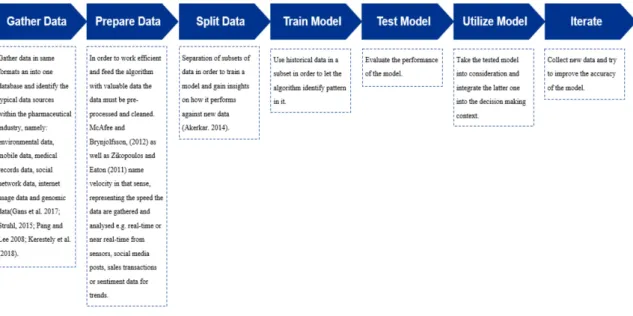
The major challenge within business units is not the implementation of machine learning applications into the IT-infrastructure of the company. A successful data management strategy as a baseline of an effective machine learning system is illustrated in figure 3. Only an efficient usage of the data can ensure that ML application running smooth and achieve the desired results.
Further development and adaption of the algorithm to achieve more precise results are one of the main challenges. That requires a constant incoming data flow as well as the knowledge about interpretations and adapting algorithms input variables. Besides, ML applications are no substitutes for the researcher's human judgments. While ML algorithm can discover robust patterns in data, conceptualize and measure (select) them, the explanation (theorizing/ reasoning) (Sheperd and Sutcliff, 2011), remain mostly human prerogatives (Puranam et al., 2018).
Figure 3: Overview for an efficient data management process for ML applications (adapted from Akerkar, 2014).
2.4.3 The use cases of Machine Learning within pharma’s
Within an organization, ML-functions and applications can enhance the entire data management process by intelligently preparing cleaning and joining data from different sources (Zhou, 2017). By integration ML algorithms into the business processes, the decision-making process will be facilitated by real-time information support. By that, having information anytime available on all devices is guaranteed (Forbes, 2017).
2.4.3.1 R&D and Manufacturing
Drug Discovery/
ML applications for drug discovery and manufacturing may be predictions of success rates based on biological factors. Moreover, precision medicine to identify alternative therapy path often involves an unsupervised learning approach. (Ajani et al., 2018).
Disease Identification and Diagnosis
Moreover, investigations in the field of disease identification (e.g., cancer) prevention and curing have dramatically emerged during the last decade (Kerestely et al., 2018). Thus, ML can
help to reduce the rising drug discovery costs and support the doctor-patient relationship by enabling personalized treatments and behavioural modification for patients (Bhardwaj et al., 2017).
Clinical trial research
Identifying through prediction candidates for clinical trials would result in smaller, quicker, and fewer trials overall. Besides, prognostic analytics can be drawn on a much more extensive range of increasing data precision (McKinsey, 2018). Hence, finding the best sample size increases the efficiency or reducing data errors are the main applications in the field.
Smart Electronical Health records
Document classification (emails) and character recognition are essential ML-applications in pharmaceutical companies and facilitate the employee's organizational outlay.
2.4.3.2 Logistics/Supply Chain
Through forecasting, the demand better, ML service level and inventory costs can be reduced. Collaboration synergies between supplier networks might be identified and enhance the supply chain environment by e.g., predict the transportation and material costs or estimate missing capacity information.
2.4.3.3 Sales and Marketing
Machine Learning in form of web or mobile analytics tools to predict individual actions, customer choices (George and Haas, 2014), customer purchases (Cui et al., 2006) or the likelihood of an event (Van der Vegt et al., 2015), are becoming significant for companies (Cui et al., 2006). Hence, the customer journey could be improved, triggers for buying decisions may be identified, and therefore sales qualified leads enhanced. Moreover, predictions in fields of individual risk propensity, avoidance behaviours, or risk mitigation are standard (George and Haas, 2016). Moreover, Chabot's, for instance, ensures a 24h/7 service offering the best answer to customers while analysing their response. Thus, ML and data analytics fostering sales productivity and drive double-digit sales without future investments and sales team changes (McKinsey, 2018).
2.4.4 Challenges and Risk of ML applications in sales
The first challenge inherent with the implementation of Machine learning in companies is access to a vast amount of sensitive data which subject to privacy concerns (Goh et al., 2019). Thus, ethical and regulatory restrictions have to be complied with at each stage of the data collecting process (European General Data Protection Regulation) (Vayena et al., 2018).
Another risk of ML algorithms is that it is a so-called "black box" system because thousands of complex rules are associated with the ML model (Long et al., 2018). Thus, the "rules engine" should be visible in order to let users understand the reasoning behind the results (Zhou, 2017). In that sense, the management of a company has to ensure the technology's understanding within the business unit. Otherwise, the technology will be employed mistakenly, and employees do not comprehend the reason behind the technology leading to a negative impact on its efficiency ratio (Goh et al., 2019). Moreover, a convenient education regarding technological changes is essential to achieve acceptance of the ML solutions throughout the salesforce overcoming the main fear of replacement (Zhou, 2017).
However, literature about the benefits of ML applications exists on a full scale, but a guideline on how to maximize efficiency in the sales process in pharma's through ML does not exist at this time. That is why the underlying dissertation endeavours to form a model that connects sales processes within pharma's with the right ML-enabled function/ technology and measures its efficiency rate.
3 CHAPTER III: METHODOLOGY
The subsequent chapter carefully examines the methodological steps taken during the given research process and explains the collected data, including qualitative results.
3.1 Research Method and Strategy
Researches in the field of ML from a managerial perspective is limited, as the technology is continuously progressing and the environment involved continually changing. That is the reason why there is a great room to add significant insights to the ML concept. The objective of the study is to recognize which technologies are enabled by ML. Afterward, the paper should give an assumption of how to utilize them in order to increase the efficiency of the sales department. In order to come up with reasonable approaches, the dissertation follows an exploratory approach. Following such an approach, the gathered insights will enhance the perception of an obstacle profoundly, seeking an in-depth description of a defined problem (Gephart, 2004). Moreover, qualitative methods are mainly applied for the exploration of a little known subject of research (pharma's) as well as for supplementing and validating existing literature (Lang, 2010).
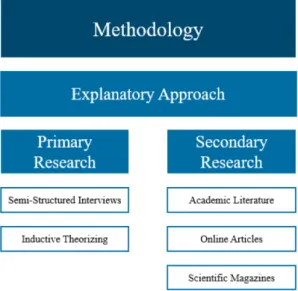
The conducted research is based on two methods. (1) The collection and inquiry of secondary data as well as (2) primary data (figure 4).
Secondary data
Secondary data in terms of online-articles and publications were convened to provide a fundamental overview of topics like ML, the pharmaceutical industry, B2B vs. B2C, and the tasks throughout the sales process. More specially, investigations on the technologies ML
enables have to be made in order to discover tasks and operations of the sales process can be affected by ML. Besides, a profound insight into the sales process is reasonable because "sales efficiency KPI's" have to be identified to compile recommendations on how to maximize efficiency throughout the sales process.
Primary data
The primary source of qualitative research is qualitative data and inductive theorizing (Bansal et al., 2018). Subsequently, qualitative data can be conducted through the collection of empirical materials e.g., case studies, personal experiences, interviews, or artefacts (Denzin and Lincoln, 2000). Inductive theorizing relies on logical reasoning based on former insights with the aim to abstract and generalizes new knowledge from the data (Bansal et al., 2018). One type of qualitative research is qualitative in-depth interviews which are beneficial in terms of ease and cost-efficiency (Given, 2008). The goal of qualitative interviews conducted during the research with ML and pharma sales experts in the production of new content benefiting from the fact that the interviewee's experiences, ideas, and impressions are documented and considered (Alvesson, 2003).
Moreover, the interviews are often loosely structured and open to content the interviewee considers as essential. Rowley (2012) describes qualitative interviews as the collection of "facts" and gain insights as well as an understanding of the interviewee's experiences, attitudes, processes, predictions, and opinions. Hence, the purpose is to go below the surface and explore new undiscovered ideas and insights (Britten, 1995). However, regularly, the type of in-depth interview can be classified based on their structure lever (Rowley, 2012). The three common types are structured, unstructured, and semi-structured interviews, all following an explanatory approach (Van Puyvelde, 2018).
Semi-structured interviews
This paper follows a semi-structured approach that empowers the researcher through a mix of rigid structure and uncertainty to go deeper into relevant topics (Ackermann and Rockmann, 2002). A couple of neutral open-end questions are predetermined with an open result. Thus, the responded has leeway in terms of flexibility and freedom of the answers (Given, 2008). The right amount of interviews is controversially discussed in the literature. While the anthropologist Spradley (1979) recommends conducting between 25 and 30 interviews, business researcher McCracken (1988) proposes to collect eight, while Glaser and Strauss (1967) do not mention a specific number but suggest to gather interviews until a state of theoretical saturation is reached. For that sake, the author decided to collect around 8 interviews. Concerning the structure of the interview Gubrium et al. (2012) recommend to start the
interview with two to three introductory icebreakers, followed by transition questions five to eight main questions. The main questions are related to the research question and should be the focal point of the interview. To conclude, valuable interview insights will be summarized (Patton, 1987).
Data Collection
The participants of the interview were contacted via E-Mail, LinkedIn, and personal contacts. Before the interview, all of the participants were given an explanation of the research objective, the research question, methods of data analysis, and reassurance about confidential issues. In total, 8 participants were interviewed for 45 minutes.
Participants
The participants of the survey composed of two different target groups. Firstly, ML experts were interviewed, mostly professors or consultants with a computer science background or experience in the field of AI. The second group consists of sales representatives and experts from large and small pharma's as well as consultants working in pharma's environment.
4 CHAPTER IV: ANALYSIS OF THE IMPACT OF ML ENABLED
TECHNOLOGIES/ FUNCTIONS ON THE B2B SALES PROCESS OF
PHARMACEUTICAL COMPANIES
The subsequent chapter summarizes the semi structured interviews with Machine Learning experts and sales expert. Throughout the chapter a model will be derived connecting the sales process and its tasks with particular machine learning functions and applications.
4.1 The sales within pharmaceutical companies
This section will sum up the most prominent trends within pharma’s aiming to come up with a verified sales process form the theory rose at the end of chapter 4.1.3.
4.1.1 The main challenges within pharma’s are diversified
The insight gathered through the interviews corresponded with the insights from the literature review.
The most influential challenges within the pharmaceutical industry address digital transformation lack (interview 6), missing technological know-how (interview 8), high R&D costs (interview 8) as well as long time to market cycles (interview 7). Pursuing a digital approach in order to implement new technologies and enhance operations is a novel challenge pharma’s have to deal with (interviewee 6). Hence, most of the pharma's are driven by costs-pressures rather than by their digital DNA. Pharma's turning their paradigm to concentrating on the access of new treatments to an affordable price for the end-consumer. For instance, Novartis – traditionally focused on vet medicine & generic drugs – specialized in the development of new affordable cutting edge therapies based on faster time-to-market cycles and fewer R&D expenses (interviewee 7). Another concern of pharma's is the high dependence on political, country-specific regulations, e.g., restrictions concerning the advertisement of drugs in Germany (interviewee 6). ISO norms and GDPR restriction and other fast-changing laws require a lot of flexibility and adaptions from pharma’s. Another example is the price pressure which permits only a small derivation from the original price set up (interview 8). The pharmaceutical industry is extremely competitive, as well as price-sensitive. That is why pharma's ought to uncover distinct methods to distinguish from their opponents. ML-applications hold the potential to strengthen the company’s competitive advantage through process optimization (interview 7).
4.1.2 The main challenge of sales representatives is to reach individual performance goals
The subsequent section implicates to identify the most significant pains and concerns sales reps might have during their daily routines. It will be essential to obtain a statement later, where to implement ML solutions.
In general, the sales department in pharma’s is represented by the respondents as a very competitive and time-intensive department, frequently with claiming daily, monthly, and yearly goals (Interviewee 7, 8). One interviewee remarks as follows:
“Sales reps traveling from one client to the other one from Monday to Friday. Once you don’t fulfil the goals, colleagues overtake the job for you with the result that you are going to be
outperformed (interviewee 7).”
Sales representatives are steadily operating under pressure and against the clock. Fast-changing product details and market situations hamper the salesforce work. Hence, it is challenging to keep up with news and real-time information for the end-customer (Interviewee 7). The competitive pressure also requires a new level of product complexity as well as a broadly diversified product portfolio. The sales staff can only overlook this complexity with the aid of digital tools accessing database, specifications, price lists, and discount rules in real-time (Interviewee 6). To build up long-lasting relations in the B2B market, credible information about the product portfolio for efficient customer support is a critical success factor (Interviewee 8). Another key challenge is to understand the customer by asking the right questions in a conversation and consult them whenever and wherever they require information. That is why detailed product specifications, a simple purchasing process, quick answers to questions, and prompt delivery are additional factors of success in the B2B sales market. Moreover, customers in the B2B market are also regularly driven by time pressure (Interviewee 7). Therefore, short tailored pitch decks, short product demonstrations, and extensive communication skills are imperative for the salesforce in pharma's. The flexibility and enormous speed demand stable connection between client databases (CRM) and ERP systems in order to provide rapid information, e.g., on product delivery or product data (Interviewee 5). The interviews confirmed that performances of sales reps are measured in terms of sales calls/emails, conversation rates, and successful deals closed as well as up-& cross-selling activities (Interview 6). In order to examine and measure the performance, the salesforce is obliged to report and monitor their activities.
“After an information exchange with clients (calls, emails, product presentations, etc.) the results need to be manually transferred to an excel/ CRM system which takes time and effort.”
Another concern mentioned in the interviews is the lack of transparency. New digital tools and applications exist within the company, but nobody knows about it. That indicates that pharma's ought to enhance their communication channels as well as their employee training (Interview 6).
4.1.3 Sales steps and operations in pharmaceutical companies are inconsistent
This chapter aims to illustrate the sales process and its particular tasks within pharma's as a foundation for chapter 4.2. The results inferred in this section are mainly based on inductive theorizing because most of the interviewees did not want to mention specific sales activities and tasks.
Nevertheless, the insights deduced unveiled that the B2B sales process in pharma's cannot be lump surmised (Interviewee 8). Each company has its independent structure and organization follow different goals depending on its size, profits, and the number of employees (Interviewee 9). In large enterprises, key accounts manage the sales, interactions, and relationships with each client. In smaller companies sales representatives are responsible for a couple of different hospitals, doctors and drug stores.
In chapter 2.3.1, the sales process consists of seven steps. A different model was derived, which clusters the sales process into four principal sales categories and two ongoing sales phases (figure 5).
Figure 5: The sales process in pharma's (own representation, 2019).
The obstacle to Dubinsky's model was that individual activities could not be separated from each other because of no precise categorization. That is why packages where develop which can depart the phases more precisely. The distinction between the main tasks and support tasks is the time component. While supportive tasks are executed on a daily base, activities belonging to the main phases are often performed less recurrent.
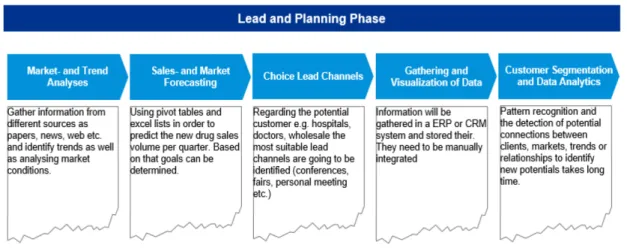
1) Lead and Planning Phase
The lead and planning phase is the starting point for further strategic decisions for the head of sales based on market, trend, and event analyses as well as forecasts. Based on those assumptions, future lead channels, and new customers may be recognized. Moreover, the forecasts and predictions provide new information on the future outlook and success rate of the particular drug. Thus, it is crucial for the setting of strategic goals. The more precise the tasks are performed, the easier it is for the sales department to determine reachable yearly, monthly, and daily sales goals. The phase terminates with the visualization of all required data to reach new customers (Interviewee 8).
Figure 6: Lead and planning phase with related activities (own representation, 2019).
2) Offering Phase
After the lead and planning phase is finalized, the offering phase sets in. During that phase, the first customer contact is made. Real-time data (prices, products, and customer data) available at every point of customer interaction is a significant success factor (Interviewee 5). During
customer interaction, it is necessary to understand the customer without losing information about their concerns and their preferences. During this phase, the salesforce offers a lot of customer-specific activities and tasks, e.g., protocolling, product presentations, pitches, and individual proposals based on the customer's input. The phase ends with the first feedback of a proposal draft (Interviewee 7).
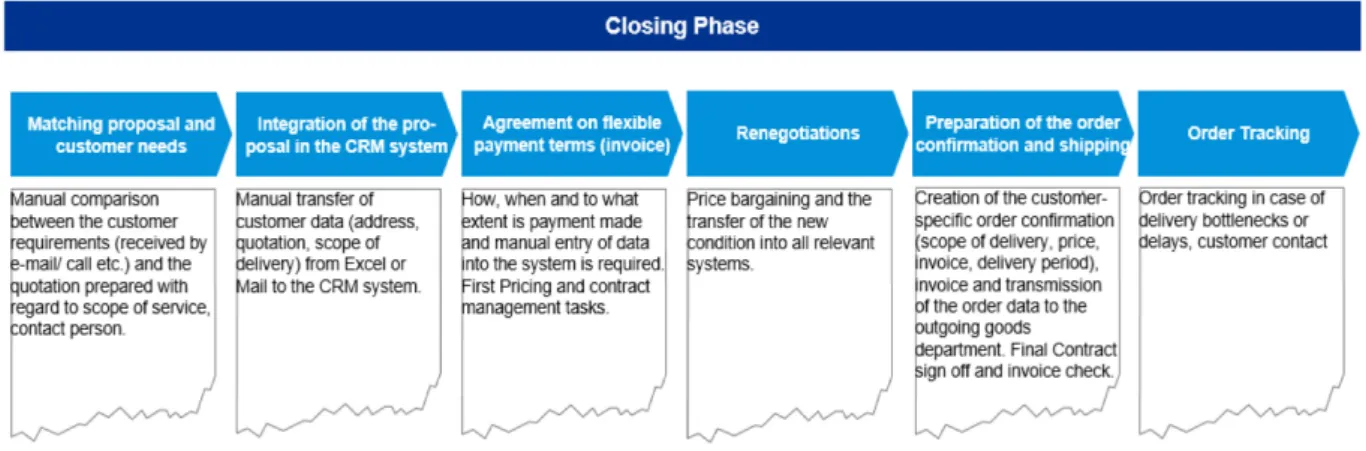
3) Closing Phase
The closing phase starts with the first customer feedback. The preparation of contract- and accounting documents, as well as the closing of the deal, are focal points. Information about prices, delivery time, discounts, and the number of products or product modifications have to be gathered, summarized, and added into a CRM/ ERP system (Interviewee 5). Notably, price anticipations and discount rates determine the success or failure of a deal. Most likely, the phase closes with the shipping and tracking of the drugs.
4) After-Sales
The after-sales services within pharma's are mainly based on permanent presence whenever the client requests information. This information can be specific company details, product-related issues as well as any other wishes the customer might have. Due to the high competition within the industry, fast and precise responses are significant because customer satisfaction and retention is the most critical factor for long-lasting relationships (Interviewee 8). Hence, the
collection of feedback is a success factor in order to retain the customer and increase the chance of closing further sales.
5) Data Management
Data management activities developed from underappreciated tasks to potential game-changers throughout the sales rep activities. Nowadays, data are gathered at any touchpoints within the sales process regardless of client interactions, conducted analyses, or the input from data into company-related systems. In pharma's, all actions need to be recorded, and thus, many data can be gathered (Interviewee 8). Despite ensuring IT-architecture and security, an automated dataflow provides the sales reps with relevant information and saves them time and manual effort. The enhancement of handling and working with these data on a daily base will boost sales reps in accomplishing their wide range of tasks and goals (Interviewee 6).
Figure 9: After sales with related activities (own representation, 2019).
6) Relationship Management
The tasks included in the relationship management phase accompany the sales rep during their entire function on a daily base (Interviewee 8). Hence, high repetition potential, a high manual effort for data input and inefficient time management (e.g., screening and answering of e-mails, customer trip planning) deemed to be barriers in the daily routine of sales reps.
4.2 Machine Learning potentials and challenges
The subsequent chapter aims to identify the potentials of ML-applications and challenges. At the end of the chapter success factors of ML applications may be derived, and suggestions of ML-applicable tasks and processes will be given.
4.2.1 The state-of-the-art technology ML has not reached its full potential in pharma’s yet
There is an agreement among the interviewees regarding the status quo of ML-applications and functions. Machine Learning applications and functions are software that is trained through algorithms (statistical models, regressions). The intention is to support operations and processes throughout the entire value chain of the businesses, reflected by 80% of the interviewees (Interviewee 3). For instance, 4/5 ML experts discern the highest potential in the production line, while 3/5 mentioned logistics as the primary implementation field. The reason for that is higher upside potential in this field triggered by uncertain cost factors for companies (Interviewee 2). Nevertheless, all of the ML experts appraise ML and its functions/ capabilities in sales as a recent hot topic for companies fostering its competitive advantage through process optimization and automation. Interviewee 1 alludes this hypothesis in as follows:
"As long as you can transform your data into numbers/ series of numbers, ML can be implemented everywhere. That is the case for all the data currently existing."
To become fundamental to more numerous companies, enhancements in the production of better and more broadly applicable algorithms for the foreseeable future are necessary (Interviewee 3). On the contrary, Interviewee 4 (2019) points out that the true potential of ML-applications does not lie in the construction of new algorithms, but in the implementation and adaption of the algorithms already existing within the particular company-specific system. Although there is consensus about the growing relevance of ML, future developments remain tough to predict because the outcome is a black box. More and more ML solutions/ ML services will undoubtedly be offered to companies during the next years due to the media hype around the topic (Interviewee 2). Large pharma's have recognized the imperative to invest in new digital solutions. Novartis established a tech-hub in Barcelona which deals with AI applications and new apps. The challenge is to close the gap between employees who produce the algorithm and those who utilize the results (Interviewee 7). Recently ML-applications are commonly used to predict the outcome of special sales events, balance sheet figures, yearly sales rates, and the potential sales volume within big pharma's. Smaller pharma's companies, on the contrary, do not have the expertise and resources in order to realize an ML strategy quickly.
4.2.2 Data Management as the key challenge of ML applications
The majority of the interviewees' consent on data preparation and processing as the major challenge for companies (5/5 experts), followed by a lack of understanding (magic number code problem 4/5 experts) appearing in challenges associated with the correct usage and adaption of algorithms (4/5 experts) (figure 12). Solutions to overcome the divergence between mathematicians/ physicians, who develop the algorithm and business people who do not understand the logic behind the algorithms, need to be figured out by companies in order to develop a result/ customer-oriented ML strategy (Interviewee 5). After all, 3/5 experts highlighted legal restrictions concerning data digitization and compliance with regulations as a significant hurdle for companies. E.g., the Russian data protection policy is less strict, allowing e-health companies to gather and use data from central IT. Thus, pharma 'sin Russia can work on new drugs even before the international competitors recognized the future problem (Interviewee 1). However, when dealing with country specific data protection laws as well as data conformity must be proofed from the companies' side in order to guarantee a smooth utilization of ML applications (Interviewee 4). Misconceptions and inefficient utilization of ML applications are often spread out from top-management who want to foster innovation without fundamental knowledge on how to nail the challenge. Thus, many pharma's desire to implement solutions into their systems but do not even have the IT- architecture to set up efficient
ML-strategies (2/5 experts). Cloud solutions and data warehouse ML-strategies are striving to accumulate data within one system in order to ensure full transparency the data availability and storage. From these hurdles, success factors may be derived in 4.2.3.
4.2.3 Success factors for an efficient usage of ML enabled applications
Among the interviewees is a collective agreement toward the most decisive success factors. All of the interviewed persons (100%) highlighted the understanding of ML applications as the most significant future challenge, illustrated in figure 13. First of all, the management level of a company must be aware of this fact that the set-up of clear goals and its communication throughout the business units is essential. The way how the management educates and cultures their employees will significantly impact the ML-adaption throughout the company. Failure will result in black box phenomena (Interviewee 2). Thus, the applications cannot reach its full potential because e.g., mistakes will not be identified, and people cannot interpret the results (Interviewee 3). Thus, the model cannot be improved, which leads to the second factor of success, classical data science work (83, 3%) including gathering, training, balancing, and ironing out data. Analyses came up with the result that these tasks take 80% of the implementation time. The remaining 20% comprise the actual coding and building up the problem (Interviewee 1). A thriving ML-introduction also needs to be compliant with the implemented IT-systems and architecture considered as the sine qua non. The adaption of the developed algorithm is another key for an efficient ML-implementation, according to 66, 6% of the interviewed persons. Based on the company-specific needs variables within the algorithm need to be continuously updated, converted, and modified based on the anticipated outcome. Moreover, persistent training and optimization of the dataset denoting convey different layers (number input) into a number output of the algorithm between different domains. In order to reach the full potential of the algorithm, data collection over a specific period needs to be collected and transformed into numbers/ series of numbers. 66, 6% of the respondents jilted data access as a successor. Today on the on hand-side several databanks exist where the company's purchase data and collect various information about the customer. From a business perspective point of view, the cost and time components also matter in order to come up with an efficient and effective implementation strategy. Unlike the common sense of ML setups solely require a few data which do not require high purchasing investments.
"A prototype can be built within a few hours and only requires between (200 MB and 2GB) of data" (Interviewee 1).
The amount of data depends on the particular company-specific intension and statistical model. While time-series scrutinizes, require only a few data, text and picture analyses call for more eloquent data in order to achieve a beneficial outcome. In that sense, pharma's need to raise the question of whether they have the resources to deal with these issues or alternatively outsource the required tasks (Interviewee 2).
4.2.4 Predictions and forecasts as the leading functions of ML
ML learning-enabled applications will significantly change the pharma’s performance and workflow. Forecasts report that in the next 15-20 years, 50% of the jobs will shift towards automatization (Interviewee 1). Form a business point of view ML- applications leading to shrinking labour costs (10 robots can replace 100 employees), flawless compliance and risk management (contract, invoice checks), higher productivity (24/7) and efficiency (4-5 time faster) and thus, generating new revenue streams for the company (McKinsey, 2018).
Recalling the most common ML applications from chapter 2.1.4 the interviewees evaluated predictions and forecasts (table 4) with 83, 3% as the function with enormous potential,
66,60% 83,30% 33,30% 66,60% 100% 33,30% 0,00% 20,00% 40,00% 60,00% 80,00% 100,00% 120,00% Data
Access ClassicalData Science
Work
Build up
Algorithm AlgorithmAdapt EmployeesEducate FactorsOther
Agr eem ent on s uc ces s Fac tor s in %
Success Factors of ML applications in % based on the Intervieews agreement
Success Factors
Figure 13: Success factors of ML applications (own representation, 2019).