A Work Project, presented as part of the requirements for the Award of a Masters Degree in Economics / Finance / Management from the Faculdade de Economia da Universidade Nova de Lisboa.
IPO IMPACT ON INDUSTRY INCUMBENTS
Nuno Filipe Matamouros Resende Frade Campos, nr. 1016
A Project carried out on the Finance course, with the supervision of: Prof. Afonso Eça
Abstract
The creation of an innovative company is suggestive of change in an industry. To test that change this paper tests the impact of IPOs on industry incumbents. IPOs are found to happen in industries that exhibited positive abnormal returns for up to 5 years before the IPO date. The IPO date is found to coincide with the end of that industry abnormal return profile. This paper suggests this evidence is consistent with the IPO acting as mechanism of enforcing market efficiency at the industry level.
1. Introduction
Innovation is a non-stationary phenomenon, ie. the very nature of creating something that did not exist before makes that act of creation unpredictably different from previous acts of creation. This prevents aggregate analysis of innovation moments. However, nu-merous previous pieces of research suggest that moments of innovation are very often followed by periods of absorption of the innovation. These periods of innovation-ab-sorption might be better vehicles for aggregate study and inferential analysis. Neverthe-less this analysis still requires the identification of a single event within those periods on which such analysis can be centred. The IPO appears to be one such event that is (i) common to most innovations and (ii) sufficiently far away from the moment of innova-tion to be comparable across innovainnova-tions.
This paper tests the hypothesis of the IPO being a significant event for incumbents in the same industry.
2. Literature Review 2.1 Innovation
For Schumpeter (1943) innovation was the “perennial gale of creative destruction” – the unavoidable certainty of new firms displacing old firms, of current economic activities being made obsolete by the ‘creative destruction’ of the entrepreneur. For Rajan (2012) innovation is what grants an individual firm profits above the required rate of return, in-novation is what justifies the creation of a new firm. For Christensen (1997, 2006), (dis-ruptive) innovation is what allows startup firms to take away market share from estab-lished incumbents and ‘beat them at their own game’.
These three views of innovation share a common thread – all three point to a process of innovation, in which the innovative action comes after a period of adaptation/absorption
of the previous innovation and itself gives way to the next period of innovation absorp-tion. Schumpeter argues that the “perennial gale of creative destruction” manifests itself in discrete rushes, with innovations being followed by periods of relative lull. Rajan posits that companies that start out innovative, as they mature, walk an unavoidable march to-wards standardisation (and away from their innovative beginnings). Christensen argues that disruptive innovations start a new cycle of sustaining innovation, until the next dis-ruptive innovation appears and the cycle restarts.
2.2 The IPO
Kortum and Lerner (2000) present evidence for the prevalence of venture-capital financ-ing in newly-created innovative frims. Lerner (1994), Ritter and Welch (2002) speak of the role of the IPO as a cash-out moment for previous venture capital investment. Ritter and Welch also explore the prevalence of the IPO once companies reach a certain size (p.1978) — “if it grows sufficiently large, it becomes optimal to go public”.
2.3 IPO impact on industry incumbents
Hsu et al (2010), Akhigbe et al (2003), Nguyen and Sutton (2014) have tested several hypotheses regarding the impact of IPOs in their respective industry — mostly focusing on the short-run return of industry portfolios after an IPO. Hsu et al (2010) test the returns of industries between 30 days before and 30 days after the dates of “large, and presumably important, IPOs (p. 499)”, finding that industry incumbents exhibit negative CAR on the 30 days after an IPO. Akhigbe et al (2003) test the returns of industries on the 10 days following the date of an IPO and find no evidence of negative or positive CAR.
Nguyen and Sutton (2014) find that industry incumbents show higher stock repurchases if the intra-industry IPO volume in the previous 6 months is higher.
3. Hypothesis
Through the lens of industry abnormal returns, this paper studies whether there is a com-mon thread acom-mong industries before and after an IPO in that industry takes place, ie. I test whether an identifiable trend exists in the ‘industry-specific’ conditions that predate and follow an IPO in that industry, or, whether IPOs influence or are influenced by their in-dustries.
The event being tested is the occurrence of an IPO in a particular industry. Specifically, letting K be an integer, the occurrence of an event is defined as the existence of K IPOs in a particular industry in a given calendar month.1 Following from the definition above comes the fact that in this study an observation is not a particular firm going public but its industry witnessing an IPO.
FIGURE I. For any one industry, the definition of an event in a particular month is dependent on the number of IPOs that industry witnessed in that month and on the event definition — eg. for K ≥ 1, an event is registered in an industry for any month in which there was at least 1 indus-try IPO.
The hypotheses previously stated can be restated as a test of whether the average cumu-lative abnormal return (CAR) around (before or after) an IPO is significantly different from the CAR unconditional mean (=0).
1 One particular formulation of this event definition is “existence of exactly 1 IPO in a particular
4. Data
A list of 9825 US IPOs from 1975 to 2013 was obtained from Prof. Jay Ritter’s website. SIC codes for these firms come from the CRSP and COMPUSTAT databases. Daily re-turns for 49 value-weighted industry portfolios were obtained from Kenneth French’s website. Daily historical returns of the Fama/French 5 Research Factors (Fama and French 2014) were also obtained from Kenneth French’s website.
5. Methodology
5.1 Identifying IPOs and assigning them to industries
The IPO database collected by Jay Ritter2 was used as a starting point. This database contains a list of companies (with each company’s name and ‘PERMNO’ identification code for the CRSP database), the date of their IPO and their founding year. The CRSP database was queried to obtain each company’s 4-digit Standard Industrial Classification code at the date of its IPO (or, if missing, at the first available date).3 Of the 9825 IPOs present in the list, 99 that didn’t have a PERMNO associated with them were excluded from further analysis — searching the databases based on the name of the company would be prone to inaccurate matching, thus prompting this decision.
The two most important criteria in defining industries against which to test the hypotheses were: (i) firms in the same industry must be engaged in similar economic activities (must in some sense of the word be competitors, so that the firm that goes public and its respec-tive industry share an economically meaningful connection); (ii) the portfolios formed
2 Available at http://bear.warrington.ufl.edu/ritter/ipodata.htm.
3 The CRSP variable name is ‘HSICCD’. For companies whose SIC code wasn’t found in CRSP the COMPUSTAT database was queried (COMPUSTAT variable name — ‘sic’).
must be diversified during the time period in analysis. Fama and French (1988) assembled industry portfolios with the same stated goals as testing my hypothesis required. Follow-ing the list of industry definitions they make available4, I assigned each IPO to each of these 49 portfolios.
5.2 General considerations regarding event study methodology
MacKinlay (1997), Brown and Warner (1980), Kothari and Warner (2004) are examples of relevant surveys of Event Studies practice and methodology. These have guided the methodology followed here, with reference to other publications being made when the specificities of this event study thus demanded.
Monthly sampling was used following MacKinlay (1997), who suggests that for a long-run event study the use of monthly sampling (instead of daily sampling) is justified. In this study monthly CARs were used as the return measure. Fama (1998), discussing specifically the issue of long-run event studies, argues for the use of CARs instead of Buy-and-Hold Abnormal Returns (BHARs).5
5.3 Choice of model for normal returns
The evaluation of abnormal returns (defined in equation 1) demands the prior definition of a model of normal returns. Risk-adjusted models (ie. market or factor models, instead
4 Industry definition consists of correspondence between SIC codes and each of their 48
indus-tries plus ‘Other’, available at http://mba.tuck.dartmouth.edu/pages/faculty/ken.french/Data_Li-brary/det_49_ind_port.html. Since the publication of their paper they have kept those portfolios updated, see eg.
http://mba.tuck.dartmouth.edu/pages/faculty/ken.french/Data_Li-brary/changes_ind.html for an update to the composition of the portfolios.
5 BHARs have historically been a popular choice for long-run event studies. However, two
fac-tors have made me opt not to use them in this particular study — (i) Fama (1998), Lyon et al. (1999) argue that in the presence of significant cross-sectional dependence (see section 5.4) there are no satisfactory inference methods for BHARs; (ii) specifically in this study, the fact that observations are industries and not individual firms reduces the spectrum of possible peers from which to estimate the performance of a non-event matched peer needed for BHAR estima-tion.
of simpler, constant mean models) are essential when dealing with long-run studies, say Kothari and Warner (2004). Furthermore Brown and Warner (1980) provided empirical evidence of the better testing performance of market/factor models when compared to simpler constant expected return models, especially for event studies that present some degree of event clustering. Some definitions of terms follow:
𝑅",$ 𝑖𝑠 𝑡ℎ𝑒 𝑅𝑒𝑡𝑢𝑟𝑛 𝑜𝑓 𝑠𝑒𝑐𝑢𝑟𝑖𝑡𝑦 𝒊 𝑖𝑛 𝑝𝑒𝑟𝑖𝑜𝑑 𝒕,
𝐴𝑅𝑖,𝑡 𝑖𝑠 𝑡ℎ𝑒 𝐴𝑏𝑛𝑜𝑟𝑚𝑎𝑙 𝑟𝑒𝑡𝑢𝑟𝑛
𝑁𝑅",$ 𝑖𝑠 𝑡ℎ𝑒 𝑁𝑜𝑟𝑚𝑎𝑙 𝑟𝑒𝑡𝑢𝑟𝑛
𝐴𝑅",$ = 𝑅",$− 𝑁𝑅",$ ( 1 )
Furthermore, it is reasonable to assume that firms whose industries witness IPOs may share common attributes — when observations are suspected to share common attributes MacKinlay (1997) suggests that the use of a multi-factor model might help capture part of the return variance and thus be warranted. Similarly, Kothari and Warner (2004) affirm the need for multi-factor models when building long-run event studies, since their use allows for the distinction of “performance associated with the event itself (p26)” from performance attributable to known risk factors.
This study uses the Fama-French 5-Factor model (Fama and French 2014, 2015), pre-sented in equation 2.6
6 Fama and French’s seminal 3-Factor model, first proposed in Fama and French (1993), is widely referenced in the event studies literature as an appropriate model for normal returns when a multi-factor model is called for. More recently, Fama and French (2014, 2015) have pro-posed a 5-Factor model in which the market, size and value factors are joined by two other fac-tors related to firm profitability and investment. They provide empirical evidence showing the 5-Factor model outperforms the 3-Factor — capturing a larger part of the abnormal returns asso-ciated with a wide array of anomalies. At any rate, this paper’s results were reproduced using the 3-factor model without affecting any of the conclusions.
The estimation of risk factor loadings were performed using the full-sample of available returns for each industry portfolio. Fama and French (1997) provide empirical evidence that, for all future estimation timeframes, full-sample estimates of risk factor loadings are as accurate or more than rolling 3/5-year estimates.
𝑁𝑅",$= 𝛼"+ 𝛽A,"∗ 𝑅C,$− 𝑟𝑓$ + 𝛽D,"∗ 𝑆𝑀𝐵$+ 𝛽H,"∗ 𝐻𝑀𝐿$+ 𝛽K,"∗ 𝑅𝑀𝑊$+ 𝛽M,"∗ 𝐶𝑀𝐴$ ( 2 ) 5.4 Issues of statistical significance
This event study required testing the significance of average CARs (CAAR). 𝐶𝐴𝑅",$A,$D = $D 𝐴𝑅",$
$O$A ( 3 )
𝐶𝐴𝐴𝑅$A,$D=PA P 𝐶𝐴𝑅",$A,$D
"OA ( 4 )
Cross-sectional dependence of abnormal returns is a significant inference issue in this study for two reasons. As Kothari and Warner (2004) point out, long-run event studies are more prone to suffer from cross-sectional dependence due to the nature of measuring returns over longer event windows — the probability of event windows overlapping in-creases. Furthermore, Kothari and Warner (2004) also point out that corporate events (like IPOs) are particularly exposed to cross-sectional dependence due to their clustering na-ture. Event clustering (ie. the existence of several IPOs in the same or adjacent months results in overlapping event windows) can lead to significant misspecification of test sta-tistics, as shown in empirical evidence collected by Bernard (1987).
In this study, this issue was dealt with through the use of the crude dependence adjustment proposed in Brown and Warner (1980), whose empirical tests show its performance is similar to that of the rolling portfolio approach first suggested by Jaffe (1974).7
7 Loughran and Ritter (2000) suggest that the rolling portfolio approach, as this method, first
𝐴𝐴𝑅$= PA P"OA𝐴𝑅",$ ( 5 ) This method consists of estimating the standard deviation of the average abnormal returns (AARs) from the time-series of average abnormal returns (see equation 6), which in turn are obtained through the cross-sectional averaging of individual abnormal returns (see equation 5). Kothari and Warner (2004, p14) corroborate the appropriateness of this method to correct this issue since the variability of the time-series “incorporates whatever cross-dependence that exists among the returns on individual event securities.”
𝑠 = QRAA QD 𝐴𝐴𝑅$− 𝐴𝐴𝑅
$OQA 𝑤𝑖𝑡ℎ 𝐴𝐴𝑅 =AQ QD$OQA𝐴𝐴𝑅$ ( 6 )
𝑠$A,$D= $D$O$A𝑠 D ( 7 )
The test statistic used is defined by Kothari and Warner (2004, p13) and MacKinlay (1997) as: CAR divided by an estimate of its standard deviation, which asymptotically follows a standard normal distribution (see equation 9). The variance of CAR is estimated through the sum of the variances of the ARs that compose it. Since the variance of AR is estimated through the method described in the previous paragraph, the estimated variance is the same for any AR. Thus, the variance of CAR can be estimated as the estimate of AR variance multiplied by the number of periods CAR includes (see equation 7).
𝐻0 ∶ 𝐸 𝐶𝐴𝑅",$A,$D = 0 ( 8 )
𝐺 = XYZ[,\],\^
_\],\^ 0 ( 9 )
one since it makes averages over calendar time instead of over individual events, thus going un-derweight on events that occur in waves. Since there is empirical evidence of IPO clustering the fact suggests this method is not appropriate.
6. Results
The sample used includes US IPOs spanning the 38 years between 1975 and 2012, dis-tributed across the set of 48 industries. Table I shows the distribution of the sample of 9399 IPOs over time and across the cross-section of industries.8
Figure II. This table presents the sample of IPOs analysed. The years can be found across the horizontal axis. Across the vertical axis the cross-section of industries is presented. Subtotals for each year and for each industry are shown respectively in the first row and first column. Inside the table, a colour scale is used to visually single-out IPO waves within industries — ie. along each row a darker tone signals higher IPO volume in that industry in that year (compared with the IPO volume of the same industry over the rest of the sample). The colour scales are inde-pendent across rows.
8 The 49th industry mentioned before (Other) is composed of what didn’t fit in the other 48, thus
is not of interest to analyse when looking for the interplay between an industry and its IPOs — such an analysis is meaningful only for actual, ‘organic’ industries. Ignoring the 49th industry meant losing 56 IPOs. Thus the full sample analysed contains 9399 IPO events.
It is clear from observation of Table I that IPOs do come in waves9, with clusters of high IPO volume alternating with clusters of low IPO volume. Sometimes these are economy-wide waves, eg. the years ’93 to ’96, which might be associated with changes in market
conditions. Indeed, Pastor and Veronesi (2005) provide empirical evidence (and suggest
a model that theoretically supports the empirical finding) that supports IPO waves being (p.1747) “preceded by high market returns” (but only coincidentally by high market lev-els).10
However, one can also observe IPO waves that are confined to a single industry, suggest-ing that factors behind these IPO waves might (at least partly) be industry-specific. To make industry-specific conditions testable, the returns of an industry portfolio can be de-composed into market conditions — that part of returns that can be explained by the var-iation of market factors — and industry-specific conditions — or abnormal returns, ie. what remains after subtracting market conditions from industry returns.
Ritter (1984) explores an IPO wave that occurred in 1980 in a single industry — the ‘natural-resource’ industry11 — and finds that it couldn’t be satisfactorily explained by
9 This fact was first documented by Ibbotson and Jaffe (1975).
10 The prevalence of market returns over market price levels (as a predictor of IPO volume) that
Pastor and Veronesi found to be true for market conditions, should prove to be true as well for industry-specific conditions. What follows is a brief exposure of their argument. The firm’s dis-count rate, which is approximated by the future expected rate of return of the market (which I’ll now call R), is one of the factors they model as affecting the present value of firms deciding to go public (and thus their IPO timing decision). The model thus predicts that more firms should go public as R drops. Drops in R are associated with previous positive market returns. Thus more firms go public when recent past market returns are positive. If periods with positive re-cent past market returns succeed one another, the price level of the market inevitably ap-proaches a maximum. However, their model predicts that firms actually go public (p.1716) “while prices were rising”, only coincidentally might they go public at the top. Their empirical tests corroborate this theoretical prediction of the prevalence of returns over levels
11 Ritter defines this industry as being composed of the following SIC codes: 100, 121, 131,
138, 139, 291, and 679. In this paper’s sample, this industry (these SIC codes) is most closely approximated with an equal-weighted portfolio of industries 28, 29 and 30, respectively, Non-Metallic and Industrial Metal Mining, Coal, Petroleum and Natural Gas. Ritter defines this wave as starting in January 1980 and running up to March 1981.
market conditions. Figure III reproduces that setting with this paper’s sample of IPOs and definition of industries. Looking at Figure III, one can see that in the year leading up to January 1980 — the starting month of the ‘wave’ — the industry exhibited significant positive abnormal returns.
FIGURE III. The ‘natural-resource’ industry of Ritter (1984) is most closely approximated in this sample by an equal-weighted portfolio of industries 28, 29 and 30. In black the time-series of monthly industry CAR is shown. The time-series of monthly industry IPO volume is shown in grey. Monthly CARs are accumulated from the first month through to the last, such that the CAR for month ‘m’ is the sum of the ARs of all previous months leading up to month m, in-cluding month m. These two time-series are plotted from January 1979 to December 1982, so that the behaviour of the industry can be observed before, during and after the ‘hot-market’ of 1980.
Now looking at another industry but over a larger timeframe — the biotech industry be-tween 1978 and 1992, which is the setting of Lerner’s ‘Venture Capitalists and the deci-sion to go public’.12 Lerner looks at the biotech industry because (1984, p.294) “each
12 Lerner doesn’t list the SIC codes he considered to be part of the biotech industry. I’ve found
the closest approximation in my sample to be the combination of industries 12 and 13, respec-tively, Medical Equipment and Pharmaceutical Products. Thus analysis of Lerner’s setting con-siders the biotech industry to be an equal-weighted portfolio of these two industries.
round involves an explicit decision to go public or remain private. Therefore, venture investors in biotechnology firms have the flexibility to try to time their IPOs according to market conditions.” — ie. conditions external to the firm.
FIGURE IV. The ‘biotech’ industry of Ritter (1984) is most closely approximated in this sam-ple by an equal-weighted portfolio of industries 12 and 13. In black the time-series of monthly industry CAR is shown. The time-series of monthly industry IPO volume is shown in grey. Monthly CARs are accumulated from the first month through to the last, such that the CAR for month ‘m’ is the sum of the ARs of all previous months leading up to month m, including month m. These two time-series are plotted from January 1978 to December 1992 – with three distinct waves being present in this timeframe.
Looking at Figure IV, three distinct IPO waves (measured in number of IPOs) are identi-fiable — the first one taking place in the second half of 1983, the second around the second half of 1986 and the third from the second half of 1991 to the second half of 1992. Lerner plots IPO volume against the performance of an index of publicly-traded biotech companies and, looking at the price level of the index of industry peers, interprets the findings as evidence of IPO waves appearing near industry peaks. Looking instead at Abnormal Returns (ARs), Figure IV (just as Figure III did) suggests that IPOs concentrate
after runs of positive industry AR — ie. significant changes in conditions specific to the
industry, embodied in a run of positive abnormal returns, appear to precede an IPO wave in the industry. This series of positive monthly ARs appears to flatten out or invert as the IPO wave comes to an end.
As suggestive of a behaviour common to industries about to witness a wave of IPOs as the present evidence may be, it is limiting to look at individual IPO waves within their actual calendar dates.
Testing whether the occurrence of an IPO is, on average, (i) preceded or (ii) followed by an identifiable pattern of industry behaviour requires replacing calendar time for time defined in function of the IPO date, ie. abstracting away the January of 1980 that comes before an IPO in March of the same year, the December of 2003 that comes before an IPO in February of 2004 for the aggregate, abstract ‘2 months before the month of the IPO’.
For any particular IPO event the month where it occurred becomes ‘month 0’ and the months before and after it are defined in reference to it — I test what happens from month –60 to month +24, which is the same as saying that I analyse the 60-month (5-year) period before an IPO and the 24-month (2-year) period that follows it.13 My tests are focused not
13 What follows is a precise description of the averaging procedure. For any one IPO event in a
particular industry, month 0 is the month on which the shares of the company going public start trading. The abnormal return of the industry for month 1 for this particular IPO event is the in-dustry abnormal return for the first calendar month that succeeded the month of the IPO. Simi-larly, the industry abnormal return for month m (or -m) is the abnormal return the industry reg-istered m calendar months after (before) the month of the IPO. The returns of the respective in-dustries are collected for all IPO events in this fashion. Then, to arrive at the average abnormal return for month –2 across the sample of IPOs, an average of the abnormal return of month –2 of each IPO is done. This average abnormal return of month –2 can thus be interpreted as the abnormal return exhibited by the average industry 2 months before an IPO occurs. The same can be said for any m (or -m) month around the IPO month (month 0).
on the average abnormal return of any particular month but on accumulations of the av-erage abnormal returns between month 0 and any particular month m — ie. whether an identifiable pattern in preceding or succeeding abnormal returns can be identified for in-dustries witnessing an IPO event.
FIGURE V. The ‘biotech’ industry of Ritter (1984) is most closely approximated in this sample by an equal-weighted portfolio of industries 12 and 13. In black the average CAR of this indus-try at each month around the date of an IPO is shown. This average is done for all IPO events between January 1978 and December 1992.
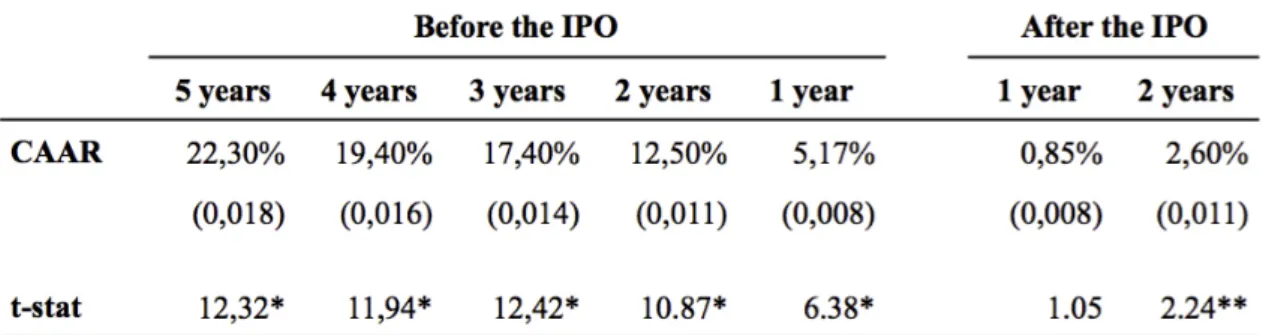
Coming back to the biotech industry in the years 1978 to 1992, aggregate analysis of all the IPO events there comprised appears to confirm the suggestions of the previous ad-hoc exploration — one can see on Table V that the average CARs registered before an IPO are all statistically significantly different from 0, decreasing as the IPO date comes near. One year after the IPO the CAAR is not statistically significantly different from 0. At the 2 year mark the average CAR is statistically significant, but barely. Observation of Figure IV suggests that IPOs happen when their industry has exhibited a moderately long run of positive abnormal returns. After the IPO there is not enough evidence to reject the hy-pothesis that average CAR is zero.
Table I
This table reports average CARs (for the biotech industry between 1978 and 1992) at yearly in-tervals before and after an IPO. *indicates significance at the 1% level. **indicates significance at the 5% level.
The time now comes to look at evidence concerning the whole sample, IPO events from 1975 to 2012 across all 48 industries. Similarly to Figure IV, an average across all IPO events is performed such that I arrive at the average industry abnormal returns for each month in the period between 60 months before and 24 months after an IPO.
Table II
This table reports average CARs (for the whole sample) at yearly intervals before and after an IPO. *indicates significance at the 1% level.
Looking at Table VI, results for the whole sample are similar to those described above for Lerner’s subsample — prior to the IPO, the average CAR is significant at all yearly intervals (1 year before, 2 years before, 3 years before, 4 years before, 5 years before the IPO). Furthermore, as previously, average CAR increases linearly the further back before the IPO we look, as can be seen in Figure VII. As for after the IPO, neither the average CAR after 1 year nor after 2 years are significantly different from 0. This evidence from the full sample thus seems to validate that IPOs, on average are preceded by positive,
significant industry abnormal returns and are followed by the absence of industry abnor-mal returns.
FIGURE VI. In black the average CAR of an industry at each month around the date of an IPO is shown. This is an average over all 9400 IPOs in the sample. An event is defined as the occur-rence of at least 1 IPO in an industry in a particular month. Only the first IPO (if more than 1 fall on the same pair month/industry) is considered for the average.
Now comes the time to introduce another variable, the incidence/concentration of IPO volume in a given industry, ie. is the industry abnormal performance profile different when more than one IPO occurs in the same month?
Evidence on post-IPO performance suggests that the occurrence of an IPO in a given industry is not associated with posterior industry out- or underperformance, or at least out- or underperformance that isn’t explained by exposure to known risk factors. This lack of abnormal posterior performance is maintained independently of how many IPOs the industry experiences at that particular moment
Evidence on pre-IPO performance suggests that IPOs tend to occur in industries whose performance leading up to IPO date had been somewhat decoupled from its exposure to known risk factors — ie. industries suffering IPOs typically exhibit a pre-IPO run of (sta-tistically significant) positive abnormal returns. The occurrence of the IPO seems to be concurrent with the extinction of the IPO abnormal returns. The magnitude of the
pre-IPO abnormal returns seems to be positively correlated with the number of firms (simul-taneously) going public in the industry at that time — in other words, the bigger the pre-IPO industry abnormal outperformance, the more pre-IPOs the industry witnesses. Irrespec-tive of how many IPOs the industry witnesses the evidence points to the IPO date coin-ciding with the extinction of industry abnormal returns.
Table III
This table reports average CARs (for the whole sample) at yearly intervals before and after an IPO. Different definitions of event are considered, according to the number of simultaneous IPOs an industry witnesses in the same month. *indicates significance at the 1% level. **indi-cates significance at the 5% level.
7. Result discussion
IPO waves are observable both economy wide and in individual industries. If market fac-tors can be reasonably expected to explain economy wide waves, industry facfac-tors must come into play to explain waves that are unique to a particular industry.
Analysis of such industry-specific waves shows that IPOs on average happen in industries that exhibited significant positive abnormal returns in the 5 years prior to the IPO. Fur-thermore, on average, the higher those abnormal returns are, the larger the number of IPOs an industry exhibits. Finally, the IPO date is, on average, coincident with the end of an industry’s positive abnormal returns, which, on average, exhibit no abnormal returns in the 2 years following an IPO.
In a moderately efficient capital market, the price of a security is a noisy estimate of its future value. How noisy is dependent on how efficient that capital market is — how well the market efficiency mechanisms act in enforcing price reaction to new information and price non-reaction to new noise.14
It has been argued extensively that efficient markets exhibit a significant degree of price reaction to noise. However, mechanisms such as riskless arbitrage then undo that price reaction to noise, enforcing market efficiency (see eg. Shiller (1981), Grossman and Stiglitz (1980)).
Riskless arbitrage has long been identified in the literature (first described by Friedman (1953)) as the chief enforcer of market efficiency — the existence of close substitutes for
14 Following Black’s (1986) definition of noise as non-information, specifically non-infor-mation that may conceivably be mistaken for actual infornon-infor-mation.
a particular security allows informed traders to take (near-)riskless positions that absorb the vagaries of uninformed trading demand. However, Wurgler and Zhuravskaya (2002) report that “high arbitrage risk stocks have steeper demand curves. This means that such stocks would be particularly likely to exhibit anomalies driven by uninformed changes in supply and demand.” Which is to say, when close substitutes do not exist arbitrage is restricted and prices diverge from value significantly. This is true eg. for the market as a whole — for which, by definition, no substitute exists — Shiller (2003) finds that "even though the aggregate stock market appears to be wildly inefficient, there is evidence that individual stock prices show some correspondence to efficient markets theory.”
Much in the same vein as the market as a whole doesn’t have a substitute, industries them-selves do not have close substitutes, otherwise they wouldn’t be identified as a distinct industry. As such, it is only natural that one observes long runs of abnormal return for industries — ie. long periods in which price diverged from value. The usual mechanism of price adjustment — arbitrage — is too risky for adjusting the price of a whole industry since there are no close substitutes on which to take the opposite position.
The evidence this paper presents for the abnormal return behaviour of industries before and after IPOs is consistent with the IPO acting as an alternative market efficiency mech-anism — one that acts through an adjustment of supply, instead of demand. Acting through supply makes the IPO a slower mechanism, since (upward) supply adjustment of stock securities is costly and slow. IPOs are thus a rational (albeit slow due to its nature) response of market actors to supply-demand imbalances that arise in industries as a whole.
Seen through this light, the runs of positive industry abnormal return that on average pre-cede IPOs are consistent with there being limits to riskless arbitrage of industry mispric-ing — for those runs of positive abnormal return that are symptomatic of slow adjustment to an upwards revision of an industry’s efficient price, a run of IPOs acts as a slow adjust-ment mechanism that gradually does what riskless arbitrage would have done immedi-ately.
8. Conclusion
This paper presents empirical evidence that suggests IPOs happen in industries that ex-hibited significant positive abnormal returns in the 5 years prior and that exhibit no ab-normal returns in the 2 years following an IPO.
It is also argued that this abnormal return profile surrounding IPO dates is consistent with the IPO being a delayed market efficiency adjustment mechanism that acts due to the limits of riskless arbitrage involving whole industries.
References
- Akhigbe, A., Borde, S. F., & Whyte, A. M. (2003). Does an industry effect exist for initial public offerings?. Financial Review, 38(4), 531-551.
- Bernard, Victor L.; (1987) Cross-Sectional Dependence and Problems in Inference in Market-Based Accounting Research; Journal of Accounting Research, Vol. 25, No. 1 (Spring, 1987), pp. 1-48
- Black, F. (1986). Noise. The journal of finance, 41(3), 529-543. Chicago
- Brown, Stephen and Warner, Jerold B., (1980), Measuring security price performance, Journal of Financial Economics, 8, issue 3, p. 205-258
- Christensen, C. (1997). The innovator’s dilemma. Harvard Business School Press, Cam-bridge, Mass.
- Christensen, C. (2006). The ongoing process of building a theory of disruption. Journal of Product innovation management, 23(1), 39-55.
- Fama, Eugene, (1998), Market efficiency, long-term returns, and behavioural finance, Journal of Financial Economics, 49, issue 3, p. 283-306
- Fama, Eugene F.; French, Kenneth R. (1988) Permanent and Temporary Components of Stock Prices; Journal of Political Economy, vol. 96, no. 2
- Fama, Eugene F.; French, Kenneth R. (1993) Common risk factors in the returns on stocks and bonds; Journal of Financial Economics 33 (1993) 3-56. North-Holland - Fama, Eugene F.; French, Kenneth R. (1997) “Industry costs of equity” Journal of Fi-nancial Economics, Elsevier, vol. 43(2), pages 153-193, February.
- Fama, Eugene F.; French, Kenneth R. (2014) Dissecting Anomalies with a Five-Factor Model; Fama-Miller Working Paper
- Fama, Eugene F.; French, Kenneth R. (2015) A five-factor asset pricing model; Journal of Financial Economics 116 (2015) 1–22
- Fama, E. F., Fisher, L., Jensen, M. C., & Roll, R. (1969). The adjustment of stock prices to new information. International economic review, 10(1), 1-21.
- Friedman, M. (1953). The case for flexible exchange rates. Essays in positive econom-ics. University of Chicago Press.
- Grossman, S. J., & Stiglitz, J. E. (1980). On the impossibility of informationally efficient markets. The American economic review, 393-408.
- Hsu, H. C., Reed, A. V., & Rocholl, J. (2010). The new game in town: Competitive effects of IPOs. The Journal of Finance, 65(2), 495-528.
- Ibbotson, R. G., & Jaffe, J. F. (1975). “Hot issue” markets. The journal of finance, 30(4), 1027-1042.
- Jaffe, Jeffrey F, (1974), Special Information and Insider Trading, The Journal of Busi-ness, 47, issue 3, p. 410-28.
- Kortum, S., & Lerner, J. (2000). Assessing the contribution of venture capital to inno-vation. RAND journal of Economics, 674-692.
- Kothari, S. P. and Warner, Jerold B., (1997), Measuring long-horizon security price performance, Journal of Financial Economics, 43, issue 3, p. 301-339
- Kothari, S. P., & Warner, J. B. (2004). The econometrics of event studies.
- Lerner, J. (1994). Venture capitalists and the decision to go public. Journal of Financial economics, 35(3), 293-316.
- Loughran, Tim and Ritter, Jay, (2000), Uniformly least powerful tests of market effi-ciency, Journal of Financial Economics, 55, issue 3, p. 361-389
- Lyon, J. D., Barber, B. M. and Tsai, C.-L. (1999), Improved Methods for Tests of Long-Run Abnormal Stock Returns. The Journal of Finance, 54: 165–201
- MacKinlay, A. Craig (1997), Event Studies in Economics and Finance, Journal of Eco-nomic Literature, 35, issue 1, p. 13-39
- Nguyen, T. T., & Sutton, N. K. (2014). Intra-Industry Effects of IPOs on Stock Repur-chase Decisions of Rival Firms. Journal of Accounting and Finance, 14(4), 61.
- Pástor, Ľ., & Veronesi, P. (2005). Rational IPO waves. The Journal of Finance, 60(4), 1713-1757.
- Rajan, R. G. (2012). Presidential address: The corporation in finance. The Journal of Finance, 67(4), 1173-1217. Chicago
- Ritter, J. R. (1984). The" hot issue" market of 1980. Journal of Business, 215-240. - Ritter, J. R., & Welch, I. (2002). A Review of IPO Activity, Pricing, and Allocations. The Journal of Finance, 57(4), 1795-1828.
- Schumpeter, J. (1943). The Process of Creative Destruction. Capitalism, socialism and democracy.
- Schumpeter, J. A. (1947). The creative response in economic history. The journal of economic history, 7(02), 149-159.
- Shiller, R. J. (1981). The Use of Volatility Measures in Assessing Market Efficiency. The Journal of Finance, 36(2), 291-304.
- Shiller, R. J. (2003). From efficient markets theory to behavioral finance. Journal of economic perspectives, 83-104.
- Wurgler, J., & Zhuravskaya, E. (2002). Does Arbitrage Flatten Demand Curves for Stocks?. The Journal of Business, 75(4), 583-608.