Breaking Barriers With Qualitative
Multi-Method research for engineering
studies: Pros, cons and issues!
João Reis a1, Marlene Amorim b,Nuno Melão c
a CINAMIL - Centro de Investigação da Academia Militar, Academia Militar, Lisboa, Portugal. b Department of Economics, Management and Industrial Engineering, University of Aveiro.
c Department of Management, School of Technology and Management of Viseu, Polytechnic Institute
of Viseu.
ABSTRACT
The purpose of this article is to investigate how contemporary studies about engineering are breaking down boundaries of knowledge. This study uses a systematic literature review to show how the application of qualitative multi-method approaches may offer reliable results and provide greater emphasis to the dimensions of development, triangulation and complemen-tarity. The article offers new insights on the role of qualitative researches for the engineering domain, an area which has been largely unaddressed in the literature.
Keywords: Engineering, Systematic literature review, Multi-method approach,
Development, Triangulation, Complementarity, Qualitative research.
RESUMO
O objetivo deste artigo é analisar como os estudos contemporâneos sobre a engenharia estão a quebrar as fronteiras do conhecimento. Este artigo utili-za uma revisão sistemática da literatura para mostrar como a utiliutili-zação de abordagens qualitativas multi-método pode oferecer resultados fiáveis e dar maior enfase às dimensões de desenvolvimento, triangulação e complementa-ridade. O artigo discute as novas dinâmicas que as investigações qualitativas oferecem ao domínio da engenharia, área que que tem sido amplamente negligenciada pela literatura.
Palavras-Chave: Engenharia, Revisão sistemática da literatura, Abordagem
multi-método, Desenvolvimento, Triangulação, Complementaridade, Inves-tigação qualitativa.
1. INTRODUCTION
Multi-method research is based on a methodological research strategy that includes more than one method of collecting data and or more than one method of analysing the data; such methods can be based on qualitative techniques, quantitative techniques or a mix of both (Mills et al., 2010). A common misconception is that the various research strategies should be arrayed hierarchically, but the hierarchical view may be questioned, as the goal is to avoid gross misfits, when investigators plan to use one type of strategy but another is really more advantageous (Yin, 2003). The empha-sis should be given to break down barriers, since there are preconceived ideas that certain areas of knowledge should necessary follow a particular research strategy. While researchers are adopting a variety of methods, the potential advantages of combining different qualitative methods remains largely unexploited (Monrad, 2013). Herein lies the relevance of this arti-cle, as it discusses the pros, cons and issues of using research methods in a complementary way. In this article we set up to describe two qualitative research methods that may help researchers to reduce potential bias when performing qualitative studies. Thus, the implementation of a multi-method research program may generate comprehensiveness and rich knowledge (Mills
et al., 2010), counterbalancing the weaknesses that inherent to individual
methods (Wood et al., 1999). Building on these suggestions, we perceived that the vast majority of academic research carries out a literature review. On this basis, we propose the discussion of a systematic literature review as a research method. Additionally, it also seems appropriate to discuss a case study methodology, as a complementary method to a systematic literature review. Complementing research methods may take a number of forms, in this specific case, one study is used to corroborate (or not) empirical find--ings. Hence, the overall aim is to enhance the validity of research findings.
2. THEORETICAL BACKGROUND
Epistemologically hodos is equivalent to the contemporary word of method. Firstly, hodos was defined as a journey or path. Combined with the prefix
meta-, we get methodos, a “following after, pursuit, especially pursuit of
knowledge, a plan or system of pursuing an inquiry” (Liddell et al., 1940). Our modern-day understanding of method, especially the scientific method, strongly resonates with methodos, which emphasizes the methodical system
of generating and legitimizing knowledge (Thorpe & Holt, 2008). Method--ology has a particular meaning, as an “ology” is the study of a whole academic field, it is a stepping-back from a subject and a consideration of it at a broader level (Fisher, 2007). Fisher (2007) goes further stating that methodology is the study of methods and it raises all sorts of philosophical questions about what it is possible for researchers to know and how valid their claims to knowledge might be. Additionally, research in common par-lance refers to a search of knowledge, and can be defined as a scientific and systematic search for pertinent information on a specific topic (Kothari et
al., 2004). At this point we are in condition to comment on the difference
between research methods and research methodology. Research methods may be understood as all methods or techniques, thus, they refer to the metho-ds that researchers use in conducting research operations, in other wormetho-ds, are all methods that are employed by the researcher during the course of addressing his/her research problem (Kothari et al., 2004). The same au-thors also distinguish research technique as the behaviour and instruments we use in conducting research operations (e.g. recording data) and research method to the behaviour and instruments used in selecting and constructing a research technique. In practice, the two terms are taken as interchangeable. Research methodology is associated with a broader approach, i.e. including the assumptions, postulates, rules, and methods – the blueprint or roadmap – that researchers employ to render their work open to analysis, critique, replication, repetition, and/or adaptation and to choose research methods (Given, 2008), in other words, is the way to resolve our research problem. Methodological triangulation leads to more accurate, complete, and analyti-cally satisfying representation of the social world (Elliott, 2005). Trian-gulation is a term that generally describes the use of multiple approaches to the study of a phenomenon (Denzin & Lincoln, 2000). Denzin (1978) include: (a) data triangulation, where data are collected at different times or from different sources; (b) investigator triangulation, where different researchers or evaluators independently collect data on the same pheno-menon and compare the results; (c) methodological triangulation, where multiple methods of data collection are used; and (d) theory triangulation, where different theories are used to interpret a set of data. Within each type of triangulation there are various sub-types, for example, methodological triangulation can include various combinations of qualitative and quantita-tive research designs (Thorpe & Holt, 2008). Particularly, methodological triangulation is defined as more than one method which is used to gather data (e.g. interviewing, participant observation) (Mills et al., 2010). Denzin (1978) also distinguished within-methods triangulation, which refers to the
use of either multiple quantitative or multiple qualitative approaches, from
between-methods triangulation, which involves the use of both quantitative
and qualitative approaches (Johnson et al., 2007).
Quantitative approaches involve the generation of data of quantitative nature which can be subject to rigorous quantitative analysis in a formal and rigid fashion, while qualitative approaches to research are concerned with subjec-tive assessment of attitudes, opinions and behaviours (Berg, 2004; Kothari
et al., 2004). Since the last decade of the 20th century, there has been a
growing interest in the use of qualitative techniques in the social sciences (Benbasat et al., 1987). This interest has been sparked by a general dis--satisfaction and the limitation associated with the type of research infor-mation that is provided by quantitative techniques (Maanen, 1982). The dissatisfaction stems from several sources:
the complexity of multivariate research methods, the distribution restrictions inherent in the use of these methods (e.g., multivariate normality), the large sample sizes these methods dictate, and the difficulty of understanding and interpreting the results of studies in which complex quantitative methods are used (Benbasat et al., 1987). Finally, methodological triangulation has received the most attention and it has become almost obligatory for qualita-tive researchers, in planning their studies, to demonstrate their commitment to methodological rigor by multi-method research designs, allegedly capable of validation through triangulation (Bloor & Wood, 2006).
3. METODOLOGY
This article follows a systematic literature review as a research method. This choice is appropriate because qualitative multi-method researches are still in an early stage of development (Monrad, 2013).
A truly comprehensive approach to produce a systematic literature review generally requires the use of more than one database (Reis et al., 2014). However, we just used one database since our priority was transparency and easy reproduction of results (Buchanan and Bryman, 2009). On the 21st of
October 2016 we conducted a research with the Scopus database, which is one of the largest abstract and citation databases of peer-reviewed literature, and we searched keywords related with our subject, as displayed in the table 1.
Table 1. Methodological approach
The search returned 35 documents using the keyword “Multi-Method Re-search” or “Multimethod ReRe-search”, 123 documents using “Systematic Lite--rature Review” and 150 documents using “Case Study Research”. Besides the Multi-Method Research Methodology that is the core investigation of this article, additionally we selected two other different approaches, firstly a qualitative methodology centred on a content analysis of the literature (Combes and Nicholson, 2013) and then, in order to empirically corroborate the findings in the literature a case study methodology. Both techniques present advantages and disadvantages and, therefore, they must be seen as being “complementary” in gaining the overall understanding of a subject under investigation. The review process was based on the application of successive filters to exclude irrelevant papers and ensure viable results (Reis et al., 2015). According to table 1, we can observe that only articles written in English were deemed relevant in order to avoid wrong interpretations. To ensure the quality of the findings, the authors only considered articles from indexed scientific journals and, to guarantee the adequacy of the results, we selected subjects from social sciences and engineering areas. From a 11,948 documents, we excluded 11,640, remaining, at the end, 308 articles that will be the focus of further analysis in the next sections of this paper.
4. MULTI-METHOD RESEARCH
Multi-method research is an increasingly prominent technique (Ahram, 2013) as some scholars have become progressively aware of its benefits, through which the strengths of one method can offset the limits of another (Bennett,
2015). The justification for the relevance in choosing a multi-method re--search is briefly explained by the frequent recommendations in the literature:
e.g., “Further work may employ a multimethod approach, using both empirical and simulated Closed Loop Supply Chain data to validate and deep our contribution.” (Cannella et al., 2016).
After careful analysis of the 35 articles, we realised that, frequently, the term mixed- and multimethod research is used indistinctively. Although, since the mid-1970s there has been a prominent discussion centred on the use of mixed methods, we believe that the future lies in dropping the terms “qualitative” or “quantitative” research, so that it is referred to simply as research (Given, 2008). This argument is being strengthened, when the multi-method approach is put in place. Nevertheless, Darlington and Scott (2002) admit that there are four common approaches to mixing/multi-methods: (1) qualitative then quantitative approach - this design occurs when the fin-dings of the qualitative research are used to develop the quantitative phase of the research; (2) quantitative then qualitative approach - when the fin-dings of the quantitative research are needed to develop and make sense of the quantitative phase; (3) qualitative and quantitative concurrently, is when a mixed qualitative and quantitative designs do not always have to be inter-dependent, the purposes of a mixed-method study of this type would gene-rally be triangulation, complementarity or expansion, or some combination of these; lastly, (4) mixing qualitative data collection approaches, just as it is possible to combine quantitative and qualitative methods in order to more thoroughly investigate a research problem.
Much of the methods used in the literature analysed in this study are mixed, with 49% of applications. The analysis showed that 34% of multi-method research is purely qualitative research. Additionally, we noticed that there are no purely quantitative investigations, and 17% of the articles do not refer to any explicit method (figure 1).
Figure 1. Multi-method research
Legend: x-axis – date of publication; y-axis – number of articles published Thus, it is possible to conclude that multi-method research is mainly focused on mixed-researches (qualitative vs. quantitative), neglecting, partly, pure-methods. Hence, we recommend further investigations to use qualitative or quantitative research methods. Furthermore, Brones et al. (2014) article is an example of a pure multi-method research. These authors presented a study that explored the points of intersection of a specific research area, via a combination of multi--methods: a literature review and a field research. In their study, several data collection methods were combined and both research approaches, i.e., systematic literature review and case study were performed in an integrated manner. The systematic literature review was performed to better explain the general cons-tructs and their relationships by merging bibliometrics and content analysis. The purpose of the case study was to understand how different constructs were related. Next, we explore what we call pure multimethod.
Since the combination of pure qualitative methods seems to be an adequate contribution to contemporary studies, and also suitable in the extent that fits with the dimensions of Darlington and Scott (2002), as a mixing of qualitative data collection approaches – this method searches for theoretical and empirical balance in the same investigation, as shown in some of the 35 selected articles (cf. Niehaves, 2011; Waitzkin et al., 2008).
5. SYSTEMATIC LITERATURE REVIEW
An example of qualitative research is the systematic literature review method, which is turn can be part of a multi-method research approach. According to Fink (2005), a systematic literature review is an “explicit and reproducible me-thod for identifying, evaluating and synthesizing the existent body of completed and recorded work produced by researchers”. Overall, a systematic review is
a valuable tool to discover key theories, concepts, ideas and debates around multidisciplinary studies (Hart, 1998). A brief analysis showed us that, when we use the keyword “systematic literature review” (123 articles), just 6 of these articles mentions multi-method research. But, surprisingly, we also discovered that about half of the articles (55 to be more precise) made reference to case studies. This means that, although the multi-method approach is not explicitly recognized as a methodology in the articles, it is clearly put in practice. The reason for this is possibly associated to the fact that researchers use systematic literature reviews to help building conceptual models or developing protocols to conduct exploratory interviews when performing case study research (cf. Brones et al., 2014). Therefore, it is legitimate to sustain that qualitative multi-method research naturally searches for a methodological balance. This means that a method assists to develop other methods, to triangulate data or to mutually complement it. Furthermore, several articles also mentioned that the conceptual models that emerge from systematic literature reviews may be empirically validated through case study research (Esposito & Evangelista, 2014; Naim & Gosling, 2011; Qu et al., 2016).
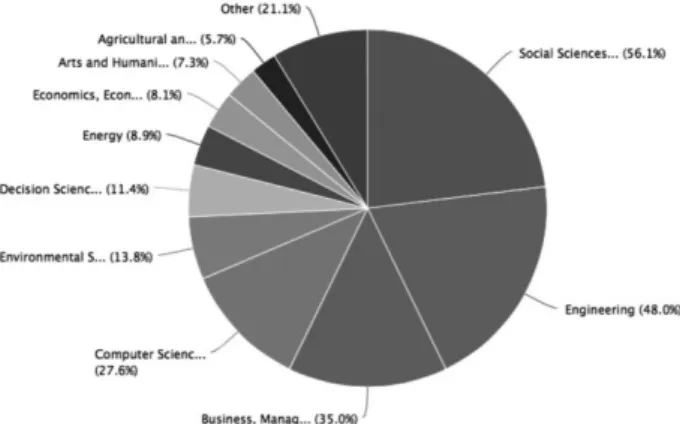
Like we previously mentioned, the initial search was restricted to the subject areas of social sciences and engineering, but Scopus can automatically refine this restriction and assign minor subject areas for a more detailed analysis. Thus, titles may belong to more than one (minor) subject area. Figure 2 shows that 55,7% of the articles are related to the social sciences and 48,4% are related to engineering. In a multidisciplinary perspective, these minor subject areas are likely in-dication that exact sciences are increasingly interested in using qualitative methods, in particular in the areas of engineering.
Figure 2. Documents by subject area – systematic literature review (source: Scopus) The interesting aspect here is that most part of the minor subject areas also belong to the social sciences and engineering scope, confirming the perspective that qualitative methods are becoming more widely accepted.
6. CASE STUDY RESEARCH
Another example of qualitative research is the case study research, which can also be part of a multimethod research approach. Case study research offers the opportunity to explore and explain a phenomenon for which little or no empirical data exists (Yin, 2003). Additionally, the case study method enables the research to acquire an in-depth and holistic understanding of multiple aspects of a phenomenon as well as the interrelationships between the different aspects (Gummesson, 1991). A common criticism directed at qualitative research is that it fails to adhere to canons of validity (Given, 2008). Case study research may use multiple sources of data collection for triangulation purposes.
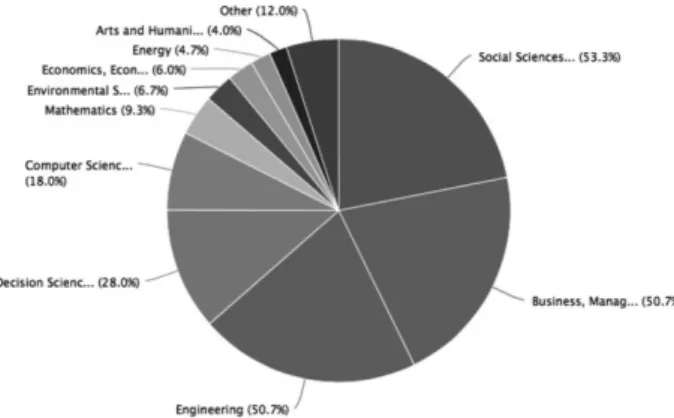
Sources of data collection may consist on e.g., interviews, direct observation or document analysis (Yin, 2003). A case study research that uses multiple sources of data collection as a form of triangulation prevents an exclusive reliance on a single data collection method and, thus, aids to neutralize any bias inherent to a particular data source (Given, 2008). A brief analysis showed that from a total of 150 case study research articles, just 3 articles employ multi-method research. As in the previous section, we also discovered that 35 articles made reference to systematic literature reviews, corroborating the view that the multi-method approach is not explicitly recognized as a methodology in those articles. The reason for this is that the literature reviews were being used to build conceptual models (Grimm et al., 2016; Kickert, 2014) and triangulate data (Hilletofth, 2011). Similarly, most case study articles pertain to the social sciences and engi-neering fields. Figure 3 shows that 53,0% of the minor subject areas are related to the social sciences and 51,0% are related to engineering.
Figure 3. Documents by subject area – case study strategy (source: Scopus)
sciences are increasingly interested to use qualitative methods, in particular in the areas of engineering.
7. PROS, CONS AND ISSUES
Yauch and Steudel (2003) that used both quantitative and qualitative me-thods, in two exploratory case studies, have contributed to the definitional debates to distinguish triangulation, which is aimed at corroborating data and reducing bias, from complementarity, which is aimed at deepening understanding. Similarly, Green et al. (1989) identified comparably dimen-sions that emerged from 57 evaluation studies that used mixed methods and identified five main purposes for combining methods:
(1) triangulation, seeks convergence, corroborating and correspondence of results from the different methods; (2) complementarity, seeks elaboration, enhancement, illustration and clarification of the results from one method with the results from the other method; (3) development, seeks to use the results from one method to help develop or inform the other method, where development is broadly construed to include sampling and implementation, as well as measurement decisions; (4) initiation, seeks the discovery of paradox and contradiction, new perspectives of frameworks, the recasting of questions or results from one method with questions from the other method; (5) expansion, seeks to extend the breadth and range of inquiry by using different methods for different inquiry components.
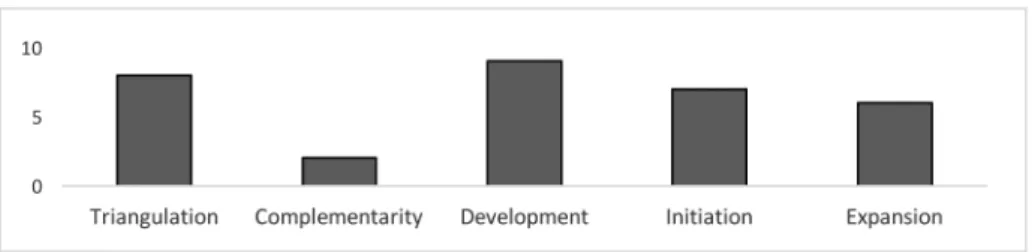
We used Green et al. (1989) dimensions in our study, and concluded that most part of the articles seek to apply results from one method to help develop the other (development), and pursue corroborating purposes from different methods (triangulation) (figure 4) – this information is fully cor-roborated by Darlington and Scott (2002, p.124).
In addition, we performed the same exercise to pure-qualitative multi-method researches and we did not find significant differences. Evidence shows that the qualitative multi-method researches are undoubtedly development, e.g., the validity and reliability of a case study is strengthened by a litera-ture review (theory triangulation) to develop interview protocols and data analysis coding systems (Denzin, 1989, Banerjee, 2014). Moreover, these qualitative articles also corroborate the seek for triangulation, e.g., as qua-litative empirical research may validate and corroborate the findings on the literature review. A small difference is that, unlike the mixed multi-method studies (qualitative vs. quantitative), the pure-qualitative studies mentioned the dimension of complementarity in 50% of the pure-qualitative articles. This dimension has a greater weight for purely qualitative studies, unlike what is shown in figure 4.
Qualitative multi-method research differs from the mixed method studies (qualitative vs. quantitative) in the extent that it gives greater emphasis to the dimensions of complementarity, triangulation and complementarity. Thus, qualitative multi-method research has been shown to be a multidisciplinary research tool for development, triangulation and complementary purposes, with applicability to social sciences but also to exact sciences (cf. Gimpel
et al., 2012). Furthermore, contemporary investigations have shown that
the bridge from social sciences and engineering methods is being diluted, although the number of studies are still incipient (3 studies in 35).
The next section explains how social sciences techniques are being applied to contemporaneous engineering studies. However, the use of this type of methodology is not free of limitations. As with qualitative research methods, qualitative approaches are difficult to generalize. This phenomenon occurs because generalization is difficult to obtain without the use of repeatable, quantitative metrics (Neufeld et al., 2003). Moreover, some issues may rise when an investigator uses different methods in the same study: it may carry the risk to obtain contradictory findings, but this should not in itself be con-sidered as a problem; it is, however, a clear indication that further work may be required to understand better what is happening (Darlington & Scott, 2002).
8. QUALITATIVE MULTI-METHOD RESEARCH IN ENGINEERING STUDIES
There are several plausible explanations for why engineering researchers appear to strongly prefer quantitative methods. One reason is because the majority of engineering education researchers are engineering faculty mem-bers, who were trained within the post-positivism perspective (Borrego et
al., 2009). Conversely, with recent calls for expanding the scope and rigor
of engineering research, the use of qualitative methods to answer research questions that cannot be answered through quantitative methods is taking an increasing significance (Koro-Ljungberg & Douglas, 2008).
Ljungberg and Douglas (2008) also remark that it is this growing diversity of approaches and perspectives that marks the field of engineering as vi-brant and strong and that qualitative methods provide important insights that would not have been possible through quantitative approaches. The articles identified in the literature review that concern the engineering field use multi--method research (qualitative vs. quantitative), as we did not identify any pure qualitative multi-method article. Clearly, this is a gap in the literature. Qualitative multi-method studies are essential for the engineering sector. Koro-Ljungberg & Douglas (2008) express the same concern and noticed that an incipient quantity of qualitative articles was published. Still, we believe that engineering research will follow the contemporary trend, with respect to an increase of purely qualitative multi-method studies (cf. figure 1). Researchers obstinately stay away from qualitative studies because it may appear easy and less rigorous than quantitative research, while quantitative research requires the use of statistical methods that can provide a sense of reliability (Yin, 2003). For that reason, Borrego et al. (2009) suggested that all research (quantitative and qualitative) should be evaluated with regard to four aspects of trustworthiness (table 2).
Table 2: Quantitative and qualitative research criteria (adapted: Lincoln & Guba, 1985; Tashakkori & Teddlie, 1998; and Chism et al., 2008)
Table 2 illustrates an intellectual exercise that may put in place the credibility of qualitative researches, along with quantitative studies. In fact, qualitative research can be just as difficult to conceptualize, and be as methodologi-cally and theoretical challenging, if not more challenging, than quantitative
research (Koro-Ljungberg & Douglas, 2008). To strengthen our arguments a qualitative multi-method research is not free of data analysis, as many of contemporaneous researches use qualitative data analysis software (e.g., NVivo)2 allowing investigators for handling large volumes of data, as an
integrative process of coding and categorizing.
9. CONCLUSIONS
Characterizing a study as multi-method research is not a straightforward task (Small, 2011) as it is essential further investigation to find a consensual and multidisciplinary definition among academia. The results suggest that: (1) multi-method approaches offer the possibility of leading to reliable results in engineering studies; (2) qualitative multi-method research is generally balanced, usually integrating theoretical and empirical studies; (3) qualita-tive multi-method research differs from other mixed methods in the extent that gives greater emphasis to the dimensions of development, triangulation and complementarity; (4) new developments show that engineering studies will probably follow the contemporary trend, with respect to an increase of purely qualitative multimethod researches.
One limitation of this study is associated with the incipient amount of multi--method research articles in the field of engineering, hence, the reason why most articles are qualitative is because they are mixed with social sciences articles. The search on Scopus did not make any distinction during the application of filters, the social sciences were selected in the same extent of engineering (cf. table 1).
This limitation may be mitigated with the cross-contributions of similar aca-demic articles, which obtained identical results (Borrego et al., 2009). Due to space limitations it is not possible to list all the references. References can be provided on request, by contacting the first author.
Further investigation is needed. In line with this article, we suggest that future research should focus on new trends of qualitative multi-method research. For instance, it would be interesting to find a consensual multidisciplinary concept/definition concerning the qualitative multi-method research.
With our timely contribution, we expect to instigate other researchers to promote the engineering education and the use of contemporaneous trends to investigate. 2 http://www.qsrinternational.com/
REFERENCES
AHRAM, Ariel (2011). “Concepts and measurement in multimethod research”.
Political Research Quarterly, 66, 2, 280-291.
BANERJEE, Madhumita (2014). “Misalignment and its influence on integration quality in multichannel services”. Journal of Service Research, 17, 4, 460-474.
BENBASAT, Izak, GOLDSTEIN, David and MEAD, Melissa (1987). “The case research strategy in studies of information systems”. MIS Quarterly. BERG, Bruce (2004). “Qualitative research methods for the social sciences”. Allyn and Bacon. 4th Ed.
BLOOR, Michael and WOOD, Fiona (2006). “Keywords in qualitative methods: A vocabulary of research concepts”. SAGE Publications.
BORREGO, Maura, DOUGLAS, Elliot and AMELINK, Catherine (2009). “Quantitative, qualitative, and mixed research methods in engineering education”. Journal of Engineering Education, 98, 1, 53-66.
BRONES, Fabien, CARVALHO, Marly and ZANCUL, Eduardo (2014). “Ecodesign in project management: a missing link for the integration of sustainability in product development”. Journal of Cleaner Production, 80, 106-118.
BUCHANAN, David, and BRYMAN, Alan (2009). “The Sage handbook of organizational research methods”. SAGE Publications.
CANNELLA, Salvatore, BRUCCOLERI, Manfredi and FRAMINAN, Jose (2016). “Closed-loop supply chains: What reverse logistics factors influence performance?” International Journal of Production Economics, 175, 35-49. CHISM, Nancy, DOUGLAS, E. and HILSON, Wayne (2008). “Qualitative Research Basics: A guide for Engineering educators”. Rigorous Research
in Engineering Education.
COMBES, Philip. and NICHOLSON, John (2013). “Business models and their relationship with marketing: A systematic literature review”. Industrial
Marketing Management, 42, 656-664.
DARLINGTON, Yvonne and SCOTT, Dorothy (2002). “Qualitative research in practice stories from the field”. Allen & Unwin.
DENZIN, Norman (1978). “The research act: A theoretical introduction to sociological methods 2nd ed”. New York: McGraw-Hill.
DENZIN, Norman (1989). “The research act: A theoretical introduction to sociological research methods 3rd ed”. Englewood Cliffs, NJ: Prentice Hall.
DENZIN, Norman and LINCOLN, Yvonna (2000). “Handbook of qualitative research”. 2nd Ed. Thousand Oaks, CA: SAGE.
ELLIOT, Jane (2005). “Using narrative in social research: Qualitative and quantitative approaches”. London: SAGE.
ESPOSITO, Emilio and EVANGELISTA, Pietro (2014). “Investigating virtual enterprise models: literature review and empirical findings”. International
Journal of Production Economics, 148, 145-157.
FINK, Arlene (2005). “Conducting research literature reviews: From paper to the Internet 2nd ed.”. Thousand Oaks, CA: SAGE.
FISHER, Colin, BUGLEAR, John, LOWRY, Diannah, MUTCH, Alistair, TANSLEY, Carole (2007). “Researching and writing a dissertation: A guidebook for business students”. 2nd edition. Prentice Hall, Financial Times.
GIMPEL, Gregory, AHLUWALIA, Punit and VARSHNEY, Upkar (2012). “The wireless Internet decision: A multi-method investigation of decision drivers.”
International Journal of Mobile Communications (IJMC), 10, 5, 449-474.
GIVEN, Lisa (2008). “The SAGE Encyclopedia of qualitative research methods”. SAGE Publications
GREEN, Jennifer, CARACELLI, Valerie and GRAHAM, Wendy (1989). “Toward a conceptual framework for mixed-method evaluation designs”.
Educational Evaluation and Policy Analysis, 11, 3, 255-274.
GRIMM, Jorg, HOFSTETTER, Joerg and SARKIS, Joseph. “Exploring sub-suppliers´ compliance with corporate sustainability standards”. Journal of
Cleaner Production, 112, 1971-1984.
HART, Chris (1998). “Doing a literature review: Releasing the social science research imagination”. London: SAGE.
HILLETOFTH, Per (2011). “Demand-supply chain management: industrial survival recipe for new decade”. Industrial Management & Data Systems, 111, 2, 184-211.
JOHNSON, Burke, ONWUEGBUZIE, Anthony and TURNER, Lisa (2007). “Toward a definition of mixed methods research”. Journal of Mixed Methods
KICKERT, Walter (2014). “Specificity of change management in public organizations: Conditions for successful organizational change in Dutch ministerial departments”. American Review of Public Administration, 44, 6, 693-717. KORO-LJUNGBERG, Mirka and DOUGLAS, Elliot (2008). “State of qualitative research in engineering education: Meta-analysis of JEE Articles, 2005-2006”. Journal of Engineering Education, 97, 2, 163-175.
KOTHARI, Suraj (2004). “Research methodology. Methods and techniques”. New Age International (P) Limited, Publishers. New Delhi
LIDDELL, Henry, SCOTT, Robert AND JONES, Henry (1940). “The Greek-English lexicon”. Oxford: Oxford University Press.
LINCOLN, Yvonna and GUBA, Egon (1985). “Naturalistic Inquiry”. Beverly Hills, CA: SAGE Publications.
MILLS, Albert, EUREPOS, Gabrielle and WIEBE, Elden (2010). “Encyclopedia of case study research”. SAGE Publications, California.
MONRAD, Merete (2013). “On a scale of one to five, who are you? Mixed methods in identity research”. Acta Sociologica, 56, 4, 347-360.
NAIM, Mohamed and GOSLING, Jonathan (2011). “On leanness, agility and leagile supply chains”. International Journal of Production Economics, 131, 342-354.
NEUFELD, Derrick, FANG, Yulin and WAN, Zeying (2013). “Community of practice behaviors and individual learning outcomes.” Group Decision
and Negotiation, Springer, 22, 4, 617-639.
NIEHAVES, Björn (2011). “Iceberg ahead: On electronic government research and societal aging”. Government Information Quarterly, 28, 3, 310-319. QU, Min, YU, Suihuai, CHEN, Dengkai, CHU, Jianjie and TIAN, Baozhen (2016). “State-of-theart of design, evaluation, and operation methodologies in product service systems”. Computers in Industry, 77, 1-14.
REIS, João, MARLENE, Amorim and MELÃO, Nuno (2014). “Research opportunities in multichannel services: A systematic review”. Proceedings
of the 21st International European Operations Management Association Conference (EurOMA), Palermo, Italy, 20-20th June.
REIS, João, MARLENE, Amorim and MELÃO, Nuno (2015). “Disclosing paths for multi-channel service research: A contemporaneous phenomenon and guidelines for future investigations”. Exploring Service Sciences – Lecture Notes in Business
Information Processing (Springer International Publishing), 201, 289-300.
SILVERMAN, David and MARVASTI, Amir (2008). “Doing qualitative research. A comprehensive guide”. SAGE Publications
SMALL, Mario (2011). “How to conduct a mixed methods study: Recent trends in a rapid growing literature”. Annual Review of Sociology, 37, 1, 57-86. TASHAKKORI, Abbas and TEDDLIE, Charles (1998). “Mixed methodology: Combining qualitative and quantitative approaches”. Thousand Oaks, CA: SAGE Publications.
THORPE, Richard and HOLT, Robin (2008). “The SAGE dictionary of qualitative management research”. SAGE publications.
Van Maanen, J. (1982). Introduction in j. Van Maanen, J.M. Dabbs Jr., and R.R. Faulkner (eds.), Varieties of qualitative research (pp. 11-29). Beverly Hills, CA: Sage Publications.
WAITZKIN, Howard, SCHILLACI, Michael and WILLGING, Cathleen (2008). “Multimethod evaluation of health policy change: An application to Medicaid managed care in a rural state”. Health Services Research, 43, 4, 1325-1347.
WOOD, Murray, DALY, John, MILLER, James and ROPER, Marc (1999). “Multi-method research: An empirical investigation of object-oriented technology”. The Journal of Systems and Software, 48, 1, 13-26.
YAUCH, Charlene, STEUDEL, Harold (2003). “Complementary use of qualitative and quantitative cultural assessment methods”. Operations
Research Methods, 6, 4, 465-481.
YIN, Robert (2003). “Case Study Research: Design and Methods”. SAGE Publications, Thousand Oaks.
João Reis is a Military Lecturer at the Department of Sciences and Military Technologies, Military Academy. He is currently following Doctoral studies in Engineering and Industrial Management at University of Aveiro. He is also a rsearcher at the Military Academy Research Center, Portuguese Military Academy.
Marlene Amorim is Pro-Rector at the University of Aveiro. She is a Assistant Professor at the Department of Economics, Management and Industrial Engineering, University of Aveiro. She conducts her research at GOVCOPP, University of Aveiro.
Nuno Melão is an Assistant Professor at the Department of Management, School of Technology and Management of Viseu, Polytechnic Institute of Viseu. He is a researcher from the CEGE, Catholic University of Portugal (Porto).