* Corresponding author: E-mail: [email protected]
Received: December 27, 2016 Approved: May 23, 2017
How to cite: Tiecher T, Schenato RB, Santanna MA, Caner L, Rheinheimer DS. Phosphorus forms in sediments as indicators of anthropic pressures in an agricultural catchment in southern Brazil. Rev Bras Cienc Solo. 2017;41:e0160569. https://doi.org/10.1590/18069657rbcs20160569
Copyright: This is an open-access article distributed under the terms of the Creative Commons Attribution License, which permits unrestricted use, distribution, and reproduction in any medium, provided that the original author and source are credited.
Division - Soil Processes and Properties | Commission - Soil Chemistry
Phosphorus Forms in Sediments as
Indicators of Anthropic Pressures
in an Agricultural Catchment in
Southern Brazil
Tales Tiecher(1), Ricardo Bergamo Schenato(2)*, Maria Alice Santanna(3), Laurent Caner(4) and Danilo Rheinheimer dos Santos(2)
(1)
Universidade Federal do Rio Grande do Sul, Departamento de Ciência do Solo, Porto Alegre, Rio Grande do Sul, Brasil.
(2)
Universidade Federal de Santa Maria, Departamento de Ciência do Solo, Santa Maria, Rio Grande do Sul, Brasil. (3)
Universidade Federal de Santa Maria, Departamento de Física, Santa Maria, Rio Grande do Sul, Brasil. (4)
Université de Poitiers, IC2MP-HydrASA, Poitiers, France.
ABSTRACT: Phosphorus (P) fractionation is a suitable procedure to ascertain P lability in sediments and is able to distinguish sources of P under different soil management practices in a catchment. Brazil is the second largest producer and the largest exporter of tobacco in the world. Inadequate management of cultivated areas exposes the soil to erosion processes, accelerating the transfer of sediment and P to water bodies, which leads to eutrophication. We evaluated the P forms in suspended sediments collected at two rainfall events in the stream of a small catchment in the state of Rio Grande do Sul. The samples were collected upstream and downstream areas in three sub-catchments with different degrees of anthropogenic pressure and in three phases of the hydrograph in the catchment outlet. The first rainfall event occurred during the fallow period, and the second one, during the period of transplanting the tobacco crop. The sediment P forms were evaluated by successive extractions, following the Hedley method. The results showed that an increase in anthropogenic pressure leads to an increase in total inorganic P and a decrease in the levels of organic C and total organic P in sediments. In the control area, the quantity and quality of the eroded material remained the same in both rainfall events. The levels of total P in sediment alone were not sufficient to evaluate the influence of the soil management practices prevalent in each sampling period. However, P fractionation shows that during the tobacco transplanting period, P in sediments was mainly in labile fractions, and rainfall during this period was more likely to promote the eutrophication process. Sediments carried in runoff during the tobacco transplanting period have larger amounts of available P than those borne during rainfall in the fallow period.
INTRODUCTION
Degradation of natural resources caused by human activities has increased in recent decades. Agricultural activities are among those that most disturb the environment, exposing soil to erosion processes and accelerating the transfer of sediments (Magnusson et al., 2013; Yahia and Elsharkawy, 2014) and nutrients, such as N (Cameron et al., 2013) and P (Dodd et al., 2014), into water bodies.
In Southern Brazil, about 160 thousand families cultivate tobacco (Afubra, 2015), the majority of them in the state of Rio Grande do Sul, under conventional tillage, with no conservationist practice, which leads to negative environmental impacts at the local level (Lecours et al., 2012). These fields are in steeply sloped areas, resulting in a large amount of sediment (Pellegrini et al., 2010; Bonumá et al., 2012; Bonumá et al., 2014; Tiecher et al., 2014).
Nutrient enrichment of water bodies arising from human activities is considered the main problem for most surface waters in the world (Smith and Schindler, 2009). In waters with a high level of eutrophication, periods of high temperature accelerate multiplication of microorganisms, which impairs the limnological conditions of rivers (Salomoni et al., 2007) and may cause episodes of high fish mortality (Chellappa et al., 2008). In Brazil, P eutrophication has been responsible for some events of excessive macrophyte growth in rivers (Kobayashi et al., 2008) or algae blooms in lakes (Ribeiro et al., 2012), coastal waters (Teichberg et al., 2010), and dam reservoirs (Chellappa et al., 2008; Matsumura-Tundisi et al., 2010).
Eutrophication affects the resident biota, and the intensity of this impact depends on nutrient loading but also on the environmental conditions of the water body. Rivers, lakes, and estuaries have different characteristics. Along transport pathways within a catchment, some P input from nonpoint and point sources can accumulate in various locations, such as soils in downslope areas, sediments, or biomass (Sharpley et al., 2013). This has been referred to as the P legacy of the catchment. These hotspots can release, remobilize, or recycle the P legacy, impacting the water quality of downstream water bodies for years, decades, or centuries (Heisler et al., 2008).
The internal capacity of river systems to remove P from or release P to the water column is a result of physical, chemical, and biological processes that can transform P among organic, inorganic, particulate, and dissolved forms. The diffuse agricultural P inputs also have within-river ecological impacts (Jarvie et al., 2005). Large amounts of sediment-associated P from agricultural sources are transported to the stream channel during storm events. Along the downstream pathway, part of these particles is deposited and stored on the river bed. Later, these river bed sediments can release dissolved P, playing an important role as buffers of soluble reactive phosphorus (SRP) in surface waters (Jarvie et al., 2005). In the watershed studied, the Lino Stream is a tributary of the Jacuí River, which is the main affluent of Guaíba Lake, a freshwater shallow lake in which wave-created resuspension of environment sediments are frequently observed (Nicolodi et al., 2010). During cyanobacterial summer blooms observed in Guaíba Lake, Ribeiro et al. (2012) identified SRP limitation and indicated the total P increase as an environmental driving factor. That said, it is likely that the internal P load stored in the bottom sediments of Guaíba Lake contributed to these algal blooms since in freshwater lakes, P is usually the limiting nutrient for eutrophication (Hilton et al., 2006).
range from 75 % (Horowitz, 2009) to 90 % (Sharpley et al., 2000). Moreover, more than 90 % of the sediment losses in a catchment occur during rainfall events (Horowitz, 2009). To access the P bioavailability of suspended sediments, selective sequential extraction based on the difference in reactivity of sediment P with different chemical extractors should be used (Kerr et al., 2011).
Therefore, our hypothesis is that the analysis of sediment P forms obtained by selective sequential extraction can be a useful tool for assessing the magnitude of P pollution in agricultural catchments, and consequently, the ability of these forms to promote the water eutrophication process. The aim of the present study was to verify the effect of anthropic activity on the P forms in sediments by comparing areas with distinct land uses under different seasonal soil management practices.
MATERIALS AND METHODS
Site description
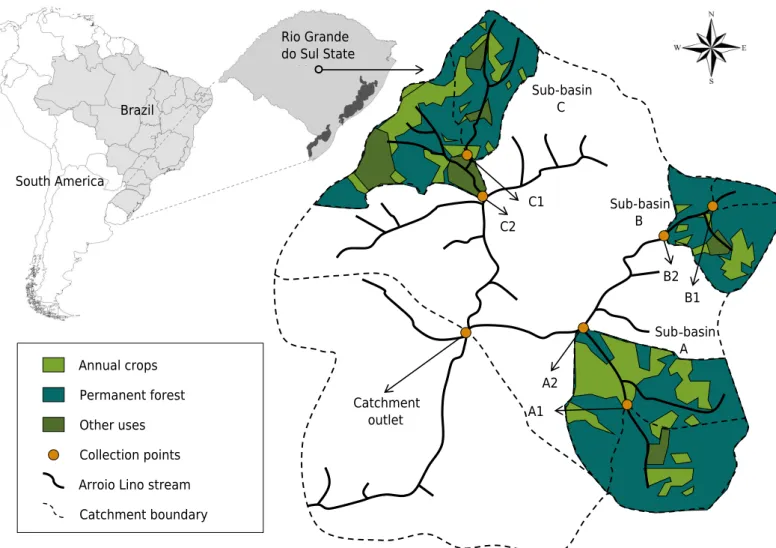
The Agudo catchment has 480 ha and the main watercourse is the Arroio Lino stream, located in the municipality of Agudo, state of Rio Grande do Sul, in southern Brazil (29° 30’ S and 53° 15’ W). The Arroio Lino Stream is a tributary of the Jacuí River, which is responsible for 85 % of the water input in Guaíba Lake, the most important water supply for the municipality of Porto Alegre, which has a population of 1.5 million inhabitants. The channel network is characterized by step-pool channels with high roughness and turbulent flux, composed of cobbles and boulders that protect finer bed material. The average stream width is 3 m, with a depth of 0.5 m in the catchment outlet. There are no water control structures along the stream.
The altitude in the catchment ranges from 120 to 480 m, while the topography is hilly with long and short slopes, usually greater than 25°. The climate is humid subtropical (Cfa, according to the Köppen classification system) with an average annual temperature of 20 °C. Annual rainfall ranges from 1,300 to 1,800 mm. The catchment is underlain by acid volcanic rocks in the upper part and sandstone in the lower zones.
Clay content in all soils was lower than 210 g kg-1. Organic matter contents ranged from
7.0 to 34.0 g kg-1. The soil pH in water ranged from 5.1 to 6.1. In the soil clay fraction,
2:1 clay minerals are predominant; however, illite and kaolinite are present in lower amounts (Bortoluzzi et al., 2013). The main soil types in the watershed are Chernozem, Regosol, and Arenosol (WRB, 2014), which are classified as Chernossolo Argilúvico férrico,
Neossolo Litólico eutrófico, and Neossolo Quartzarênico órtico, respectively, accordingly to the Brazilian System of Soil Classification (Santos et al., 2013).
Approximately 90 % of the 36 agricultural production units belong to family farmers dedicated to tobacco production. Fertilizers are still added based on the system of precaution and approximately 180, 60, 210, and 20 kg ha-1 of N, P, K, and S, respectively,
are applied annually. Tobacco cultivation usually includes two to six soil operations per year, as well as the use of many pesticides for weed control.
The Sub-basin B has landscape based on highly sloped topography with a low level of human activity. In Sub-basin B, one point was sampled upstream (B1), which corresponds to the only area undisturbed by human activity in the present study, where 100 % of the land is covered with native forest (assumed as a control area). Another point was collected downstream (B2), in a region with few cropping areas. The Sub-basin C has highly sloped topography and high level of human pressure. Two sampling points were chosen, one located in an upstream area (C1) and another in a downstream area (C2).
Table 1. Areas and relative contribution of the land uses at each point of the three sub-basins monitored in the Agudo catchment, Rio Grande do Sul, Brazil
Sub-basins Collection point Anthropic condition Total
area Annual crops Permanent forest Other uses
(1)
ha ha % ha % ha %
A A1 Disturbed 26.9 3.2 11.9 21.4 79.6 2.3 8.5
A2 Disturbed 69.2 17.1 24.7 48.1 69.5 4.0 5.8
B B1 Undisturbed 3.1 0.0 0.0 3.1 100.0 0.0 0.0
B2 Disturbed 24.3 3.9 16.1 18.5 76.1 1.9 7.8
C C1 Disturbed 21.2 4.2 19.8 16.0 75.5 1.0 4.7
C2 Disturbed 48.3 12.0 24.8 29.5 61.1 6.8 14.1
(1)
Perennial pasture, subsistence cultivation, orchards, gardens, installations, and roads.
Rio Grande do Sul State
Brazil
South America
C2 C1
B1 B2
A2
A1 Catchment
outlet
Sub-basin C
Sub-basin B
Sub-basin
A Annual crops
Permanent forest
Other uses
Collection points
Arroio Lino stream
Catchment boundary
Sediment sampling
Suspended sediments were sampled during storm events that occurred during the fallow period (April 2008 - figure 2a) and during the tobacco transplanting period (August 2008 - figure 2b) in order to represent the different seasonal soil management practices in the catchment. The samples were collected in two ways. First, at the upstream and downstream points of the three sub-basins (A, B, and C), US U-59 suspended sediment samplers were installed at 0.05 m above the baseflow. This methodology consists of the automatic capture of water and suspended sediment when the water level rises. Secondly, in the catchment outlet, suspended sediment samples were collected at different phases of the hydrograph: rising limb (1), peak discharge (2), and recession limb (3) through use of a US DH-48 manual sampler. Phases sampled during the fallow period were named F1, F2, and F3, and the phases sampled during tobacco transplanting were named T1, T2, and T3. After the rainfall event, the containers with the samples were kept at ±4 °C and immediately taken to the laboratory where they were analyzed.
In the catchment outlet, a Parshall flume was installed in which the water level was monitored during the storm event. Later, water discharge was calculated using equation 1 obtained by Sequinatto (2007) relating the height of the water level (h) and the water discharge with a determination coefficient of 0.982.
20:30 20:50 21:10 21:30 21:50 22:10 22:30 22:50
0 2 4 6 8 0 5 10 15 20 25 30 0 100 200 300 400 500 600 700 800 900 0 10 20 30 40
Ascent Maximum Descent
Ascent Maximum Descent
0 5 10 15 20 25
Hysteresis index = 0.94
0.0 0.3 0.6 0.9 1.2 1.5 1.8
0 1 2 3 4 5
0 1 2 3 4 5 6 (d) (c) (b) (a)
Hysteresis index = 1.95
Wa
ter flow (L
s
-1 )
Q (L s-1
)
SSC (g
L
-1 )
A
ccumulated sediment (Mg)
SSC (g L -1 ) SSC (g L -1 ) Ra infall (mm) Ra infall (mm) 2.0 1.5 1.0 0.5 0.0
07:00 08:00 09:00 10:00 11:00
8 6 4 Water flow Sediment concentration Accumulated sediment Rainfall Water flow Sediment concentration Accumulated sediment Rainfall 300 0 2 4 6 8 10 250 200 150 100 50 0 2 0
Water discharge (m3 s-1) = 10.544 × h1.267 Eq. 1
The hysteresis index (HI) between suspended sediment concentration (SSC) and water flow rate (Q) was calculated by using the two single stages of calculation for any given hysteresis loop, as suggested by Lawler et al. (2006). First, the value of Q central (Qcen)
was calculated by using the values of maximum (Qmax) and minimum (Qmin) water flow
in the ascending branch of the hydrograph (Qmax is the peak discharge and Qmin is the
starting discharge for the storm event) (Equation 2):
Qcen = 0.5 × (Qmax ˗ Qmin) + Qmin Eq. 2
Then, the values of SSC for Qcen is found for the rising stage (SSC+) and the recession
phase (SSC-) by using the Q × SSC plot. If the hysteresis curve is in a clockwise direction,
the HI will be positive and calculated by equation 3, but if the hysteresis curve is in a counterclockwise direction, the HI will be negative and calculated by equation 4.
HI = (SSC+/SSC- ) - 1 Eq. 3
HI = [-1/(SSC+/SSC- )] + 1 Eq. 4
Sediment analysis
Suspended sediment concentration was calculated after drying an aliquot of water + sediment sample at 105 °C. For physicochemical characterization and P fractionation, another aliquot was dried at ±50 °C. A third aliquot was filtered through a 0.45 µm cellulose membrane to estimate soluble P (Murphy and Riley, 1962).
Particle size distribution was analyzed by laser granulometry (Muggler et al., 1997). Aluminum and Fe crystalline oxides were estimated by extraction with dithionite-citrate-bicarbonate (Mehra and Jackson, 1960). Aluminum and Fe amorphous oxides were estimated by extraction with ammonium oxalate (Claessen, 1997). The Al and Fe in the extracts were determined using an atomic absorption spectrometer (AAS). Total organic carbon (TOC) content was determined by wet oxidation (Walkley and Black, 1934).
Sediment P forms were evaluated by sequential chemical fractionation proposed by Hedley et al. (1982). Briefly, the sequential extractions were (1) distilled water with one anion exchange resin membrane (identified as Av-P); (2) 0.5 mol L-1 NaHCO
3 at pH 8.5
(identified as Bic-P); (3) 0.1 mol L-1 NaOH (identified as Hid
0.1-P); (4) 1.0 mol L-1 HCl
(identified as HCl-P); and (5) 0.5 mol L-1
NaOH (identified as Hid0.5-P). After each extraction,
the soil suspensions were centrifuged at 2,510 × g for 15 min to collect clear supernatants. After centrifugation and storage of the supernatant from each extraction, the soil tubes were washed with the addition of 0.5 mol L-1 NaCl and then centrifuged once more;
this supernatant was added to the previous extract. After extractions, the remaining sediment was dried at ± 50 °C, ground, and digested with H2SO4 and H2O2 in the
presence of saturated MgCl2; after that, the P content was determined (identified as
Residual-P) (Olsen and Sommers, 1982). Inorganic P from the acid extractions was determined according to the Murphy and Riley (1962) method. In the NaHCO3 and NaOH
extractions, total P was estimated by digestion with H2SO4 and ammonium persulfate
in an autoclave at 121 °C (Usepa, 1971), with subsequent determination of P by the Murphy and Riley (1962) method.
Total organic P (Organic-P) estimated by the ignition method was obtained by the difference between the amount of P extracted with 0.5 mol L-1 H
2SO4 from ignited (550 °C,
2 h) and non-ignited soil samples (Olsen and Sommers, 1982). Total P was estimated by digestion with H2SO4 and H2O2 in the presence of saturated MgCl2, as proposed by
Statistical analysis
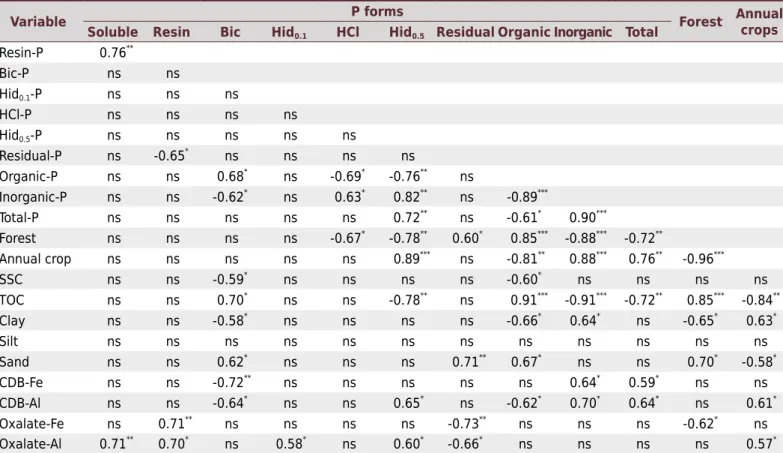
All the P forms in sediments passed in the Lilliefors and Kolmogorov-Smirnov test for normality. Pearson’s correlation analysis of the P forms with the land use and the physicochemical properties of sediments was performed using the data from the six points sampled in the three sub-basins in both rainfall events (n =2). To evaluate the effect of the seasonal soil management practices, the means of the P forms and physicochemical properties were compared by the nonparametric Mann-Whitney U test. This test was used because non-parametric models differ from parametric models in that the model structure is not specified a priori but is instead determined from data.
Principal Component Analysis (PCA) based on the correlation matrix and Discriminant Analysis Function (DAF) was performed using all the sediment samples (n =18) and all the sediment P forms. The DAF was performed in the backward mode to determine the minimum number of P forms that maximizes the discrimination among the sediments collected at different land uses and seasons. The groups tested were: undisturbed sites (B1 during fallow and transplanting); disturbed sites in fallow (A1, A2, B2, C1, C2, F1, F2, and F3), and disturbed sites during transplant (A1, A2, B2, C1, C2, T1, T2, and T3). The multivariate discriminant function is based on the Wilks’ Lambda (Λ*) value from analysis of variance, where the criterion used by the statistical model is the minimization of Λ*. A Λ* of 1 occurs if all the group means are the same, while a low Λ* value means that the variability within the groups is small compared to the total variability. At each step, the P-form which minimized the overall Wilks’ Lambda was entered. The maximum significance of F to enter a property was 0.01. The minimum significance of F to remove a property was 0.01. All statistical analysis was performed using Statistica software (StatSoft, USA).
RESULTS AND DISCUSSIONS
Effect of land use and soil management on suspended sediment concentration
Total rainfall and its intensity can be more important than seasonal soil management in determining suspended sediment content (SSC), as highlighted by data collected during the storm events that occurred in the fallow and tobacco transplanting periods (Figures 2a and 2b), particularly considering the erosivity (R) value of 7.866 MJ mm ha-1 h-1,
calculated for the Santa Maria municipality (Cogo et al., 2003), next to the area of study. In the storm event that occurred during the fallow period, the total rainfall was 55 mm, the mean intensity was 47 mm h-1, the maximum intensity was 192 mm h-1, and the
sediment yield was 845 Mg. In the storm event that occurred during tobacco transplanting, the total rainfall was 38 mm, the mean intensity was 17 mm h-1, the maximum intensity
was 124 mm h-1, and the sediment yield was 284 Mg.
Both storm events had a clockwise hysteresis loop, with a higher SSC in the rising limb than in the recession limb (Figures 2c and 2d). The index, calculated according to Lawler et al. (2006), was 0.94 for the storm event that occurred during the fallow period and 1.95 for the transplanting period. That means sediments were quickly mobilized, transported, and deposited (Seeger et al., 2004). This indicates that the main sediment source is close to the stream, such as the particles deposited in the bottom of the river channel (Minella et al., 2011). It was observed especially in the rainfall occurring during the tobacco transplant, which showed the highest hysteresis index.
In the undisturbed site, the SSC, the physicochemical properties, and the P forms in the suspended sediment transported in both storm events were very similar, whereas in the disturbed areas, the SSC is highly influenced by the intensity of the rainfall events. These findings show that, under natural conditions, the quantity and quality of the eroded material are largely unaltered, even under extremely different rainfall events. In contrast, when virtually all crop fields were plowed for tobacco transplanting, the measured values of SSC were approximately four times lower than those under an event with higher total rainfall and rainfall intensity, such as in the fallow period (Table 2).
The influence of the magnitude of the rainfall is also evidenced by the particle size distribution of the sediment. The fallow period can be characterized by transport of sediments with higher sand and lower clay contents, which can be ascribed to an increase in rainfall transport capacity. The Fed content was one third of that obtained during the Table 2. Physicochemical properties and phosphorus forms in sediments eroded from undisturbed areas (B1) and disturbed areas (A1, A2, B2, C1, and C2) and during the phases of ascension (1), maximum flow rate (2), and recession (3) at the watershed outlet during the rainfall events that occurred during the fallow and transplanting period in the Agudo catchment, Rio Grande do Sul, Brazil
Variable
Sub-basins Watershed outlet
Undisturbed Disturbed Fallow Transplant
U-test(2)
Fallow Transplant Fallow TransplantU-test(1) F1 F2 F3 T1 T2 T3
SSC (g L-1
) 0.1 0.1 8.0 2.1 * 4.8 13.5 5.3 1.7 2.1 1.1 *
TOC (g kg-1) 74.7 103.2 26.7 36.9 ns 24.0 23.2 27.0 16.9 24.7 25.9 ns
Clay (g kg-1
) 7.8 7.1 17.5 16.1 ns 18.8 18.7 18.4 20.4 21.9 25.7 *
Silt (g kg-1
) 77.1 80.8 78.5 79.4 ns 75.6 76.0 75.5 79.6 78.1 70.2 ns
Sand (g kg-1
) 15.0 12.0 4.0 4.5 ns 5.5 5.3 6.1 0.0 0.0 4.1 *
CDB-Fe (g kg-1) 19.5 12.3 75.3 24.3 ** 102.3 96.3 78.8 37.6 33.5 29.1 *
CDB-Al (g kg-1
) 1.0 0.6 3.6 1.7 * 5.6 4.6 4.0 2.6 2.5 2.4 *
Oxalate-Fe (g kg-1
) 0.8 0.6 3.2 5.1 * 3.2 4.2 2.5 3.4 5.4 3.6 ns
Oxalate-Al (g kg-1
) 0.2 0.4 0.5 1.2 ** 0.5 0.7 0.5 1.6 1.7 1.6 *
Phosphorus form
Soluble-P (µg L-1
) 17 14 49 137 * 25 20 35 181 100 256 *
Resin-P (mg kg-1
) 9 13 79 176 * 121 148 102 166 185 362 *
Bic-P (mg kg-1
) 91 110 35 78 * 31 37 39 32 73 62 ns
Hid0.1-P (mg kg-1
) 216 147 281 404 * 182 199 232 155 276 253 ns
HCl-P (mg kg-1) 18 23 120 120 ns 165 142 153 140 132 121 ns
Hid0.5-P (mg kg-1
) 117 130 266 278 ns 196 155 160 123 172 125 ns
Residual-P (mg kg-1
) 484 333 314 247 * 372 395 345 297 275 300 *
Organic-P (mg kg-1
) 498 513 177 239 ns 103 148 148 162 214 271 *
Inorganic-P (mg kg-1) 123 147 815 658 ns 823 1,020 1,167 931 910 662 ns
Total-P (mg kg-1
) 622 660 992 897 ns 927 1,167 1,316 1,094 1,124 933 ns
(1)
Comparison between fallow and transplanting periods in the disturbed areas. (2)
fallow period (Table 2) at the time of tobacco transplant, indicating a qualitative difference in the sediment. In a study conducted in the same catchment, Minella et al. (2007) found that soils from croplands have two times more Fed content than sediments from the road
and river banks.
Effect of land use and soil management on sediment P forms
The change in land use from forest to tobacco fields results in an increase in Inorganic-P and a decrease in Organic-P and TOC in the suspended sediments. The Total-P content in sediments in the downstream area of Sub-basins A and B was higher than the content in the upstream area in both storm events (Figure 3). In Sub-basin C, Total-P content was almost the same upstream and downstream, due to the similar land use. Nevertheless, the percentage of Organic-P downstream was always lower, while the proportion of Inorganic-P was always higher than the analogous values upstream. Furthermore, the TOC content in sediments upstream was always higher than the content downstream. This occurs because transformation of natural ecosystems into cultivated areas changes the distribution of soil P forms (Tiecher et al., 2012a,b); generally organic P and TOC decrease quickly in continuous cultivation systems (Solomon et al., 2002).
Or ga ni c-P an d In or ga ni c-P (% ) 0 20 40 60 80 100 500 600 700 800 900 1000 1100 1200 0 20 40 60 80 100 120 0 2 4 6 8 10 12 14 16 Organic-P Inorganic-P Total-P TOC Suspended sediment Permanent forest area (annual crops area) (%)
73.7 (16.0) 71.0 (20.0) 100 (0) 78.3 (11.9) 60.8 (20.3) 54.9 (24.4)
0 20 40 60 80 100 (b) (a) To ta l-P (m g kg -1 ) 500 600 700 800 900 1000 1100 1200 Sub-basin
A1 A2 B1 B2 C1 C2
TO C (g kg -1 ) 0 20 40 60 80 100 120 Su spen ded sedi me nt (g L -1 ) 0 2 4 6 8 10 12 14 16
The tobacco crop requires large amounts of phosphate, 60 kg ha-1 yr-1 of P are applied in
the fields, an amount much higher than that exported by tobacco leaves, which leads to an accumulation of soil P, mainly in inorganic forms (Rheinheimer and Anghinoni, 2001; Guardini et al., 2012), in highly weathered subtropical soils. An increase in the proportion of Inorganic-P at the expense of Organic-P in suspended sediments as the proportion of cropland increases in relation to forest areas can be observed in figure 3 and table 2. These data analyzed together with correlation analysis (Table 3) clearly demonstrate that an increase in Inorganic-P and decrease in Organic-P and TOC in suspended sediments were caused by anthropic pressure. Linear correlation also showed in increase in the contents of Organic-P, Residual-P, and TOC as the proportion of the area occupied by forests increased, whereas Inorganic-P, Total-P, HCl-P, and Hid0.5-P content increases with
an increasing proportion of cropped area.
Evaluating only the Total-P content in the disturbed areas and at the catchment outlet, the influence of seasonal soil management could not be verified. Resolution No.357/2005 of the National Environmental Council of Brazil (Conama, 2005) stipulates that water bodies with concentration above 0.1 mg L-1 of total P cannot be classified as fresh waters;
however, it does not mention values of specific P fractions. In the disturbed areas and at the catchment outlet, the soluble P concentration was over this limitduring the rainfall event in the tobacco transplanting period (Table 2), highlighting the high pollutant load and the real potential for impact on important areas located downstream. For example, the water drained from the watershed under study goes to Guaíba Lake, an important waterbody that is the main source of water for the metropolitan region of Porto Alegre (more than four million people). Despite its importance, this lake receives a high load of pollutants, and phytoplankton blooms are frequent (Andrade and Giroldo, 2014).
Table 3. Linear correlation of the variables evaluated at the downstream and upstream points of Sub-basins A, B, and C (n =12) in the Agudo catchment, Rio Grande do Sul, Brazil
Variable P forms Forest Annual
crops
Soluble Resin Bic Hid0.1 HCl Hid0.5 Residual Organic Inorganic Total
Resin-P 0.76**
Bic-P ns ns
Hid0.1-P ns ns ns
HCl-P ns ns ns ns
Hid0.5-P ns ns ns ns ns
Residual-P ns -0.65* ns ns ns ns
Organic-P ns ns 0.68* ns -0.69* -0.76** ns
Inorganic-P ns ns -0.62* ns 0.63* 0.82** ns -0.89***
Total-P ns ns ns ns ns 0.72** ns -0.61* 0.90***
Forest ns ns ns ns -0.67* -0.78** 0.60* 0.85*** -0.88*** -0.72**
Annual crop ns ns ns ns ns 0.89*** ns -0.81** 0.88*** 0.76** -0.96***
SSC ns ns -0.59* ns ns ns ns -0.60* ns ns ns ns
TOC ns ns 0.70* ns ns -0.78** ns 0.91*** -0.91*** -0.72** 0.85*** -0.84**
Clay ns ns -0.58* ns ns ns ns -0.66* 0.64* ns -0.65* 0.63*
Silt ns ns ns ns ns ns ns ns ns ns ns ns
Sand ns ns 0.62* ns ns ns 0.71** 0.67* ns ns 0.70* -0.58*
CDB-Fe ns ns -0.72** ns ns ns ns ns 0.64* 0.59* ns ns
CDB-Al ns ns -0.64* ns ns 0.65* ns -0.62* 0.70* 0.64* ns 0.61*
Oxalate-Fe ns 0.71** ns ns ns ns -0.73** ns ns ns -0.62* ns
Oxalate-Al 0.71** 0.70* ns 0.58* ns 0.60* -0.66* ns ns ns ns 0.57*
ns: not significant.*, ** and ***: significant at p<0.05, p<0.01, and p<0.001, respectively. SSC: suspended sediment concentration. TOC: total organic
However, the results of P fractionation clearly show that the suspended sediments transported during tobacco transplanting were enriched with more labile P forms than the sediments transported during the fallow period. This can be verified in the disturbed areas by an approximate doubling of the levels of Av-P and Bic-P in sediments carried in the runoff from rainfall during tobacco transplanting. In addition, in the sediments sampled in the disturbed areas, the levels of Hid0.5-P (P of intermediate lability) were also higher during tobacco
transplanting (Table 2). These results highlight that the P applied in the soil in the tobacco transplanting period remains loosely bound to the sediment in the catchment runoff, which means it is easily available to the aquatic biota. Furthermore, in the rainfall event that occurred during the tobacco transplanting period, there was an increase in Av-P in the descent phase of the hydrograph, which corresponds to twice the analogous value observed in the ascent and maximum flow phases. This result indicates that most of the sediment reaching the water bodies at the end of the rainfall event came from distant recently-fertilized crop fields. Frequent application of high rates of P in tobacco fields leads to saturation of the sites with high affinity for P in the soil surface layers. For that reason, there was higher content of Total-P, Inorganic-P, Av-P, Bic-P, HCl-P, Hid0.1-P, and Hid0.5-P in the suspended
sediment from disturbed areas compared to the undisturbed site (Table 2). In addition to the P content being lower in the sediment from the undisturbed area, the P is mostly in recalcitrant and organic forms. Furthermore, the sediment from the undisturbed area has low levels of Fe oxides and low content of Hid0.1-P and Hid0.5-P, which are considered
as the P that is associated with Fe oxides (Hedley et al., 1982).
In rivers, biogeochemical activation and release of P stores can be triggered by organic C input from wastewater or septic tank effluents, particularly under baseflow conditions (Sharpley et al., 2013). Under high temperatures and low-flow conditions, microbial activity increases, spurring degradation of the organic C load, which elevates the biochemical O2 demand. Consequently, in these anoxic conditions, reductive dissolution of ferric iron
minerals occurs, releasing the bound P stored in sediments into the water column, which increases the algal available P and may promote eutrophication. Molot et al. (2014) argue that internal Fe2+ loading from anoxic sediments is also an important factor that
regulates the ability of cyanobacteria to compete with eukaryotic phytoplankton. Linking this to our results, even if the sediment coming from the undisturbed site reaches a lentic environment, such as Guaíba Lake, the probability of P release promoted by the dissolution of Fe oxides in a reduced environment will be very small. However, the sediment from disturbed areas not only has higher content of labile P (Av-P and Bic-P), it also has higher content of Fe oxides and higher content of Hid0.1-P and Hid0.5-P, representing high
pollution potential, especially if it reaches anoxic environments (Schärer et al., 2009). Labile P contained in the sediment acts as a source of phosphate readily available to organisms in the water column (Kerr et al., 2011). In this respect, we found a positive correlation between the Av-P content in the sediments and soluble P (Table 3). Furthermore, the increase in labile P content during transplanting also resulted in increased content of soluble P in the disturbed areas and in the catchment outlet (Table 2). Further evidence of this phenomenon can be found in the rainfall event that occurred during tobacco transplanting, in which there was an increase in soluble P that accompanied the increase in Av-P in the final third of the hydrograph in the catchment outlet.
Potential use of P forms as an indicator of anthropic pressures
The first two principal components of PCA explained 64 % of the total variation in sediment P forms among all the suspended sediment samples collected in both rainfall events (Figure 4). The P fractions that were more closely associated with PC1 and thus more discriminant in forming the heterogeneous groups (Aleixo et al., 2017) were Organic-P,
Table 4. Factor analysis of soil P in different fractions
Factor loading(1) Factor
1 2 3
Resin-P - - 0.446
Bic-P - -
-Hid0.1-P - 0.346
-HCl-P - -
-Hid0.5-P - 0.182 0.359
Residual-P - 0.243
-Organic-P 0.230 -
-Inorganic-P 0.233 -
-Total-P 0.176 -
-(1) Only loadings ≥70 % of the maximum are given. Resin-P: available P. Bic-P: P extracted by 0.5 mol L‒1
NaHCO3 at pH 8.5. Hid0.1-P: P extracted by 0.1 mol L‒1 NaOH. HCl-P: P extracted by 1.0 mol L‒1 HCl. Hid0.5-P: P extracted by 0.5 mol L‒1 NaOH. Residual-P: P residual obtained after digestion with H2SO4 and H2O2. Organic-P: total organic P. Inorganic-P: total inorganic P. Total-P: total P concentration.
Principal component 1 (41.4 %)
-3 -2 -1 0 1 2 3 4 5
Pr
incipal component 2 (22.1 %)
-3 -2 -1 0 1 2
1F 2F
3F 1T
2T 3T
Av-P
Bic-P
Hid0.1-P HCl-P
Hid0.5-P
Residual-P
Organic-P Inorganic-P
Total-P
A1 Fallow A1 Transplant A2 Fallow A2 Transplant B1 Fallow B1 Transplant B2 Fallow B2 Transplant C1 Fallow C1 Transplant C2 Fallow C2 Transplant
Figure 4. Projection of sediment P forms in the first factorial plan of the Principal Component Analysis (PCA) of the suspended sediment collected upstream and downstream in the Sub-basins A, B, and C, and during rising limb (1), peak discharge (2), and recession limb (3) at the catchment outlet, in two storm events occurred in the periods of fallow (F) and tobacco transplantation (T), in Agudo catchment, Rio Grande do Sul, Brazil. Numbers in parentheses indicate the percentage of variance explained by each axis.
Table 5. Results of the stepwise discriminant function analysis as indicated by the Wilks’ Lambda values
Step P-form p to remove Wilks’ Lambda Cumulative of sediment samples correctly classified
%
1 Bic-P <0.0001 0.3100 89
2 Resin-P 0.0012 0.1340 94
3 Hid0.1-P 0.0025 0.0610 94
4 Residual-P 0.0037 0.0239 94
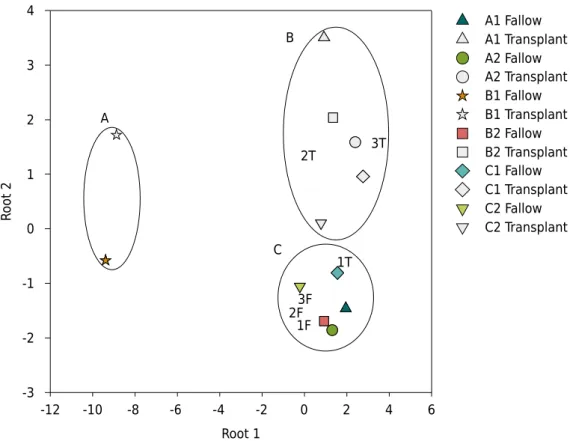
Figure 5. Two-dimensional scatter plot of the first and second discriminant functions from stepwise Discriminant Function Analysis (DFA) using P forms in suspended sediment collected upstream and downstream in the Sub-basins A, B, and C, and during rising limb (1), peak discharge (2), and recession limb (3) at the catchment outlet, in two storm events occurred in the periods of fallow (F) and tobacco transplantation (T), in Agudo catchment, Rio Grande do Sul, Brazil.
Root 1
-12 -10 -8 -6 -4 -2 0 2 4 6
R
oot 2
-3 -2 -1 0 1 2 3 4
1F
2F3F
1T
2T 3T
A
B
C
A1 Fallow A1 Transplant A2 Fallow A2 Transplant B1 Fallow B1 Transplant B2 Fallow B2 Transplant C1 Fallow C1 Transplant C2 Fallow C2 Transplant
Table 6. Classification of sediment samples by discriminant analyses using the P forms of sediments eroded from the Agudo catchment, Rio Grande do Sul, Brazil
Period Anthropic condition Sub-basins/
phase
Groups of suspended sediment
Undisturbed Disturbed fallow Disturbed
transplant
SMD(1) p-value SMD p-value SMD p-value
Fallow
Disturbed A1 117.6 <0.0001 2.9 0.8280 6.0 0.1720
Disturbed A2 82.5 <0.0001 1.3 0.9844 9.6 0.0156
Undisturbed B1 3.0 1.0000 102.1 <0.0001 127.6 <0.0001
Disturbed B2 106.6 <0.0001 0.6 0.9905 9.8 0.0095
Disturbed C1 132.5 <0.0001 7.6 0.9488 13.4 0.0512
Disturbed C2 115.7 <0.0001 1.4 0.9909 10.8 0.0091
Disturbed F1 87.5 <0.0001 1.4 0.9974 13.3 0.0026
Disturbed F2 81.0 <0.0001 3.0 0.9967 14.5 0.0033
Disturbed F3 85.5 <0.0001 0.5 0.9901 9.7 0.0099
Transplant
Disturbed A1 143.2 <0.0001 12.0 0.0105 2.9 0.9895
Disturbed A2 101.1 <0.0001 5.1 0.4797 5.0 0.5203
Undisturbed B1 3.0 1.0000 101.3 <0.0001 113.1 <0.0001
Disturbed B2 113.1 <0.0001 13.8 0.0026 1.9 0.9974
Disturbed C1 111.6 <0.0001 26.5 0.0001 7.5 0.9999
Disturbed C2 134.5 <0.0001 12.9 0.0029 1.2 0.9971
Disturbed T1 121.1 <0.0001 3.1 0.7890 5.8 0.2110
Disturbed T2 86.0 <0.0001 8.1 0.0609 2.7 0.9391
Disturbed T3 164.0 <0.0001 22.4 0.0010 8.6 0.9990
(1)
Inorganic-P, and Total-P, whereas the Hid0.1-P, Hid0.5-P, and Residual-P were associated with
PC2 (Table 4). In both rainfall events, the P forms of sediments collected during different flow rates in the catchment outlet resemble more the P forms of sediment sampled in the disturbed areas than those in the undisturbed area (Figure 5).
The table 5 shows the progressive change in the Wilks’ Lambda value (Λ*) as the variables are introduced into the analysis. The set of P forms selected by Discriminant Analysis Function (DAF) comprised four P forms, namely Bic-P, Resin-P, Hid0.1-P, and Residual-P.
The final value of the Λ* parameter was 0.0239. As the value of Λ* is the proportion of the total variance due to the error of sample discrimination, the selected variables provided an error of ≈2.4 %. That means the set of selected P forms explains approximately 97.6 % of the differences between the samples.
The results of DA showed that suspended sediment samples were correctly classified in their groups according to the degree of disturbance by human activities and evaluation periods (Table 6). Only one sample was not correctly classified: the sediment collected during the rise in water flow in the rainfall event of the tobacco transplanting period. There is higher probability of this sample belonging to the group of sediments from disturbed areas during the fallow period (p=0.789) than to the group of sediments from disturbed areas during the transplanting period (p=0.211).
CONCLUSIONS
Human activities lead to an increase in inorganic P in sediments, and a decrease in total organic carbon and total organic P. The areas without human interference had the same quantity and quality of the material eroded in both rainfall events studied.
The impact of seasonal soil management practices on stream water quality cannot be determined only on the basis of the total P levels present in suspended sediments; the method of chemical fractionation of P was useful for distinguishing sediments from sub-basins with different land uses that were affected by seasonal soil management practices. Suspended sediments carried by rainfall during tobacco transplanting had higher P availability. These sediments are more likely to act as pollution agents, promoting the water eutrophication process, than those transported during rainfall in the fallow period.
REFERENCES
Associação dos Fumicultores do Brasil - Afubra. Fumicultura regional [internet]. 2015 [acesso em 01 out 2015]. Disponível em: http://www.afubra.com.br/index.php/conteudo/show/id/84
Aleixo S, Gama-Rodrigues AC, Costa MG, Sales MVS, Gama-Rodrigues EF, Marques JRB. P transformations in cacao agroforests soils in the Atlantic forest region of Bahia, Brazil. Agroforest Syst. 2017;91:423-37. https://doi.org/10.1007/s10457-016-9939-6
Andrade RR, Giroldo D. Limnological characterisation and phytoplankton seasonal variation in a subtropical shallow lake (Guaiba Lake, Brazil): a long-term study. Acta Limnol Bras.
2014;26:442-56. https://doi.org/10.1590/s2179-975x2014000400011
Bonumá NB, Rossi CHG, Arnold JG, Reichert JM, Minella JP, Allen PM, Volk M. Simulating
landscape sediment transport capacity by using a modified SWAT model. J Environ Qual.
2014;43:55-66. https://doi.org/10.2134/jeq2012.0217
Bonumá NB, Rossi CG, Heil DM, Williams JR. Evaluation of the Langmuir model in the soil and water assessment tool for a high soil phosphorus condition. Environ Modell Softw. 2012;38:40-9. https://doi.org/10.1016/j.envsoft.2012.04.018
Cameron KC, Di HJ, Moir JL. Nitrogen losses from the soil/plant system: a review. Ann Appl Biol. 2013;162:145-73. https://doi.org/10.1111/aab.12014
Chellappa NT, Chellappa SL, Chellappa S. Harmful phytoplankton blooms and fish mortality
in a eutrophicated reservoir of Northeast Brazil. Braz Arch Biol Techn. 2008;51:833-41. https://doi.org/10.1590/s1516-89132008000400022
Claessen MEC, organizador. Manual de métodos de análise de solo. 2a ed. Rio de Janeiro: Centro Nacional de Pesquisa de Solos; 1997.
Cogo NP, Levien R, Schwarz RA. Perdas de solo e água por erosão hídrica influenciadas por
métodos de preparo, classes de declive e níveis de fertilidade do solo. Rev Bras Cienc Solo. 2006;27:743-53. http://dx.doi.org/10.1590/S0100-06832003000400019
Conselho Nacional do Meio Ambiente - Conama. Resolução nº 357 de 17 de março de
2005: Dispõe sobre a classificação dos corpos de água e diretrizes ambientais para o seu enquadramento, bem como estabelece as condições e padrões de lançamento de efluentes, e
dá outras providências [internet]. Brasília, DF [acesso em 13 de fevereiro de 2017]. Disponível em: http://www.mma.gov.br/port/conama/res/res05/res35705.pdf.
Dodd RJ, Mcdowell RW, Condron LM. Is tillage an effective method to decrease
phosphorus loss from phosphorus enriched pastoral soils? Soil Till Res. 2014;135:1-8. https://doi.org/10.1016/j.still.2013.08.015
Guardini R, Comin JJ, Schmitt DE, Tiecher T, Bender MA, Santos DR, Mezzari CP, Oliveira BS, Gatiboni LC, Brunetto G. Accumulation of phosphorus fractions in typic Hapludalf soil after long-term application of pig slurry and deep pig litter in a no-tillage system. Nutr Cycl Agroecosys. 2012;93:215-25. https://doi.org/10.1007/s10705-012-9511-3
Hedley MJ, Stewart JWB, Chauhan BS. Changes in inorganic and organic soil phosphorus fractions induced by cultivation practices and by laboratory incubations. Soil Sci Soc Am J. 1982;46:970-6. https://doi.org/10.2136/sssaj1982.03615995004600050017x
Heisler J, Glibert PM, Burkholder JM, Anderson DM, Cochlan W, Dennison WC, Dortch Q, Gogler
CJ, Heil CA, Humphries E, Lewitus A, Magnien R, Marshall HG, Sellner K, Stockwell DA, Stoechker
DK, Suddleson M. Eutrophication and harmful algal blooms: a scientific consensus. Harmful
Algae. 2008;8:3-13. https://doi.org/10.1016/j.hal.2008.08.006
Hilton J, O’Hare M, Bowes MJ, Jones JI. How green is my river? A new paradigm of eutrophication in rivers. Sci Total Environ. 2006;365:66-83. https://doi.org/10.1016/j.scitotenv.2006.02.055
Horowitz AJ. Monitoring suspended sediments and associated chemical constituents in urban
environments: lessons from the city of Atlanta, Georgia, USA Water Quality Monitoring Program.
J Soils Sediments. 2009;9:342-63. https://doi.org/10.1007/s11368-009-0092-y
Jarvie HP, Jürgens MD, Williams RJ, Neal C, Davies JJL, Barrett C, White J. Role of river bed sediments as sources and sinks of phosphorus across two major eutrophic UK river basins: the Hampshire Avon and Herefordshire Wye. J Hydrol. 2005;304:51-74. https://doi.org/10.1016/j.jhydrol.2004.10.002
Kerr JG, Burford MA, Olley JM, Bunn SE, Udy J. Examining the link between terrestrial and aquatic phosphorus speciation in a subtropical catchment: the role of selective erosion
and transport of fine sediments during storm events. Water Res. 2011;45:3331-40.
https://doi.org/10.1016/j.watres.2011.03.048
Kobayashi JT, Thomaz SM, Pelicice FM. Phosphorus as a limiting factor for Eichhornia crassipes growth
in the upper Paraná river floodplain. Wetlands. 2008;28:905-13. https://doi.org/10.1672/07-89.1
Lawler DM, Petts GE, Foster IDL, Harper S. Turbidity dynamics during spring storm events in an urban headwater river system: The Upper Tame, West Midlands, UK. Sci Total Environ. 2006;360:109-26. https://doi.org/10.1016/j.scitotenv.2005.08.032
Lecours N, Almeida GEG, Abdallah JM, Novotny TE. Environmental health impacts of tobacco farming: a review of the literature. Tob Control. 2012;21:191-6. https://doi.org/10.1136/tobaccocontrol-2011-050318
Matsumura-Tundisi T, Tundisi JG, Luzia AP, Degani RM. Occurrence of Ceratium furcoides
(Levander) Langhans 1925 bloom at the Billings Reservoir, São Paulo state, Brazil. Braz J Biol. 2010;70:825-9. https://doi.org/10.1590/s1519-69842010000400013
Mehra OP, Jackson ML. Iron oxide removal from soils and clays by a
dithionite-citrate system buffered with sodium bicarbonate. Clays Clay Miner. 1960;7:317-27.
https://doi.org/10.1016/b978-0-08-009235-5.50026-7
Minella JPG, Merten GH, Magnago PF. Análise qualitativa e quantitativa da histerese entre vazão e concentração de sedimentos durante eventos hidrológicos. Rev Bras Eng Agr Amb. 2011;15:1306-13. https://doi.org/10.1590/s1415-43662011001200013
Minella JPG, Merten GH, Reichert JM, Santos DR. Identificação e implicações para a
conservação do solo das fontes de sedimentos em bacias hidrográficas. Rev Bras Cienc Solo.
2007;31:1637-46. https://doi.org/10.1590/s0100-06832007000600039
Molot LA, Watson SB, Creed IF, Trick CG, McCabe SK, Verschoor MJ, Sorichetti RJ, Powe C,
Venkiteswaran JJ, Schiff SL. A novel model for cyanobacteria bloom formation: the critical role of
anoxia and ferrous iron. Freshw Biol. 2014;59:1323-40. https://doi.org/10.1111/fwb.12334
Nicolodi JL, Toldo Junior EE, Farina L. Dinâmica e ressuspensão por ondas no Lago Guaíba (RS, Brasil) e implicações nos locais de captação de água para abastecimento humano. Pesq Geocienc. 2010;37:25-39.
Muggler CC, Pape Th, Buurman P. Laser grain-size determination in soil genetic studies 2. Clay content, clay formation, and aggregation in some Brazilian Oxisols. Soil Sci. 1997;162:219-28. https://doi.org/10.1097/00010694-199703000-00008
Murphy J, Riley JP. A modified single solution method for the determination of phosphate in
natural waters. Anal Chim Acta. 1962;27:31-6. https://doi.org/10.1016/s0003-2670(00)88444-5
Olsen SR, Sommers LE. Phosphorus. In: Page AL, Miller RH, Keeney DR, editors. Methods of soil analysis. 2nd ed. Madison: American Society of Agronomy; 1982. Pt 2. p.403-30.
Pellegrini JBR, Santos DR, Gonçalves CS, Copetti ACC, Bortoluzzi EC, Tessier D. Impacts of anthropic pressures on soil phosphorus availability, concentration, and phosphorus forms in sediments in a Southern Brazilian watershed. J Soils Sediments. 2010;10:451-60. https://doi.org/10.1007/s11368-009-0125-6
Rheinheimer DS, Anghinoni I. Distribuição do fósforo inorgânico em sistemas de manejo de solo. Pesq Agropec Bras. 2001;36:151-60. https://doi.org/10.1590/s0100-204x2001000100019
Ribeiro GF, Andrade RR, Maizonave CRM, Crossetti LO. Effects of cyanobacterial summer bloom
on the phytoplankton structure in an urban shallow lake, Guaíba Lake, Southern Brazil. Neotrop Biol Conserv. 2012;7:78-87. https://doi.org/10.4013/nbc.2012.72.01
Salomoni SE, Rocha O, Leite EH. Limnological characterization of Gravataí River, Rio Grande do Sul State, Brazil. Acta Limnol Bras. 2007;19:1-14.
Santos HG, Jacomine PKT, Anjos LHC, Oliveira VA, Oliveira JB, Coelho MR, Lumbreras JF, Cunha
TJF. Sistema brasileiro de classificação de solos. 3a ed. Rio de Janeiro: Embrapa Solos; 2013. Schärer M, De Grave E, Semalulu O, Sinaj S, Vandenberghe RE, Frossard E. Effect of redox
conditions on phosphate exchangeability and iron forms in a soil amended with ferrous iron. Eur J Soil Sci. 2009;60:386-97. https://doi.org/10.1111/j.1365-2389.2009.01135.x
Seeger M, Errea MP, Beguería S, Arnáez J, Martí C, García-Ruiz JM. Catchment soil moisture and rainfall characteristics as determinant factors for discharge/suspended sediment hysteretic loops in a small headwater catchment in the Spanish pyrenees. J Hydrol. 2004;288:299-311. https://doi.org/10.1016/j.jhydrol.2003.10.012
Sequinatto L. A insustentabilidade do uso do solo com fumicultura em terras declivosas [dissertação]. Santa Maria: Universidade Federal de Santa Maria; 2007.
Sharpley AN, Foy B, Withers P. Practical and innovate measures for the control of
agricultural phosphorus losses to water: an overview. J Environ Qual. 2000;29:1-9.
Sharpley AN, Jarvie HP, Buda A, May L, Spears B, Kleinman P. Phosphorus legacy: overcoming
the effects of past management practices to mitigate future water quality impairment. J Environ Qual. 2013;42:1308-26. https://doi.org/10.2134/jeq2013.03.0098
Sharpley AN, Smith SJ, Jones OR, Berg WA, Coleman GA. The transport of
bioavailable phosphorus in agricultural runoff. J Environ Qual. 1992;21:30-5.
https://doi.org/10.2134/jeq1992.00472425002100010003x
Smith VH, Schindler DW. Eutrophication science: where do we go from here? Trends Ecol Evol. 2009;24:201-7. https://doi.org/10.1016/j.tree.2008.11.009
Solomon D, Lehmann J, Mamo T, Fritzsche F, Zech W. Phosphorus forms and dynamics
as influenced by land use changes in the sub-humid Ethiopian highlands. Geoderma.
2002;105:21-48. https://doi.org/10.1016/s0016-7061(01)00090-8
Teichberg M, Fox SE, Olsen YS, Valiela I, Martinetto P, Iribarne O, Muto EY, Petti MAV, Corbisier TN, Soto-Jiménez M, Páez-Osuna F, Castro P, Freitas H, Zitelli A, Cardinaletti M, Tagliapietra D. Eutrophication and macroalgal blooms in temperate and tropical coastal
waters: nutrient enrichment experiments with Ulva spp.. Glob Change Biol. 2010;16:2624-37.
https://doi.org/10.1111/j.1365-2486.2009.02108.x
Tiecher T, Santos DR, Calegari A. Soil organic phosphorus forms under different soil
management systems and winter crops, in a long term experiment. Soil Till Res. 2012b;124:57-67. https://doi.org/10.1016/j.still.2012.05.001
Tiecher T, Santos DR, Kaminski J, Calegari A. Forms of inorganic phosphorus in soil under
different long term soil tillage systems and winter crops. Rev Bras Cienc Solo. 2012a;36:271-81.
https://doi.org/10.1590/S0100-06832012000100028
Tiecher T, Minella JPG, Miguel P, Alvarez JWR, Pellegrini A, Capoane V, Ciotti LH, Schaefer GL, Santos DR. Contribuição das fontes de sedimentos em uma bacia
hidrográfica agrícola sob plantio direto. Rev Bras Cienc Solo. 2014;38:639-49.
https://doi.org/10.1590/S0100-06832014000200028
United States Environmental Protection Agency - Usepa. Methods of chemical analysis for water and wastes.Washington, DC; 1971.
Walkley A, Black IA. An examination of the Degtjareff method for determining soil organic matter, and a proposed modification of the chromic acid titration method. Soil Sci. 1934;37:29-38.
http://dx.doi.org/10.1097/00010694-193401000-00003
World Reference Base for Soil Resources - WRB: A framework for international classification,
correlation and communication. Food and Agriculture Organization of the United Nations. Rome: IUSS/ISRIC/FAO; 2014. (World Soil Resources Reports, 106)
Yahia D, Elsharkawy EE. Multi pesticide and PCB residues in Nile tilapia and catfish in Assiut city,