Full paper published online: November 30, 2006 ISSN 1678-9199.
PARAMETRIC VALUES OFAndroctonus crassicauda (OLIVER, 1807) (SCORPIONES: BUTHIDAE) FROM TURKEY
OZKAN O. (1), ADIGUZEL S. (1), KAR S. (2)
(1) Refik Saydam Hygiene Center, Ankara, Turkey; (2) Department of Entomology
and Protozoology, Faculty of Veterinary Medicine, Ankara University, Ankara,
Turkey.
ABSTRACT: The aim of the present study was to analyze the parametric values of
Androctonus crassicauda (Oliver, 1807), the most significant scorpion species in
Turkey. For this purpose, 11 male and 11 female A. crassicauda specimens were
collected from Sanliurfa region. The body parts most important for species
identification were measured by using sensitive calipers. Differences between sexes
were statistically significant for pectinal organ length (♀: 7.50±1.26mm; ♂:
8.63±1.05mm; p=0.033), pectinal tooth count (♀: 25.36±0.86; ♂: 33.36±0.80;
p=0.000), and carapace width (♀: 10.27±1.19mm; ♂: 9.09±0.73mm; p=0.000).
However, body length (♀: 90.09±14.74mm; ♂: 82.95±5.40mm), abdomen width (♀:
12.09±1.90mm; ♂: 11.09±0.88mm), and metasoma length (♀: 43.09±3.08mm; ♂:
44.63±6.50mm) were not significantly different between sexes.
KEY WORDS: scorpion, Androctonus crassicauda, morphometry, Turkey.
CORRESPONDENCE TO:
OZCAN OZKAN, Poison Research Center, Refik Saydam Hygiene Center, Ankara,
INTRODUCTION
Scorpions can be considered living fossils since they have barely changed during the
last 400 million years. These venomous arthropods of the Arachnida class are
relatives of spiders, ticks and mites. They have a characteristic form (16, 17) which
makes them easily recognizable.
Among the 1,500 species described so far, 50 present dangerous venoms for
humans (14, 17, 18, 20, 29) and most of them belong to Buthus, Parabuthus,
Mesobuthus, Tityus, Leiurus, Androctonus, and Centruroides genera of the Buthidae
family (1, 6, 12, 14, 15, 16). Androctonus crassicauda is the most significant scorpion
species in Turkey due to scorpionism and antivenom production (10, 16, 21, 22).
Besides Turkey, this species can be found in Azerbaijan, Iran, Iraq, Syria, Jordan,
Saudi Arabia, and Yemen, being medically important in these countries too (6, 7-10,
15, 16, 19, 20, 29).
In Turkey, Androctonus crassicauda was first identified by Vachon (24) in a collection
from different regions of the country made by Tolunay ve Kosswing in 1960 (16, 21,
22). Later, A. crassicauda was also reported in Southeastern Anatolia, especially in
Sanlıurfa and Mardin, causing more envenomation in humans than any other
scorpion species (2, 5, 8-10, 16, 23).
The present study aimed at analyzing the parametric values of A. crassicauda, which
is the most important scorpion species in Turkey due not only to envenomation cases
but also to antivenom production.
MATERIALS AND METHODS Samples
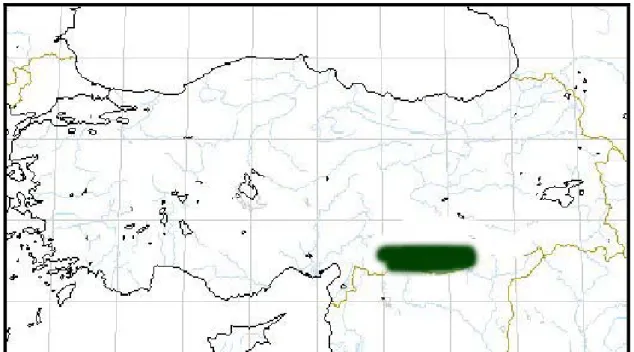
Scorpions were collected from Harran and Akçakale towns of Sanlıurfa (36° 40’ - 38°
02’ W and 37° 50’ - 42° 12’ E; Figure 1) in July 2003. Thirty-two specimens (11 males
and 21 females) were stored in 70% ethanol at the Department of Entomology,
Faculty of Veterinary Medicine, Ankara University, Turkey.
Specimen examination and diagnosis
Morphometric measurements of the thirty-two scorpions were carried out as
described by Vachon (23, 25-28). Pectinal tooth count and morphological
investigation were performed under stereomicroscope using diagnosis keys (11, 26,
number and confirmed by the presence of genital papillae in males. For all the
measurements, we used callipers to the nearest 0.1mm. Statistical analysis
(parametric and non-parametric) of results were performed using SPSS version 11.0.
Habitat
Most specimens were collected at night, by using a UV lamp, inside buildings and
houses in Harran, and others were collected under stones at daytime. The area is at
the altitude of 518 m and presents typical continental climate and steppe vegetation.
RESULTS
Morphological characteristics
All scorpions were examined under stereomicroscope. Most of them were
reddish-brown, varying from brown to black. Patellae of pedipalps did not present ventral
trichobothria. Pedipalps were also reddish-brown. Chelae were slender with long
fingers.
The specimens had movable pedipalp fingers with three principal distal granules and
one terminal granule. Carapaces bore granules and well-developed carinae. Tergites
presented granules and slightly marked carinae. Sternites were pale brown and
triangular. Legs were yellow-ochre.
Metasomas and vesicles were uniformly reddish-brown with blackish carinae; aculei
were reddish-brown at the base and blackish at the end. Metasomal segments were
slightly widened backwards; metasomal segments I-IV had strongly developed
carinae and spiniform granules on the posterior side; vesicles showed three ventral
series of granules; aculei as well as vesicles were moderately curved in scorpions
identified as A. crassicauda.
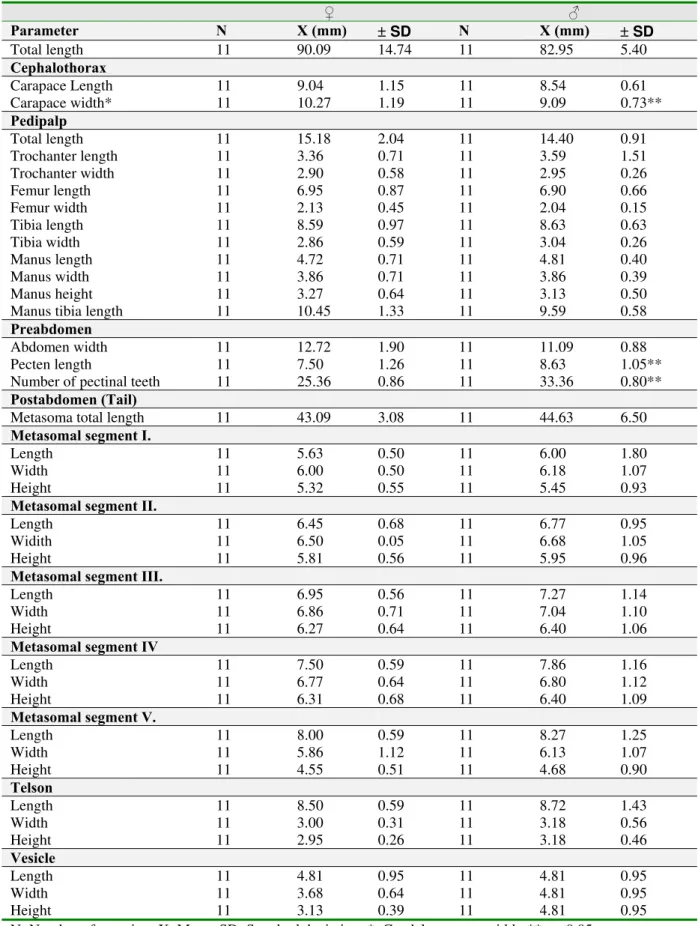
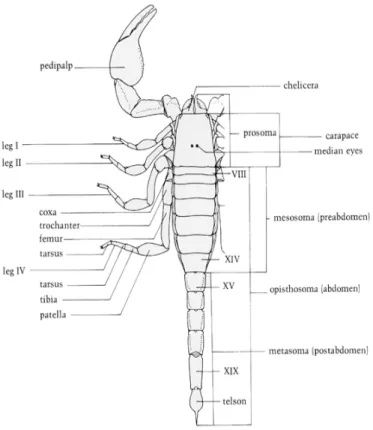
Results of morphometric measurements of the scorpions body parts (Figures 2 and
3), according to sex, are shown in Table 1. Males presented 82.95±5.40mm mean
body length; 11.09±0.88mm mean abdomen width; 9.09±0.73mm mean caudal
carapace width; 44.63±6.50mm mean metasoma length; 8.63±1.05mm mean
pectinal organ length; 33.36±0.80 mean pectinal tooth count. Females showed
90.09±14.74mm mean body length; 12.09±1.90mm mean abdomen width;
length; 7.50±1.26mm mean pectinal organ length; 25.36±0.86 mean pectinal tooth
count.
Sexual dimorphism
Adult female A. crassicauda (Figure 4) are larger than males. However, males have a
higher number of pectinal teeth and therefore longer pectines than females.
Metasoma is longer and wider in males than in females with the same total length.
Carapace is wider in females than in males. Pectinal organ length (males, p=0.033),
pectinal tooth count (males, p=0.000) and caudal carapace width (females, p=0.011)
were significantly different between sexes. Differences of body and metasoma
lengths and abdomen width between males and females were not statistically
significant (p>0.05).
Figure 1: Map of Turkey highlighting Sanliurfa (36° 40’ - 38° 02’ W and 37° 50’ - 42°
12’ E) and close localities of Androctonus crassicauda occurrence in Southeastern
Figure 2: Scorpion dorsal view (14)
Figure 4: Androctonus crassicauda from Southeastern Anatolia [Photographed by
Table 1: Some morphometric measurements of female and male specimens of
Androctonus crassicauda (statistically significant; p<0.05).
♀ ♂
Parameter N X (mm) ± SD N X (mm) ± SD
Total length 11 90.09 14.74 11 82.95 5.40
Cephalothorax
Carapace Length 11 9.04 1.15 11 8.54 0.61 Carapace width* 11 10.27 1.19 11 9.09 0.73**
Pedipalp
Total length 11 15.18 2.04 11 14.40 0.91 Trochanter length 11 3.36 0.71 11 3.59 1.51 Trochanter width 11 2.90 0.58 11 2.95 0.26 Femur length 11 6.95 0.87 11 6.90 0.66 Femur width 11 2.13 0.45 11 2.04 0.15 Tibia length 11 8.59 0.97 11 8.63 0.63 Tibia width 11 2.86 0.59 11 3.04 0.26 Manus length 11 4.72 0.71 11 4.81 0.40 Manus width 11 3.86 0.71 11 3.86 0.39 Manus height 11 3.27 0.64 11 3.13 0.50 Manus tibia length 11 10.45 1.33 11 9.59 0.58
Preabdomen
Abdomen width 11 12.72 1.90 11 11.09 0.88 Pecten length 11 7.50 1.26 11 8.63 1.05** Number of pectinal teeth 11 25.36 0.86 11 33.36 0.80**
Postabdomen (Tail)
Metasoma total length 11 43.09 3.08 11 44.63 6.50
Metasomal segment I.
Length 11 5.63 0.50 11 6.00 1.80
Width 11 6.00 0.50 11 6.18 1.07
Height 11 5.32 0.55 11 5.45 0.93
Metasomal segment II.
Length 11 6.45 0.68 11 6.77 0.95
Widith 11 6.50 0.05 11 6.68 1.05
Height 11 5.81 0.56 11 5.95 0.96
Metasomal segment III.
Length 11 6.95 0.56 11 7.27 1.14
Width 11 6.86 0.71 11 7.04 1.10
Height 11 6.27 0.64 11 6.40 1.06
Metasomal segment IV
Length 11 7.50 0.59 11 7.86 1.16
Width 11 6.77 0.64 11 6.80 1.12
Height 11 6.31 0.68 11 6.40 1.09
Metasomal segment V.
Length 11 8.00 0.59 11 8.27 1.25
Width 11 5.86 1.12 11 6.13 1.07
Height 11 4.55 0.51 11 4.68 0.90
Telson
Length 11 8.50 0.59 11 8.72 1.43
Width 11 3.00 0.31 11 3.18 0.56
Height 11 2.95 0.26 11 3.18 0.46
Vesicle
Length 11 4.81 0.95 11 4.81 0.95
Width 11 3.68 0.64 11 4.81 0.95
Height 11 3.13 0.39 11 4.81 0.95
DISCUSSION
Measurements such as body length, abdomen width, pectinal organ length, pectinal
tooth count, and carapace length are the most commonly used parameters for
species identification and sex discrimination of scorpions.
Karatas and Karatas (8, 9) used pectinal tooth count to discriminate between sexes
and identify species. Vachon (25) stated that the pectinal tooth number of male A.
crassicauda is 33 while several other studies have reported 30 pectinal teeth in
males and 24 in females (13). In the present investigation, the number of pectinal
teeth were not significantly different between males (33.36±0.80) and females
(25.36±0.86); p=0.000. Comparing recent findings on A. crassicauda with data from
the present study, and according to the identification key, no morphological
differences were detected.
According to recent reports, Androctonus crassicauda can be found in the Sinai
Peninsula (Egypt), across the entire Middle East (Southeastern Anatolia - Turkey),
Arabian Peninsula and Armenia (15, 30). In the present study, it is reported that this
species is common in Southeastern Anatolia region, especially Akçakale and Harran
towns of Sanlıurfa province near Syria and Iraqi borders in the Middle East.
Vignoli et al. (30) collected A. crassicauda specimens in a village, inside farmhouses
and houses, and in the desert; they also found dead specimens inside farmhouses.
In the present study, most specimens were collected in similar places (inside
farmhouses, buildings and adobe houses in Harran). According to Fet and
Braunwalder (5), species of the Androctonus genus inhabit deserts. In the study by
Crucitti (3), the specimens were collected inside buildings. Our results showed that A.
crassicauda can be found in different habitats, such as clefts in adobe bricks, sandy
areas, inside houses, on the surface and bottom of stones and under dry feces inside
animal houses.
According to recent reports, the total length of A. crassicauda (Figure 4) is 80-100mm
(4, 16). In the present study, the mean total length was similar between sexes
(females: 90.09mm; males: 82.95mm). Vachon (26) reported 48mm total metasoma
length in male. Our findings were similar, 44.63±6.50mm in males and
43.09±3.08mm in females.
Differences in pectinal organ lengths (males, p=0.033), pectinal tooth counts (males,
On the other hand, body and metasoma lengths and abdomen width showed no
significant differences between sexes (p>0.05).
In conclusion, human envenomation caused by A. crassicauda sting still constitutes a
serious health problem in many countries including Turkey. It is one of the most
medically important species in the Middle East, which is also used for antivenom
production. Morphometric measurements of A. crassicauda from Turkey had not
been thoroughly determined so far and our study described its detailed parametric
values.
ACKNOWLEDGMENTS
We wish to thank Karina Luiz Chamma for her valuable comments on this
manuscript.
REFERENCES
1 AL-SADOON MK., JARRAR BM. Epidemiological study of scorpion stings in Saudi
Arabia between 1993 and 1997. J. Venom. Anim. Toxins incl. Trop. Dis., 2003,
9, 1, 54-64.
2 ALTINKURT O., ALTAN M. Pharmacological effects of the scorpion (Androctonus
crassicauda) venom from Urfa enviroment on laboratory animals and the
antagonistic effects of streptomycin to most of these effects. J. Fac.
Pharmacol. Ankara., 1980, 10, 41-61.
3 CRUCITTI P. Bio-ecological researches on Androctonus crassicauda in
south-eastern Anatolia (Scorpiones Buthidae). Boll. Soc. Entomol. Ital., 2003, 135,
3-14.
4 DEMIRSOY A. Invertebrate (out of Insecta). 2.ed. METEKSAN Published: 1998, 2,
734-9.
5 FET V., BRAUNWALDER ME. The scorpions (Arachnida: scorpiones) of the aegen
area: current problems in taxonomy and biogeography. Belg. J. Zool., 2000,
130, 15-20.
6 GAJRE G., DAMMAS AS. Scorpion envenomation in children: should all stings be
given antivenom? Ann. Saudi Med., 1999, 19, 444-6.
7 ISMAIL M., ABD-ELSALAM MA., AL-AHAIDIB MS. Androctonus crassicauda
(Olivier), a dangerous and unduly neglected scorpion-I. Pharmacological and
8 KARATAS A., KARATAS A. First record of Mesobuthus eupeus (C.L.Koch, 1839)
from central Anatolia (Scorpiones: Buthidae). Scorpions, Mem. Gray A. Polis.,
2001: 297-9.
9 KARATAS A., KARATAS A. Mesobuthus eupeus (C.L.Koch, 1839) (Scorpiones:
Buthidae) in Turkey. Euscorpius, 2003, 7, 1-6.
10 KARATAS A., KARATAS A. Türkiye Akrepleri (Arachnida: Scorpiones), [serial
online], 2003. Available from: http://host.nigde.edu.tr/~akaratash/akrep.htm.
11 KOVARÍK F. Review of European scorpions, with a key to species. Sekret, 1999,
6, 38-44.
12 LOURENÇO R. The scorpion families and their geographical distribution. J.
Venom. Anim. Toxins, 2001, 7, 3-23.
13 MEINE SKORPIONE. Androctonus sp (Ehrenberg, 1828); 2004. Available from:
http://bultel.p.free.fr/Deutsch/Androctonus_sp.htm.
14 MULLEN G., STOCKWELL SA. Scorpions (Scorpiones). In: MULLEN G.,
DURDEN L. Eds. Medical and Veterinary Entomology. Amsterdam: Academic
Press, 2002: 411-23.
15 OZKAN O., FILAZI A. The determination of acute lethal dose-50 (LD50) levels of
venom in mice, obtained by different methods from scorpions Androctonus
crassicauda (Oliver 1807). Acta Parasitol. Turcica, 2004, 28, 50-3.
16 OZKAN O., KARAER Z. The scorpions in Turkey. Turkish Bull. Hyg. Exp. Biol.,
2003, 60, 55-62.
17 OZKAN O., KARAER Z. Body structures of scorpions. Acta Parasitol. Turcica,
2004, 28, 54-8.
18 OZKAN O., YAMAN N. Scorpion venom. Turkish Bull. Assoc. Vet. Med., 2004, 2,
19-22.
19 OZKAN O., YAMAN N. Scorpion. Turkish Bull. Assoc. Vet. Med., 2004, 11, 15-8.
20 RADMANESH M. Androctonus crassicauda sting and its clinical study in Iran. J.
Trop. Med. Hyg., 1990, 93, 323-6.
21 TULGA T. Cross-reactions between anti-scorpion (Buthus quinquestriatus) and
anti-scorpion (Prionurus crassicauda) sera. Turkish Bull. Hyg. Exp. Biol., 1960,
20, 191-203.
22 TULGA T. Scorpions found in Turkey and paraspecific action of an antivenin
produced with the venom of the species Androctonus crassicauda. Turkish
23 VACHON M. A propes de quelques scorpions de Turquie collectes par M. le
Professeur Dr.Curt Kosswing. I.U Fen Fak. Mec., 1951,16, 341-4.
24 VACHON M. Caracteres servant a la classification. In: VACHON M. Etudes Sur
Les Scorpions. Inst. Pasteur D’ Algerie, 1952: 44-70.
25 VACHON M. Description des scorpions du Nord-Ouest de L'Afrique (Maroc,
Algerie, Tunisie, Fezzan, Sahara et Sahel). A. Familie des Buthidae E. Simon,
1879. [Part I: Genera Cicileus, Buthiscus, Lissothus, Butheoloides and
Anoplobuthus]. In: VACHON M. Etudes Sur Les Scorpions. Inst. Pasteur D’
Algerie, 1952: 71-115.
26 VACHON M. Description des scorpions du Nord-Ouest de L'Afrique (Maroc,
Algerie, Tunisie, Fezzan, Sahara et Sahel). A. Familie des Buthidae E. Simon,
1879. [Part II: Genus Androctonus]. In: VACHON M. Etudes Sur Les
Scorpions. Inst. Pasteur D’ Algerie, 1952: 116-78.
27 VACHON M. Determination des scorpions du Nord-Ouest de L'Afrique: Tableu
regionaux. Secteur sahlien [Regional identification keys for North-African
scorpions (keys for families, genera and species). Also identification keys for
identifying specimens based on the body, pedipalps or cauda]. In: VACHON
M. Etudes Sur Les Scorpions. Inst. Pasteur D’ Algerie, 1952, 420-70.
28 VACHON M. Morphologie, Bionomie et repartition mondiale. In: VACHON M.
Etudes Sur Les Scorpions. Inst. Pasteur D’ Algerie, 1952, 1-44.
29 VATANPOUR H. Effects of black scorpion Androctonus crassicauda venom on
striated muscle preparation in vitro. Iranian J. Pharmac. Res., 2003, 2, 17-22.
30 VIGNOLI V., KOVARÍK F., CRUCITTI P. Scorpiofauna of Kashan (Esfahan
![Figure 4: Androctonus crassicauda from Southeastern Anatolia [Photographed by Ozkan (17)]](https://thumb-eu.123doks.com/thumbv2/123dok_br/15912425.673706/6.892.131.736.120.510/figure-androctonus-crassicauda-southeastern-anatolia-photographed-ozkan.webp)