A Computational Study of Conflict Graphs and
Aggressive Cut Separation in Integer
Programming
Samuel Souza Brito and Haroldo Gambini Santos
1Dep. de Computa¸c˜ao, Universidade Federal de Ouro Preto - UFOP
Marcus Poggi
2Dep. de Inform´atica, Pontif´ıcia Universidade Cat´olica do Rio de Janeiro
Abstract
This work explores the fast creation of densely populated conflict graphs at the root node of the search tree for integer programs. We show that not only the Generalized Upper Bound (GUB) constraints are useful for the fast detection of cliques: these can also be quickly detected in less structured constraints inO(nlogn). Routines
for the aggressive separation and lifting of cliques and odd-holes are proposed. Improved bounds and a faster convergence to strong bounds were observed when comparing to the default separation routines found in the current version of the COmputation INfrastructure for Operations Research (COIN-OR) Branch and Cut solver.
Keywords: conflict graphs, integer programming, cutting planes, cliques, odd-holes
1 Email: {samuelsouza,haroldo}@iceb.ufop.br 2 Email: [email protected]
Electronic Notes in Discrete Mathematics 50 (2015) 355–360
1571-0653/© 2015 Elsevier B.V. All rights reserved.
www.elsevier.com/locate/endm
1
Introduction
A conflict graph (CG) represents logical relations between binary variables.
CGs are typically constructed using probing techniques [8] based on
con-straints analysis. On this work we propose an approach to speed up the creation of dense conflict graphs at the root node. Exact separation routines are employed to discover violated cliques and odd-holes, which are lifted in subsequent steps.
In Section 2 we formally explain our approach to speedup the detection
of logical implications; in Section 3 we present the cut separation and lifting
routines; in Section 4computational experiments are presented and finally, in
Section 5we conclude and discuss the results of this work.
2
Conflict Graphs in Integer Programming
A conflict graph represents logical relations between binary variables. Ver-tices represent variables and their complements, and edges indicate that two variables represented by the vertices must not be set to specific values without violating one or more constraints.
Given an Integer Program (IP), a conflict graph can be constructed using
probing techniques based on feasibility considerations [1], checking the impact
of fixing pairs of variables to different combinations of values. First, consider
that each constraint i ∈ {1, . . . , m} can be written as
j∈N
aijxj ≤ bi, where
N ={1, . . . , n} is the index set of binary variablesx, aij is the coefficient for
variable xj at constraint iand bi is the right-hand side of constraint i.
Suppose we are analyzing two particular variables xj and xk with respect
to constrainti. Consider that these variables are assigned with valuesuandv,
respectively. Consider also that Ni− ={j∈N :aij <0}. Then, L
xj=u, xk=v
i =
l∈N− i \{j,k}
ail + aiju+ aikv, is a lower bound for the value on the left-hand
side of the constraint i, considering the assignments xj = u and xk = v. If
Lxj=u, xk=v
i > bi, a conflict is detected for these assignments.
Performing these steps considering each pair of variables in each constraint,
leads to the creation of a conflict graph in O(m×n2), where mis the number
of constraints and n is the number of binary variables of the problem.
Nev-ertheless, for some constraint types a large number of conflicts can be quickly
discovered such as the Generalized Upper Bound constraints (
j∈N
following paragraphs describe the developed approach, which allows to detect
cliques in individual constraints faster than O(n2). Notations yik and cik are
used to indicate the variable with the k-th smallest coefficient in constraint
i and its coefficient. Constants ni and Si− denote the number of non-zero
variables and the sum of all negative coefficients of constrainti.
Conflicting variables can be detected just by traversing constraints with variables sorted in non-decreasing order of their coefficients. Thus, conflicts
in these constraints are discovered inO(nlogn).
At first, consider that at a given position k the summation of negative
coefficients excluding the pair of variables at positionskandk+1 in constraint
iis: Di[yik, yik+1] =Si−−min(0, cik)−min(0, cik+1). Thus, the lower bound for
the LHS of constraintiwhen variables with thek−th and (k+ 1)−th smallest
coefficients are fixed at one is: LHSi[yik= 1, yik+1= 1] =Di[yik, yik+1] +cik+
cik+1.
Since this lower bound is monotonically non-decreasing as k increases, if
LHSi[yik = 1, yik+1= 1] > bi, then there is a clique involving the activation of
all variables from position k until position ni. Moreover, we can discard the
existence of such cliques by checking if LHSi[yini−1 = 1, yini = 1]≤bi.
Analogously, cliques involving complements of variables from positions ni
until k (i.e. traversing constraint i in non-increasing order) can be obtained
or discarded by calculating the limit incurred from positions k and k −1:
LHSi[yik = 0, yik−1= 0] = Di[yik, yik−1].
When the detected clique does not involve all variables of the analyzed constraint, a binary search is performed for each variable outside of the clique.
Given a variable yio outside of the clique detected in i, binary search returns
the first variableyil that has conflict withyio. Thus, all variables from position
l to ni have conflict with yio, forming another clique.
The developed approach can detect all conflicts involving original variables and also all cliques involving complements of variables. Conflicts involving both original and complements of variables are not discovered.
3
Cutting Planes
Linear programming relaxations can be significantly strengthened by the
inclu-sion of inequalities derived from the Set Packing Polytope [6]. A clique
inequal-ity for a setC of conflicting variables has the form
j∈C
inequality with conflicting variables C can be defined as
j∈C
xj ≤
|C| −1
2 .
Our proposed clique separation routine has two main components. The
first of them is a module to separate all violated cliques in the conflict
sub-graph induced by variables with fractional values at linear relaxation of root node. This module uses an improved version of the (exact) Bron-Kerbosch
algorithm [3] that implements an optimized pivoting rule [2] to speed up the
discovery of maximal cliques with large weight. The second component is a (heuristic) lifting module that considers the original conflict graph and iter-atively tries to insert inactive variables, which are previously sorted in non-decreasing order of reduced cost.
The developed odd-hole separation routine is the same used in [6]. The
main idea is to construct an auxiliary bipartite graph from the original one and to search for shortest paths. We also heuristically lift the generated odd-holes, using strategy which is similar to used in the clique lifting. Iteratively, inactive variables previously sorted in non-decreasing order of reduced cost are selected and analyzed to be inserted in the generated odd-hole. A lifted odd-hole for
variablesC and a wheel centerW can be written as:
j∈W
|C| −1
2 xj+
j∈C
xj ≤
|C| −1
2 .
4
Experimental Results
Our code was written using the open source COIN-OR [5] CLP libraries to
solve linear programs and the CGL library was used to compare with our cut generation routines. All experiments ran on a computer with an Intel Core i7 3.6GHz processor and 32GB of RAM.
The first set of instances is the benchmark set of from MIPLIB 2010 [4],
containing 87 instances. The second set of instances (INRC) comes from an IP
formulation used to solve the Nurse Rostering Problem [7] of the International
Nurse Rostering Competition, containing 60 instances. Characteristics of each
problem set are presented in Table 1: columns (n), rows (m), non-zeros (nz).
The notation (v,v,˜v) indicates minimum, maximum and average values.
The first experiment compares the construction of conflict graphs using
pairwise detection (P D), which only detects cliques quickly in GUB
con-straints (conflicts in the remaining concon-straints are discovering by pairwise
number of edges (|E|) and total time in seconds spent in the construction of
conflicts graphs for all instances of each set (T ime(sec)).
Table 1
Characteristics of instance sets.
Inst. Set
Problem Sizes (×103
)
n/n/˜n m/m/ ˜m nz/nz/ ˜nz
MIPLIB 0.1/164.6/13.7 0.1/624.2/32.1 0.7/27678.7/515.9 INRC 9.8/63.6/29.7 3/29.2/11.7 201.1/1068.1/534.8
Table 2
Comparison between pairwise detection and our approach.
Inst. Set
PD FCG
|E|/|E|/|E˜|(×103
) Time (sec) |E|/|E|/|E˜| (×103
) Time (sec)
MIPLIB 0/11396,11/480,82 173,37 0/11396,11/477,71 23,91 INRC 2470,14/12807,28/6346,36 370,4 2469,70/12803,68/6344,88 369,99
The second experiment compares the cut generation routine of COIN-OR CGL (CGL) and our cut generation routines with (LNPSEP) and without
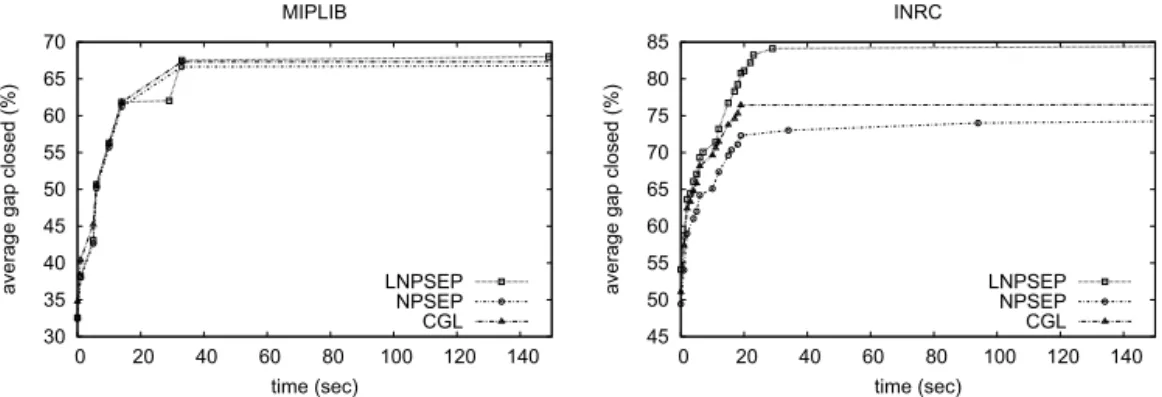
lifting module (NPSEP). Figure1shows the average gap closed improvement
for each instance set. After removing infeasible instances and instances where neither our code or CGL found any violated inequality, there were left 18 instances of MIPLIB and 60 of INRC set. The time limit was fixed in 150 seconds. While remarkable improvements in terms of bounds were obtained in the INRC instances (from 76.56% with CGL to 84.76% with LNPSEP), which have a large number of dense set partitioning and packing constraints, a modest improvement occurred in MIPLIB instances. The average gap closed for these instances was improved from 67.32%, obtained with CGL, to 68.83%, obtained with LNPSEP within the time limit imposed.
5
Conclusions
30 35 40 45 50 55 60 65 70
0 20 40 60 80 100 120 140
average gap closed (%)
time (sec) MIPLIB
LNPSEP NPSEP CGL
45 50 55 60 65 70 75 80 85
0 20 40 60 80 100 120 140
average gap closed (%)
time (sec) INRC
LNPSEP NPSEP CGL
Figure 1. Dual bound improvement using LNPSEP, NPSEP and CGL routines.
and detailed results of all experiments can be found on the project web page:
https://github.com/hgs/npsep/wiki.
References
[1] Atamt¨urk, A., G. L. Nemhauser and M. W. Savelsbergh, Conflict graphs
in solving integer programming problems, European Journal of Operational
Research121 (2000), pp. 40 – 55.
[2] Brito, S. and H. G. Santos, Pivoting in the Bron-Kerbosch algorithm for maximum-weight clique detection (in portuguese)., in:Anais do XLIII Simp´osio Brasileiro de Pesquisa Operacional, 2011, pp. 3052–3059.
[3] Bron, C. and J. Kerbosch, Algorithm 457: finding all cliques of an undirected
graph, Commun. ACM16 (1973), pp. 575–577.
[4] Koch, T., T. Achterberg and E. Andersen, MIPLIB 2010, Mathematical Programming Computation3 (2011), pp. 103–163.
[5] Lougee-Heimer, R., The Common Optimization INterface for Operations Research, IBM Journal of Research and Development47(2003), pp. 57–66.
[6] Rebennack, S.,Stable set problem: Branch & cut algorithms stable set problem: Branch & cut algorithms, in: C. A. Floudas and P. M. Pardalos, editors,
Encyclopedia of Optimization, Springer US, 2009 pp. 3676–3688.
[7] Santos, H. G., T. A. Toffolo, R. A. Gomes and S. Ribas, Integer programming
techniques for the nurse rostering problem, Annals of Operations Research
(2014).
[8] Savelsbergh, M. W. P., Preprocessing and probing techniques for mixed integer