Olive cultivar and maturation process on
the oviposition preference of
Bactrocera
oleae
(Rossi) (Diptera: Tephritidae)
R. Malheiro
1,2, S. Casal
2, L. Pinheiro
1, P. Baptista
1and
J.A. Pereira
1*
1
Centro de Investigação de Montanha (CIMO), ESA, Instituto Politécnico de
Bragança, Campus de Santa Apolónia, 5300-253 Bragança, Portugal:
2
REQUIMTE/LAQV/Laboratório de Bromatologia e Hidrologia, Faculdade
de Farmácia, Universidade do Porto, Porto, Portugal
Abstract
The olive fly,
Bactrocera oleae
(Rossi) (Diptera: Tephritidae), is a key-pest in the
main olives producing areas worldwide, and displays distinct preference to different
olive cultivars. The present work intended to study oviposition preference towards
three Portuguese cultivars (Cobrançosa, Madural, and Verdeal Transmontana) at
different maturation indexes. Multiple oviposition bioassays (multiple-choice and
no-choice) were conducted to assess cultivar preference. No-choice bioassays were
conducted to assess the influence of different maturation indexes (MI 2; MI 3, and
MI 4) in single cultivars. The longevity of olive fly adults according to the cultivar
in which its larvae developed was also evaluated through survival assays.
Cultivar and maturation are crucial aspects in olive fly preference. Field and
laboratory assays revealed a preference towards cv. Verdeal Transmontana olives
and a lower susceptibility to cv. Cobrançosa olives. A higher preference was observed
for olives at MI 2 and MI 3. The slower maturation process in cv. Verdeal
Transmontana (still green while the other cultivars are reddish or at black stage)
seems to have an attractive effect on olive fly females, thus increasing its infestation
levels. Olive fly adults from both sexes live longer if emerged from pupae developed
from cv. Verdeal Transmontana fruits and live less if emerged from cv. Cobrançosa.
Therefore, olive cultivar and maturation process are crucial aspects in olive fly
pref-erence, also influencing the longevity of adults.
Keywords:
adult longevity, cultivar preference, olive fly, olive ripening,
oviposition
(Accepted 22 January 2018)
Introduction
The olive fly,Bactrocera oleae(Rossi) (Diptera: Tephritidae)
is one of the most important pest of olive crops worldwide and a key-pest in the Mediterranean region. The impact of the olive fly is considerably high, causing production losses due to pulp spoilage, fruit drop, and contamination of olives with
microorganisms (Iannotaet al.,2012), compromising the
com-mercial classification of olive products, reducing olive oil
qual-ity, composition and functional properties (Pereiraet al.,2004),
and causing an overall unprecedented economic impact
(Malheiroet al.,2015a). Nevertheless, this impact varies
con-siderably among cultivars. Some cultivars are concon-siderably less susceptible to olive fly attacks, while in others, the produc-tion can be totally lost in years of high infestaproduc-tion levels
(Navrozidiset al.,2007; Burrack & Zalom,2008).
The interaction between olive cultivars and olive fly re-garding oviposition preference has been studied in order to understand the parameters involved in such phenomena. The studies conducted were mainly based on physical *Author for correspondence
Phone: +351 273303277 Fax: 351 273325405
E-mail:[email protected]
Bulletin of Entomological Research, Page 1 of 11 doi:10.1017/S0007485318000135
©Cambridge University Press 2018
https://www.cambridge.org/core/terms. https://doi.org/10.1017/S0007485318000135
(Rizzoet al.,2012), chemical (Kombargiet al.,1998), and
mo-lecular factors (Corradoet al.,2012; Imperatoet al.,2012). In
the case of physical parameters, studies were conducted in order to establish correlations between the olive size and
hard-ness and the olive fly oviposition preference (Gonçalveset al.,
2012), as well as its colour (Katsoyannos & Kouloussis,2001;
Malheiroet al.,2015b). The olive colour is intrinsically
corre-lated with fruit maturation, during which olives undergo modifications induced by metabolic processes, but in each olive cultivar, the maturation process is characteristic. Some cultivars have a fast ripening process, rapidly changing from
green to black and passing through the so-called ‘
cherry-phase’, while others remain green for quite long periods.
Therefore, the colour of olives in the different maturation
in-dexes (MI) influences olive flies’ choice towards a specific
olive cultivar (Malheiroet al.,2015b). Some authors verified
a higher attraction of olive fly females to red colours
(Katsoyannos & Kouloussis, 2001), while others report the
preference of the olive fly for green olives (Vlahov,1992).
In Portuguese cultivars from the Trás-os-Montes region, the olive fly oviposition preference is also observed (Gonçalves
et al., 2012), particularly for cvs. Verdeal Transmontana and
Madural, while cv. Cobrançosa reported, every year, to have low infestation levels.
Therefore, the main objective of the present work is to study the influence of olive cultivar and MI under laboratory conditions, in Portuguese cultivars with different susceptibil-ity degrees. The effect of the cultivar on olive fly adult survival was also evaluated.
Material and methods
In the present work, all olive samples and insects used were collected from an Integrated Production olive grove located in
Paradela (Mirandela–41°32′35.72″N; 7°07′27.17″W),
Trás-os-Montes region (Northeast of Portugal) in the years of 2013 and 2014. The study focused on three of the main cultivars of the Trás-os-Montes region, namely Cobrançosa, Madural, and Verdeal Transmontana.
Infestation level and MI determination
From each olive cultivar, five trees (approximately 60 years-old; 4 m high; rain-fed; no control treatments) were se-lected and marked to determine the infestation level and MI. Both parameters were assessed fortnightly from 27 August to 6 November 2013 (last possible date to be assessed prior to ol-ives harvest).
In order to assess infestation level, 40 random handpicked fruits were collected from each olive tree (five trees per culti-var; 200 fruits; morphological characterization of the fruits
from each cultivar can be found at Malheiroet al.,2015a) in
the mentioned periods and inspected in a binocular stereo-microscope for signs of infestation (oviposition sites or exit holes). The infestation level was expressed as the percentage of infested olive fruits.
Simultaneously, fruits were collected per tree for
calcula-tion of the MI as described by Hermosoet al.(2001). Briefly,
samples of 100 olive fruits (20 fruits per tree) were separated in eight maturation categories based on epidermis and pulp
colour (0–7). Therefore, the fruits were classified as‘MI 0’if
the epidermis was green;‘MI 1’for yellowish green;‘MI 2’if
the epidermis showed red spots in less than half the fruit;‘MI
3’if the epidermis was red or purple in more than half the fruit;
‘MI 4’for black epidermis and white pulp;‘MI 5’if the
epider-mis was black and less than half the pulp is purple;‘MI 6’if the
epidermis is black and more than half pulp purple (without
reaching the stone);‘MI 7’if the epidermis was black and the
total pulp purple (reaching the stone). The MI was calculated as follows:
MI=
(n×0+n×1+n×2+n×3
+n×4+n×5+n×6+n×7) 100
wherenis the number of fruits in each MI of classification
considered.
Bactrocera oleaecollection and rearing
Olives with signs of olive fly infestation were collected from the trees, separated and spread in trays, larvae and pupae were collected daily and transferred to rearing boxes. Once hatched from pupae, adults were separated daily (for age control purposes) into new rearing boxes. Larvae, pupae, and adults were maintained under the following con-ditions: 26 ± 1°C, 70 ± 10% of relative humidity, with a
photo-period of 16L:8D. Adults were fed ad libitumwith a honey
solution (10% w/v), artificial diet (sucrose and yeast extract at a ratio of 4:1) and water, and the diet changed every 2 days.
Oviposition bioassays
For all the oviposition assays, 15-day-old olive fly adults (both males and females) were used in order to ensure that all females were gravid. The olives used in all oviposition bioassays were collected from marked trees in each cultivar. Once in the laboratory, all olives were inspected one by one so as to select only perfectly healthy olives. Olives with signs of diseases were discarded and olives with signs of olive fly infestation were used for survival assays (in more detail in
the section‘Survival bioassays’).
The conditions in which all oviposition bioassays were con-ducted and the diet given to the flies are the same as those
de-scribed in the section‘Bactrocera oleae collection and rearing’.
After the bioassays, each set of olives was observed under a binocular stereomicroscope in order to count the number of oviposition sites on each olive. Subsequently, the olives were maintained for 1 month under the same conditions previously described so that the number of pupae and/or adults emerged could be collected and registered. The following parameters were considered: number of ovipositions; number of olives re-covered without ovipositions; number of olives rere-covered with ovipositions; number of ovipositions per assayed olive; number of ovipositions per infested assayed olive; number of pupae/adults collected; percentage of recovered pupae/ adults to the total amount of ovipositions.
Oviposition bioassays based on olive cultivar
In order to verify the cultivar oviposition preference of the olive fly, two types of bioassays were carried out:
(i) Multiple-choice oviposition assays: olive fly males and
fe-males (10 pairs) were placed in cages (0.05 m3) and
was repeated during 10 consecutive days in five
inde-pendent cages (n= 5), totalizing 1000 olives assessed
per cultivar.
(ii) No-choice oviposition assays: The no-choice oviposition
bioassays were replicated under same procedure and conditions applied in multiple-choice oviposition bioas-says, however, in this case, 60 olives of a single cultivar are exposed to the flies during 24 h for 10 consecutive days. Five independent bioassays per cultivar were de-veloped, totalizing 3000 olives assessed per cultivar.
In both the multiple-choice and no-choice oviposition bioas-says, the olives from cvs. Cobrançosa and Madural were at
an MI of 3–4, and the olives from cv. Verdeal Transmontana
were at an MI of 2–3.
Oviposition bioassays based on MI
In order to verify the impact of MI on the olive fly ovipos-ition preference, an oviposovipos-ition bioassay similar to the no-choice oviposition bioassay was developed. In this case, three MI were tested per olive cultivar: MI 2, MI 3, and MI 4. The olives used were separated according to the scale of
Hermosoet al.(2001) (see section 2.1. for further details). The
replicates were limited to the number of available healthy fruits in each MI, so five replicates were conducted at MI 2 and MI 3 for cvs. Cobrançosa and Madural (3000 olives per cultivar and MI); four replicates were conducted at MI 2 and MI 3 for cv. Verdeal |Transmontana (2400 olives assessed per MI); three and two replicates were conducted at MI 4 for cvs. Cobrançosa and Madural, respectively (1800 and 1200 olives assessed, respectively). Due to the slower maturation process of cv. Verdeal Transmontana, it was impossible to collect en-ough amounts of healthy olives prior to the harvest date in order to implement oviposition bioassays at MI 4 for this cultivar.
Survival bioassays
The olives destined for oviposition bioassays, but with signs of olive fly infestation were separated by cultivar. These fruits were spread in trays and larvae and pupae were collected daily and then transferred to three rearing cages, one per cultivar. Rearing cages were inspected daily (every 8 h) for signs of adults. Once emerged, olive fly adults were separated by sex and maintained in groups of a maximum of ten indivi-duals in smaller cages, only with water (no diet supplied), and
with diet (as mentioned in the section‘Bactrocera oleae collection
and rearing’). The cages were inspected at least every 8 h to
re-move and register possible dead individuals. For each olive cultivar and sex (without and with diet), 100 individuals were monitored. The most approximate date and hour of emergence and death were recorded so as to calculate the proximate survival period in days. Temperatures, relative hu-midity, and photoperiod applied were the same as previously described.
Statistical analysis
Analysis of variance (ANOVA)
An ANOVA with Type III sums of squares was performed using the GLM (General Linear Model procedure) of the SPSS software, version 21.0 (IBM Corporation, New York, USA). The fulfilment of the ANOVA requirements, namely the
normal distribution of the residuals and the homogeneity of
variance, were evaluated by means of the Kolmogorov–
Smirnov with Lilliefors correction (ifn> 50) or the Shapiro–
Wilk’s test (ifn< 50), and Levene’s tests, respectively. All the
dependent variables were analyzed using a one-way ANOVA with or without Welch correction, depending on whether the requirement of the homogeneity of variances was fulfilled or not. The main factors studied were: longevity of olive fly males and females whose larvae developed in different olive cultivars. If a statistical significant effect was found, the
means were compared using Tukey’s honestly significant
dif-ference multiple comparison test or Dunnett T3 test, also de-pending on whether equal variances could be assumed or not. All statistical tests were performed at a 5% significance level.
Survival curves were represented for each treatment with
Kaplan–Meier estimates using the Surv and survfit functions
from the‘survival’package (Therneau,2014) in R software.
Four separated Cox Proportional Hazard Models using the coxph function from the same package were fitted for: (i) unfed females, (ii) fed females, (iii) unfed males, (iv) fed males. This was done in order to analyze the effect of the larva development of the olive fly inside different olive culti-vars (Cobrançosa, Madural, and Verdeal Transmontana) on the survival of adults (females and males), both unfed and fed on an artificial diet.
Results
Infestation levels and maturation
The infestation levels registered remained low (<5%), in the
three olive cultivars until 10 October (fig. 1). After that, the
olive fly infestation increased in all cultivars, with a higher in-crement in cvs. Madural (17.5%) and Verdeal Transmontana (15.0%). In the last sampling date (6 November), infestation levels of 24.5% for cv. Verdeal Transmontana were observed, followed by cv. Madural (16.0%), and at last by cv. Cobrançosa (8.5%). Significant differences were found between cv. Verdeal
Transmontana and cv. Cobrançosa (P= 0.030) in the last
sam-pling date.
Olives from cv. Verdeal Transmontana reported a very slow maturation process, being completely green at the begin-ning of the study (MI = 0) and still yellow-green (MI = 0.89)
Fig. 1. Infestation levels (%) (lines) and maturation index (markers) of olives from cvs. Cobrançosa, Madural, and Verdeal Transmontana.
Bactrocera oleaeoviposition preference 3
https://www.cambridge.org/core/terms. https://doi.org/10.1017/S0007485318000135
at the end of it, coinciding with the olive harvest for olive oil extraction. For cv. Madural, at the end of the study, the olives were already in the cherry-stage, becoming reddish (MI = 2.03). Regarding the olives from cv. Cobrançosa, they re-ported a faster maturation rate, reporting an MI = 2.08 on 23 October and an MI = 3.01 on the last assessed date, being com-pletely reddish by then. Therefore, the olive fly can simultan-eously find olives with green, yellow green and reddish colouration in the field but shows a clear preference towards
green or yellow-green olives, as verified by our data (fig. 1).
Effect of cultivar in olive fly oviposition
Multiple-choice oviposition bioassays
In all the three olive cultivars, it was noted that the number of ovipositions progressively increased as the days assessed
passed by, increasing from 1 ovipositionnday 1–44, 41, and
54 ovipositions (day 10) for cvs. Cobrançosa, Madural, and
Verdeal Transmontana, respectively (table 1).
The olives from cv. Madural reported the lowest ovipos-ition average, 170 ± 21 (in 200 fruits overall), followed by cv. Cobrançosa with 184 ± 8, while cv. Verdeal Transmontana reported the highest number of ovipositions, with 207 ± 24 (table 1). Meanwhile, no statistical differences were observed in the number of ovipositions in the three cultivars
(P= 0.373). Regarding the number of attacked and
non-attacked olives, the three cultivars showed similar values
without statistical differences (P= 0.836), with the number of
attacked olives varying between 103 ± 7 and 106 ± 3 (table 1).
In general, the olives from cv. Verdeal Transmontana reported a higher number of ovipositions per fruit (1.04 ± 0.12), and when reporting ovipositions only to the attacked olives, the number increased to 2.13 ± 0.23, against 1.96 ± 0.04 and 1.79 ± 0.17 for cvs. Cobrançosa and Madural, respectively
(P= 0.344). From the 207 ovipositions made in cv. Verdeal
Transmontana olives, 134 pupae/adults were collected (table 1). In the cases of cvs. Cobrançosa and Madural, 115 ± 6 and 108 ± 4 pupae/adults were recovered, respectively. No statistical differences were verified in the number of pupae/
adults recovered (P= 0.285).
No-choice oviposition bioassays
In the no-choice oviposition bioassays, a single olive culti-var was presented to the olive fly females, therefore a real choice is not in question. The results obtained in this type of bioassay were concise and clear: the olives from cv. Verdeal Transmontana are highly preferred to oviposit, followed by
cvs. Madural and Cobrançosa olives (table 2).
Ovipositions were significantly higher in cv. Verdeal
Transmontana (P< 0.001), with 1073 ± 77 ovipositions (in 600
olives overall). Only 133 ± 7 out of 600 olives were not infested, reporting an overall number of ovipositions per olive of 1.79 ±
0.13 (table 2). Regarding cv. Madural, 577 + 12 ovipositions
were recorded, nearly half of those reported by cv. Verdeal Transmontana. An average of 0.96 ± 0.02 ovipositions per olive was observed, with a rise to 1.63 ± 0.04 per infested olive. The olives from cv. Cobrançosa were less attacked by the olive fly, with 450 ± 23 ovipositions overall, less than 1
Table 1. Parameters evaluated in multiple-choice oviposition bioassays during 10 consecutive days, with olives from cvs. Cobrançosa, Madural, and Verdeal Transmontana (mean values ± standard error;n= 5).
Days assayed
Parameter 1 2 3 4 5 6 7 8 9 10 Σ
Ovipositions (n)
Cobrançosa 1 1 2 6 19 26 27 21 37 44 184 ± 8 a
Madural 1 2 2 4 17 28 22 24 29 41 170 ± 21 a
Verdeal Transmontana 1 3 2 5 14 24 23 29 52 54 207 ± 24 a
Olives not attacked (n)
Cobrançosa 19 19 18 15 9 5 6 8 4 3 106 ± 3 a
Madural 19 19 18 16 9 5 4 6 6 3 105 ± 5 a
Verdeal Transmontana 19 18 18 16 10 7 5 4 4 2 103 ± 7 a
Olives attacked (n)
Cobrançosa 1 1 2 5 11 15 14 12 16 17 94 ± 3 a
Madural 1 1 2 4 11 15 16 14 14 17 95 ± 5 a
Verdeal Transmontana 1 2 2 4 10 13 15 16 16 18 97 ± 7 a
Ovipositions per olive
Cobrançosa 0.04 0.04 0.11 0.31 0.95 1.28 1.36 1.04 1.86 2.22 0.92 ± 0.04 a
Madural 0.04 0.08 0.10 0.20 0.85 1.38 1.10 1.18 1.43 2.04 0.85 ± 0.11 a
Verdeal Transmontana 0.06 0.13 0.10 0.24 0.70 1.21 1.17 1.45 2.60 2.68 1.04 ± 0.12 a Ovipositions per infested olive
Cobrançosa 0.40 0.40 0.80 1.33 1.70 1.72 1.90 1.71 2.29 2.61 1.96 ± 0.04 a
Madural 0.40 0.40 0.80 0.85 1.59 1.86 1.35 1.65 1.94 2.36 1.79 ± 0.17 a
Verdeal Transmontana 0.60 0.64 0.65 1.08 1.26 1.73 1.56 1.77 3.07 3.00 2.13 ± 0.23 a Collected pupae/adults
Cobrançosa 0 0 2 4 10 16 13 14 25 31 115 ± 6 a
Madural 0 2 1 1 12 16 15 13 19 29 108 ± 4 a
Verdeal Transmontana 0 1 1 3 10 17 19 17 33 33 134 ± 8 a
Ratio pupae/stings (%)
Cobrançosa 0 0 100 66.7 52.6 61.5 48.1 66.7 67.6 70.4 62.5 ± 2.6 a
Madural 0 100 50.0 25.0 70.6 57.1 68.1 54.2 65.5 70.7 63.5 ± 3.5 a
oviposition per olive assayed (0.75 ± 0.04) and an average of
1.66 ± 0.11 ovipositions per infested fruit (table 2).
Concerning the number of pupae/adults recovered, 657 ± 16, 361 ± 17, and 230 ± 14 were collected from cvs. Verdeal Transmontana, Madural, and Cobrançosa, respectively. This means a percentage of recovery from the total number of ovipositions of 61.2 ± 5.3, 62.6 ± 2.2, and 51.1 ± 5.3%. Besides being the least preferred by olive fly females to oviposit, the olives from cv. Cobrançosa reported a lower ratio between pupae/adults recovered and the number of ovipositions. In this case, it means that 39.8, 37.4, and 48.9% of the ovipositions
made were unable to lead to adults’formation in cvs. Verdeal
Transmontana, Madural, and Cobrançosa, respectively.
Maturation process and cultivar in olive fly oviposition preference
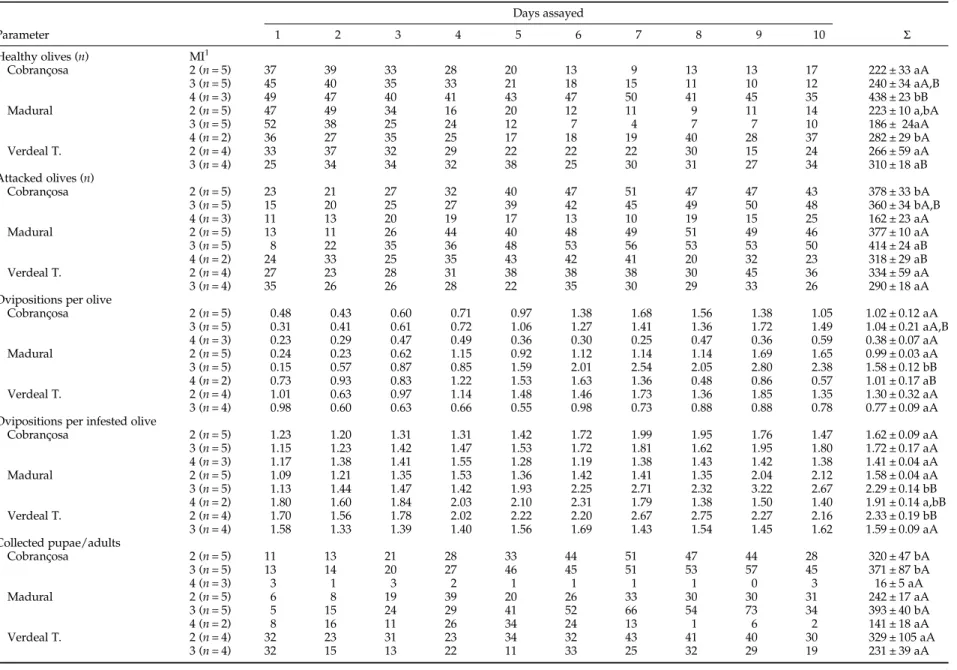
The results obtained showed that besides the olive cultivar, the maturation stage is a preponderant factor influencing the olive fly oviposition. At the sameMI, MI 2, the olives from cv. Verdeal Transmontana were the most infested, reporting an average of 778 ± 195 ovipositions against 614 ± 74 and 594 ± 19
in cvs. Cobrançosa and Madural, respectively (fig. 2). No
sig-nificant differences were reported among cultivars at MI 2
(P= 0.457).
The number of ovipositions decreased slightly from MI 2 to MI 3, mainly in cv. Verdeal Transmontana, while in
cv. Madural a significant increase (P< 0.001) was observed
(fig. 2), to 948 ± 73. Infig. 2it is possible to observe that both olive cultivars tested at MI 4 reduced the number of oviposi-tions significantly: cv. Cobrançosa decreased from 621 ± 128
at MI 3 to 229 ± 40 at MI 4 (P= 0.007), while cv. Madural
de-creased from 948 ± 73 to 608 ± 100 (P= 0.003). It is clear that
the olive fly prefers green or reddish olives rather than black olives to oviposit. Another interesting aspect observed in the maturation oviposition bioassays was the percentage of col-lected pupae/adults in respect to the mean number of ovipo-sitions. At MI 4, only 7 ± 0.7% of cv. Cobrançosa pupae/adults were recovered, which means that about 93% of ovipositions made were sterile punctures or eggs and larvae that died in-side the drupe of cv. Cobrançosa. At MI 2 and 3, the percent-age of recovery was, respectively, 52.1 ± 4.4 and 59.7 ± 3.1% (table 3). The same happened in olives from cv. Madural. The percentage of recovery of pupae/adults was 40.7 ± 3.8 and 41.4 ± 1.8% at MI 2 and MI 3, but it decreased to 23.2 ± 0.8% at MI 4. These observations clearly state that be-sides the lower attraction of olive flies to black olives, the ovi-positions carried out are highly unsuccessful to maintain this pest populations.
Survival of olive fly adults
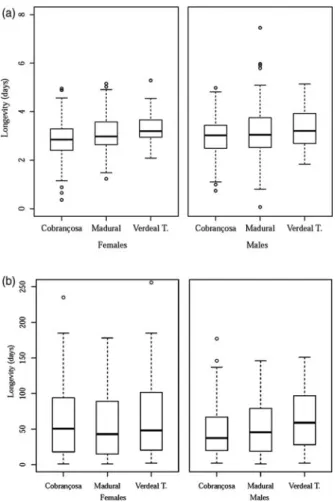
The cultivar influences significantly the longevity of
olive fly adults (fig. 3), with no significant differences found
between males and females in each cultivar (P= 0.423;
P= 0.374; and P= 0.868; respectively, for cvs. Cobrançosa,
Madural, and Verdeal Transmontana). However, the adults which emerged from pupae developed in cv. Verdeal Transmontana olives lived longer than those from cvs. Cobrançosa and Madural. On average, a male emerged from cv. Verdeal Transmontana lived for 3.31 ± 0.07 days while
Table 2. Parameters evaluated in no-choice oviposition bioassays during 10 consecutive days, with olives from cvs. Cobrançosa, Madural, and Verdeal Transmontana (mean values ± ;n= 5).
Days assayed
Parameter 1 2 3 4 5 6 7 8 9 10 Σ
Ovipositions (n)
Cobrançosa 16 60 26 45 17 29 36 82 55 84 450 ± 23 a
Madural 62 60 90 39 51 79 34 89 18 55 577 ± 12 a
Verdeal T. 42 148 96 111 140 107 135 85 125 84 1073 ± 77 b
Healthy olives (n)
Cobrançosa 47 26 41 28 44 40 32 21 24 26 329 ± 17 a
Madural 11 29 12 33 31 16 35 14 44 22 247 ± 8 b
Verdeal T. 28 4 25 9 10 14 12 15 5 11 133 ± 7 c
Attacked olives (n)
Cobrançosa 13 34 19 32 16 20 28 39 36 34 271 ± 17 a
Madural 49 31 48 27 29 44 25 46 16 38 353 ± 8 b
Verdeal T. 32 56 35 51 50 46 48 45 55 49 467 ± 7 c
Ovipositions per olive
Cobrançosa 0.27 1.00 0.43 0.75 0.28 0.48 0.60 1.37 0.92 1.40 0.75 ± 0.04 a
Madural 1.03 1.00 1.50 0.65 0.85 1.32 0.57 1.48 0.30 0.92 0.96 ± 0.02 a
Verdeal T. 0.70 2.47 1.60 1.85 2.33 1.78 2.25 1.42 2.08 1.40 1.79 ± 0.13 b
Ovipositions per infested olive
Cobrançosa 1.23 1.76 1.37 1.41 1.06 1.45 1.29 2.10 1.53 2.47 1.66 ± 0.11 a
Madural 1.27 1.94 1.88 1.44 1.76 1.80 1.36 1.93 1.13 1.45 1.63 ± 0.04 a
Verdeal T. 1.31 2.64 2.74 2.18 2.80 2.33 2.81 1.89 2.27 1.71 2.30 ± 0.15 b
Collected pupae/adults
Cobrançosa 8 41 12 29 5 5 17 50 33 30 230 ± 14 a
Madural 104 36 78 24 23 17 22 70 11 34 361 ± 17 b
Verdeal T. 35 99 81 80 77 48 71 45 42 79 657 ± 16 c
Ratio pupae/stings
Cobrançosa 50.0 68.3 46.2 64.4 29.4 17.2 47.2 61.0 60.0 35.7 51.1 ± 5.3 a
Madural 74.2 60.0 86.7 61.5 45.1 21.5 64.7 78.7 61.1 61.8 62.6 ± 2.2 a
Verdeal T. 83.3 66.9 84.4 72.1 55.0 44.9 52.6 52.9 33.6 94.0 61.2 ± 5.3 a
Bactrocera oleaeoviposition preference 5
https://www.cambridge.org/core/terms. https://doi.org/10.1017/S0007485318000135
females lived for 3.29 ± 0.06 days. In cv. Madural, males and females lived for 3.20 ± 0.11 and 3.08 ± 0.07 days, while in cv. Cobrançosa they lived for 2.98 ± 0.08 and 2.89 ± 0.08
days, respectively (fig. 3). Survival curves are represented
infig. 4.
The death hazard of unfed males and females was
signifi-cantly different according to the olive cultivar (P< 0.001 for
both sexes). Particularly, the death hazard was lower in unfed females developed in Verdeal Transmontana [1.99 times lower
than in Cobrançosa (P< 0.001), and 1.48 times lower than in
Madural (P= 0.017)]. The death hazard of unfed adult males
born from larvae developed in cvs. Cobrançosa and Madural
were significantly higher (1.47 times, P= 0.026) and slightly
higher (1.34 times,P= 0.059), respectively, than the ones
devel-oped in cv. Verdeal Transmontana. Furthermore, the death hazard for males which died after day 4.1 was lower when larvae had developed in cv. Madural than when fed in cv.
Cobrançosa (4.129 times, P= 0.014) and in cv. Verdeal
Transmontana (5.058 times,P< 0.001).
The diet of tephritids, and specially theBactroceraspecies
considerably influence their survival (Jaleelet al.,2017). The
larva development in different olive cultivars did not
signifi-cantly affect the adult females and males’survival when fed
on the artificial diet (P= 0.399 andP= 0.083 for females and
males respectively). In general, males and females from cv. Verdeal Transmontana lived significantly longer than those
from cv. Cobrançosa (P= 0.008 and P< 0.001 respectively),
approximately 11.1% longer for males, while females lived 13.8% longer.
Discussion
Infestation levels and maturation
The results obtained regarding the infestation level fol-lowed a trend observed in other years, indicating that cvs. Madural and Verdeal Transmontana are more susceptible to the olive fly infestation than cv. Cobrançosa (Gonçalves
et al.,2012; Malheiroet al.,2015b,c). It was interesting to
ob-serve that infestation levels start rising at the exact moment
when maturation begins (fig. 1). This period also coincides
with the decrease of the high temperatures recorded during July and August, which are not favourable to a fast develop-ment of olive fly populations and causes high mortality of
the laid eggs (Gonçalveset al.,2012). The higher preference
of olive flies to oviposit in cv. Verdeal Transmontana olives may be related to the maturation process since these olives re-main green for longer periods. Some authors refer that olive fly females prefer to oviposit in greener and reddish olives
(Vlahov,1992; Katsoyannos & Kouloussis,2001). This could
be one explanation for the high levels of infestation in olives from cv. Verdeal Transmontana comparatively to the other two cultivars in different years. This hypothesis is further
Table 3. Parameters evaluated in one-choice oviposition bioassays during 10 consecutive days at different maturation stages, with olives from cvs. Cobrançosa, Madural, and Verdeal Transmontana (mean values; number of replicates displayed in each row with maturation index).
Days assayed
Parameter 1 2 3 4 5 6 7 8 9 10 Σ
Healthy olives (n) MI1
Cobrançosa 2 (n= 5) 37 39 33 28 20 13 9 13 13 17 222 ± 33 aA
3 (n= 5) 45 40 35 33 21 18 15 11 10 12 240 ± 34 aA,B
4 (n= 3) 49 47 40 41 43 47 50 41 45 35 438 ± 23 bB
Madural 2 (n= 5) 47 49 34 16 20 12 11 9 11 14 223 ± 10 a,bA
3 (n= 5) 52 38 25 24 12 7 4 7 7 10 186 ± 24aA
4 (n= 2) 36 27 35 25 17 18 19 40 28 37 282 ± 29 bA
Verdeal T. 2 (n= 4) 33 37 32 29 22 22 22 30 15 24 266 ± 59 aA
3 (n= 4) 25 34 34 32 38 25 30 31 27 34 310 ± 18 aB
Attacked olives (n)
Cobrançosa 2 (n= 5) 23 21 27 32 40 47 51 47 47 43 378 ± 33 bA
3 (n= 5) 15 20 25 27 39 42 45 49 50 48 360 ± 34 bA,B
4 (n= 3) 11 13 20 19 17 13 10 19 15 25 162 ± 23 aA
Madural 2 (n= 5) 13 11 26 44 40 48 49 51 49 46 377 ± 10 aA
3 (n= 5) 8 22 35 36 48 53 56 53 53 50 414 ± 24 aB
4 (n= 2) 24 33 25 35 43 42 41 20 32 23 318 ± 29 aB
Verdeal T. 2 (n= 4) 27 23 28 31 38 38 38 30 45 36 334 ± 59 aA
3 (n= 4) 35 26 26 28 22 35 30 29 33 26 290 ± 18 aA
Ovipositions per olive
Cobrançosa 2 (n= 5) 0.48 0.43 0.60 0.71 0.97 1.38 1.68 1.56 1.38 1.05 1.02 ± 0.12 aA
3 (n= 5) 0.31 0.41 0.61 0.72 1.06 1.27 1.41 1.36 1.72 1.49 1.04 ± 0.21 aA,B
4 (n= 3) 0.23 0.29 0.47 0.49 0.36 0.30 0.25 0.47 0.36 0.59 0.38 ± 0.07 aA
Madural 2 (n= 5) 0.24 0.23 0.62 1.15 0.92 1.12 1.14 1.14 1.69 1.65 0.99 ± 0.03 aA
3 (n= 5) 0.15 0.57 0.87 0.85 1.59 2.01 2.54 2.05 2.80 2.38 1.58 ± 0.12 bB
4 (n= 2) 0.73 0.93 0.83 1.22 1.53 1.63 1.36 0.48 0.86 0.57 1.01 ± 0.17 aB
Verdeal T. 2 (n= 4) 1.01 0.63 0.97 1.14 1.48 1.46 1.73 1.36 1.85 1.35 1.30 ± 0.32 aA
3 (n= 4) 0.98 0.60 0.63 0.66 0.55 0.98 0.73 0.88 0.88 0.78 0.77 ± 0.09 aA
Ovipositions per infested olive
Cobrançosa 2 (n= 5) 1.23 1.20 1.31 1.31 1.42 1.72 1.99 1.95 1.76 1.47 1.62 ± 0.09 aA
3 (n= 5) 1.15 1.23 1.42 1.47 1.53 1.72 1.81 1.62 1.95 1.80 1.72 ± 0.17 aA
4 (n= 3) 1.17 1.38 1.41 1.55 1.28 1.19 1.38 1.43 1.42 1.38 1.41 ± 0.04 aA
Madural 2 (n= 5) 1.09 1.21 1.35 1.53 1.36 1.42 1.41 1.35 2.04 2.12 1.58 ± 0.04 aA
3 (n= 5) 1.13 1.44 1.47 1.42 1.93 2.25 2.71 2.32 3.22 2.67 2.29 ± 0.14 bB
4 (n= 2) 1.80 1.60 1.84 2.03 2.10 2.31 1.79 1.38 1.50 1.40 1.91 ± 0.14 a,bB
Verdeal T. 2 (n= 4) 1.70 1.56 1.78 2.02 2.22 2.20 2.67 2.75 2.27 2.16 2.33 ± 0.19 bB
3 (n= 4) 1.58 1.33 1.39 1.40 1.56 1.69 1.43 1.54 1.45 1.62 1.59 ± 0.09 aA
Collected pupae/adults
Cobrançosa 2 (n= 5) 11 13 21 28 33 44 51 47 44 28 320 ± 47 bA
3 (n= 5) 13 14 20 27 46 45 51 53 57 45 371 ± 87 bA
4 (n= 3) 3 1 3 2 1 1 1 1 0 3 16 ± 5 aA
Madural 2 (n= 5) 6 8 19 39 20 26 33 30 30 31 242 ± 17 aA
3 (n= 5) 5 15 24 29 41 52 66 54 73 34 393 ± 40 bA
4 (n= 2) 8 16 11 26 34 24 13 1 6 2 141 ± 18 aA
Verdeal T. 2 (n= 4) 32 23 31 23 34 32 43 41 40 30 329 ± 105 aA
3 (n= 4) 32 15 13 22 11 33 25 32 29 19 231 ± 39 aA
Continued
Bac
trocer
a
oleae
oviposition
pre
ference
7
https://www.cambridge.org/core/terms
.
https://doi.org/10.1017/S0007485318000135
Downloaded from
https://www.cambridge.org/core
. Tulane University Libraries, on 26 Feb 2018 at 12:10:01, subject to the Cambridge Core terms of us
discussed ahead in the section‘Maturation process and cultivar
in olive fly oviposition preference’.
Effect of cultivar on olive fly oviposition
Multiple-choice oviposition bioassays
No differences were found in the results of the multiple-choice bioassays for all the parameters analyzed. Several fac-tors influence the oviposition behaviour of tephritids.
However, according to Aluja & Mangan (2008), the most
im-portant factors in artificial laboratory assays are: (i) ovarian dynamics and oviposition drive (motivation); (ii) learning; (iii) age and concomitant aculeus wear in females; (iv) social context; and (v) genetic and rearing background (wild flies versus laboratory reared). Nevertheless, volatiles and olfac-tory stimuli play an important role in the behaviour, recogni-tion, and attraction of tephritids towards hosts (Light & Jang,
1996; Thiboutet al.,2007). Our hypothesis is that presenting
the three cultivars at the same time in the same assay may cause confusion in the behaviour of the fly. Each cultivar has
its own distinct volatile profile (Malheiroet al.,2015c), which
may exert important attractive and repellent actions in the olive grove. However, in laboratory bioassays, with olives
T able 3. ( C ont .) Da y s ass ay ed P ar am et er 123456 789 10 Σ Ra tio pup ae/s tin gs C obr anç osa 2 ( n = 5) 32.2 46.1 55.6 63.9 54 .1 53.3 50.6 52.6 54.6 41 .0 52 .1 ± 4.4 aA 3( n = 5) 75.4 60.4 52.3 66.0 72 .9 57.6 58.2 63.8 55.3 50 .6 59 .7 ± 3.1 aB 4( n = 3) 24.4 6.8 14.1 4.7 2.4 8.2 2.2 7.1 1.3 11 .3 7.0 ± 0.7 bA Mad ur al 2 ( n = 5) 28.9 48.1 49.4 57.7 38 .4 40.0 49.4 43.0 30.5 32 .5 40 .7 ± 3.8 bA 3( n = 5) 47.2 38.7 44.6 56.2 44 .3 44.1 42.6 43.0 42.2 22 .7 41 .4 ± 1.8 bA 4( n = 2) 18.5 27.5 25.0 33.9 36 .5 26.1 9.7 1.4 11.6 3.8 23 .2 ± 0.8 aB V erdea l T . 2 ( n = 4) 60.3 62.0 54.9 40.2 42 .8 33.5 41.6 46.5 40.7 34 .0 42 .3 ± 3.8 aA 3( n = 4) 57.5 45.8 34.3 54.1 33 .3 55.3 54.1 51.6 50.7 39 .5 50 .0 ± 2.6 aA 1 Ma tur ation inde x bas ed on Herm oso et al. ( 20 01 ).
within similar maturation stages, the preference is highly re-duced, and the volatiles action may be reduced. On the other hand, considering that all the available fruits had similar MI and were freely mixed, it was difficult for the females to select different cultivars. Therefore, we implemented a new bioassay with only one option, the no-choice oviposition bioassay.
No-choice oviposition bioassays
The results obtained from the no-choice oviposition bioas-says were clear, showing a higher preference of olive fly fe-males towards cv. Verdeal Transmontana, followed by cv. Madural, and cv. Cobrançosa, which showed to be the least
susceptible cultivar (table 2). These results are in accordance
with the infestation levels recorded in the field as well as with previous works carried out with the same cultivars
(Gonçalveset al.,2012; Malheiroet al.,2015b,c).
In these bioassays, besides being the least preferred, cv. Cobrançosa also registered the lowest percentage of pupae/ adults recovered from the olives within the three cultivars (51.1%). This suggests that in 48.9% of the ovipositions made in cv. Cobrançosa olives, the eggs did not hatch or the larvae or pupae died inside the fruit. Three aspects could be related to these observations: (i) a high number of sterile ovipositions, in which olive fly females perforate the fruit epidermis but no egg is laid inside; (ii) the egg is laid but it is unable to develop correctly and no larvae hatch; (iii) the larvae are capable of hatching but die inside the olive pulp. In the three scenarios presented, olive volatiles and phenolic compounds may have a crucial role. In the case of sterile ovipositions, when the olive fly introduces the ovipositor and the olive tissues are disrupted, it causes a series of enzymatic mechanisms
(li-poxygenase pathway (LOX) andβ-glucosidase activity) that
yield deterrent volatiles (Scarpatiet al.,1993). Another aspect
is the structural degradation caused in the aculeus tip due
to excessive firmness of the drupe (Jones & Kim,1994), thus
increasing the number of sterile ovipositions. Olives from
cv. Cobrançosa report a significantly higher firmness com-paratively with cvs. Madural and Verdeal Transmontana
(Gonçalveset al.,2012).
In the second and third hypothesis raised, phenolic com-pounds may have a direct role in the low rate of pupae/adults collected in cv. Cobrançosa. Indeed, once an olive is attacked by the olive fly, a complex internal defense mechanism is trig-gered which yield highly reactive toxic molecules (Spadafora
et al., 2008), with strong protein-denaturing properties
(Koudounaset al.,2015). This enzymatic mechanism is more
pronounced in less susceptible olive cultivars and reports a low expression in highly susceptible cultivars, as observed in cvs. Carolea (highly susceptible) and Cassanese (low
suscepti-bility) (Spadaforaet al.,2008). These toxic molecules may abort
eggs in the olive pulp, since a higher accumulation of these structures are found around the oviposition site (Spadafora
et al.,2008). Nevertheless, even if the egg is viable and larvae
hatch, the amounts of these compounds during larvae devel-opment as well compromise its normal develdevel-opment, thus leading to death due to toxicity.
Maturation process and cultivar in olive fly oviposition preference
A considerable decrease in ovipositions from olives at MI 3 (reddish-green olives) to those at MI 4 (black olives) was veri-fied. Some authors claim that the dark colouration of olive drupes at advanced ripening stages may confuse the olive fly females, preventing them from recognizing the olives and consequently reducing the risk of infestation (Iannotta &
Scalercio,2012). Also, the infestation odds of black olives are
clearly low comparatively with red or green olives (Rizzo
et al.,2012). Katsoyannos & Kouloussis (2001) results highlight
that olive fly females are especially attracted to red colour sphere traps. Reddish spheres catch three times more females compared to McPhail traps, the most common trap for
moni-toring olive flies in Greece (Katsoyannos & Kouloussis,2001).
Another aspect that could contribute to the reduction of
Fig. 4. Survival curves obtained by Kaplan–Meier estimates of unfed ((a) females; (b) males) and fed ((c) females; (d) males) olive fly adults emerged from pupae developed under cvs. Cobrançosa, Madural, and Verdeal Transmontana olives.
Bactrocera oleaeoviposition preference 9
https://www.cambridge.org/core/terms. https://doi.org/10.1017/S0007485318000135
ovipositions at MI 4 is the penetrability. The physical efforts necessary to oviposit influence host choice (Aluja & Mangan,
2008). Olives at MI 4 report a lower skin break force, but higher
skin elasticity associated with a lower firmness (Gonçalves
et al., 2012), a combination of factors which could difficult
the oviposition. Furthermore, these physical changes in the fruits can lead to their rejection, since the chemical compos-ition and characteristics of the fruit skin change and tephritids lose the ability to recognize host surface chemicals with their
tarsal receptors (Städleret al.,1987).
Another interesting result obtained was the very low per-centage of recovery of pupae/adults in olives from MI 4, main-ly in cv. Cobrançosa, the least susceptible olive cultivar. These results could be ascribed to the accumulation of toxic
mole-cules (Appel, 1993) of glutaraldehyde-type structures that
may remain in the olive pulp during maturation, an hypoth-esis in accordance with the decrease of oleuropein in olives
from the three cultivars (Sousaet al.,2014,2015). Sharma &
Sohal (2013) also verified that phenols, namely gallic acid,
are toxic to tephritids (B. cucurbitae), thus critically influencing larval survival and emergence in a concentration-dependent manner. Our results point out that maturation reduces the ovi-positions of olive flies, but can also naturally control their population by affecting the development of eggs and larvae.
Survival of olive fly adults
We verified that the adults emerged from cv. Verdeal Transmontana olives live longer. Besides being more suscep-tible to the olive fly, the olives from this cultivar also confer a higher life span to olive flies. From an ecological point of view, this is an important asset for the species survival, since flies can live longer even if they hatch in a place with food scar-city. In this case, lipid reserves sustain the survival of the indi-vidual for some days, as observed in our work and also in
other Tephritidae species, such as Anastrepha serpentine
(Jacome et al., 1995). A. serpentine individuals reduce their
lipid reserves by 75% 4 days after hatching, only with the
sup-ply of water (Jacomeet al.,1995). Therefore, we assume that
olives fat content influenced the survival of both sexes of the olive fly. Verdeal Transmontana olives possess a higher fat
content than the remaining cultivars (Gonçalveset al.,2012).
Since pupae feed on olive pulp, they store higher amounts of
fat in their body, which will influence adults’longevity,
pro-viding them with higher lipid reserves. Another aspect related to the oviposition preferences of tephritids is the learning
pro-cess and previous experience with hosts (Prokopyet al.,1993;
Robacker & Fraser, 2005). Olive flies may know that cv.
Verdeal Transmontana may confer higher survival odds to their progeny.
Based on our results, olive cultivar and maturation are cru-cial parameters in the oviposition preference of olive fly fe-males. Both in the field and in laboratory bioassays, olive fly females have a clear preference for olives from cv. Verdeal Transmontana, followed by cv. Madural and the least pre-ferred was cv. Cobrançosa. The MI influenced olive fly ovipos-ition preference, with results showing a clear reduction in oviposition from green (MI 2) and reddish (MI 3) to black ol-ives (MI 4). Advanced MI may cause high levels of mortality of eggs/larvae and absorptive ovipositions. Since each olive cul-tivar has different maturation pathways, the slower process in olives from cv. Verdeal Transmontana has a highly attractive action over olive fly females since olives remain greener for longer periods. It was also concluded that olive fly adults
live longer and the death hazard is lower if larvae develop in olives from cv. Verdeal Transmontana, a fact probably
re-lated to insects’lipid reserves.
Acknowledgements
The authors are grateful to the Portuguese Foundation of Science and Technology for financial support through the
project EXCL/AGR-PRO/0591/2012 ‘Olive crop protection
in sustainable production under global climatic changes:
link-ing ecological infrastructures to ecosystem functions’ and
Pest-C/EQB/LA0006/2013. Ricardo Malheiro thanks FCT, POPH-QREN and FSE for PhD grant (SFRH/BD/74675/ 2010). This manuscript is part of Ricardo Malheiro PhD Thesis.
References
Aluja, M. & Mangan, R.L.(2008) Fruit fly (Diptera: Tephritidae) host status determination: critical conceptual, methodo-logical, and regulatory considerations. Annual Review of Entomology53, 473–502.
Appel, H.M. (1993) Phenolics in ecological interactions: the importance of oxidation.Journal of Chemical Ecology19, 1521– 1552.
Burrack, H.J. & Zalom, F.G. (2008) Olive fruit fly (Diptera: Tephritidae) ovipositional preference and larval performance in several commercial important olive varieties in California. Ecology and Behavior101, 750–758.
Corrado, G., Alagna, F., Rocco, M., Renzone, G., Varricchio, P., Coppola, V., Coppola, M., Garonna, A., Baldoni, L., Scaloni, A. & Rao, R.(2012) Molecular interactions between the olive and the fruit flyBactrocera oleae.BMC Plant Biology 12, 1–17.
Gonçalves, M.F., Malheiro, R., Casal, S., Torres, L. & Pereira, J.A. (2012) Influence of fruit traits on oviposition preference of the olive fly,Bactrocera oleae(Rossi) (Diptera: Tephritidae), on three Portuguese olive varieties (Cobrançosa, Madural and Verdeal Transmontana).Scientia Horticulturae145, 127–135. Hermoso, M., Uceda, M., Frias, L. & Beltrán, G. (2001).
Maduración. pp. 153–170 in Barranco, D., Fernández-Escobar, R. & Rallo, L. (Eds)El cultivo del olivo. Madrid, Spain, Ediciones Mundi-Prensa.
Iannota, N., Belfiore, T., Noce, M.E., Scalercio, S. & Vizzarri, V. (2012) Correlation betweenBactrocera oleae infestation and Camarosporium dalmaticum infection in an olive area of Southern Italy.Acta Horticulturae949, 309–316.
Iannotta, N. & Scalercio, S.(2012) Susceptibility of cultivars to biotic stresses. pp. 81–106 in Muzzalupo, I. (Ed.) Olive Germplasm–The Olive Cultivation, Table Olive and Olive Oil Industry in Italy. Rijeka, Croatia, InTech.
Imperato, A., Corrado, G., Alagna, F., Varricchio, P., Baldoni, L. & Rao, R. (2012) Olive molecular response to attack of Bactrocera oleae: identification of up-regulated genes in in-fested olive fruits.Acta Horticulturae929, 125–128.
Jacome, I., Aluja, M., Liedo, P. & Nestel, D.(1995) The influence of adult diet and age on lipid reserves in the tropical fruit fly Anastrepha serpentina(Dipetra: Tephritidae).Journal of Insect Physiology41, 1079–1086.
Jones, S.R. & Kim, K.C. (1994) Aculeus wear and oviposition in four species of Tephritidae (Diptera). Annals of the Entomological Society of America87, 104–107.
Katsoyannos, B.I. & Kouloussis, N.A.(2001) Captures of the olive fruit fly Bactrocera oleae on spheres of different colours. Entomologia Experimentalis et Applicata100, 165–172. Kombargi, W.S., Michelakis, S.E. & Petrakis, C.A.(1998) Effect
of olive surface waxes on oviposition by Bactrocera oleae (Diptera: Tephritidae). Journal of Economic Entomology 91, 993–998.
Koudounas, K., Banilas, G., Michaelidis, C., Demoliou, C., Rigas, S. & Hatzopoulos, P.(2015) A defense-relatedOlea europaea β-glucosidase hydrolyses and activates oleuropein into a po-tent protein cross-linking agent.Journal of Experimental Botany 66, 2093–2106.
Light, D.M. & Jang, E.B.(1996) Plant volatiles evoke and modu-late tephritid behavior. pp. 123–133in McPheron, B.A. & Steck, G.J. (Eds)Fruit Fly Pests: A World Assessment of Their Biology and Management. Delray Beach, St. Lucie Press. Malheiro, R., Casal, S., Baptista, P. & Pereira, J.A.(2015a) A
re-view ofBactrocera oleae(Rossi) impact in olive products: from the tree to the table.Trends in Food Science and Technology44, 226–242.
Malheiro, R., Casal, S., Baptista, P. & Pereira, J.A. (2015b) Physico-chemical characteristics of olive leaves and fruits and their relation withBactrocera oleae(Rossi) cultivar oviposition preference.Scientia Horticulturae194, 208–214.
Malheiro, R., Casal, S., Cunha, S., Baptista, P. & Pereira, J.A. (2015c) Olive volatiles from Portugueses cultivars Cobrançosa, Madural and Verdeal Transmontana: role in oviposition preference of Bactrocera oleae (Rossi) (Diptera: Tephritidae).PLoS ONE10, e0125070.
Navrozidis, E., Zartaloudis, Z., Thomidis, T., Karagiannidis, N., Roubos, K. & Michailides, Z. (2007) Effect of soil plowing and fertilization on the susceptibility of four olive cultivars to the insect Bactrocera oleae and the fungi Sphaeropsis dalmaticaandSpilocaea oleagina.Phytopathology 35, 429–432.
Pereira, J.A., Alves, M.R., Casal, S. & Oliveira, M.B.P.P.(2004) Effect of olive fruit fly infestation on the quality of olive oil from cultivars Cobrançosa, Madural, and Verdeal Transmontana.Italian Journal of Food Science16, 355–365. Prokopy, R.J., Cooley, S.S. & Papaj, D. (1993). How well
can relative specialistRhagoletisflies learn to discriminate
fruit for oviposition? Journal of Insect Behavior 6, 167–176.
Rizzo, R., Caleca, V. & Lombardo, A.(2012) Relation of fruit color, elongation, hardness, and volume to the infestation of olive cultivars by the olive fruit fly,Bactrocera oleae.Entomologia Experimentalis et Applicata145, 15–22.
Robacker, D.C. & Fraser, I.(2005). What do Mexican fruit flies learn when they experience fruit?Journal of Insect Behavior18, 529–542.
Scarpati, M.L., Lo Scalzo, R. & Vita, G.(1993)Olea europaea vo-latiles attractive and repellent to the olive fly (dacus oleae, Gmelin).Journal of Chemical Ecology19, 881–891.
Sharma, R. & Sohal, S.K.(2013) Toxicity of gallic acid to melon fruit fly, Bactrocera cucurbitae (Coquillett) (Diptera: Tephritidae). Archives of Phytopathology and Plant Protection46, 2043–2050. Sousa, A., Malheiro, R., Casal, S., Bento, A. & Pereira, J.A.(2014)
Antioxidant activity and phenolic composition of Cv. Cobrançosa olives affected through the maturation process. Journal of Functional Foods11, 20–29.
Sousa, A., Malheiro, R., Casal, S., Bento, A. & Pereira, J.A.(2015) Optimal harvesting period for cvs. Madural and Verdeal Transmontana, based on antioxidant potential and phenolic composition of olives.LWT–Food Science and Technology62, 1120–1126.
Spadafora, A., Mazzuca, S., Chiappetta, F.F., Parise, A. & Innocenti, A.M. (2008) Oleuropein-specific-β-glucosidase activity marks the early response of olive fruits (Olea euro-paea) to mimed insect attack.Agricultural Sciences in China7, 703–712.
Städler, E., Schöni, R. & Kozlowski, M.W.(1987) Relative air humidity influences the function of the tarsal chemoreceptor cells of the cherry fruit fly (Rhagoletis cerasi).Physiological Entomology12, 339–346.
Therneau, T. (2014) A Package for Survival Analysis in S. R package version 2.37-7. Available online athttp://CRAN. R-project.org/package=survival
Thibout, É., Pierre, D., Mondy, N., Lecomte, J.C., Biémont, J.C. & Auger, J. (2007) Host-plant finding by the asparagus fly, Plioreocepta poeciloptera(Diptera: Tephritidae), a monopha-gous, monovoltine tephritid.Bulletin of Entomological Research 95, 393–399.
Vlahov, G.(1992) Flavonoids in three olive (Olea europaea) fruit varieties during maturation.Journal of the Science of Food and Agriculture58, 157–159.
Bactrocera oleaeoviposition preference 11
https://www.cambridge.org/core/terms. https://doi.org/10.1017/S0007485318000135