O R I G I N A L C O N T R I B U T I O N
Suppression of
Bactrocera oleae
(Diptera: Tephritidae) pupae by
soil arthropods in the olive grove
A. M. Dinis1, J. A. Pereira1, M. C. Pimenta1, J. Oliveira1, J. Benhadi-Marın1,2& S. A. P. Santos1,a
1 Mountain Research Center, CIMO, School of Agriculture, Polytechnic Institute of Bragancßa, Bragancßa, Portugal 2 Department of Life Sciences, University of Coimbra, Coimbra, Portugal
Keywords
Forficulidae, olive fruit fly, omnivorous, predators, pupae suppression
Correspondence
Sonia A. P. Santos (corresponding author),
Barreiro School of Technology, Polytechnic Institute of Setubal, Rua Am erico da Silva Marinho, 2839-001 Lavradio, Portugal. E-mail: [email protected]
aPresent address: Barreiro School of
Technology, Polytechnic Institute of Setubal, Rua Americo da Silva Marinho, Lavradio, Portugal
Received: May 20, 2015; accepted: November 14, 2015.
doi: 10.1111/jen.12291
Abstract
Soil arthropods can provide ecosystem services, such as biological control of crop pests that spend part of their life cycle in the soil. This is the case of
Bactrocera oleae(Rossi) (Diptera: Tephritidae), one of the most important pests of olives. The impact of edaphic arthropods on the abundance of
B. oleaepupae was evaluated and their contribution for biological control of the pest was quantified. Exclusion and exposed boxes with B. oleae
pupae were installed in olive groves in parallel with pitfall traps used for sampling arthropods and the percentage of pupae suppression was evalu-ated from January to May 2014. Forficulidae dominevalu-ated the community during the winter period while Formicidae dominated in spring. Pupae suppression reached the maximum value in the beginning of spring and these results indicate that soil arthropods have strong impact in the decline ofB. oleaepupae in olive groves.
Introduction
The olive fruit fly, Bactrocera oleae (Rossi) (Diptera: Tephritidae), is the key pest of commercial olive pro-duction, surviving and developing in any area where olive tree is cultivated (Daane and Johnson 2010; Matallanas et al. 2013). Losses caused by this insect include the premature fall of infested fruits, pulp con-sumption due to the larvae development inside the fruit and, ultimately, the general reduction in olive oil quality (Pereira et al. 2004). Control measures for this pest have been based on the use of organophosphate insecticides cover sprays, which have led to the devel-opment of pesticide resistance and enhancement of the risk of pest outbreaks (Hawkes et al. 2005; Kakani and Mathiopoulos 2008). Furthermore, insecticide applications have both ecological and toxicological side effects, such as environmental pollution, destruc-tion of beneficial arthropods and contaminadestruc-tion of olive products (Ruano et al. 2004; Santos et al.
2007a; Daane and Johnson 2010). Thus, environmen-tally friendly methods to control this pest have been developed in the context of integrated pest manage-ment programs, such as the use of kaolin (Saour and Makee 2004), insecticide bait sprays (Ruiz-Torres et al. 2004; Goncßalves et al. 2012), mass trapping (Haniotakis et al. 1986; Broumas et al. 2002) and lure and kill (Mazomenos et al. 2002). Overall, these methods provided divergent results, showing limited efficacy mainly at high pest population levels and side effects on the community of natural enemies (Broumas et al. 2002; Mazomenos et al. 2002; Pas-cual et al. 2010; Goncßalves et al. 2012).
availability of host flies throughout the year, overwin-tering success, or searching efficiency at low host den-sities (Wang et al. 2012).
Regarding these constrains, other approaches are needed, such as exploring the impact of soil arthro-pods as predators ofB. oleae, since this pest overwin-ters as pupae in the soil starting to emerge in spring (Collier and Van Steenwyk 2003). During the over-wintering period, the olive fruit fly is more exposed and vulnerable to the attack of different predaceous species (Dimou et al. 2003).
Olive groves comprise complex soil arthropod com-munities composed mainly by carabids, staphylinids, ants, spiders, opiliones, centipedes and earwigs (Santos et al. 2007b; Goncßalves and Pereira 2012). Some studies conducted in Europe and in the USA (California) indicate that some carabids, staphylinids, centipedes and ants can be potential predators of pupae (Neuenschwander et al. 1983; Orsini et al. 2007; Odo-guardi et al. 2008), although the impact of these groups on olive fruit fly populations is poorly known. Under field conditions, there are some methods that can be used to demonstrate this impact (e.g. Gardiner et al. 2009). Among these, exclusion methods can offer valuable clues to examine linkages between arthropod communities and pest suppression by comparing prey population from which natural enemies have been excluded, with population to which natural enemies are allowed to access (Gardiner et al. 2009; Chisholm et al. 2014). Thus, the main objective of this work was to evaluate the potential of soil arthropods as biological control agents of olive fruit fly pupae, using a paired exposed-exclusion method.
Material and Methods
Rearing ofB. oleae
Bactrocera oleae pupae were obtained from field-collected infested olive fruits in several olive groves in the region of Mirandela (north-eastern Portugal) in October/November 2013 and kept under controlled conditions at 211°C, 705% relative humidity (RH) and a photoperiod of 16:8 (L:D) h. Pupae were collected and transferred to poly(methyl methacry-late) cages (409 30930 cm). Fifty to 100 emerged adult flies were kept per cage and fed ad libitum on water, a mixture of sucrose and brewer’s yeast at a ratio 4:1 (based on dry weight) and they were being provided with 100 healthy olive fruits every 2 days as oviposition places. At the fourth generation, 900 pupae were gradually separated for 5 days, stored at 5°C, and used in field assays after 1 week.
Exposed and exclusion boxes
Potential predation exerted by natural control agents on olive fruit fly pupae was tested using exposed and exclusion boxes. These boxes were plastic Petri dishes (6.0 cm diameter and 1.0 cm height), which were modified so that the bottom was removed and replaced by a permeable piece of cloth (1.0 mm mesh), to let the rain water pass through. Each box was filled with sterilized sand and five pupae of olive fruit flies per box were buried at about 0.5 cm depth. A total number of 180 boxes were used, with 90 of those covered by a fine mesh piece of cloth (1.0 mm), glued to the walls, to prevent access of edaphic arthro-pods to pupae – exclusion boxes– and the other 90 remained uncovered and served as exposed boxes.
Study areas
The study areas are located in two olive groves near Mirandela (north-eastern Portugal), respectively, in Valbom dos Figos (41˚ 330 00.58″N, 7˚080 39.92″W) and Ced~aes (41˚29016.86″N, 7˚07034.02″W). Valbom dos Figos grove has been conducted according to organic growing guidelines since 1991. The grove cov-ers an area of 5 ha and was planted with trees between 70 and 100 years old, spaced 109 10 m
apart. The predominant cultivars were Cobrancßosa and Verdeal Transmontana. Insecticides were not sprayed during the assay. An application of copper was sprayed in February. Considering soil coverage, a mixture of leguminous plants (Trifolium repensL., Tri-folium fragiferumL.,Trifolium incarnatumL.) was sown in 2008 and it is regularly grazed by sheep. The grove in Ced~aes is being treated according to the principles of Integrated Pest Management since 2003. This grove covers an area of 4 ha, with trees of approximately 20 years old; plants are spaced 797 m apart and the
dominant cultivar is Cobrancßosa. Pesticides were not sprayed during the assay. Soil was covered by sponta-neous plants. Both groves were rain-fed and no vege-tation cuttings occurred during the field assay.
Field assay
exposed and exclusion boxes were arranged around it at a distance of about 20 cm. Sets were placed in an arrangement of 393 and spaced 45–50 m from one another. Pitfall traps (plastic cups with a top diameter of 115 mm and 130 mm height) were filled with 250 ml of ethylene glycol (antifreeze liquid) and a lid supported by iron wires was placed to exclude rain, debris and small vertebrates. Pitfall traps were used to assess soil arthropod activity density near exposed and exclusion boxes. Every 3 weeks, for a total of five sampling periods, one exposed box and one exclu-sion box were taken from each set and were carried out to the laboratory and the content of each pitfall trap was collected. The five sampling periods corre-sponded to 22, 42, 63, 84 and 105 days after the installation of the experiment on the 21st of January 2014, and represented, respectively, the winter period (day 22 till day 42) and the spring period (day 63 till day 105).
In the laboratory, sand was removed from each box, spread on the bottom of a container (15979 5 cm) and covered with water. This
mix-ture was shaken and all floating pupae or pupae remains were recovered and examined under a binoc-ular stereomicroscope for signs of predation (i.e. traces of pupae cuticle, or pupae with holes or pierced). Apparently intact pupae were placed under controlled conditions at 211°C, 70 5% relative humidity (RH) and a photoperiod of 16:8 (L:D) h for evaluating emergence rates.
Arthropod identification
All individuals captured with the pitfall traps were sorted, counted, identified using a binocular stereomi-croscope and preserved in ethanol 70%. Araneae, Formicidae, Carabidae and Staphylinidae were identi-fied to order, family or species according to Roberts (1985, 1987), Collingwood and Price (1998), Aguiar and Serrano (2012), and Outerelo and Gamarra (1985), respectively. Each taxon was further classified by their trophic guild based on personal observations and literature review. Arthropods were classified as predators (P) that actively pursue their prey, mainly predators (MP) that complement their diets with other type of foods, or have scavenger or opportunis-tic habits, omnivorous (OM) that have different food sources, granivorous (G) that eat seeds, or are seed harvesters, saprophagous/fungivorous (SFA) that feed on organic matter, or microorganisms. Specimens not belonging to any of these groups were labelled as non-identified (NI) and were not included in the analysis.
Data analysis
Data analyses were performed for comparing the abundance of arthropods and trophic guilds collected in pitfall traps in both olive groves and over the sam-pling period. First, the normal distribution of the residuals and the homogeneity of variance were eval-uated by means of the Kolmogorov–Smirnov test and Levene’s tests, respectively. General linear models were used to test the effect of olive grove and sam-pling date followed by the Tukey–Kramer HSD test. The olive grove was included in the analyses as ran-dom factor and data values were transformed as log (x +1) to normalize the data.
A Wilcoxon paired signed-rank test was used to compare the average number ofB. oleaepupae found in the exclusion and exposed boxes for the five sam-pling dates and each olive grove. These statistical anal-yses were performed with IBM-SPSS statistics, version 19.0.0 (SPSS Inc. IBM Company, 2010).
Data from exposed and exclusion boxes were used to calculate the percentage of pupae suppression that expresses the change in the number ofB. oleaepupae in the presence of edaphic arthropods (Eq. 1).
Pupae suppression (%)¼ðBex BeÞ ðBexÞ
100 ð1Þ
Pupae suppression was calculated for each pair of exclusion/exposed boxes taken from each set and counts of B. oleae pupae on the exclusion box (Bex) were compared with counts of B. oleaepupae on the exposed box (Be). Mean and standard error of the mean (SE) were calculated for each sampling period. Only pupae recovered with no signs of predation were counted.
Results
Composition of the community of edaphic arthropods
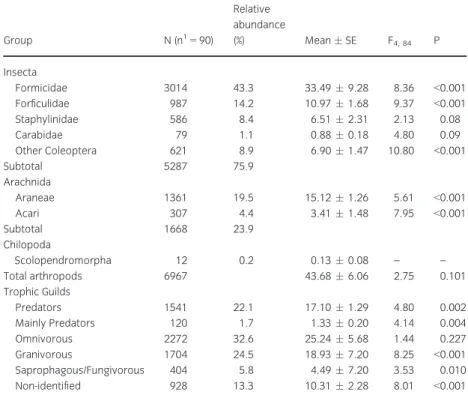
A full list of the abundance, relative abundance (%), meanstandard error (SE) and trophic guilds of cap-tured taxa in total pitfall traps in the two olive groves is provided in Appendix and summarized in table 1. A total of 6967 arthropods were captured in both olive groves (table 1).
Forficulidae (14.2%), Staphylinidae (8.4%) and Cara-bidae (1.1%). Class Arachnida was dominated by the order Araneae with 19.5% of relative abundance, fol-lowed by Acari with 4.4%. The most abundant trophic guild of arthropods captured in pitfall traps were omnivorous, representing 32.6% of total cap-tures, followed by granivorous representing 24.5% and predators, representing 22.1%.
Considering the family Formicidae, 3014 individu-als were captured in both olive groves belonging to 22 species from 13 genera. The most abundant species was Messor barbarus(L.), representing 55.8% of total captured individuals, followed byTapinoma nigerrinum
(Nylander) with 29.5%, Crematogaster auberti Emery with 4.8% and Cataglyphis hispanicus (Emery) with 2.2% (Appendix 1). For the family Formicidae, granivorous was the dominant functional group (56.5%) followed by omnivorous (42.4%) and mainly predators (1.1%) (Appendix 1). Forficulidae was rep-resented by a single species, Forficula auricularia(L.), included in the omnivorous guild, with 987 individu-als captured in both groves.
In the family Staphylinidae, 586 individuals were captured, belonging to five different subfamilies that were identified in 16 genera. The most abundant gen-era wereAnotylus(subfamily Oxytelinae) with 64.3%
of relative abundance, followed byOcypus(subfamily Staphylininae) with 13.0%, Mycetoporus (subfamily Tachyporinae) with 8.7% andQuedius(subfamily Sta-phylininae) with 4.6%. In Staphylinidae, sapropha-gous/fungivorous represented the dominant functional group followed by predators (68.9% and 19.5% respectively) and mainly predators (11.6%) (Appendix 1).
For the family Carabidae, 79 individuals were cap-tured in both olive groves belonging to 16 species and 11 genera. The most abundant species were
Calathus granatensis Vuillefroy, representing 33% of the total captures, Pterostichus globosus (Quensel in Schonherr) representing 20.3%, Licinus punctatulus
(Fabricius) representing 10.1% andAmara aenea(De Geer) representing 7.6%. Within Carabidae, preda-tors were the most abundant functional group (65.8%) followed by species that are mainly preda-tors (25.3%) and omnivorous species (8.9%) (Appendix 1).
In the order Araneae, 1361 individuals were cap-tured in both olive groves belonging to 13 different families. The most abundant families were Gnaphosi-dae representing 47.1% of the total captures, followed by Lycosidae with 19.1%, Zodariidae with 9.7% and Thomisidae with 9.4% (Appendix 1).
Group N (n1
=90)
Relative abundance
(%) MeanSE F4, 84 P
Insecta
Formicidae 3014 43.3 33.499.28 8.36 <0.001
Forficulidae 987 14.2 10.971.68 9.37 <0.001
Staphylinidae 586 8.4 6.512.31 2.13 0.08
Carabidae 79 1.1 0.880.18 4.80 0.09
Other Coleoptera 621 8.9 6.901.47 10.80 <0.001
Subtotal 5287 75.9
Arachnida
Araneae 1361 19.5 15.121.26 5.61 <0.001
Acari 307 4.4 3.411.48 7.95 <0.001
Subtotal 1668 23.9
Chilopoda
Scolopendromorpha 12 0.2 0.130.08 – –
Total arthropods 6967 43.686.06 2.75 0.101
Trophic Guilds
Predators 1541 22.1 17.101.29 4.80 0.002
Mainly Predators 120 1.7 1.330.20 4.14 0.004
Omnivorous 2272 32.6 25.245.68 1.44 0.227
Granivorous 1704 24.5 18.937.20 8.25 <0.001
Saprophagous/Fungivorous 404 5.8 4.497.20 3.53 0.010
Non-identified 928 13.3 10.312.28 8.01 <0.001
1Total number of samples. F and P are statistical results for comparisons of abundance between
sampling dates.
The abundance of the different groups of soil arthropods varied through the sampling period (fig. 1), and statistical analyses showed significant dif-ferences for Araneae, Formicidae, Forficulidae, Coleoptera and Acari (table 1). During the winter per-iod (days 22 and 42 after the installation), soil com-munity was dominated by Forficulidae, followed by Araneae and Formicidae. During the spring period (days 63 to 105), the community was dominated by Formicidae followed by Araneae and Staphylinidae. The dynamics of abundance of different functional groups through sampling time is shown in fig. 2. In the winter period and in the first sampling date of spring (day 63 after installation), the community was dominated by omnivorous and predators. In the two last sampling dates, granivorous dominated the com-munity followed by omnivorous and predators (fig. 2).
Exposed vs. exclusion boxes and pupae suppression
The Wilcoxon test showed that the number ofB. oleae
pupae found in exposed boxes (median [quartiles] of 1 [0, 2]) was significantly different from exclusion boxes (median of 5). The percentage of pupae sup-pression was calculated for each sampling time and varied between 62.39% in the first date and 100% in the last date (table 2).
During the field assay, from a total of 450 pupae placed in 90 exposed boxes (i.e. five pupae per box), only 41 pupae were recovered; in the first sampling time, 31 of 90 pupae (34.4%) were recovered from exposed boxes, from which 13 pupae (41.9%) had signs of predation and three adults (9.7%) emerged from pupae in laboratory conditions. In the second sampling date, 10 of 90 pupae (11.1%) were recov-ered, from which eight pupae (80.0%) had signs of predation and no adults emerged from pupae in labo-ratory conditions. In the three last sampling dates, no pupae were recovered from exposed boxes. The initial number of pupae placed in each exclusion box was recovered at the end of the sampling time, but only five adults (1.1% of the total) emerged from pupae collected in the first date.
Discussion
During this study, there were several evidences that soil arthropods could have impact on the abundance of B. oleae pupae. These evidences were mainly supported by the functional composition of soil arthropod community, by the decrease in the number of pupae in the exposed boxes when compared to the
exclusion boxes and by the remains of pupae recov-ered from exposed boxes with signs of predation. The percentage of pupae suppression ranged from 62.39% Fig. 1 Dynamics of the abundance (mean+standard error - SE) of edaphic arthropods captured in pitfall traps in two olive groves, Miran-dela, Portugal. Thex-axis represents the number of days after the instal-lation of pitfall traps on the 21st of January 2014 and the sampling month. Note different scales of right and left y-axes. n=18 for each sampling period.
to 100% indicating that soil arthropods can actively reduceB. oleaein its pupal stage.
This study took place during winter to early spring, which is a period that has been less considered regard-ing the study of composition of soil arthropod com-munities in olive groves and their relevance for suppressing B. oleae. The community of arthropods that was active in this period was mainly composed by Formicidae, Forficulidae, Araneae, Staphylinidae, Carabidae and Scolopendromorpha. In general, these soil arthropods have been commonly found in olive groves throughout the year and in several countries of the Mediterranean region (Neuenschwander et al. 1983; Morris and Campos 1999; Ruano et al. 2004; Santos et al. 2007b; Goncßalves and Pereira 2012).
Usually, Formicidae was the dominant group in studies developed in spring (in particular, in late spring) and summer (Morris and Campos 1999; Santos et al. 2007b) but, during winter, its activity was reduced, remaining in nests, due to low tempera-tures. Goncßalves and Pereira (2012) also observed lower numbers of Formicidae in early spring. The community of formicids was mainly composed by the speciesM. barbarus andT. nigerrimumthat have been previously referred in other works concerning the same ecosystem (Morris and Campos 1999; Santos et al. 2007b; Goncßalves and Pereira 2012). The former was the dominant species in the winter period while the latter dominated in the beginning of spring, and previous studies also indicated that both species were highly abundant in late spring and summer (Morris and Campos 1999; Santos et al. 2007b).M. barbarusis a seed harvester species that prefers open areas and
T. nigerrimumis an aggressive omnivorous species that consumes honeydew and animal items (Cerda et al. 1989; Azcarate and Peco 2003). In the olive grove, it can be an important predator of the olive moth,Prays oleae(Bern.) (Morris and Campos 1999). In this study, formicids could have important predatory action on
the olive fruit fly between the second and the third sampling periods as it was in this period that their activity (mainlyT. nigerrimum activity) increased sig-nificantly and pupae suppression reached 100%. This corresponds to the rise of temperatures that can also promoteB. oleaepupae emergence. The teneral stage may be more susceptible of being predated by formi-cids due to its reduced mobility as it was reported by several authors for other fruit flies (Wong and Wong 1988; Eskafi and Kolbe 1990; Hodgson et al. 1998). On the other hand, M. barbarus seems an unlikely predator of B. oleae pupae due to its granivorous habits, although, in a laboratory experiment, Neuen-schwander et al. (1983) observed this species carrying pupae into the nest. Thus, it is possible that this beha-viour could also occur in the field and contribute to the decline of pupae in exposed boxes as well as to bury the pupae in deeper layers of the soil, hindering emergence.
The order Araneae was also abundant in this study and was mainly composed by the families Gnaphosi-dae, LycosiGnaphosi-dae, Zodariidae and ThomisiGnaphosi-dae, which is similar to the results obtained by Cardenas et al. (2012) in Spain and Thaler and Zapparoli (1993) in Italy. Gnaphosidae dominated in all sampling dates, except in the last date, where Lycosidae were more abundant. Gnaphosidae is a typical family in Mediter-ranean habitats (Cardoso et al. 2007), represented essentially by nocturnal hunters that move very fast on the ground and that were reported to forage actively for larvae and eggs of Diptera, other spiders, Thysanoptera, Hemiptera and Coleoptera (Richman et al. 1980; Chatzaki 2008). Lycosidae includes both diurnal and nocturnal active hunters with a wide range of prey in their diet such as dipterans and collembolans (Nyffeler and Benz 1988; Allen and Hagley 1990) and that rely on vibratory and visual stimuli to locate and detect prey (Rovner 1991; Persons and Uetz 1996). There are no references about consumption ofB. oleaepupae by Gnaphosidae or Lycosidae families. However, Monzo et al. (2009) observed that Pardosa cribata Simon, an abundant lycosid spider in citrus orchards in Spain, fed on both larval and adult stages but not on pupae of Ceratitis capitata(Wiedemann). Thus, due to the immobility of pupae on the ground, it seems unlikely that spiders could act as active predators of B. oleae pupae, although some predation can occur on teneral flies.
Forficulidae was composed by a single species,
F. auricularia that dominated the community of arthropods in winter period, decreasing its abundance in spring. In winter period, captures were mainly composed by nymphal stages. In spring, nymphs of Table 2Percentage of pupae suppression, cumulative abundance of
predators and cumulative abundance of omnivorous (meanSE) during five sampling periods
Number of days after box installation
Pupae suppression (%)
Cumulative abundance of predators
Cumulative abundance of omnivorous
22 62.396.24 17.221.47 19.225.16
42 86.883.95 26.002.17 39.896.31
63 100.000.00 51.563.75 81.2824.58
84 100.000.00 66.114.63 100.3337.65
the third instar migrate from the soil to the tree moti-vated by the increase of the temperature (Gobin et al. 2008) which can explain the decrease of the abun-dance on soil.F. auriculariais an omnivorous species, feeding on a high variety of food items such as soft-fleshed fruit and plant material as well as a wide range of arthropods (Shaw and Wallis 2010), and is referred as an important generalist predator (Gobin et al. 2008). In Crete, Neuenschwander et al. (1983) observedF. aetolica Brunner predatingB. oleaepupae in laboratory experiments. In this study,F. auricularia
could be one of the most active predators of pupae, mainly in the first three sampling dates (winter and early spring), since its abundance was high in that per-iod and they were frequently found in exposed boxes.
Considering Staphylinidae, the community was dominated byOcypussp. that was mainly abundant in winter andAnotylussp. that was abundant in spring. Neuenschwander et al. (1983) also reported the occurrence of Ocypus sp. in olive groves in Crete (Greece). Staphylinids have been referred as predators of buried pupae such as C. capitata in coffee and orange orchards in Guatemala (Eskafi and Kolbe 1990),Rhagoletis pomonella(Walsh) in apple orchards in Southern Ontario (Allen and Hagley 1990) and
B. oleaein laboratory experiments (Neuenschwander et al. 1983).
Carabidae were the least abundant group collected in this study, contrasting with other works conducted in spring and particularly in autumn where they rep-resented one of the most abundant groups of arthro-pods (Goncßalves and Pereira 2012; Oliveira 2013). Dominant species, C. granatensis and P. globosus, are predaceous species and both genera were also caught in olive groves in Crete and observed eatingB. oleae
pupae in laboratory experiments (Neuenschwander et al. 1983). In Italy, Pterostichus melas (Creutzer), Calathus fuscipes (Goeze), Pseudoophonus rufipes (De Geer), Laemostenus cimmerius(Fischer von Waldheim) andDistichus planus(Bonelli) fed regularly onB. oleae
pupae in a laboratory feeding assay (Odoguardi et al. 2008). Although staphylinids and carabids were not abundant during this sampling period, it seems likely that they could exert predatory action on pupae bur-ied in exposed boxes. Moreover, their high abun-dance in autumn can be important to reduceB. oleae
pupae in this season.
Other factors such as abiotic factors (e.g. low tem-peratures or high soil moisture levels due to rain) can also contribute to pupal mortality (Daane and John-son 2010) and the low number of adults emerged from pupae recovered in exclusion boxes can indicate this. Both olive groves studied maintained a ground
cover of vegetation which can influence the abun-dance and the composition of the community of arthropods occurring in olive groves. Usually, ground covers have been related to a high abundance and activity of several species of ants, carabids and spiders (Cotes et al. 2009; Campos et al. 2011; Cardenas et al. 2012) which can be reflected in a high biological con-trol ecosystem service. It is possible that changes in ground covers, due to tillage or herbicide application, can negatively affect arthropod communities, but fur-ther works are required to look at the effect of these actions on biological control of the olive fruit fly.
In conclusion, an abundant and diverse soil arthro-pod community in olive groves could have impact and provide important suppression of B. oleaeduring its pupal stage.
Acknowledgements
This study was financially supported by FEDER Funds throughout Programa Operacional Factores de Com-petitividade – COMPETE and National Funds throughout FCT–Fundacß~ao para a Ci^encia e Tecnolo-gia, within the project EXCL/AGR-PRO/0591/2012: Olive crop protection in sustainable production under global climatic changes: linking ecological infrastruc-tures to ecosystem functions.
References
Aguiar CA, Serrano ARM, 2012. Coleopteros Carab ıdeos
(Coleoptera, Carabidae) de Portugal Continental: Chaves
para sua identificacß~ao. Sociedade Portuguesa de
Ento-mologia, Lisbon.
Allen WR, Hagley EAC, 1990. Epigeal arthropods as predators of mature larvae and pupae of the apple maggot (Diptera: Tephritidae). Environ Entomol, 19,
309–312.
Azcarate FM, Peco B, 2003. Spatial patterns of seed
preda-tion by harvester ants (MessorForel) in Mediterranean
grassland and scrubland. Insect Soc, 50, 120–126.
Broumas T, Haniotakis G, Liaropoulos C, Tomazou T, Ragoussis N, 2002. The efficacy of an improved form of the mass-trapping method, for the control of the olive fruit fly,
Bactrocera oleae(Gmelin) (Diptera, Tephritidae): pilot-scale
feasibility studies. J Appl Entomol, 126, 217–223.
Campos M, Fernandez L, Ruano F, Cotes B, Cardenas M,
Castro J, 2011. Short term response of ants to the removal of ground cover in organic olive orchards. Eur J
Entomol, 108, 417–423.
Cardenas M, Castro J, Campos M, 2012. Short-term
Cardoso P, Silva I, De Oliveira NG, Serrano ARM, 2007. Seasonality of spiders (Araneae) in Mediterranean ecosystems and its implications in the optimum
sam-pling period. Ecol Entomol, 32, 516–526.
Cerda X, Retana J, Bosch J, Alsina A, 1989. Exploitation of
food resources by the antTapinoma nigerrimum
Hyme-noptera Formicidae. Acta Oecol-Oec Gen, 10, 419–430.
Chatzaki M, 2008. A critical review of the spider family Gnaphosidae in Greece. In: Advances in arachnology and developmental biology. Ed. by Makarov SE, Dimitri-jevic , RN . Papers dedicated to Prof. Dr. Bozidar Curcic,
Institute of Zoology, Belgrade, Monographs 12, 355–
374.
Chisholm P, Gardiner M, Moon E, Crowder DW, 2014. Tools and techniques for investigating impacts of habitat
complexity on biological control. Biol Control, 75, 48–
57.
Collier T, Van Steenwyk R, 2003. Prospects for integrated control of olive fruit fly are promising in California. Cal
Ag, 57, 28–30.
Collingwood C, Price A, 1998. A Guide to ants of
Conti-nental Portugal, Supplement n°5. Boletim da Sociedade
de Entomologia, Lisbon.
Cotes B, Castro J, Cardenas M, Campos M, 2009. Responses
of epigeal beetles to the removal of weed cover crops in
organic olive orchards. B Insectol, 62, 47–52.
Daane KM, Johnson MW, 2010. Olive fruit fly: managing an ancient pest in modern times. Ann Rev Entomol, 55,
151–169.
Delrio G, Lentini A, Satta A, 2005. Biological control of
olive fruit fly through inoculative releases ofOpius
con-colorSzepl. IOBC/WPRS Bulletin-Proceedings of the meeting-Integrated Protection of Olive Crops, Chania,
Greece, 29-31 May 2003, 28:53–58.
Dimou I, Koutsikopoulos C, Economopoulos AP, Lykakis
J, 2003. Depth of pupation of the wild olive fruit fly,
Bac-trocera (Dacus) oleae(Gmel.) (Diptera, Tephritidae), as
affected by soil abiotic factors. J Appl Entomol, 127, 12–
17.
Eskafi FM, Kolbe MM, 1990. Predation on larval and
pupalCeratitis capitata(Diptera: Tephritidae) by the ant
Solenopsis geminata(Hymenoptera: Formicidae) and other predators in Guatemala. Environ Entomol, 19,
148–153.
Gardiner MM, Landis DA, Gratton C, DiFonzo CD, O’Neal M, Chacon JM, Wayo MT, Schmidt NP, Mueller EE, Heimpel GE, 2009. Landscape diversity enhances biological control of an introduced crop pest in the
north-central USA. Ecol Appl, 19, 143–154.
Gobin B, Peusens G, Moerkens R, Leirs H, 2008. Under-standing earwig phenology in top fruit orchards. Pro-ceedings of Ecofruit-13th International Conference on Cultivation Technique and Phytopathological Problems in Organic Fruit-Growing, 18-20 February 2008,
Weins-berg, Germany. pp. 208–212.
Goncßalves MF, Pereira JA, 2012. Abundance and diversity of soil arthropods in the olive grove ecosystem. J Insect Sci, 12, 20. available online: insectscience.org/12.20 Goncßalves F, Santos SAP, Torres L, 2012. Efficacy of
spino-sad bait sprays to controlBactrocera oleaeand impact on
non-target arthropods. Phytoparasitica, 40, 17–28.
Haniotakis GE, Kozyrakis E, Bonatsos C, 1986. Control of
the olive fruit fly,Dacus oleaeGmel. (Dipt., Tephritidae)
by mass trapping: Pilot scale feasibility study. J Appl
Entomol, 101, 343–352.
Hawkes NJ, Janes RW, Hemingway J, Vontas J, 2005. Detection of resistance-associated point mutations of organophosphate-insensitive acetylcholinesterase in the
olive fruit fly,Bactrocera oleae(Gmelin). Pest Biochem
Phys, 81, 154–163.
Hodgson PJ, Sivinski J, Quintero G, Aluja M, 1998. Depth
of pupation and survival of fruit fly (Anastrephaspp.:
Tephritidae) pupae in a range of agricultural habitats.
Environ Entomol, 27, 1310–1314.
Kakani EG, Mathiopoulos KD, 2008. Organophosphos-phate resistance-related mutations in the acetyl-cholinesterase gene of Tephritidae. J Appl Entomol, 132,
762–771.
Kapatos E, Fletcher BS, Pappas S, Laudeho Y, 1977. The
release ofOpius concolorandO. concolorvar.Siculus
[Hym.: Braconidae] against the spring generation of
Dacus oleae[Dipt.: Trypetidae] on Corfu. Entomophaga,
22, 265–270.
Matallanas B, Lantero E, M’Saad M, Callejas C, Ochando MD, 2013. Genetic polymorphism at the cytochrome
oxidase I gene in Mediterranean populations of
Bactro-cera oleae(Diptera: Tephritidae). J Appl Entomol, 137,
624–630.
Mazomenos BE, Pantazi-Mazomenou A, Stefanou D,
2002. Attract and kill of the olive fruit flyBactrocera oleae
in Greece as a part of an integrated control system. IOBC/WPRS Bulletin-Proceedings of the meeting Phero-mones and Other Biological Techniques for Insect Con-trol in Orchards and Vineyards, Samos, Greece, 25-29
September 2000, 25, 137–146.
Monzo C, Moll aO, Casta nera P, Urbaneja A, 2009. Activ-~
ity-density ofPardosa cribatain Spanish citrus orchards
and its predatory capacity onCeratitis capitataandMyzus
persicae. Biocontrol, 54, 393–402.
Morris TI, Campos M, 1999. Entomofauna depredadora
del suelo del olivar. Zoo Baetica, 10, 149–160.
Neuenschwander P, Bigler F, Delucchi V, Michelakis S,
1983. Natural enemies of preimaginal stages ofDacus
oleaeGmel. (Dipt., Tephritidae) in Western Crete. I. Bio-nomics and phonologies. Boll Lab Entomol Agrar Filippo
Silvestri, 40, 3–32.
Nyffeler M, Benz G, 1988. Feeding ecology and predatory
importance of wolf spiders (Pardosaspp.) (Araneae,
Lycosidae) in winter wheat fields. J Appl Entomol, 106,
Odoguardi R, Bonnacci T, Bruno L, BrandMayr P, Zetto T, 2008. Carabid beetles as potential natural predators of olive fly pupae. Young Ideias in Insect Science. 1st meet-ing of PhD students and Post-Doctoral Fellows. Florence. June 5-6. 3pp.
Oliveira JMS, 2013. Abund^ancia e diversidade de
car-abıdeos ao longo de um gradiente crescente de praticas
agrıcolas no olival transmontano. MSc. Thesis,
Polytech-nic Institute of Bragancßa, Bragancßa, Portugal. 60 pp.
Orsini MM, Daane KM, Sime KR, Nelson EH, 2007. Mor-tality of olive fruit fly pupae in California. Biocontrol Sci
Techn, 17, 797–807.
Outerelo R, Gamarra P, 1985. Las familias y generos de los
estafilinideos de la Penınsula Iberica. Claves de
identifi-cacion de la fauna espa~nola, n. 10. Universidad
Com-plutense de Madrid, Madrid.
Pascual S, Cobos G, Seris E, Gonzalez-Nunez M, 2010.~
Effect of processed kaolin on pests and non-target
arthropods in a Spanish olive grove. J Pest Sci, 83, 121–
133.
Pereira JA, Alves R, Casal S, Oliveira MBPP, 2004. Effect of olive fruit fly infestation on the quality of olive oil from
cultivars Cobrancßosa, Madural and Verdeal
Transmon-tana. Ital J Food Sci, 16, 355–365.
Persons MH, Uetz GW, 1996. The influence of sensory information on patch residence time in wolf spiders
(Araneae: Lycosidae). Anim Behav, 51, 1285–1293.
Richman DB, Hemenway RC, Whitcomb WH, 1980. Field
cage evaluation of predators of the soybean looper,
Pseu-doplusia includens(Lepidoptera: Noctuidae). Environ
Entomol, 9, 315–317.
Roberts M, 1985. The Spiders of Great Britain and Ireland. Atypidae to Theridosomatidae Vol. 1. Harley Books, Colchester, Essex.
Roberts MJ, 1987. The Spiders of Great Britain and Ire-land. Linyphiidae Vol. 2. Harley Books, Colchester, Essex.
Rovner JS, 1991. Evidence for idiothetically controlled turns and extraocular photoreception in lycosid spiders.
J Arachnol, 19, 169–173.
Ruano F, Lozano C, Garcia P, Pe~na A, Tinaut A, Pascual F,
2004. Use of arthropods for the evaluation of the olive-orchard management regimes. Agri Forest Entomol, 6,
111–120.
Ruiz-Torres NI, Madueno-Magdaleno C, Montiel-Bueno A, 2004. Efficacy of ground application with Spinosad and Imidacloprid bait sprays to control olive fruit fly (Bactrocera oleae). Preliminary results. Bol Sanid Veg
Pla-gas, 30, 415–425.
Santos SAP, Pereira JA, Torres LM, Nogueira AJA, 2007a. Evaluation of the effects, on canopy arthropods, of two agricultural management systems to control pests in olive groves from north-east of Portugal. Chemosphere,
67, 131–139.
Santos SAP, Cabanas JE, Pereira JA, 2007b. Abundance and diversity of soil arthropods in olive grove ecosystem (Portugal): Effect of pitfall trap type. Eur J Soil Biol, 43,
77–83.
Saour G, Makee H, 2004. A kaolin-based particle film for suppression of the olive fruit fly Bactrocera oleae Gmelin (Dip., Tephritidae) in olive groves. J Appl Entomol, 128,
28–31.
Shaw PW, Wallis DR, 2010. Susceptibility of the European
earwig,Forficula auriculariato insecticide residues on
apple leaves. N Z Plant Protect-SE, 63, 55–59.
SPSS Inc., IBM Company, 2010. IBM, SPSS Statistic for Windows, version 19.0.0. IBM Corporation, New York, USA.
Thaler K, Zapparoli M, 1993. Epigeic spider in an
olive-grove in central Italy (Araneae). Redia, 56, 307–316.
Wang XG, Levy K, Son Y, Johnson MW, Daane KM, 2012. Comparison of the thermal performance between a pop-ulation of the olive fruit fly and its co-adapted
para-sitoids. Biol Control, 60, 247–254.
Wong MA, Wong TT, 1988. Predation of the Mediter-ranean fruit fly and the Oriental fruit fly (Diptera: Tephritidae) by the fire ant (Hymenoptera: Formicidae)
Appendix 1
Total abundance (N), meanstandard error (SE) and trophic guilds of captured edaphic arthropods in pitfall traps in the two olive groves, January–May 2014
Taxa N (n=90) MeanSE Trophic Guild
Carabidae
Calathus granatensisVuillefroy 26 0.290.13 Predator
Pterostichus globosus(Quensel in Schonherr) 16 0.180.07 Mainly Predator
Calathus mollis(Marsham) 4 0.040.02 Predator
Calathus cinctusMotschulsky 1 0.010.01 Predator
Calathussp. 1 0.010.01 Predator
Nebria salinaFairmaire & Laboulbene 3 0.030.02 Predator
Amara aenea(De Geer) 6 0.070.03 Omnivorous
Brachinussp. 1 0.010.01 Mainly Predator
Brachinus explodensDuftschmid 1 0.010.01 Mainly Predator
Brachinus variventrisSchaufuss 2 0.020.02 Mainly Predator
Licinus punctatulus(Fabricius) 8 0.090.04 Predator
Anchomenus dorsalis(Pontoppidan) 1 0.010.01 Predator
Olisthopus fuscatusDejean 1 0.010.01 Predator
Parophonus maculicornis(Duftschmid) 1 0.010.01 Omnivorous
Trechus obtususErichson 4 0.040.02 Predator
Poecilussp. 3 0.030.02 Predator
Staphylinidae
Ocypussp. 76 0.840.23 Predator
Quediussp. 27 0.300.07 Predator
Mycetoporussp. 51 0.570.14 Mainly Predator
Oxytelussp. 16 0.180.07 Saprophagous/Fungivorous
Tachyporussp. 11 0.120.05 Mainly Predator
Thinodromussp. 7 0.080.07 Saprophagous/Fungivorous
Othiussp. 5 0.060.02 Predator
Gabriussp. 2 0.020.02 Predator
Anotylussp. 377 4.192.32 Saprophagous/Fungivorous
Coproporussp. 4 0.040.03 Mainly Predator
Philonthussp. 1 0.010.01 Predator
Xantholinussp. 2 0.020.02 Predator
Astenussp. 1 0.010.01 Predator
Tachinussp. 2 0.020.02 Mainly Predator
Carpelinussp. 2 0.020.02 Saprophagous/Fungivorous
Metopsiasp. 2 0.020.02 Saprophagous/Fungivorous
Other Coleoptera 621 6.901.47 Non-identified
Formicidae
Messor barbarus(Linnaeus) 1681 18.687.20 Granivorous
Messor bouvieriBondroit 20 0.220.18 Granivorous
Camponotus pilicornis(Roger) 23 0.260.12 Omnivorous
Camponotus aethiops(Latreille) 3 0.030.03 Omnivorous
Camponotus piceus(Leach) 7 0.080.06 Omnivorous
Camponotus cruentatus(Latreille) 1 0.010.01 Omnivorous
Camponotus lateralis(Olivier) 1 0.010.01 Omnivorous
Camponotus foreliEmery 2 0.020.02 Omnivorous
Tetramorium forteForel 63 0.700.19 Omnivorous
Tetramorium semilaeveAndre 11 0.120.05 Omnivorous
Tapinoma nigerrimum(Nylander) 890 9.895.50 Omnivorous
Crematogaster aubertiEmery 144 1.600.32 Omnivorous
Cataglyphis hispanicus(Emery) 66 0.730.27 Omnivorous
Cataglyphissp. 54 0.600.24 Omnivorous
Plagiolepis pygmaea(Latreille) 29 0.320.13 Mainly Predator
Lasiussp. 1 0.010.01 Mainly Predator
Appendix 1 (continued)
Taxa N (n=90) MeanSE Trophic Guild
Goniommasp. 3 0.030.02 Granivorous
Aphaenogaster gibbosa(Latreille) 4 0.040.03 Omnivorous
Aphaenogastersp. 8 0.090.09 Omnivorous
Pheidolesp. 1 0.010.01 Omnivorous
Formica subrufaRoger 1 0.010.01 Mainly Predator
Solenopsissp. 1 0.010.01 Mainly Predator
Forficulidae
Forficula auriculariaLinnaeus 987 10.971.68 Omnivorous
Scolopendromorpha
Scolopendromorpha 12 0.130.08 Predator
Araneae
Agelenidae 89 0.990.17 Predator
Dysderidae 1 0.010.01 Predator
Eresidae 1 0.010.01 Predator
Gnaphosidae 641 7.120.71 Predator
Linyphiidae 40 0.440.11 Predator
Lycosidae 260 2.890.64 Predator
Philodromidae 17 0.190.05 Predator
Salticidae 33 0.370.08 Predator
Sparassidae 1 0.010.01 Predator
Tetragnathidae 1 0.010.01 Predator
Theridiidae 17 0.190.06 Predator
Thomisidae 128 1.420.21 Predator
Zodariidae 132 1.470.31 Predator
Acari 307 3.411.48 Non-identified