TEMAS LIVRES FREE THEMES
Pesticide exposure among students and their families
in Nova Friburgo, Rio de Janeiro
Exposição a agrotóxicos entre estudantes e seus familiares
em Nova Friburgo, Rio de Janeiro
Resumo Agricultura é uma ocupação de risco, principalmente a familiar em países em desenvol-vimento. Os perigos ocupacionais comuns a essa atividade podem atingir a toda família, incluindo crianças e adolescentes. Este estudo descreve o pa-drão do uso de agrotóxicos entre estudantes e seus familiares em uma região agrícola localizada em Nova Friburgo, Estado do Rio de Janeiro, Brasil. Características sociodemográficas, hábitos, práti-cas de trabalho e grau de exposição a agrotóxicos foram adquiridas através do uso de questionário. Nossa população de estudo consistiu em estu-dantes e seus familiares de ambos os sexos, entre 6 e 85 anos de idade (N = 352) sendo 167 mul-heres e 185 homens. Houve a predominância de participantes entre 10 - 19 anos (71,3%), soltei-ros (77,5%), e a maioria com o ensino funda-mental incompleto (54,5%). Quanto à ocupação, 45,5% reportaram-se como agricultores e 39,6% como estudantes. As variáveis mais associadas à exposição a agrotóxicos foram sexo (p < 0,001), nível educacional (p < 0,001) e ser agricultor (p < 0,001). Nossos resultados mostraram que crianças e adolescentes parecem ter o mesmo grau de ex-posição a agrotóxicos que adultos. Nossos achados também sugerem que sexo, ocupação e nível edu-cacional, incluindo professores, estão diretamente
associados ao grau de exposição.
Palavras-chave Agricultor, Questionário, Pestici-da, Estudantes
Abstract Farming is a risky occupation, espe-cially family farming in developing country. The occupational hazards commonly used in such activity could affect all family members, includ-ing children and adolescents. This study describes the pattern of pesticide exposure among students and their families from a farming region located in Nova Friburgo, State of Rio de Janeiro, Brazil. Sociodemographic characteristics, habits, working practices and the degree of exposure to pesticides were assessed by a questionnaire. Our study pop-ulation consisted of students and family members of both sexes, aged between 6 and 85 years old (N = 352) being 167 women and 185 men. There was a predominance of participants between 10-19 years (71.3%), singles (77.5%), and most had not completed primary education (54.5%). In terms of occupation, 45.5% reported to be farmers and 39.6% were students. The variables mostly associ-ated with pesticide exposure were sex (p < 0.001), educational level (p < 0.001), and being a farm-er (p < 0.001). Our results showed that children and teenagers seemed to have the same degree of exposure to pesticides as the adults. Our findings also suggest that sex, occupation and educational level, despite teachers were included, are directly
associated with degree of exposure.
Key words Farmer, Questionnaire, Pesticide,
Students Gesiele Veríssimo 1
Maria Isabel Kós 2
Tatiana Rodrigues Garcia 1
Janinne Alves dos Santos Ramos 1
Carolyne Cosme de Souza 1
Josino Costa Moreira 3
Armando Meyer 1
1 Instituto de Saúde Pública,
Universidade Federal do Rio de Janeiro (UFRJ). Av. Horácio Macedo s/n, Fundão. 21941-598 Rio de Janeiro RJ Brasil. [email protected]
2 Faculdade de
Fonoaudiologia, UFRJ. Rio de Janeiro RJ Brasil.
3 Centro de Saúde do
V
eríssimo G Introduction
After World War II, the Green Revolution trans-formed the countryside through introduction of new technologies, such as machinery, genetic im-provement, and agrochemicals1.
Among the agrochemicals the synthetic pes-ticides, such as DDT, were first used in large scale when little was known about the toxicological effects of these substances2. In Brazil, pesticides and chemical fertilizers gained ground in the agribusiness sector in the 1970’s, upon the imple-mentation of the National Rural Credit System (SNCR). According to this system, the amount of loans granted depended on the percentage of money to be spent on pesticides3. This resulted in significant changes which affected the environ-ment and human health4,5.
In Brazil, pesticide sales increased by 945.51% between 1998 and 20086. While in 2010 world-wide sales of pesticides involved approximately US$ 48 billion, in 2008 Brazilian pesticide market shared US$ 7.1 billion of this amount, when the country used 986,500 tons of pesticides7. These numbers placed Brazil as the world’s leader pesti-cide market in 2008.
The mountain region of the State of Rio de Janeiro (RJ) is one of the major producers of agricultural products in this State. According to the Brazilian Institute of Geography and Statis-tics8, pesticide consumption in RJ was 18.3 kg per worker per year. However, in the region of Cór-rego de São Lourenço, a small village belonging to the city of Nova Friburgo, in the State of Rio de Janeiro, the use of pesticides was among the highest in this State, reaching 56.5 kg of pesti-cides per worker per year3. The climate, the soil and the great diversity of crops cultivated in this region, mainly in family farms, allows farming all year round, but also requires an intense use of agrochemicals especially of pesticides. In this occupational environment, where the workforce is composed basically by family members, adults and children work together and share the occu-pational and environmental risks imposed by this job, such as pesticide exposure9. Chemical expo-sure is particularly worrisome because houses and schools are commonly located very close or even inside the crop plantations, which facilitate the continuous exposure of all family members4.
Children and adolescents have unique char-acteristics in terms of development, which makes them more vulnerable to chemical exposure10,11.
In order to understand the pattern of pesti-cide exposure among students and their families
in a farming region in this region of Nova Fribur-go City, state of Rio de Janeiro, Brazil this work was done.
Method
The city of Nova Friburgo is located in the cen-tral region of the State of Rio de Janeiro (137 km from the capital). It has 182,082 inhabitants, of which 12.5% live in rural areas, where 6,792 households make their living by family farming8. This study was conducted in the micro region of Córrego São Lourenço, which is located 1,000-1,200m above sea level, and is part of Campo do Coelho District.
Students of the agricultural school Rei Alber-to I (IBELGA) and family members were invited to participate in it by signing an informed con-sent form. Participants younger than 18 years old had the form signed by their legal guardians. This study was approved by the Research Ethics Com-mittee of the Institute for Studies in Collective Health, Federal University of Rio de Janeiro.
IBELGA offers technical training in farming and formal education in a very peculiar system to 300 students. To avoid evasion, students at-tend school in a day-long basis for one week, be-ing taught theoretical and practical classes. After this technical training week they stay home for identical period (one week) to apply and share with their families the agricultural techniques they learned.
All students and their family were invited to take part in this study and there were no exclu-sion criteria. Not necessarily students included in the study had their family participating, every subject were free to choose about their inclusion or not. All participants were asked to respond questions adapted from the questionnaires used in the Agricultural Health Study12 and all answers were self-reported. Hereupon, students could also report themselves as being farmers.
Three previously trained researchers inter-viewed each participant. The questionnaire in-cluded demographic (address, sex, marital status, and educational level); occupation and habits (occupation, length of time working in farming, type of activities performed, type, duration, and frequency of pesticides used, and types of crops grown), and health-related questions (hyperten-sion, high cholesterol levels, diabetes, consump-tion of medicaconsump-tions).
aúd
e C
ole
tiv
a,
23(11):3903-3911,
2018
some occupational variables. The age of the first exposure was assigned points ranging from 0 to 2. For the hours of work, distance between the crop fields and the participants’ homes, and number of pesticides used per month, assigned points ranged from 0 to 3, for each item. Direct contact with pesticides was assigned 0 to 4 points. The activities carried out in the field (weeding, dig-ging holes, sowing, fertilizing, building strips of land, spreading manure, removing extra sprouts, harvesting, preparing pesticides for use, pulling a hose to spray pesticides, spraying pesticides using a backpack sprayer or a hose, washing backpack sprayer after use, and storing pesticides) were cat-egorized following the scores proposed by Dose-meci et al.13; and ranged from 0 to 9 points (Table 1). Accordingly, pesticide exposure score varied from 0 to 76. The higher the participants’ score, the higher the estimated exposure to pesticides.
We administered 356 questionnaires, and four of them were excluded from the analysis because of lacking of important answers on the forms. Our analyses were then conducted for the remaining 352 participants and do not rep-resent the general population. The sociodemo-graphic variables were analyzed together with the exposure variables. We used the Student’s t test to compare groups regarding numeric variables with normal distribution and the Mann-Whit-ney test for those with asymmetric distribution. The level of significance was set at 0.05. A mul-tiple linear regression was used to test the influ-ence of sex, age, marital status, educational level, and occupation on the distribution of the pesti-cide exposure score.In line,the variables show-ing statistical significance in the bivariate analy-sis were included in the model using the stepwise technique.
Results
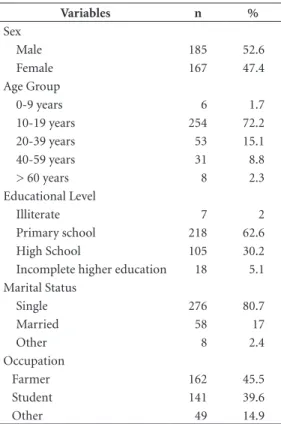
The sociodemographic information of the sam-ple is shown in Table 2. We interviewed 167 fe-male (47.4%) and 185 fe-male participants (52.6%). Their ages ranged from 6 to 85 years. Most of the participants were 10 to 19 years old (72.2%), single (77.5%), and had uncompleted primary education level (54.5%). In terms of occupation, 162 (45.5%) of the participants reported being farmers, and 141 (39.6%) students. Moreover, 15.5% of these students reported working in the field, though they did not consider themselves as farmers. Most participants (57%) reported ac-tively participating in the agricultural activities
in the crop fields and/or in their home vegetable garden. The most common crops reported were:
Table1. Ranking of activities performed in the fields.
Activitiesperformed
inthefields Sometimes Always Never
Weeding 1 point 1 point 0 points
Holes 1 point 1 point 0 points
Sowing 1 point 1 point 0 points
Fertilizing 1 point 1 point 0 points
Building strips of land 1 point 1 point 0 points
Spreading manure 1 point 1 point 0 points
Removing extra sprouts
1 point 1 point 0 points
Harvesting 1 point 1 point 0 points
Preparing pesticides for use
9 points 9 points 0 points
Pulling hose to spray pesticides
8 points 9 points 0 points
Spraying pesticides using backpack sprayer or hose
9 points 9 points 0 points
Washing backpack sprayer after use
8 points 8 points 0 points
Storing pesticides 9 points 9 points 0 points
Table2. Sociodemographic data of the studied population (n = 352).
Variables n %
Sex
Male 185 52.6
Female 167 47.4
Age Group
0-9 years 6 1.7
10-19 years 254 72.2
20-39 years 53 15.1
40-59 years 31 8.8
> 60 years 8 2.3
Educational Level
Illiterate 7 2
Primary school 218 62.6
High School 105 30.2
Incomplete higher education 18 5.1
Marital Status
Single 276 80.7
Married 58 17
Other 8 2.4
Occupation
Farmer 162 45.5
Student 141 39.6
V
eríssimo G tomato (33.33%), cauliflower (19.71%), parsley
(7.51%), broccoli (6.57%), and lettuce and cab-bage (6.10%).
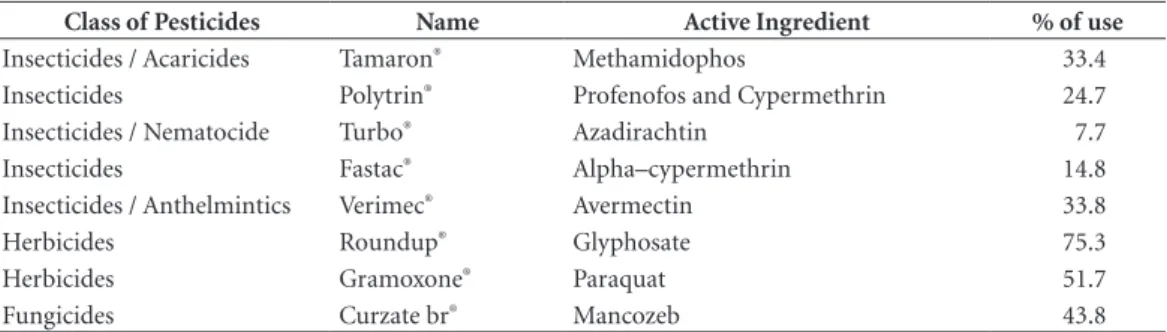
Forty-four pesticides were mentioned as cur-rently used. For each type of crop and/or stage of the crops, these chemicals were sprayed alone or in multiple combinations prepared by the farm-ers. The pesticides most frequently mentioned were: herbicides (glyphosate and paraquat), fun-gicide (Mancozeb), and insecticides (avermectin and methamidophos) (Table 3). The majority of the studied population (64.6%) reported having contact with pesticides. While 22.7% of them reported direct contact while mixing and apply-ing, 23.3% reported contact while pulling pesti-cide spraying hoses. In addition, 19.3% reported having indirect contact because they lived in the close vicinity of the crop fields or were respon-sible for washing the backpack sprayer as a daily task. Only 34.3% said they did not have contact with pesticides (Table 4).
The pesticide exposure score (mean: 20.83; standard deviation: 13.48) of the 352 participants ranged from 0 (the least exposed) to 76 points (the most exposed). Men had a mean score 2.2 times higher than women. The adolescents’ mean was only 13% lower than the adults’ value. Being a farmer raised the mean score 4.5 times com-pared with those who reported other professions. Table 5 shows the results of the bivariate analy-sis between the exposure score and sociodemo-graphic variables. The variables showing associa-tion with pesticide exposure were sex (p < 0.001), educational level (p < 0.001), and occupation (p < 0.001). Neither age group nor marital status was associated with exposure, showing a p-value of 0.381 and 0.43, respectively. Finally the multi-ple linear regression reveled how predictable was the used model including sex and occupation. Being a farmer predicted 53.2% of exposure, and when the variable sex was included the exposure
prediction was increased by 7.7%. The linear co-efficients strengthened the significance of sex and occupation on the score magnitude (sex b = 8.1, IC 5.3 - 20.0; and occupation b= 26.1, IC 23.2 - 28.9).
Discussion
Our results show that the population of this re-gion of Nova Friburgo is frequently exposed to pesticides. Most participants reported living within 50 meters from the nearest crop field, 43.5% mentioned using pesticides at least once a month, 19% were indirectly exposed these chem-icals, and 22% prepared and sprayed pesticides on their plantations. These results are similar to those found in the cohort of American farmers in the Agricultural Health Study14, which showed that 21% of the farmer’s houses were located no more than 50 meters from the pesticide mixing area. In addition, 27% of families stored pesti-cides at home (garage or basement), and most pesticide-contaminated clothes were washed to-gether with the family’s regular clothing.
Data collected from our studied population suggest that educational level and sex are directly associated with the pesticide exposure score. The participants with the lowest educational levels had much higher exposure scores than those who had higher education degrees, which is probably due to the inclusion of teachers who were not farmers in the study. When comparing the scores of the participants who completed primary edu-cation with those who completed high school, we found similar degrees of exposure. Additionally, the older participants had a slightly higher score because they had been working in the fields for longer.
Women had statistically significant lower scores than men. Farming is heavy work, and
Table3. Pesticides most frequently used in the rural community of Córrego de São Lourenço, Nova Friburgo, RJ, Brazil.
Class of Pesticides Name Active Ingredient % of use
Insecticides / Acaricides Tamaron® Methamidophos 33.4
Insecticides Polytrin® Profenofos and Cypermethrin 24.7
Insecticides / Nematocide Turbo® Azadirachtin 7.7
Insecticides Fastac® Alpha–cypermethrin 14.8
Insecticides / Anthelmintics Verimec® Avermectin 33.8
Herbicides Roundup® Glyphosate 75.3
Herbicides Gramoxone® Paraquat 51.7
aúd
e C
ole
tiv
a,
23(11):3903-3911,
2018
men are usually responsible for direct contact with pesticides. Women are often indirectly exposed through their daily activities, such as washing clothes and equipment used in the field, as well as helping to spray the pesticides by pull-ing spraypull-ing hoses and cleanpull-ing pesticide-con-taminated dust in their homes.
Other studies conducted in the same region showed similar results15. In the U.S. cohort, at least half of the women also reported working in the fields and 40% reported preparing and
ap-plying the mix of pesticides. In addition, more than half of the U.S. children older than 11 years had farming responsibilities that exposed them to pesticides14.
This is a common reality for children from Nova Friburgo as many regularly participate in farming activities. Seventy-two percent of our study population was between 10 and 19 years old, and their mean exposure score was 20.9. Adult participants’ mean score was only 3 points higher than that. This is a small difference when
Table4. Occupational and pesticide exposure information of the students and family members at Córrego de São Lourenço, Nova Friburgo, RJ, Brazil.
Variable Score Frequency %
Occupation
Farmer 1 162 45.5
Other 0 194 54.5
Hours of field work
0 hour a day 0 191 53.7
1-4 hours a day 1 22 6.2
5-8 hours a day 2 45 12.6
9-10 hours a day 3 88 24.7
+ 10 hours a day 4 10 2.8
Distance between home and crops
More than 200 meters 0 80 22.5
100-200 meters 1 34 9.6
50-100 meters 2 61 17.1
Less than 50 meters 3 181 50.8
Length of time working with pesticides
Has never worked with pesticides 0 263 73.9
1-5 years 1 46 12.9
5-20 years 2 22 6.2
+ 20 years 3 25 7
Type of contact with pesticides
No contact 0 126 35.4
Indirect (crops near the house) 1 4 1.1
Indirect (washing backpack sprayer) 2 64 18
Direct (pulling hoses) 3 82 23
Direct (mixing and applying pesticide on the fields) 4 80 22.5
Length of time of pesticide application in the last season
Not one day 0 215 60.4
1-5 days 1 67 18.8
6-25 days 2 53 14.9
26-50 days 3 7 2
+ 50 days 4 14 3.9
Number of times of pesticide use per month
None 0 201 56.5
1-5 times 1 105 29.5
5-10 times 2 36 10.1
V
eríssimo G
compared with the mean score of 36.5 among farmers of all ages. The findings seem to indicate that inhabit this region leads to the high exposure of this population to pesticides.
In addition to their farming tasks, children who live in rural areas have closer contact with contaminated environments because they play in fields, lakes, rivers, and plantations that have of-ten recently been sprayed with pesticides16. Such human vulnerability needs to be considered be-cause children’s exposure is different quanti-tatively and qualiquanti-tatively from that of adults as younger people may be more sensitive to the tox-icity induced by these chemicals17. The effects of these pollutants on children’s health have been receiving more attention within the scientific community because such harm to the physiolog-ical system before full development may be irre-versible10,11,18.
Studies have demonstrated associations be-tween exposure to pesticides during childhood
and cancer incidence and genetic polymor-phism19-21. Higher urinary concentrations of pesticides were found in children living in ru-ral areas when compared with children living elsewhere22,23. A significant correlation between pesticide concentrations in children’s urine and contaminated dust found in their homes has been shown by other studies24-26. This enhanc-es the idea that the environmental exposure to pesticides in this region could potentially lead to contamination of these population.
There are many consequences to human health related to agrochemical exposure. National and international studies have correlated the use of pesticides with chronic adverse effects, such as depression and suicide27, respiratory28,29, immu-nological30,31, and reproductive disorders32-34, as well as neurotoxic and teratogenic35-37, genotox-ic38, and neurotoxic39, and cancer40-43. Although there is limited information about the used types and amount types of pesticides in this studied re-gion, the participants reported using certain high toxic pesticides already banned in most of devel-oped countries such as paraquat and methami-dophos. In 2012, one year after this study, Brazil National Health Surveillance Agency (Anvisa) prohibited methamidophos use, one example of the rural hazards that was yet used in this region by the studied period. However, others pesticides like paraquat and glyphosate are still regularly being free marketed44,45.
All inhabitants of regions where there is in-tensive chemical-dependent agriculture are vul-nerable to the dangers inherent in this exposure. Because these chemicals are sprayed, air pollution by pesticides is one of the main reasons for the environmental exposure experienced by farming families, especially when the topography is flat or slightly sloped. When pesticides are inhaled as gases or absorbed as particles smaller than 2.5 µm, pesticides are easily absorbed by the respi-ratory system46. Toxicity is influenced by tem-perature, humidity, rainfall, and winds47. In the countryside, the sunlight stimulates the volatil-ization process when the soil is wet, and the wind balances residue concentrations between the soil and the air48. Wind also plays an important role in dispersing these molecules49; further, while the rainfall cleans the air, the wind also contaminates the soil at different distances depending on the speed of the wind50.
Drinking water contamination is another important source of exposure for the commu-nities that do not have water supply and sewage systems, because they use water collected from
Table5. Bivariate analysis between exposure score and sociodemographic variables.
Variables Mean P-value
Sex < 0.001
Female 13.0
Male 28.6
Age Group 0.381
0-9 6.8
10-19 20.9
20-29 22.7
30-39 23.6
40-59 23.7
60 or older 23.1
Educational Level < 0.001
Illiterate 35.0
Incomplete primary school 18.7
Primary school 26.9
Incomplete high school 25.0
High school 27.3
Incomplete higher education 25.8
Higher education 2.8
Marital Status 0.43
Single 20.7
Married 26.0
Widowed 14.6
Divorced 3.8
Occupation < 0.001
Farmer 36.4
aúd
e C
ole
tiv
a,
23(11):3903-3911,
2018
nearby water springs or directly from contami-nated rivers or groundwater tables.
Other studies have shown that young people begin to participate in farming activities very early because of the cultural characteristics of the rural population51. In the present study, the expo-sure scores confirmed that simply living in a re-gion with intense agrochemical spraying activity was enough to predispose individuals to a quite high level of exposure, even in cases of environ-mental exposure. Furthermore, this exposure was similar to those levels demonstrated by individu-als with direct exposure in the fields. Such con-tamination may be caused by sleeping in a room with the windows facing a newly sprayed tion, or walking on the roads alongside planta-tions, or even eating food grown using pesticides.
Conclusion
The present study has confirmed that sociode-mographic characteristics, as well as habits and working practices, are related to the patterns of pesticide exposure. Our findings have revealed that children and adolescents have similar degree of exposure to pesticides as adults, suggested that sex, occupation and educational level, despite teaches were included, are directly associated with the degree of exposure to this substances. These results enhance a warning sign about the risks of pesticide exposure during early phases of the development.
Collaborations
V
eríssimo G References
1. Andrades TO, Ganimi RN. Revolução verde e a apro-priação capitalista. CES Revista 2007; 21:43-56. 2. Organização Pan-Americana de Saúde (OPAS).
Man-ual de Vigilância da Saúde de populações expostas a agrotóxicos. Brasília: OPAS; 1997.
3. Peres F. É veneno ou é remédio? Os desafios da comuni-cação rural sobre agrotóxicos. Rio de Janeiro: Fiocruz; 1999.
4. Moreira JC, Jacob SC, Peres F, Lima JS, Meyer A, Ol-iveira-Silva JJ, Sarcinelli PN, Batista DF, Egler M, Faria MVA, Araújo AJ, Kubota AH, Soares MO, Alves SR, Moura CM, Curi R. Avaliação integrada do impacto do uso de agrotóxicos sobre a saúde humana em uma comunidade agrícola de Nova Friburgo, RJ. Cien Saude Colet 2002; 7(2):299-311.
5. Alves SR. Avaliação dos resíduos de agrotóxicos organo-fosforados e carbamatos por metodologia enzimática no Córrego de São Lourenço, Nova Friburgo-RJ, Brasil. Rio de Janeiro: Fiocruz; 2000.
6. Sindicato Nacional das Empresas de Aviação Agrícola (SINDAG). Vendas de agrotóxicos por estados brasileiros 2012 [cited 2012 Oct 1]; Available from: http://www. sindag.com.br/EST97989900.zip.
7. Agência Nacional de Vigilância Sanitária (Anvisa).
Seminário volta a discutir mercado de agrotóxicos em 2012. Sala de Imprensa 2012 [cited 2013 Jul 1]; Avail-able from: http://portal.anvisa.gov.br/wps/content/ anvisa+portal/anvisa/sala+de+imprensa/menu+-+no- ticias+anos/2012+noticias/seminario+volta+a+dis-cutir+mercado+de+agrotoxicos+em+2012.
8. Instituto Brasileiro de Geografia e Estatística (IBGE).
Censo Demográfico. 2010. [cited 2013 Jun 1]. Available from: http://www.ibge.gov.br/cidadesat/xtras/perfil. php?codmun=330340
9. Peres F, Rozemberg B. Pesticide use reporting in a rural area of Rio de Janeiro state, Brazil. Rev Saude Publica
2001; 35(6):564-570.
10. Kreipe RE, McAnarney ER.Adolescent Medicine. In: Behrman RE, Kliegman RB, editors. Essentials of Pedi-atrics. 2nd ed. Philadelphia: W.B. Saunders & Co; 1994.
p. 215-229.
11. Sanborn M, Cole D, Kerr K, Vakil C, Sanin LH, Bas-sil K. Pesticides Literature Review: Systematic Review of Pesticide Human Health Effects. Ontario: The Ontario College of Family Physicians; 2012.
12. Agricultural Health Study (AHS). Farmer Applicator Questionnaire. 1996. [cited 2011 Jun 1]; Available from: http://aghealth.nih.gov/collaboration/questionnaires. html.
13. Dosemeci M, Alavanja MC, Rowland AS, Mage D, Zahm SH, Rothman N, Lubin JH, Hoppin JA, Sandler DP, Blair A. A quantitative approach for estimating ex-posure to pesticides in the Agricultural Health Study.
Ann Occup Hyg 2002; 46(2):245-260.
14. Gladen BC, Sandler DP, Zahm SH, Kamel F, Rowland AS, Alavanja MC. Exposure opportunities of families of farmer pesticide applicators. Am J Ind Med 1998; 34(6):581-587.
15. Araujo AJ, Lima JS, Moreira JC, Jacob SC, Soares MO, Monteiro MC, Amaral AM, Kubota A, Meyer A, Cosen-za CA, Neves C, Markowitz S. [Multiple exposure to pesticides and impacts on health: a cross-section study of 102 rural workers, Nova Friburgo, Rio de Janeiro State, Brazil]. Cien Saude Colet 2007; 12(1):115-130. 16. Mazoto ML, Filhote MIF, Câmara VM, Asmus CIRF.
Environmental childhood health: proposals and per-spectives review. Cad. Saúde Colet. 2011; 19(1):41-50. 17. Sarcinelli PN. A exposição de crianças e adolescentes a
agrotóxicos. In: Peres F, Moreira JC, organizadores. É veneno ou é remédio?: agrotóxicos, saúde e ambiente. Rio de Janeiro: Editora Fiocruz; 2003. p. 43-58.
18. Gamlin J, Hesketh T. Child work in agriculture: acute and chronic Health Hazards. AAOHN J 2007; 17(4):1-23.
19. Infante-Rivard C, Labuda D, Krajinovic M, Sinnett D. Risk of childhood leukemia associated with exposure to pesticides and with gene polymorphisms. Epidemi-ology 1999; 10(5):481-487.
20. Meinert R, Schüz J, Kaletsch U, Kaatsch P, Michaelis J. Leukemia and non-Hodgkin’s lymphoma in childhood and exposure to pesticides: results of a register-based case-control study in Germany. Am J Epidemiol 2000; 151(7):639-646; discussion 647-650.
21. Reynolds P. Agricultural exposures and childhood can-cers. Rev Environ Health 2009; 24(4):339-344. 22. Panuwet P, Prapamontol T, Chantara S, Barr DB.
Uri-nary pesticide metabolites in school students from northern Thailand. Int J Hyg Environ Health 2009; 212(3):288-297.
23. Panuwet P, Prapamontol T, Chantara S, Thavornyuth-ikarn P, Bravo R, Restrepo P, Walker RD, Williams BL, Needham LL, Barr DB. Urinary paranitrophenol, a metabolite of methyl parathion, in Thai farmer and child populations. Arch Environ Contam Toxicol 2009; 57(3):623-629.
24. Becker K, Seiwert M, Angerer J, Kolossa-Gehring M, Hoppe HW, Ball M, Schulz C, Thumulla J, Seifert B. GerES IV pilot study: assessment of the exposure of German children to organophosphorus and pyrethroid pesticides. Int J Hyg Environ Health 2006; 209(3):221-233.
25. Bouchard MF, Bellinger DC, Wright RO, Weisskopf MG. Attention-deficit/hyperactivity disorder and uri-nary metabolites of organophosphate pesticides. Pedi-atrics 2010; 125(6):e1270-1277.
26. Barr DB, Olsson AO, Wong LY, Udunka S, Baker SE, Whitehead RD, Magsumbol MS, Williams BL, Need-ham LL. Urinary concentrations of metabolites of py-rethroid insecticides in the general U.S. population: Na-tional Health and Nutrition Examination Survey 1999-2002. Environ Health Perspect 2010; 118(6):742-748. 27. Chrisman JR, Koifman S, de Novaes Sarcinelli P,
aúd
e C
ole
tiv
a,
23(11):3903-3911,
2018
This is an Open Access article distributed under the terms of the Creative Commons Attribution License
BY CC
28. Castro-Gutierrez N, McConnell R, Andersson K, Pa-checo-Antón F, Hogstedt C. Respiratory symptoms, spirometry and chronic occupational paraquat expo-sure. Scand J Work Environ Health 1997; 23(6):421-427. 29. Valcin M, Henneberger PK, Kullman GJ, Umbach
DM, London SJ, Alavanja MC, Sandler DP, Hoppin JA. Chronic bronchitis among nonsmoking farm women in the agricultural health study. J Occup Environ Med
2007; 49(5):574-583.
30. Chatzi L, Alegakis A, Tzanakis N, Siafakas N, Kogevinas M, Lionis C. Association of allergic rhinitis with pesti-cide use among grape farmers in Crete, Greece. Occup Environ Med 2007; 64(6):417-421.
31. Okabe M, Nishimoto S, Sugahara T, Akiyama K, Ka-kinuma Y. Oral administration of paraquat perturbs immunoglobulin productivity in mouse. J Toxicol Sci
2010; 35(2):257-263.
32. Meyer A, Sarcinelli PN, Moreira JC. [Are some Brazil-ian population groups subject to endocrine disrupt-ers?]. Cad Saude Publica 1999; 15(4):845-850. 33. Koifman S, Koifman RJ, Meyer A. Human reproductive
system disturbances and pesticide exposure in Brazil.
Cad Saude Publica 2002; 18(2):435-445.
34. Gibson G, Koifman S. Agricultural toxic use and tem-poral distribution of male birth rate in the state of Pa-rana, Brazil. Rev Panam Salud Publica 2008; 24(4):240-247.
35. Hertzman C, Wiens M, Bowering D, Snow B, Calne D. Parkinson’s disease: a case-control study of occupa-tional and environmental risk factors. Am J Ind Med
1990; 17(3):349-355.
36. Liou HH, Tsai MC, Chen CJ, Jeng JS, Chang YC, Chen SY, Chen RC. Environmental risk factors and Parkin-son’s disease: a case-control study in Taiwan. Neurology
1997; 48(6):1583-1588.
37. Landrigan PJ, Sonawane B, Butler RN, Trasande L, Callan R, Droller D. Early environmental origins of neurodegenerative disease in later life. Environ Health Perspect 2005. 113(9):1230-1233.
38. Bolognesi C. Genotoxicity of pesticides: a review of human biomonitoring studies. Mutation research 2003; 543(3):251-272.
39. Tanner CM, Ross GW, Jewell SA, Hauser RA, Jankovic J, Factor SA, Bressman S, Deligtisch A, Marras C, Lyons KE, Bhudhikanok GS, Roucoux DF, Meng C, Abbott RD, Langston JW. Occupation and risk of parkinson-ism: a multicenter case-control study. Arch Neurol
2009; 66(9):1106-1113.
40. Meyer A, Chrisman J, Moreira JC, Koifman S. Cancer mortality among agricultural workers from Serrana Region, state of Rio de Janeiro, Brazil. Environ Res 2003; 93(3):264-271.
41. Koifman S, Koifman RJ. Environment and cancer in Brazil: an overview from a public health perspective.
Mutation research 2003; 544(2-3):305-311.
42. Turner MC, Wigle DT, Krewski D. Residential pesticides and childhood leukemia: a systematic review and me-ta-analysis. Environ Health Perspect 2010; 118(1):33-41.
43. Alavanja MC, Sandler DP, Lynch CF, Knott C, Lu-bin JH, Tarone R, Thomas K, Dosemeci M, Barker J, Hoppin JA, Blair A. Cancer incidence in the agricul-tural health study. Scand J Work Environ Health 2005; 31(Supl. 1):39-45; discussion 5-7.
44. Jardim ANO, Caldas ED. Brazilian monitoring pro-grams for pesticide residues in food – Results from 2001 to 2010.Food Control 2012; 25(2):607-616. 45. Brasil. Anvisa (Brazilian Sanitary Surveillance Agency).
Resolução-RDC nº 1, de 14 de janeiro de 2011. Regu-lamento técnico para o ingrediente ativo Metamidofós em decorrência da reavaliação toxicológica. Diário Ofi-cial da União 2011; 17 jan.
46. Noyes PD, McElwee MK, Miller HD, Clark BW, Van Tiem LA, Walcott KC, Erwin KN, Levin ED. The toxi-cology of climate change: environmental contaminants in a warming world.Environ Int 2009; 35(6):971-986. 47. Bloomfield JP, Williams RJ, Gooddy DC, Cape JN,
Guha P. Impacts of climate change on the fate and be-haviour of pesticides in surface and groundwater--A UK perspective.Sci Total Environ 2006; 369(1-3):163-177.
48. van den Berg E, Oliveira-Filho AT. Spatial partitioning among tree species within an area of tropical mon-tane gallery forest in south-eastern Brazil.Flora 1999; 194(3):249-266.
49. Siebers J, Binner R, Wittich KP. Investigation on downwind short-range transport of pesticides after application in agricultural crops.Chemosphere 2003; 51(5):397-407.
50. Beyer A, Wania F, Gouin T, Mackay D, Matthies M. Temperature dependence of the characteristic travel distance.Environ Sci Technol 2003; 37(4):766-771. 51. White B. Agriculture and the Generation Problem:
Ru-ral Youth, Employment and the Future of Farming.Ids Bulletin-Institute of Development Studies 2012; 43(6):9-19.
Artigo apresentado em 27/06/2016 Aprovado em 25/11/2016