Girl’s perception about Computer Science Courses and their
career intention - Study with High School Students
Cleusa F. Granatto1, Leticia M. de O. Camenar2, Nádia P. Kozievitch3, Rita Berardi4, Silvia A. Bim5, Maria Claudia F. P. Emer6 and Mariangela de O. G. Setti7
Resumo
O número de mulheres nos cursos de informática tem diminuído ultimamente no Brasil. Numerosas pesquisas têm sido realizadas tentando entender esse fenômeno, e outras buscando instigar atividades de participação ativa de mulheres desde cedo, nas escolas. O problema do apoio e incentivo muitas vezes representa uma barreira para as mulheres ingressarem nessas carreiras. Este artigo descreve workshops realizados nas áreas de banco de dados e engenharia de software para estudantes do ensino médio. A hipótese é que as oficinas para meninas do ensino médio apresentadas em conferências de ciência da computação podem encorajá-las e motivá-las a pensar em computação como uma possível carreira. Além disso, a participação de professores e estudantes de pós-graduação junto com um público jovem fez com que repensassem a importância de diferentes facetas da ciência da computação.
Palavras-chave:Ciência da Computação, feminino, gênero, diversidade estudantil. Abstract
The number of women in computer science courses have decreased lately in Brazil. Numerous researches have been carried out trying to understand this phenomenon, and others seeking to instigate activities of active participation of women from an early age, in schools. The problem of inconsistent support and encouragement often poses a barrier for women to enter these careers. This article describes workshops conducted in database and software engineering subjects for high school students. The hypothesis is that workshops for high school girls presented in computer science conferences might encourage and motivate them to think in computation as a possible career. In addition, the participation of professors and graduate students along with a young public made them rethink the importance of different facets of computer science.
Keywords:Computer Science, female, gender, student diversity.
1Federal University of Technology (UTFPR), Paraná, Brazil, Email: [email protected] 2Federal University of Technology (UTFPR), Paraná, Brazil, Email: [email protected] 3Federal University of Technology (UTFPR), Paraná, Brazil, Email: [email protected]
4Federal University of Technology (UTFPR), Paraná, Brazil, Email: [email protected] 5Federal University of Technology (UTFPR), Paraná, Brazil, Email: [email protected] 6Federal University of Technology (UTFPR), Paraná, Brazil, Email: [email protected] 7Federal University of Technology (UTFPR), Paraná, Brazil, Email: [email protected]
1 Introduction
Careers in Science, Technology, Engineering, and Mathematics fields rank among the fastest-growing nationally (Bureau of Labor Statis-tics, 2014). Yet, the problem of inconsis-tent support and encouragement often poses a barrier for women to enter these careers. This occurrence has led to increased research on factors that promote women’s interest, re-tention, and success in related careers. Sev-eral actions are carried out in the world with the aim of closing the gender gap in technol-ogy. Other initiatives are promoted by na-tional organizations such as Girls Who Code in USA (Girls Who Code, 2010), Girls Develop It in USA (Girls Develop It, 2010) , Ladies Learning Code in Canada (Canada Learning Code, 2018) , Chicas en Tecnologia in Ar-gentina (Chicas en Tecnologia, 2015), Girls Code (Girls Code, 2016) in Paraguay, among others. Some studies in Brazil, such as profile analysis (OLIVEIRA, 2014), seek to awake the interest of young women in computer courses. Most of these initiatives present com-putation through a single programming per-spective. In addition, some initiatives develop activities that explore other areas of comput-ing, such as human-computer interaction (MA-CIEL, 2013) and the database area (MARTIN-HAGO, 2013) (RODRIGUEZ, 2016).
This article describes workshops conducted in database and software engineering subjects for high school students. Both areas are Top Brazilian areas considering computer science publications (SILVA, 2017). These work-shops are part of a project called Emili@s (Emíli@as - Armação em Bits, 2016) , which focuses at presenting computation to girls in high schools in order to clarify the different perspectives of computation. The hyphotesis is that workshops for high school girls pre-sented in computer science conferences might encourage and motivate them to think in com-putation as a possible career. Through the data of this study, we show the girl’s perception about careers related to computers, limitations and possible activities that can motivate and
encourage them.
The rest of this paper is organized as fol-lows: Section II presents the related work followed by the Scenario and Methodology, at Section III. In Section IV we present the workshops followed by the results and lessons learned at Section V. Finally, conclusion is listed in Section VI.
2 Related Work
There are several initiatives that have as tar-get high school girls (such as (WANG, 2012), (BIM, 2016), (NUNES, 2015)), university students ((BIM, 2016), (MICHELL, 2017), (CHERYAN, 2015), (SAX, 2017), (AMA-RAL, 2017), (WANG, 2017)), school chil-dren (MASTER, 2017) and industry (such as (BLACK, 2005) and (DUPONT, 2008)).
Black et al. (BLACK, 2005) present an anal-ysis of the situation of women in computation having the information obtained through ques-tionnaires and surveys conducted with women in China, Germany, Ireland, Italy and U.K.The results evidenced the low female participation in computing in all countries examined and the similarities in the cultural perception of tech-nology and gender issues, even with the dis-tinction of the socioeconomic realities of each of the countries considered.
Other similar study (MICHELL, 2017) sug-gested a number of ways by which Aus-tralian universities could stand alongside girls and women and support broadening partic-ipation in computer science, such as could change the male culture on campus by chang-ing classroom décor, uschang-ing libraries as gath-ering places for computer science (and other STEM) women, and ensuring that their mar-keting campaigns do not reproduce stereo-types.
In the study proposed by the University of Heidelberg (KOCH, 2008) the stereotype threat paradigm was applied to the computer domain assuming that computer competence – particularly in handling technical problems – would be viewed as a male domain. The au-thors of the article divided 86 volunteers into
three groups, two received information and one had no external influence, being grouped as follows: (a) men generally perform bet-ter than women in a threatened condition, (b) women generally perform better than men (positive condition), and (c) received no threat or gender-related information (control group). The authors demonstrated that the group of women threatened had a lower performance in relation to the men and the control group. In addition, it was possible to observe that al-though all volunteers were aware of the use of computers, women were less encouraged to understand or use them in the same way as men, which generated a technical disadvantage at times and a pressure the authors pointed to guidelines that can be adopted to strengthen woman’s self-confidence in computing, mak-ing it possible to reduce the existmak-ing gap of women in this area, including by society in these changes.
For evaluating the choice of technology as a career, Dupont et al. (DUPONT, 2008) fo-cused on understanding why there are so few women in information technology. The re-sults pointed that discrimination or skill differ-ences can act as filters that reduce the entry of women into occupations of technology. Others factors mentioned in [11] are stereotyped and representation.
Sax et al. (SAX, 2017) revealed heavy fluc-tuations in student’s interest in computer sci-ence from 1971 to 2011 in USA, with trends highlighting a significant downturn between the late 1990s and 2011 as well as a persistent, sizeable underrepresentation of women across all years.
Amaral et al. (AMARAL, 2017), at the other hand, discuss which factors influence the entrance of a woman in a course of com-putation occurs, how happens its permanence and what encourages the continuation. The research has noted that female students were influenced, mostly, by men in the choice of course and professional career to follow. All the interviewees said that contact with other women strengthens issues of respect for gen-der.
Olmedo-Torre et al. (OLMEDO-TORRE, 2018) applied a survey to 1060 female stu-dents and STEM graduates belonging to the university of authors in six schools in Spain, to investigate the existence of a stereotype for women taking STEM and CCEEE stud-ies. The women surveyed considered social stereotypes (31.47%) and the immediate envi-ronment (14.5%) as the main reasons for the low enrollment of women in STEM studies. Surprisingly, the the third reason (11.03%) is that women do not like engineering.
In the study proposed by the University of Heriot-Watt(BERG, 2018), 96 students were selected, age between 13 and 17, from dif-ferent schools in Scotland. These students were divided into groups of 3, 4 or 5 people. They were requested to draw the reasons why few girls choose computing as a profession. The drawings showed several results: the stu-dents see the computer scientist in a male fig-ure, with glasses and freckles. Students also stated that girls should work in professions re-lated to personal care, while boys should focus on computing, construction or manly things. When the boy studies computer science, he is considered intelligent. But the girl did not. She is not considered capable of doing academic work. Some girls say they do not like comput-ers and that studying computer science would limit their social life, so they prefer makeup and fashion. It has also been mentioned that few women become heads of large companies. The boys say that most women do not play, and if they do not know games, they can not de-velop them. One problem cited is that women have few female computer models on social networks.
In addition to the activities mentioned above, there are numerous organizations that promote female participation in areas related to computers. Among the examples we can mention The Global Fund for Women in USA (Global Fund for Women, 2016), Girls Who Code in USA (Girls Who Code, 2012), Chi-cas en Tecnología in Argentina (ChiChi-cas en Tec-nologia, 2015) and AnitaB in USA (AnitaB, 2018). Brazil is another country that has
sev-eral promotional organizations such as: Mul-heres na Tecnologia (MulMul-heres na Tecnologia, 2009) , Tech Ladies (Tech Ladies, 2016), and Mulheres na Computação (Mulheres na Com-putação, 2018).
The Emili@s Project (Emíli@as - Armação em Bits, 2016) considered a gap in relation to this problem in Brazil and sought to show the different facets of IT to spread the many possi-bilities of action in the area.
3 Scenario & Methodology
This section presents the project background followed by the scenario and methodology from the workshops.
3.1 Project Background - Emili@s – Ar-mação em Bits
The Emili@s Project was initially proposed in 2013 by a group of professors from the De-partment of Informatics of Federal University of Tecnology - Paraná. Since its inception, its goal was to disseminate and promote the areas of computation to girls in high schools consid-ered it as a gap, with opportunities to show the different facets of IT to spread the many pos-sibilities of action in the area. The activities started locally, with the two courses of com-puter science, through workshops, talks and events (such as Women’s day). In 2016 the activities were expanded, integrating the work-shops to Brazilian Computer Science events. 3.2 Scenario
The project mentioned in the previous section already had a background working with the local community. But another objective was present: to integrate the remote high school girls to the respective computer science events. The workshops were presented at two events: 1) the first one was The Regional School of Databases (ERBD) 2017 (April 3rd to 5th, 2017) and; 2) The Brazilian Symposyum in Software Engineering (SBES) 2016 (Septem-ber 19th to 23rd, 2016). Both workshops lasted no more than three hours each one. The tools
used in workshops were simple: a windows laboratory for the database workshop, along with portable computers, A4 paper, colored post-its, colored pens, pencil, eraser, scissors and stick glue for the software engineering one.
ERBD is an annual, non-profit event pro-moted by SBC (Brazilian Computer Society) and organized by one or more Higher Edu-cation Institutions of the Southern Region of Brazil. The objective of these workshops was to integrate the participants, providing the dis-semination and discussion of works in a re-gional forum on databases and related areas. In 2017, ERBD was held at the city Passo Fundo in the state Rio Grande do Sul, Brazil.
SBES, annually promoted by the Brazil-ian Computer Society (SBC), is the premier Software Engineering event in Latin Amer-ica. SBES is held in conjunction with CB-Soft. The CBSoft program includes technical research and insightful ideas sessions, industry sessions, invited talks, courses, tutorials, pan-els, demonstration of software tools, a Ph.D. and M.Sc. dissertations/theses workshop, and several other satellite events. In 2016, the 7th edition of CBSoft was held in Maringá/PR. The event was held by the Federal Univer-sity of Technology Paraná (UTFPR) - Campo Mourão.
3.3 Methodology
The methodology from the workshops was composed of the following steps (KOZIEVITCH, 2009): the survey and adaptation of the themes to be addressed, the integration with undergraduate and graduate students in the elaboration of the teaching material and the realization of the workshops.
A. Adapting Themes:
For the Database workshop the following topics were addressed: (i) Database Basic Concepts: DB, DBMS, Relational Model and Data Types; (ii) Motivation: differ-ent applications within the database area (such the Digital Libraries); (iii) social networks (such as the Brazilian Group
Women in Databases (Women in DB, 2018) ), and (iv) GIS applications.
For the Software Engineering workshop the following topics were addressed: (i) concepts: requirements and software de-velopment based on prototyping; (ii) Mo-tivation: presentation of different com-puting applications in several areas of knowledge, (iii) initiatives for girls in technology, and (iv) development and presentation of a paper prototyping from brainstorming.
B. Team Integration:
The preparation of the workshops had the participation of professors and Emili@s project members along with five under-graduate students from UTFPR, and three graduate students from Post Graduation Program in Applied Computing. The ac-tivities had the objective of instigating curiosity about computer science themes (such as the database area). The mate-rial (set of slides-activities initially made by graduate students and the workshop teacher) was debated and improved by postgraduate students, including online resources. The objective was to take advantage of the market knowledge of undergraduate students to improve lan-guage, examples, exercises, the connec-tion with external themes, along with the presentation approach (Figure 1).
Figure 1: The integration of groups and themes (RODRIGUEZ, 2016)
Briefly, the knowledge of teachers, under-graduate, graduate and external students were contextualized for high school, in subjects such as Digital Libraries, Edu-cation, Social Networks, among others. Two questionnaires were created in Por-tuguese language. An initial one was used
before starting the class, and a final one was given at the end of the workshop. The workshops were held in the laboratory or classroom of the event using slides (for theoretical parts), and exercises (for un-derstanding the practical impact).
C. Questionnaires:
The workshops used two questionnaires to reach the objective of disseminating the area of computation with the students and to analyze the possible causes of the reduced number of women seeking this area.
The initial questionnaire consists in twenty-two questions who helps to iden-tify the participating public and made aware about the need to combat discrim-ination of genre in computing. The final questionnaire consists in seven questions with the feedback character. The average time for response for both questionnaires is approximately twenty minutes.
.
4 The Workshops
The workshops were announced with the as-sistance of the institution, along with the pub-lication at the official page of the Emili@s project. The selection of participants was made by the local event coordinators along with school principals, based on the premise of the Emili@s project: the vacancies are prefer-ably to the girls. However, boys could also par-ticipate if vacancies were available. The two workshops were attended only by girls, since the activities were mainly aimed at female au-dience.
A. First WorkShop: Databases
Initially the students were introduced to the Emili@s participants and the project (an average of thirty minutes). After the presentations, the students completed the first questionnaire for collecting personal data. The students were then presented to the database topics (an average of two
hours with a twenty minutes interval), along with a basic database modeling ex-ercise. In the last half hour, a final ques-tionnaire was presented.
Thirty four students completed and re-turned the initial questionnaire. Thirty five students completed and returned the final questionnaire for the second exper-iment. Twenty six of the thirty four stu-dents that participated in the Workshop are between 13 and 18 years old. The majority frequented only public schools. Most participants used a computer, cell phone and accessed the internet every day. Twenty five of the thirty four stu-dents used some application on their cell phone to assist them in the studies, such as ENEM and Duolingo. Fifteen of the twenty four students never thought about taking a degree in Computer Science. Some of the reasons mentioned are the lack of knowledge in the area and the lack of interest. At the end of the workshop, twenty seven of the thirty five students changed their minds about Computing. Most of them mentioned that they liked the activity and that they changed their perception about computing. Among the phrases they mentioned, we can cite: "I came to see computing with other eyes," "Now, I’m thinking of a career in comput-ing", "Women have a lot of potential to work with computing and should not give up or disinterest for criticism of society". B. Second Workshop: Software Engineering The initial activity took an average of one hour and was composed by an informal conversation with the students, present-ing the Emili@s project, its members and the objectives of the workshop. The stu-dents were then invited to form teams to develop a prototype that presented a solution for one of the six themes pro-posed: health, environment, education, safety, urban mobility and social prob-lems. The models were developed on pa-per and had a low level of complexity, due
to the development time and the discus-sion of basic concepts of software engi-neering. The development and presenta-tion time was approximately ninety min-utes, and was followed by the final ques-tionnaire (using an average of thirty min-utes).
Firstly, the students were introduced to the concepts of the software engineer-ing and then the different applications in computing area. In a second phase, two evaluation questionnaires were pre-sented to the students (such as mentioned in experiment one). Twenty one students completed and returned the initial ques-tionnaires. Twenty students completed and returned the final questionnaire for the second experiment. Seventeen of the twenty one students that participated in the Workshop are between 15 and 16 years old. All had access to the Inter-net at home, school, work and/or other places. Some of them used technologi-cal resources in the school such as social networks, Internet search browsers. Most participants did not know anyone who studies or works in computing area but they had mentioned the interest in the area and classified the activity as “extremely” or “much” interesting and fun.
5 Results and Lessons Learned
During the design and implementation of the activities several key decisions were included to ensure the activities success, listed below within three sections.
• General Discussions.
A. The project team made a concerted effort to include software tools that were freely available, had online learning resources, and could be in-dependently accessed outside of the program so that students could con-tinue to increase their technology prociency beyond the program.
Ex-amples include the online digital li-braries and online SQL courses; B. The participants in Emili@s
(teach-ers, graduation students, postgradu-ation students) were exposed to top-ics where these skills could be de-veloped and/or improved to enhance their experience with technology, in-crease self-condence;
C. The influence of undergraduate fe-male students participation was also discussed among the coordination of events. In particular, the impact in ERBD 2017 was so positive that that workshop was repeated in 2018. • Database Workshop. Among the results
that can be cited, we can list the partici-pants (students, volunteers and teachers) considerations and the difficulties faced. On the experience of working in the database workshop, one of the volunteers commented that ”It was a great experi-ence and I would recommend it to other students, as it served as a basis to solid-ify my knowledge of the area, and also helped me to map a perspective for other workshops that I developed and applied within the University. With the workshop it was possible to develop a critical view of what and computing for people who only use it as ordinary users. This helped me to realize a new area of research based on demystification of computing.”
In the first experiment, 79,4% of the par-ticipants planned to take a higher course, but only 56 % planned to study computa-tion.
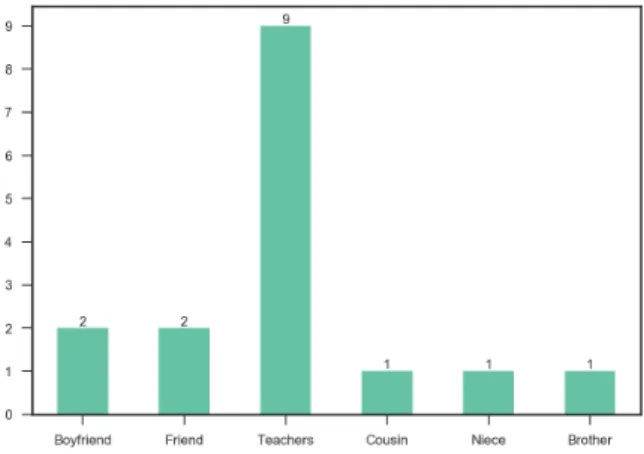
Most of the participants mentioned that the only people they know which work/study in computer areas are their teachers (as shown in Figure 2).
Another interesting topic was discrimina-tion and machismo in the areas of com-putation. Half the participants indicated that women suffer discrimination in the area. The participants also mentioned that
Figure 2: People you know and work in com-puter areas – First Workshop.
they experienced discrimination because the area is considered “only for men”. This results in acts of machismo and lack of recognition of abilities (see Figure 3). Figure 4 presents the perception about the computation after the activities. Most of the participants said that their perception about computation change after the work-shop.
• Software Engineering Workshop. In the second experiment, most participants mentioned that they use computers and Smartphones and the use of the Internet is daily (see Figure 5).
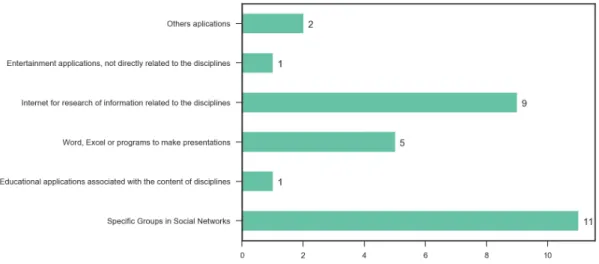
Although schools use technology re-sources, there has been low adherence of educational applications associated with the content of the subjects, perhaps this fact evidences the lack of experience of teachers with educational applications [18] (as shown in Figure 6). Figure 7 presents the team and the laboratories used.
Most of the participants (60%) classified the activity (Workshop) as extremely in-teresting and fun, along with 30% which considered it as much fun. It is likely that this has motivated their interest in the computation areas.
When analyzing the results obtained, we can mention that it was possible to identify similar-ities with the study conducted and (BLACK,
Figure 3: Reasons for discrimination against women in computer areas – First Workshop.
Figure 4: The activities carried out changed your opinion about computing? – First Work-shop.
Figure 5: Main equipment used – Second Workshop.
2005), (DUPONT, 2008) and (AMARAL, 2017). The results pointed that discrimina-tion or skill differences can act as filters that
reduce the entry of women into occupations of technology. Among the limitations of this study, we can mention that: 1) only two work-shops were applied, and the number of partic-ipants is still low (an average of 25 females); 2) only specific topics were used within com-puting area (basic concepts of databases and software engineering); 3) each experiment had only three hours; and 4) the two experiments were performed inside medium size events for computer science.
6 Conclusion
The number of women in computer science is low, and have been decreasing over the years in Brazil.
This article describes workshops on database and software engineering subjects for high school female students. They were conducted by Emili@s project, which has been promoting local events since 2013, but it aimed to extent the activities through com-puter science events, impacting other cities. The realization of the computing workshops were positive, most of the girls changed their perception related of computation areas. The main relevant points of the questionnaire men-tion the girls do not consider a career opmen-tion any area of computation for several possible reasons: 1) lack of encouragement from fam-ily, friends or the educational community, 2)
Figure 6: Use of technological resources in the school – Second Workshop.
Figure 7: Main equipment used – First Workshop (left) and Second Workshop (right).
discrimination and lack of confidence in their abilities. Results indicated that the workshops also presented a positive impact in professors and graduate students, since: (1) computer science had to be rethought in a different facet; (2) teaching also reinforced the subject for the students and (3) the impact in one of the events was so positive that the activity was repeated in 2018.
Nevertheless, when analyzing the data of the workshops, it is noticed that for the number events, the audience as a whole is still small and the data from the questionnaires shows that the community still need to discuss the theme "Women in Computing".
As future work we can mention the neces-sity of follow-up the students who actually en-rolled in computer courses including people
from LGBT groups and person with disabil-ities. As a methodological improvement, we could consider different workshops and the im-pact on students over the years. Furthermore, the simple methodology used in our analysis could be extended to better capture additional characteristics of students.
Acknowledgments
We would like to thank EU-BR EUBra-BigSea project (MCTI/RNP 3rd Coordinated Call). References
AMARAL, M.; EMER, M.; BIM, S.; SETTI, M.; GONçALVES, M. Investigando questões de gênero em um curso da área de
computação. Estudos Feministas, v. 2, n. 25, p. 857–874, 2017.
AnitaB. . 2018. <https://anitab.org/>. [Online; accessed 12-December-2018].
BERG, T.; SHARPE, A.; AITKIN, E. Females in computing: Understanding stereotypes through collaborative picturing. IEEE Transactions on Education, p. 1–10, 2018. BIM, S. A.; AMARAL, M. A.;
KOZIEVITCH, N.; EMER, M.; SETTI, M.; PELLISON, L.; MERKLE, L. Divulgar para atrair, motivar para manter. 10 WIT-Women in Information Technology, p. 2665–2669, 2016. BLACK, S. E.; JAMESON, J.; KOMOSS, R.; MEEHAN, A.; NUMERICO, T. Women in computing: a european and international perspective. 3rd GICT, 2005.
Bureau of Labor Statistics. STEM 101: Intro to tomorrow’s jobs. Occupational Outlook Quarterly online publication. 2014. Retrived on <http://www.bls.gov/careeroutlook/2014/ spring/art01.pdf>. (February 21, 2018). Canada Learning Code. . 2018. <https: //www.canadalearningcode.ca>. [Online; accessed 19-July-2018].
CHERYAN, S.; MASTER, A.; MELTZOF, A. Cultural stereotypes as gatekeepers: increasing girl’s interest in computer science and engineering by diversifying stereotypes. Frontier in Psychology, v. 49, n. 6, p. 1–8, 2015.
Chicas en Tecnologia. . 2015. <https: //www.chicasentecnologia.org/>. [Online; accessed 19-July-2018].
DUPONT, B.; ROSENBLOOM, J.; ASH, R.; CODER, L. Why are there so few women in information technology? assessing the role of personality in career choices. Journal of Economic Psychology, v. 4, n. 29, p. 543–554, 2008.
Emíli@as - Armação em Bits. . 2016. <http://emilias.dainf.ct.utfpr.edu.br/>. [Online; accessed 19-July-2018].
Girls Code. . 2016. <http://www.girlscode. com.py/>. [Online; accessed 19-July-2018]. Girls Develop It. . 2010. <https://www. girldevelopit.com/>. [Online; accessed 19-July-2018].
Girls Who Code. . 2010. <https:// girlswhocode.com>. [Online; accessed 19-July-2018].
Girls Who Code. . 2012. <https:// girlswhocode.com/>. [Online; accessed 19-July-2018].
Global Fund for Women. . 2016. <https: //www.globalfundforwomen.org//>. [Online; accessed 19-July-2018].
KOCH, S.; MüLLER, S. M.; SIEVERDING, M. Women and computers. effects of stereotype threat on attribution of failure. IEEE Transactions on Education, p. 1–8, 2008.
KOZIEVITCH, N. P.; TORRES, S. R.; FALCãO, T.; RAMOS, E.; ANDRADE, F.; MARQUES, S.; UETA, M.; MADI, R. R.; MURTHY, U.; FOX, E. A.; CHEN, Y.; HALLERMAN, E. Evaluation of a tablet pc image annotation and retrieval tool in the parasitology domain. ECDL 2010, n. 160, p. 466–469, 2009.
MACIEL, C.; BIM, S. A.; BOSCARIOLI, C. Hci with chocolate: Introducing hci concepts to brazilian girls in elementary school. CLIHC 2013, n. 8278, p. 90–94, 2013.
MARTINHAGO, A.; SMARZARO, R.; LIMA, I.; GUIMARãES, L. Computação desplugada no ensino de banco de dados na educação superior. XXII WEI, n. 8278, p. 1307–1315, 2013.
MASTER, A.; CHERYAN, A. M. S.; MELTZOFF, A. Programming experience promotes higher stem motivation among
first-grade girls. Journal of Experimental Child Psychology, n. 160, p. 92–106, 2017. MICHELL, D.; SZORENYI, A.; FALKNER, K.; SZABO, C. Broadening participation not border protection: how universities can support women in computer science. Journal of Higher Education Policy and Management, v. 4, n. 39, p. 406–422, 2017.
Mulheres na Computação. . 2018. <https://mulheresnacomputacao.com/>. [Online; accessed 19-July-2018].
Mulheres na Tecnologia. . 2009. <https: //www.mulheresnatecnologia.org>. [Online; accessed 19-July-2018].
NUNES, M.; RODRIGUES, L.; MAR-TINHAGO, A.; SOARES, S.; REIS, R. Meninas++: uma iniciativa para fomentar a participação feminina na área de computação. 10 WIT-Women in Information Technology, v. 3, n. 1, p. 58–78, 2015.
OLIVEIRA, A.; MORO, M.; PRATES, R. Perfil feminino em computação: Análise inicial. XXII WEI, p. 1465–1474, 2014. OLMEDO-TORRE, N.; SáNCHEZ, F.; SALáN, M.; LóPEZ, D.; PEREZ-POCH, A.; LóPEZ-BELTRáN, M. Do female motives for enrolling vary according to stem profile? IEEE Transactions on Education, p. 1–9, 2018.
RODRIGUEZ, J.; KOZIEVITCH, N.; BIM, S.; SETTI, M.; EMER, M.; AMARAL, M. Uma proposta para apresentar a
computação/banco de dados no ensino médio para o público feminino. XII ERBD, p. 155–158, 2016.
SAX, L.; LEHMAN, K.; JACOBS, J.; KANNY, M.; LIM, G.; MONJE-PAULSON, L.; ZIMMERMAN, H. Anatomy of an enduring gender gap: The evolution of women’s participation in computer. Journal of Higher Education, p. 258–293, 2017.
SILVA, T. H. P.; LAENDER, A. H. F.; DAVIS, C. A.; SILVA, A. P. C. da; MORO, M. M. A profile analysis of the top brazilian computer science graduate programs. Scientometrics, v. 113, n. 1, p. 237–255, Oct 2017. Disponível em: <https: //doi.org/10.1007/s11192-017-2462-3>. Tech Ladies. . 2016. <http://www.techladies. com.br>. [Online; accessed 19-July-2018]. WANG, C.; TANG, C.; ZHANG, L.; CUKIERMAN, D. Try/CATCH - A CS Outreach Event Organized by Female University Students for Female High School Students: A Positive Experience for All the Parts Involved. WCCCE ’12, p. 12–18, 2012. WANG, J.; MOGHADAM, S. H.;
MORALES, J. Social perceptions in computer science and implications for diverse students. ICER’17, p. 47–55, 2017.
Women in DB. . 2018. <https://www.
facebook.com/groups/womenindb/>. [Online; accessed 19-July-2018].