A Work Project presented as part of the requirement for the Award of a Master Degree in Finance from the NOVA School of Business and Economics
“ENERGY TRANSACTION, A REALITY. ANALYSIS OF NEW SOLAR BUSINESS MODELS AND BARRIERS TO THEIR DEVELOPMENT”
Daniel Alexandre Martins Marques | 29737
This Work Project was carried out in a Direct Research Internship model in partnership with Energias de Portugal
A Project carried out on the Master in Finance Program, under the supervision of: Professor Doctor João Pedro Pereira
Mariana Gonçalves (EDP Comercial) January 2019
2 Abstract
An enormous transformation is happening in the electric sector as a consequence of the energy transition that is taking place. Digitalization, electrification and decentralization will change the entire electrical system and will change the relationship between the utility and the end customer. Through the analysis of three solar energy business models, the new challenges and barriers that utilities will face as a result of the transformations that are happening in the sector will be addressed. In addition, the advantages, disadvantages and main barriers to the same business will be addressed, as well as a conclusion of which business model is most feasible.
3 Index
1. Introduction - Motivation and Organizational challenge to be addressed………..……...4
1.1 – Current situation of the Solar business………4
1.2 – Limitations and problems associated with the current Solar business……….5
1.3 – Guiding principles for the development of new solar business models…..………5
2. Energy Transition – A huge impact on the electric sector………6
2.1 – Trends that are impacting the energy sector……….……6
2.2 Changing the unidirectional energy flow paradigm………...8
2.2.1 Behind the meter - an opportunity to create value for utilities…………...9
2.3 Death Spiral - the path to grid disconnection or a growth opportunity?.…………....9
2.4 The choice utilities will have to make………..10
3. Decentralized business models of solar energy production………11
3.1 The current solar energy business ………..………..11
3.2 Solar as a service……….……….14
3.3 Community-owned………...……….16
4. Balance between models: choice of the most viable……….……….………19
5. Barriers to the development of new business models of solar energy...………..………21
6. Conclusion……….24
4 1. Introduction - Motivation & Organizational challenge to be addressed
1.1 – The current situation of the Solar Business
EDP's business with solar panels dates to 2008 when, to honor Portugal's commitments to environmental targets, legislation (Decree-law nº363/2007) was created to regulate the production of energy through renewable sources, particularly through solar energy. Then started the microgeneration regime in which all the energy that was produced was directly sold to the grid at a predetermined rate. However, in 2014, the Decree-law 53/2014 was created to regulate the production of electricity under a regime of self-consumption, allowing energy production in a decentralized way to be used to supply the customer’s electrical needs, being injected into the grid only the surplus energy - the Self-Consumption regime.
In what respects to the Solar business in self-consumption regime, it showed a great evolution over the years and it’s expected to have more than twenty thousand photovoltaic solar panels installed in Portugal in the end of 2018.
Source: EDP Data
Although EDP's business with solar panels is showing strong growth and reaching some maturity, there are several problems that are limiting the potential growth of the solar energy business.
5 1.2 – Limitations and problems associated with the current Solar Business
As a result of EDP's experience, it was possible to identify the three main limitations that reduce the attractiveness of the product: limitation on self-consumption legislation, limitation on the space required for the product and limitation with the sale of the equipment.
Regarding legislation, the main limitation is that with the Decree-law 53/2014 (Self-Consumption regime) the injection in the grid is not remunerated, causing a part of the energy produced to be injected in the grid, without the client receiving any compensation for that. In addition, to optimize the use of the energy produced the consumptions should be made in the daytime (when there is sunlight) which is the most active period of the day and in which most people are not at home, therefore, they do not optimize the consumption of the energy produced. All this means that the reductions in the electricity bill fall short of its potential, thus leading to dissatisfaction and less attractiveness of the product, with a consequent reduction in demand. The other limitation is with the space required. The space required for the placement of the panels limits the market to customers who own houses. Solar panels may be placed in apartments, however other requirements are introduced such as the authorization of two-thirds of the condominium, making it more complicated to sell to this type of customers.
Lastly, the restriction on the sale of equipment is due to the fact that the investment that the client has to make is high, there are very few barriers to entry of competitors, as well as a low long-term relationship with the customer and there is no recurring cash flow.
1.3 – Guiding principles for the development of new solar business models
In addition to the problems that have been enunciated, there is also the need to scale the business to numbers that accompany the success of other EDP businesses. Selling twenty thousand solar panels is good (given the insipid state of this industry), however, for a customer base of a total of 4 million and for a market share (liberalized market) of 80%, it turns out not to be so good
6 when compared to these numbers, and consequently there was a need to start thinking about business models that would allow EDP to sell more than 100,000 panels per year. In addition, guiding principles were defined to think about businesses that would bring benefits to the client, maximizing expected value and minimizing pain points, and, lastly, attractive businesses for EDP, which ensure a long-term relationship with high margins and to create barriers to competition, but also to make EDP a pioneer in the transformation of the industry. It was here that the opportunity arose to develop this Direct Research Internship with the objective of studying the transformation of the industry and business models related to solar energy. In relation to the businesses chosen by EDP to be studied, their advantages, disadvantages and main barriers will be addressed and, finally, to conclude the most viable business model. 2. Energy Transition – A huge impact on the electric sector
The energy transition is not a prediction of the future, it is a reality. Our economy is increasingly based on digitalization and technological innovation, making it increasingly change paradigms in various sectors of our society. The energy sector is one of the sectors that is being impacted by the revolution, and with this comes transformations at all levels, whether at the level of utilities, energy producers, or at the level of end consumers of energy (Martin, Starace, 2017). 2.1 – Trends that are impacting the energy sector
Cheryl Martin, in her paper of 2017, says that there will be three trends that will guide the transformation of the electric sector: Decentralization, Electrification and Digitization. Electrification is known to be an essential part of achieving the objectives of various countries in controlling climate change, because when we electrify our entire economy, the ecological footprint will be much smaller. If we can effectively electrify key sectors, such as the industrial and transport sector (which are the most polluters) and thus reduce consumption of fossil fuels,
7 the environmental impact will be enormous. In addition, electrification often translates into greater energy efficiency and better use of resources (Martin, Starace, 2017).
Decentralization will be one of the consequences of the technological advance that has allowed new technologies to be associated with the production of energy, making the customer an active part in the production of energy (Yaqoot, et al, 2015). This will be the transformation that will have more visibility to the naked eye and in which utilities want to take an active role.
Digitalization will be the cornerstone that will allow the development of both Electrification and Decentralization by allowing greater and better control of the energy produced and consumed by customers, by allowing all relevant information to be communicated to customers, but mainly for the management and operation of the grid through devices that reflect the Internet of Things, such as smart meters and energy management systems. It will, therefore, strengthen communication between utilities and the electricity system and between utilities and customers, making the energy produced be allocated more efficiently (Martin, Starace, 2017).
Decentralization will impact the sector through: decentralized energy production resources, mainly through photovoltaic solar panels (which are also the main focus of this work); decentralized power storage, through the possession of small batteries in the home of consumers and energy producers; through energy efficiency programs, as more and more equipment will be electric and therefore more efficient, but also because the market will increasingly reflect the internet of things and the equipment will be integrated with each other, and with the electrical system simultaneously, for a better allocation of energy (Hemmingsen, Durocher, 2016). Connected to this will be the management of energy on the demand side, that is, energy management made by energy consumers, where they will proactively begin to manage their energy needs, buying from the grid the necessary energy and selling to it the surplus. This will have a positive impact on the grid and the environment as it allows greater
8 control of energy needs and thus reducing energy needs during peak demand. This will obviously have effects on utilities as they do not have to prepare the electrical system for large demand peaks and thereby also reduce their production costs because they can rely on the energy produced by customers in a decentralized way (Martin, Starace, 2017).
Solar panels will reduce the demand for energy during the day, that is, when there is sun. Batteries will soften the demand for energy throughout the day since, when there is a peak of energy production, they will store that surplus energy so that when there is a peak of demand for energy the customers can use the stored energy, thus reducing and smoothing energy consumption. Energy efficiency programs will reduce the energy consumed as a whole as less energy is needed to achieve the same goal. Finally, energy management made by consumers (Demand Side Management) will make it easier to predict and reduce peak demand through incentives that are given to customers through price (Martin, Starace, 2017).
2.2 Changing the unidirectional energy flow paradigm
The traditional unidirectional business model in which electricity production is exclusive to large producers and therefore the energy flow is from the major producers to the end customer is shifting to a two-way electricity production. Nowadays, customers of utilities are not only consumers, they are also producers of energy through decentralized resources to produce energy, e.g solar panels, causing the customer to stop being a consumer and become a producer and consumer, giving rise to the prosumer (producer + consumer), who consumes electricity from the grid, but also exports the excess energy produced that is not consumed (Rutovitz et al, 2014). In this context, utilities will have to attach greater importance to the potential value that exists for Behind the Meter business models.
9 2.2.1 Behind the Meter - an opportunity to create value for utilities
The concept Behind the Meter is used in reference to the technologies that are used in the home of the final consumer with the purpose of producing energy, which is on the other side of the meter (behind), i.e., in the consumer side and not on the utility side. It is a system which is located in one or more buildings and is owned by an individual or entity and which is intended to provide all or part of the energy required for the end user (Bayram, Ustun, 2016).
Utilities will realize that investing in Behind the Meter services can play a key role in stimulating the adoption of decentralized energy production resources, for example, by creating communication channels that increase communication between utility and the consumer utilities will help to communicate incentives to sell energy to the utility by the customer through pricing schemes, making it profitable for the consumer and giving in this way incentives to invest in more associated products. There are other business opportunities of great value regarding smart home devices, energy management services, among others (Aguirre, 2014). 2.3 Death Spiral - the path to grid disconnection or a growth opportunity?
One of the themes that starts to emerge when talking about the growth of decentralized energy resources is the Death Spiral. Some authors argue that there is a clear tendency for the electricity price to increase and this creates incentives for customers to seek cheaper energy sources, requiring less energy from the grid and end up leaving it initiating a spiral of exits and price increases called Death Spiral (Hyman, Tilles, 2016).
As more and more consumers are producing their own energy, there will be an ever-lower electricity consumption on the grid, causing the unit price of energy to increase as electricity producers have to recover the same fixed costs from a smaller customer base. Clients who remain on the grid will tend to face ever-increasing prices on the grid, which has been designed and built to the size of a much larger customer base. This event puts even more pressure on
10 prices for those who remain on the grid, making them pay even more for the electricity they consume and giving them more incentive to invest in their own energy production and to disconnect from the grid and thus creating a spiral of price increases for those who remain on the grid and a spiral of customers leaving the grid (Rutovitz et al, 2014).
However, there are other opinions. Mohammed Muaafa argues that the possibility of Death Spiral happening is minimal because the scale with which adoption of panels is happening do not threats utilities business and there is a chance utilities will be able to keep up with these changes by thinking in new business models that diversify revenue sources (Muaafa, 2017). Other researcher says that there is a clear risk that customers will disconnect from the grid because of the associated cost increase trend, which is a clear incentive for utilities to identify new business models and services associated with the sale of energy (Martin, Starace, 2017). Also mentioned in the study by Leonard Hyman and Willian Tilles is that this could be a growth opportunity for utilities in the sense that they can diversify their product portfolio, offering products and having high value-added business models, such as the provision of energy-related services or, for instance, investment in electric mobility, which is predicted to increase electricity consumption by 15% in the United States if half of the cars in the United States are powered by electricity (Hyman, Tilles, 2016).
2.4 The choice utilities will have to make
The market, utilities, but above all, the energy industry will have to respond to the forces that begin to be exercised in an agile, resilient and efficient way. Utilities will have to move from commodity-centric utilities to consumer-centric utilities (Chidambaram, et al, 2017).
Utilities will be able to choose between two paths: keeping their general business model the way it is, putting the system's increased costs on customers who remain on the grid, subsequently facing heavy customer losses and consequent revenue losses; or will try to keep
11 up with the revolution that is happening, looking for new business models and new methods of providing services associated with the sale of energy, trying in this way to compensate for the loss of revenue (Hemmingsen, Durocher, 2016).
Utilities will have to realize that there is a considerable risk of not taking advantage of the great potential to create value through distributed energy resources. EDP has already realized that it must follow the transformations and decided to choose the second path, to look for new business models that diversify the sources of revenue and to strengthen the portfolio of products to offer to its customer base, trying to follow and be a pioneer in transformations in order to overcome the challenges posed and thus achieving success. It is with this motivation that this Direct Research Internship arose, aiming to synthesize the changes that are occurring in the sector, but mainly to study three business models associated with solar energy,
3. Decentralized business models of solar energy production
As already mentioned, the main objective of this work, besides talking about the already discussed energy transition, is to analyze new business models related to solar energy and to understand the main barriers to its development. EDP chose three business models to be analyzed and compared: the current solar energy business model, which is a customer-owned business model; Solar as a service, which is utility-owned business model; and finally, a Community-owned business model.
3.1 The current solar energy business model
This is EDP's current business model and the most normal to see. In this type of business model, the customer buys the solar panels that are installed in his house and is the only user of the energy produced. It is the so-called self-consumption regime, regulated by the Decree-law 53/2014, where all energy produced is instantaneously injected into the house, with surplus energy (which is not instantaneously consumed) being injected into the grid.
12 In the current offer, the customer buys the panels and in that value are included inverters, cables and a turn-key installation. The client may pay in monthly installments, without interest, or in one shot. In this model, the advantages for the customer lie in the fact that the customer becomes prosumer (explained in point 2.2 of this paper), therefore, he does not consume so much energy from the grid causing the electricity bill to decrease.
In this model, utility’s main source of revenue is the margin that is made with the sale of the panels and the amount that is charged for the installation (reflected in the price). There may be other sources, such as maintenance and repair, or energy consultancy services (Strupeit, 2016). Regarding utility’s costs, the main slice is with the materials (solar panels, cables, inverters and installation). Other relevant expenses are with salary expenses (independent commercial teams, managers, etc.) and with the storing of materials and vehicles (Reddy, 2004).
Advantages:
- The customer owns the panels, being the sole beneficiary of the energy produced. - In case of sale, the customer will have his house valued for owning solar panels.
- The utility can make fixed packages of associated products, for example, the customer pays a single value for a pack that includes panels, inverters, cables and installation. Or, all these products can be sold separately allowing the customer to customize their installation. Typically, companies offer packs because the installation is not easy to perform by the customer, it must be done by a specialized technician, through a technical visit (Zhang, 2016).
- Clients and companies may receive government incentives such as reduced taxes and subsidized tariffs (Couture, 2010). This makes the offer much more attractive because it reduces the payback period. In Portugal, there are currently no tax benefits for solar panels, whether
13 photovoltaic or thermal. In 2009 there were tax benefits on income tax (IRS). At that time, 30% of the expenses with thermal panels were deductible, with a maximum limit of € 796 (a). Disadvantages:
- The customer has to make a high initial investment, with a strong impact on demand. - It is necessary to have a roof with adequate conditions (space, sun exposure, orientation). - Many customers cannot install solar panels in their home for three main reasons: they are not the owners of the building (e.g. tenants); live in a condominium and need the authorization of the remaining residents; or the roof has no conditions (e.g. lack of sun exposure). In addition, after installing they have to worry about cleaning and performance, or quite simply do not want to have such equipments on the roof for other issues such as aesthetics (Comello, 2016). - The utility has costs with the installation of the solar panels at each customer's home.
- It's all done by the utility - it designs the offer, installs, arranges licenses, handles maintenance, repair and replaces, etc., having costs associated with all these activities (Huijben, 2013). - If the installation is carried out by an external company, in an outsourcing, complaints arise with the quality of the service, with the formation of new teams, among others, introducing noise and damaging the quality of the sale and the customer experience.
- The utility has to deal with many solar panel suppliers and installers across the country, causing them to always negotiate prices and conditions (Strupeit, 2016).
- There is currently no offer from financing institutions to help clients finance these types of energy production solutions, causing many business opportunities to be lost because customers cannot make the initial investment (Frantzis, et al, 2008).
14 - Do not allow economies of scale. In each sale that is carried out there is an installation, cables, inverters included and for each installation an external company that has to be contracted to carry out the installation - all this reduces the margin of each sale, thus not obtaining gains of scale and causing the profit margin to be reduced.
3.2 Solar as a service
As the name says, this model it is a service associated with the production of solar energy. The customer does not own the panels and therefore only pays a value for the service provided. This value corresponds to the fee for the service and the price of the energy produced. The price paid for this energy is lower than the normal price of electricity that the customer would pay if consumed of the grid, being here that the savings for the client reside (Zhang, 2016).
The utility owns and installs the panels in the customer's home. The customer signs a medium or long-term contract with the utility for the power supply. Therefore, this business model is often associated with Power Purchase Agreements (PPA) and leasing solutions (Kollins, 2010). The main advantage is that in this model the problem of the high initial investment that should be done to acquire the solar panels, as in the regular model, is overcome.
The main target customers are customers who would like to reduce their electricity bill and use renewable energy in their home but are either not financially able or unwilling to make the high initial investment that is required in the normal model for the sale of solar panels (Zhang, 2016). Regarding utilities revenues, the main source is the revenue from the PPA and Leasing contracts. The duration of these contracts is typically between 10 and 25 years (Feldman, 2013). Under a PPA contract, the customer pays a price per kWh (€ / kWh) (Davidson, 2015). At the end of the contract the customer has the option to renew the contract, not renew the contract (the company remove the panels) or to buy the panels by a residual value (Corfee, 2014). In the case of a leasing contract, the customer does not pay for the energy produced, only for the use
15 of the equipment and, therefore, consumes the energy that was produced. Therefore, the utility earns with the price at which it sells the energy to the customer (which will still be lower than the price that the customer would pay if it were to be consumed from the grid) or wins with the portion of energy produced that is not accounted for in the account of the customer, that is, of the total energy that is produced by the panels, one part is for use in the client's house and the other part is for the utility (Davidson, 2015).
Other sources of revenue may be government subsidies, tax benefits or incentives (which may be given to the utility or the costumer) given by local entities such as municipalities (Tuballa, 2015). Lastly, consumption monitoring services, maintenance or repair services, may also be a source of revenue for utilities (Zhang, 2016).
In terms of costs, in addition to having the same cost structure as the regular model, utility has extra costs with the management of the Leasing and PPA contracts. Connected to this is the additional cost that is required with more sophisticated IT systems (Strupeit, 2016).
In this business model, banks, financing institutions or people with this type of skills are essential for managing the PPA and Leasing contracts (Frantzis, 2008).
Advantages:
- Bypasses the problem of the high upfront cost for the customer. The customer has access to renewable energy and is able to achieve savings without having to make a big initial investment. - The customer starts saving immediately and there is no worry about a long payback period because he gets monthly savings right from the start (Hobbs, Pierpont, 2013).
- The customer pays the energy produced at a much more competitive price compared to the normal energy tariff (Drury, et al, 2012).
16 - The customer has the possibility to decide whether to renew the contract (PPA or leasing), not renew the contract or to buy the panels for a residual value (Corfee, 2014).
- The PPA and leasing contracts mean that the customer does not have the same responsibilities as in the other models, placing all the monitoring, maintenance and operation activity under the responsibility of the utility or the company responsible for this activity (Kollins, 2010).
Disadvantages:
- As in the regular model, the customer needs roof with conditions to carry out the installation (space, sun exposure, orientation). The difference is that the utility owns the panels.
- In addition to having the same cost structure as in the regular model (panels, inverters, cables, equipment shifts, turn-key installation), utilities have costs with the removal of the panels (when the customer decides) and with the management of stock of used panels (Coughlin, 2009). - Utility has additional costs with the management of PPA and Leasing contracts (Hobbs, 2013). - There is also a lack of availability of agents, companies and banks willing to make such type of contracts that are typical in this business model (Frantzis, 2008).
3.3 Community-owned business model
This model allows the client to have access to energy that was produced in a solar park that could have any location, meaning that the client does not install panels in his house, but receives energy credits that allow him to achieve savings (Augustine, McGavisk 2016).
In this model, the utility builds a solar park (in a location chosen by the utility) where there will be energy production and will allow customers to subscribe to a part of that park. Of course, there is no real transfer of energy to client's home, since energy is produced in a solar park and not at the customer's home, existing later a clearing of the energy produced (depending on customer subscriptions) and a credit on the customer's electricity bill (Carey, Gertel, San, 2017).
17 For this to be possible, a contract must be made between the utility that owns the solar park and some company that is willing to buy that energy, through a Power Purchase Agreement, which typically lasts between 10 and 25 years and will allow the utility to ensure the sale of energy (Davidson, 2013). Or the utility has the solar park integrated into its energy production system and therefore, the energy produced will be for the final customer.
In this model the customer has several possibilities: buy panels; lease panels; buy energy or buy production capacity. Therefore, one of the main activities that must be ensured by the utility is the management of the subscriptions made by the clients (Augustine, McGavisk, 2016). Generally, the solar park is built and operated by a specialist company in the area, placing the responsibility for the operation and maintenance in the operating company (Davidson, 2013), not in the customer nor in the utility. Therefore, in this model the utility may or may not be responsible for the operation of the park, that is, it may create teams that deal with all operations and maintenance activities, or may deliver this activity to other company (Funkhouser, 2015). This model has the great advantage of allowing the customer to achieve savings through the production of green energy, being this characteristic one of the main advantages to the customer as he can have a direct clearance on the electricity bill, without having to purchase the panels or install them in his home (Augustine, McGavisk 2016).
In terms of revenues to the utility, the main source is the sale of the energy produced through a PPA agreement with an entity (willing to buy the energy). Then there is also the revenue with the different kind of subscriptions that the client may choose, for instance, the revenue with the sale of the energy produced in portions that the customer may acquire as if it were a bond (Rai, 2016). This option makes us almost look at this model almost as a financial product in which the customer buys bonds and receives an interest which in this case are the energy credits.
18 Another source of revenue is when customers, instead of buying energy, buy a certain number of panels just like in regular business, with the difference that the panels are installed in a solar park, so the customer does not need any conditions in his home (Chwastyk, Sterling, 2015). Regarding utility’ costs, these come mainly from the initial investment that the utility has to do to build the park, putting some risk on the utility (Rai, 2016). Another part of the costs also comes from the solar park maintenance operations that have to be continually made and can be done by the utility or by a company specialized in this task, as mentioned previously. The costs with subscriptions management and information and software systems are also relevant as they are essential to the park's activity (Carey, Gertel, San, 2017).
Advantages
- Main advantage for utilities: it allows to realize economies of scale (Feldman, 2015).
- The customer has several options: buy or lease panels; buy systems; purchase energy or production capacity (Augustine, 2015).
- It will allow the customer to produce renewable energy without having to have panels at home. Additionally, the customer may not have to make the initial investment necessary to acquire the solar panels as in the regular business. He can lease panels or purchase energy (Feldman, 2015). - The customer does not have to worry about the performance of the solar panels because this function is ensured by the company that operates the park, receiving the customer only his energy credits in the electricity bill (Funkhouser, 2015).
- If the client moves out of the house, there will be no transfer of panels or anything of the kind, since the client does not have the physical asset, everything remains the same and only needs to change the address in the contract or may sell his subscription of the park (Coughlin, 2012).
19 - The fact that the calculation of energy produced and the subsequent credit in the electricity bill can only be applied in cases where the consumer is a customer of the utility makes it a way to get more clients to the utility because if the consumer wants to have access to this model has to be customer, and is also a way of creating barriers to other utilities. (Coughlin, 2012). Disadvantages:
- One of the attractions of this model for customers is the virtual net metering, that is, the calculation of the energy produced that will dictate the amount of energy that will be credited to the client's electricity bill, however, in many regions, states or countries, as in the case of Portugal, there is still no legislation that allows this action because the legislator is not clear whether this model is a financial product or if it is commercialization of energy, being so far this lack of definition in legislation one of the main barriers and disadvantages.
- There are extra costs with information systems, management of participations and other systems that are essential to the correct operation of this business (Carey, Gertel, San, 2017). 4. Balance between models: Choice of the most viable
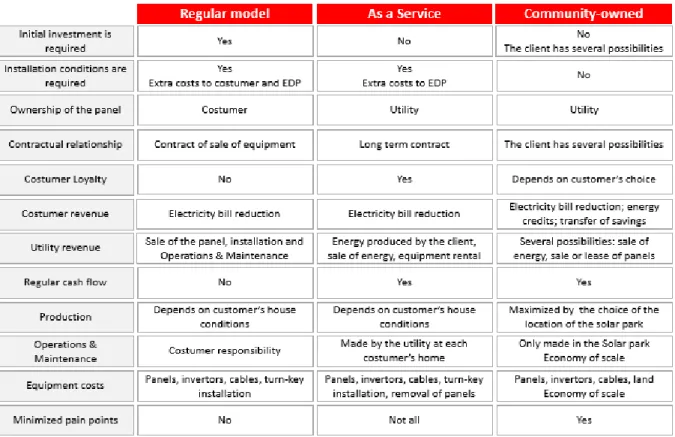
Analyzing the three business models and considering several factors, it was possible to reach a conclusion about the business model with greater viability.
The savings for the client are transversal to the three models, however, in the regular business model the client has to make a large initial investment affecting the profitability as a whole, increasing the payback period and reducing the attractiveness of the investment to the client. The initial investment that the client has to make is the biggest barrier that exists in the regular model. In addition, the need to have adequate housing conditions (space, sun exposure, etc.) is also a limitation to the dissemination of this model and the Solar as a Service model as it is also
20 necessary installation of the panels at the customer's home, with the costs that the installation and removal operation represent to the utility (if customer rescinds or not renew the contract). On the other hand, the Community-owned model surpasses the limitations previously mentioned because the client does not need to make the initial investment and does not need to install the panels because he can be a subscriber of the solar park. In addition, the Community-owned model gives customers the flexibility to choose which subscription units they prefer and that fit their financial conditions. The customer can buy energy, productive capacity or panels, and there is the possibility of terminating the contract when the customer wishes. Another advantage is that the customer's rights to receive credits in the electricity bill as a result of solar production may be sold to another person, passing that person to have the rights to receive the credits, making this right easy to sell and to realize liquidity in case the client needs it. Therefore, the Community-owned model, like As a Service model, offer a way to exceed the initial investment, however, the Community-owned model offers more possibilities to do so. Regarding the costs, in all businesses there are similar costs with panels, inverters, cables, installations and systems. However, and probably this is one of its biggest advantages and that makes it very attractive to utilities, is that in the Community-owned model it is possible to realize economies of scale that are not possible to perform in the regular model and as a service, being, therefore, a clear advantage for the utilities to evolve towards this business.
Related to this are also the costs of systems installations, maintenance and operations: in the regular model and in the as a service model, the utility often has to perform this type of functions or has to hire other companies to do so, losing in this way some margin and bringing with it some problems such as the lack of training of these teams.
In the Community-owned model, economies of scale are achieved because only one operating company has to be contracted, for the maintenance of the park, thus reducing costs and
21 increasing the margins of the business. In addition, the fact that it is only a place to install solar panels gives the utilities the possibility to choose the location that maximizes solar production and thus leads to an optimization of the resources invested and the output withdrawn.
In conclusion, it is clear and easy to point out that there are more favorable conditions to the customer and the utility in the Community-owned model, making this the model chosen as the business with greater viability for the utilities and, of course, it is also EDP's choice.
Table 1 - Comparison between business models
5. Barriers to the development of new business models of Solar Energy
In the previous points, the transformation of the industry, the reaction that the industry could and should have, the new business models that the companies could develop and even the conclusion of which business with greater viability at various levels were addressed.
However, there is still an important and crucial topic that, because of its importance, must be addressed because it touches on all of the above. The issue is the barriers that still exist to the
22 development of decentralized energy production resources and to the type of business models addressed, that is, barriers that impede its growth and its massification.
From the research carried out it was possible to conclude that the existing barriers fall into three main types: legislative barriers, technological barriers and monetary barriers. Then two other types of barriers, behavioral barriers and resource barriers may be considered by the company, but not at the same level of magnitude.
Regarding monetary barriers, and as previously mentioned, they are mainly in relation to the high initial investment that is required, particularly in the regular business in which the customer has to acquire the panels and pay a high up front. This makes the return on investment (ROI) and the payback period less attractive to the customer, with the obvious consequence of decreasing demand (Drury, et al, 2012). In the other two business models, Solar as a service and Community-owned, this barrier is circumvented, however there are still high initial costs, for example, in the case of the community-owned business model, the utility has to make the high investment in the construction of the solar park.
As mentioned previously, the idiosyncrasies of the normal business and the as a Service model make it impossible for the utility to achieve economies of scale, which is also a barrier to investment and development in the residential segment (Richter, 2013) because the margins are quite low (Ruggiero, 2015). An alternative to this barrier is in the Community-owned model because it is the only one that surrounds it.
As discussed earlier, many clients do not have the financial capacity to carry out this type of investment, so it will be relevant for utilities and financial institutions to evolve and think about new forms of financing that help increase customer attractiveness (Davidson, 2015). An example of the type of innovations that have to occur is, for instance, what was done by EDP by offering the possibility to its customers to pay the solar panels on their electricity bill in 36
23 monthly installments without interest, that is, it is a payment facility and not a credit, making it much easier and appealing to the customer to adhere to such solutions.
Regarding technological barriers, these are mainly based on the need to have confidence in the grid, a trust based mainly on its stability and efficiency (Uhlir, 2016). This is because, with the increase in the number of decentralized power generation, the grid will have to adapt to these additional loads, leading to considerable investment in order to make it more functional, stable and technological (Ruggiero, 2015).
The transformations that will occur on the grid have to be based on technological upgrades in the infrastructures, since in case the electrical system presents constant intermittency and poor performance, this will influence the performance of all the individual energy production systems, causing a waste of the energy produced, impacting the investment of the customers by reducing the savings that could be achieved (Engelken, 2016).
Legislative barriers play a major role because they simply prohibit some type of technology or some types of business models are prevented because of lack of legislation.
Legislative barriers also play a relevant role in the view that these are constraints that are not dependent on utilities, but rather on power and political will. A clear example of this is the lack of legislation for new businesses like the Community-owned model, preventing some business models from being more attractive.
Another important point is the lack of fiscal incentives for the acquisition of solar panels and adherence to new business models. In Portugal, there were incentives only for the purchase of solar thermal panels and not solar photovoltaic panels. On the other hand, (Karakaya, 2016) and (Schoettl, 2011) argue that low electricity prices and the existence of feed-in tariffs constitute a barrier to the spread of this type of business to the extent that, if electricity prices were higher and did not exist negotiated rates, there would be a greater incentive to reduce their
24 dependence on the grid and to seek to invest in alternative sources of energy production, because the fact that the electricity price is low will make the payback period higher.
In addition to these three barriers, two other types of barriers could be considered. When analyzing the models, it is possible to realize that these will depend heavily on technology, monitoring and control systems of sales and subscriptions, therefore, this type of resources and the know-how necessary to its use and applicability may be a barrier as companies may have difficulty finding human capital with this type of skills (technical and theoretical) because it is something new. As business models evolve, they change the key competencies that are required for day-to-day operations and business success, so it will be an internal challenge for utilities to provide this type of training or hire people with this profile on the market (Richter, 2013). Another barrier is the lack of knowledge and trust on the part of customers in these new types of business models of solar energy production. The opinion and acceptance of this type of business is essential because the success of all depends on the demand from the customers. Many people think that such solutions are still very expensive and practically inaccessible to most people (Engelken, 2016). Moreover, the lack of awareness of the possible savings and benefits of renewable energy in everyday life and its impact on the planet may also reduce the demand for such solutions (Eleftheriadis, 2015).
People in general are risk averse so they may think that they will not achieve great benefits and that there are no advantages in producing renewable energy and therefore are not willing to invest in such solutions (Ellabban, 2016).
6. Conclusion
The behavior of utilities must change in order to keep pace with the transformation of the sector. In addition to selling energy, utilities will have to find new business models related to the commercialization of energy and create services associated with these new businesses, thereby
25 trying to diversify their product portfolio and reduce exposure to the energy business, but also try to help the customer to achieve savings and use resources more efficiently.
The success of the energy transaction will depend not only on the degree of innovation and on the attractiveness of the models, but also on the effort to inform customers about the new business models and their benefits. Utilities and government entities should try to inform people about what renewable energies are, their benefits and how people can access them.
There must be a clear political commitment and a strategic plan to help the development of this kind of business, which involves innovation in the electricity system and support for disruptive business models that bring value to companies and to customers. This political commitment translates into proper legislation that accommodates business innovation.
The main finding of this work was about the business model that brings greater gains to the customer and to utilities. The customer will be more demanding, more informed and increasingly subject to more information, so utilities will have to simplify the message more and more and to innovate their business models in order to maximize customer output, but above all, minimize their pain points. Business models such as the Community-owned model mean increased benefits and reduced problems for both parties.
Another conclusion is that to exist massification of businesses in which it is necessary to have physical assets it is necessary to have some degree of control or ownership by the utility. Whether because of the know-how of the product and the business that they have or for the size they have and that will be necessary to manage a growing number of new forms of production. This work project has as main objective to reach the conclusion of which business model will be more attractive for the utilities, however, it is also expected to serve as a guide to alert the various stakeholders of the barriers that still exist and that hinder the success and the massification of new businesses in a very rigid sector.
26 7. References
. Aguirre, Mariana, and Gbenga Ibikunle. 2014, “Determinants of Renewable Energy Growth: A Global Sample Analysis”. Energy Policy; 69: 374-384.
https://www.sciencedirect.com/science/article/pii/S0301421514001451
. Augustine, Paul. 2015. “The time is right for utilities to develop community shared solar
programs.” The Electricity Journal, 28:107–108.
https://www.sciencedirect.com/science/article/pii/S1040619015002493
. Augustine, Paul, and Emily McGavisk. 2016. “The next big thing in renewable energy: Shared solar”. The Electricity Journal, 29:36–42. http://dx.doi.org/10.1016/j.tej.2016.04.006. . Bayram, Islam, and Taha Ustun. 2016. “A survey on behind the meter energy management systems in smart grid” Renewable and Sustainable Energy Reviews, 72: 1208-1232.
http://dx.doi.org/10.1016/j.rser.2016.10.034
. Carey, Brian, and Debi Gertel, and Sean Jang. 2017. “Community Solar – Share the sun rooflessly.” Working paper from Strategy&, PWC – PricewaterhouseCoopers.
. Chidambaram, Vivek, and Muqsit Ashraf, and Manas Satapathy. 2017. “Energy company
of the future”. Working paper from Accenture, Accenture Strategy.
. Chwastyk, D., and Sterling, J. 2015. “Community Solar Program Design Models”. Retrieved September 09, 2018, from Solar Electric Power Association website:
https://www.solarelectricpower.org/media/422096/community-solar-de- sign-plan_web.pdf. . Comello, Stephen, and Stefan Reichelstein. 2016. “Cost competitiveness of residential solar PV: the impact of net metering restrictions”. Renewable and Sustainable Energy Reviews. 75: 46–57. http://dx.doi.org/10.1016/j.rser.2016.10.050.
27 . Corfee, Karin, and Shannon Graham, and Beth Davis, and Jane Hummer, and Charlie Bloch, and Jack Cullen, and Nicole Fry, and Amy Meyer, and Shalom Goffri. 2014. “California Solar Initiative: Third-Party Ownership Market Impact Study”. Navigant Research, 415.356.7100. http://www.cpuc.ca.gov/WorkArea/DownloadAsset.aspx?id=7689
. Coughlin, Jason, and Karlynn Cory. 2009. “Solar photovoltaic financing: residential sector deployment.” National Renewable Energy Laboratory. Technical Report NREL/TP-6A2-44853 https://www.energy.gov/sites/prod/files/2014/11/f19/44853.pdf
. Coughlin, Jason, and Jennifer Grove, and Linda Irvine, and Janet Jacobs, and Sarah Philips, and Alexandra Sawyer, and Joseph Wiedman. 2012. “A guide to community shared solar: utility, private, and nonprofit project development.” National Renewable Energy
Laboratory, 39: 1-68.
. Couture, Toby, and Karlynn Cory, and Claire Kreycik, and Emily Williams. 2010 “A Policymaker’s Guide to Feed-in Tariff Policy Design”. National Renewable Energy
Laboratory. Technical Report NREL/TP-6A2-44849
https://www.nrel.gov/docs/fy10osti/44849.pdf
. Davidson, Carolyn, and Daniel Steinberg. 2013. “Evaluating the impact of third-party price reporting and other drivers on residential photovoltaic price estimates.” Energy Policy; 62:752– 761. http://dx.doi.org/10.1016/j.enpol.2013.07.112.
. Davidson, Carolyn, and Daniel Steinberg, and Robert Margolis. 2015. “Exploring the market for third-party-owned residential photovoltaic systems: insights from lease and power-purchase agreement contract structures and costs in California.” Environmental Research
Letters; 10:1–12. http://dx.doi.org/10.1088/1748-9326/10/2/024006.
. Drury, Easan, and Mackay Miller, and Charles Macal, and Diane Graziano, and Donna Heimiller, and Jonathan Ozik, and Thomas Perry. 2012. “The transformation of southern
28 California's residential photovoltaics market through third party ownership.” Energy Policy; 42:681–690. http://dx.doi.org/10.1016/j.enpol.2011.12.047.
. Dustan C, and Sharpe S, and Harris S, and Wynee L, and Jenni D, and Razain H. 2013. “Decentralized energy and electricity networks in the low carbon era. Prepared for the City of Sidney”. Institute for Sustainable Futures, UTS, 48.
. Eleftheriadis, Iordanis, and Evgenia Anagnostopoulou. 2015. “Identifying barriers in the diffusion of renewable energy sources.” Energy Policy; 80:153–64.
http://dx.doi.org/10.1016/j.enpol.2015.01.039.
. Ellabban, Omar, and Haitham Abu-Rub. 2016. “Smart grid customers' acceptance and engagement: an overview.” Renewable Sustainable Energy Reviews; 65:1285–1298.
http://dx.doi.org/10.1016/j.rser.2016.06.021.
. Engelken, Maximilian, and Benedikt Römer, and Marcus Drescher, and Isabel Welpe, and Arnold Picot. 2016. “Comparing drivers, barriers, and opportunities of business models for renewable energies: a review.” Renewable Sustainable Energy Reviews; 60:795–809.
http://dx.doi.org/10.1016/j.rser.2015.12.163.
. Feldman, David, and Barry Friedman, and Robert Margolis. 2013. “Financing, overhead, and profit: an in-depth discussion of costs associated with third-party financing of residential and commercial photovoltaic systems”. National Renewable Energy Laboratory; Technical Report NREL/TP-6A20-60401. https://www.nrel.gov/docs/fy14osti/60401.pdf
. Feldman, David, and Anna Brockway, and Elaine Ulrich, and Robert Margolis. 2015. “Shared Solar: Current Landscape, Market Potential, and the Impact of Federal Securities Regulation”. National Renewable Energy Laboratory; Technical Report NREL/TP-6A20-63892. https://www.nrel.gov/docs/fy15osti/63892.pdf
29 . Frantzis L, and Graham S, and Katofsky R, and Sawyer H. 2008. “Photovoltaics business models”. National Renewable Energy Laboratory, Subcontract Report NREL/SR-581-42304
https://www.nrel.gov/docs/fy08osti/42304.pdf
. Funkhouser, Erik, and Griselda Blackburn, and Clare Magee, and Varun Rai. 2015. “Business model innovations for deploying distributed generation: the emerging landscape of community solar in the U.S.”. Energy Research & Social Science; 10: 90–101.
http://dx.doi.org/10.1016/j.erss.2015.07.004.
. Hemmingsen, Mary, and Todd Durocher. 2016. “The agile utility. Future-state industry model and the evolution of the utility as a network integrator”. Working paper from KPMG, 11996.
. Hobbs, Andrew, and Brendan Pierpont, and Uday Varadarajan. 2013. “Improving solar policy: lessons from the solar leasing boom in California”. Climate Policy Initiative.
https://climatepolicyinitiative.org/publication/improving-solar-policy-lessons-from-the-solar-leasing-boom-in-california/
. Huijben, J.C.C.M, and G.P.J Verbong. 2013. “Breakthrough without subsidies? PV business model experiments in the Netherlands.” Energy Policy; 56:362–370.
http://dx.doi.org/10.1016/j.enpol.2012.12.073.
. Hyman, Leonard S., Tilles, William. 2016. “The Sun Will Set on Electric Utilities” Barron’s, November 6. https://www.barrons.com/articles/the-sun-will-set-on-electric-utilities-1468041067
. Karakaya, Emrah, and Cali Nuur, and Antonio Hidalgo. 2016. “Business model challenge: lessons from a local solar company”. Renewable Energy; 85:1026–1035.
30 . Kollins, K, and Speer B, and Cory K. 2010. “Solar PV Project financing: regulatory and Legislative challenges for third-Party PPA”. Contract; 1–43.
https://www.researchgate.net/publication/255211687_Solar_PV_Project_Financing_Regulato ry_and_Legislative_Challenges_for_Third-Party_PPA_System_Owners
. Martin, Cheryl, and Francesco Starace. 2017. “The Future of Electricity. New Technologies Transforming the Grid Edge”. Working paper from World Economic Forum, Ref 030317.
. Muaafa, Mohammed, and Iqbal Adjali, and Patrick Bean, and Rolando Fuentes, Steven Kimbrough, and Frederic Murphy. 2017. “Can adoption of rooftop solar panels trigger a utility death spiral? A tale of two U.S. cities”. Energy Research & Social Science. 34: 154-162. . Rai, Varun, and D. Cale Reeves, and Robert Margolis. 2016. “Overcoming barriers and uncertainties in the adoption of residential solar PV”. Renewable Energy; 89:498–505.
https://www.sciencedirect.com/science/article/pii/S0960148115304961
. Reddy, Sudhakar, and J.P Painuly. 2004. “Diffusion of renewable energy technologies-barriers and stakeholders' perspectives”. Renewable Energy; 29:1431–1447.
http://dx.doi.org/10.1016/j.renene.2003.12.003.
. Richter, Mario. 2013. “German utilities and distributed PV: how to overcome barriers to business model innovation”. Renewable Energy; 55:456–66.
http://dx.doi.org/10.1016/j.renene.2012.12.052.
. Ruggiero, Salvatore, and Vilja Varho, and Pasi Rikkonen. 2015. “Transition to distributed energy generation in Finland: prospects and barriers”. Energy Policy; 86:433–443.
31 . Rutovitz, J, Langham, E., & Downes, J. 2014. A level playing field for local energy. Issues
paper prepared for the City of Sidney. Institute for Sustainable Futures, UTS.
. Schoettl, Jean, and Laurence Lehmann-Ortega. 2011. “Photovoltaic business models:
threat or opportunity for utilities?”
https://www.researchgate.net/publication/279670374_Photovoltaic_business_models_Threat_ or_opportunity_for_utilities
. Strupeit, Lars, and Alvar Palm. 2016. “Overcoming barriers to renewable energy diffusion: business models for customer-sited solar photovoltaics in Japan, Germany and the United
States”. Journal of Cleaner Production; 123: 124–136.
http://dx.doi.org/10.1016/j.jclepro.2015.06.120.
. Tuballa, Maria Lorena and Michael L. Abundo. 2016. “A review of the Development of Smart Grid Technologies.” Renewable and Sustainable Energy Reviews, 59: 710-725.
https://www.sciencedirect.com/science/article/pii/S1364032116000393
. Uhlir, Ivan, and Milan Danecek. 2016. “Dynamic grid stability: technology and solutions leading to smart grid technologies”. IFAC-Papers online; 49:348–351.
http://dx.doi.org/10.1016/j.ifacol.2016.10.716.
. Yaqoot, Mohammed, and Parag Diwan, and Tara C. Kandpal. 2015. “Review of barriers to the dissemination of decentralized renewable energy systems”. Renewable and Sustainable
Energy Reviews; 58: 477-490. http://dx.doi.org/10.1016/j.rser.2015.12.224
. Zhang, Sufang. 2016. “Innovative business models and financing mechanisms for distributed solar PV (DSPV) deployment in China”. Energy Policy; 95: 458–467.
http://dx.doi.org/10.1016/j.enpol.2016.01.022.
. (a) Medida Solar Térmico 2010. 2018. Painéis Solares - Governo de Portugal