195
UDC 658.3:005.95/96 УДК 658.3:005.95/96
D. S. Lifintsev, Candidate of Economic Sciences, Associate Professor, J. Canavilhas, PhD in Communication
Sciences, Associate Professor
Д. С. Ліфінцев, к. е. н., доцент, Ж. Каньявільяс, к. н. з комунікацій,
доцент CROSS-CULTURAL MANAGEMENT:
OBSTACLES FOR EFFECTIVE COOPERATION IN MULTICULTURAL ENVIRONMENT
КРОС-КУЛЬТУРНИЙ МЕНЕДЖМЕНТ: ПЕРЕШКОДИ ЕФЕКТИВНІЙ ВЗАЄМОДІЇ У
МУЛЬТИКУЛЬТУРНОМУ СЕРЕДОВИЩІ Urgency of the research. The importance of studying the
actual obstacles for effective cooperation in multicultural envi-ronment is determined by such modern trends as globaliza-tion, informational revoluglobaliza-tion, technological progress and growing impact of the Millennials.
Target setting. It is reasonable to study the attitude of
employees to work in a multicultural environment and to iden-tify the most important obstacles for effective cross-cultural cooperation.
Actual scientific researches and issues analysis. The
scientific works of such scholars as G. Hofstede, N. Adler, A.-M. Søderberg, N. Holden, J. Spencer-Rodgersa, T. McGovern and others deal with cross-cultural management issues.
Defining of uninvestigated parts of general matters. Scien-tists have not yet sufficiently explored the correlation between motivation and cross-cultural interactions. It is also important to update any data about actual obstacles for effective cross-cultural interactions which might have changed due to the changes in the mentality of workers in the era of new technol-ogies, Internet, globalization and arising role of the millennials.
The research objective. The article aims to clarify the
link between cross-cultural interaction and motivation of work-ers and to identify the most important obstacles for effective cross-cultural interactions.
The statement of basic materials. The authors use
sur-vey results from 273 respondents from Denmark, Portugal and Ukraine who have experience of cross-cultural interactions to study the relation between motivation and work in a multicul-tural environment. The article proves the link between cross-cultural interaction and motivation of workers. The empirical data analysis let the authors identify the most important and widespread barriers (obstacles) for effective cross-cultural interactions among the following: language barrier, differences in values, differences in standards of behaviour, lack of trust, lack of experience, lack of knowledge about other cultures.
Conclusions. Most people working in multicultural teams
or projects treat cross-cultural interactions as a factor of addi-tional motivation. On the other hand there are serious barriers (obstacles) for effective cross-cultural cooperation. Cross-cultural management has a wide range of approaches and specific techniques to overcome these barriers. Effective cross-cultural management can help to form diverse teams ready for effective cooperation with representatives from other cultures It gives more opportunities to expand the business to new markets, to form a global “diversity-friendly” brand.
Актуальність теми дослідження. Важливість вив-чення актуальних перешкод ефективній взаємодії у мультикультурному середовищі зумовлена такими су-часними трендами як глобалізація, інформаційна рево-люція, технологічний прогрес та зростаюча роль по-коління Millennials. Постановка проблеми. Доцільним є вивчення став-лення працівників до роботи у мультикультурному сере-довищі та виявити найбільш важливі перешкоди ефек-тивній крос-культурній взаємодії. Аналіз останніх досліджень і публікацій. У науко-вих працях таких вчених, як Г. Хофстеде, Н. Адлер, А.-М. Содерберг, Н. Холден, Дж. Спенсер-Роджерса, Т. МакГоверн та інших висвітлені різні аспекти крос-культурного менеджменту. Виділення недосліджених частин загальної про-блеми. Науковцями ще недостатньо опрацьовані пи-тання кореляції між мотивацією та крос-культурною взаємодією. Також важливо оновити дані щодо перешкод ефективній крос-культурній взаємодії, які могли зміни-тися через зміни у ментальності працівників в епоху нових технологій, Інтернет, глобалізації та зростаючої ролі покоління millennials. Постановка завдання. Стаття покликана поясни-ти зв'язок між крос-культурною взаємодією та мопоясни-ти- моти-вацією працівників, а також виявити ключові перешкоди ефективної крос-культурної взаємодії. Виклад основного матеріалу. Автори використо-вують результати опитування 273 респондентів з Данії, Португалії та України, які мають досвід крос-культурної взаємодії, з метою дослідження взаємозв‟язку між моти-вацією та роботою у мультикультурному середовищі. Доведено зв'язок між крос-культурною взаємодією і мо-тивацією працівників. Аналіз емпіричних даних дозволив авторам ідентифікувати найбільш поширені та важливі перешкоди ефективній крос-культурній взаємодії серед наступних: мовний бар„єр, відмінності у цінностях, відмінності у стандартах поведінки, нестача довіри, нестача досвіду, нестача знань щодо інших культур. Висновки. Більшість людей, які працюють у мульти-культурних командах або проектах сприймають крос-культурну взаємодію як фактор додаткової мотивації. З іншого боку, існують серйозні перешкоди ефективній крос-культурній взаємодії. Крос-культурний менеджмент може сприяти формуванню розмаїтих команд, готових до ефективної взаємодії із представниками інших куль-тур. Це відкриває можливості розширювати бізнес на нові ринки, формувати глобальний «дружній до різно-манітності» бренд.
Keywords: cross-cultural management; corporate culture;
globalization; millennials; Denmark; Portugal; Ukraine.
Ключові слова: крос-культурний менеджмент;
кор-поративна культура; глобалізація; мілленніалс; Данія; Португалія; Україна.
196
DOI:10.25140/2410-9576-2017-2-2(10)-195-202
We are sincerely grateful to Lars Krogager Ransborg, PhD for his insightful comments and for his help with the survey in Denmark
Urgency of the research. Modern social and economic trends such as informational revolution, fast technological progress, facilitation of communications along with the growing impact of the “mil-lennials” (generation born in 1980-2000) [1] keep rocketing globalization processes faster and faster. Back in 1980-s cross-cultural management was an issue primarily for large multinational corporations. Nowadays it can be a serious question for any sea-food restaurant in Lisbon, IT-company in Kyiv or a design studio in Copenhagen. Jeannet (2000) [2], Rosen (2000) [3] proved that an effective manager in a modern global World should have a global mindset; he or she should be ready to operate in a multicultural environment dealing with workers, customers, partners from completely different cultures with different values, standards of behaviour and even different ways of thinking. Dealing with such diversity is not a simple task. Modern manager must get the most out of it avoiding possible problems with misunderstanding, barriers of communications and other obstacles on the way to effective syner-getic cooperation. Identifying such obstacles and finding the ways to overcome them is one of the core tasks in cross-cultural management.
Target setting. It is important to identify actual obstacles for effective cross-cultural cooperation in a multicultural business environment and develop managerial approaches and specific techniques to overcome them.
Actual scientific researches and issues analysis. Among the most influential researches in the field of cross-cultural management are the works of N. Adler and G. Hofstede. Geert Hofstede’s deep fundamental analysis of work-related values in different nations’ cultures (Hofstede, 1980; Hofstede, 1997) [4; 5] gave a start to a big-scale interest to cross-cultural relations studies while Nancy Adler was one of the first researchers who gave definition to cross-cultural management. According to Adler cross-cultural management is pointed to describe and compare organizational behavior in different cultures seeking to improve the interaction between co-workers, partners, clients, managers etc from different countries or cultures (Adler, 1991) [6].
Some of the early approaches to cross-cultural interaction described culture mostly as a communi-cational barrier that can cause many problems to business. In fact, different languages, manners, cus-toms, values, attitudes and aesthetics can be a huge obstacle in a multicultural business environment. But later researchers realized that cultural diversity should be treated as an opportunity to find some new, original solutions (Hoecklin, 1995) [7]. Dealing with the representatives of different cultures is the only way to get access to new markets, learning new ways of doing business, marketing, management etc. From that time on cultural differences are being treated by global, international companies as a competitive advantage (Luo, 2016) [8].
Considering big changes that heavily influenced global business environment Holden and S øder-berg updated the definition of cross-cultural management concentrating on its task to “facilitate and direct synergetic interaction and learning at interfaces, where knowledge, values and experience are transferred into multicultural domains of implementation” (Holden & Søderberg, 2002) [9].
One of the core elements of cross-cultural management and cross-cultural relations is communica-tion between representatives of different cultures. Effective cross-cultural communicacommunica-tion is highly im-portant for favorable intergroup relations (Dodd, 1995; Gudykunst, 1986) [10; 11]. Intercultural com-munication barriers can be caused by differences in cognition (e.g. values, norms, etc.), expression (e.g., types and levels of emotional expressivity), and patterns of behavior (e.g., language, customs, communication styles, etc.) (Spencer-Rodgersa & McGovern, 2002) [12], different understanding of social roles, stereotype thinking etc. (Delecta & Raman, 2015; Lifintsev, Maximov & Yakovenko, 2016) [13; 14]. As a result, the effectiveness of cross-cultural interaction can be relatively low.
The growth of Internet usage changed this situation because it allowed the emergence of a global culture where the individual could easily access information that allows him to understand the socio-cultural context of his co-worker (Canavilhas, 2015) [15]. In this situation, the communication process
197
can become more fluid, creating an environment closer to the so-called “high-context cultures” (Hall, 1960) [16] that are characterized by a relationship orientation. If so, the generation of millennials should feel more motivated to work in multicultural environments, something that can be confirmed in the empirical study.
Defining of uninvestigated parts of general matters. On the other hand cross-cultural interac-tions themselves are quite interesting for the many workers involved. Some issues of the correlation between motivation and cross-cultural interactions have been discussed in the works of different scholars (Chen et al., 2010; Ang et al., 2007) [17, 18] but this problem still needs more empirical data and deeper analysis. We must also note that the obstacles for effective cross-cultural interactions might change due to the changes in mentality of workers in the era of new technologies, the Internet, globalization and arising role of the millennials.
The research objective is to clarify the link between cross-cultural interaction and motivation of the workers and to identify the most important obstacles for effective cross-cultural interactions.
The statement of basic materials. We hypothesized that working in cross-cultural environment can give additional motivation to an employee due to forming non-standard, challenging conditions which make workers communicate and cooperate with the representatives of other cultures. On the other hand there are some serious obstacles (barriers) on the way to effective cross-cultural coopera-tion. They are affected mostly by differences in values and standards of behavior of partners (workers etc) from different cultures. We summarized it in two hypotheses.
Hypothesis 1. Cross-cultural cooperation can be an additional motivation for employees.
Hypothesis 2. Differences in values and standards of behavior are among the most important ob-stacles (barriers) for effective cross-cultural cooperation.
To test these hypotheses we explored the attitude to cross-cultural relations in three different Euro-pean countries. Indeed, Denmark, Portugal and Ukraine have very little in common considering key social and economic indicators (Tab.1) and national mentality.
Table 1
Some key social and economic indicators of Denmark, Portugal and Ukraine [19] Key indicators (incl. most relevant for cross-cultural relations
need in business), 2015
Denmark Portugal Ukraine
Population, million. 5,676 10,349 45,198
Land area, sq. km. 42.922 92.225 603.550
Gross enrolment ratio, primary, both sexes (%) 101,332 108,512 103,915 Gross enrolment ratio, secondary, both sexes (%) 129,868 116,395 99,237
GDP, billion US$ 295,091 198,923 90,615
GNI per capita, US$ 58.550 20.530 2.640
Exports of goods and services (% of GDP) 53,4 40,3 52,8
International tourism, receipts (% of total exports)* 3,8 18,9 3,5
Imports of goods and services (% of GDP) 47,2 39,6 54,8
International migrant stock (% of population) 10,1 8,1 10,8 *2014 year data
Being the largest by territory and land area Ukraine is struggling to reach the GDP and GNI per capita levels of the comparatively smaller and less populated Denmark and Portugal. All 3 economies are highly interdependent on foreign trade (both export and import) which raises the importance of cross-cultural interaction for their domestic companies’ management. Additional factors pedaling the need for intercultural communication skills are relatively high level of migrant stock in all countries, the high level of importance of international inbound tourism for the Portuguese economy and the active processes of European integration in Ukraine [20].
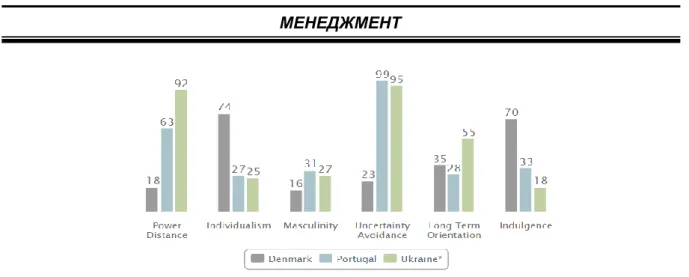
We used the famous Geert Hofstede 6-D model data to compare the national cultures of the coun-tries analyzed. The results proved big gaps between them at almost all cultural dimensions (Fig. 1).
198
Fig. 1. National cultures dimensions [21]
The egalitarian mind-set of the Danes put them at the very low end of power distance (18 points) compared to all other nations. Ukraine has the opposite situation with 92 points while Portugal is among cultures with a relatively balanced attitude to power distance (63 points). The superiors in Denmark count on their teams, they build a very informal atmosphere in the office, normally communi-cating on a first name basis. Not many companies in Ukraine use such a model, normally being more hierarchical with more centralized power.
In contrast to Portugal and Ukraine Danish society is much more individualistic and indulgent. Both Ukraine and Portugal have very high scores on uncertainty avoidance while Denmark has the features of a society whose members are not afraid of unknown situations, more flexible, ready to change plans, jobs etc. Ukrainians are little bit more long term oriented than the Danes and the Portuguese. The only dimension with more or less similar scores for all 3 cultures is Masculinity/Femininity. All the countries have feminine societies where such values as “cooperation”, “good relationships in group” and “caring for others” dominate over “achievement”, “competition” and “success”.
A diverse group of participants took part in the study: the representatives of three nations (Den-mark, Portugal, Ukraine) who have had the experience of cooperation in multicultural environment (n=273). The demographic characteristics of the sample were as follows: 65 Danes, 106 Portugueses, 102 Ukrainians. The sample consisted of 52% men (141) and 48% women (129). 14,7% of the re-spondents were high school graduates, 16,8% had bachelor’s degree, 47,6% - master’s degree, 17,9% - PhD degree or higher. 5,1% of the participants were under 21 years old, 44,7% - 21-30 years old, 27,1% - 31-40 year old, 14,7% - 41-50 years old, 8,4% - >50 years old.
The respondents were asked 3 main questions to explore their attitude to cross-cultural interaction: 1. Does working in multicultural business environment motivate you?
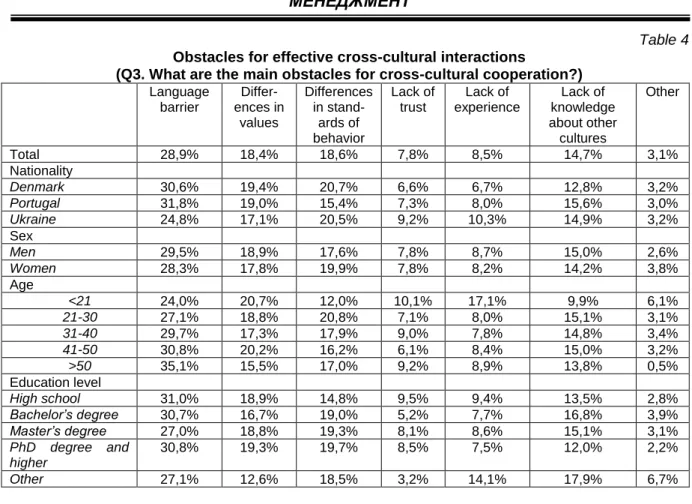
2. How do you feel working in multicultural environment? 3. What are the main obstacles for cross-cultural cooperation? The results of the survey are presented in the Tables 2, 3 and 4.
Table 2
Attitude to working in multicultural business environment
(Q1. Does working in multicultural business environment motivate you?) Working in multicultural
business environment is an additional motivation for me
My attitude to working in multicultural business environment is neutral
Working in multicultural busi-ness environment is a factor
of demotivation for me 1 2 3 4 Total 69,6% 28,6% 1,8% Nationality Denmark 44,6% 52,3% 3,1% Portugal 78,3% 19,8% 1,9% Ukraine 76,5% 22,5% 1,0% Sex
199 Continuation of Table 2 1 2 3 4 Men 67,6% 29,6% 2,8% Women 71,8% 27,5% 0,8% Age <21 78,6% 14,3% 7,1% 21-30 67,2% 31,1% 1,6% 31-40 62,2% 35,1% 2,7% 41-50 90,0% 10,0% 0,0% >50 65,2% 34,8% 0,0% Education level High school 75,0% 22,5% 2,5% Bachelor‟s degree 58,7% 41,3% 0,0% Master‟s degree 74,6% 23,8% 1,5% PhD degree and higher 69,4% 28,6% 2,0% Other 25,0% 62,5% 12,5% Table 3
Attitude to working in multicultural business environment (Q2. How do you feel working in multicultural business environment?)
Absolutely comfortable
Comfortable Normal Uncomfortable Very uncom-fortable Total 46,5% 32,2% 18,7% 1,8% 0,7% Nationality Denmark 43,1% 35,4% 16,9% 3,1% 1,5% Portugal 43,4% 37,7% 17,9% 0,9% 0,0% Ukraine 52,0% 24,5% 20,6% 2,0% 1,0% Sex Men 43,0% 33,8% 19,7% 2,1% 1,4% Women 50,4% 30,5% 17,6% 1,5% 0,0% Age <21 35,7% 57,1% 7,1% 0,0% 0,0% 21-30 52,5% 27,0% 18,0% 1,6% 0,8% 31-40 43,2% 35,1% 17,6% 2,7% 1,4% 41-50 42,5% 35,0% 22,5% 0,0% 0,0% >50 39,1% 30,4% 26,1% 4,3% 0,0% Education level High school 42,5% 40,0% 12,5% 5,0% 0,0% Bachelor‟s degree 50,0% 32,6% 15,2% 0,0% 2,2% Master‟s degree 50,0% 30,0% 17,7% 2,3% 0,0% PhD degree and higher 38,8% 32,7% 26,5% 0,0% 2,0% Other 37,5% 25,0% 37,5% 0,0% 0,0%
According to the results of the survey, cross-cultural relations themselves can give additional moti-vation to employees willing to work in a multicultural environment (70% of respondents). The main bar-riers to effective cross-cultural cooperation are language barbar-riers (28,7%), differences in values (18,5%) and standards of behaviour (18,6%). We can notice strong correlation between the age of the respondents and the problems they have with the language barrier: for younger workers this issue is less worrying. On the other hand youngest respondents (<21 years old) obviously have problems with the experience of business cross-cultural interactions.
200
Table 4
Obstacles for effective cross-cultural interactions
(Q3. What are the main obstacles for cross-cultural cooperation?) Language barrier Differ-ences in values Differences in stand-ards of behavior Lack of trust Lack of experience Lack of knowledge about other cultures Other Total 28,9% 18,4% 18,6% 7,8% 8,5% 14,7% 3,1% Nationality Denmark 30,6% 19,4% 20,7% 6,6% 6,7% 12,8% 3,2% Portugal 31,8% 19,0% 15,4% 7,3% 8,0% 15,6% 3,0% Ukraine 24,8% 17,1% 20,5% 9,2% 10,3% 14,9% 3,2% Sex Men 29,5% 18,9% 17,6% 7,8% 8,7% 15,0% 2,6% Women 28,3% 17,8% 19,9% 7,8% 8,2% 14,2% 3,8% Age <21 24,0% 20,7% 12,0% 10,1% 17,1% 9,9% 6,1% 21-30 27,1% 18,8% 20,8% 7,1% 8,0% 15,1% 3,1% 31-40 29,7% 17,3% 17,9% 9,0% 7,8% 14,8% 3,4% 41-50 30,8% 20,2% 16,2% 6,1% 8,4% 15,0% 3,2% >50 35,1% 15,5% 17,0% 9,2% 8,9% 13,8% 0,5% Education level High school 31,0% 18,9% 14,8% 9,5% 9,4% 13,5% 2,8% Bachelor‟s degree 30,7% 16,7% 19,0% 5,2% 7,7% 16,8% 3,9% Master‟s degree 27,0% 18,8% 19,3% 8,1% 8,6% 15,1% 3,1% PhD degree and higher 30,8% 19,3% 19,7% 8,5% 7,5% 12,0% 2,2% Other 27,1% 12,6% 18,5% 3,2% 14,1% 17,9% 6,7%
It is clear that our World becomes faster and more global. In order to be successful companies must be prepared to work in a global environment, operate in different regional markets, cooperating with foreign partners and involving workers representing different cultures. A cross-cultural manage-ment concept (Fig. 2) can be accepted today by almost any company no matter what the size, industry or country of origin.
Fig. 2. Cross-cultural management concept
Cross-cultural management
(CCM) Preconditions
Possible outcomes of effective cross-cultural interactions
Globalization
Growing impact of the “Millennials” Informational revolution Technological progress
Objectives
Get the most out of team’s diversity Simplify the processes of interactions and cooperation with partners from other cultures Form an innovative and motivating corporate
culture
Form a positive corporate image and a glob-al “diversity-friendly” brand Train cosmopolitan,global-minded managers Higher productivity
Innovations New markets access Motivating corporate culture
CCM instruments to overcome the obstacles
Communicational
Motivational Organizational
Obstacles for cross-cultural cooperation
Language barrier Differences in values Differences in standards of
behavior Lack of knowledge about
other cultures Lack of experience
Lack of trust Good reputation, goodwill
201
Accepting a multicultural environment as a given fact, companies must get the most out of it, trying to get higher productivity from multicultural teams. Diversity can become a source of innovations, addi-tional motivation and a global-oriented corporate culture.
Conclusions. The results of our research proved the link between cross-cultural interaction and motivation of the workers. Most employees working in multicultural teams or projects treat cross-cultural interactions as a factor of additional motivation. On the other hand among most serious and most widespread actual barriers (obstacles) for effective cross-cultural cooperation in multicultural business environment are language barriers, differences in values and standards of behaviour and lack of knowledge about other cultures. There is a wide range of managerial approaches and specific techniques to overcome these barriers: communicational, organizational and motivational. The re-wards for effective cross-cultural management are high quality diverse teams ready for innovations and effective cooperation with representatives from other cultures; more opportunities to expand the business to new markets and to form a global “diversity-friendly” brand.
References Література
1. Lipman, V. (2016). Key Management Trends For 2016? Here Are 6 Research-Based Predictions. Forbes, Re-trieved from : -http://www.forbes.com/sites/victorlipman- /2016/01/01/key-management-trends-for-2016-here-are-6-research-based-predictions/#67c7f0d41071 (Accessed Feb-ruary, 2016) [in Engilsh].
2. Jeannet, J.-P. (2000). Managing with a global mind-set. London : Financial Times/Prentice Hall [in English].
3. Rosen, R. (2000). Global literacies: Lessons on busi-ness leaderships and national cultures. New York : Simon & Schuster [in English].
4. Hofstede, G. (1980). Culture's Consequences: Inter-national Differences in Work-Related Values. Beverly Hills CA: Sage Publications [in English].
5. Hofstede, G. (1997). Cultures and Organizations: Software of the Mind. 1st edition, McGraw-Hill USA [in Eng-lish].
6. Adler, N. (1991). International dimensions of organiza-tional behaviour. Boston, MA : PWS-Kent Publishing Compa-ny [in English].
7. Hoecklin, L. (1995). Managing Cultural Differences: Strategies for Competitive Advantage. London: Economist Intelligence Unit/Addison Wesley [in English].
8. Luo, Y. (2016). Toward a reverse adaptation view in cross-cultural management, Cross Cultural & Strategic Man-agement Vol. 23, No 1, 2016, pp. 29-41 [in English].
9. Søderberg, A.-M. and Holden, N. (2002). Rethinking cross cultural management in a globalizing business world. International Journal of Cross Cultural Management 2(1): pp. 103–121 [in English].
10. Dodd, C. H. (1995). Dynamics of intercultural commu-nication (4th ed.). Madison: Brown & Benchmark. [in English].
11. Gudykunst, W. B. (Ed.). (1986). Intergroup communi-cation. Baltimore : E. Arnold [in English].
12. Spencer-Rodgersa, J., McGovern, T. (2002). Attitudes toward the culturally different: the role of intercultural commu-nication barriers, affective responses, consensual stereotypes, and perceived threat, International Journal of Intercultural Relations 26, 2002, pp. 609–631 [in English].
13. Delecta J., Raman, C. (2015). “Cultural Communica-tion Barriers in Workplace”, InternaCommunica-tional Journal of Manage-ment, vol. 6, issue 1, pp. 348-351 [in English].
14. Lifintsev, D., Maximov, S., Yakovenko, M. (2016). Podolannia stereotypnoho myslennia yak skladova kros-kulturnoho menedzhmentu [Overcoming stereotypical thinking as a component of cross-cultural management]. Effective
1. Lipman, V. (2016) Key Management Trends For 2016? Here Are 6 Research-Based Predictions. Forbes, Re-rieved from : http://www.forbes.com/sites/- victorlipman/2016/01/01/key-management-trends-for-2016-here-are-6-research-based-predictions/#67c7f0d41071 (Ac-cessed February, 2016).
2. Jeannet, J.-P. (2000) Managing with a global mindset. London: Financial Times/Prentice Hall.
3. Rosen, R. (2000) Global literacies: Lessons on busi-ness leaderships and national cultures. New York: Simon & Schuster.
4. Hofstede, G. (1980) Culture's Consequences: Interna-tional Differences in Work-Related Values. Beverly Hills CA: Sage Publications.
5. Hofstede, G. (1997) Cultures and Organizations: Software of the Mind. 1st edition, McGraw-Hill USA.
6. Adler, N. (1991) International dimensions of organiza-tional behaviour. Boston, MA: PWS-Kent Publishing Compa-ny.
7. Hoecklin, L. (1995) Managing Cultural Differences: Strategies for Competitive Advantage. London: Economist Intelligence Unit/Addison Wesley.
8. Luo, Y. (2016) Toward a reverse adaptation view in cross-cultural management, Cross Cultural & Strategic Man-agement Vol. 23, No1, 2016, pp. 29-41.
9. Søderberg A.-M. and Holden N. (2002) Rethinking cross cultural management in a globalizing business world. International Journal of Cross Cultural Management 2(1): 103–121.
10. Dodd, C. H. (1995). Dynamics of intercultural commu-nication (4th ed.). Madison: Brown & Benchmark.
11. Gudykunst, W. B. (Ed.). (1986). Intergroup communi-cation. Baltimore: E. Arnold.
12. Spencer-Rodgersa, J., McGovern, T. (2002) Attitudes toward the culturally different: the role of intercultural commu-nication barriers, affective responses, consensual stereotypes, and perceived threat, International Journal of Intercultural Relations 26, 2002, pp. 609–631.
13. Delecta, J., Raman, C. (2015) “Cultural Communica-tion Barriers in Workplace”, InternaCommunica-tional Journal of Manage-ment, vol. 6, issue 1, pp. 348-351.
14. Ліфінцев, Д. С., Максимов, С. С., Яковенко, М. В. (2016) Подолання стереотипного мислення як складова крос-культурного менеджменту. Ефективна економіка, №4. 15. Canavilhas, João (2015), Nuevos medios, nuevo eco-sistema. El profesional de la información, v. 24, n. 4, pp.
357-202 economy, issue 4 [in Ukrainian].
15. Canavilhas, João (2015), Nuevos medios, nuevo eco-sistema. El profesional de la información, v. 24, n. 4, pp. 357-362 [in Spanish].
16. Hall, Edward T. (1960). The silent language. Garden City, NY, Doubleday [in English].
17. Chen, G., Kirkman, B. L., Kim, K., Farh, C. I. C. and Tangirala, S. (2010). “When does cross-cultural motivation enhance expatriate effectiveness? A multilevel investigation of the moderating roles of subsidiary support and cultural dis-tance”, Academy of Management Journal, Vol. 53 No. 5, pp. 1110-1130 [in English].
18. Ang, S., Van Dyne, L., Koh, C., Ng, K. Y., Templer, K. J., Tay, C. & Chandrasekar, N. A. (2007). Cultural intelligence: Its measurement and effects on cultural judgment and deci-sion making, cultural adaptation and task performance. Man-agement and Organization Review, 3 (3), pp. 35-371 [in Eng-lish].
19. The official site of the World Bank (2016), Retrieved from : http://www.worldbank.org (Accessed March 2017) [in English].
20. Lifintsev, D. (2014). Transliatsiia tsinnostei korpo-ratyvnoi kultury yak instrument formuvannia imidzhu kompanii [Broadcasting the Values of Corporate Culture as a Tool of Forming the Company's Image]. Business Inform, issue 12, pp. 440–443 [in Ukrainian].
21. The official site of G. Hofstede centre (2016). Re-trieved from : https://www.geert-hofstede.com (Accessed March 2017) [in English].
362 (in Spanish).
16. Hall, Edward T. (1960). The silent language. Garden City, NY, Doubleday
17. Chen, G., Kirkman, B. L., Kim, K., Farh, C. I. C. and Tangirala, S. (2010), “When does cross-cultural motivation enhance expatriate effectiveness? A multilevel investigation of the moderating roles of subsidiary support and cultural dis-tance”, Academy of Management Journal, Vol. 53 No. 5, pp. 1110-1130.
18. Ang, S., Van Dyne, L., Koh, C., Ng, K. Y., Templer, K. J., Tay, C. & Chandrasekar, N. A. (2007). Cultural intelligence: Its measurement and effects on cultural judgment and deci-sion making, cultural adaptation and task performance. Man-agement and Organization Review, 3 (3), 35-371.
19. The official site of the World Bank (2016), Retrieved from : http://www.worldbank.org (Accessed March 2017).
20. Ліфінцев Д.С. Трансляція цінностей корпоративної культури як інструмент формування іміджу компанії / Д. С. Ліфінцев // Бізнес Інформ. – 2014. - №12. - С. 440-443.
21. The official site of G. Hofstede centre (2016), Re-trieved from : https://www.geert-hofstede.com (Accessed March 2017).
Received for publication 15.03.207 Бібліографічний опис для цитування :
Lifintsev, D. S. Cross-cultural management: obstacles for effective cooperation in multicultural environment / D. S. Lifintsev, J. Canavilhas // Науковий вісник Полісся. – 2017. - № 2 (10). Ч. 2 . – С. 195-202.
![Table 1 Some key social and economic indicators of Denmark, Portugal and Ukraine [19]](https://thumb-eu.123doks.com/thumbv2/123dok_br/18144332.871330/3.892.112.788.662.881/table-key-social-economic-indicators-denmark-portugal-ukraine.webp)