UNIVERSIDADE DA BEIRA INTERIOR
Faculdade Ciências da Saúde
Clinical Characterization of Bronchial Asthma in
Elderly and Non-Elderly Patients: the relevance of
clinical phenotypes
Bruna Filipa Vilaça Rodrigues
Dissertação para obtenção do Grau de Mestre em
Medicina
(ciclo de estudos integrado)
Orientador: Prof. Doutor Luís Taborda Barata
iii
Dedicatória
Aos meus pais e avó por terem investido na minha educação e formação profissional e por me acompanharem ao longo deste longo percurso, incentivando-me a cada minuto, a fazer mais e melhor.
iv
Agradecimentos
Ao Dr. Luís Taborda Barata, pela orientação, dedicação, disponibilidade e apoio demonstrados desde o início deste projeto, tornando-o possível.
Ao Dr. Jorge Gama, pela disponibilidade e apoio no tratamento de dados e na compreensão da análise estatística.
Aos meus colegas, Adriana, Fábio, Gonçalo e Eduardo pelo companheirismo e empenho no trabalho coletivo realizado.
À Dra. Maria de La Salete Beirão Valente, diretora do serviço de Pneumologia do CHCB, pelo apoio prestado no recrutamento de idosos e não idosos asmáticos.
À Dra. Marta Duarte, pela disponibidade e competência demonstrada na logística dos questionários.
A todos os voluntários do estudo que disponibilizaram o seu tempo para me ajudar neste projeto.
Aos funcionários do CHCB pela simpatia e cedência do espaço para realizar a recolha dos dados.
Ao Fábio Almeida, por me ter apoiado e ajudado a ultrapassar todos os obstáculos.
À minha família por me apoiarem em todos os momentos e acreditarem sempre em mim.
A todos os amigos que fiz enquanto estudante, nos quais me apoiei nos melhores e piores momentos.
v
Abstract
Background: Bronchial Asthma is a chronic inflammatory disease that affects about 300
million people worldwide. It is extremely important to compare clinical and functional features of asthma between elderly (EA) and non elderly (NEA) patients because several aspects of the diagnosis are different. Furthermore, in elderly asthmatic patients, late-onset (LOA) / adult-onset asthma (AOA) seems to be more frequent than long standing (LSA) / early-onset (EOA) / childhood-onset asthma (COA) and the former may be more frequently associated with more severe forms of asthma. In addition, in elderly patients, asthma frequently co-exists with other heart and lung diseases, particularly with chronic heart failure and chronic obstructive pulmonary disease (COPD). Thus, a thorough study of the clinical characteristics of bronchial asthma, taking into account the age of onset could help to clarify undervalued aspects of the clinical expression of the disease as well as different profiles of expression that are associated with clinical phenotypes. Such characterization may contribute towards better control of the disease as improvement in quality of life, once the appropriately tailored medication, taking into consideration phenotypic differences is given, particularly in the elderly.
Methods: Analytic and cross-sectional study in which the target population was composed of
individuals with a confirmed diagnosis of asthma, who were either between 18-64 years or 65 years or older and were regularly followed up at an Immunoallergology or Pulmonology outpatient clinic of CHCB. All volunteers answered a questionnaire about personal and family history of respiratory disease, current and past occupational exposure, characterization of the place of residence, co-morbidities, usual medication, asthma triggers, number of acute crises and admittance to wards, principal symptoms and their frequency, asthma control medication, among other factor. Results were analyzed using the Software Package for Social Sciences (SPSS).
Results: Overall, 192 volunteers were included, with a median age of 59.1 years and
predominantly of the female gender. Most patients were smokers, had a low level of schooling and social class and lived in urban areas. The predominant phenotype found was that of LSA/EOA/COA in association with atopic asthma, and mostly only partially or not controlled. For EA patients, the most prevalent and associated phenotypes were LOA/AOA with non-atopic asthma. In contrast, for NEA patients the most predominant phenotype was the combination of LSA/EOA/COA with atopic asthma. In terms of co-morbidities, rhinitis or a combination of rhinitis with dermatitis was significantly more common in the LSA/EOA/COA phenotype. In addition, a previous history of allergies was more frequently reported in EA patients with the LSA/EOA/COA phenotype. In terms of quality of life, NEA patients with
vi
LOA/AOA phenotype were 4.48 times more likely to have limitation of activities caused by dyspnoea than NEA patients with the LSA/EOA/COA phenotype. On the other hand, the LOA/AOA phenotype was more frequently associated with limitation of activities caused by coughing and a higher frequency of wheezing manifestation (more than twice weekly) as well as having to use short-acting beta2-agonist (SABA) rescue medication. On the other hand, the beta2-agonists long-action (LABA) and anti-leukotrienes were more frequently associated with LOA/AOA.
Conclusion: LOA/AOA and LSA/EOA/COA phenotypes have significant differences in terms of
manifestations of severity, family history of diseases and control medication. Nevertheless, these phenotypes may manifest to a similar extent, in different age groups.
Keywords
vii
Resumo
Introdução: A Asma brônquica é uma doença inflamatória crónica, que afeta cerca de 300
milhões de pessoas em todo o mundo. É extremamente importante comparar a asma nos idosos e nos não idosos, porque vários aspectos relativos ao diagnóstico são diferentes. Além disso, nos asmáticos idosos, a asma de início tardio (LOA) / asma com início na idade adulta (AOA) parece ser mais frequente do que a asma de longa duração (LSA) / Asma com início precoce (EOA) / Asma com início na infância (COA) e o primeiro fenótipo pode ser associado a formas mais severas da doença. Adicionalmente, a asma nos idosos coexiste com outras doenças respiratórias e pulmonares, particularmente a doença pulmonar obstrutiva crónica. Assim, o estudo mais aprofundado das características clínicas da asma brônquica, tendo em conta o início da manifestação dos sintomas poderá ajudar a clarificar aspetos subvalorizados na expressão clínica da doença, bem como diferentes perfis de expressão associados a fenótipos clínicos. Tal caracterização poderá contribuir para a melhoria da qualidade de vida e um melhor controlo da doença com a medicação adequada às diferenças fenotípicas, principalmente nos idosos.
Métodos: Estudo analítico e transversal cuja população era constituída por pacientes com
diagnóstico de Asma Brônquica confirmado, com idades entre os 18-64 anos e 65 anos ou mais velhos, regularmente seguidos nas consultas de Imunoalergologia ou Pneumologia do Centro Hospitalar Cova da Beira (CHCB). Todos os voluntários responderam a um questionário sobre a história pessoal e familiar de doença respiratória, exposição ocupacional actual e passada, caracterização da residência, comorbilidades associadas, hábitos medicamentosos, factores desencadeantes, número de crises agudas e internamentos, principais sintomas e a sua frequência, medicação de controlo da doença, entre outros. Os resultados foram analisados através do Pacote de Software para Ciências Sociais (SPSS).
Resultados: Foram incluídos 192 voluntários, com idade média de 59.1 anos e
predominantemente do sexo feminino. A maioria era fumadora, tinha um baixo nível de escolaridade e classe social, e residiam predominantemente em meio urbano. A maior parte dos pacientes tinha LSA/EOA/COA e asma atópica e apenas controlo parcial ou não controlo da asma. Nos idosos, o fenótipo LOA/AOA foi associado à não atopia, enquanto que, para os não idosos, verificou-se a associação do fenótipo LSA/EOA com a atopia.
A presença de rinite ou da combinação da rinite e dermatite foi significativamente maior no fenótipo LSA, tal como a história de alergias nos pacientes idosos com este fenótipo. Um paciente jovem com LOA apresenta 4.48 vezes mais probabilidade de apresentar limitação das atividades causadas por dispneia. Também se observou que o fenótipo LOA estava mais frequentemente associado à limitação de actividades físicas, causada por tosse, e a uma maior frequência de manifestação da pieira (mais do que duas vezes por semana), tal como o
viii
uso de agonistas beta2-ação curta. Por outro lado, os beta2-agonitas de ação longa e o uso de anti-leucotrienos associaram-se à LOA/AOA.
Conclusões: Os fenótipos LOA/AOA e LSA/EOA/COA apresentam diferenças significativas
relativas à severidade das manifestações da asma, história familiar de doenças e medicação de controlo. De uma maneira geral, manifestam-se de igual modo nos diferentes grupos etários.
Palavras-chave
ix
Resumo Alargado
Introdução: A Asma brônquica é uma doença inflamatória crónica, que afeta cerca de 300
milhões de pessoas, em termos mundiais, e a sua prevalência tem vindo a aumentar em muitos países e a estabilizar noutros, em níveis relativamente elevados. É extremamente importante comparar a asma nos diferentes grupos etários, pelas diferenças associadas ao seu diagnóstico. Por exemplo, nos idosos pode coexistir com outras doenças pulmonares ou cardíacas, nomeadamente, a doença pulmonar obstrutiva crónica. Também neste grupo, as manifestações clínicas mais frequentemente associadas à asma brônquica – dispneia, tosse e sibilâncias intermitentes podem não ser tão aparentes e a sua importância é minimizada ao ser atribuída “à idade” ou serem mascaradas por co morbilidades. Assim, o estudo mais aprofundado das características clínicas da asma brônquica nos idosos, comparando-os com a população mais jovem, poderá ajudar a clarificar aspetos subvalorizados na expressão clínica da doença, bem como diferentes perfis de expressão dos sintomas, associados a diferentes fenótipos clínicos, tendo em conta a idade de início da manifestação dos sintomas. Tal caracterização poderá contribuir para a melhoria da qualidade de vida e um melhor controlo da doença com a medicação adequada nos asmáticos. Existem poucos estudos comparativos sobre a expressão clínica de asma brônquica nas duas faixas etárias, e particularmente nos idosos, o que, em Portugal e em outros países, será uma falha relevante dada a percentagem crescente de população envelhecida que apresentam.
Metodologia: Estudo analítico e transversal cuja população era constituída por pacientes com
diagnóstico de Asma Brônquica confirmado, com idades entre os 18-64 anos e 65 anos ou mais velhos, regularmente seguidos nas consultas de Imunoalergologia ou Pneumologia do Centro Hospitalar Cova da Beira (CHCB), Covilhã. Alguns dos pacientes também foram contactados por via telefónica para comparecerem no Hospital. Todos os voluntários responderam a um questionário sobre a história pessoal/familiar, exposição actual/passada a fatores desencadeantes, caracterização da residência, comorbilidades associadas, hábitos medicamentosos, número de crises agudas e internamentos, principais sintomas e a sua frequência, medicação de controlo da doença, ACT, CARAT, entre outros. Os resultados foram analisados através do Pacote de Software para Ciências Sociais (SPSS),versão 23.0. Um valor-p inferior ou igual a 0,05 foi considerado significativo em todos os testes estatísticos.
Resultados: Foram incluídos 192 voluntários, com idade média de 59.1 anos e
predominantemente do sexo feminino. A maioria era fumadora, tinha um baixo nível de escolaridade e classe social, e residiam predominantemente em meio urbano. A maioria da população em estudo tinha LSA/EOA/COA e asma atópica e tinha apenas controlo parcial ou não controlo da asma.
x
A presença de rinite ou da combinação da rinite e dermatite foi significativamente maior no fenótipo LSA/EOA/COA, tal como a história de alergias nos pacientes idosos com este fenótipo. Nos pacientes idosos, o fenótipo predominante foi a associação de LOA/AOA com asma não-atópica. Contrariamente, nos não idosos, foi a combinação do fenótipo LSA/EOA/COA com asma atópica. Em termos de qualidade de vida, um paciente jovem com AOA apresentava uma probabilidade 4.48 vezes maior de ter limitação das atividades causada por dispneia. Também se observou que o fenótipo LOA/AOA estava mais frequentemente associado à limitação da actividade causada por tosse e a uma maior frequência de manifestação da pieira (mais do que duas vezes por semana), tal como o uso de agonistas beta2 de ação curta (SABA). Por outro lado, o uso de agonistas beta2 de ação longa (LABA) associou-se preferencialmente à AOA, tal como o uso de anti-leucotrienos.
Conclusões: O fenótipo mais frequente na população geral foi o de asma com início na
infância/adolescência, predominantementeatópicae surgindo no sexo feminino. Os fenótipos LOA/AOA e LSA/EOA/COA apresentaram diferenças significativas relativamente à severidade das manifestações da asma, história familiar de doenças e medicação de controlo. Contudo, de uma maneira geral, estes fenótipos manifestavam-se clinicamente de igual modo nos diferentes grupos etários.
xi
Índice
Dedicatória ... iii Agradecimentos ... iv Abstract... ..v Keywords ...vi Resumo ... vii Resumo Alargado ... ixLista de figuras ... xii
Lista de tabelas ... xiiii
Lista de Acrónimos... xivv
1. Introduction ... 1
2. Material and Methods ... 4
2.2. Patient Recruitment ... 4
2.3. Questionnaire ... 4
2.4. Definitions ... 5
2.5. Spirometry with bronchodilation...5
2.6. Statistical analysis...5 3. Results ... 6 4. Discussion...2 0 5. Future prospects...26 6.Reference...27 7.Appendix...30
xii
Lista de figuras
xiii
Lista de tabelas
Table 1 – Demographic characteristics of the sample
Table 2 – Clinical characterization and quality of life of sample Table 3 – Cognitive characterization and QoL
Table 4 - Phenotypes and presence of atopy
Table 5 – Phenotypes and personal/family background of diseases Table 6 - Phenotypes and place of residence and occupational exposure Table 7 – Phenotypes and asthma severity
Table 8 - Phenotypes and asthma manifestations Table 9 - Phenotypes and asthma treatment Table 10 - Phenotypes and asthma control
xiv
Lista de Acrónimos
ASA – acetylsalicylic acidACES CB – Cova da Beira Health Centre ACT – The Asthma Control Test
BA – Bronchial Asthma BB – beta blockers
CARAT – The Control of Allergic Rhinitis and Asthma Test CES-D – Center for Epidemiologic Self-Report Depression Scale CHCB – Cova da Beira Academic Hospital Centre
CHF – Congestive heart failure
COPD – Chronic Obstructive Pulmonary Disease DM – Diabetes mellitus
FCS-UBI – Faculty of Health Sciences of the University of Beira Interior GDS–15 – Geriatric Depression Scale
GERD - Gastro-esophageal Reflux Disease HBP – High Blood Pressure
HrQoL – Health related Quality of Life IC – Inhaled Corticosteroid
EA – Elderly asthmatic NEA – Non- elderly asthmatic LABA - Long-acting Beta2-Agonist LOA - Late Onset Asthma
LSA – Long Standing Asthma
MMES – The Mini-Mental Examination State NIA – Non-elderly asthmatic
NINA - Non-elderly non-asthmatic OSA – Obstructive Sleep Apnea Syndrome QoL – Quality of Life
SABA – Short-acting Beta2-Agonist SF36 - Short Form Health Survey
SPSS - Software Package for Social Sciences UBI – Universidade da Beira Interior
1
1. Introduction
Bronchial asthma is a heterogeneous disease, usually characterized by chronic airway inflammation. It is defined by the history of respiratory symptoms such as wheeze, shortness of breath, chest tightness and cough that vary over time and in intensity, together with variable expiratory airflow limitation (1).
The prevalence of asthma is increasing in many areas of the globe and affects about 300 million people worldwide, having substantially the same prevalence in both sexes (1,2). Asthma is the 14th most important disorder in the world in terms of extent and duration of disability, often causing a reduced quality of life (3). Furthermore, although, over time, deaths from asthma have globally decreased, they tend to occur most often in the elderly (3). In Portugal, around 10.5% of the residents are asthmatic (4, 36). According to the 4º
Inquérito Nacional de Saúde, from 2005/06, 7.2% of the elderly have asthma, most of whom
are women (65.9%) (2). Nevertheless, data concerning the elderly may underestimate the true prevalence of asthma since several studies have suggested that Asthma in this age group remains poorly perceived, poorly recognized and sub-optimally treated (3, 4).
Given these facts and knowing that disease can vary individually (6), it is increasingly important to study the possible phenotypes to find similarities and differences between them. A precise definition of asthma phenotypes may further improve our understanding of underlying genetic basis, pathophysiologic mechanisms, treatment response and prognosis (28). Currently, asthma phenotypes are defined as the integration of different characteristics that are the product of the interaction of the patient's genes with the environment (27), based on a variety of clinical presentations, physiological characteristics, and responses to therapy. This classification could be based on age of onset of manifestations, the presence of atopy, inflammatory markers, among other (7, 27).
Previous studies suggest that factors such atopy, age of onset, duration of illness and comorbid conditions are possible determinants of different phenotypes observed in severe persistent asthma (7) as well as in other forms of asthma (1).
Asthma more frequently begins in childhood, with an incidence peak at around 3 years of age (3). Nevertheless, many cases begin later in life, namely in adulthood. According to the age of onset and duration of asthma it is possible to divide asthmatics into those with early-onset, long-standing asthma (LSA), and those with late-onset asthma (LOA). However, there are discrepant definitions of the specific threshold age that discriminates between these two subtypes (8), with some studies stating that LOA is the subtype that arises after 40 years of age (9), whereas other studies define the threshold at as early as 12 years of age (8). Generally, LSA begins in childhood or adolescence and LOA begins in adulthood (10). An
2
additional, related possibility is to define onset-related phenotypes according to 16 or 18 years of age, with asthma beginning earlier than that period being defined as early-onset or childhood-onset asthma (EOA / COA), and asthma that begins later than that being defined as late-onset or adult-onset asthma (AOA) (8). In the current study, asthma that had begun before 18 years was regarded as EOA/COA and asthma that had begun later than that being labelled as AOA (9). Thus, in our study, AOA is generally equivalent to LOA and EOA/COA is generally superimposable upon LSA.
Some studies have shown that AOA / LOA is more common in the female gender, has a low remission rate and is less often associated with allergy and atopic diseases (10). In fact, it has been reported that AOA / LOA patients are a mixed group of patients and different sub-phenotypes may be identified (39). Some studies were able to subdivide LOA/AOA into five different subtypes, based upon cluster analysis: eosinophilic inflammation predominant asthma, mild-to-moderate-well controlled asthma, obese-noneosinophilic asthma, smoking asthma and severe obstructive asthma (20). Although LSA/COA/EOA patients may represent a relatively more homogeneous group of patients, often with a strong allergic history and family history of asthma (7), there are also different clinical sub-phenotypes that have been reported (1).
Thus, LSA/COA/EOA and LOA/AOA may have different clinical presentation, disease course and response to treatment (2, 10, 39). Although they share some common features, they may have different causes and very different prognoses.
It is also advantageous to characterize asthma in terms of atopy, in order to optimize management of disease. Atopic/extrinsic asthma is characterized by the manifestation of symptoms when patients are exposed to allergenic triggers and is generally associated with rhinitis, atopic dermatitis or other allergies. It generally begins in childhood and is therefore more likely to be associated with EOA/COA/LSA whereas non-atopic/intrinsic asthma generally begins in adulthood, may be preferentially associated with occupational or viral exposures and is more likely observed in LOA/AOA patients (11,12).
Independently of the phenotypes in question, investigation of clinical features of asthma in the elderly may be difficult. In fact, a diagnosis of asthma in the elderly may be harder to confirm due to several diseases that may also cause breathlessness, and may be confounding factors, such as chronic obstructive pulmonary disease (COPD) and chronic heart failure (CHF) (16). Furthermore, elderly patients tend to assume that breathlessness is due to advanced age, which may have implications such as poor management of asthma and a negative impact on quality of life (3). Many studies demonstrated efficacy of adequate asthma treatment in reducing symptoms and exacerbations, thereby improving health-related quality of life and lung function, achieving asthma control, controlling airway inflammation, and reducing mortality rates (35). Recent evidence has further suggested that treatment tailored to specific asthma phenotypes may be quite advantageous in terms of outcomes. However, clinical trials in elderly patients are very scarce, since this type of patients is
3
generally excluded from such studies. Nevertheless, a thorough phenotypic characterization of elderly asthmatic patients is warranted so that treatments may also be tailored to different subgroups of asthmatics in that period of life.
Thus, the goal of this study was to compare the different phenotypes (LOA/AOA and EOA/COA/LSA) in elderly and non-elderly patients, to analyze whether there was a tendency for the presence of different triggers, risk factors and disease manifestations in different phenotypes in different age groups.
4
2. Material and Methods
2.1. Study Design and Sample Selection
This was an observational and descriptive study. The target population consisted of individuals with a confirmed diagnosis of Bronchial Asthma (BA), who were regularly seen at Pulmonology or Immunoallergology hospital outpatient clinics.
The volunteers were separated into two age groups: non-elderly (at least 18 years of age but below 65) and elderly (at least 65 years of age). For each patient, the data were collected in one single moment.
The exclusion criteria were co-morbidity with Chronic Pulmonary Obstructive Disease (COPD) or Restrictive Pulmonary Disease and low Mini-Mental State Examination (MMSE) score. This study was approved by the Ethics Committee of the Faculty of Health Sciences of the University of Beira Interior (FCS), Covilhã, Portugal and the Ethics Committee of Cova da Beira Hospital (CHCB).
2.2. Patient Recruitment
Patients were invited to participate in the study by being sequentially recruited at the hospital clinics or via a telephone call. All volunteers that accepted to participate signed a written informed consent that had been approved by the Ethics Committee of the CHCB (Appendix II).
2.3. Questionnaire
The standardized and detailed questionnaire was filled out by the patients in the presence of the investigators. Data collection was performed by a group of trained researchers who also participated in the planning of the study, thereby ensuring maximal homogeneity. Data about personal and family history of diseases, current and past occupational exposure, characterization of place of residence, personal hobbies and educational qualifications, drug and personal habits, the main asthma triggers, number of acute crises and admittances to wards, principal symptoms and their frequency, and co-morbidities associated with asthma were obtained.
Standardized questionnaires, validated for the Portuguese population were used: Geriatric Depression Scale (GDS-15), the Center of Epidemiologic Study Depression Scale (CES-D), Mini-Mental Examination State (MMES) (Appendix IV), Short Form Health Survey (SF-36) and Asthma Quality of Life questionnaire (AQLQ).
The GDS-15 and the CES-D were used as instruments for the assessment of depression-specific symptoms in the elderly and non-elderly patients, respectively (13, 14). The MMSE was employed for the screening of cognitive deterioration, taking into consideration the
5
interviewee’s degree of schooling(15).
SF-36 was used to assess the health related quality of life in all volunteers (18, 19). AQLQ was applied for the assessment of QoL in all asthmatic patients (15, 19).
The Asthma Control Test (ACT) and the Control of Allergic Rhinitis and Asthma Test (CARAT) were applied to assess the level of asthma control either on its own (ACT) or in association with rhinitis control (CARAT).
2.4. Definitions
For this study, we defined Long Standing Asthma (LSA) as equivalent to the Dutch definition of Early Onset Asthma (EOA) or Childhood Onset Asthma (COA), and involving the development of asthma symptoms and confirmed bronchial asthma before 18 years of age (8). We also defined Late Onset Asthma (LOA) as equivalent to Adult Onset Asthma (AOA), when symptoms of asthma developed after that age (8).
We also defined atopy as the presence of at least one positive cutaneous response (> 3 mm) to aeroallergens and/or a positive serum test for screening aeroallergen-specific IgE (> 0.35 kUA/L. The in vitro test for determination of serum values of IgE specific for the standard screening battery of aeroallergens (Phadiatop aeroallergens) was performed using a fluorometric methodology (Unicap 100 Phadia Diagnosis®, Phadia, Sweden),
2.5. Spirometry with Bronchodilation
Spirometry was performed in volunteers without episodes of respiratory infections in the previous four weeks, with the patients sitting down, using the EasyOne spirometer (ndd Medical Technologies, Andover, MA, USA) before and 15 minutes after inhalation of 200 g of a short-acting beta2-agonist (salbutamol), via a metered dose inhaler and a spacer chamber. Only spirometric tests which met the American Thoracic Society (ATS) / European Respiratory Society (ERS) criteria were used for analysis (40). When bronchial obstruction was detected, bronchodilation was carried out and a positive response was recorded in the presence of an increase in FEv1 of at least 200 ml and 12% (40).
2.6. Statistical Analysis
Results were analyzed with the Software Package for Social Sciences (SPSS®), version 23.0 software. Descriptive analysis was used for the characterization of the sample.
Comparative analysis of quantitative variables between two groups was performed using Student’s t test or Mann-Whitney U test, depending on the type of distribution of variables. Chi-Square test and Fischer’s exact test were used in the case of nominal variables. Descriptive analysis was used for the characterization of the sample. Normality of the distribution of variables was analyzed using K-S Lilliefors or Shapiro-Wilk Tests.
6
3. Results
3.1. Recruitment
For the present study, 112 elderly asthmatic (EA) patients and 104 non-elderly (NEA) patients with diagnosis of Bronchial Asthma followed up at CHCB outpatient clinics were identified as possible volunteers for this study (Figure 1). Of the EA, 4 refused to participate and 11 could not be contacted. Of the 97 remaining EA patients, a further 5 patients had to be excluded: 1 had a low MMSE score, 2 had COPD co-morbidity and 2 had their questionnaires lost. The remaining 92 EA were interviewed. The NEA sample came from a list of 104 patients. We could not contact 4 of them, leaving us with 100 NEA participants, and a total of 192 asthmatic patients (EA + NEA).
Figure 1 – Representative flowchart of the selection sample
3.2. Demographic characterization of the study population
Of the 192 subjects evaluated, 157 (81.8%) were female and 35 (18.2%) were male with a mean age of 59.1 years (18 – 86 years). There were no significant gender differences between elderly and non-elderly asthmatics. Most patients had a low (4 years) degree of schooling [45.8% (n=192)] and belonged to class III [38.5% (n=74)] and class IV [40.1% (n=77)] of the Graffar Scale, with the elderly asthmatic patients having a significantly lower mean number of schooling years. Most patients lived in an urban setting (63% of NEA and 53.3% of EA), without significant differences between groups. Professionally, 10% of NEA and all EA patients were retired. Only 5% of EA were working in the textile industry and 14% of them
Eligible for study n=112 Accepted to participate n=97 Included n=92 Included n=100 Accepted to participate n=100
Eligible for study n=104
Eligible but not recruited Refused to participate = 4 Contact not possible = 11
Excluded Low MMSE= 1 COPD Morbidity = 2 Questionnaire loss = 2
Eligible but not recruited Contact not possible = 4
7
were working in agriculture. However, of all the retired elderly asthmatics, 47.9% had worked in the textile industry for several years
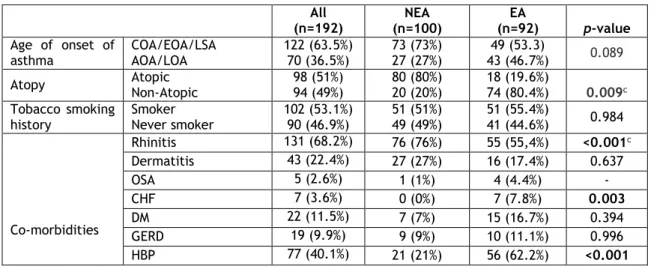
Sociodemographic features of the asthmatic patients, such as schooling, socioeconomic level, area of residence and occupation prior to retirement, are shown in Table 1.
Table 1.Demographic characteristics of the sample
All
(n=192) (n=100) NEA (n=92) EA p-value
a
Age (years) Mean + SD Median Range 59.1±18,1 64 18 – 86 45.2± 13.2 46 19-64 72.9± 5.5 71 65 - 86 - Gender Female Male 157 (81.8%) 35 (18.2%) 81 (81.0%) 19 (19.0%) 76 (82.6%) 16 (17.4%) 0.773 Schooling None 4 years 4-9 years 9-12 years ≥ 12 years 7 (7.6%) 88 (45.8%) 33 (17.2%) 34 (17.7%) 30 (15.6%) 2 (2.0%) 21 (21.0%) 23 (23.0%) 28 (28.0%) 26 (26.0%) 5 (5.4%) 67 (72.8%) 10 (10.9%) 6 (6.5%) 4 (4.3%) <0.001
Residence Rural Urban 111 (58.3%) 80 (41.7%) 37 (37.0%) 63 (63.0%) 43 (46.7%) 49 (53.3%) 0.759 Occupational exposure Professions without relevant exposure Textile industry Agriculture Mining Retired -from textile industry 70 (36.5%) 5 (2.6%) 14 (7.3%) 1 (0.5%) 102 (53.1%) 70 (70%) 5 (5%) 14 (14%) 1 (1%) 0 (0%) 0 (0%) 0 (0%) 0 (0%) 0 (0%) 92 (100%) 45 (48.9%) - Graffar Scale Class I Class II Class III Class IV Class V 11 (5.7%) 30 (15.6%) 74 (38.5%) 77 (40.1%) 0 (0%) 11 (11%) 25 (25%) 50 (50%) 14 (14%) 0 (0%) 0 (0%) 5 (5.4%) 24 (26.1%) 63 (68.5%) 0 (0%) <0.001 MMSE No cognitive defect Cognitive defect 392(100%) 0 (0%) 100 (100%) 0 (0%) 92 (100%) 0 (0%) - CES-D Normal Depressive 157 (78.5%) 43 (21.5%) 73 (73.0%) 27 (27.0%) --- - GDS Normal Slightly Depressive Severely Depressive 137 (71.4%) 47 (24.5%) 8 (4.2%) --- 65 (70.7%) 24 (26.1%) 3 (3.3%) -
It should be stressed that although the tests assessing depression in elderly and non-elderly asthmatic patients were different, most patients were not depressed and only a low, but similar proportion of patients in each group was severely depressed.
8
3.3 Clinical characterization of the population
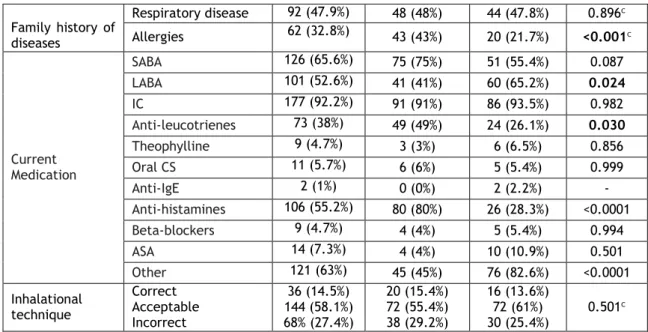
From the clinical assessment of the asthmatic patients, more volunteers had long-standing or early-/childhood-onset asthma – LSA/EOA/COA (73.7% of NEA, 53.3% of EA). Although there was a trend for more elderly patients having LOA/AOA, this did not reach statistical significance (Table 2). In contrast, there was a clear difference between both groups, in terms of atopy, with clearly a higher proportion of NEA than EA being atopic (80% versus 18%, respectively). Very similar results were also quite apparent in terms of family history of allergic diseases. Most of the patients were still current smokers, without significant differences between groups of asthmatics. More than half of the patients had previously smoked (51% of NIA, 55.4% of IA).
In terms of co-morbidities, most patients had rhinitis and this co-morbidity was significantly more frequent in NEA than in EA (76% versus 59.8%, respectively; p<0.001). In contrast, chronic heart failure (CHF) and high blood pressure (HBP) were significantly more frequently observed in elderly asthmatics.
The current medication more frequently used by asthmatics was inhaled corticosteroids (92.2 of the target population), without significant differences between elderly and non-elderly asthmatics. Short-acting beta-2 agonists (SABA) were only used as rescue medication by 75% of NEA and 55.4% of EA), with a trend for fewer elderly asthmatics using them. In contrast, significantly more elderly than non-elderly asthmatics were using long acting beta-2 agonists (LABA) (65.2% versus 41%, respectively; p=0.024). It should also be stressed that more than half of all asthmatic patients were on anti-histamines, because of their associated rhinitis, but these drugs were much more frequently used by NEA than EA (80% versus 28.3%, respectively; p<0.0001).
Finally, no significant differences, in terms of inhalational technique were detected between elderly and non-elderly asthmatics, although it should be stressed that around one quarter to one third of patients had a totally incorrect technique.
Table 2. Background clinical characterization of elderly and non-elderly asthmatic patients All (n=192) NEA (n=100) EA (n=92) p-value Age of onset of asthma COA/EOA/LSA AOA/LOA 122 (63.5%) 70 (36.5%) 73 (73%) 27 (27%) 49 (53.3) 43 (46.7%) 0.089 Atopy Atopic Non-Atopic 98 (51%) 94 (49%) 80 (80%) 20 (20%) 18 (19.6%) 74 (80.4%) 0.009c Tobacco smoking
history Smoker Never smoker 102 (53.1%) 90 (46.9%) 51 (51%) 49 (49%) 51 (55.4%) 41 (44.6%) 0.984
Co-morbidities Rhinitis 131 (68.2%) 76 (76%) 55 (55,4%) <0.001c Dermatitis 43 (22.4%) 27 (27%) 16 (17.4%) 0.637 OSA 5 (2.6%) 1 (1%) 4 (4.4%) - CHF 7 (3.6%) 0 (0%) 7 (7.8%) 0.003 DM 22 (11.5%) 7 (7%) 15 (16.7%) 0.394 GERD 19 (9.9%) 9 (9%) 10 (11.1%) 0.996 HBP 77 (40.1%) 21 (21%) 56 (62.2%) <0.001
9 Family history of diseases Respiratory disease 92 (47.9%) 48 (48%) 44 (47.8%) 0.896c Allergies 62 (32.8%) 43 (43%) 20 (21.7%) <0.001c Current Medication SABA 126 (65.6%) 75 (75%) 51 (55.4%) 0.087 LABA 101 (52.6%) 41 (41%) 60 (65.2%) 0.024 IC 177 (92.2%) 91 (91%) 86 (93.5%) 0.982 Anti-leucotrienes 73 (38%) 49 (49%) 24 (26.1%) 0.030 Theophylline 9 (4.7%) 3 (3%) 6 (6.5%) 0.856 Oral CS 11 (5.7%) 6 (6%) 5 (5.4%) 0.999 Anti-IgE 2 (1%) 0 (0%) 2 (2.2%) - Anti-histamines 106 (55.2%) 80 (80%) 26 (28.3%) <0.0001 Beta-blockers 9 (4.7%) 4 (4%) 5 (5.4%) 0.994 ASA 14 (7.3%) 4 (4%) 10 (10.9%) 0.501 Other 121 (63%) 45 (45%) 76 (82.6%) <0.0001 Inhalational technique Correct Acceptable Incorrect 36 (14.5%) 144 (58.1%) 68% (27.4%) 20 (15.4%) 72 (55.4%) 38 (29.2%) 16 (13.6%) 72 (61%) 30 (25.4%) 0.501 c
In terms of further characterization of the features of asthma in these patients, most had mild or moderate, persistent asthma but there was a trend for more elderly asthmatics than non-elderly asthmatics having moderate persistent asthma (Table 3). In addition, significantly more EA than NEA had had hospital admissions due to asthma bouts in the previous year (17.4% versus 7%; p=0.027). A high proportion of asthmatics in both groups had had mild to moderate asthma exacerbations in the previous year, without significant differences between the groups, although more NEA seemed to have been affected. In fact, more NEA than EA had had to be put on a course of oral corticosteroids in the previous year (17% versus 6.5%; p=0.026).
Table 3. Further clinical characterization of asthma in elderly and non-elderly patients All (n=192) NEA (n=100) EA (n=92) p-value Asthma severity Mild intermittent Mild persistent Moderate persistent Severe 37 (19.3%) 62 (32.3%) 93 (48.4%) 0 23 (23%) 39 (39%) 38 (38%) 0 14 (15.2%) 23 (25%) 55 (59.8%) 0 0.058 Number of Admissions 0 ≥1 169 (88%) 23 (12%) 93 (93%) 7 (7%) 76 (82.6%) 16 (17.4%) 0.027c Number of Exacerbations last year 0 ≥1 105 (54.6%) 87 (45.3%) 50 (50%) 50 (50%) 55 (59.8%) 37 (40.2%) 0.174c Took oral steroids last year
No Yes 169 (88%) 23 (12%) 83 (83%) 17 (17%) 86 (93.5%) 6 (6.5%) 0.026c Asthma control (ACT) Well controlled Not well controlled Very poorly controlled 134 (69.8%) 58 (30.2%) 18 (9.4%) 67 (67%) 22 (22%) 11 (11%) 67 (72.8%) 18 (19.6%) 7 (7.6%) 0.573c Lung function FEV1 (L/min) Mean + SD Median Range 2.13 + 0.73 2.08 1.74 - 4.31 2.60 + 0.64 2.55 1.74 - 4.31 1.72 + 0.53 1.68 0.87 - 3.19 P<0.0001a
10 FEV1 (%) Mean + SD Median Range 102.9 + 21.7 103.7 70.0 – 147.2 104.2 + 16.2 103.1 70.0 – 147.2 101.9 + 25.7 104.6 40.3 – 141.5 0.833 FVC (L/min) Mean + SD Median Range 2.86 + 0.85 2.71 1.74 - 5.87 3.36 + 0.80 3.25 1.74 - 5.87 2.42 + 0.64 2.38 1.28 - 4.24 <0.0001a FVC (%) Mean + SD Median Range 114.4 + 19.3 113.6 77.5 – 147.2 113.9 + 16.0 112.3 77.5 – 147.2 114.9 + 21.9 117.6 74.0 – 150.2 0.772 FEV1/FVC (Tiffeneau) Mean + SD Median Range 74.1 + 9.9 75.1 58.8 – 94.9 77.7 + 8.1 78.1 58.8 – 94.9 70.9 + 10.4 72.9 44.9 – 87.5 <0.0001a
Patients with airway obstruction (n; %) Mild Moderate Severe 167 (86.9%) 17 (8.6%) 8 (4.2%) 100 (100%) 0 0 67 (72.8%) 17 (18.5%) 8 (8.7%) <0.0001 b Patients (n; %) with reversibility (positive response to bronchodilation) 93 (48.4%) 71 (71%) 22 (24.3%) <0.0001c
In terms of asthma control, as assessed using the ACT, although most patients had their asthma well controlled in the past month (72.8% of EA and 67% of NEA) that, nevertheless, implies that around one third of the patients were either not well controlled or very poorly controlled, in spite of being on regular corticosteroids and or combination therapy (Table 3).
As far as lung function is concerned, as was expected, elderly asthmatics had lower FEV1 and FVC volumes than non-elderly asthmatics but no significant differences were observed between these groups, when values were reported as percentage of predicted values. However, elderly asthmatics had significantly lower FEV1/FVC (Tiffeneau) ratios than non-elderly asthmatics, suggesting generally more obstructed airways. Furthermore, when the degree of obstruction was analyzed, elderly asthmatics had clearly more moderate and severe cases of bronchial obstruction than non-elderly asthmatics. Finally, the percentage of patients with reversible airway obstruction, which responded to a test bronchodilator (SABA) was very significantly lower in elderly asthmatics than in non-elderly asthmatics (24.3% versus 71%, respectively; p<0.0001).
11
3.4. Asthma phenotypes
In order to study phenotypes taking into account the age of onset of manifestations data about atopy, personal/familiar background of diseases, triggers and other exposures, severity of asthma and clinical aspects about disease were analyzed.
3.4.1. Distribution according to age of first asthma episode and atopy
In the different age groups, the most predominant phenotype related to age of onset of asthma symptoms was LSA/EOA/COA (73% of NEA and 53.3% of EA). In terms of the presence of atopy, the most predominant phenotype was atopic, but only in the global sample (51%) and in NEA (80%), whereas most EA had non-atopic asthma (80.4%).
In terms of the global sample, and particularly for each age group, there was an association between phenotypes taking into account age of onset and atopy. For EA patients, the most predominant and associated phenotypes were LOA/AOA with non-atopic asthma. In contrast, for NEA patients the most predominant phenotype was the combination of LSA/EOA/COA with atopic asthma (Table 4).
Table 4. Phenotypes and presence of atopy
NEA EA LSA/EOA/COA N (%) LOA/AOA N (%) p-value and OR(CI95%) LSA N (%) LOA N (%) p-value and OR(CI95%) Total NEA+EA p-value and OR (CI95%) Non-Atopic 8 (11) 10 (38.5) 0.006a 27 (55.1) 34 (82.9) 0.006a <0.0001b Atopic 65 (89) 16 (61.5) 22 (44.9) 7 (17.1)
3.4.2. Personal/Familiar background of diseases
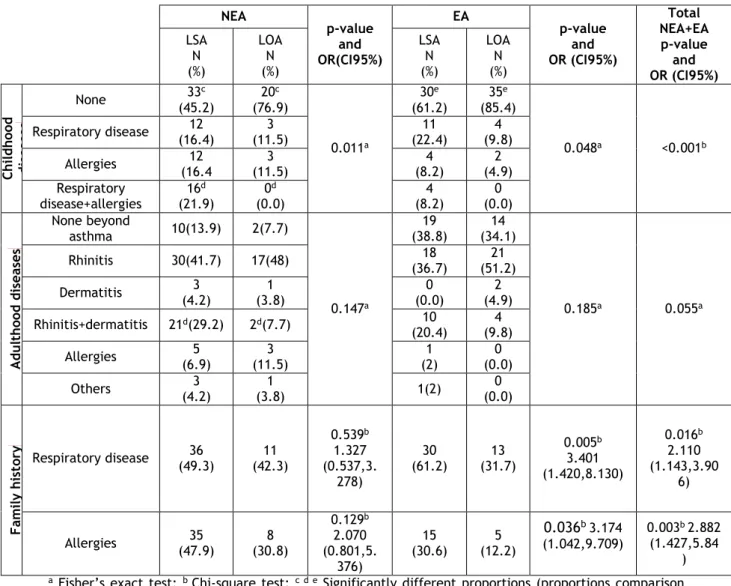
Most patients had no history of illness in infancy (62.4% of population) (Table 5). In NEA and EA patients, the absence of childhood diseases was significantly different in terms of population proportion between the LSA/EOA/COA and LOA/AOA phenotypes with a preferential association between absence of childhood diseases and the LOA/AOA phenotype (p-value=0.018 for NEA and 0.046 for IA; Fisher’s Exact test). In this context, the most frequently reported childhood disease in NEA patients was the combination of respiratory disease and allergies (16.2%) whereas respiratory disease was frequently reported in EA patients (22.4%), without significant differences between the phenotypes.
Rhinitis was the co-morbidity most frequently associated with asthma in both age groups. Curiously, in NEA patients, there was a significant difference in terms of proportion of
12
population with rhinitis or with a combination of rhinitis and dermatitis, between LOA/AOA and LSA/EOA/COA patients. Rhinitis and the combination of rhinitis with dermatitis were present in a major proportion of NEA with LSA/EOA/COA (41.7% and 29.2%, respectively).
A clear family history of allergies was reported in different age group (24.5% of NEA and 10.4% of EA) and there was an association between history of allergies and the LSA/EOA/COA phenotype value=0.003), particularly in elderly asthmatic patients (p-value=0.036).
Table 5. Phenotypes and personal/family background of diseases NEA p-value and OR(CI95%) EA p-value and OR (CI95%) Total NEA+EA p-value and OR (CI95%) LSA N (%) LOA N (%) LSA N (%) LOA N (%) Ch ild h oo d d is eas es None (45.2) 33c (76.9) 20c 0.011a 30e (61.2) 35e (85.4) 0.048a <0.001b Respiratory disease (16.4) 12 (11.5) 3 (22.4) 11 (9.8) 4 Allergies (16.4 12 (11.5) 3 (8.2) 4 (4.9) 2 Respiratory disease+allergies 16d (21.9) 0d (0.0) 4 (8.2) 0 (0.0) A d u lth oo d d is eas es None beyond asthma 10(13.9) 2(7.7) 0.147a 19 (38.8) 14 (34.1) 0.185a 0.055a Rhinitis 30(41.7) 17(48) (36.7) 18 (51.2) 21 Dermatitis (4.2) 3 (3.8) 1 (0.0) 0 (4.9) 2 Rhinitis+dermatitis 21d(29.2) 2d(7.7) 10 (20.4) 4 (9.8) Allergies (6.9) 5 (11.5) 3 (2) 1 (0.0) 0 Others (4.2) 3 (3.8) 1 1(2) (0.0) 0 F am ily h is to ry Respiratory disease 36 (49.3) (42.3) 11 0.539b 1.327 (0.537,3. 278) 30 (61.2) (31.7) 13 0.005b 3.401 (1.420,8.130) 0.016b 2.110 (1.143,3.90 6) Allergies (47.9) 35 (30.8) 8 0.129b 2.070 (0.801,5. 376) 15 (30.6) (12.2) 5 0.036b 3.174 (1.042,9.709) 0.003b 2.882 (1.427,5.84 )
a Fisher’s exact test; b Chi-square test; c d e Significantly different proportions (proportions comparison
13
3.4.3. Triggers and other exposures
Factors such as strong smells, house dust (71.7% of NEA and 67.8% of EA), pollen (71.7% of NEA and 65.6% of EA), viral infections (53.5% of NEA and 61.1% of EA) and changes in temperature (54.5% of NEA and 56.7% of EA) were reported as triggers by more than half of both asthma phenotypes, and were the most common reported triggers, without significant differences between both groups. Physical activity (41.4% of NIA and 30% of EA), animals with fur (41.4% of NEA and 30% of EA) and emotions (34.4%of NIA and 24.4% of EA) were also frequently reported as triggers. Wool (22.2%), open fireplace (10.6%) and animals with feathers (19%) were reported by a minority. However, there were no significant differences between different phenotypes or among different age groups, in terms of triggers.
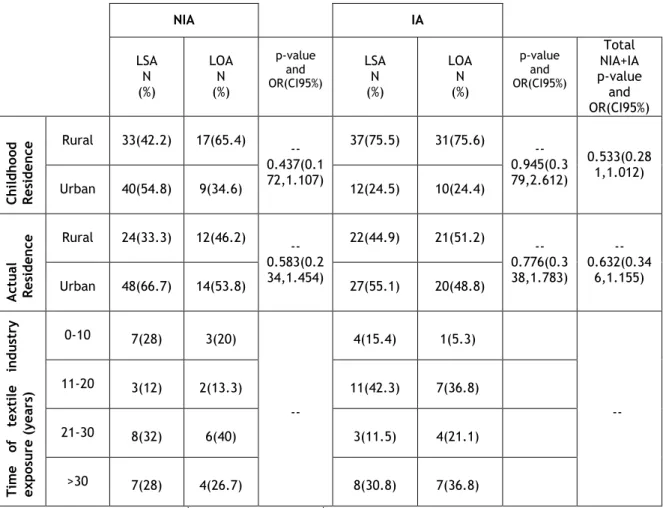
Most asthmatic patients had lived in rural areas as a child, but there was no association between childhood residence and the different phenotypes (Table 6). Currently, most patients had an urban residence.
Approximately 40% of NEA and almost half of EA (48.9%) had had in the past or still had textile industry exposure. Around 16% of EA patients had worked more than 30 years in the textile industry.
Table 6. Phenotypes and place of residence and occupational exposure
NIA IA LSA N (%) LOA N (%) p-value and OR(CI95%) LSA N (%) LOA N (%) p-value and OR(CI95%) Total NIA+IA p-value and OR(CI95%) Ch ild h oo d R es id en ce Rural 33(42.2) 17(65.4) -- 0.437(0.1 72,1.107) 37(75.5) 31(75.6) -- 0.945(0.3 79,2.612) 0.533(0.28 1,1.012) Urban 40(54.8) 9(34.6) 12(24.5) 10(24.4) A ct u al R es id en ce Rural 24(33.3) 12(46.2) --0.583(0.2 34,1.454) 22(44.9) 21(51.2) -- 0.776(0.3 38,1.783) --0.632(0.34 6,1.155) Urban 48(66.7) 14(53.8) 27(55.1) 20(48.8) Ti m e of tex ti le in d u st ry ex p os u re (years ) 0-10 7(28) 3(20) -- 4(15.4) 1(5.3) -- 11-20 3(12) 2(13.3) 11(42.3) 7(36.8) 21-30 8(32) 6(40) 3(11.5) 4(21.1) >30 7(28) 4(26.7) 8(30.8) 7(36.8)
a Fisher’s exact test; b Chi-square test; c d e Significantly different proportions (proportions
14
3.4.4. Severity of asthma
In order to evaluate whether the severity of asthma was different between phenotypes data regarding hospitalizations due to asthma, the number of acute exacerbations of asthma and the need for oral CES were analysed (Table 7). None of the criteria used to measure the severity of disease was significantly associated with any of the phenotypes. Only 9% of population reported one or two hospitalizations due to asthma in the previous year and 29.1% reported one or two acute exacerbations. Curiously, the frequency of these episodes was not higher in EA patients than in NEA patients for any of the age of onset phenotypes. However, the need for oral CES was relatively more frequent in NEA patients, both for LSA/EOA/COA and LOA/AOA.
Table 7. Phenotypes and asthma severity
NIA IA LSA N (%) LOA N (%) p-value LSA N (%) LOA N (%) p-value NIA+IA p-value and OR (CI95%) Hospitalization For asthma None 68(93.2) 24(92.3) 0.224a 39(79.6) 35(85.4) 0.467a 0.994 a 1 or 2 5(6.8) 1(3.8) 6(12.2) 5(12.2) 3 or >3 0(0) 1(3.8) 4(8.2) 1(2.4) Acute exacerbation None 35(47.9) 14(53.8) 0.168a 29(59.2) 25(61) 0.985a 0.496 a 1 or 2 24(32.9) 4(15.4) 15(30.6) 12(29.3) 3 or >3 14(19.2) 8(30.8) 5(10.2) 4(9.8)
Need for oral
CES Yes 12(16.4) 5(19.2) 0.748a 3(6.1) 3(7.5) 0.797a 0.972a
a Fisher’s exact test; b Chi-square test; c d e Significantly different proportions (proportions comparison
test)
3.5. Clinical aspects of asthma according to phenotypes
Manifestations of asthma, treatment and control of disease were analyzed both in the total sample of patients as well in terms of each asthma phenotype (Table 8).
3.5.1. Asthma manifestations
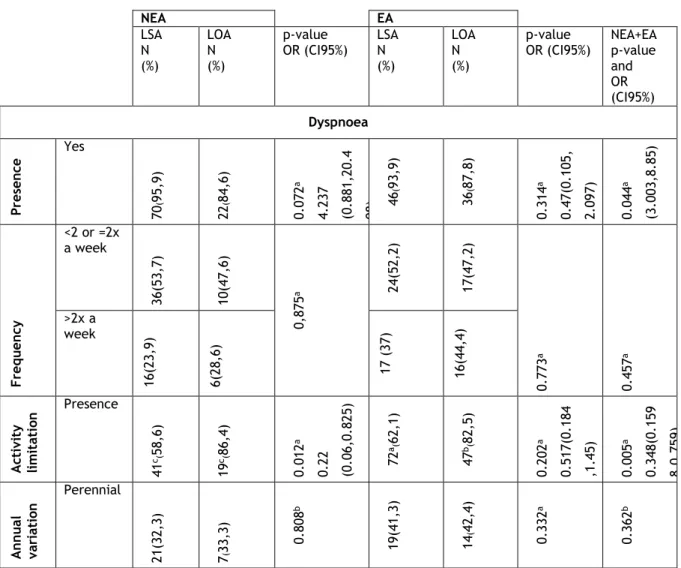
Dyspnoea (92.1%) was the most frequently reported symptom, followed by wheezing (91.7%), and cough (90.9%). There was an association between dyspnoea and phenotype in each phenotypic group, independently of age (p-value = 0.038). In this context, both elderly and non-elderly asthmatic patients with LSA/EOA/COA were 4.237 more likely to have dyspnea than patients with the LOA/AOA phenotype. There was also an association between phenotypes and limitation of activities caused by dyspnoea. NEA patients with a LOA/AOA phenotype were 4.48 times more likely to have limitation of activities caused by dyspnoea (p-value =0.017, Odds ratio LOA/LSA).
15
The limitation of activities due to cough was present in 43.9% of EA with LSA/EOA/COA and in 68.4% of EA with LOA/AOA, suggesting that EA patients with the latter phenotype had more frequent limitation of activities caused by cough than EA patients with LSA/EOA/COA (p-value=0.028).
In terms of wheezing, there was an association, in terms of proportion, between the frequency of manifestation and phenotype, in NEA patients. In fact, more than half of NEA patients with LOA/AOA (59.1%) reported the occurrence of wheezing more than twice per week, whereas that only occurred in 28.6% of NEA patients with LSA/EOA/COA phenotype. Thus, with a level of significance of 3.7%, NEA with LOA/AOA had a manifestation of more persistent wheezing.
In terms of annual variation, for all symptoms, manifestations were more frequent in Spring and Summer.
Table 8. Phenotypes and asthma manifestations
NEA EA LSA N (%) LOA N (%) p-value OR (CI95%) LSA N (%) LOA N (%) p-value
OR (CI95%) NEA+EA p-value and OR (CI95%) Dyspnoea Pres en ce Yes 70 ( 95 ,9 ) 22( 84 ,6 ) 0. 07 2 a 4. 23 7 (0 .8 81 ,2 0. 4 08) 46 ( 93 ,9 ) 36 ( 87 ,8 ) 0. 31 4 a 0. 47 (0 .1 05 , 2. 09 7) 0. 04 4 a (3 .0 03 ,8 .8 5) F requ en cy <2 or =2x a week 36 (5 3, 7) 10 (4 7, 6) 0, 87 5 a 24 (5 2, 2) 17 (4 7, 2) 0. 77 3 a 0. 45 7 a >2x a week 16 (2 3, 9) 6( 28 ,6 ) 17 ( 37 ) 16 (4 4, 4) A ct iv it y li m it at io n Presence 41 c (58 ,6 ) 19 c (86, 4) 0. 01 2 a 0. 22 (0 .0 6, 0. 82 5) 72 a (62 ,1 ) 47 b (82 ,5 ) 0. 20 2 a 0. 51 7( 0. 18 4 ,1 .4 5) 0. 00 5 a 0. 34 8( 0. 15 9 8, 0. 75 9) A n n u al vari at io n Perennial 21 (3 2, 3) 7( 33 ,3 ) 0. 80 8 b 19 (4 1, 3) 14 ( 42 ,4 ) 0. 33 2 a 0. 36 2 b
16 Spring and Summer 38 (5 8, 5) 13 (6 1, 9) 25( 54 ,3 ) 19 (5 7, 6) Autumn and Winter 6 ( 9, 2) 1( 4, 8) 2(4, 3) 0 ( 0, 0) Cough Pres en ce Yes 66( 93 ) 25( 10 0) 0. 07 8 a 0. 72 5( 0. 63 9 ,0 .8 23 ) 40 (8 1, 6) 38 (9 2, 7) 0. 11 5 a 0. 35 3( 0. 08 8 ,1 .3 95 ) 0. 09 a 0. 36 1( 0. 01 , 1. 30 4) F requ en cy <2 or =2x a week 24 (3 6, 9) 7( 29 ,2 ) 0. 50 8 b 18 (4 3, 9) 14 (3 6, 8) 0. 22 0 b 0. 10 5 a >2x a week 29 (4 4, 6) 14( 58 ,3 ) 17 ( 41 ,5 ) 22 (5 7, 9) A ct iv it y li m it at io n Presence 22 (3 3, 3) 13 (5 2, 0) 0.105a 0.461(0.18 1,1.178) 18d ( 43 ,9 ) 26 d( 68 ,4 ) 0. 02 7 a 0. 36 1( 0. 14 4 ,0 .9 07 ) 0. 00 2 a 0. 36 1( 0. 19 3 ,0 .6 98 ) A n n u al vari at io n Perennial 30 (4 6, 9) 9( 37 ,5 ) 0. 10 4 a 16 ( 39 ,0 ) 16 ( 42 ,1 ) 0. 62 0 a 0. 18 3 b Spring and Summer 29( 45 ,3) 15( 62 ,5 ) 22 (5 3, 7) 21 (5 5, 3) Autumn and Winter 5( 7, 8) 0( 0) 3( 7, 3) 1( 2, 6) Wheezing Pres en ce Yes 64 (8 8, 9) 21 (8 0, 8) 0. 31 1 a 1. 90 5( 0. 56 2 ,6 .4 5) 46 (9 5, 8) 38 (9 2, 7) 0. 52 0 a 1. 81 5( 0. 28 9 ,1 1. 49 4) 0. 42 9 a 1. 49 3( 0. 55 9 ,3 .9 84 ) F requ en cy <2 or =2x a week 31( 49 ,2 ) 6( 27 ,3 ) 0. 03 7 b 19 (4 1, 3) 15 (3 9, 5) 0. 70 3 a 0. 14 8 a
17 >2x a week 18 e (28 ,6 ) 13 e (59 ,1 %) 18 (3 9, 1) 17 (4 4, 7) A ct iv it y li m it at io n Presence 20 (3 1, 3) 5( 22 ,7 %) 0. 44 0 a 1. 54 6( 0. 5, 4. 785) 18(3 8, 3) 19 (5 0, 0) 0. 27 9 a 0. 62 1( 0. 26 1 ,1 .4 93 ) 0. 45 5 a 0. 78 1( 0. 40 8 ,1 .4 93 ) A n n u al vari at io n Perennial 24 (4 0, 7) 7( 31 ,8 %) 0. 36 7 b 21 (4 4, 7) 22 (5 9, 5) 0. 15 7 a 0. 19 5 b Spring and Summer 28 (4 7, 5) 14 (6 3, 6%) 24 (5 1, 1) 15 (4 0, 5) Autumn and Winter 7( 11 ,9 ) 1( 4, 5%) 2( 4, 3) 0( 0) Chest tightness Pres en ce Yes 48 (6 8, 6) 20 (8 0, 0%) 0. 26 5 a 0. 54 6( 0. 18 1 ,1 .6 42 ) 34 (6 9, 4) 31 (7 5, 6) 0. 51 0 a 0. 73 1( 0. 28 7 ,3 .4 84 ) 0. 22 0 a 0. 65 2( 0. 32 6 ,1 .3 05 ) F requ en cy <2 or =2x a week 28 (5 8, 3) 8( 42 ,1 %) 0. 42 7 a 21 (5 8, 3) 14 (4 5, 2) 0. 29 9 a 0. 25 9 a >2x a week 9( 18 ,8 ) 6( 31 ,6 %) 10 (2 7, 8) 8( 25 ,8 ) A ct iv it y li m it at io n Presence 27 (5 6, 3) 12 (6 0, 0%) 0. 77 5 a 0. 85 7( 0. 29 7 ,2 .4 75 )) 21 (5 8, 3) 22 (7 1, 0) 0. 28 0 a 0. 57 3( 0. 20 7 ,1 .5 87 ) 0. 27 0 a 0. 66 7( 0. 32 3 ,1 .3 77 ) A n n u al vari at io n Perennial 27 (5 8, 7) 13 (6 8, 4%) 0. 74 0 a 18 (5 0, 0) 19 (6 1, 3) 0. 38 6 a 0. 37 8 a Spring and Summer 15 (3 2,6 ) 5( 26 ,3 %) 17 (4 7, 2) 12 (3 8, 7)
18 Autumn and Winter 4( 8, 7) 1( 5, 3%) 1( 2, 8) 0( 0, 0)
a Fisher’s exact test; b Chi-square test; c d e Significantly different proportions (proportions comparison
test)
3.5.2. Treatment
Data were also collected on rescue medication, used in acute exacerbations, as well on daily medication used to control the manifestations and to stabilize the disease (Table 9). Finally, some data regarding additional medication was also obtained.
Rescue medication was associated with phenotype in different age groups (p-value=0.016). As expected, short-Acting Beta2-Agonist (SABA) was the most frequent medication used by asthmatic patients when they had an acute exacerbation. Curiously, the use of SABA was preferentially associated with LSA/EOA/COA phenotypes (p-value=0.016), particularly in NEA patients p-value=0.015).
On the other hand, for the same age group (NEA), Long-Acting Beta2-Agonist (LABA) was preferentially associated with the LOA/AOA phenotype (p-value=0.015), which may suggest a more frequent presence of moderately severe persistent asthma in this age group and phenotype.
Inhaled Corticosteroids (IC) was the most frequent medication for NEA, followed by the combination of a Long-Acting Beta2-Agonist with an inhaled corticosteroid (LABA+IC). In NEA patients, its use was more frequent, in terms of proportion in patients with LOA/AOA phenotype than patients with LSA/EOA/COA phenotype, although this did not reach statistical significance.
The combination of IC with LABA was the most frequent daily medication for EA patients. Antihistamines were the main additional drug in these asthmatics, used to help control rhinitis symptoms, and were more frequently used by NEA patients.
Finally, the use of anti-leukotriene drugs was associated with phenotypes, being more frequently used NEA patients with LOA/AOA (69.2%), with level of significance of 1.8%.
Table 9. Phenotypes and asthma treatment
NEA EA
LSA
N(%) N(%) LOA p-value N(%) LSA N(%) LOA p-value
Total NIA+IA p-value Res cu e m ed ic a ti on SABA 56c(77.6) 11c(42.3) 0.015a 22(44.9) 17(41.5) 0.402a 0.016a LABA 5d(6.8) 6d(23.1) 3(6.1) 7(17.1) IC 0 0 1(2) 0(0) IC+LABA 5(6.8) 3(11.5) 3(6.1) 3(7.3) D ai ly m e di ca ti SABA o n 1(1.4) 0(0) 0.116a 0(0) 0(0) 0.980a 0.252a LABA 0(0) 0(0) 2(4.1) 2(4.9)
19 IC 47(64.4) 15(57.7) 19(38.8) 17(41.5) IC+LABA 14c(19.2) 10c(38.5) 26(53.1) 20(48.8) Su p p ort m ed ic at io n Antileuko trienes 31e(42.5) 18e(69.2) 0.018a 16(32.7) 8(19.5) 0.157a 0.97a Antihista mine 58(79.5) 21(80.8) 0.886b 14(28.6) 11(26.8) 0.854b 0.132b
a Fisher’s exact test; b Chi-square test; c d e Significantly different proportions (proportions
comparison test)
3.6.3. Asthma control
Asthma control was also analysed in terms of all studied phenotypes, to determine whether there were differences between groups (Table 10). In this regard, patients with LSA/EOA/COA phenotype had a higher percentage of controlled asthma, when compared with the LOA/AOA phenotype. However, no statistically significant differences were found between phenotypes in NEA and EA patients.
Table 10. Phenotypes and asthma control
NEA EA NEA+EA Total
LSA N (%)
LOA N(%)
p-value
OR(CI95%) N(%) LSA N(%) LOA
p-value OR(CI95% ) p-value OR(CI95%) A CT Uncontroll ed 22(22.2) 9(9.1) 0.147a 12(13.3) 12(13.3) 0.639a 0.620a Controlled 51(51.5) 17(17.2) 37(41.1) 29(32.2)
a Fisher’s exact test; b Chi-square test; c d e Significantly different proportions (proportions
20
4. Discussion
The present study is the first thorough phenotypic study of asthma in Portuguese patients, aiming to investigate features of asthma and their expression in different phenotypes in non-elderly and non-elderly patients with early onset and late onset asthma phenotypes. The most frequently observed phenotype in elderly asthmatic patients was late onset (LOA)/ adult-onset (AOA) asthma phenotype without atopy, whereas in non-elderly asthmatics the long-standing (LSA) / early-onset (EOA) / childhood-onset (COA) phenotype associated with atopy was more frequent. We also showed that elderly and non-elderly patients with LOA/AOA asthma phenotype and those with LSA/EOA/COA phenotype have significant differences in terms of manifestations of severity, family history of diseases and control medication. Nevertheless, these phenotypes may manifest to a similar extent, in different age groups.
Most patients in our sample were female, smokers, with low level of schooling and social class (Graffar III and IV), predominantly urban, although in childhood most had lived in rural areas. Although the predominance of women in our study may suggest that there was a bias in selection process, we believe that this is not the case since most of the patients who were contacted for recruitment, independently of refusing or accepting, were women. In fact, various studies have shown that there is an increased incidence of asthma in women (23) and in adults, namely in elderly patients, female patients tend to predominate, particularly in cases of LOA/AOA (39). Furthermore, women may have more severe and or persistent manifestations of asthma than men and this may account for them to be preferentially seen at outpatient speciality clinics (41).
Previous studies suggested the burden of asthma is more significant in the elderly than in their younger counterparts, particularly with regard to mortality, hospitalization, medical costs or health-related quality of life (20). There are data to suggest that asthma in older adults is phenotypically different from young patients, with potential impact on the diagnosis, assessment and management in this population (20). So, in this study we included approximately the same number of non-elderly and elderly patients and studied LSA/EOA/COA and LOA/AOA phenotypes, taking into account the presence of atopy, personal and family background of respiratory disease, triggers and occupational exposure, severity of disease, and clinical aspects about asthma, included asthma manifestations, treatment and its control. The most frequent phenotype both was LSA/EOA/COA, in terms of onset disease. In addition, atopy was also the most frequent phenotype in the general sample of asthmatics as well as in NEA but clearly not in EA, in whom a non-atopic phenotype predominated. It is known that Non atopic/allergic BA is generally less frequent than atopic/allergic BA (12). When we analysed a combination of phenotypes, the most frequently observed in NEA was LSA/EOA/COA with atopic asthma, but in EA patients the most phenotype observed was
21
LOA/AOA with non-atopic asthma. According to some studies this may imply that most patients with LOA had mild-to-moderate persistent asthma, particularly for EA patients because among patients with adult onset asthma, those with severe disease are less likely to be atopic (20).
We defined long standing asthma (LSA) as early- (EOA) or childhood-onset (COA) asthma, beginning before 18 years of age, and late-onset asthma (LOA) as adult-onset (AOA) asthma beginning after that age (8; 39). Although various researchers use the age of 40 as the threshold for discrimination between LSA and LOA (25), the threshold ages separating between these two subtypes in fact vary in different studies. However, generally speaking, asthma which begins in childhood or young adulthood is regarded as LSA (27,28) and we believe our definition is acceptable and capable of comparison with studies carried out elsewhere.
In terms of diseases associated with asthma, most asthmatic patients in our study had rhinitis, which is consistent with a predominant atopic phenotype, in the case of the non-elderly asthmatics. In fact, we observed that the presence of rhinitis or the combination of rhinitis and dermatitis was significantly higher in the LSA/EOA/COA phenotype in both age groups, although it did not reach no statistical significance. A review on European-wide epidemiological studies on the prevalence of chronic rhinosinusitis (CRS) confirmed the well-known association between allergic rhinitis and LSA (17). But, according some studies, rhinitis is a significant risk factor for adult-onset asthma in both atopic and non-atopic subjects (24). Likewise, a family history of allergies was more frequently documented by patients with LSA, but in this case, with the particularity of being more common in EA patients. This fact corroborates other studies that showed that parental and/or sibling history of asthma and allergy were generally more strongly associated with LSA/EOA/COA when compared with early onset transient or late onset asthma (26,34).
Despite LSA being more frequently associated with a allergen sensitisation and more allergic symptoms (8), in this study no associations between triggers such as pollens, house dust, the presence of animals, or contact with wools and LSA were observed for any of the age groups.
In terms of clinical features, the LSA/EOA/COA phenotype was associated with the presence of dyspnoea, independently of age. In fact, NEA and EA patients with this phenotype seem to have a higher probability of having dyspnoea as a relevant asthma symptom. Although LOA/AOA is associated with a greater severity of disease this finding may be explained by the fact that LSA/EOA patients have an increased susceptibility to frequent exacerbations (28, 32) due to being exposed to environmental triggers. It is also consistent with the more frequent use of SABA for NEA patients with LSA/EOA. Nevertheless, this phenotype was also associated with a higher percentage of patients with controlled asthma, when compared with
22
the LOA/AOA phenotype, although without statistical significance. This apparent discrepancy may be justified by the fact that the test measuring asthma control (ACT) only focuses upon the previous four weeks whereas the other parameters regarding SABA use and exacerbations involve the previous 12 months.
We also analyzed the personal and family background of patients to determine factors that might be associated with the development of each phenotype. An association was found between absence of respiratory diseases or allergies in childhood and the LOA/AOA phenotype in both elderly and non-elderly asthmatics. Thus, the presence of respiratory diseases may indicate the earlier development of asthma. Various studies have indeed shown that the LOA/AOA phenotype is less often associated with allergy and atopic diseases (34) and suggested that many patients with this phenotype describe the onset of asthma symptoms following a viral illness, occupational exposure, or the ingestion of aspirin, while such histories are less frequent among those with LSA/EOA/COA asthma (7).
An association between limitation of activities caused by dyspnoea and LOA was found in non-elderly asthmatic patients. In fact, a young patient with LOA/AOA was 4.48 times more likely to have limitation of activities caused by dyspnoea. In the same way, LOA/AOA was associated with a greater frequency of wheezing manifestations (more than twice per week) in non-elderly asthmatics. Curiously, limitation of activities caused by cough was associated with LSA/EOA/COA in the general sample of patients, and particularly in EA patients. This tendency towards more frequent manifestations and limitation of activities may be explained by the clinical characteristics of LOA/AOA since patients with this phenotype have been shown to have marked airflow restriction, probably related to airway inflammation and remodeling, and with a faster decline in forced expiratory volume in 1 second (FEV1) (28). The fact that limitation caused by dyspnea and a higher frequency of wheezing manifestations were more frequently reported by younger patients could be due to decreased perception or under-reporting of symptoms by elderly patients (20) and also to the fact that elderly patients tend to be less mobile than younger patients and, therefore, less likely to have physical exercise induced dyspnoea. In contrast, a limitation of activities caused by cough was more frequently reported by EA patients with the LSA/AOA phenotype. Studies about cough in the elderly showed that EA tend to have an increased incidence of illnesses, including those affecting the lungs and though the cough is a common symptom, and this may suggest a more serious underlying disease, in view of its frequent association with chronic bronchitis, ACE inhibitor-treated high blood pressure, and heart failure (17, 21, 22). In the same way, persistent coughing in elderly may more easily lead to exhaustion, insomnia, dizziness and musculoskeletal pain (22). Thus, the fact those patients with LSA/EOA had chronic cough earlier than patients with LOA/AOA, could be a more limiting factor to physical activities in the former phenotype.