AGE IN THE PERSONNEL SELECTION DECISION
by
Filipa da Nova Soto Maior
Master Thesis in Economics and Human Resources Management
Written under orientation of:
Maria Teresa Vieira Campos Proença
ii
Biographical Note:
Filipa da Nova Soto Maior was born on the 4th of September 1983 in Póvoa de Varzim, where she still resides.
Her academic career started in 2001, when she left for Coimbra and enrolled in Universidade de Coimbra, to study Psychology at the Faculdade de Psicologia e Ciências da Educação. After five intense years, she graduated.
Her professional career started little after. Having worked briefly in the Human Resources area, she then dedicated herself to Educational Psychology, working with both adults and adolescents. Due to the professional uncertainty in this field, she decided to change her professional future and invest in a career in Human Resources. She enrolled in the Master in Economics and Human Resources Management lectured by the Faculdade de Economia do Porto, and after a brief period of unemployment, she is currently working in human resources for the private sector, where she is actively involved in the development of a human resources policy for that specific organization.
iii
I would like to thank:
My parents for all the emotional support; My boyfriend for being my rock;
My friends, especially Felisbela, Iva, Cristiana, Elisabete and Marisa for all the pep talks;
My former manager, Lurdes Alves for all the understanding and kindness;
Dr.ª Margarida Palos and Dr.ª Alexandra Oliveira for believing in me, even when I started to doubt myself;
Professora Doutora Teresa Proença, Professora Doutora Eva Oliveira and Professor Doutor Carlos Mauro for all the guidance;
And finally, to all of those who are in my life and that in one way or another carried me throughout this year.
iv
Resumo:
Os estereótipos negativos sobre trabalhadores mais velhos e as suas capacidades, o idadismo, parecem ser uma realidade nas organizações e estes podem estar presentes nas decisões tomadas em processos de seleção. Estas decisões podem ser estudadas de acordo com a abordagem dos dois sistemas de pensamento. Esta defende a existência de dois tipos de pensamento: um rápido e automático, o Sistema 1 (S1) e outro lento e deliberativo, o Sistema 2 (S2).
O objetivo deste trabalho foi analisar se a idade de um candidato tem influência na avaliação feita do seu Curriculum Vitae (CV), e como consequência, na decisão de o passarmos ou não para uma próxima fase do processo de seleção.
Recorrendo ao método experimental e a um design between subjects, foram manipuladas três variáveis: tipo de pensamento (com duas variáveis, S1 e S2); idade do candidato (com dois níveis, novo e velho) e idade do recrutador (com dois níveis, novo e velho) numa amostra com 545 participantes. A variável dependente é a avaliação do CV. Os resultados obtidos contrariaram as hipóteses que defendiam que a idade do candidato iria influenciar a avaliação do CV quando a decisão fosse tomada usando S1. Este seria o sistema permeável à tomada de decisões influenciadas pelo idadismo. O mesmo ocorreu com as hipóteses que previam a existência de um efeito da idade do recrutador sobre a avaliação do CV, usando S1. Apenas as hipóteses que previam que a idade, do candidato ou do recrutador, não iriam influenciar os resultados da avaliação quando a decisão fosse tomada usando S2 foram validadas. Uma diferença significativa entre as avaliações feitas usando S1 ou S2 foi encontrada. Estes resultados indicam que as avaliações feitas usando S1 são inferiores às que são feitas recorrendo a S2. Isto pode indicar que o uso de S2, o sistema deliberativo, permite fazer avaliações com maior grau de confiança do que quando estas são feitas usando S1, o sistema intuitivo.
v
Abstract:
If discrimination occurs in the selection decision, the best candidates for the job may not be chosen. Negative stereotypes about older workers and their abilities prevail in organizations. Ageism may be present in the selection decision as numerous studies have found. This decision can be studied using the dual process theories of reasoning. They advocate the existence of two types of reasoning: a quick and automatic one, known as System 1 (S1), and a slow and deliberative one, System 2 (S2).
The goal with this work was to assess whether a candidate’s age has an impact in the decision of passing him onto the next stage of the selection process, when evaluating his Curriculum Vitae (CV) using S1 or S2.
Using the experimental method, a between subjects design was used, in a total of 545 participants, that allowed for the manipulation of the three independent variables: type of thought (with two variables, S1 and S2); candidate’s age (with two levels, young and old); and recruiter’s age (with two levels, young and old). The dependent variable was the CV evaluation. Our hypotheses stated that there would be an age effect when using S1 because this system would allow for the manifestation of ageism. This however did not occur. Even when the sample was divided into young or old recruiters there was no effect present. When using S2, a system that would prevent ageism from influencing the selection decision, and according to predictions, there was also no age effect. Interestingly, there was a difference found between the scores attributed when using S1 or S2. The results indicate that when using S1, evaluations are lower than when using S2. This may indicate that the use of S2 (the deliberative system) allows for more confidence in the evaluations than when using S1 (the intuitive system).
vi
Index:
Biographical Note Thanks Resumo Abstract Introduction……….……….……….1Part I – Literature Review 1. The Selection Process and Discrimination………3
2. Discrimination Against Older People: Ageism……….………5
3. Dual Process Theories of Reasoning……….………8
3.1Methods for inducing the two types of reasoning..………..………….……12
4. Age Discrimination in the Personnel Selection Decision………15
Part II – Experimental Study 1. Research Objectives and Hypotheses………..………17
2. Methodology………..……….………19
2.1Experimental Design……….…19
2.2Proceedings and instruments used………..…...20
2.3Sample………..……….23
3. Results………...………..24
3.1Homogeneity Tests………..………..24
3.2Testing the Hypothesis………..………....26
vii
4.1Discussing the Hypothesis………...…………..30
5. Conclusion………...34
5.1Limitations and futures studies……….……….36
Bibliography……….………...39
viii
Tables Index:
Table 1: Experimental Designs
Table 2: Homogeneity Tests in Design 1 Table 3: Homogeneity Tests in Design 2 Table 4: Descriptive Results in Design 1 Table 5: Descriptive Results in Design 2
Table 6: Test Results Comparing Means Between Groups in Design 1 Table 7: Test Results Comparing Means Between Groups in Design 2
ix
Experimental Group Acronyms
S1A: using S1 to evaluate the ageless CV;
S1 – 31: using S1 to evaluate the CV marked 31 years; S1 – 45: using S1 to evaluate the CV marked 45 years; S2A: using S2 to evaluate the ageless CV;
S2 – 31: using S2 to evaluate the CV marked 31 years; S2 – 45: using S2 to evaluate the CV marked 45 years; YS1A: young recruiters using S1 to evaluate the ageless CV;
YS1 – 31: young recruiters using S1 to evaluate the CV marked 31 years; YS1 – 45: young recruiters using S1 to evaluate the CV marked 45 years; YS2A: young recruiters using S2 to evaluate the ageless CV;
YS2 – 31: young recruiters using S2 to evaluate the CV marked 31 years; YS2 – 45: young recruiters using S2 to evaluate the CV marked 45 years; OS1A: old recruiters using S1 to evaluate the ageless CV;
OS1 – 31: old recruiters using S1 to evaluate the CV marked 31 years; OS1 – 45: old recruiters using S1 to evaluate the CV marked 45 years; OS2A: old recruiters using S2 to evaluate the ageless CV;
OS2 – 31: old recruiters using S2 to evaluate the CV marked 31 years; OS2 – 45: old recruiters using S2 to evaluate the CV marked 45 years.
1
Introduction
The strategic human resources management considers that hiring the best professionals is one of the ways of ensuring the organization’s competitive advantage (Cunha et al., 2012). Therefore, the recruitment and selection decisions are some of the most important decisions that an organization may take concerning its human resources. Such a decision affects the organization’s ability to attain its goal, the quality of its services and products and the well-being of their workers (Dale, 2003; Sutherland & Jordaan, 2004, in Sutherland & Wӧcke, 2011).
Recruitment is the process of attracting and encouraging adequate candidates to apply for an opening, and Selection is the process of assessing the weakest and the strongest aspects of each candidate in a fair way, with the intention of hiring the best and the most suitable candidate considering the organization and the job itself (Boxall & Purcell, 2008; Breaugh & Starke, 2000, in Sutherland & Wӧcke, 2011). This process goes through several stages, from the definition of the organization’s needs (the job profile), the placement of the advertisements, the assessment of the Curriculum Vitae (CV), psychological evaluations and interviews, among others (Cunha et al., 2012).
In Portugal, the selection methods that are mostly used are the selection interview (87.9%), normally with the person responsible for the request, and the CV analysis (85.7%) (Correia, 2002, 2005). It´s our belief that, many times, both of these go together. These methods are used whether it´s considered a high or low responsibility job (Correia, 2002, 2005).
The impact of a bad personnel selection decision, i.e. when the best candidate for the job is not chosen, has severe costs for corporations. There is the cost associated with the recruitment and selection process (that may or may not be repeated), the cost associated with the integration of the candidate that proves himself inadequate and the probable dismissal of that individual. Finally, we cannot forget the cost of losing a good candidate to the competitors (Ribeiro, 2002; in Vicente, 2011). Jackson and Schuler (2003, in Sutherland & Wöcke, 2011) found that a poor hiring decision can cost as
2
much as five times the employee’s salary. The more senior or more specialized the position, the higher the costs are likely to be (Sutherland & Wöcke, 2011).
Many studies have found that a candidate’s age has an impact in the selection decision. However, age is generally not a part of the job profile because nothing indicates that a person with a certain age will have a better performance at that job than someone with a different age (Finkelstein, Burke & Raju, 1995). Age on itself can merely indicate that someone may or may not have more experience at that function. This indicates that when age is included in the selection decision a bias might occur. So, if managers apply stereotypical thinking when predicting the probable success of a candidate for hire, then the process of the selection decision should be studied in order to understand how age has impact on it.
The selection decision process can be studied using the dual process theories. These believe that decisions can be made using two types of reasoning, the System 1, unconscious and intuitive, and System 2, conscious and deliberative. It is important to discover if age will impact the selection decision in either of them and in what manner. Considering all this, we will try to assess the impact of the candidate’s age in the selection decision of passing or not a candidate merely by analyzing his CV to the next step in the selection process.
This paper is organized in two parts. The first one will focus on the literature review. We will start by showing how age discrimination may occur in the selection process, and then we will try to explain ageism, or the process of discrimination against older people. Dual process theories of reasoning will be explained as well as the selection decision process and finally we will review the data from current research regarding age impact in the selection decision. The second part of this paper consists of the experimental study. We will start by explaining our goals and hypotheses and follow with a detailed description of the methodology used (experimental design, procedures and instruments). The results will be exposed and discussed thoroughly. Lastly, we will end our work with the conclusions, practical implications of our findings, study limitations and some suggestions for future research.
3
Part I: Literature Review
1. The Selection Process and Discrimination
As we saw earlier, recruiting is the process of attracting candidates and selection is the process of deciding on the best person for the job. The selection choice must be both ethical and fair and it should consider the articulation between the organization´s needs and the candidate´s knowledge, skills and abilities. Selection requires that you seek the adjustment between people and jobs, that is, person-job fit. This process includes defining the selection criteria that candidates must possess (Cunha et al., 2012).
According to Chiavenato (1999), selection criteria are usually extracted from the job characteristics. They may include personality traits, technical knowledge, professional qualifications, skills and previous experience in similar jobs, among others. These criteria must be defined so that by presenting them the candidate indicates a high probability of demonstrating high performance on the job (Peres, 2003; Cunha et al., 2012).
Discrimination in a recruitment and selection process can occur in many different forms and in many different stages: the definition of age limits and the use of discriminatory language in the advertisements; asking direct or indirect questions concerning a candidate’s age during interviews; using age as a selection criteria when assessing the resume (Arrowsmith & McGoldrick, 1996; Bennington & Wein, 2000, in Bennington, 2002).
The one source of discrimination we are concerned about is the one that occurs when selectors are analyzing CV. CV are the source of the first contact between a candidate and an organization. It serves as a filter because it allows the recruiter to reject a candidate that does not meet the criteria established for the job in question (Cunha et al., 2012), preventing him to pass on the next stage. It may be considered that discrimination is present when the candidate is rejected based upon his age, whether this happens consciously or not, even though he meets the criteria that predict a good future performance.
4
In an aging society, studies have shown older people have longer periods of unemployment, the least probabilities of re-entering the job market; the largest probabilities of only finding a part-time job and suffer most concerning loss in wages (Chan & Stevens, 2001; Hirsch et al., 2000; Schwartz & Kleiner, 1999; Yearta & Warr, 1995, in Bennington, 2002). In Portugal, it is estimated that an unemployed person between the ages of 45 and 55 years old remains unemployed an average of 28.4 months; in comparison, an unemployed person between the ages of 26 and 35 remains unemployed an average of 17.7 months (Marques, 2011, in Vicente, 2011). This can be the result of decisions influenced by age discrimination.
5
2. Discrimination Against Older People: Ageism
Negative stereotyping and inaccurate beliefs about older workers’ abilities and motivations prevail in many organizations and societies (Cuddy, Norton & Fiske, 2005; Ng % Feldman, 2008, 2012, 2013; Schalk et al. 2010, in Vitoria, 2014).
Attitudinal stereotypes have been conceptualized as cognitive processes that filter and structure a vast amount of information about target-groups (Lippman, 1922; Hamilton, 1979, 1981; Taylor, 1981, in Singer & Sewell, 1989). As a result of this categorization the variability within a group is reduced and the differences towards others outside the group exaggerated. Several studies have shown that these processes have negative discriminatory consequences in the perception of individuals that belong to minority groups, as in the reactions or behaviors towards these individuals (Brewer, 1979; Fiske & Cox, 1979; Stephan, 1985, in Singer & Sewell 1989). The ability to cognitively discriminate has been characterized as a significant human cognitive process, which occurs prominently along three dimensions: race, gender and age (Bargh, 1994; Fiske & Neuberg, 1990, in Roberts, 2008)
The elderly in our society find themselves viewed in a predominantly negative fashion, victims of a pervasive form of discrimination and disparagement sometimes referred as “ageism” (Butler, 1969, in Perdue & Gurtman, 1990). Ageism comprises negative attitudes, stereotypes and behavioral discrimination based solely on a person’s chronological age (Jelenec & Steffens, 2002). The attitudinal basis of ageism appears systematically linked to negative evaluations of older persons, including stereotypes of their character and capability. The aged are often described as more ill, tired, slow, forgetful, withdrawn, self-pitying, defensive and unhappy than younger persons (Perdue & Gurtman, 1990). Characterizing the aged as unemployable, unintelligent and naturally unhealthy may help to rationalize discriminatory practices in employment, among other areas (Perdue & Gurtman, 1990). Ageism is perpetuated in the social media by portrayals of older people in unproductive and unpleasant roles (Ansello, 1977; Charles, 1977; Greenberg, Korzenny, & Atkin, 1979; Northcott, 1975; Schuerman, Eden, & Peterson, 1977; in Perdue & Gurtman, 1990) and also by showing off young people in dynamic and successful roles. According to Palmore (1999, in Roberts, 2008) approximately 25 – 27% of the general population exhibits age bias.
6
Age discrimination has been seen as subtle and hard to detect (Capowski, 1994, in Bennington, 2002). In the United Kingdom, Arrowsmith and McGoldrick (1996, in Bennington, 2002) found that the use of age as a decision mechanism is applied more extensively in recruiting and selection processes than in other areas of Human Resources Management.
Age related biases in person perception may have become so routinized that they may influence social judgments at a level below that at which we consciously ascribe traits to others. When individuals process information related to others designated as old, evaluative negative information appears to be encoded in such a manner as to render it relatively more accessible in memory; the reverse seems to be true for those targets labeled as young. Research on construct accessibility in memory tells us that the information which is easier to retrieve is most likely to be used in evaluating other persons (Perdue & Gurtman, 1990). If negative traits data associated with old persons are encoded in such a way as to render them relatively more accessible, then it is more probable that they will be included in developing impressions of older persons. Over a period of time, this bias would tend to potentiate ageism by facilitating the association of negative traits with the aged, increasing even more the negative content of the old schema. This means negative traits are incidentally encoded and retrieved more effectively than are positive traits when they are encountered in association with old persons and therefore probably reflect an unintentional schematic age bias at an initial stage of social perception (Perdue & Gurtman, 1990). The differentially greater evocation of negative characteristics by the concept old can be shown to occur outside of conscious awareness, in a truly automatic fashion. Cognitively categorizing a person as old may create a subset of predominantly negative constructs which are more accessible and more likely to be employed in evaluating that person, and thus will tend to perpetuate ageism from the beginning of the social perception process. Such automatic ageism may be hard to eradicate if it has been incorporated into our implicit personality theories or social schemata and is evoked without awareness on our part (Perdue & Gurtman, 1990).
Kogan (1979, in Perdue & Gurtman, 1990) has suggested that ageism may occur only in specific judgmental contexts, when explicit comparisons are drawn between older
7
persons and some other younger group. However, what Perdue and Gurtman (1990) tells us seems to discredit this, suggesting that negative inferences concerning the elderly would not be limited to those situations.
Having said this, it can be predicted that recruiters when evaluating a candidate´s CV would unconsciously associate negative traits to older candidates giving them a lower evaluation, whether they compared them with younger candidates or not. This means the automatic selection decision would be biased. It is now important to understand the decision making process, using the dual theories of reasoning, to see how age can impact it.
8
3. Dual Process Theories of Reasoning
Research about cognitive processes provides strong evidence of the coexistence of two types of reasoning: quick and automatic ones that don’t require effort and the slow, sequential and controlled ones that require effort. In cognitive psychology, these two types of thinking are named differently according to different authors. Evans (2003, 2011) refers to implicit and explicit thinking and Type 1 and Type 2 reasoning, Sloman (2002, in Evans 2003) refers to conscious and unconscious thinking.
In this paper, we chose to use the terms System 1 (S1) and System 2 (S2) initially proposed by Stanovich and West (2000, in Evans 2003; Kahneman, 2011) to name both types of thinking.
S1, or intuitive system, consists of a set of subsystems that operate with some autonomy, independently of work memory and cognitive capacity. The processes associated with this type of thinking are fast, unconscious, parallel, automatic, have high capacity and are linked to associative learning (Evans, 2008).
S2 is frequently defined as being unique to the human species. This type of thinking is slow, conscious, sequential, deliberative and functions using work memory. S2 allows for abstract thinking that cannot be developed by S1 (Evans, 2008).
The description of both types of processing requires a profound analysis of its attributes that can be presented in four categories: (1) conscience, (2) evolution, (3) functional
characteristics and (4) individual differences. This description is based on the studies
of Evans (2008) and Kahneman (2011).
1) Conscience
S1 can be characterized as unconscious, implicit, automatic, effortless, having a fast execution and a high capacity. However, S1 can lead to conscious emotions and intuitions even though the process happens unconsciously. In S1, only the final product is conscious. This means that most of the times we are making choices without even being aware of the alternatives. Only one interpretation comes to mind, and you are never aware of the ambiguity. S1 does not keep track of alternatives that it rejects, or even of the fact that there are alternatives. Conscious
9
doubt is not in the repertoire of S1. Uncertainty and doubt are in the domain of S2 (Kahneman, 2011). S1 does not involve effort and is activated without any voluntary control; it includes instinctive behavior programmed in an innate way. It’s the default functioning method. This type of reasoning is generally perceived as reflecting autonomous systems that do not require controlled attention (Evans, 2008; Kahneman, 2011). Therefore they do not use work memory and allow for the fast processing of a lot of information. On the other hand, S2 is in part consciously accessible but it depends on a number of unconscious support systems (Evans, 2011). Besides, it is explicit, controlled, effortful, of slow execution, has limited capacity and it’s analytical. It’s a form of thinking under intentional control, which can be based in unconscious S1 processes. S2 monitors our behaviour. However, it is necessary to note that unconscious S1 processes like heuristics, which can be defined as mental shortcuts, can equally control our behaviour without our awareness. Heuristics used by S1 control behaviour unless conscious control is made by S2. This control can however, be unsuccessful. Conscious S2 reasoning is frequently used to explain unconscious behaviors from S1. You can say that one of the main functions of S2 is to inhibit default answers by S1 (Kahneman, 2011). Additionally to being conscious and controlled, S2 requires the access to work memory, where knowledge acquired through life is in storage and which capacity is limited. It is necessary to mobilize a lot of attention and abstract from other tasks in order to have a deliberative reasoning. Consciousness and work memory capacity explain the slow, sequential and limited nature of S2.
2) Evolution
S1 is described by most authors as the oldest of both systems (Stanovich & West, 2000; Evans, 2003; Osmand, 2004). However, it includes a multitude of cognitive processes, such as vision or attention, that didn’t evolve at the same time, so it is wrong to think that all S1 implicit processes are old. While S1 is described as a reasoning mode shared with other animals, S2 is characterized as being specific to the human race and able to be reflected consciously. S2 is associated to the linguistic ability, conscious and hypothetic thinking. However, some animals have also showed signs of learning capacity through the use of S2 (Evans, 2006).
10
Therefore it is imprudent to say that S2 is human specific. The correct thing to say is that S2 is more developed in the human species which has unique abilities of applying this reasoning to wider domains.
3) Functional Characteristics
As was mentioned, S1 is quick, automatic and parallel. This type of reasoning allows for concrete thinking. It is context and domain specific. It matches implicit cognition that is acquired by implicit learning or innate. It is sometimes characterized as based on experience, reflecting explicit learning but also previous beliefs and knowledge (Evans, 2003). S1 functions through associative activation. This occurs when ideas generate other ideas. Words evoke memories that provoke emotions and even physical expressions. In fact, ideas are integrated in an interconnection network called associative memory (Evans, 2003). Therefore, the impressions and sensations created by S1 are explicit beliefs sources and deliberate choices by S2 (Kahneman, 2011). It is important to note that this automatic cognitive process is equally linked to heuristics that compete with logic (Evans, 2003). Considering the huge variety of S1 implicit processes it is hard to characterize them all in the same way.
S2 is slow, controlled, sequential and rule based. It can be characterized as an effortful mental process, associated to experience and concentration. One of its functions is to control thoughts and actions suggested by S1, allowing that some be translated into behaviours and other not. At times, there are conflict situations between the two types of reasoning. These occur when an individual is led to have an automatic response given by S1 but tries to control himself through S2. In this case S2’s goal is to beat S1´s urges, exerting self-control (Kahneman, 2011). When S2 is busy, self-control allows S1 to be more influential. Because self-control demands attentions and effort, when S2 is busy mobilizing these resources into another activity, self-control is not as active.
Kahneman (2011) presents S1 as gullible and skew in its beliefs, reasons why S2 must doubt and not believe. However, S2 is sometimes busy and can´t do its job of controlling S1. It is important to note that the effort of self-control consumes mental
11
resources. Therefore, self-control is less active when several activities happen at once and S2 is less able to control S1. Also, S2 is abstract, decontextualized and domain general. But if abstract thought requires S2 this does not mean that concrete situations can´t be S2´s domain. S2 is logical and able to have hypothetic thought through suppositions and mental simulations. It is pertinent to underline that S2 requires S1 and S2 functioning, while S1 never demands S2´s activity (Evans, 2011). Regarding this, two theories can be identified concerning the coexistence and functioning of S1 and S2:
• Parallel – competitive, in which S1 and S2 act in parallel, each one assuming a role;
• Default – interventionist, in which S1 produces a quick and intuitive answer by default that may or may not be followed by S2 which is slower and deliberative by nature.
Evans (2011) states that S1 gives a default answer through intuition which reflects the lack of effort or motivation, more than a limitation of cognitive capacity. Intuitive responses can be assumed if S2 does not intervene with hypothetical thought. Intervention happens frequently when individuals have more time to think or are more motivated by context or by personality traits.
4) Individual Differences
Individual differences influence reasoning capacity. S2 requires the use of work memory which varies according to individual characteristics. Besides, there is a positive relation between S2 and general intelligence, while S1 is independent from intellectual ability (Evans, 2006). When S2 is associated to a higher level of intelligence it exerts its function of self-control more efficiently. Therefore, Evans and Curtis-Holmes (2005) demonstrated that individuals with higher IQ aren’t influenced as much by their beliefs as others. Abstract reasoning and the ability to follow instructions, more than logic, differentiate individuals with higher cognitive ability. In this manner, people with higher ability to solve statistical and decision making problems are more capable to resist contextualization of the problem through previous knowledge and beliefs (Evans, 2003). S2 supplies the basis for
12
hypothetical thinking that leads individuals to have a higher rational potential in decision making situations. Therefore controlled cognitive processes are correlated with individual differences in terms of general intelligence and work memory capacity.
In conclusion, when evaluating a CV, recruiters judge the future performance of the candidate through reading and analyzing the CV (Proença & Oliveira, 2009). This process involves the coexistence of both types of thinking. On one hand, S1 makes intuitive and automatic judgments; on the other, S2 involves more effort, and has the goal of controlling the impulses of S1 through a more deliberate process. This can indicate that when using S1 recruiters are more susceptible to discriminate a candidate because of his age and the negative traits associated with it than when using S2. Because negative thoughts about old people are so routinized and more accessible to memory than positive ones, when a selection decision is made using S1 (the autonomous and unconscious system that reflects previous beliefs) ageism is more likely to occur. Studying this would imply using and assessing each one of the systems isolated from the other. There are several methods for inducing both types of reasoning that will be explained in the next section.
3.1 Methods for inducing the two types of reasoning
There are five methods that allow reasoning manipulation and the access to intuitive and deliberative decision making processes: direct instructions, time limitation, distraction tasks, humour manipulation, reinforcing task relevance (Horstmann, Hausmann, & Ryf, 2010 in Magalhães, 2013).
1) Direct Instructions:
In decision making literature, deliberative and intuitive processes are frequently manipulated by the use of direct instructions (Horstmann, Hausmann, & Ryf, 2010 in Magalhães, 2013). The idea is to ask directly of the participants to decide about a problem intuitively or through deliberation. However, the words “intuition” and “deliberation” aren’t always mentioned in the instructions. Therefore, if the goal is to
13
induce intuition then it is possible to ask participants to: decide quickly or spontaneously so as to create implicit time pressure, tell them to trust their feelings and base their decisions in them, see the decision in a holistic manner, integrating a huge amount of information. On the other hand, if we want to induce deliberative processes we must ask them to: consider the motives for the chosen answers, think of pros and cons for each alternative, evaluate each information in detail, think carefully and take time (Horstmann, Hausmann, & Ryf, 2010 in Magalhães, 2013).
2) Time Limitations
It is possible to force the use of S1 or S2 imposing time limits. Limiting the time taken to answer a question will induce the use of S1 (Horstmann, Hausmann, & Ryf, 2010 in Magalhães, 2013). Again, deliberative processes take time, so, by imposing time limitation, this capacity is constrained. Besides, time pressure reduces the cognitive resources available for analytic deliberation because a part of those resources is occupied controlling the available time. Since deliberation takes time, S2 can be activated by indicating a timeframe before which the participant cannot answer (Evans & Curtis-Holmes, 2005 in Martins, 2013).
3) Distraction Tasks
Because our concentration capacity is limited, studies show that it is difficult to perform two tasks at the same time, especially when they are demanding in a cognitive level. Therefore, we can only fully dedicate ourselves into two tasks at the same time if they are both undemanding (Kahneman, 2011). As a result, one way to avoid conscious thinking is to overload S2 with another task (Horstmann, Hausmann, & Ryf, 2010 in Magalhães, 2013). Whatever occupies our work memory reduces our thinking ability (Kanheman, 2011).
4) Humor Manipulation
Humor influences the use of S1 or S2 (Horstmann, Hausmann, & Ryf, 2010 in Magalhães, 2013). According to Kahnemann (2011) when individuals are unhappy, uncomfortable or suspicious, they analyze information in a more deliberate way. As a result they prevent S1 from working, they become less intuitive. On the other hand a
14
joyful disposition weakens the control of S2 over performance because individuals become more intuitive, creative and less vigilant, facilitating errors.
5) Reinforcing task relevance
More important decisions demand more effort. In fact, in these situations, individuals focus more on the task at hand trying to feel confident to make a decision. Therefore, focusing on the decision’s relevance can be a way of increasing the use of S2 (Horstmann, Hausmann, & Ryf, 2010 in Magalhães, 2013). It is important to state that the level of trust in intuitive answers is a determinant factor because it makes us believe too much in intuitions, avoiding cognitive effort. When that happens, people believe in the conclusions without analyzing the consistency of the arguments that should support the decisions/answers. This can be explained by the fact that S1 is involved and by the fact that S2 is lazy (Kahneman, 2011).
15
4. Age Discrimination in the Personnel Selection Decision
The study of age impact in personnel selection decision making processes dates from several years ago. Triandis found discrimination solemnly in low status jobs (1963, in Singer & Sewell, 1989); in Haefner’s study (1977) managers preferred hiring younger workers only when in comparison to older workers for semiskilled jobs. In a study conducted with university students, Craft et al. (1979, in Singer & Sewell, 1989) found that these hesitated in hiring older workers even though they believed that these where as competent as the young ones. Arvey et al. (1987, in Singer & Sewell, 1989) show that managers gave more positive evaluations to older candidates than to young ones in interviews, and these had a better probability of being hired.
Singer and Sewell (1989) in a single study used a sample of both managers and university students. They had to evaluate different candidates with equal qualifications but different ages (old versus young) regarding two job openings: accounts clerk (low status job) and finance manager (high status job). They found managers gave similar evaluations to older and younger candidates applying to the high status job. However for a low status job they chose to hire younger candidates. On the other hand, students evaluated older and younger candidates similarly for low status jobs but favoured older candidates for high status jobs (Singer & Sewell, 1989). Data indicated that when selecting candidates for a job opening in a position similar to the one the recruiter holds, the recruiter’s decisions were not affected by the candidate’s age. However when choosing candidates for a higher or lower position their decisions were influenced by age stereotypes, favouring younger subordinates and older superiors (Singer & Sewell, 1989). Another interpretation for these results suggests that the age prejudice can be determined by the interaction pattern between recruiter’s age and age stereotypes related to the job itself (Singer & Sewell, 1989). In that way, younger recruiters believe that older candidates are more suited for high status jobs and older recruiters believe that younger candidates are more suited for low status jobs (Singer & Sewell, 1989).
When studying the age impact, Finkelstein, Burke and Raju (1995) found participants instructed to make simulated employment decisions tended to discriminate against older workers (giving less favourable ratings to older workers) when participants were younger, when there was no job relevant information about the workers provided to
16
participants and when participants concurrently rated old and young workers. In this study, the raters considered to be young fell between the ages of 17 and 29 years, whereas old raters fell between the ages of 30 and 60 years. In another study, the same authors found younger workers were rated as just slightly more qualified for younger jobs (like trainee or computer programmer) than were older workers. No difference was found in ratings of older and younger workers for older jobs (like head of accounting or director of marketing) (Finkelstein, Burke and Raju, 1995).
Morrow (1990) suggests two possible explanations why older workers are negatively affected in selection decision making: (a) generalized beliefs that older workers are less effective; (b) a perception that young employees have more potential and represent a better return on investment (as the length of the future income stream accruing to an older worker is likely to be shorter than that for a younger worker). It would seem that ageing in itself may reduce the incentive for investment in human capital for the employer (Urwin, 2006). According to Case (1997, in Peres, 2003) older executives are discriminated by their lack of energy, dynamics, creativity, and inflexibility and relationship problems. These characteristics integrate the stereotypes connected with old age referred by Palmore (1999, in Peres, 2003) and Neri (1991, in Peres, 2003).
None of the investigations mentioned above studied the decision making process or used the dual process theories of reasoning to study the age impact in the selection decision process. However all these previous investigations seem to have found some sort of age discrimination based on the candidate´s age. Adding to this, there seems to be data indicating that recruiters’ age also may play a role in the way this discrimination occurs. Thus, our study will focus on the impact of a candidate’ age on the selection decision, using systems S1 and S2, and both “young” and “old” recruiters.
17
Part II: Experimental Study
1. Research Objectives and Hypotheses
Summarizing, what the literature review tells us is that:
- Ageism occurs because negative traits associated with old people are so routinized that they become more accessible to memory than positive ones, when evaluating and old person. However, all this seems to happen without one’s awareness;
- When considering the dual process theories of reasoning in the study of the selection decision process, ageism seems more plausible to occur when decisions are made using S1 (the intuitive and unconscious system) than S2 (the conscious and deliberative one).
Because the goal with this work is to assess whether a candidate’s age has an impact in the decision of passing him on to the next stage of the selection process, when assessing his CV, the age effect will be studied in both types of reasoning: S1, which can be easily influenced by negative preconceptions about old people; and S2 the slow and rational thinker that tries to control what S1 tells us to do. According to the literature review the research also aims to assess the impact of the recruiters’ age in the CV assessment. Our belief is that the presence of ageism in the stage of CV analysis within a selection process can occur without the recruiter having a clear conscious of it and his own age can have an effect on that discrimination. Therefore, our hypotheses (H) are:
a) When considering merely the effects of age and the type of reasoning used:
H1 – In S1 the CV representing an old candidate will have a lower evaluation
than a CV representing a young candidate (due to the influence of negative preconceptions);
H2 – In S2 evaluations will be similar throughout all the experimental
18
focusing on the need at hand and evaluating the CV in a objective way, disregarding any information that is not relevant for the task at hand, such as age.
b) When the effect of the recruiter’s age is added to those considered above:
H3 – Younger recruiters will give a higher evaluation to the CV representing an
old candidate in S1;
H4 - Older recruiters will give a higher evaluation to the CV representing an old
candidate in S1;
H5 – Younger and older recruiters will give similar evaluations throughout the
19
2. Methodology
For this research, the goal was to examine possible cause and effect relationships among variables so the experimental method was used. Using this method it can be established that a change in the independent variable caused a change in the dependent variable (Sekaran & Bougie, 2011). Due to several constraints it was not possible to design a lab experiment or even a field experiment, so this research uses simulation. This means the environment is artificially created but it tries to be as similar to reality as possible (Sekaran & Bougie, 2011).
In this chapter the design, procedures and instruments used will be presented. Also, a characterization of the sample will be provided.
2.1 Experimental Design
In this research a between-subjects design was used, i.e., separate groups of participants were used for each of the different conditions in the experiment. Each participant was tested only once. It was essential that participants were allocated randomly to the experimental conditions so as to isolate the effects of the manipulation to the independent variable and avoid error scores (the influence on the participants of all sorts of other, extraneous factors, such as intelligence, that prevented us from measuring what we’re really interested in) (Field & Hole, 2003).
The study has three independent variables:
- Type of thought, with two levels, S1 and S2;
- Candidate´s age presented in the CV, with two levels, young (31 years old) and old (45 years old);
- Recruiter´s age, consisting of the age of the subjects involved in the experiment that were also divided into two levels: “young”, ages from 18 to 34, and “old”, ages from 35 and up.
The dependent variable is the evaluation of the CV consisting on a scale ranging from 0 (zero) to 100 points, being zero the lowest classification and 100 the highest.
20
The task was designed to simulate the difficulty felt in real life when assessing a CV, so as to be more credible and its results more meaningful. Participants could not go back after evaluating a CV to change their response.
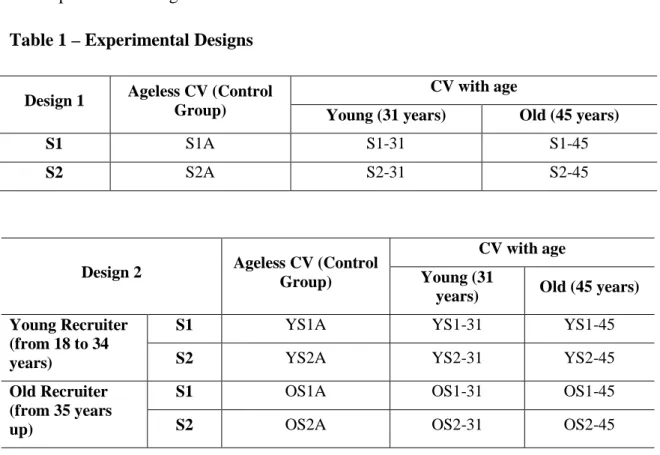
The experimental design is as follows:
Table 1 – Experimental Designs
2.2 Proceedings and instruments used
As said previously, the experiment consisted of simulating the real life task of assessing and evaluating a CV send to a recruiter as a consequence of an opening for a specific function. In other words, the task consists of evaluating the fit between a candidate and a job. To do this, several information was presented to the participants:
- Cover story: initially the participants were informed that they were to act as if they were part of a company that was recruiting someone for a specific task, and that it was their job to screen the CV and evaluate it according to the need at hand (appendix 1 and 2);
- Job Profile: after reading the cover story, the job profile was presented. It consisted of two parts, the first is a description of the type of profile the
Design 1 Ageless CV (Control
Group)
CV with age
Young (31 years) Old (45 years)
S1 S1A S1-31 S1-45
S2 S2A S2-31 S2-45
Design 2 Ageless CV (Control
Group)
CV with age Young (31
years) Old (45 years)
Young Recruiter (from 18 to 34 years)
S1 YS1A YS1-31 YS1-45
S2 YS2A YS2-31 YS2-45
Old Recruiter (from 35 years up)
S1 OS1A OS1-31 OS1-45
21
company seeks, or the mandatory requisites; the second is a functional description and listing of the responsibilities that the chosen candidate must perform (appendix 3);
- Application Form (CV) consisting of academic qualifications and professional experience (appendix 4). Each participant only sees and evaluates one CV. The job profile and the application form used were the ones created by Martins (2013), which consists of a Marketing Manager position. At the time the author studied the fit between the CV and the job profile which achieved a high score (4.43 in a scale from 1 to 5, being 5 the highest score) (Martins, 2013).
In order to apply the experimental design, the independent variables where manipulated according to the needs of this research:
- Type of though: to condition the participant’s to use S1 or S2 specific and direct instructions were used, also time limitations and the reinforcement of the task relevance allowed the conditioning. To enable the use of S1 the instructions given created less attachment to the task, undermining its relevance, and the participant only had 20 seconds in total to do the evaluation. To enable the use of S2, instructions emphasized the relevance of the task and attached the participant to the task and a minimum of 30 seconds to read and consider the CV, prior to the evaluation, were given. It is important to say that in S1 the participant could not be exposed to the task of seeing and evaluating the CV for more than 20 seconds in total and in S2 it was impossible for him to evaluate the CV before the 30 seconds where up (appendix 1 and 2). The time limitations of 20 seconds maximum to access S1 and 30 seconds minimum to access S2 were chosen based on Martins’ (2013) work. In both situations the countdown was visible.
- Candidate’s age presented on the CV: the application forms where all the same, the only thing that changed was the age indicated in each one. According to the experimental design, there were three possibilities, ageless (control group), 31 years old and 45 years old (appendix 4).
- Recruiter’s age: before the beginning of the task it was asked of all participants to render some personal data such as: age, gender, nationality, country of
22
residence, academic information, professional situation and it was decided to add a question to discover whether the participants had already been involved in the decision of hiring employees or not. Based on the age each participant indicated, they were then allocated into two different groups when the data were analyzed (appendix 5). Participants with ages ranging from 18 to 34 were classified as “young” and with ages 35 and up where classified as “old”.
The experiment was conducted online mainly because a large sample was needed, with a minimum of 360 participants. The platform used was Qualtrics as it allowed constructing and controlling all that was needed to fulfill the requisites for the experimental design. Participants accessed a link that was passed around using social media networks such as Facebook and LinkedIn, and gave informed consent before beginning the task. Confidentiality and anonymity were assured. Before it was launched online, a small pilot test (n=5) was conducted to verify if it was simple, had no errors and was understandable. No changes were made because all five of the respondents gave us a positive feedback.
Another pilot test was conducted to help analyze if the instruments used (Cover Story, Job Profile, Application Form and the platform Qualtrics) were appropriate. With a sample of 189 participants, the results showed that the CV evaluation was high (M= 79.19; DP= 20.21) indicating a good fit between the job profile and the application form. It also became clear that the experiment was simple and the instructions easy to follow.
It was decided to open the task to everyone, instead of just managers or recruiters, because in everyday life personnel selection decisions can be made by anyone. Unless you are part of a large corporation that has a department occupied solely with that task, you will see the selection decision being made by the site-manager, the head of the department, etc. And this is what happens in most small and medium enterprises in which consists most of the Portuguese economic tissue.
23
2.3 Sample
A total sample of 545 responses from adults that agreed to participate in the research was assembled. Their ages ranged from 18 to 68 years of age, giving an average age of 34.69. The vast majority of respondents were feminine, 74.9%, with only 25.1 % of male respondents. Mostly, they were Portuguese living in Portugal (96.3%; 93.9%). Eighteen people (3.3%) were from one of the countries belonging to the Community of Countries with Portuguese Language (CPLP) and two were from northern America (0.4%). Twenty one (3.9%) of the respondents lived in one of the countries belonging to CPLP, nine in European countries (1.7%), two in northern America (0.4%) and one in New Zealand (0.2%). Most of the participants are university graduates (43.5%) or have a master’s degree (20.4%). However the total academic experience of the participants ranges from 6th year in basic education (Ensino Básico) to a PHD. More than half of the sample is actively working, being employed by others (56.9%), self-employed (13.6%) or working as researchers (1.3%). 18.9% is unemployed, 2.9% are retired and 6.4% are still studying. When we asked the question “Have you ever had to select an employee” 40.9% answered yes, and 59.1% answered no.
24
3. Results
The sample gathered guaranteed that every experimental condition had a minimum of 30 subjects which allowed inferring that the results have a normal distribution. Because of this, parametric tests were used to analyze the results (Pestana & Gajeiro, 2005). Before the analysis it was important to identify and remove outliers so that they would not influence the outcome. To do this it was used the Stem-and-Leaf Plot and Boxplot and they were then removed from the sample. After this, all the groups still maintained a minimum of 30 subjects. Descriptive analyzes were made (means, standard deviation and frequencies) and because the groups were independent, the tests used in SPSS to study the results were: Student’s T Test (to test if the means of two conditions were statistically different); ANOVA (to test if the means of three or more conditions were statistically different); Chi-square (to analyze nominal variables between conditions and verify if they were different); Kruskal-Wallis one way analyzes of variance (to test ordinal variables between conditions to verify if they were different) and Mann-Whitney U test (used when there is no homogeneity of variance among groups in the t test) (Pestana & Gajeiro, 2005).
3.1 Homogeneity Tests
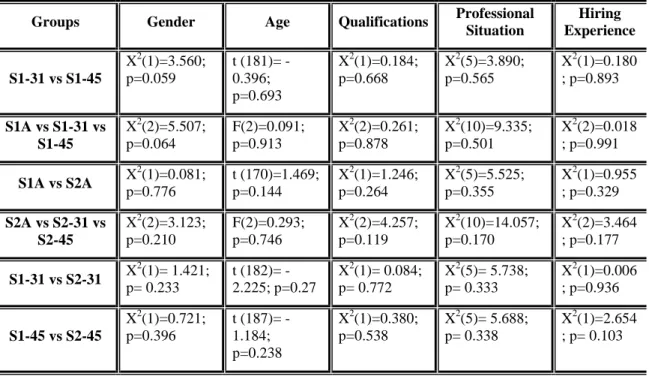
Before presenting the analyses to test the hypotheses it was important to compare the various samples amongst themselves to assure that they were similar (homogeneous). The reason for doing this is to show that every effect that may be present in the dependent variable happens only due to manipulation in the independent variables. Homogeneity tests were done comparing gender, age, qualifications, professional situation and prior experience in the decision to hire workers.
25
Table 2 – Homogeneity Tests in Design 1
Groups Gender Age Qualifications Professional Situation Hiring Experience S1-31 vs S1-45 X2(1)=3.560; p=0.059 t (181)= -0.396; p=0.693 X2(1)=0.184; p=0.668 X2(5)=3.890; p=0.565 X2(1)=0.180 ; p=0.893 S1A vs S1-31 vs S1-45 X2(2)=5.507; p=0.064 F(2)=0.091; p=0.913 X2(2)=0.261; p=0.878 X2(10)=9.335; p=0.501 X2(2)=0.018 ; p=0.991 S1A vs S2A X 2 (1)=0.081; p=0.776 t (170)=1.469; p=0.144 X2(1)=1.246; p=0.264 X2(5)=5.525; p=0.355 X2(1)=0.955 ; p=0.329 S2A vs S2-31 vs S2-45 X2(2)=3.123; p=0.210 F(2)=0.293; p=0.746 X2(2)=4.257; p=0.119 X2(10)=14.057; p=0.170 X2(2)=3.464 ; p=0.177 S1-31 vs S2-31 X 2 (1)= 1.421; p= 0.233 t (182)= -2.225; p=0.27 X2(1)= 0.084; p= 0.772 X2(5)= 5.738; p= 0.333 X2(1)=0.006 ; p=0.936 S1-45 vs S2-45 X2(1)=0.721; p=0.396 t (187)= -1.184; p=0.238 X2(1)=0.380; p=0.538 X2(5)= 5.688; p= 0.338 X2(1)=2.654 ; p= 0.103
Considering the values presented in the table above, it can be concluded that in this case all groups are homogenous, which allows the interpretation that all the changes in the dependent variable come as a result of manipulating the independent variable.
Considering the second design:
Table 3 – Homogeneity Tests in Design 2
Groups Gender Age Qualifications Professional Situation Hiring Experience YS1-31 vs YS1-45 X2(1)=2.229; p=0.135 t (116)= -0.600; p=0.550 X2(1)=0.028; p=0.866 X2(4)=3.465; p=0.483 X2(1)=0.239; p=0.625 YS2A vs YS2-31 vs YS2-45 X2(2)=2.206; p=0.332 F (2)=0.704; p=0.496 X2(2)=4.535; p=0.104 X2(10)=15.090; p=0.129 X2(2)=3.435; p=0.179 OS1-31 vs OS1-45 X2(1)=1.145; p=0.285 t (63)=0.824; p=0.413 X2(1)=0.253; p=0.615 X2(3)=4.681; p=0.197 X2(1)=0.393; p=0.531 OS2A vs OS2-31 vs OS2-45 X2(2)=1.527; p=0.466 F (2)=0.028; p=0.972 X2(2)=0.332; p=0.847 X2(8)=7.463; p=0.488 X2(2)=1.676; p=0.433
26 YS1A vs YS1-31 vs YS1-45 vs OS1A vs OS1-31 vs OS1-45 X2(5)=6.884; p=0.229
Does not apply X2(5)=5.331; p=0.377 X2(25)=43.101; p=0.014 X2(5)=10.818; p=0.055 YS1A vs OS1A
Does not apply Does not apply Does not apply X2(3)=3.765; p=0.288
Does not apply
YS1-31 vs OS1-31
Does not apply Does not apply Does not apply X2(5)=12.496; p=0.029
Does not apply
YS1-45 vs OS1-45
Does not apply Does not apply Does not apply X2(4)=9.069; p=0.059
Does not apply
YS2A vs YS2-31 vs YS2-45 vs OS2A vs OS2-31 vs OS2-45 X2(5)=14.722; p=0.012
Does not apply X2(5)=14.202; p=0.014 X2(25)=49.685; p=0.002 X2(5)=10.249; p=0.068 YS2A vs OS2A X2(1)=3.394; p=0.065
Does not apply X2(1)=0.965; p=0.326
X2(5)=10.947; p=0.052
Does not apply
YS2-31 vs OS2-31
X2(1)=5.592; p=0.018
Does not apply X2(1)=3.985; p=0.046
X2(5)=11.132; p=0.049
Does not apply
YS2-45 vs OS2-45
X2(1)=2.677; p=0.102
Does not apply X2(1)=4.164; p=0.041
X2(5)=10.207; p=0.070
Does not apply
According to the data there is no homogeneity in only three groups: - Between YS1-31 and OS1-31 in professional situation;
- Between YS2-31 and OS2-31 in gender, qualifications and professional situation;
- Between YS2-45 and OS2-45 in qualifications.
This means that differences in the results of these groups may be due to one of these characteristics instead of being solely because of manipulation of the independent variables: type of thought, candidate’s age and recruiter’s age.
3.2 Testing the Hypotheses
27
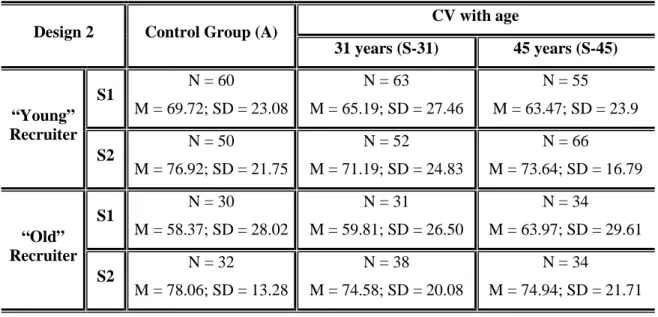
Table 4 – Descriptive results in Design 1
Table 5 – Descriptive results in Design 2
When comparing the groups in the first experimental design, the results are the following:
Table 6 – Tests results comparing means between groups in design 1
Groups Results
S1-31 vs S1-45 t (181)= -0.063; p= 0.950
S1A vs S1-31 vs S1-45 F (2)=0.255; p=0.775
S1A vs S2A U=2787; p=0.006
S2A vs S2-31 vs S2-45 F (2)=1.240; p=0.291
Design 1 Control Group (A)
CV with age 31 years (S-31) 45 years (S-45) S1 N = 90 M = 65.93; SD = 25.26 N = 94 M = 63.41; SD = 27.13 N = 89 M = 63.66; SD = 26.06 S2 N = 82 M = 77.37; SD = 18.81 N = 90 M = 72.62; SD = 22.89 N = 100 M = 74.08; SD = 18.51
Design 2 Control Group (A)
CV with age 31 years (S-31) 45 years (S-45) “Young” Recruiter S1 N = 60 M = 69.72; SD = 23.08 N = 63 M = 65.19; SD = 27.46 N = 55 M = 63.47; SD = 23.9 S2 N = 50 M = 76.92; SD = 21.75 N = 52 M = 71.19; SD = 24.83 N = 66 M = 73.64; SD = 16.79 “Old” Recruiter S1 N = 30 M = 58.37; SD = 28.02 N = 31 M = 59.81; SD = 26.50 N = 34 M = 63.97; SD = 29.61 S2 N = 32 M = 78.06; SD = 13.28 N = 38 M = 74.58; SD = 20.08 N = 34 M = 74.94; SD = 21.71
28
S1-31 vs S2-31 U= 3392; p= 0.020
S1-45 vs S2-45 U= 3432.5; p= 0.007
These results indicate that meaningful differences were only found when comparing both systems, S1 and S2 (control group, groups with CV age 31 and CV age 45). This means that these data confirm hypothesis number two (H2 - evaluations between all three groups in S2 are similar) but rejects hypothesis number one (H1 - in S1 evaluations of the CV with the age 31 would have higher scores than the evaluations of the CV with the age 45).
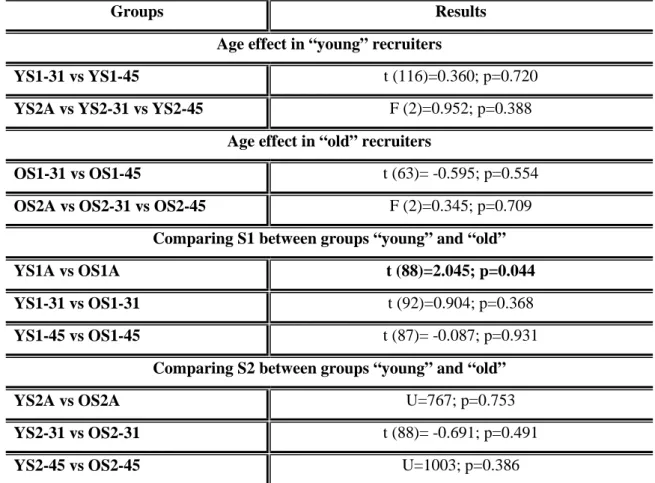
Using the second design the results are:
Table 7 – Tests results comparing means between groups in design 2
Groups Results
Age effect in “young” recruiters
YS1-31 vs YS1-45 t (116)=0.360; p=0.720
YS2A vs YS2-31 vs YS2-45 F (2)=0.952; p=0.388
Age effect in “old” recruiters
OS1-31 vs OS1-45 t (63)= -0.595; p=0.554
OS2A vs OS2-31 vs OS2-45 F (2)=0.345; p=0.709
Comparing S1 between groups “young” and “old”
YS1A vs OS1A t (88)=2.045; p=0.044
YS1-31 vs OS1-31 t (92)=0.904; p=0.368
YS1-45 vs OS1-45 t (87)= -0.087; p=0.931
Comparing S2 between groups “young” and “old”
YS2A vs OS2A U=767; p=0.753
YS2-31 vs OS2-31 t (88)= -0.691; p=0.491
YS2-45 vs OS2-45 U=1003; p=0.386
Based on the results it can be seen that there are only differences with statistical meaning between the groups YS1A and OS1A. When considered the hypotheses listed
29
before, this data only confirms H5 (similar evaluations should be made in all three conditions of S2, whether the recruiter is classified as “young” or “old”). The other hypotheses, H3 (younger recruiters would evaluate the CV with age 45 higher than the one marked 31) and H4 (older recruiters would evaluate the CV with age 45 higher than the one marked 31), are rejected.
30
4.
Discussion
We started by analyzing the homogeneity between all the different groups to make sure that no other variable would explain the results other than the independent variable that was manipulated throughout the experiment. Unfortunately, and even though all the participants were assigned randomly to their experimental condition, some differences were found between groups in the second design. Therefore, the results may have been influenced by the lack of homogeneity between groups, as will be discussed ahead.
4.1 Discussing the Hypotheses:
The first hypothesis (H1) states that the CV representing an old candidate, CV labeled with 45 years of age, would have a lower evaluation than the CV representing a young candidate, CV labeled 31 years old, when using S1. This hypothesis was rejected. Simply by looking at the average evaluation given by the participants in both groups it can be perceived that it is highly similar. This assumption is confirmed by the results in the student’s t test.
These results allow concluding that no discrimination was made based on the age presented on the CV as both presented similar evaluations. This seems to contradict what was found in the literature which indicates age related biases in person perception could have become so routinized that they influenced judgments unconsciously (Perdue & Gurtman, 1990). System 1, being the automatic and unconscious system would allow for these preconceptions to influence judgment and evaluation when assessing the CV. Also, it was expected that because of its associative activation, in S1 the mere vision of a CV by someone with 45 years would trigger negative thoughts about someone that age influencing in a negative way the result of the evaluation. All of this did not happen. Because the experimental conditions also included a control group, it was decided to observe if the results were similar between the three groups when using S1. Once the age effect was absent in the initial hypothesis, it was to be expected its absence when comparing all three groups. The average result in the control group was a bit higher than the one encountered in the other two groups, however this difference was not
31
significant, reinforcing the result indicating that age had no effect when evaluating the CV.
The second hypothesis (H2) is that, when using S2, all the evaluations would be similar throughout the conditions and that no age effect would be present. The results obtained in all three conditions indicate that the results obtained in the control group are the highest, followed by the group S2-45 and lastly by the group S2-31. These differences, if significant, would indicate age had an effect on evaluations, valuing older candidates. However, when tested, these differences are not statistically meaningful validating our hypothesis. When H2 was first written it was assumed that when using S1 there would be an age effect and that when using S2 this effect would disappear because S2 would control the thoughts suggested by S1, exerting self-control, preventing the evaluation from being influenced by age (Kahneman, 2011). However, age, in S1 and S2, did not influence the evaluation. Interestingly the results in both control groups are clearly different and these differences are significant. The same occurs when S1 and S2 are compared in the other two groups (S1-31 vs S2-31 and S1-45 vs S2-45). This result indicates that both systems were indeed accessed. Both systems are different and act differently when presented with the same task (evaluating a CV). On average, when using S1 (the intuitive thinker) participants gave lower evaluations than when using S2 (the deliberative thinker) risking less in their decision. Because S2 is slow, sequential and allows for abstract thinking it makes sense that the evaluation given is higher than when using S1, which demonstrates a high level of certainty in the decision. S1, being fast, intuitive and automatic allows for the decisions to be made but the level of certainty in them is not as high.
Hypothesis number three (H3) stated that when the sample was divided into two categories “young” and “old”, according to the participants age, the evaluation given by the “young” recruiters/participants would be higher to the CV with the older age than to the one with the younger age. This effect would happen when using S1. This hypothesis was set because prior research indicated that there might be a pattern between the recruiters age and age stereotypes related to the job itself leading younger recruiters to believe that older candidates are more suited for high status jobs, as the one we used in our research (marketing manager position) (Singer & Sewell, 1989). When considering