Rev Bras Cir Plást. 2012;27(3):478-81 478
Farrapeira AB
Closed circular suspension in the middle third of the face
Suspensão circular fechada do terço médio da face
ABSTRACT
The surgical treatment presented here involves technical innovations, making it a less-ag-gressive procedure. The goal is to demonstrate a different way of executing a suspension of the skin in the medial third of the face. The procedure is performed with semi-circular Stocchero needles with the passage of a 2-0 nylon thread through the subcutaneous plane at the anterior edge of the parotid gland and ixation to the temporal fascia. A total of 49 patients were operated on using this method with good aesthetic results. One patient required a pre-au ricular incision to accommodate the skin. This method is safe, simple, does not require hospital inpatient admission, avoids a pre-auricular scar, and provides satisfactory results.
Keywords: Rejuvenation. Rhytidoplasty. Cosmetic techniques.
RESUMO
O tratamento cirúrgico apresentado neste artigo tem inovações táticas e torna o procedimento pouco agressivo. O objetivo é demonstrar uma maneira diferente de executar a suspensão do terço médio da face. O procedimento é realizado com agulhas semicirculares tipo Stocche-ro, com passagem de io de náilon 2.0 no plano subcutâneo, na altura da borda anterior da glândula parótida, e ixação do io na fáscia temporal. Foram operados com emprego desse método 49 pacientes, com obtenção de bons resultados estéticos. Em um paciente, houve necessidade de executar uma cicatriz pré-auricular, para acomodação da pele. O método é seguro, simples, não necessita de internação hospitalar, evita uma cicatriz pré-auricular e o resultado oferece boa satisfação aos pacientes.
Descritores: Rejuvenescimento. Ritidoplastia. Técnicas cosméticas. This study was performed
at the Instituto de
Cirurgia Especializada,
Brasília, DF, Brazil.
Submitted to SGP (Sistema de Gestão de Publicações/Manager Publications System) of RBCP (Revista Brasileira de Cirurgia Plástica/Brazilian Journal of Plastic Surgery).
Article received: June 25, 2012 Article accepted: August 7, 2012
Adilson BrAnco
FArrApeirA1
Franco T et al.
Vendramin FS et al.
IDEAS AND INNOVATIONS
INTRODUCTION
The growing concerns of patients with scars resulting from rhytidoplasty led to the search for non-stigmatizing methods, even if indications were restricted and the results were not excellent.
Roundblock is a treatment technique of the supericial muscular aponeurotic system (SMAS) developed by Stocche ro1. A variant based on this technique was devised, in which the passage of the suspension thread through the SMAS lifts the medial third of the face without leaving scars. Other tech-niques described in the literature that in volve suspensions of the face, leave pre- and/or retroauricular scars2,3.
1. Head of the Plastic Surgery Department of the Hospital das Forças Armadas, plastic surgeon at private practice, President of the Distrito Federal Regional
Ofice of the Sociedade Brasileira de Cirurgia Plástica/Brazilian Society of Plastic Surgery, Technical Director of the Instituto de Cirurgia Especializada (ICEL), Brasília, DF, Brazil.
Indications
The indications of the procedure are of great importance, because there are restrictions considering that this is a less-in vasive method4. This surgery is indicated in patients aged between 35 and 45 years, with discrete skin flaccidity, mainly on the mandibular and submandibular regions5,6.
Rev Bras Cir Plást. 2012;27(3):478-81 479
Closed circular suspension in the middle third of the face
expectations of the results. In addition, the photograph is used as a protection against possible complaints7,8.
The patient’s medical history is carefully recorded, and the procedure is precisely and thoroughly explained to the patients9. Patients are informed that the procedure does not require inpatient admission and that, in case of discomfort, it is possible to remove the suspension thread10.
METHODS
Anesthesia
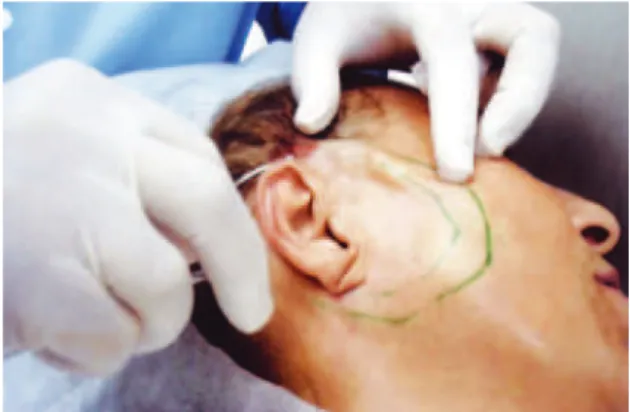
The anesthetic solution is prepared with a bottle of li -docaine hydrochloride 2% (20 mL) with a vasoconstrictor diluted in 60 mL saline. In a 10-mL syringe with a Jelco no. 22 catheter, the solution is injected into the subcutaneous space between the previously marked lines (Figure 2).
Sedation must be performed in the presence of an anes -thesiologist; however, this procedure may be performed
Figure 1 – Maneuver for preoperative photography. The patient shows how he/she wishes to appear; in that position,
the skin redundancy at the pre-auricular region is indicated.
Figure 2 – Marking of the passage of the suspension thread and
beginning of anesthetic iniltration. Figure 3
– Passage of the Stocchero needle through subcutaneous plane.
without sedation in emotionally balanced patients who have a good relationship with the surgeon.
Technique
After anesthetic iniltration, a small incision is made on the scalp on the temporal region approximately 2 cm above the upper implantation line of the pinna. When the aponeurotic level is reached, the Stocchero curved needle is passed, following the 2 previously marked lines (Figure 3). This passage continues through the subcutaneous tissue and emerges on the skin approximately 2 or 3 cm below the ear lobe. Next, a 2-0 nylon thread, preferably transparent, is passed through the hole of the needle, and the needle is returned in the upper direction, exiting at the incision of the temporal region (Figure 4). The nylon thread may be passed around the pinna using Stocchero’s curved needle or, in progressive maneuvers, using a Reverdin needle or a semi-circular needle (3/4 curved) with a false bottom, cutting edges, and 4 cm or more in length (Figure 5). When the passage around the pinna is completed, the 2 extremities of the nylon thread are at the upper incision. Thread traction is subsequently performed in order to assess the extent of skin suspension (Figure 6). After obtaining the ideal suspension, a triple knot is made with the nylon threads (Figure 7). The scalp is sutured with a 5-0 black nylon thread.
DISCUSSION AND CONCLUSIONS
The technique described above is a less-aggressive proce-dure, easy to execute, and can be performed without hospital inpatient admission and without sedation in emotionally balanced patients.
The results are well accepted, and treatment can occasio-nally be repeated (Figures 8 and 9).
Rev Bras Cir Plást. 2012;27(3):478-81 480
Farrapeira AB
Figure 4 – Mounting of 2-0 transparent nylon thread onto the tip of the needle.
Figure 5 – Passage of the thread through the retroauricular region using a Reverdin needle or a false-bottom curved needle.
Figure 6 – Traction of the 2-0 thread showing suspension of the skin.
Figure 7 – Fixation of the passed thread to the temporal aponeurosis and tying of a triple knot.
Figure 8 – In A, preoperative appearance, frontal view. In
B, preoperative appearance, frontal view. In C, preoperative
appearance, proile view. In D, postoperative appearance, showing
accumulation of skin at the pre-auricular region, proile view.
In E, postoperative appearance 1 month after the procedure,
proile view. In F, postoperative appearance after 1 month, showing an absence of skin accumulation on the
pre-auricular region, proile view. A
C
E
B
D
F
must be made aware that there will be an accumulation of skin in the pre-auricular region that must be hidden with hair. However, this accumulation practically disappears after approximately 1 month.
Figure 9 – In A, preoperative appearance. In B, postoperative appearance; the patient covers the volume of
skin in the pre-auricular region with hair for 1 month.
Rev Bras Cir Plást. 2012;27(3):478-81 481
Closed circular suspension in the middle third of the face
In conclusion, this procedure is effective when well in -dicated and well guided, and adds one more resource to the plastic surgeon’s toolkit.
REFERENCES
1. Stocchero IN. The roundblock SMAS treatment. Plast Reconstr Surg.
2001;107(7):1921-3.
2. De Paola DQ, Varon EC. Mini-MACS lift: um minilift simpliicado e
de rápida recuperação. Rev Bras Cir Plást. 2011;26 Supl:30. 3. Stocchero I. Shortscar face-lift with the roundblock SMAS
treat-ment: a younger face for all. Aesthetic Plast Surg. 2007;31(3): 275-8.
4. Bafutto MG. Agulha para pontos internos de suspensão por ios. Rev Bras Cir Plást. 2008;23(4):310-2.
5. Baker TJ, Gordon H, Stuzin JM. Surgical rejuvenation of the aging face. 2nd ed. St. Louis: CV Mosby; 1996.
6. Converse JM. Personal communication, 1963, apud Johnson JB, Hartley
R. The aging face. In: Converse JM, ed. Reconstructive Plastic Surgery.
Philapelphia: WB Saunders; 1964. p. 1306-42.
7. Cardoso C. Ritidoplastia, arte e ciência. Rio de Janeiro: Di Livro; 2007. 8. Franco T, Rebello C. Cirurgia estética. Rio de Janeiro: Atheneu; 1977. 9. Farrapeira AB. Abordagem segmentar do terço médio da face. Triângulo
da região geniana: ponto de sutura dermogorduroso. Rev Bras Cir Plást.
2009;24(4):497-503.
10. Souza AST, Andrade Júnior JCCG. Suspensão musculoaponeurótica com ixação periostal minimamente invasiva do terço médio da face: revisão de 50 casos. Rev Bras Cir Plást. 2011;26(3):439-45.
Correspondence to: Adilson Branco Farrapeira