Effect of a cryopreservation protocol on the
in vitro
yield of adipose-derived stem cells
Inluência de um protocolo de criopreservação no rendimento
in vitro
de células-tronco derivadas do tecido adiposo
ABSTRACT
Background: Adipose tissue obtained by liposuction may be an accessible source of stem cells for future clinical application in tissue regeneration. Cryopreservation maintains stem cells in a live state for long periods of time, without impairing their function. The aim of this study was to assess the effect of a cryopreservation protocol on the proliferation of adipose-derived stem cells. Methods: Fragments of mouse adipose tissue were subjected to enzymatic digestion in order to isolate cells that were then cultured in minimum essential
medium (αMEM) supplemented with 10% fetal bovine serum (FBS). Cells were main -tained at 37°C in 5% carbon dioxide (CO2). At the irst passage, an aliquot of 1 × 10
6 cells
was cryopreserved in FBS with 10% dimethylsulfoxide (DMSO) for 30 days, whereas the
remaining cells were seeded and maintained in culture. When these cells reached the third
passage, the 2 groups of cells (cryopreserved and non-cryopreserved) were seeded for experiments. Cell viability and proliferation curves were established at intervals of 24, 48, and 72 hours by counting cells with a hemocytometer and MTT assay. Nuclear morphology was assessed by DAPI staining. The data were statistically analyzed, with a signiicance level of 5%. Results: Increasing cellular proliferation was observed in both groups, with no signiicant difference throughout the experiment (P > 0.05). There was no signiicant
change in cell viability and signs of nuclear damage were not detected in both the groups studied. Conclusions: The cryopreservation protocol analyzed was effective for maintaining the integrity of adipose-derived stem cells, allowing their storage for later use.
Keywords: Adipose tissue. Stem cells. Cryopreservation. Cell proliferation.
RESUMO
Introdução: O tecido adiposo obtido por lipoaspiração pode ser uma fonte acessível de células-tronco, para posterior aplicação clínica na regeneração tecidual. O processo de criopreservação mantém essas células vivas por longos períodos, sem prejuízo a suas fun
-ções. O objetivo deste estudo foi avaliar a influência de um protocolo de criopreservação na proliferação das células-tronco derivadas do tecido adiposo. Método: Fragmentos de
tecido adiposo de camundongos foram submetidos a digestão enzimática e as células fo
-ram cultivadas em meio α-MEM (do inglês Minimum Essential Medium), suplementado com 10% de soro fetal bovino (SFB), e mantidas a 37ºC em 5% de dióxido de carbono. No primeiro subcultivo, uma alíquota de 1x10⁶ células foi criopreservada em SFB com
10% de dimetilsulfóxido por 30 dias, e outro grupo permaneceu em cultura. No terceiro subcultivo, as células dos dois grupos (não-criopreservadas e criopreservadas) fo ram plaqueadas e a viabilidade celular e as curvas de crescimento foram estabelecidas a partir de contagem em hemocitômetro e pelo ensaio de MTT, nos intervalos de 24 horas,
This study was performed at Universidade Federal do
Rio Grande do Norte (UFRN), Natal, RN, Brazil. Submitted to SGP (Sistema de Gestão de Publicações/Manager Publications System) of RBCP (Revista Brasileira de Cirurgia Plástica/Brazilian Journal of Plastic Surgery). Article received: June 12, 2012 Article accepted: August 7, 2012 Founder: CAPES
1. Specialist in Morphological Sciences, Masters Student of the Post-graduate Program in Public Health at the Universidade Federal do Rio Grande do Norte (UFRN), Natal, RN, Brazil.
2. Doctor in Oral Pathology, Associate Professor of the Department of Morphology at the UFRN, Natal, RN, Brazil.
Fernanda Ginani1
dieGo Moura SoareS1
CarloS auGuSto Galvão
48 horas e 72 horas. A avaliação da morfologia nuclear foi realizada pela marcação por DAPI. Os dados foram analisados estatisticamente, com nível de significância de 5%. Resultados: Observou-se padrão de crescimento celular ascendente em ambos os grupos, sem diferença significante ao longo do experimento (P > 0,05). Não houve alteração considerável da viabilidade celular e danos nucleares também não foram observados
nos grupos estudados. Conclusões: O protocolo de criopreservação avaliado mostrou-se
eficaz para manter a integridade das células-tronco de tecido adiposo, permitindo seu armazenamento para uso posterior.
Descritores: Tecido adiposo. Células-tronco. Criopreservação. Proliferação de células.
INTRODUCTION
Throughout life, adult stem cells are responsible for the replacement of cells in the tissues to which they belong. Adult stem cells have been isolated from several organs, including
the highly complex adipose tissue1,2, which consists of mature
adipocytes, preadipocytes, ibroblasts, endothelial cells, re -sident monocytes/macrophages, and lymphocytes3. Stem cell
research has focused on the adipose tissue as a rich source of pluripotent stem cells4,5.
Stem cells isolated from adipose tissue (adipose tissue-de rived stem cells, ADSCs) have a capacity to differentiate
that is similar to that of bone marrow-derived stem cells, thus leading eventually to mesodermal cells and tissues such as adipocytes, cartilage, bone, and skeletal muscle6.
However, the main advantage of ADSCs is that they can be
easily obtained from patients by a simple and minimally invasive procedure, in addition to being easily maintained in culture7.
The necessity to maintain live cells for a long time without compromising their functions led to the development of cryo-preservation techniques. These procedures aim to inhibit, in a reversible and controlled manner, all of the biological functions of living tissues by storing cells at an ultralow tem
-perature that is usually around -196°C8. Another possibility is
to cryopreserve cells at a temperature of -80°C, which ensures similar results as those of preservation in liquid nitrogen,
as reported by Woods et al.9. These authors cryopreserved undifferentiated mesenchymal cells of the dental pulp for 6 months at the 2 different temperatures mentioned above. They observed an identical capacity for cellular differentia-tion in both groups.
However, it is necessary to assess whether cryopreserva -tion affects the prolifera-tion of cryopreserved cells as well
as their ability to differentiate. Problems with the cryopre -servation process can hamper the restoration of biological functions of cells after thawing. Taking this into account, the aim of this study is to assess, with in vitro experiments, the
effect of a simple cryopreservation protocol on the
prolife-rative capacity of ADSCs.
METHODS
Isolation and Cell Culture
This study was approved by the Animal Research Ethics
Committee (AREC) of the Federal University of Rio Grande do Norte, with the number 036/2012. Two Swiss albino mice, both males, aged 3 months, and weighing about 30 g,
were euthanized with a lethal dose of sodium pentobarbi tal
(150 mg/kg, intraperitoneal). Fragments of adipose tissue were isolated from the inguinal region. In a laminar flow
tissue culture hood, the fragments were washed 3 times
for 10 minutes each, with minimum essential medium (α-MEM; Cultilab, Brazil) supplemented with antibiotics and antifun gal agents (Gibco, USA) to eliminate any pos
-sible con tamination.
Subsequently, the adipose tissue was enzymatically di -gested with a solution containing 3 mg/mL collagenase I (Gibco, USA) and 1 mL trypsin/EDTA (Cultilab, Brazil) for 1 hour at 37°C. Cells were then cultured in α-MEM supple
-mented with 10% fetal bovine serum (FBS) and maintained at 37°C in 5% carbon dioxide (CO2) until reaching a conluence
between 70% and 90%. The medium was changed every 3 days. An aliquot of cells was cultured in osteogenic and adipo
-genic differentiation medium (StemPro® Differentiation Kits,
Invitrogen Corp., USA) for 21 days. After this period, the
cells presented the characteristic morphology of osteoblastic and adipose cells when observed under a light microscope.
This conirmed the pluripotent phenotype of these cells.
Cryopreservation
At the irst passage (P1), an aliquot of 1 × 10⁶ cells was
cryopreserved in FBS with 10% dimethylsulfoxide (DMSO), according to the following protocol: 2 hours at 4°C, 18 hours at -20°C, and then, storage at -80°C for 30 days. After this
period, cells were thawed and maintained in culture in the
same way as cells that were not cryopreserved (P2).
Assessment of Proliferation and Cell Viability At the third passage (P3), the 2 groups of cells (cryopre
(n = 4) at a density of 3 × 10⁴ cells/well. Cellular yield and
proliferation curves were assessed in the 2 groups at 24, 48, and 72 hours after seeding by counting cells with the try pan blue exclusion method. Cellular proliferation was also determined by [3-(4,5-dimethylthiazol-2-yl)-2,5-diphe-nyltetrazolium bromide] (MTT) assay. For this experiment, cells were seeded in 96-well plates at a density of 5 × 10³
cells/well. The time points mentioned above were also used
for MTT assay. The optical density was obtained by reading the plates in a spectrophotometer at a wavelength of 570 nm.
Assessment of Morphological Nuclear Damage Cell nuclei were stained with 4′,6′-diamino-2-phenylin
-dole (DAPI) in the 2 groups at 72 hours in order to identify
possible apoptotic changes in nuclear morphology, such as chromatin condensation and nuclear fragmentation.
Statistical Analysis
The data were analyzed using nonparametric tests. The differences between the 2 groups for the time points
consi-dered (24, 48, and 72 hours) were assessed using the Mann-Whit ney statistical test with a signiicance level of 5% (P < 0.05).
RESULTS
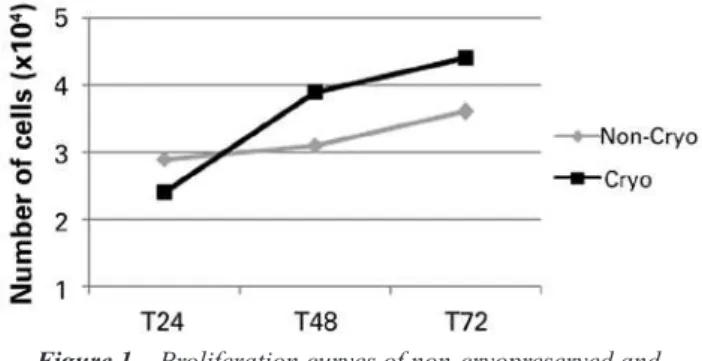
Increased proliferation was observed in both cryopreser
ved and non-cryopreserved cells. A higher proliferation rate
was detected in cryopreserved cells (Figure 1).
No statistically signiicant difference was observed by comparing the average trypan blue exclusion of
ved and non-cryopreserved cells. There was also no sig
ni-icant difference in cell viability (Table 1) using this me thod. Similarly, no statistically signiicant difference in cellular proliferation was observed by MTT assay between the 2 groups at the time points considered (P > 0.05; Figure 2).
In both groups, no morphological changes were observed in the nuclei of ADSCs (nuclear fragmentation or the presence of pyknotic nuclei; Figure 3).
DISCUSSION
Nowadays, liposuction is a very common procedure
per formed in aesthetics clinics. With this surgery, a large
amount of adipose tissue is easily obtained. In addition to being used as illing to increase the volume of soft tissues,
this adipose tissue can also be used as a source of stem cells for tissue regeneration10. Therefore, cryopreservation has been investigated for the storage of adipose tissue (or speciic
cells) for later use.
Several studies have suggested different cryopreservation
times, which vary from one day to longer periods11,12. The
Figure 1 – Proliferation curves of non-cryopreserved and
cryopreserved cells at the time points assessed. Cryo = cryopreserved; Non-Cryo = non-cryopreserved;
T24 = 24 hours; T48 = 48 hours; T72 = 72 hours.
Table 1 –Average and standard deviation of cell number and percentage of cell viability in each group.
Non- cryopreserved Cryopreserved P*
T24 2.9 + 0.3
100%
2.4 + 0.6
100%
0.2059
T48 3.1 + 0.6
100%
3.9 + 0.8
94.8%
0.1913
T72 3.6 + 0.5
96.4% 4.4
+ 0.6
100% 0.1441
* Mann-Whitney test.
T24 = 24 hours; T48 = 48 hours; T72 = 72 hours.
Figure 2 – Mitochondrial activity of adipose tissue-derived stem
cells in the groups analyzed. Cryo = cryopreserved; Non-Cryo = non-cryopreserved; T24 = 24 hours;
T48 = 48 hours; T72 = 72 hours.
time used in the current article for our experiments corres -ponds to what we found in the literature, as several authors
evaluated the cryopreservation effect after 30 days9,13,14
and differentiation capacity between cryopreserved cells and non-cryopreserved cells.
With the aim of assessing the pluripotent and
prolife-rative capacity of human cryopreserved ADSCs, Gonda et
al.12 stored these cells at low temperature for 6 months. After this period, they noticed that cryopreserved cells presented an osteogenic, adipogenic, and chondrogenic proliferation and differentiation capacity similar to that of noncryo pre -served cells. The difference between these groups that was highlighted by the authors was the higher variability in the chondrogenic differentiation capacity presented by cryopre-served cells. With regards to proliferation, these results are consistent with the results of our current study, as both
groups (non-cryopreserved and cryopreserved cells) had an
increasing cellular proliferation curve.
When assessing cryopreservation of ADSCs, Thiruma la
et al.15,16 mainly described the physical effect that the pro -cesses of freezing and thawing might have on the integrity of these cells. The results obtained by DAPI staining conirm that the cryopreservation protocol used in the present study conserved the nuclear membranes as well as the nuclear
morphology of ADSCs.
Cryopreservation protocols for ADSCs suggest that the se cells be stored at a temperature of 196°C (liquid nitro gen)12,17,18. This increases the cost of maintenance to levels
that cannot be afforded by many research laboratories. In
the current study, we used a simpler, more accessible, and
low cost protocol by storing cells at a temperature of -80°C,
which allowed preservation of their viability.
Liu et al.19 observed results similar to those obtained in the
present study when they cryopreserved human ADSCs for 2 weeks. In another study, dog ADSCs were cryopreserved for 12 months, and when thawed, they showed a proliferation
rate similar to that of non-cryopreserved cells17. The time for which the cells remain cryopreserved may affect their
viability. However, shorter periods, as used in this study (30 days), or longer periods (12 months), as assessed by Martinello et al.17, do not alter cellular proliferation. The data
found in the literature suggest that the cryopreservation time
for these cells can even be extended. However, the possible
damage caused by longer periods of cryopreservation should
be assessed in this speciic cell type.
Among the factors that might influence cell cryopreser-vation, cryoprotectant agents may significantly impair the
survival rate and proliferative capacity after thawing. In the current study, DMSO was chosen as a cryoprotectant,
as it is commonly employed for the cryopreservation of different cell types11,17.As observed in our study, DMSO provided positive results in terms of cell viability and
pro liferative capacity after ADSC cryopreservation for a pe riod of 30 days.
The rate with which the temperature decreases during freezing might be another important factor for cell viability
after cryopreservation. Moreover, the appropriate rate of temperature decrease should be determined for each speciic
cell type in order to prevent the formation of intracellular ice crystals20. For other cells in culture, we adopted a standard protocol, as described by Vasconcelos et al.14 (2 hours at 4°C,
18 hours at -20°C, and, then, storage at -80°C for 30 days), which also proved to be quite effective for ADSCs.
In general, the results of this study demonstrated that the
cryopreservation protocol described might be an appropriate
procedure for the storage of ADSCs, thus allowing the use of
these cells in the investigation of future clinical applications
in subsequent in vivo experiments.
CONCLUSIONS
The cryopreservation protocol tested was effective in
maintaining the integrity of ADSCs, preserving their pro
-liferation capacity without causing morphological nuclear damage.
REFERENCES
1. Levi B, Longaker MT. Concise review: adipose-derived stromal cells for skeletal regenerative medicine. Stem Cells. 2011;29(4):576-82. 2. De Rosa A, De Francesco F, Tirino V, Ferraro GA, Desiderio V, Paino
F, et al. A new method for cryopreserving adipose-derived stem cells: an attractive and suitable large-scale and long-term cell banking
tech-nology. Tissue Eng Part C Methods. 2009;15(4):659-67.
3. Caspar-Bauguil S, Cousin B, Galinier A, Segafredo C, Nibbelink M, André M, et al. Adipose tissues as an ancestral immune organ: site-spe-ciic change in obesity. FEBS Lett. 2005;579(17):3487-92.
4. Prunet-Marcassus B, Cousin B, Caton D, André M, Pénicaud L, Cas
-teilla L. From heterogeneity to plasticity in adipose tissues: site-speciic differences. Exp Cell Res. 2006;312(6):727-36.
5. Zuk PA, Zhu M, Ashjian P, De Ugarte DA, Huang JI, Mizuno H, et al. Human adipose tissue is a source of multipotent stem cells. Mol Biol Cell. 2002;13(12):4279-95.
6. Nakagami H, Morishita R, Maeda K, Kikuchi Y, Ogihara T, Kaneda Y.
Adipose tissue-derived stromal cells as a novel option for regenerative
cell therapy. J Atheroscler Thromb. 2006;13(2):77-81.
7. Sterodimas A, de Faria J, Nicaretta B, Pitanguy I. Tissue engineering with adipose-derived stem cells (ADSCs): current and future applica
-tions. J Plast Reconstr Aesthet Surg. 2010;63(11):1886-92.
A B
Figure 3 – In A, photomicrography of non-cryopreserved cells at
72 hours. In B, photomicrography of cryopreserved cells
8. De Santis GC, Prata KL. Criopreservação de célulasprogenitoras he -matopoéticas. Medicina. 2009;42(1):36-47.
9. Woods EJ, Perry BC, Hockema JJ, Larson L, Zhou D, Goebel WS. Optimized cryopreservation method for human dental pulp-derived
stem cells and their tissues of origin for banking and clinical use.
Cryobiology. 2009;59(2):150-7.
10. Moseley TA, Zhu M, Hedrick MH. Adipose-derived stem and progenitor cells as illers in plastic and reconstructive surgery. Plast Reconstr Surg. 2006;118(3 Suppl):121S-8.
11. Papaccio G, Graziano A, d’Aquino R, Graziano MF, Pirozzi G, Men ditti D, et al. Long-term cryopreservation of dental pulp stem cells (SBP
--DPSCs) and their differentiated osteoblasts: a cell source for tissue repair. J Cell Physiol. 2006;208(2):319-25.
12. Gonda K, Shigeura T, Sato T, Matsumoto D, Suga H, Inoue K, et al. Preserved proliferative capacity and multipotency of human adipose-de rived stem cells after long-term cryopreservation. Plast Reconstr Surg. 2008;121(2):401-10.
13. Temmerman L, Beele H, Dermaut LR, Van Maele G, De Pauw GA. Inluence of cryopreservation on the pulpal tissue of immature third molars in vitro. Cell Tissue Bank. 2010;11(3):281-9.
14. Vasconcelos RG, Ribeiro RA, Vasconcelos MG, Lima KC, Barboza CA. In vitro comparative analysis of cryopreservation of undifferentiated
mesenchymal cells derived from human periodontal ligament. Cell
Tissue Bank. 2011;13(3):461-9.
15. Thirumala S, Gimble JM, Devireddy RV. Transport phenomena during freezing of adipose tissue derived adult stem cells. Biotechnol Bioeng. 2005;92(3):372-83.
16. Thirumala S, Zvonic S, Floyd E, Gimble JM, Devireddy RV. Effect of
various freezing parameters on the immediate post-thaw membrane
integrity of adipose tissue derived adult stem cells. Biotechnol Prog. 2005;21(5):1511-24.
17. Martinello T, Bronzini I, Maccatrozzo L, Mollo A, Sampaolesi M, Mascarello F, et al. Canine adipose-derived-mesenchymal stem cells
do not lose stem features after a long-term cryopreservation. Res Vet
Sci. 2011;91(1):18-24.
18. Miyamoto Y, Oishi K, Yukawa H, Noguchi H, Sasaki M, Iwata H, et al. Cryopreservation of human adipose tissue-derived stem/progeni
-tor cells using the silk protein sericin. Cell Transplant. 2012;21(2-3): 617-22.
19. Liu G, Zhou H, Li Y, Li G, Cui L, Liu W, et al. Evaluation of the viability
and osteogenic differentiation of cryopreserved human adipose-derived
stem cells. Cryobiology. 2008;57(1):18-24.
20. Hubel A. Parameters of cell freezing: Implications for the cryopreserva-tion of stem cells. Transfus Med Rev. 1997;11(3):224-33.
Correspondence to: Carlos Augusto Galvão Barboza
Departamento de Morfologia, Universidade Federal do Rio Grande do Norte