261 Pró-Fono Revista de Atualização Científica. 2009 jul-set;21(3).
Avaliação eletromiográfica e ultrassonográfica do músculo masseter em indivíduos normais: estudo piloto.
Avaliação eletromiográfica e ultrassonográfica do músculo
masseter em indivíduos normais: estudo piloto******
Electromyographic and ultrasonographic assessment of the masseter
muscle in normal individuals: a pilot study
*Fonoaudióloga. Doutoranda em Ciências pela Faculdade de Medicina da Universidade de São Paulo. Endereço para correspondência: Rua Madalena, 523 Apto 41 São Paulo -SP - CEP 05434-090
**Fonoaudióloga. Doutora em Ciências pela Faculdade de Medicina da Universidade de São Paulo.
***Médico. Departamento de Radiologia da Faculdade de Medicina da Universidade de São Paulo.
****Fisioterapeuta. Professora Titular do Departamento de Fisioterapia, Fonoaudiologia e Terapia Ocupacional da Faculdade de Medicina da Universidade de São Paulo.
****Fonoaudióloga. Professora Titular do Departamento de Fisioterapia, Fonoaudiologia e Terapia Ocupacional da Faculdade de Medicina da Universidade de São Paulo.
******Trabalho Realizado na Serviço de Fonoaudiologia do Instituto Central do Hospital das Clínicas e Serviço de Radiologia do Instituto de Radiologia.
Carta sobre Pesquisa
Artigo Submetido a Avaliação por Pares
Conflito de Interesse: não
Recebido em 17.06.2009. Revisado em 16.07.2009.
Aceito para Publicação em 23.07.2009.
Laura Davison Mangilli* Fernanda Chiarion Sassi** Renato Antônio Sernik*** Clarice Tanaka****
Claudia Regina Furquim de Andrade*****
Abstract
Background: recent studies have used ultrasonography with the purpose of measuring muscle cuts. Aim: to characterize the motor control and the morphology of the masseter muscle in normal individuals, verifying the compatibility between surface electromyography and ultrasonography. Method: five adult individuals, with no alterations of the stomatognathic system. The adopted assessment procedures for all participants were: 1. Surface Electromyography; 2. Ultrasonography. Results: a high correlation was observed only when comparing both hemifaces in the ultrasonographic assessment (rest 0.95; biting 0.86). Conclusion: the results indicate that there is no correlation between the tested methods, suggesting that both methods are complementary and not mutually excludent.
Key Words: Masseter Muscle; Electromyography; Ultrasonics.
Resumo
Tema: estudos recentes utilizaram a ultrassonografia com o objetivo de medir cortes musculares. Objetivo: caracterizar o controle motor e a morfologia do músculo masseter em indivíduos normais, verificando a compatibilidade entre a eletromiografia de superfície e a ultrassonografia. Método: cinco indivíduos adultos, sem alterações no sistema estomatognático. Os procedimentos adotados para a avaliação dos participantes foram: 1. Eletromiografia de Superfície; 2. Ultrassonografia. Resultados: houve alta correlação apenas para a comparação entre hemifaces direita e esquerda no exame de ultrassonografia (repouso 0,95; máxima intercuspidação dentária 0,86). Conclusão: os resultados indicam não haver correlação entre os métodos testados, sugerindo que os exames são complementares e não excludentes.
Palavras-Chave: Músculo Masseter; Eletromiografia; Ultra-som.
Referenciar este material como:
Pró-Fono Revista de Atualização Científica. 2009 jul-set;21(3).
Mangilli et al. 262
Introduction
Recent studies have used ultrasonography to measure cross-sectional distances of muscles of the head and neck and have correlated these data with other pathologies like temporomandibular disorders (TMD), muscle palpation pain, facial morphology, bite force and occlusal factors 1-4.
The purpose of the present study was to characterize muscle control and the morphology of the masseter muscle in normal individuals, and also to verify the compatibility between surface electromyographic and ultrasonographic data.
Method
Participants
Participants of this research were five individuals with ages between 20 and 30 years (mean age 24.6 years), with no alterations of the stomatognathic system and scapular region, with complete permanent dentition (absence/extraction of the third molar was accepted), with Angle's Class I facial pattern and absence of severe malocclusion and braces, and with no history of previous speech-language intervention (CP 024/09).
Materials and Procedures
Participants were evaluated at the Speech-Language Service of the Central Institute of Hospital das Clínicas and at the Radiology Service of the Radiology Institute of the same hospital. These services are responsible for the electromyographic and ultrasonographic assessments respectively.
The methodology and procedures adopted for both assessments are described below:
1. Objective instrumental assessment - Surface Electromyography (SEMG).
A surface electromyography equipment - Miotool 400 - was used for the objective instrumental assessment, following the parameters recommended by THE INTERNATIONAL SOCIETY OF ELECTROPHYSIOLOGICAL KINESIOLOGY ISEK (n.d.). The electric activity of the masseter muscles was assessed during:
. rest (3 data collections with 30 seconds each); . Teeth clenching using cotton roles between the teeth - AL (3 data collections of 5 seconds of isometric contraction, with an interval of 5 seconds between each muscle activity);
. teeth clenching with maximal teeth intercuspidation
- MIC (3 data collections of 5 seconds of isometric contraction, with an interval of 5 seconds between each muscle activity)5,6 .
Electromyographic tracing was obtained using a raw signal and then analyzed using a rectified signal (RMS).
2. Objective instrumental assessment -Ultrasonography (USG).
Assessment of the thickness of the masseter muscle was done using the methodology proposed by Satiroglu et al.4. Each participant was examined by the same radiologist using a Philips iu22 equipment.
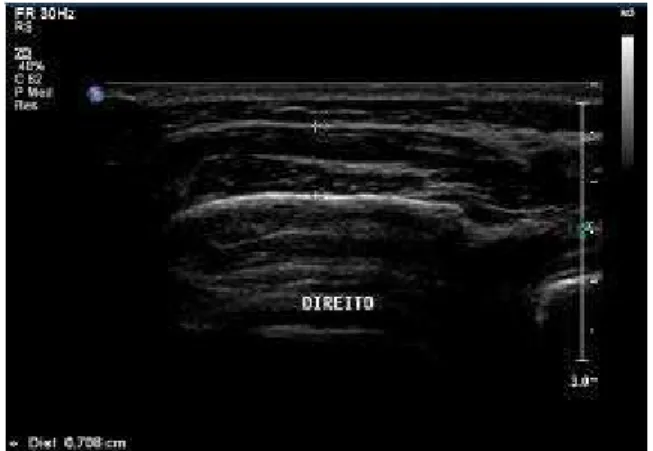
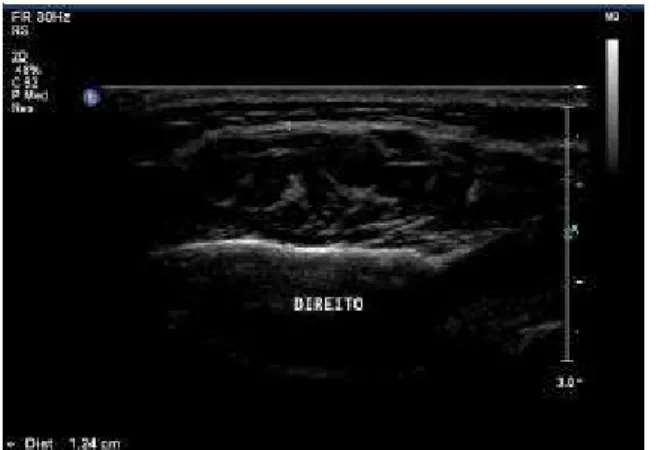
During imaging, the transducer was held perpendicular to the surface of the skin and special care was taken to avoid excessive pressure. The measurement site was at the thickest part of the masseter, close to the level of the occlusal plane, approximately in the middle of the mediolateral distnace of the ramus2,3,7. The imaging and measurements were performed bilaterally with participants in supine position under three different conditions: at rest (habitual position - 3 times - Figure 1); during maximal clenching using 10mm cotton roles between the dental arches in the first and second molars region (3 times - Figure 2; AL); and during maximal clenching without the cotton roles (3 times - Figure 3; MIC).
Resultados
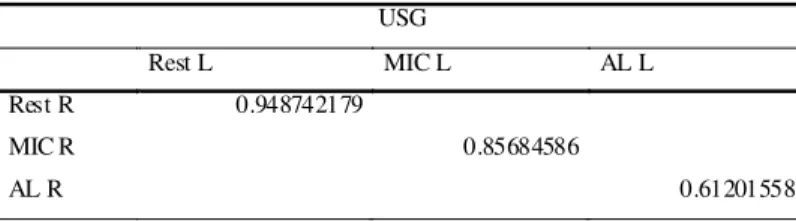
For the statistical analysis the Pearson's Correlation Test was used in order to verify compatibility between the applied techniques (Table 1) and between the hemifaces (Table 2 USG; Table 3 SEMG).
Results indicate that there was a high positive correlation only for the comparison between the right and left sides of the face during the USG assessment.
263 Pró-Fono Revista de Atualização Científica. 2009 jul-set;21(3).
Avaliação eletromiográfica e ultrassonográfica do músculo masseter em indivíduos normais: estudo piloto.
Discussion
Surface electromyography (SEMG) has been extensively used in researches related to the assessment of the masticatory function. It is considered a valid method for the assessment of the masticatory muscles and can be correlated to masticatory efficiency8. However, due to within subject differences it is hard to determine significant quantitative differences between subjects using this method. Specific literature indicates that SEMG can be influenced by the thickness of the skin fat layer, by the positioning of the electrodes and by the individual's motivation in undergoing the exame5. Besides that, the results of the present study indicate that there is no symmetry between muscle activities during the tested conditions.
Ultrasonography of the masseter muscle demonstrated to be a simple, quick, non-invasive and reproducible technique for the accurate assessment of muscle thickness provided the radiologist strictly follows the described protocol, i.e. avoiding excessive pressure of the transducer on the skin surface.
Previous studies3 discuss the difficulty in determining whether changes observed in muscle thickness is either because of an actual change of the parameter under study or measurement error. In the present study, transducer position was strictly standardized2,3,4,7. In addition, variables such as body posture, interocclusal relationship and resting time did not differ among the participants. The results of our study suggest that the meaningful interpretation of repeated masseter muscle thickness requires accurate repositioning of the transducer.
Other studies also indicate large variation in masseter muscle thickness among individuals, during
FIGURE 2. Ultrasonographic image during AL (right masseter).
FIGURE 3. Ultrasonographic image during MIC (right masseter).
TABLE 1. Pearson's Correlation Coefficient Values - USG x SEMG.
USG/ SEMGs
Rest MIC L AL L Rest R MIC R AL R
Rest L -0. 10569993
MIC L 0.512993124
AL L 0.78922939
Rest R 0.577823082
MIC R 0.207729686
Pró-Fono Revista de Atualização Científica. 2009 jul-set;21(3).
Mangilli et al. 264
both relaxation and contraction. These inter-individual differences may be due to a variable number of muscle fiber, variation in fiber size, or both9. Further studies are necessary in order to investigate differences between ages, gender, facial pattern and body mass index (BMI).
While USG has been viewed as a useful tool for studying masseter muscle thickness, our findings suggest that it may also be used to investigate specfic regions of the masseter. Of course, the relative spatial sensitivity of masseter muscle thickness is not determined solely by the anatomical characteristics of the tissues being scanned (bone, muscle, facsia, skin), but is influenced by the adopted imaging techniques4. For example, optimization of a pulse sequence or post-processing of images may increase ultrasonography imaging sensitivity to a difficult-to-image masseter cross-section.
Conclusion
The results of this study do not indicate any correlation between the tested methods, suggesting
References
1. Benington PCM, Gardener JE, Hunt NP. Masseter muscle volume measured using ultrasonographic and its relationship with facial morphology. Eur. J. Ortho. 1999;21:659-70. 2. Bertram S, Brandlmaier I, Rudisch A, et al. Cross-sectional characteristics of the masseter muscle: an ultrasonographic study. Int. J. Oral Maxillofac Surg. 2003;32:64-8. 3. Emshoff R, Emshoff I, Rudisch A, et al. Reliability and temporal variation of masseter muscle thickness measurements utilizing ultrasonography. J. Oral Rehabil. 2003;30:1168-72.
4. Satiroglu F, Arun T, Isik F. Comparative data on facial morphology and musle thickness using ultrasonography. Eur. J. Ortho. 2005;27:562-7.
5. Nakata Y, Ueda HM, Kato M, et al. Change in stomatognathic function induced by orthognathic surgery in patients with mandibular prognathism. J. Oral Maxillofac Surg. 2007;65:444-51.
6. Sforza C, Peretta R, Grandi G, et al. Soft tissue facial planes and masticatory muscle function in skeletal Class III patients before and after orthognatic surgery treatment. J. Oral Maxillofac Surg. 2008;66:691-8.
7. Emshoff R, Bertram S, Brandlmaier I, et al. Ultrassonographic assessment of local cross-sectional dimension of masseter muscle sites: a reproducible technique? Journal of Oral Rehabilitation. 2002;29:1059-62. 8. Felício CM, Couto GA, Ferreira CLP, et al. Reliability of masticatory efficiency with beads and correlation with the muscle activity. Pró-Fono Revista de Atualização Científica. 2008;20(4):225-30.
9. Kiliardis S, Kälebo P. Masseter muscle thickness measured by ultrasonography and its relation to facial morphology. Jornal of Dental Research. 1991;70:1262.
that these provide complementary but not excluding data. It is important to highlight that this is a pilot study and that the group of participants will be increased, not only with normal individuals but also with those with craniofacial alterations, in order to confirm the findings .
TABLE 3. Pearson's Correlation Coefficient - SEMG. TABLE 2. Pearson's Correlation Coefficient Values - USG.
USG
Rest L MIC L AL L
Rest R 0.948742179
MIC R 0.85684586
AL R 0.61201558
SEMG
Rest L MIC L AL L
Rest R 0.586551807
MIC R 0.5001288