©Revista Brasileira de Fisioterapia
O
RIGINALA
RTICLEMusculoskeletal pain, profile and quality of life
of individuals with sickle cell disease
Dor osteomuscular, perfil e qualidade de vida de indivíduos com doença falciforme
Daniela G. Ohara¹, Gualberto Ruas2, Shamyr S. Castro2, Paulo R. J. Martins³, Isabel A. P. Walsh2
Abstract
Background: Sickle cell disease is a prevalent condition in Brazil. Its clinical presentation includes vascular occlusion that result in ischemia, inflammation, dysfunctions, pain and chronic hemolysis, causing irreversible damage and compromising quality of life. Objective: The objectives of this study were to verify the relationship between musculoskeletal pain, from different body parts, with social economic characteristics and quality of life among individuals with sickle cell disease. Method: 27 individuals with sickle cell disease were interviewed with the use of a structured questionnaire with questions about personal, social, economic and cultural variables, the Nordic musculoskeletal symptoms questionnaire and the SF-36 Health Survey. Data were analyzed descriptively using frequencies and percentages. The inferential Chi-Square test was used for dichotomous variables and the Student t- test for continuous variables, with a significance of 5%. A logistic regression was performed using all variables that correlated with pain as dependent variables. Results: The mean age was 31.77 years, predominantly male, black, registered active employment, with average education and income up to three minimum wages. The regions most affected by pain were hip/limbs, chest, lower back and arms. Physical Functioning from the SF-36 had the highest score and mental health the lowest score. Musculoskeletal pain was present in the arms, chest and lower back. Social Functioning was not associated with pain, indicating the influence of other factors. Arm pain was more frequent in black individuals and those with low education. Conclusion: Body pain was associated with race and education and all pain areas were associated with the physical components of the SF-36. Pain was significantly associated with vitality and mental health components of the SF-36.
Keywords: sickle cell disease; pain; physical therapy; quality of life.
Resumo
Contextualização: As doenças falciformes constituem um grupo frequente no Brasil. Suas alterações ocasionam vaso-oclusão, resultando em isquemia, inflamação, disfunções, dor e hemólise crônica, gerando danos irreversíveis, comprometendo a qualidade de vida. Objetivo: Verificar a relação entre a dor osteomuscular, considerando sua localização corporal, e características sociais, econômicas e de qualidade de vida em indivíduos com doença falciforme. Método: Foram coletadas informações pessoais, sociais e econômicas, além de dados do Questionário Nórdico de Sintomas Osteomusculares (QNSO) e Short Form 36 em 27 indivíduos. Os dados foram analisados descritivamente por meio de frequências e porcentagens. A análise inferencial usou o teste do qui-quadrado (variáveis dicotômicas) e t de Student (variáveis contínuas), com significância de 5%. Análises de regressão logística utilizaram como variáveis dependentes cada uma das que se relacionaram com dor. Resultados: A média de idade foi de 31,77 anos, predominando sexo masculino, negros, emprego ativo, escolaridade média e rendimento inferior a três salários mínimos. Quadril/membros inferiores, região dorsal, lombar e braços foram mais acometidos pela dor. A capacidade funcional apresentou o maior valor, e saúde mental, o menor. Aspectos físicos foram comprometidos pela dor nos braços, coluna dorsal e lombar. Aspectos sociais não se associaram com a dor, indicando influência de outros fatores. A dor nos braços foi mais frequente entre os negros e os com baixa escolaridade. Conclusão: A dor nas regiões corporais analisadas relacionou-se com a raça e a escolaridade e com todos os domínios referentes ao componente físico do SF-36. Os componentes vitalidade e saúde mental apresentaram associação significativa com a dor.
Palavras-chave: anemia falciforme; dor; fisioterapia; qualidade de vida.
Received: 02/26/2012 – Revised: 05/02/2012 – Accepted: 05/18/2012
¹ Physical Therapist, Uberaba, MG, Brazil
2Department of Applied Physical Therapy, Institute of Health Sciences (ICS), Universidade Federal do Triângulo Mineiro (UFTM), Uberaba, MG, Brazil 3Department of Medicine, ICS, UFTM, Uberaba, MG, Brazil
Introduction
Sickle cell disease comprises a group of genetic conditions that are between the most common in Brazil and other coun-tries. It is characterized by a mutation in the β chain of the hemoglobin gene, changing its normal structure (HbA) to a S (HbS) or even a HbSS, a HbSC, a S-thalassemia and other less incident types1,2.
In Brazil, the law No. 1.391/GM developed by the National Health System, established the guidelines for the National Policy of Comprehensive Healthcare for People with Sickle Cell Disease and other hemoglobinopathies, with the following resolutions: creation of a national registry of this population, comprehensive healthcare through a multidisciplinary team, training of professionals for the promotion of permanent learning, promotion of access to information and genetic counseling to families and people with the condition or sickle cell trait, access to essential medicines and stimulation of research to improve quality of life3.
he HbS presents with diferent chemical characteristics and its functions are maintained under normal oxygenation. However, in situations of absence or reduced oxygen tension, the HbS undergoes polymerization changing its morphology and transforming into a sickle shape (sickling) resulting in ischemia, inlammation, disorders, pain and also chronic he-molysis that generates irreversible damage to various tissues and organs2,4-6.
Pain crises in this patient population are frequent and factors contributing to this process are: cold exposure, in-tense physical effort, hypoxia, dehydration, infections and general trauma2,6. Generally, these crises are the first
mani-festation of this disease and are considered the primary reason for the high rates of hospitalizations. Pain can occur in the extremities, spine and abdominal regions, negatively impacting quality of life7-8. Thus, chronic pain is considered
a serious public health problem, taking into consideration that its treatment requires distinct interventions empha-sizing pain reduction and the ability to perform self-care activities9.
Several studies examined pain and quality of life in patients with sickle cell disease10-20. However, studies evaluating pain on
speciic body regions, especially in the musculoskeletal system (bones, joints, muscles, or surrounding structures) were not found in the literature.
While individuals should be considered as a whole, factors related to pain location and its inluence on quality of life must be taken into consideration when charting goals for a multi-disciplinary health care, particularly physical therapy, which may have an important role in reducing pain crises, recurrent
hospitalizations, morbidity and improving general mobility, itness endurance and quality of life8.
he objective of this study was to investigate the relation-ship between musculoskeletal pain of diferent body regions and social, economic and quality of life characteristics of indi-viduals with sickle cell disease.
Method
Study type and population
his study was an exploratory observational cross sectional cohort study with a quantitative methodology.
The convenience sample was recruited by selecting in-dividuals over 18 years, through the assessment of records from the Regional Blood Bank of Uberaba city (HRU), MG, Brazil and the Regional Association of Sickle Cell Disease in Uberaba (ARFA), totaling 65 individuals. Of these, 38 were not included because they refused to participate, were not able to be contacted due to a change in contact informa-tion (phone and address) or because they had difficulty in understanding or answering the questionnaires. The study included 27 individuals who met the inclusion criteria: age over 18, diagnosis of sickle cell disease, hemodynamic and clinical stability, without painful crises at the time of assess-ment, who agreed to participate and signed an informed consent form.
Data collection was conducted from July to December 2011.
Procedure for data collection
After surveying the records of the HRU and ARFA and pa-tients were identiied, the papa-tients upcoming medical appoint-ments at the HRU was tracked, so they could be approached and respond to the questionnaires.
We proceeded to data collection through individual inter-views, conducted in a reserved room by a previously trained physical therapist. To maintain conidentiality, the question-naires were numbered.
Tools for data collection
to gender, age, schooling, occupation, monthly income and medical history.
he Nordic Musculoskeletal Questionnaire (QNSO)21 was
used to assess musculoskeletal pain. he questionnaire was developed with the aim to standardize the assessment of mus-culoskeletal symptoms and to facilitate comparison between studies. he questionnaire has been translated into several languages over the last decade. It consists of multiple choice or binary choice questions about musculoskeletal symptoms of nine body regions over the 12 months and seven days preced-ing the interview. he questionnaire has been validated for use in Brazil22.
Quality of life was assessed using the SF-36 Health Survey translated and validated in Brazil by Ciconelli et al.23. It is a
ge-neric questionnaire that allows comparisons between diferent diseases and diferent treatments. It considers the perception of individuals regarding their own health and their most repre-sentative aspects. It is multidimensional, consisting of 36 items encompassed in eight domains that assess both negative as-pects of health (disease and illness) and positive asas-pects (wel-fare). he answers are transformed into scores from 0 to 100 for each component, in which zero corresponds to the worst level of quality of life and 100 to the best23.
Database preparation
Age was categorized into three age groups: 19–30 years, 31–42 years and 43–54 years as it was not normally distributed. Race was divided into white, black and brown; schooling, into low (elementary school), mean (high school) and high (higher education) and household income into less than three, three to six and more than six minimum wages.
he presence of pain by region, assessed by the QNSO was coded into the categories: “not and rarely” and “often and al-ways”, creating a new dichotomous variable, both for the last seven days and for the last 12 months.
Data analysis
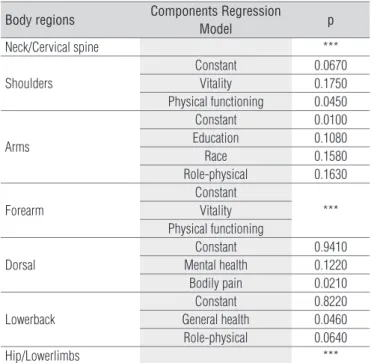
Data were analyzed descriptively by means of absolute numbers, frequencies and percentages. he inferential analy-sis was performed using the chi-square test for dichotomous variables and the Student t test for continuous variables, respecting the normality of the variables, with signiicance of 5%. Logistic regression analyses were performed using as dependent variables all variables found to be associated with pain. he method used was backward stepwise elimitation, in
which the variables that were signiicant in the inferential analysis (independent) were placed all together in the model, being removed one by one. he variables that had a p-value between 0.20 and 0.05 were retained in the regression mod-els for adjustment efects. he signiicance adopted for the model and for the variables was 5%. he statistical software used was Stata 9.1.
he inferential and the logistic regression analyses were performed only for pain over the previous 12 months, consider-ing that pain crises are frequent in this condictiont2,7 and that
results based on a longer period could better explain its impact on quality of life.
Legal aspects of the research
he project was approved by the Committee of Ethics in Research of the Universidade Federal do Triângulo Mineiro (UFTM), Uberaba, MG, Brazil, under Protocol nº 1818. he subjects were informed about the objectives and methodol-ogy of the study and signed an informed consent, according to the Resolution nº 196 of October 10, 1996, of the National Health Council.
Results
he study included 27 patients with sickle cell disease. From these, 85.20% were HbSS; 7.40% were HbSC and 7.40% were HbSβ. he mean age was 31.77 years (SD±1.87), with a predominance of males (55.56%) and blacks (59.26%); 37.04% had active formal employment and 59.1% had a mean school-ing and low income (74.07% lower than three minimum wages). The mean SF-36 component socres are presented in Figure 1.
All subjects reported pain in the previous 12 months and 81.5%, in the previous seven days in at least one body region. he results of the distribution of pain by body regions are shown in Table 1. he highest incidence of pain was in the hip/ lower limbs, followed by the thoracic spine, lumbar spine and arms, both in the previous 12 months and seven days.
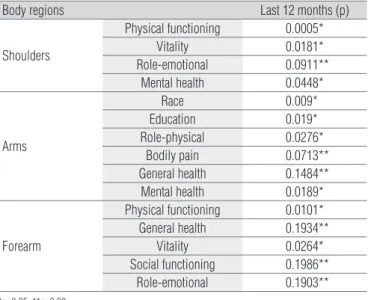
he results of signiicant associations (p<0.05) and p<0.20 found in the inferential analysis are described in Table 2 and 3.
Body regions
Previous 12 months Previous seven days
No pain Presence of pain No pain Presence of pain
n % n % n % n %
Neck/Cervical spine 23 85.19 4 14.81 21 77.78 6 22.22
Shoulders 22 81.48 5 18.52 22 81.48 5 18.52
Arms 16 59.26 11 40.74 18 66.67 9 33.33
Elbows 24 88.89 3 11.11 23 85.19 4 14.81
Forearms 23 85.19 4 14.81 23 85.19 4 14.81
Wrist /hand / fingers 22 81.48 5 18.52 22 81.48 5 18.52
Toracic spine 13 48.15 14 51.85 17 62.96 10 37.04
Lower back 14 51.85 13 48.15 18 66.67 9 33.33
Hip /Lower limbs 11 40.74 16 59.26 13 48.15 14 51.85
Table 1. Pain distribution during the previous 12 months and the previous seven days.
Body regions Last 12 months (p)
Shoulders
Physical functioning 0.0005*
Vitality 0.0181*
Role-emotional 0.0911**
Mental health 0.0448*
Arms
Race 0.009*
Education 0.019*
Role-physical 0.0276*
Bodily pain 0.0713**
General health 0.1484**
Mental health 0.0189*
Forearm
Physical functioning 0.0101*
General health 0.1934**
Vitality 0.0264*
Social functioning 0.1986**
Role-emotional 0.1903**
Table 2. Association between personal, social, economic and cultural
characteristics, SF-36 components and the presence of pain upper extremity pain on the previous 12 months.
Bodyregions Last 12 months (p)
Neck/Cervical spine
Physical functioning 0.0001*
General health 0.0891**
Vitality 0.1742**
Role-emotional 0.1086**
Mental health 0.0985**
Dorsal
Role-physical 0.0099*
Bodily pain 0.0029*
Mental health 0.0365*
Lowerback
Role-physical 0.0008*
General health 0.0014*
Role-emotional 0.0976**
Mental health 0.0650**
Hip /Lowerlimbs
Physical functioning 0.1775**
Role-physical 0.1757**
Bodily pain 0.0342*
General health 0.1927**
Vitality 0.1119**
Mental health 0.0755**
Table 3. Association between personal, social, economic and cultural characteristics, SF-36 components and the presence of pain on the spine and lower lombs over the previous 12 months.
*p<0.05; **p<0.20.
Figure 1. SF36-Health Survey domains average results.
Physical functioning
QQV - SF36 DOMAINS AVERAGE
Role-emotional General health Role-physical Vitality Bodily pain Social Aspects Mental Health
86.85 77.16
68.88 58.33
53.7 52.96 50.4648.29
0 10 20 30 40 50
%
60 70 80 90 100
vitality and Social Functioning) the result were signiicant only for vitality and mental health.
he Physical Functioning component of the SF-36 was the one with the lowest impairment (score 86.85) and was in-luenced by pain in the neck/cervical region, shoulders and forearms. he Social Functioning component was between the most afected (score 50.46), however it was not signiicantly associated with pain in any of the studied regions.he com-ponent of mental health was the most afected in this study (48.29), being inluenced by pain in the shoulders and arms.
Pain in the arms were signiicantly associated with race (blacks had more pain), schooling (individuals with low educa-tion had more pain) and a reduceduca-tion in the domains of Role-Physical and Mental Health of the SF-36. Regression analysis revealed that race, schooling and Role-Physical of the SF-36 were also afected by pain in this region.
Discussion
he mean age in this study was 31.77 years (SD±1.87), re-vealing the low life expectancy that individuals sufering from this condition are likely to have. According to Alves24, 78.6% of
Body regions Components Regression
Model p
Neck/Cervical spine ***
Shoulders
Constant 0.0670
Vitality 0.1750
Physical functioning 0.0450
Arms
Constant 0.0100
Education 0.1080
Race 0.1580
Role-physical 0.1630
Forearm
Constant
*** Vitality
Physical functioning
Dorsal
Constant 0.9410
Mental health 0.1220
Bodily pain 0.0210
Lowerback
Constant 0.8220
General health 0.0460
Role-physical 0.0640
Hip/Lowerlimbs ***
Table 4. Logistic regression analysis between personal, social, economic and
cultural characteristics, SF-36 components and the presence of pain over the previous 12 months.
***The regression model adjusted for variables with p<0.20.
all deaths in individuals with sickle cell disease occur before 29 years of age, demonstrating its severity and lethality.
The highest prevalence of the condition in black individ-uals found in this study is in agreement with what has been reported in the literature. The condition is thought to be of African origin and been brought to the Americas through the forced immigration of slaves. In Brazil, black and brown individuals are more oftenly affected, although it occurs at a lower frequency in white individuals due to miscegenation1.
The results demonstrated that 100% of the subjects ex-perienced pain on at least one body region in the previous 12 months and 81.5% in the previous seven days. A previous study also conducted in the same recruitment site (HRU)25
showed that the most prevalent cause of health care consul-tation (64.4%) were pain crises.
Male individuals were predominant in our sample, per-haps due to the small sample size. Still, there was no sta-tistically significant difference between genders regarding pain. Smith et al.18 conducted a study that assessed pain in
adults with sickle cell disease and also found no difference in gender.
Pain was more common on the hip/lower limbs, fol-lowed by the thoracic spine, lumbar spine and arms. Taylor et al.26 conducted a literature review on the multiple
dimen-sions of chronic pain in adults with sickle cell disease and also found that the region mostly affected by chronic pain was the hip (the variation in the studies ranged from 60%
to 100%), followed by the spine. Silva and Marques17 stated
that the femur and the tibia were among the areas most frequently affected by pain symptoms and Felix, Souza and Ribeiro15 showed that the lower limbs were among the areas
most commonly affected by pain.
he inferential analysis indicated a signiicant associa-tion between pain in the thoracic spine, hip/lower limbs and greater impairment in bodily pain assessed using the SF-36. his pain domain assesses pain intensity and its extent or interference with activities of daily living (ADL)23. hese
re-sults can be explained, at least in part, by the study of Ballas14,
which indicated that many complications of sickle cell dis-ease, such as avascular necrosis and lower limb ulcers, could also have been involved with the mechanisms of chronic pain, , given that 44% of the sample had or would have been afect by sickle ulcers throughout their lives. Furthermore, ac-cording to Daltro et al.27 the prevalence of osteonecrosis of
the femoral head increases with increasing age.
In sickle cell disease, deformities can occur mostly as a result of recurrent vascular occlusion, which can lead to bone infarcts. In the spine, the sites of bone infarction can reach central regions of the vertebral plateaus causing ex-cessive growth in adjacent regions and a depression of the central plateaus, resulting in a characteristic deformity of the vertebral bodies known as “H vertebra”28,29.
These infarcts can also reach the epiphyseal regions of bones. In fact half of the individuals under 35 years of age suffering from sickle cell disease have osteonecrosis of the hip. This is another factor predisposing a patient to the presence of pain in this region. This osteonecrosis can oc-cur in any bone, however it is more common in the humerus and femur29,30 and is more prevalent in men and those with
older age. Furthermore, the development of ulcers in the lower limbs, specifically the malleoli are common, causing severe pain and difficult scarring31.
Considering that functional capacity includes the per-formance of daily activities, such as capacity for self-care, dressing, bathing and climbing stairs23, the findings that
functional capacity were influenced by pain in the neck/ cervical region, shoulders and forearms, were to be ex-pected. Shoulder pain is known to influence the whole up-per limb mobility and strength, given the rise in overload of the other structures such as the cervical region/neck32.
their rights, taking the pain as a normal part of the dis-ease. Also, Lobo, Marra and Silva16 reported that, although
patients with sickle cell disease suffers intense pain, many continue performing their activities normally, without showing the expected image of intense pain that those without the disease would demonstrate in this situation.
The role-physical component of the SF-36 that includes the impact of physical health on performance of daily activi-ties and/or professional activiactivi-ties23, was significantly
com-promised by pain in the arms, thoracic and lumbar spine. In many occupational situations, organizational and job physical requirements, force workers to perform their func-tions in an way that overloads specific body structures33.
Thus, these results can be directly associated to the profes-sional activities performed by these individuals, since most have active employment. Considering the study by Ivo and Carvalho34 that investigated the behavior of patients with
sickle cell disease and identified the presence of joint defor-mities in half of the sample studied resulting in altered gait and posture, we could assume that the patients in this study would have been affect similarly and therefore be prone to increased overload and triggering and perpetuation of pain in these regions.
The low schooling was significantly associated with pain in the arms, indicating that, in addition to aspects related to quality of life, it can help to understand the interference of pain in work activities. According to Wijnhoven, de Vet and Picavet35, low schooling and occupations that include
excess physical effort (housemaid, construction workers, general services, among others) are risk factors for the de-velopment of pain. Many individuals in the present study performed activities such as housemaids, general services and car washer, predisposing them to pain in the arms.
The pathophysiological changes of vascular occlusion could explain the fact that aspects related to the assessment of vitality, which encompasses both the energy level and fatigue23, were influenced by the pain in the shoulders
and forearms. These blood vessel blockages are more com-mon in shoulders, in the region of the long bones and verte-brae, causing pain, decreased concentration of oxygen and therefore, fatigue17.
Strickland et al.20 found that the difficulty in dealing with
recurrent painful conditions adversely affects the quality of life of individuals with sickle cell anemia in the physical, emotional and social aspects.
In this study, the social functioning component of the SF-36 that examine whether the integration of the individual in social activities was affected by their health problems23 showed significant impairment (score 50.46);
while, for the component role-emotional, that deal with the limitations on the type and amount of work and how these limitations hamper the work and performance of daily life activites23, the scores were lower (score 71.16).
However, they were not significantly associated with pain in any of the regions studied. These results suggest that these domains are affected by other components of the disease other than pain. The occupational instability that is common in this patient population due to the constant need for sick leave due to treatment34, and the associated
financial issues, could explain these results, since in the present study, the majority of individuals showed active formal employment and mean schooling, while income remained less than three minimum wages.
It should be added that the body development of this patient group is slower, not corresponding to their chrono-logical age, which can cause a decrease in self-esteem, as-sociated with social isolation34.
McClishet et al.36 assessed quality of life of 308
individu-als with sickle cell disease using the SF-36 and found that the mental health component, including issues related to anxiety, depression, abnormal behavior or emotional imbal-ance and psychological welfare23, was the only that did not
show worse scores than the general population. The authors explained this event as a result of increased social support, absence of other stressors or behavior change in face of their mental health, adapting to conditions that the chronic dis-ease provide. In contrast, in the present study, the domain related to mental health was the most affected (score 48.29). This fact can be explained by the individual’s knowledge of the disease severity and its commitments, generating inse-curity about the near future and fear of imminent death34.
Added to this, the pain crises and frequent hospitalizations that occurred in the course of their lives can cause anxiety, depression, aggressive behavior and fear10. In addition, this
component was also influenced by pain in the shoulders and arms which may be associated with work activities that required greater physical effort. A decrease in the perfor-mance of work activities due to pain may generate a feel-ing of inferiority and low self-esteem, reflectfeel-ing directly in mental health, which may be one more justification for the low mental health value reached.
References
1. ANVISA. Manual de diagnóstico e tratamento de doença falciforme. Brasília: [s.d.]; 2002.
2. Brasil. Ministério da Saúde. Secretaria de Atenção à Saúde. Departamento de Atenção Especializada. Manual de eventos agudos em doença falciforme. Ministério da Saúde, Secretaria de Atenção à Saúde, Departamento de Atenção Especializada. Brasília: Editora do Ministério da Saúde; 2009.
3. Brasil. Ministério da Saúde. Portaria GM/MS nº 1391, de 16 de agosto de 2005. Institui no âmbito do Sistema Único de Saúde, as diretrizes para a Política Nacional de Atenção Integral às Pessoas com Doença Falciforme e outras Hemoglobinopatias. Diário Oficial da União, Brasília (DF), p. 40, col. 2, 2005.
4. Brasil. Ministério da Saúde, Secretaria de Atenção à Saúde, Departamento de Atenção Especializada. Manual de Educação em Saúde: autocuidado na Doença Falciforme. Brasília: Editora do Ministério da Saúde, 2008. 70 p.
5. Machado RFP. Hipertensão arterial pulmonar associada à anemia falciforme. J Bras Pneumol. 2007;33(5):583-91.
6. Moreira GA. Repercussões respiratórias da anemia falciforme. J Bras Pneumol. 2007;33(3):xviii-xx.
7. Brasil. Ministério da Saúde. Secretaria de Atenção à Saúde. Departamento de Atenção Especializada. Manual de condutas básicas na doença falciforme. Brasília: Editora do Ministério da Saúde; 2006.
8. Silva IA. Atuação fisioterapêutica na anemia falciforme. Lato & Sensu. 2003;4(1):3-5.
9. Carpenter L, Baker GA, Tyldesley B. The use of the canadian occupational performance measure as an outcome of a pain mangement program. Can J Occup Ther. 2001;68(1):16-22.
10. Santos ARR, Miyazaki MCO. Grupo de sala de espera em ambulatório de doença falciforme. Rev Bras Ter Comport Cogn. 1999;1(1):41-8.
11. Filha ACS, Barros FNS, Carvalho FJR, Souza JB, Picão VS. Mensuração da dor em pacientes portadores de anemia falciforme. Revista Digital de Pesquisa CONQUER da Faculdade São Francisco de Barreiras. 2008;3:1-8.
12. Asnani MR, Lipps GE, Reid ME. Utility of WHOQOL-BREF in measuring quality of life in sickle cell disease. Health Qual Life Outcomes. 2009;7:75.
13. Galiza Neto GC, Pitombeira MS. Aspectos moleculares da anemia falciforme. J Bras Patol Med Lab. 2003;39(1):51-6.
14. Ballas SK. Pain management of sickle cell disease. Hematol Oncol Clin North Am. 2005;19(5):785-802.
15. Felix AA, Souza HM, Ribeiro SBF. Aspectos epidemiológicos e sociais da doença falciforme. Rev Bras Hematol Hemoter. 2010;32(3):203-8.
16. Lobo C, Marra VN, Silva RMG. Crises dolorosas na doença falciforme. Rev Bras Hematol Hemoter. 2007;29(3):247-58.
17. Silva DG, Marques IR. Intervenções de enfermagem durante crises álgicas em portadores de anemia falciforme. Rev Bras Enferm. 2007;60(3):327-30.
18. Smith WR, Penberthy LT, Bovbjerg VE, McClish DK, Roberts JD, Dahman B, et al. Daily assessment of pain in adults with sickle cell disease. Ann Intern Med. 2008;148(2):94-101.
19. Pereira SAS, Cardoso CS, Brener S, Proietti ABFC. Doença falciforme e qualidade de vida: um estudo da percepção subjetiva dos pacientes da Fundação Hemominas, Minas Gerais, Brasil. Rev Bras Hematol Hemoter. 2008;30(5):411-6.
20. Strickland OL, Jackson G, Gilead M, McGuire DB, Quarles S. Use of focus groups for pain and quality of life assessment in adults with sickle cell disease. J Natl Black Nurses Assoc. 2001;12(2):36-43.
studies that have studied the association of pain with qual-ity of life usually do not separate pain by body regions, mak-ing it difficult to discuss this research with the scientific literature. Thus, new multicenter studies and with larger samples should be encouraged, in order to allow compari-sons with this and others studies, as well as provide a better understanding of pain in this condition.
Conclusion
Pain was one of the most common symptoms of patients with sickle cell disease, as all patients in this study reported pain in at least one body region.
The physical aspects of quality of life were influenced by pain from different body regions. Pain in the upper limbs contributed to reduced Physical Functioning, Vitality, Role-Physical and Mental Health and was also associated with race (blacks had more pain) and schooling (low schooling was associated with pain). Pain on the spine and the lower limbs, contributed to a reduction in the scores of Physical
Functioning, Role-Physical, General Health, Mental Health and Bodily pain components of the SF-36. Physical func-tioning, role-physical , schooling and race were associated with pain in the upper limbs, while the pain on the thoracic and the lumbar spine were associated with bodily pain and Role-Physical.
It is hoped that the results of this research will contribute to the planning of interventions not only in rehabilitation, but mostly preventive and in health promotion through proper multidisciplinary care. In physical therapy, the data will sup-port decision making, allowing a service rich in resources and techniques for prevention and musculoskeletal rehabilitation, with reduction and improvement of pain, recovery of mobil-ity, improvement of resistance to eforts, allowing individuals greater skill in performing the ADL and work activities.
Acknowledgments
21. Kuorinka I, Jonsson B, Kilbom A, Vinterberg H, Biering-Sørensen F, Andersson G, et al. Standardised Nordic questionnaires for the analysis of musculoskeletal symptoms. Appl Ergon. 1987;18(3):233-7.
22. Pinheiro FA, Tróccoli BT, Carvalho CV. Validação do questionário nórdico de sintomas osteomusculares como medida de morbidade. Rev Saúde Pública. 2002;36(3):307-12.
23. Ciconelli RM, Ferraz MB, Santos W, Meinão I, Quaresma MR. Tradução para a língua portuguesa e validação do questionário genérico de avaliação de qualidade de vida SF-36 (Brasil SF-36). Rev Bras Reumatol. 1999;39(3):143-50.
24. Alves AL. Estudo da mortalidade por anemia falciforme. Inf Epidemiol SUS. 1996;5(4):45-53.
25. Martins PRJ, Moraes-Souza H, Silveira TB. Morbimortalidade em doença falciforme. Rev Bras Hemoter Hematol. 2010;32(5):378-83.
26. Taylor LEV, Stotts NA, Humphreys J, Treadwell MJ, Miaskowski C. A review of the literature on the multiple dimensions of chronic pain in adults with sickle cell disease. J Pain Symptom Manage. 2010;40(3):416-35.
27. Daltro G, Alencar DF, Sobrinho UB, Guedes A, Fortuna VA. Osteonecrose da cabeça femoral na anemia falciforme. Gazeta Médica da Bahia. 2010;80(3):29-32.
28. Almeida A, Roberts I. Bone involvement in sickle cell disease. Br J Haematol. 2005;129(4):482-90.
29. Lonergan GJ, Cline DB, Abbondanzo SL. Sickle cell anemia. Radiographics. 2001;21(4):971-94.
30. Yanaguizawa M, Taberner GS, Cardoso FNC, Natour J, Fernandes ARC. Diagnóstico por imagem na avaliação da anemia falciforme. Rev Bras Reumatol. 2008;48(2):102-5.
31. Minniti CP, Eckman J, Sebastiani P, Steinberg MH, Ballas SK. Leg ulcers in sickle cell disease. Am J Hematol. 2010;85(10):831-3.
32. Santos MC, Lancman S. Avaliação da função do ombro em técnicos de trânsito pelo protocolo de Constant-Murley. Fisioter Pesqui. 2008;15(3):259-65.
33. Picoloto D, Silveira E. Prevalência de sintomas osteomusculares e fatores associados em trabalhadores de uma indústria metalúrgica de Canoas – RS. Ciênc Saúde Coletiva. 2008;13(2):507-16.
34. Ivo ML, Carvalho EC. Assistência de enfermagem a portadores de anemia falciforme, à luz do referencial de Roy. Rev Latinoam Enferm. 2003;11(2):192-8.
35. Wijnhoven HAH, de Vet HCW, Picavet HSJ. Explaining sex differences in chronic musculoskeletal pain in a general population. Pain. 2006;124(1-2):158-66.