O
RIGINAL
A
R
TICLE
Pain assessment and training: the impact
on pain control after cardiac surgery
*TREINAMENTO E AVALIAÇÃO SISTEMATIZADA DA DOR: IMPACTO NO CONTROLE DA DOR DO PÓS-OPERATÓRIO DE CIRURGIA CARDÍACA
ENTRENAMIENTO Y EVALUACIÓN SISTEMATIZADA DEL DOLOR: IMPACTO EN EL CONTROL DEL DOLOR POSTOPERATORIO DE CIRUGÍA CARDÍACA
Magda Aparecida dos Santos Silva1, Cibele Andrucioli de Mattos Pimenta2,
Diná de Almeida Lopes Monteiro da Cruz3
*Extracted from the dissertation, “Efeitos da intervenção treinamento, avaliação e registro sistematizado no controle da dor no pós-operatório de cirurgia cardíaca”, School of Nursing, University of São Paulo, 2007. 1 Master Degree in Nursing, School of Nursing, University of São Paulo. São Paulo, SP, Brazil. [email protected] 2 Full Professor, Department of Medical-Surgical Nursing , School of Nursing, University of São Paulo. São Paulo, SP, Brazil. parpca@ usp.br 3 Full Professor, Department of Medical-Surgical Nursing , School of Nursing, University of São Paulo. São Paulo, SP, Brazil. Dean of the School of
RESUMO
Neste estudo analisou-se o efeito do Treinamento e uso de Ficha de Avaliação Sistema zada para controle da dor após cirurgia cardíaca, sobre a intensidade da dor e o consumo de morfi na suplementar. Três grupos de pacientes foram subme -dos a um ensaio clínico não randomizado com prescrição analgésica padronizada. No Grupo I, a equipe de enfermagem não recebeu treinamento sobre avaliação e manejo da dor e cuidou dos doentes con-forme a ro na da ins tuição. Nos grupos II e III, toda a equipe foi treinada. A equipe de enfermagem do grupo II u lizou a Fi-cha Sistema zada sobre Dor, e a do grupo III não a u lizou. O grupo II apresentou dor menos intensa e maior uso de morfi -na suplementar. O trei-namento associado à Ficha de Avaliação aumentou a chance de iden fi car a dor e infl uenciou o proces-so de decisão do enfermeiro na adminis-tração de morfi na, favorecendo o alívio da dor dos pacientes.
DESCRITORES Cirurgia torácica Dor pós-operatória Medição da dor Analgesia Educação
Cuidados de enfermagem ABSTRACT
We analyzed the eff ects of training and the applica on of a form for systema zed pain assessment of pain control a er cardiac surgery on pain intensity and supplemen-tary morphine use. Three pa ent groups underwent a non-randomized clinical trial with standardized analgesic prescrip ons. In Group I, the nursing staff did not receive specifi c training regarding pain assessment and management, and pa ents were treat-ed following the establishtreat-ed protocol of the ins tu on. In Groups II and III, the nursing staff received targeted training. In Group II the nursing staff used a form for system-a zed psystem-ain system-assessment, which wsystem-as not used in Group III. Group II presented a lower in-tensity of pain and greater consump on of supplementary morphine compared to Groups I and II. Training associated with the systema zed assessment form increased the chance of iden fying pain and infl uenced nurses’ decision-making process, thus pro-mo ng pain relief apro-mong pa ents.
DESCRIPTORS Thoracic surgery Pain, postopera ve Pain measurement Analgesia Educa on Nursing care
RESUMEN
Se analizó el efecto del Entrenamiento y uso de Ficha de Evaluación Sistema zada para control del dolor posterior a cirugía cardíaca, sobre la intensidad del dolor y consumo de morfi na suplementaria. Tres grupos de pacientes fueron some dos a ensayo clínico no randomizado, con pres-cripción analgésica estandarizada. En Gru-po I, el equiGru-po de enfermería no recibió entrenamiento sobre evaluación y manejo del dolor, y cuidó a los pacientes confor-me las ru nas ins tucionales. En Grupos II y III, todo el equipo recibió entrenamien-to. El Grupo II u lizó la Ficha Sistema za-da sobre Dolor, el Grupo III no la u lizó. El Grupo II presentó dolor menos intenso y mayor uso de morfi na suplementaria. El entrenamiento asociado a la Ficha de Eva-luación aumentó la chance de iden fi car el dolor e infl uyó en el proceso decisorio del enfermero en la administración de morfi na, favoreciendo el alivio del dolor de los pacientes.
DESCRIPTORES Cirugía torácica Dolor postoperatorio Dimensión del dolor Analgesia
Educación
INTRODUCTION
Pain stands out as a relevant source of stress in cri cal-ly ill pa ents. Ac ons toward improving pain assessment and treatment have not been suffi ciently studied. Nurs-es play an important role in the decision-making procNurs-ess for employing supplementary analgesia and can infl uence pain control standards(1-4).
Nurses assess and record pa ents’ pain intensity on a daily basis, and o en, despite the availability of strat-egies(2), nurses do not adjust analgesia or administer
the prescribed medica on as qualifi ed on an as needed
basis (5-7). The apprehension of health professionals in
ad-ministering opioids has also been known for decades(5-6,8).
Educa onal programs are capable of improving health-care professionals’ prac ces. The eff ects of educa onal in-terven ons on pain assessment and control, as well as on fear of pa ent addic on have already been tested in nurses, doctors and pharmacists(9).A decrease in the fear of
on to administered opioids and more personalized med-ical prescrip ons were observed(9). Another
study on this issue showed an improvement in the communica on status among pa ents, the nursing team and the medical team; the same study indicated that the pa ents cared for by nurses who took part in educa onal interven ons had their pain addressed more comprehensively(10).On the other hand, these
studies did not assess the impact of these programs on pa ents’ pain intensity.
The eff ects of educa onal programs are quite restricted when adequate analgesic protocols are not available. When the use of
a pain ra ng scale was encouraged, it was observed that the educa onal program assisted in improving pain re-cords but promoted only a slight allevia on of pain inten-sity, due to the lack of an adequate analgesic protocol(11).
In addi on to the involvement of other professionals, the authors suggested the adop on of pain assessment and treatment protocols(11).
The involvement of the nurse in the mul profession-al process of pain and seda on assessment seems to im-prove cri cally ill pa ents’ care. Systema zed pain and agita on assessments, associated with the educa on of the medical team regarding analgesia and seda on, re-sulted in the reduc on of pain and intensity of agita on in pa ents(12). Pain control requires the combined use of
an educa onal program, systema zed assessment and adequate analgesia protocols. The present study tested the hypothesis that training and a systema zed pain as-sessment provides nurses with decision-making support concerning the administra on of morphine and the con-sequent pain relief of pa ents. The goal was to assess the
ff
Systema zed Assessment Form (SAF) for pain control af-ter cardiac surgery, as well as pain intensity and pa ents’ supplementary morphine consump on.
METHODS
A non-randomized clinical trial was carried out to test the eff ects of two interven ons on pain intensity and as needed morphine consump on for six me points through-out the fi rst 30 hours following extuba on of ve cardiac surgery pa ents. Interven ons were comprised of the applica on of a specifi c training program to all nurses in the Intensive Care Unit (ICU) and the implementa on of a SAF for pain, aimed at recording pain intensity.
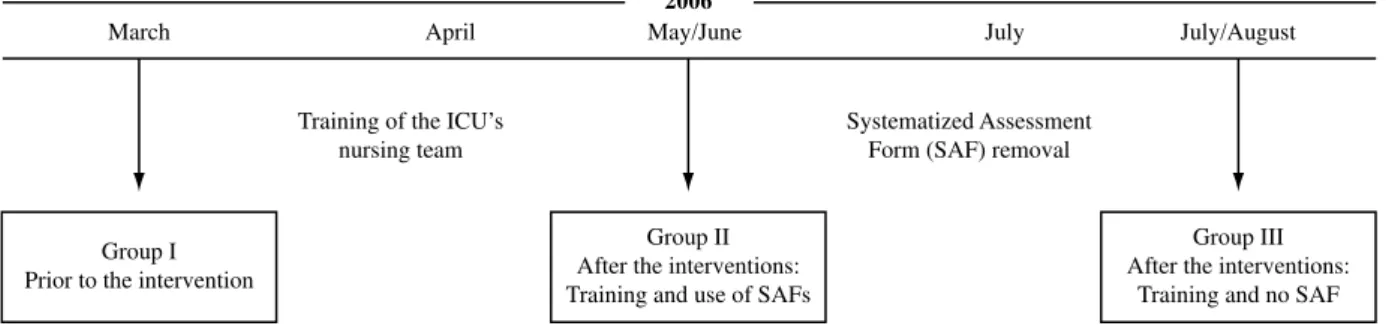
Three groups of pa ents were assessed: the fi rst group was assessed prior to the interven ons (GI); the second group was assessed a er the two interven ons (GII); and the third group (GIII) was assessed a er removal of the SAF for pain (Figure 1).
To create similar condi ons for all three groups, a pre-opera ve pa ent educa on stage, standardiza on of drug therapy and nurs-ing staff training were performed. The study was carried out in the surgical ICU of a public hospital, an educa onal reference for cardiovascular surgeries in São Paulo, Brazil. The research was assessed by the Scien fi c Commission of the Heart Ins tute of the University of São Paulo (InsƟ tuto do Coração da Faculdade da Medicina da Uni-versidade de São Paulo - InCor-HC.FMUSP) and approved by the Research Ethics Com-mi ee of the HC.FMUSP Clinical Board un-der review number 1224/05.
To create each one of the groups, all admi ed ents undergoing elec ve cardiac surgery were invited to par cipate in the study; those who agreed signed the Free and Informed Consent Form. Inclusion criteria were as follows: age between 18 and 75 years; pa ents submi ed to elec ve cardiac surgery and administered general anesthesia; pa ents having an ASA classifi ca on lower than 5; pa ents extubated up to 12 hours a er the anesthesia eff ect wore off ; pa ents who did not have any type of allergy to the proposed medica on; and
ents with adequate comprehension and verbaliza on skills. The following pa ents were excluded: those who received neuraxial anesthesia; those who presented with hemodynamic instability, featured by a persistent systolic arterial pressure lower than 90 mmHg, massive hemorrhage, and cardiopulmonary arrest; pa ents who were re-operated or re-intubated during the data
on period; pa ents with a previous history of chronic pain; and those discharged from the ICU prior to the
The involvement of the nurse in the
multiprofessional process of pain and sedation assessment
seems to improve critically ill patients’
IntervenƟ ons
Training
To guide the clinical decision-making process regard-ing the applica on of supplementary morphine, a specif-ic lecture was delivered on the impact of post-opera ve pain, pain assessment, the Numerical Ra ng Pain Scale, the World Health Organiza on’s analgesic step ladder, ap-plica on of analgesic medica on at fi xed mes and sup-plementary morphine (as needed), as well as procedures for the use of analgesic medica on. A er the lecture, at-tending nurses responded to fi ve case studies demanding decision-making processes regarding the administra on of supplementary morphine, based on variable data relat-ed to the clinical status of the pa ent. The training pro-gram lasted 75 minutes. The en re ICU’s nursing team (75 nurses and 105 nursing technicians) par cipated in small groups comprised of ten professionals per lecture.
SystemaƟ zed Assessment Form (SAF) for Pain
An SAF for pain was a ached to each pa ent’s health record. The document was comprised of three pain as-sessment items and included blank spaces to be fi lled out according to pain intensity: at rest, while taking a deep breath and while coughing. A drowsiness assessment was needed to ensure the pa ent’s safety prior to the admin-istra on of morphine. The nurses were required to make use of the form every two hours, together with the mea-surement of vital signs, beginning at the me of the ent’s extuba on and con nuing up to the 30th hour a er
the surgery. The goal was to encourage nurses to consider the need for adjustments in analgesic prescrip ons with the evalua on of pain on a regular basis, according to the established protocol.
Analgesic protocol
The employed analgesic protocol was the one nely set by the ins tu on, namely: tramadol hydro-chloride and dipyrone given at fi xed mes, as well as morphine sulfate given on an as needed basis. A 50 mg tramadol hydrochloride dosage was administered to pa ents with a maximum weight of 65 kg, and a 100
65 kg. This administra on was interposed with a 30 mg/ kg dipyrone dose. Both medica ons were administered intravenously and followed a fi xed 6-hour schedule. A 2
mg intravenous dose of morphine sulfate was adminis-tered on an as needed basis. Morphine sulfate should be administered to pa ents displaying the following
ons: pain equal to or higher than 5 (0-10) on the Nu-meric Pain Ra ng Scale (NRS), seda on level lower than 4 (1-6) on the Ramsay Seda on Scale (RSS), and systolic blood pressure equal to or higher than 90 mmHg. Fif-teen minutes a er each administra on of the morphine sulfate, the pa ent should be reassessed regarding pain intensity, level of seda on and systemic blood pressure. This protocol aimed to evaluate pain intensity and pro-vide professionals with a sense of security in terms of administering further dosages of morphine. Once the analgesic tra on with morphine was ini ated, it should have been interrupted only when a NRS pain score be-low 5 was reached; seda on was above 3 on the RSS; the systolic blood pressure reading was below 90 mmHg; or any hemodynamic complica on or other signifi cant ad-verse event was present.
Instruments
Pain intensity was assessed using the Numeric Pain Ra ng Scale (0-10) at rest, while taking a deep breath and while coughing. Drowsiness status was assessed by the Ramsay Seda on Scale (1-6)(13).The supplementary
mor-phine use and demographic data of the pa ents, as well as the type of surgery, the physical state defi ned by the
Ameri-can Society of Anesthesiologists (ASA) and the type of drain were all collected from the pa ents’ health records.
Procedures
All pa ents scheduled for elec ve cardiac surgery who met the inclusion criteria were approached by the re-searcher on the day prior to surgery. Pa ents who agreed to par cipate in the study received pre-opera ve
on on pain and its control. Two nurses who did not be-long to the ins tu on were specifi cally trained to provide support during the data collec on process, especially on the night shi . A er being extubated, pa ents were vis-ited by either the researcher or the collec on assistant at regular 6-hour intervals, up to the 30th hour. This
pro-March April
Training of the ICU’s nursing team
Systematized Assessment Form (SAF) removal
Group I Prior to the intervention
Group II After the interventions: Training and use of SAFs
Group III After the interventions:
Training and no SAF
May/June July
2006
July/August
was assessed. These moments were named M1, M2, M3, M4, M5 and M6. The fi rst assessment took place immedi-ately a er the extuba on of each pa ent and was named M1. Data regarding the surgery and analgesics were ob-tained from the pa ents’ records, and pain intensity was described according to their individual reports. It should be noted that the data collected by the researcher regard-ing pain intensity and seda on took place regardless of the ICU nurse’s informa on record.
The researcher a ached the standardized analgesic med-ical prescrip on to the charts of all pa ents in the groups, to ensure homogeneity. The assessment of the pa ents be-longing to Group I occurred in February and March of 2006, before the implementa on of the training program and in-troduc on of the SAF. In April, the whole ICU team under-went the training program previously described. Group II was assessed in May and June of 2006 and the form was then a ached to the pa ents’ health records. In July and August of 2006, pa ents belonging to Group III were assessed. The nurses con nued to apply the assessment and the as needed
analgesia protocol but without making use of the form be-cause it was removed to evaluate the eff ect of the
ons. Figure 1 demonstrates the study framework.
Sample size
Taking into account the greatest diff erence in mor-phine use (50% and 20%) among the groups, the sample
size was calculated based on a 5% margin of error and 90% power, resul ng in an es mated number of 52
ents in each group.
Data analysis
The classifi ca on variables are presented in tables comprised of absolute (n) and rela ve (%) frequencies. The correla on of these variables with the groups was assessed by either the Chi-Square test or the Likelihood Ra o Test. Quan ta ve variables are descrip vely pre-sented in tables composed of average, median, standard devia on and varia on (minimum and maximum). The comparison among the groups was made by the Krus-kal-Wallis test and the Dunn test was applied to verify achieved diff erences. All p< 0.05 scores were considered sta s cally signifi cant.
RESULTS
A total of 339 pa ents were eligible, 157 of which were excluded in compliance with the established criteria. One hundred and eighty-two pa ents fi nished the study,
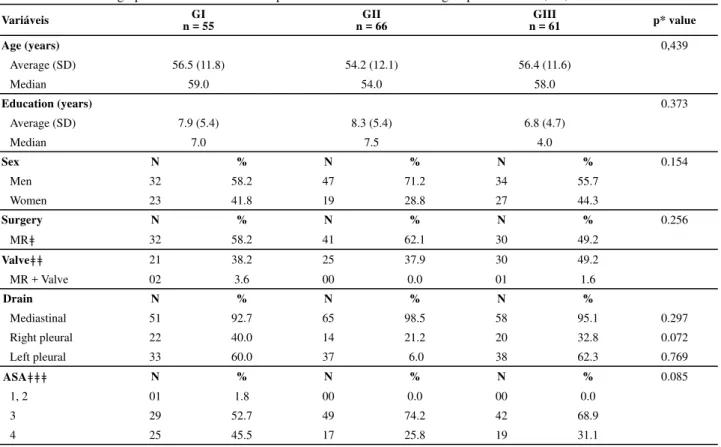
gener-a ng the following composi on for egener-ach group: 55 in Group I, 66 in Group II and 61 in Group III. The three groups did not diff er regarding the parameters of age, gender, educa on, type of surgery, type of drain and ASA physical status, which made their comparison possible for the study (Table 1).
Table 1 - Social-demographic characteristics of the patients inserted into the three groups - São Paulo, SP, 2006
Variáveis n = 55GI n = 66GII n = 61GIII p* value
Age (years) 0,439
Average (SD) 56.5 (11.8) 54.2 (12.1) 56.4 (11.6)
Median 59.0 54.0 58.0
Education (years) 0.373
Average (SD) 7.9 (5.4) 8.3 (5.4) 6.8 (4.7)
Median 7.0 7.5 4.0
Sex N % N % N % 0.154
Men 32 58.2 47 71.2 34 55.7
Women 23 41.8 19 28.8 27 44.3
Surgery N % N % N % 0.256
MRǂ 32 58.2 41 62.1 30 49.2
Valveǂǂ 21 38.2 25 37.9 30 49.2
MR + Valve 02 3.6 00 0.0 01 1.6
Drain N % N % N %
Mediastinal 51 92.7 65 98.5 58 95.1 0.297
Right pleural 22 40.0 14 21.2 20 32.8 0.072
Left pleural 33 60.0 37 6.0 38 62.3 0.769
ASAǂǂǂ N % N % N % 0.085
1, 2 01 1.8 00 0.0 00 0.0
3 29 52.7 49 74.2 42 68.9
4 25 45.5 17 25.8 19 31.1
Pain intensity
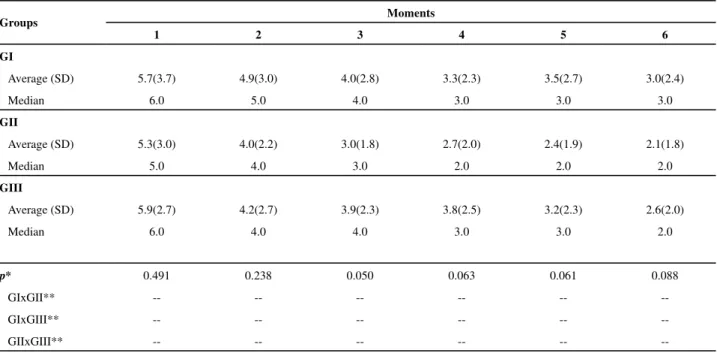
The Kruskal-Wallis test was performed with the pur-pose to iden fy diff erences between the groups by com-paring them two-by-two, using the Dunn test. For each group, pain was measured at six moments using the 0-10 numeric pain scale while the pa ent was at rest, during deep breathing and during coughing. The Kruskal Wallis test showed a signifi cant diff erence among the groups
concerning pain intensity at rest (Table 2) in Moment 2 (p=0.012) and while coughing (Table 3) in Moment 2 (p= 0.021), 3 (p= 0.005), 4 (p= 0.048) and 6 (p= 0.006). Ac-cording to the Dunn test, Group II presented a lower pain intensity at rest (p= 0.007) and while coughing (p=0.036, p=0.005, p=0.046 and p= 0.011, respec vely). Pain with deep breathing was not shown to be diff erent among the groups (Table 3).
Table 2 - Intergroup comparisons (0-10) of pain intensity at rest at all six moments - São Paulo, SP, 2006
Groups Moments
1 2 3 4 5 6
GI
Average (SD) 4.1(3.6) 3.0(2.9) 1.9(2.5) 1.3(1.8) 1.6(2.3) 1.2(2.1)
Median 5.0 3.0 0.0 0.0 0.0 0.0
GII
Average (SD) 4.2(3.2) 1.6(2.0) 1.1(2.5) 1.1(1.7) 1.1(2.0) 0.6(1.3)
Median 4.0 0.5 1.0 0.0 0.0 0.0
GIII
Average (SD) 4.6(3.1) 2.9(2.8) 1.5(1.9) 1.7(2.2) 1.2(1.6) 0.9(1.5)
Median 5.0 2.0 1.0 1.0 0.5 0.0
p* 0.770 0.012 0.603 0.210 0.487 0.293
GIxGII** -- 0.007 0.005 -- -- 0.006
GIxGIII** -- -- -- -- --
--GIIxGIII** 0.007 -- -- -- --
--* statistically signifi cant difference produced by the Kruskal Wallis test ** statistically signifi cant difference produced by the Dunn test
Table 3 - Intergroup comparisons (0-10) of pain intensity while taking a deep breath at all six moments - São Paulo, SP, 2006
Groups Moments
1 2 3 4 5 6
GI
Average (SD) 5.7(3.7) 4.9(3.0) 4.0(2.8) 3.3(2.3) 3.5(2.7) 3.0(2.4)
Median 6.0 5.0 4.0 3.0 3.0 3.0
GII
Average (SD) 5.3(3.0) 4.0(2.2) 3.0(1.8) 2.7(2.0) 2.4(1.9) 2.1(1.8)
Median 5.0 4.0 3.0 2.0 2.0 2.0
GIII
Average (SD) 5.9(2.7) 4.2(2.7) 3.9(2.3) 3.8(2.5) 3.2(2.3) 2.6(2.0)
Median 6.0 4.0 4.0 3.0 3.0 2.0
p* 0.491 0.238 0.050 0.063 0.061 0.088
GIxGII** -- -- -- -- --
--GIxGIII** -- -- -- -- --
--GIIxGIII** -- -- -- -- --
--* statistically signifi cant difference produced by the Kruskal Wallis test ** statistically signifi cant difference produced by the Dunn test
It should be noted that the groups had the same basal pain intensity at Moment 1 and that such homogeneity allowed for the deduc on that the observed diff erences
ff
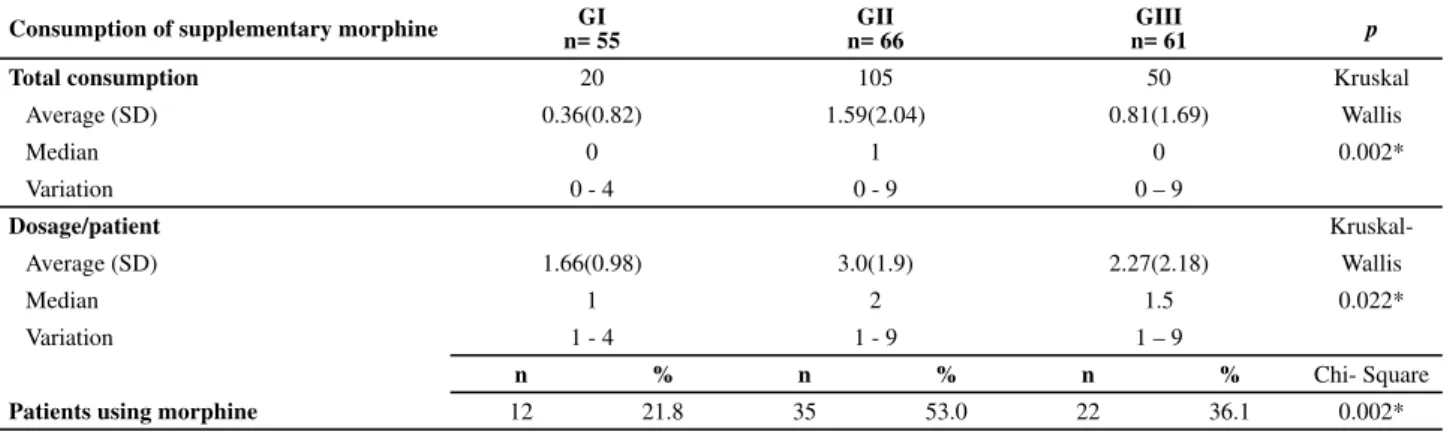
Morphine consumpƟ on
con-Table 5 - Comparison of supplementary morphine dosages and the number of patients who received these dosages in all three Groups - São Paulo, SP, 2006
Consumption of supplementary morphine n= 55GI n= 66GII n= 61GIII p
Total consumption 20 105 50 Kruskal
Average (SD) 0.36(0.82) 1.59(2.04) 0.81(1.69) Wallis
Median 0 1 0 0.002*
Variation 0 - 4 0 - 9 0 – 9
Dosage/patient
Kruskal-Average (SD) 1.66(0.98) 3.0(1.9) 2.27(2.18) Wallis
Median 1 2 1.5 0.022*
Variation 1 - 4 1 - 9 1 – 9
n % n % n % Chi- Square
Patients using morphine 12 21.8 35 53.0 22 36.1 0.002* * statistically signifi cant difference
Table 4 – Intergroup comparisons (0-10) of pain intensity while coughing at all six moments - São Paulo, SP, 2006
Groups Moments
1 2 3 4 5 6
GI
Average (SD) 6.3(3.4) 5.5(3.2) 5.1(3.1) 4.3(2.8) 4.2(3.0) 3.8(2.8)
Median 7.0 6.0 4.0 4.0 4.0 4.0
GII
Average (SD) 5.4(3.2) 4.2(2.5) 3.3(2.1) 3.4(2.1) 2.9(2.1) 2.3(1.9)
Median 5.0 4.0 3.0 3.0 3.0 2.0
GIII
Average (SD) 6.2(3.0) 5.2(2.7) 4.4(2.6) 4.6(2.7) 3.8(2.4) 3.6(2.4)
Median 7.0 5.0 4.0 4.0 4.0 3.0
p* 0.199 0.021* 0.005* 0.048* 0.050 0.001*
GIxGII** -- 0.036** 0.005** 0.229 -- 0.006**
GIxGIII** -- 0.703 0.317 0.641 -- 0.813
GIIxGIII** -- 0.087 0.092 0.046** -- 0.011**
* statistically signifi cant difference produced by the Kruskal-Wallis test ** statistically signifi cant difference produced by the Dunn test
DISCUSSION
The objec ve of the present study was to determine whether the training program and the use of a system-a zed system-assessment form by the nursing tesystem-am would infl
u-ence the pain experiu-enced by post-opera ve cardiac sur-gery pa ents. Pa ents from Group II, whose nursing team had par cipated in the training program and made use of the Pain Systema zed Assessment Form, reported greater pain relief and higher supplementary morphine
on. When the form was removed, as occurred in Group
nursing team did not a end the training program or use the form, displayed the worst results.
The nursing team that had been adequately trained to assess pain and decide on more appropriate adjustments to the analgesic therapy iden fi ed the presence of pain and decided to administer supplementary morphine dos-ages, thus having a posi ve eff ect on analgesia. The sim-ilari es in the social-demographic variables, type of sur-gery and pain intensity in Moment 1 among the groups allow us to affi rm that these variables did not infl uence
ff
distributed in accordance with the total consumption, number of patients receiving the morphine and num-ber of doses per patient. The study carried out compar-isons both among the groups and within each group, showing differences in the number of administered morphine dosages (p=0.002, Kruskal-Wallis test), in the number of patients who received the medication
(p=0.002, Chi-Square test) and in the number of dos-ages per patient (p=0.022, Kruskal-Wallis test). In the two-by-two comparison with the Dunn test (p<0.05),
One hundred percent of the nursing team that cared for pa ents from Groups II and III par cipated in the train-ing program, aimtrain-ing to demonstrate the observed eff ect of educa on on pain and morphine consump on pa erns. A er the training program, the nursing team showed a more adequate infl uence on pain control. Although it is
impossible to standardize competencies among diff erent professionals, the training program on pain provided ba-sic informa on toward the most homogeneous and ade-quate teamwork possible. Another concern was to cer fy that the same team cared for the pa ents from all three groups, a feature that was diffi cult to implement due to days off , work leaves and vaca ons. The study observed that 86% of nurses and 73.4% of nursing technicians and assistants cared for pa ents in all three groups, thus showing a sa sfactory result.
Pain intensity
Care and rehabilita on ac vi es may trigger pain, es-pecially during the fi rst few post-opera ve days. Pa ents reported variable pain intensity with coughing, moving in bed, ge ng up, taking a deep breath, using a spirometer, and at rest(14). The measurement of pain at rest, during
deep breathing and during coughing resulted from the at-tempt to analyze the effi cacy of the analgesia under diff er-ent painful s muli, as the developmer-ent of post-opera ve pain control is meant to provide pa ents with be er con-di ons and reserves to carry out rehabilita on exercises.
Pa ents from Group II reported less intense pain at rest and while coughing at several assessment moments, indica ng a favorable eff ect of the training interven on and systema zed form. Such results are highly desirable because eff ec ve coughing is quite important for bronchi-al hygiene. Therefore, pa ents from Group II were in bet-ter shape to carry out respiratory exercises with regards to pain intensity. The results of this study showed the rele-vance of assessing pain under diff erent condi ons (at rest, while coughing and while taking a deep breath).
The fi ndings of this present study corroborate the
re-sults of various authors who note a decline in pain inten-sity a er an educa onal interven on(10-12) and the use of
systema zed forms(15-16). Few studies, however, have
as-sessed the eff ects of these interven ons on pain intensity and on the use of supplementary analgesia in
ve periods, such as developed by this present research. A given study observed the eff ects of a con nued educa onal program for the nursing team and doctors on the assessment and documenta on of post-opera ve pain intensity at rest and at movement, as well as on analgesic prescrip ons. The pain assessment frequency rose from 60% to 88% during this study(16). Nonetheless,
the study did not analyze the impact of the training pro-gram on pain intensity.
Authors(17) who applied a two-stage educa onal
inter-the post-opera ve period. Notwithstanding, inter-they did not observe any diff erence in pain intensity among pa ents performing ac vi es such as ambula on, deep breathing and coughing.
Another study assessed the eff ect of an educa on-al program associated with an anon-algesia protocol on post-opera ve pain intensity (at rest, during movement in bed and while coughing) in surgical pa ents. The authors trained pa ents, nurses and doctors and observed that the educa onal program reduced pain (moderate to se-vere) at rest from 32% to 12%, and decreased pain (mod-erate to severe) in movement from 37% to 13%(18). Morphine consumpƟ on
At rest, deep breathing and while coughing, pain in-tensi es were less intense in Group II, most likely due to the more frequent use of supplementary morphine. The as needed basis morphine was used to analyze whether the iden fi ca on of a worsening pain scenario would lead the nursing team to a therapeu c adjustment, a feature that was eventually verifi ed. Such data diff er from those of a
previous study, which observed a lack of reassessment by the nursing team a er the analgesic interven on(19). The
seda on degree was one of the previous prerequisite as-sessment parameters for the administra on of the supple-mentary morphine. It should be noted that the Ramsay se-da on scale did not show any diff erence among the groups of pa ents (Median=2 in all three groups), indica ng that the decision to administer supplementary dosages of mor-phine was a safe step, as it did not alter the seda on level. In the present study, nursing staff in Group II assessed pain 16 mes in 30 hours, quite an expressive frequency. Group III did not have the SAF for Pain and the
on was defi ned by each professional. As the results in Group III were lower than those observed in Group II, it is assumed that the frequency of assessment, ac on and repor ng behaviors decreased.
It should be highlighted that a er removing the SAF, some professionals ini ally affi rmed that they missed the form in their ac vi es, as they had already adapted to the pain assessment and recording rou ne. Such a complaint, however, did not last long. In pa ents from Group III, good indicators were lower than those found in Group II, and this fact drew our a en on. All employees in this group were trained, similarly to what had happened in Group II; however, they were favored by their experience in the applica on of the SAF and the analgesic adjustment pro-tocol. Taking such facts into account, the results in Group III seemed to be higher than or equal to those found in Group II, but that was not the case in actuality.
The decline in the pa ent’s improvement observed in Group III was most likely due to the absence of a
beginning of the collec on process took place 42 days af-ter the training program).
A study of the American College Associa on observed that all knowledge acquired in training programs begins to progressively decline a er six months. The same study con-cluded that whenever the training content is experienced and u lized daily by professionals, the reten on me lasts longer. These data support the expecta on of be er results in Group III(20). On the other hand, it is believed that the
ad-hesion to an ac on, idea or behavior can diminish with me. A study that tested the eff ects of an educa onal pro-gram on pain aimed at nurses and doctors in medical and surgical units from fi ve general hospitals showed a
progres-sive decline in the nursing team’s commitment toward re-cording pain intensi es. The ini al adhesion of profession-als to carrying out two daily pain assessments in pa ents and recording printable vital signs results was sa sfactory at fi rst; however, it decreased to 59% seven months a er the implementa on of the educa onal program(21).
The decrease in the results can be assigned to the lack of the compulsoriness toward assessing and recording per-taining informa on. The presence of the SAF may have en-hanced the professionals’ commitment to pain control, al-lowing them to experience, together with the pa ents, the inves ga on rou ne and pain control, as well as providing greater assurance toward further ac ons. Addi onally, the clinical prac ce in surgical ICUs, especially concerning high-risk pa ents, shows that the team is more concerned about the diagnosis and the treatment of other organic
ons than about the issue of pain(22); such a fact reinforces
the relevance of the form for reminding professionals re-garding pa ent pain assessment and the need for an anal-gesic protocol toward the implementa on of the treatment. The limita on of this present study is that the data collec on procedure in all three groups was not a simul-taneous and randomized process; because the research took place in a single unit, there was a high risk that
ents could be mistakenly mixed among the groups. How-ever, such a limita on does not overrule the strength of the achieved results. It is important to highlight that the procedure for grouping pa ents did not take samples in-to account but popula ons in similar condi ons in-to those found in everyday prac ces. The uniformity of the groups allowed for comparisons and the achieved results can be a ributed to the applied interven on.
The greatest contribu on of this study is to note that the ac ve behavior of the nursing team toward adjus ng analgesia, encouraged by the training program and the use of the systema zed form, ul mately promoted be er pain control.
CONCLUSION
The training program and the use of the Systema zed Assessment Form for Pain (Group II) cons tuted a be er strategy toward pain control for post-opera ve cardiac surgery pa ents, as the interven ons increased the em-ployment of supplementary morphine and resulted in lower pain intensity as reported by the pa ents.
REFERENCES
1. Rond MEJ, Wit R, van Dam FSAM, Mueller MJ. A Pain
Mon-itoring Program for nurses: eff ect on the administra on of
analgesics. Pain. 2000;89(1):25-38.
2. Pimenta CAM, Santos EMM, Chaves LDC, Mar ns LM, Gu errez BAO. Controle da dor no pós-operatório. Rev Esc Enferm USP. 2001;35(2):180-3.
3. Manias E, Bucknall T, Bo M. Nurses’ strategies for man-aging pain in the postopera ve se ng. Pain Manag Nurs. 2005;6(1):18-29.
4. Richards J, Hubert AO. Experiences of expert nurses in car-ing for pa ents with postopera ve pain. Pain Manag Nurs. 2007;8(1):17-24.
5. Cohen F. Postsurgical pain relief: pa ents’ status and nurses’ medica on choices. Pain. 1980;9(2):265-74.
6. Ferguson J, Gilroy D, Pun llo K. Dimensions of pain and an-algesic administra on associated with coronary artery by-pass gra ing in an Australian intensive care unit. J Adv Nurs.
7. Dihle A, Bjølseth G, Helseth S. The gap between saying and doing in postopera ve pain management. J Clin Nurs. 2006;15(4):469-79.
8. Willson H. Factors aff ec ng the administra on of analgesia
to pa ents following repair of a fractured hip. J Adv Nurs. 2000;31(5):1145-54.
9. Greer SM, Dalton JA, Carlson J, Youngblood R. Surgical pa ents’ fear of addic on to pain medica on: the ef-fect of an educa onal program for clinicians. Clin J Pain. 2001;17(2):157-64.
10. Rond MEJ, Wit R, van Dam FSAM, Mueller MJ. A pain
mon-itoring program for nurses: eff ects on communica on,
assessment and documenta on of pa ents’ pain. J Pain Symptom Manage. 2000;20(6):424-39.
11. Ravaud P, Keïta H, Porcher R, Durand-Stocco C, Desmonts
JM, Mantz J. Randomized clinical trial to assess the eff ect
12. Chanques G, Jaber S, Barbo e E, Violet S, Sebbane M, Perrigault PF, et al. Impact of systema c evalua on of pain and agita on in an intensive care unit. Crit Care Med. 2006;34(6):1691-9.
13. Carrasco G. Instruments for monitoring intensive care unit seda on. Cri c Care. 2000;4(4):217-25.
14. Milgrom LB, Brooks JA, Qi R, Bunell K, Wuestefeld S, Beckaman D. Pain levels experienced with ac vi es a er cardiac surgery. Am J Crit Care. 2004;13(2):116-25.
15. Faries JE, Mills DS, Goldsmith KW, Phillips KD, Orr J. System-a c pSystem-ain records System-and their impSystem-act on pSystem-ain control. CSystem-ancer Nurs. 1991;14(6):306-13.
16. Karlsten R, Ström K, Gunningberg L. Improving assessment of postopera ve pain in surgical wards by educa on and training. Qual Saf Health Care. 2005;14(5):332-5.
17. Bédard D, Purden MA, Sauvé-Larose N, Certosini C, Schein C. The pain experience of post surgical pa ents following the implementa on of an evidence-based approach. Pain Manag Nurs. 2006;7(3):80-92.
18. Harmer M, Davies KA. The eff ect of educa on, assessment
and a standardized prescrip on on postopera ve pain ma-nagement: the value of clinical audit in the establishment of acute pain services. Anaesthesia. 1998;53(5):424-30. 19. Bucknall T, Manias E, Bo M. Nurses’reassessment of
post-opera ve pain a er analgesic administra on. Clin J Pain. 2007;23(1):1-7.
20. Broomfield R. A quasi-experimental research to inves-tigate the retention of basic cardiopulmonary resusci-tation skills and knowledge by qualified nurses follo-wing a course in professional development. J Adv Nurs. 1996;23(5):1016-23.
21. Rond M, Wit R, van Dam F. The implementa on of a Pain Monitoring Programme for nurses in daily clinical prac ces:
results of a follow-up study in fi ve hospitals. J Adv Nurs.
2001;35(4):590-8.
22. Pun llo K. Pain experiences of intensive care units pa ents. Heart Lung. 1990; 19(5):526-32.
Acknowledgment