O
RIGINAL
A
R
TICLE
1 RN. Full Professor, University of São Paulo at Ribeirão Preto College of Nursing. Ribeirão Preto, SP, Brazil. [email protected] 2 RN. Associate Professor,
University of São Paulo at Ribeirão Preto College of Nursing. Ribeirão Preto, SP, Brazil. [email protected] 3 Dentist. PhD Student in Clinical Medicine
of University of São Paulo at Ribeirão Preto Medical School. Ribeirão Preto, SP, Brazil. [email protected] 4 RN. PhD Student of University of São
Paulo at Ribeirão Preto College of Nursing. Ribeirão Preto, SP, Brazil. [email protected] 5 Statistician. Associate Professor, University of São Paulo at Ribeirão
Preto College of Nursing. Ribeirão Preto, SP, Brazil. [email protected] 6 Dentist. M.Sc. Researcher, Nursing and Communication Group, University of
Examination of the oral cavities of patients
with cancer: clinical evaluation and indirect
measurement of the nitric oxide level
EXAME DA CAVIDADE BUCAL DE PACIENTES COM CÂNCER: AVALIAÇÃO CLÍNICA E DOSAGEM INDIRETA DE ÓXIDO NÍTRICO
EXAMEN DE LA CAVIDAD ORAL DE LOS PACIENTES CON CÁNCER: VALUACIÓN CLÍNICA Y MEDICIÓN INDIRECTA DE ÓXIDO NÍTRICO
Emilia Campos de Carvalho1, Evelin Capellari Cárnio2, Vivian Youssef Khouri3, Caroline Guilherme4, Claudia Benedita dos Santos5, Mariangela Aparecida Pace6
RESUMO
Neste estudo buscou-se verifi car associa-ção entre avaliaassocia-ção clínica da cavidade oral (pelos Índices de dentes Cariados, Perdidos e Obturados e Índice de Higiene Oral – Simplifi cado) e a determinação in-direta de óxido nítrico em pacientes com patologias onco-hematológicas. Trata-se de estudo observacional, no qual foram incluídos vinte sujeitos internados, diag-nos cados com Leucemia (35%), Linfoma (50%), Mieloma (15%), em avaliação para início de quimioterapia, sendo que 50% apresentaram normalidade da condição bucal (sem lesões ou traumas); a maioria apresentou higiene sa sfatória (35%) ou regular (35%), porém, 30% veram higie-ne defi ciente ou péssima. A expressão in-direta do óxido nítrico variou de 13,34 a 257. O óxido nítrico não apresentou asso-ciação com os outros parâmetros; houve grande variabilidade de seus valores. No-vos estudos são necessários, em especial pela potencialidade deste indicador na detecção precoce de alterações bucais.
DESCRITORES
Óxido nítrico Higiene bucal Quimioterapia
Cuidados de enfermagem
ABSTRACT
This observa onal study aimed to verify the associa on between the clinical state of the oral cavity (based on the Index of Decayed, Missing, and Filled Teeth and the Simplifi ed Oral Hygiene Index) and the indirectly determined nitric oxide level in pa ents with oncologic and hematologic diseases. This study included 20 hospital-ized pa ents who were in the evalua on phase prior to star ng chemotherapy and who had been diagnosed with leuke-mia (35%), lymphoma (50%) or myeloma (15%). Fi y percent of these pa ents had normal oral health (no injury or trauma), and most had sa sfactory (35%) or typical (35%) hygiene, but 30% had poor or very poor hygiene. The indirectly measured levels of nitric oxide ranged from 13.34 to 257. The nitric oxide level was not asso-ciated with other parameters, and there was great variability in its level. Further studies are necessary given the poten al of using this indicator in the early
on of oral diseases.
DESCRIPTORS
Nitric oxide Oral hygiene Drug therapy Nursing care
RESUMEN
Este estudio observacional buscó verifi car la asociación entre evaluación clínica de la cavidad oral (por medio de el índice de dientes cariados, perdidos y obturados y el índice de higiene oral simplifi cado) y la determinación indirecta de óxido nítrico en pacientes con enfermedades oncohe-matológicas. Estudio observacional, que incluyó a 20 pacientes hospitalizados, con diagnós co de leucemia (35%), linfoma (50%), mieloma (15%), bajo evaluación para el inicio de la quimioterapia, de los cuales el 50% tenía salud bucal normal (sin lesión o trauma). La mayoría mos-tró higiene sa sfactoria (35%) o regular (35%), pero el 30% tenía mala o muy mala higiene. La expresión indirecta del óxido nítrico varió de 13,34 hasta 257. El óxido nítrico no presentó asociación con otros parámetros, hubo gran variabilidad de los valores. Se necesitan más estudios, en par cular, el potencial de este indicador para la detección precoz de las enferme-dades bucodentales.
DESCRIPTORES
INTRODUCTION
The clinical evalua on of pa ents’ oral cavi es has been a challenge to health teams. In pa ents undergoing hematopoie c stem cell transplanta on (HSCT), this eva-lua on represents a crucial component of care and an interdisciplinary approach is valued because published studies(1-2) found high frequencies of complica ons and discomfort, including oral mucosi s, in pa ents who un-derwent HSCT. This fact jus fi es the recommenda ons regarding the need to prevent and note the occurrence of this infl amma on process, as well as the need to include this knowledge in undergraduate health care curricula, es-pecially in nursing.
This clinical evalua on includes extra- and intra-oral examina ons, the assessment of the oral mucosa, the condi on of teeth and prostheses, the need for immedia-te dental treatment, the presence of prostheses and the evalua on of oral hygiene and related instruc ons.
In the literature, criteria are highlighted for the exami-na on of lesions (presence, condi on, loca on and types) and aff ected structures. There are criteria for
both extra-oral examina on, such as those of the World Health Organiza on (WHO)(3), and intra-oral examina on to determine too-th condi on and number and too-the hygiene level(4). In epidemiological oral health sur-veys, the Decayed, Missing, and Filled Teeth (DMFT index) and the Simplifi ed Oral Hygie-ne Index (OHI-S index) is used for permaHygie-nent teeth. This index represents the propor on of decayed, missing and fi lled teeth. It is the most widely applied index around the world and remains a basic reference point for the diagnosis of dental condi ons and the for-mula on and assessment of oral health programs.
Oral hygiene assessments can also be performed using the Simplifi ed Oral Hygiene Index - OHI-S, which is used to indicate the extent of residues (biofi lms) on represen-ta ve tooth surfaces. The OHI-S consists of the Simplifi ed Debris Index (DI-S) and the Simplifi ed Calculus Index (CI--S). Both indices can be used individually, but when com-bined, they make up the OHI-S. Hygiene can be conside-red sa sfactory (a score from 0 to 1), typical (1.1 to 2), defi cient (2.1 to 3) or very poor (3.1 to 6)(4).
Another oral condi on assessment guide is the BRU-SHE(5), the name of which is based on the terms bleeding, erythema or plaque, ulcera on, saliva, halitosis, external and debris factors. Although recommended for intensive ca-re units (ICUs), this guide can be useful in any caca-re se ng.
In some individuals, however, such as pa ents who de-velop mucosi s a er chemotherapy, oral changes are not always iden fi ed during their ini al or preclinical phases. Therefore, we intended to determine, for these pa ents
and in this context, whether oral health could be assessed using an indirect measure of the nitric oxide (NO) level in saliva because the role of NO in the pathogenesis of oral and periodontal diseases has been analyzed.
When present at low and controlled concentra ons, this gas plays a relevant role in biological systems(6). One of these roles is as a poten al bactericide: the produc on of NO in the gastrointes nal tract has a defensive role in organisms. Neutrophils play a relevant role in the oral ca-vity mucosa and spontaneously produce NO (without any s mulus). This free radical is part of the defense system against infec ons and is synthesized through the conver-sion of L-arginine into L-citrulline during NO synthesis. It aff ects the prolifera on, diff eren a on and apoptosis of diff erent cell types involved in the healing of lesions (7).
The presence of excessive free radicals in the saliva can favor the occurrence of oral mucosa lesions(6). Excess NO can contribute to ssue destruc on in pa ents with periodon s, and higher levels of NO have been found in infl amed periodontal ssue(8).
It is also hypothesized that NO is ac ve in the regula on of saliva secre on, with high salivary NO produc on levels in individuals with oral mucosal disease(9). An NO synthe-sis inhibitor can be useful, especially for the treatment of diseases related to the salivary glands and of some oral mucosal diseases, because these inhibitors favor increased sa-liva on and act as a physiopathological re-gulator(6). It should be noted that saliva plays a relevant role in oral health due to its fl ow, capacity, ac vity/microbial eff ects and lubri-ca ng eff ects, among other ac vi es(10-11).
NO is rela vely unstable in the presence of oxygen and rapidly autoxidates, making its concentra on diffi cult to measure. The indirect determina on of the NO concen-tra on based on the concenconcen-tra on of niconcen-trate has been used successfully(12). Findings involving salivary NO levels in physiologically normal mucosa and oral mucosal lesions prompted the use of this parameter in this study, which ai-med to determine whether clinical oral cavity assessment indicators are associated with the NO concentra on deter-mined indirectly using the nitrate concentra on in pa ents with oncologic and hematologic diseases before the start of intravenous chemotherapy.
METHODS
This observa onal study received approval from the ins tu on’s Research Ethics Commi ee (Protocol 8329/2009), in compliance with ethical requirements. The subjects were pa ents who were hospitalized during the fi rst semester of 2010 in a clinical unit for pa ents with on-cologic and hematologic diseases at a school hospital in the
In epidemiological oral health surveys, the Decayed, Missing,
and Filled Teeth (DMFT index) and the Simplifi ed Oral Hygiene Index (OHI-S
interior of São Paulo State. Pa ents were being assessed prior to star ng chemotherapy. They had platelet levels of 20,000 or higher and neutrophil counts of 1,000 or more. In addi on, they did not have oral or nasal tubes or cathe-ters, and had a clinical condi on that allowed the use of oral hygiene procedures. All subjects received oral hygiene materials (surgical toothbrush, toothpaste containing fl uo-ride and a case in which to store the materials), donated a saliva sample (non-s mulated saliva collec on)(13) and were submi ed to clinical oral cavity examina ons.
The saliva was collected in the morning, before the ents ate and a er the oral hygiene process. Each sample was collected in a sterile fl ask for organic material, covered, stored on ice in a Styrofoam box un l transporta on to the Physiology Laboratory at EERP-USP and stored in a freezer at -20o C. Then, 1 ml of saliva from each sample was dilu-ted in 4 ml of dis lled water and centrifuged. The NO/ozo-ne chemilumiNO/ozo-nescence technique was used. A script(3) was used to evaluate the oral condi on (DMFT) and the level of oral hygiene (OHI-S), and an instrument was used to record sociodemographic data, the diagnosis and treatments.
The data were imported into Sta s cal Package for Social Sciences (SPSS), version 17.0, and analyzed des-crip vely. Sta s cal tests were applied, with signifi cance set at 0.05 (α = 0.05). For categorical variables, Fisher’s exact test was used, and for quan ta ve variables, the Kolmogorov-Smirnov was used test to check for the nor-mal distribu on of sample means. Student’s t-test, Mann--Whitney and Spearman’s correla on were also used.
RESULTS
The 20 subjects, ten men and ten women, were ents between 22 and 65 years of age. Sixteen pa ents were white (80%), three were mula o (15%), and one was black (5%). Fi een percent were unemployed, 15% were re red, and 15% were housewives. The following occu-pa ons stood out: agricultural worker (5%), hairdresser (5%), opera ons manager (5%), truck driver (5%), kinder-garten aid (5%), bricklayer (5%), teaching aid (5%), clerk (5%), teacher (5%), automo ve painter (5%) and indepen-dent/re red (5%).
Four pa ents indicated that they used tobacco or twist tobacco. None of the pa ents reported a drinking habit. The following medical diagnoses were iden fi ed: acute myeloid leukemia (1), acute myeloid leukemia with the t(8;21) transloca on (1), acute promyelocy c leukemia (1), M3 acute myeloid leukemia (1), acute lymphocy c leukemia (1), pro-B acute lymphocy c leukemia (1), B-cell prolymphocy c leukemia (1), non-Hodgkin Lymphoma (3), mantle-zone non-Hodgkin lymphoma (2), marginal--zone non-Hodgkin lymphoma (1), mul ple myeloma (3), Hodgkin lymphoma (1), splenic relapse of Hodgkin’s lym-phoma (1), Burki lymlym-phoma (1) and anaplas c large T ALK + cell lymphoma (1).
Oral condiƟ on: In the clinical evalua on, 50% of
sub-jects had no dental lesions, traumas or infec ons (Table 1). The following abnormali es were observed in the other subjects (50%): a dental infec on (15%), sores (10%), gingivi s (5%), trauma c lesions (15%) and the joint occurrence of a trauma c lesion and an infec on (5%).Twenty-fi ve percent of the subjects had prostheses, 10% of which were fi xed, 10% par al and 5% full superior. The sample distribu on was homogeneous with regard to the oral condi on based on the presence or absence of lesions (p=1/Fisher’s exact test).
The subjects were also evaluated with using the DMFT index. These evalua ons revealed an average of four de-cayed teeth (median=2 dede-cayed teeth, SD=5, minimum=0 decayed teeth, maximum=16 decayed teeth) and seven missing teeth (median=4 missing teeth, SD=8, minimum=0 missing teeth, maximum=26 missing teeth).
Oral Hygiene: Using the OHI-S, hygiene was
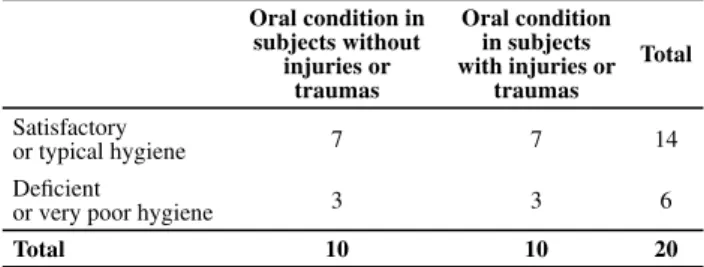
consired pconsiredominantly sa sfactory (35%) or typical (35%); de-fi cient and very poor hygiene condi ons were also obser-ved (30%). The median OHI-S score was 1.58 (mean=1.58, SD=1.03, minimum=0.16, maximum=4). Given the rele-vance of this parameter for these pa ents, from a clinical viewpoint, the defi cient and very poor scores were con-sidered undesirable; hence, oral hygiene was concon-sidered unsa sfactory in 30% of par cipants (Table 1).
Table 1 - Distribution of subjects according to oral condition and oral hygiene - Ribeirão Preto, 2010
Oral condition in subjects without
injuries or traumas
Oral condition in subjects with injuries or
traumas
Total
Satisfactory
or typical hygiene 7 7 14
Defi cient
or very poor hygiene 3 3 6
Total 10 10 20
Oral Hygiene and CondiƟ on
For the OHI-S, the mean score of the 14 subjects with a sa sfactory/typical OHI-S score was 1.06 (SD=0.64, mi-nimum=0.16, maximum=2.0, median=1.07). Among the seven subjects in this group who did not have oral lesions or traumas, the values were as follows: median=0.83, mean=1.05, SD=0.72, minimum=0.16 and maximum=2 (p=0.958/ Kolmogorov-Smirnov test). In the group wi-th lesions and traumas, wi-the values were as follows: me-an=1.09, minimum=0.33, maximum 1.83, SD=0.63 and median=1.32 (p=0.751/ Kolmogorov-Smirnov). No signifi -cant diff erence between these two groups was found with respect to the mean OHI-S score (p=0.914/t-test).
lesions or traumas, the values were as follows: me-an=2.87, minimum=2.13, maximum=4.00, SD=0.99 and median=2.49. For the three subjects in this group with le-sions or traumas, the values were as follows: mean OHI-S score=2.72, SD=0.48, minimum=2.16, maximum=3.00 and median=3.00. No sta s cally signifi cant diff erence was found between the groups with respect to the median OHI-S score (p=0.825/Mann-Whitney).
Regarding the oral condi on, for the ten subjects wi-thout oral traumas or injuries, the mean OHI-S score was 1.60 (SD=1.16, minimum=0.16, maximum=4.0, me-dian=1.65). This group had a normal distribu on with res-pect to the diff erent levels of hygiene, (p=0.983, Kolmogo-rov-Smirnov test). Similarly, among the ten subjects with abnormal oral condi ons (lesions and traumas), the mean OHI-S score was 1.58 (SD= 0.97, minimum=0.33, maxi-mum=3.00, median=1.58, p=0.940, Kolmogorov-Smirnov test). No sta s cally signifi cant diff erence was observed be-tween the mean OHI-S score of the two groups (ten subjects with lesions or traumas and ten subjects without lesions or traumas; p=0.970/t-test). Regarding the assessment of the oral condi on, varia ons in the sa sfactory/typical oral hy-giene indices were observed in the group without lesions and traumas and in the group with these altera ons.
Nitric Oxide
The indirectly determined levels of salivary NO in the study subjects were as follows: mean= 95.92, minimum= 13.34, maximum= 268.96 and mean= 50.11.
Oral CondiƟ on and Nitric Oxide
Among the ten subjects without oral lesions or trau-mas, the mean NO level was 133.36 (minimum=19.42, maximum=268.96, median=114.34, SD=104.16, p=0.686/ Kolmogorov Smirnov). Similarly, among the ten subjects with abnormal oral condi ons, i.e., with lesions or trau-mas, the meanNO level was 58.49 (minimum=13.34, ma-ximum=170.25, median=49.5, SD=43.83, p=0.155/ Kolmo-gorov Smirnov).
The diff erences in mean NO levels in rela on to the oral condi on were not sta s cally signifi cant (p=0.058/ t-test). Clinically, however, higher NO levels were obser-ved in the fi rst group. These fi ndings may be due to the small number of study subjects, resul ng in a low sta
cal test power.
Oral Hygiene (OHI-S) and Nitric Oxide
The 14 subjects with sa sfactory/typical OHI-S sco-res (70% of the sample) had a mean salivary nitric oxi-de level of 110.97 (minimum=19.42, maximum=268.96, median=51, SD=94.59). Among the par cipants with unsa sfactory OHI-S scores (defi cient/very poor, 30% of the sample), the mean nitric oxide level was 60.80 (mini-mum=13.34, maximum=170.25, SD=56.68).
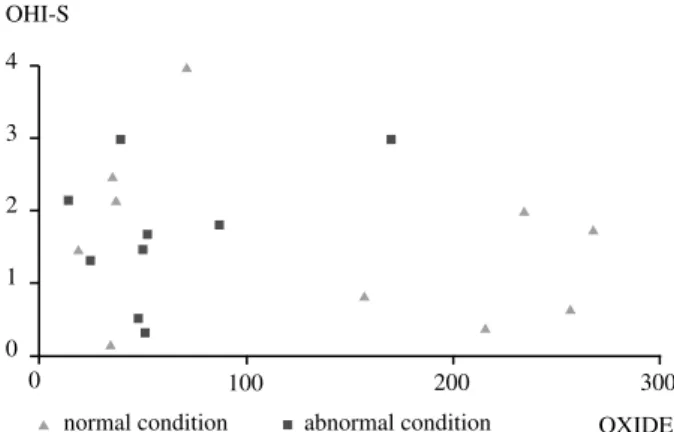
When the associa on between the OHI-S score and the nitric oxide level was assessed, no associa ons were observed (p= 0.88/Spearman); i.e., there was no linear correla on, as shown in Figure 1.
CorrelaƟ ons among Oral CondiƟ on, Nitric Oxide and Oral Hygiene
For the ten subjects without oral lesions or traumas, the mean NO level was 133.37 (minimum=19.42, maxi-mum=268.96, median=114.34, SD=104.16, p=0.686/ Kol-mogorov-Smirnov test). Seven of them (70%) had a sa sfac-tory/typical OHI-S score, and the mean NO level for these seven pa ents was 170.21 (SD=104.19, minimum=19.42, maximum=268.96). The other three, who had unsa sfac-tory OHI-S scores (defi cient or very poor), had a mean NO le-vel of 47.37 (SD=20.25, minimum=34.69, maximum=70.73, median=36.70). No sta s cally signifi cant diff erences were found with respect to the mean NO levels in the group of pa ents without oral condi on altera ons between those with sa sfactory/typical OHI-S scores and those with defi -cient/very poor OHI-S scores (p=0.210/ Mann Whitney).
Regarding the OHI-S score, the ten subjects with ab-normal oral condi ons (presence of lesions or traumas) had a mean NO level of 74.24 (minimum=13.34, maxi-mum=170.25, median=49.5, SD=43.83, p=0.058 (t-test)); the diff erences between the groups with dis nct OHI--S scores were not sta s cally signifi cant. Seven (75%) of them had sa sfactory/typical oral hygiene levels, and the mean NO level for these seven pa ents was 51.73 (SD=18.57, minimum=24.15, maximum=87.60, me-dian=49.74). Three pa ents had non-sa sfactory oral hygiene levels and a mean NO level of 74.24 (SD=84.14, minimum=13.34, maximum=170.25, median=39.13). The mean NO levels in the group with altered oral condi ons were diff erent between the pa ents with sa sfactory/ typical OHI-S scores and those with defi cient/very poor OHI-S scores, but this diff erence was not sta s cally
cant (p=0.569/ Mann-Whitney). 4
3
2
1
0
0 100 200 300
normal condition abnormal condition OXIDE OHI-S
No signifi cant diff erences were found with respect to the median NO level for subjects with sa sfactory/typical OHI-S scores between those subjects with and without lesions or traumas (p=0.142/Mann Whitney). When the diff erence in the means between the groups with and without oral altera ons was evaluated, the T-test indica-ted that there was a higher mean NO level in the group without oral traumas or lesions and with sa sfactory or typical hygiene (p=0.023).
When the median NO levels for subjects with defi cient or very poor OHI-S scores were analyzed, no diff erences were found between the groups with and without lesions or traumas (p=0.827/ Mann Whitney).
Tobacco use has an eff ect on the NO level. Out of the four subjects who indicated a past smoking habit, three had typical OHI-S scores and defi cient hygiene le-vels; however, no altera ons (lesions or traumas) we-re found when examining the smokers’ oral condi ons. The mean NO level for smokers was 140.19 (SD=130.38, minimum=19.42, maximum=268.96, median=136.19, p=0.831/ Mann Whitney), and there was no sta s cally signifi cant diff erence with respect to other subjects in the group without oral lesions or traumas (mean=128.82, SD=96.27, median=114.34, minimum=34.69 and maxi-mum=257.88). In comparison with the non-smoking ents in the sample, whose mean NO level was 84.86 (SD=74.02, minimum=13.34, maximum=257.88, me-dian=50.30, p=0,705/Mann Whitney), no sta s cally sig-nifi cant diff erences were observed between the median values, although smoking subjects’ NO levels were higher.
DISCUSSION
Among the subjects, 30% had high NO levels, abo-ve 150. One of them reported a history of smoking, was missing most teeth, had an infec on in one tooth, had a trauma c lip injury, used an implant and was consuming a predominantly liquid oral diet. Three others were had re-ceived chemotherapy previously. One pa ent had a neu-trophil count of 1000, and another had a fever and seven missing teeth. Five pa ents were diagnosed with lympho-ma and one with leukemia. Among the subjects with high NO levels, the majority were immunosuppressed.
Various factors can lead to varia ons in the NO level; for example, diet contributes to NO produc on. A diet rich in vegetables (nitrates) plays a protec ve role against oral and gastric lesions. Cigare es are rich in nitrites, which or-ganisms can rapidly absorb and eliminate through urine or even saliva(10). NO produc on increases during the
on of dental plaque, and cigare e use inhibits the defen-se against bacterial prolifera on(14). Bacteria also produce NO, and the oral fl ora is very rich and diversifi ed.
The presence of excessive free radicals in pa ents’ sa-liva can enhance the occurrence of oral mucosa lesions(6). In addi on, excessive NO contributes to ssue destruc on
in individuals with periodon s. Saliva contains a range of infl ammatory mediators, including cytokines, enzymes, growth factors and hormonal factors, that can change the NO level by inhibi ng or poten a ng its expression(15).
When the median NO levels in subjects with defi cient or very poor OHI-S scores were examined, no diff erence was found between the groups with and without lesions or traumas. In a study that indirectly determined the NO levels in pa ents with implants, higher NO levels were observed in pa ents whose healing process did not in-volve any lesions(16).
This study contributes to the body of research inves -ga ng(16) the associa on between oral care and physiologi-cal cliniphysiologi-cal indicators. Large varia ons in the NO level were found. The clinical condi ons, medica ons used, level of immunodefi ciency, history of tobacco use and the type of diet before the examina on, all variables that could not be controlled for in the study, may have interfered with the described results. Studies that control for these varia-bles are recommended.
CONCLUSION
The OHI-S, the DMFT and the assessment instrument for traumas, lesions and dental infec ons were adequate to characterize the oral condi ons of the pa ents.
Great varia on was found in the determined NO levels. Signifi cant diff erences were found between the mean NO levels of subjects with sa sfactory/typical hygiene
ons and the mean NO levels of both individuals with le-sions or traumas and pa ents with good oral health. The highest levels were found in pa ents without oral lesions or traumas and with sa sfactory/typical oral hygiene.
Variables that could not be controlled for in the study, the sample size and the use of convenience sampling, wi-thout es mates of the sta s cal power, may have interfe-red with the described results.
The indirect NO measurements in this study exhibited no associa on with the OHI-S score in the assessment of oral health. Further research is recommended, and future studies should include more par cipants and should de-termine the typical NO levels of healthy pa ents.
This study exemplifi es the use of joint interdisciplina-ry pa ent assessments, and the diff erent views will fur-ther the use of preven ve and educa onal interven ons
for pa ents who will undergo chemotherapy or treat-ment changes, when necessary, with a view to greater pa ent safety.
REFERENCES
1. Gondim FM, Gomes IP, Firmino F. Prevenção e tratamento de mucosite oral. Rev Enferm UERJ. 2010;18(1):67-74.
2. Ferreira P, Gamba MA, Saconato H, Gu érrez MGR. Trata-mento da mucosite em pacientes subme dos a transplan-te de medula óssea: uma revisão sistransplan-temá ca. Acta Paul Enferm. 2011;24(4):563-70.
3. World Health Organiza on (WHO). Oral health surveys, ba-sic methods. 4th ed. Geneva; 1997.
4. Green RM, Vermillion JR. The simplifi ed oral hygiene index. J Am Dent Assoc. 1964;68(1):7-13.
5. Abidia RF. Oral care in the intensive care unit: a review. J Contemp Dent. 2007;8(1): 1-2.
6. Sunitha M, Shanmugam S. Evalua on of salivary nitric oxide levels in oral mucosal diseases: a controlled clínical trial. Ind J Dent Res. 2006;17(3):117-20.
7. Luo J, Chen AF. Nitric oxide: a newly discovered func on on wound d healing. Acta Pharmacol Sin. 2005;26(3):259-64.
8. Ugar-Çankal D, Nurdan O. A mul faceted molecule, ni-tric oxide in oral and periodontal diseases. Clin Chim Acta. 2006;366(1-2):90-100.
9. Ohashi M, Iwase M, Nagumo M. Elevated produc on of sali-vary nitric oxide in oral mucosal diseases. J Oral Pathol Med. 1999;28(8):355-9.
10. Sato EF, Choudhury N, Inoue M. Dynamic aspect of reac ve oxygen and nitric oxide in oral cavity. J Clin Biochem Nutr. 2008;42(1):8-13.
11. Pace MA, Watanabe E, Face o MP, Andrade D. Staphylococcus spp. na saliva de pacientes com entubação orotraqueal. Rev Panam Infectol. 2008;10(1):8-13.
12. Marchi-Alves LM, Carnio EC. Is there any correla on be-tween insulin resistance and nitrate plasma concentra on in white coat hypertensive pa ents? Cardiol Res Pract. 2009;24:376-82.
13. Davies NA, Broadley K, Beighton D. Salivary gland hypo-func on in pa ents with advanced cancer. Oral Oncol. 2002;38(7):680-5.
14. Carossa S, Pera P, Doglio P, Lombardo S, Colagrande P, Brussino L, Rolla G, Bucca C. Oral nitric oxide during plaque deposi on. Eur J Clin Invest. 2001;31(10):876-9.
15. Rocha FMS, Siqueira CS, Rocha FSR, Moura CCG, Souza MA, Barbosa DZ. Análise dos níveis de óxido nítrico na saliva de pacientes desdentados totais reabilitados com implantes. Horiz Cient. 2010;4(2):1-20.
16. Lacerda RA, Nunes BK, Ba sta AO, Egry EY, Graziano KU, Angelo M, et al. Evidence-based prac ces published in Brazil: iden fi ca on and analysis of their types and meth-odological approches. Rev Esc Enferm USP [Internet]. 2011 [cited 2011 Nov 22];45(3):777-86.