Sao Paulo Med J. 2015; 133(6):531-4 531
CASE REPORT
DOI: 10.1590/1516-3180.2014.9061512Removing a broken guidewire in the hip joint: treatment
options and recommendations for preventing an avoidable
surgical catastrophe. A case report
Removendo um io-guia quebrado na articulação do quadril: opções de tratamento
e recomendações para prevenir uma evitável catástrofe cirúrgica. Um relato de caso
Abhijeet Ashok Salunke
I, Prem Haridas Menon
II, Gurunathampalayam Ilango Nambi
III, Junhao Tan
IV, Vivek Patel
V,
Yongsheng Chen
VI, Jay Kumar
VIIDepartment of Orthopedics and Traumatology, Pramukswami Medical College, Karamsad, Anand, Gujarat, India
ABSTRACT
CONTEXT: Hardware breakage during hip surgery can pose challenging and diicult problems for orthopedic surgeons. Apart from technical diiculties relating to retrieval of the broken hardware, complications such as adjacent joint arthritis and damage to neurovascular structures and major viscera can occur. Complications occurring during the perioperative period must be informed to the patient and proper documentation is essential. The treatment options must be discussed with the patient and relatives and the implant company must be informed about this untoward incident.
CASE REPORT: We report a case of complete removal of the implant and then removal of the broken guidewire using a combination of techniques, including a cannulated drill bit, pituitary forceps and Kerrison rongeur.
CONCLUSIONS: We suggest some treatment options and recommendations for preventing an avoidable surgical catastrophe.
RESUMO
CONTEXTO: Ruptura de material de síntese durante a cirurgia de quadril pode representar problemas desa-iadores e difíceis para cirurgiões ortopédicos. Além de diiculdades técnicas com recuperação do material quebrado, complicações como artrite na articulação adjacente, danos às estruturas neurovasculares e às prin-cipais vísceras podem ocorrer. A complicação durante o período perioperatório deve ser informada ao paciente e documentação apropriada é essencial. As opções de tratamento devem ser discutidas com o pa-ciente e seus familiares e a empresa do implante deve ser informada sobre este incidente desagradável.
RELATO DE CASO: Nós relatamos um caso da remoção completa do implante e, em seguida, a remoção do io-guia quebrado usando uma combinação de técnicas, incluindo uma broca canulada, fórceps da hipóise e rongeur de Kerrison.
CONCLUSÕES: Sugerimos algumas opções de tratamento e recomendações para prevenir uma evitável catástrofe cirúrgica.
IMD. Clinical Fellow, Division of Musculoskeletal Oncology, National University Hospital, Singapore. Assistant Professor, Department of Orthopedics, Pramukswami Medical College, Karamsad, Anand, Gujarat, India.
IIMD. Clinical Fellow, Department of Orthopedics, National University Hospital, Singapore. IIIMD. Consultant, Department of Plastic & Reconstructive Microvascular Services, Kovai Medical Center & Hospital, Coimbatore, Tamil Nadu, India. IVMedical Student, Yong Lin Loo School of Medicine, National University of Singapore, Singapore.
VMD. Assistant Professor, Department of Orthopedics and Traumatology, Pramukswami Medical College, Karamsad, Anand, Gujarat, India. VIMD. Resident, Hand & Reconstructive Microsurgery Cluster, Department of Orthopedics, National University Hospital, Singapore.
VIIMD. Resident, Department of Orthopedics and Traumatology, Pramukswami Medical College, Karamsad, Anand, Gujarat, India.
KEY WORDS:
Hip fractures. Pelvis. Hip joint. Bone wires. Bone nails.
PALAVRAS-CHAVE:
Fraturas do quadril. Pelve.
CASE REPORT | Salunke AA, Menon PH, Nambi GI, Tan J, Pate V, Chen Y, Kumar J
532 Sao Paulo Med J. 2015; 133(6):531-4 INTRODUCTION
Hardware breakage during hip surgery can pose challeng-ing and diicult problems for orthopedic surgeons. Apart from technical diiculties relating to retrieval of the broken hard-ware, complications such as adjacent joint arthritis and damage to neurovascular structures and major viscera have also been
described.1-4 Previously reported techniques for removing broken
guidewires in the hip joint include use of over-reaming, use of disc forceps, arthroscopically assisted methods and arthrotomy of the hip joint. In this article, we report a case of complete removal of the implant and then removal of the broken guidewire using a combination of techniques including a cannulated drill bit, pitu-itary forceps and Kerrison rongeur.
CASE REPORT
A 65-year-old woman presented with let hip pain following triv-ial trauma. She was found to have sustained an Evan’s type 4 let
intertrochanteric hip fracture (Figure 1). he patient had diabetes
and hypertension, which were well controlled with oral medica-tion. We decided to ix the fracture surgically using a proximal intramedullary femoral nail. he patient underwent surgery on the third day ater the injury.
During the surgery, the patient underwent routine unevent-ful combined spinal and epidural anesthesia. She was positioned supinely on a standard orthopedic fracture table. Closed reduc-tion of the let intertrochanteric hip fracture was performed under image guidance. he surgeon performed a standard skin incision at 5 cm proximally to the tip of the greater trochanter, in line with the long axis of the femur. he entry point was into the lateral aspect of the greater trochanter, as per our usual practice. Ater reaming, a short proximal femoral nail was inserted easily. Two guidewires were then placed with the aid of the insertion device, to guide the insertion of the recon screws. A distal hip screw was subsequently placed successfully.
However, during the placement of the proximal hip screw over the cannulated guidewire, a sudden loss of resistance was unexpectedly encountered. Intraoperative images were immedi-ately obtained and the guidewire was found to have broken with its tip lying within the subchondral area of the femoral head. he broken guidewire had not breached the hip joint. he sur-geon therefore decided to leave the guidewire alone, with no further attempt at removing it.
On postoperative day two, plain radiographs were pro-duced, which revealed that the broken guidewire had migrated
proximally into the hip joint (Figure 2). he patient therefore
underwent a repeat procedure in an attempt to remove the bro-ken guidewire. We began the revision surgery by removing the proximal hip screw. We attempted to reach the broken guide wire with the aid of a cannulated drill bit but we were unable to retrieve the broken wire. We then tried to use the pituitary forceps and Kerrison rongeur to remove the broken guide. Both of the above attempts at removing the broken guidewire were unsuccessful, so we removed the distal hip screw, distal locking screw and intra-medullary nail. Ater complete removal of all other implants, the existing track from the proximal recon screw was enlarged using a cannulated drill bit. We were able to partially engage the tip of the guidewire with the cannulated drill bit. his allowed us to
Figure 1. Preoperative radiograph showing Evan’s type 4 left intertrochanteric hip fracture (white arrow).
Removing a broken guidewire in the hip joint: treatment options and recommendations for preventing an avoidable surgical catastrophe. A case report | CASE REPORT
Sao Paulo Med J. 2015; 133(6):531-4 533
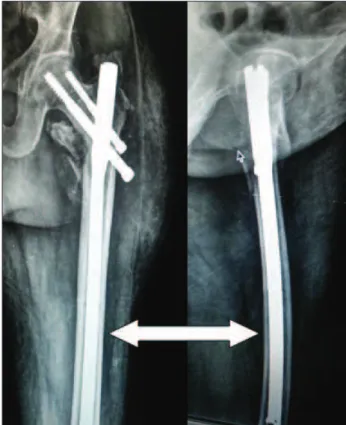
reverse the guidewire slightly into the track. Once the track was large enough, a 2 mm pituitary rongeur and Kerrison rongeur were used successively to grasp the tip of the broken guidewire and remove it. Following successful retrieval of the broken guide-wire, a long proximal femoral intramedullary nail was inserted to
achieve fracture ixation (Figure 3).
he patient was mobilized with partial weight-bearing on the third postoperative day. Her postoperative recovery was unevent-ful and she was discharged ive days ater the revision procedure. She underwent routine follow-up in the outpatient clinic. By three months ater the operation, her fracture had completely united and she was walking independently without support.
DISCUSSION
We searched for similar cases in different databases (PubMed and Lilacs database) using the terms: “hip joint” AND “guide
wire” AND “breakage” (Table 1). We found that few cases
have been published. Abstracts or full texts were analyzed and it was seen that less than 20 reports were similar to ours (Table 2).4-9 This literature review suggests that the most com-monly broken orthopedic hardware is the drill bit, followed by guidewires. The complications caused by broken hardware include adjacent joint arthritis and damage to neurovascular
structures and major viscera. Hardware may break through reuse, or due to technical problems such as drilling at a low angle of incidence or inadvertent bending during insertion. Price et al. and Sharma et al. studied the reasons for hardware failure due to repeated use of guidewires. They suggested that repeated use of guidewires over time causes deformation and loss of bending and torsional strength, such that the chances of failure increase while drilling and inserting a screw over the
wire.5,6 In addition, technical errors that predispose towards
intraoperative guidewire breakage may be due to inadvertent changes in direction and twisting during insertion, penetra-tion of the subchondral bone into the hip joint, or inserpenetra-tion of a reamer or screw improperly at an angle to the guidewire, thereby causing excessive contact stress.
he known methods of removing of broken guidewires include use of over-reaming, use of pituitary forceps, arthroscop-ically assisted methods of retrieval and open arthrotomy and
dislocation of the hip joint.6-9
It has been shown that the cross-sectional shape of the
guide-wire changes from round to oval following breakage.9 his was
perhaps the reason why we were able to use the cannulated drill bit to engage the broken guide wire, to assist in its removal in the present case.
Figure 3. Postoperative radiographs produced after revision surgery, showing that the broken guidewire was removed and a long femoral nail was inserted (white arrow).
Database Search strategies Papers found
Papers related
Medline (Via PubMed)
((bone wires) OR (guide wire) OR (guide wires)) AND (hip
joint)
27 9
Lilacs database
((bone wires) OR (guide wire) OR (guide wires)) AND (hip
joint)
35 7
Table 1. Results from review of the literature in medical databases for case reports and case series regarding hip fractures with implant breakage. Search conducted on September 10, 2014
Table 2. Review of the literature regarding implant removal from hip joint
Author Year Method of removing broken
implant from hip joint Comments
Sharma
et al.6 2008 Dynamic hip screw reamer
Sen et al.7 2010 Laparotomy
Two cases of implant breakage, in hip joint and pelvis respectively Peivandi
et al.9 2011 Cannulated drill bit
Current study 2014
Implant removal using pituitary rongeur, Kerrison
rongeur and cannulated drill bit
A combination of methods was used for
CASE REPORT | Salunke AA, Menon PH, Nambi GI, Tan J, Pate V, Chen Y, Kumar J
534 Sao Paulo Med J. 2015; 133(6):531-4
Another technique that has been described is that of over-reaming. his method uses a larger reamer, such as that of a dynamic hip screw reamer, to provide access to the broken guide-wire. he main disadvantage of over-reaming is that it leads to formation of large bone defects, which predispose towards devel-opment of pathological fractures.
he method that we used in the present case included irstly complete removal of the implant and then removal of the bro-ken guidewire using a combination of techniques including a cannulated drill bit, pituitary forceps and Kerrison rongeur. he disadvantage of our technique was that removal of the implant led to loss of the reduction of the fracture. Fortunately, the fracture pattern was readily amenable to closed reduction and therefore did not pose much diiculty. A long femoral nail was used for re-ixation, in order to achieve better stability.
Finally, arthrotomy and hip dislocation is the last resort for removal of broken guidewires. he complications from this method include loss of fracture reduction, avascular necrosis of the hip and an increased chance of recurrent hip dislocation, especially if an extensive approach is used.
Complications that occur during the perioperative period must be informed to the patient and proper documentation is essential. he treatment options must be discussed with the patient and relatives.
Furthermore, the implant company must be informed about
this untoward incident.10
Clinical recommendations
• Use new guidewires for every new case of nailing of long bones.
• Avoid unintended changes of direction and bending during insertion of the guidewire, reaming and screw insertion. • Give proper counseling to the patient and relatives about
peri-operative complications and their consequences and treatment. • Produce proper documentation of perioperative
complica-tions and report the occurrence to the implant company.
CONCLUSIONS
he methods for retrieval of broken guidewires in the hip joint include use of over-reaming, use of pituitary forceps, use of Kerrison rongeur, arthroscopically assisted methods, complete removal of implant prior to retrieval of broken hardware and arthrotomy of the hip joint. Occasionally, a combination of the above techniques has to be used to achieve successful removal of the broken hardware.
REFERENCES
1. Medved I, Simic O, Bralic M, et al. Chronic heart perforation with 13.5
cm long Kirschner wire without pericardial tamponade: an unusual
sequelae after shoulder fracture. Ann Thorac Surg. 2006;81(5):1895-7.
2. Brodell JD, Leve AR. Disengagement and intrapelvic protrusion of the
screw from a sliding screw-plate device. A case report. J Bone Joint
Surg Am. 1983;65(5):697-701.
3. Mishra P, Jain P, Aggarwal A, et al. Intrapelvic protrusion of guide wire
during ixation of fracture neck of femur. Injury. 2002;33(9):839-41.
4. Hirt U, Auer JA, Perren SM. Drill bit failure without implant
involvement--an intraoperative complication in orthopaedic surgery.
Injury. 1992;23 Suppl 2:S5-16.
5. Price MV, Molloy S, Sollan MC, Sutton A, Ricketts DM. The rate of
instrument breakage during orthopaedic procedures. Int Orthop.
2002;26(3):185-7.
6. Sharma H, Chauhan M, Maini L. A technique to remove a broken guide
wire transixing the hip joint. Acta Orthop Belg. 2008;74(5):683-5.
7. Sen RK, Tripathy SK, Aggarwal S, et al. Broken Kirschner or guide-wire
retrieval: a report of 4 cases. Hip Int. 2010;20(4):551-4.
8. Docquier PL, Manche E, Autrique JC, Geulette B. Complications
associated with gamma nailing. A review of 439 cases. Acta Orthop
Belg. 2002;68(3):251-7.
9. Peivandi MT, Kachooei AR, Nazemian Z. New method to remove a
broken guide pin in the hip joint. Orthopedics. 2011;34(10):e685-7.
10. Sayegh FE, Tsintzas D, Kapetanos GA. Intrapelvic migration of a guide
pin during ixation of a hip fracture: who and what is to blame? Acta
Orthop Belg. 2005;71(2):239-41.
Source of funding: None
Conlict of interests: None
Date of irst submission: June 3, 2014
Last received: September 11, 2014
Accepted: September 25, 2014
Address for correspondence:
Abhijeet Ashok Salunke
Assistant Professor & Consultant Orthopedic Oncosurgeon, Department
of Orthopedics
Pramukswami Medical College — Karamsad 388325
Anand — Gujarat — India
Tel: 919726500263