Occupational accident with sharpe
edge material among workers of
an operating center
ACIDENTE OCUPACIONAL POR MATERIAL PERFUROCORTANTE ENTRE PROFISSIONAIS DE SAÚDE DE UM CENTRO CIRÚRGICO
ACCIDENTE LABORAL POR EXPOSICIÓN A MATERIAL CORTO-PUNZANTE ENTRE LOS PROFESIONALES DE UN CENTRO QUIRÚRGICO
1 RN. Post-doctoral degree from New York University. Adjunct Professor at Escola de Enfermagem, Universidade Federal de Minas Gerais. Belo Horizonte, MG,
Brazil. [email protected] 2 RN. M.Sc. in Nursing from Graduate Program at Escola de Enfermagem of Universidade Federal de Minas Gerais. Belo
O
RIGINAL
A
R
TICLE
RESUMO
O acidente ocupacional por material per-furocortante constitui uma preocupação para instituições e trabalhadores de saú-de, devido à elevada frequência de proce-dimentos invasivos, e a dinâmica do tra-balho. Objetivou-se identificar a incidên-cia dos acidentes, dos materiais envolvi-dos, dos fatores contribuintes e das con-dutas tomadas pós-acidente. Participaram de um estudo transversal 127 funcionári-os do centro cirúrgico. Registraram-se 23,6% (30/127) acidentes com envolvi-mento de agulha (73,3%), lâmina de bis-turi (6,7%) e eletrocautério (6,7%). Os fa-tores contribuintes para o acidente foram: falta de atenção (36,7%), más condições de trabalho (20,0%), descuido (13,3%), pressa (10%) e acaso/azar (6,7%). Somen-te 15,4% dos acidenSomen-tes foram registrados. A subnotificação deveu-se à irrelevância do acidente, desconhecimento do proto-colo de rotina, displicência e sobrecarga de trabalho. Os resultados alertam para a importância de se implementar estratégi-as para adoção/revisão de protocolos pós-acidentes, visando a redução dos aciden-tes e de sua subnotificação.
DESCRITORES
Acidentes de trabalho. Saúde do trabalhador. Centro Cirúrgico Hospitalar. Pessoal de saúde.
Adriana Cristina Oliveira1, Jacqueline de Almeida Gonçalves2
ABSTRACT
Occupational accidents involving piercing-cutting material are a concern for institu-tions and health workers due to the high frequency of invasive procedures and the dynamics involved in their practice. The ob-jective of the present study was to identify the incidence of accidents, devices in-volved, contributing factors and post-acci-dent behaviors. A cross-sectional study was conducted among 127 healthcare workers from the operating center. Of the total num-ber of accidents reported, 23.6% (30/127) involved piercing-cutting materials, includ-ing needles (73.3%), scalpels (6.7%) and electrocautery (6.7%). The factors contrib-uting to the accident were: lack of atten-tion (36.7%), poor working condiatten-tions (20.0%), neglect (13.3%), rushing (10%) and accident/chance (6.7%). Only 15.4% of the accidents were recorded. Underreporting was due to: irrelevance of the accident, unaware of the protocol of routine, negli-gence and work overload. Results show the importance of implementing strategies for adopting/reviewing post-accident proto-cols aiming at reducing accidents and their underreporting.
KEY WORDS
Accidents, occupational. Occupational health. Surgery Department, Hospital. Health personnel.
RESUMEN
El accidente laboral por elementos corto-punzantes constituye una preocupación para instituciones y trabajadores de la salud, de-bido a la elevada frecuencia con la que se realizan procedimientos invasivos y por la dinámica del trabajo. Se objetivó identificar la incidencia de los accidentes, los materia-les involucrados, los factores contribuyentes y las conductas tomadas con posterioridad al accidente. Participaron de un estudio transversal 127 trabajadores de un centro quirúrgico. Sobre un porcentaje de acciden-tados del 23,6% (30/127), el 73,3% sufrió accidentes involucrando agujas, 6,7% se accidentó con hojas de bisturí y 6,7% se accidentó con electrocauterizador. Los fac-tores que contribuyeron a los accidentes fue-ron: falta de atención (36,7%), malas condi-ciones de trabajo (20,0%), descuido (13,3%), prisa (10,0%) y casualidad / azar (6,7%). Sólo el 15,4% de los accidentes fueron registra-dos. La falta de notificación se debió a la irrelevancia del accidente, desconocimien-to del prodesconocimien-tocolo de rutina, displicencia y so-brecarga de trabajo. Los resultados alertan sobre la importancia de implementar estra-tegias para adopción / revisión de protoco-los post accidentes, apuntando a la reduc-ción de la cantidad de accidentes y a evitar la ausencia de registro de los mismos.
DESCRIPTORES
Accidentes de trabajo. Salud laboral.
478
Rev Esc Enferm USP 2010; 44(2):477-81 www.ee.usp.br/reeusp/Occupational accident with sharpe edge material among workers of an operating center Oliveira AC, Gonçalves JA
INTRODUCTION
Occupational accidents caused by exposure to biologi-cal material are a constant source for health institutions and workers, as the hospital environment favors the oc-currence of these events, mainly due to the high fre-quency of invasive procedures and the work intensity and dynamics(1).
In health professionals’ work at different care delivery units, accident risks can differ according to the work pro-cess, the specific characteristics of care delivery, infrastruc-ture and available resources.
Accidents involving piercing and cutting material and body fluids stand out, which are due to activities like the handling of needles, scalpel blades, scissors and other instruments(1).
In this context, the surgical center, due to the charac-teristics of patient care delivery, demanding both skill and precision, associated with workers’ high stress lev-els, can favor the occurrence of needlestick injuries con-taminated by microorganisms and/or
infec-tious material(2).
According to the Centers for Disease Con-trol and Prevention (CDC), approximately 384,325 cases of percutaneous accidents in-volving health workers occur every year in American hospitals, with contamination risks amounting to 0.3% for the Human Immuno-deficiency (HIV) virus (HIV), between 6% and 30% for the Hepatitis B virus (HBV) and be-tween 0.5% and 2% for Hepatitis C (HCV)(1-2).
Despite the lack of Brazilian data about the magnitude of occupational accidents in the national context, different regu-latory standards, decrees and guidelines officially recommend occupational accident prevention measures for health work-ers and institutions. These measures relate to the use of indi-vidual protection equipment, minimization of consequent problems and compulsory accident notification(3-6).
Hence, reflections about the high levels and magnitude of occupational accidents caused by piercing and cutting material and about health professionals’ frequent lack of knowledge about the importance of working in conditions that are safe for themselves and the patients motivated this research. The researchers hope its results can contribute to the assessment of biosafety protocols adopted in health professionals’ care practices, particularly at the surgical center, as well as to the greater dissemination of knowl-edge production about the theme, with a view to health professionals’ greater awareness and the consequent adop-tion of a different perspective on their practice.
OBJECTIVE
Identify the incidence of needlestick injuries, materials involved, contributing factors and post-accident conducts.
METHOD
An epidemiological and cross-sectional research was carried out. Data were collected in March and April 2007 at the surgical center of a general public university hospital were teaching, research and care delivery take place. First, approval for the research was obtained from the Research Ethics Committee under Opinion No 558/06, in compliance with National Health Council Resolution 196/96 about re-search involving human beings. Professionals voluntarily an-swered the questionnaire after giving their explicit autho-rization through the signing of the Free and Informed Con-sent Term (FICT).
The study population comprised all employees from the health professional team (physicians, nurses, nursing aux-iliaries and technicians and maintenance staff) who worked at the surgical center of the study hospital.
A semistructured questionnaire was used for data collection, including questions re-lated to demographic aspects (gender, age, profession, service time, time of work at the sector), questions about the occurrence of needlestick injuries in 2006 and conducts immediately after the occupational accident (notification or not). The study was limited to 2006 in order to minimize any memory bias. Participants answered the questionnaire in the researcher’s presence, in a private room, at a previously scheduled time. None of the selected professionals refused to participate.
After the collection, data were coded and inserted in the Statistical Program for the Social Sciences (SPSS) for Windows database, (version 11.5: SPSS, Inc. Chicago, III). Then, data were described statistically, calculating percent-ages, and presented as tables and graphs.
RESULTS AND DISCUSSION
All multiprofessional team members who were active at the surgical center at the time of research participated, excluding workers on holiday, leave or medical leave, total-ing 127 (83.5%) professionals from the sector. These were distributed in the following categories: external physicians (2.4%), preceptor physicians (21.4%) and medical residents (30.1%) (medical team); nurses (1.6%), nursing technicians (20.9%) and nursing auxiliaries (16.5%) (nursing team); and general service professionals (7.1%).
...the surgical center [...] can favor the
occurrence of needlestick injuries
contaminated by microorganisms and/or
The professionals’ mean age was 34 years; mean time sine graduation was ten years; mean activity time at the study hospital was eight years and mean work time at the surgical center seven years. This finding was similar to an-other research about health professionals working at hos-pitalization units, with a mean age of 37.7 years and 8.5 years working at the institution(7).
As shown in Figure 1, 30 needlestick injuries were re-ported among the surgical center professionals of the study hospital in 2006. The global accident incidence rate was 23.6% (30/127), 83.3% of which in the medical team, 13.4% in the nursing team and 3.3% in the maintenance category during the study period.
Figure 1 - Distribution of occupational accidents in 2006 involving piercing and cutting material among surgical center professionals - Belo Horizonte - 2007
Medical team
Nursing team
Maintenance
Professional category
Number
of
accidents
25
20
15
10
5
0
Similarly to these findings with regard to categories, an-other study(8) among surgical center professionals registered 44.5% of accidents among medical residents, 24.1% among physicians, 14.7% among nursing technicians and auxilia-ries, 10.2% among nurses and 11.3% among cleaning pro-fessionals.
With regard to the piercing-cutting material involved in the accidents, the ranking was as follows: needle (73.3%), followed by scalpel blade (6.7%), electrocautery (6.7%) and others, such as surgical instruments.
Factors contributing to the accidents’ occurrence among workers were lack of attention (36.7%), followed by bad work conditions (20.0%), a colleague’s carelessness (13.3%), hurry (10%) and coincidence/bad luck (6.7%). This differs from another research in which lack of attention was con-sidered the main factor associated with 48.1% of nursing professionals’ exposures in a hospital network(2).
The high incidence of occupational accidents involving the medical team may be related with professionals’ pos-ture as shown by the abovementioned justifications, which indicate decreased perception of accident risks.
This decreased perception was also observed after the occupational accident, due to the low demand for medical care (30%) and post-accident laboratory tests (26.7%). Like-wise, findings from another research also indicated low rates (33%) of medical care demands after the accident, demon-strating that health professionals tend to be careless with their own health in cases of exposure to piercing and cut-ting material involving blood and/or body fluids(9).
The lowest demand for post-accident care from special-ized physicians came from medical professionals (24%). This can be understood as professionals’ self-care, due to their academic training. In this case, this attitude should be re-considered, as not all medical specialties know the correct routine conduct after exposure.
After the accident, the way the notification is done should support the worker, ranging from medical care, labo-ratory tests for the accident victim and source patient, to registration in the Occupational Accident Communication (CAT) form, which should officially occur within 24 hours, depending on the work regime(10).
In all cases, the medical assessment and laboratory tests after the accident should be aimed at proposing the ad-equate conduct in terms of chemoprophylaxis, vaccination and follow-up by the institution’s trained medical profes-sional.
Despite the victim’s great concern with the possibility of diseases like AIDS, hepatitis B and hepatitis C, occupa-tional illness prevention also includes immunization against tetanus and diphtheria (adult), measles, mumps and rubella (MMR), yellow fever and hepatitis B, through the complete vaccination schedule recommended by the Ministry of Health(5,10).
In this sense, research has evidenced inadequate preven-tion through vaccinapreven-tion against Hepatitis B in health pro-fessionals (56% to 90%), while a complete vaccination sched-ule (three doses) is recommended for all workers(5,11-12).
In this respect, a possible inference is remarkable with respect to how workers perceive the contamination (“it won’t happen to me”), making adherence to biosafety stan-dards more difficult, mainly with regard to the vaccination schedule against hepatitis B.
In this research, this inference that it won’t happen to me was also supported by the main justifications for not submitting the patient to laboratory tests, due to the fact that the exposure is characterized as mild, unimportant, indifference, verification of the source patient’s recent tests, high accident frequency and burocracy. Besides, the source patient was submitted to laboratory tests in only 36.7% of accident cases.
480
Rev Esc Enferm USP 2010; 44(2):477-81 www.ee.usp.br/reeusp/Occupational accident with sharpe edge material among workers of an operating center Oliveira AC, Gonçalves JA
they are victims of accidents, such as fear about test re-sults, stress, anxiety, anguish, among others(2,13).
Thirty accidents were found, but only 26 accident vic-tims answered questions about the notification, which was officially done in only 15.4% (4) of cases. Subnotification amounted to 76.9% (20) in the medical team and 7.7% in the nursing team(2).
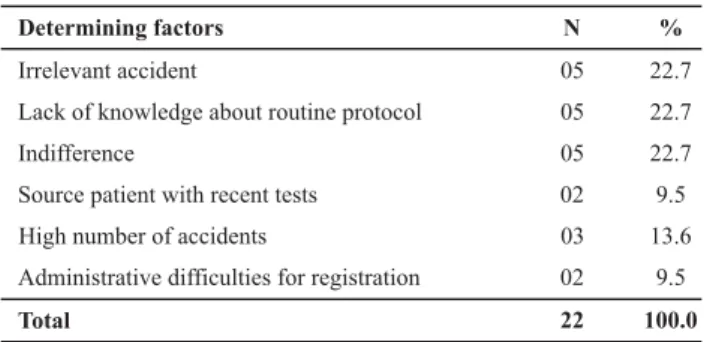
Factors contributing to subnotification were categorized and are described in Table 1.
Table 1 - Frequency of factors that contributed to the subnoti-fication of occupational accidents among accident victims work-ing at the Surgical Center - Belo Horizonte - 2007
Determining factors N %
Irrelevant accident 05 22.7
Lack of knowledge about routine protocol 05 22.7
Indifference 05 22.7
Source patient with recent tests 02 9.5
High number of accidents 03 13.6
Administrative difficulties for registration 02 9.5
Total 22 100.0
These results evidenced the considerable subnotification of accidents (84.6%), higher than literature findings, ranging from 18.2% to 53.9%. This confirms the need for institutional interventions to increase this registration, with a view to improving workers’ understanding about self-care, making them reflect on their professional practice and, mainly on the legal aspect of the occupational accident(14-15).
One way to minimize subnotification is by providing in-formation about the importance of and obligation to regis-ter accidents. In this sense, the lack of information about the register can be another important aspect of subnotification, as a form of guaranteeing labor rights and supporting claims for better safety conditions at work. This factor was perceived in only 22.7% of professionals under analysis, in line with literature and confirming its impor-tance for subnotification(16-17).
For cases of exposure to biological agents, NR 32 estab-lished conducts like diagnosis, follow-up and prevention of seroconversion and diseases, decontamination of the work environment, medical treatment and emergency care for professionals, besides information about care delivery to workers (care protocols, immunoglobulin administration, vaccines, drugs, material and special inputs for workers)(5).
These instructions should be disseminated at the insti-tutions through posters and individual information to the workers, addressing prevention measures and routines at the work site in view of exposure to biological agents. Many health services do not know this standard though, or do not disseminate it to enhance professionals’ involvement, with a view to stimulating critical and participatory think-ing for the prevention of occupational accidents.
One study(2) also registered factors contributing to sub-notification, mentioning lack of knowledge about the noti-fication (35.8%), considering the notinoti-fication unnecessary (25.6%) and lack of time, as well as source patients with negative test results and accidents classified as simple (49.9%).
Other known factors that can also influence subnoti-fication among health professionals but were not identi-fied in this research are fear, stigma, legal implications, pun-ishments and even dismissals(18).
These findings are limited by the small sample size, mainly in some categories under assessment, which did not permit association tests. Another important aspect that should have been observed was the interviewees’ possible omission about accident events out of constraint or fear of losing their job.
CONCLUSION
This study revealed the high incidence of occupational accidents involving piercing and cutting material and con-siderable subnotification in the multiprofessional care team, mainly when analyzed separately, particularly in the medi-cal team.
The needle was the main material involved in accidents and the reasons attributed to the accident events among these workers were lack of attention, bad work conditions, colleague’s carelessness, hurry and coincidence/bad luck.
Irrelevance of the accident, lack of knowledge about the routine protocol, indifference and work overload were considered factors that contributed to the subnotification of accidents.
In view of these results, effective prevention and con-trol programs should be put in practice, involving piercing and cutting material, the notification flow and the return of accident statistics in the multiprofessional care team, with a view to raising these professionals’ awareness about the severity of this issue, the risks they are exposed to and in-dividual responsibility in the prevention context.
These data also alert to the importance of the theme, underlining the need to construct, adopt and/or put in prac-tice accident notifications strategies, protocols and con-ducts when involving biological material, either through a permanent education program, clinical meetings and/or thematic seminars, in order to promote all professionals’ greater involvement.
Moreover, continuing and active epidemiological surveil-lance of occupational accidents is important and adds up to other conducts. This also represents an indicator in occupa-tional health care and serves to translate reality into data.
the follow-up of trends and variations in the accident context, with a view to the review of best practice con-ducts and protocols for the care team. These study
re-sults can also contribute to comparisons with other in-stitutions and surgical centers or other units with simi-lar characteristics.
REFERENCES
1. Nishide VM, Benatti MCC, Alexandre NMC. Ocorrência de aci-dente do trabalho em uma unidade de terapia intensiva. Rev Lat Am Enferm.. 2004;12(2):204-11.
2. Pereira ACM, Silva AR, Rocha CF, Cordeiro IS, Lopes CM. Work accidents with needles and other Sharp medical devices in the nursing team at public hospitals. Online Braz J Nurs [periódico na Internet]. 2004 [citado 2005 mar. 20];3(3):[cerca de 10 p]. Dispo-nível em: http://www.uff.br/nepae/objn303pereiraetal.htm
3. Brasil. Ministério da Saúde. Portaria n. 777, de 28 de abril de 2004. Dispõe sobre os procedimentos técnicos para a notifica-ção compulsória de agravos à saúde do trabalhador em rede de serviços sentinela específica, no Sistema Único de Saúde – SUS [legislação na Internet]. Brasília; 2004. [citado 2008 abr. 25]. Disponível em: http://dtr2001.saude.gov.br/sas/PORTARI-AS/Port2004/GM/GM-777.htm
4. Brasil. Ministério do Trabalho e Emprego. Secretaria de Inspeção do Trabalho. Portaria n. 25, de 15 de outubro de 2001. Altera a Norma Regulamentadora - NR 6, que trata de Equipamento de Proteção Individual [legislação na Internet]. Brasília; 2006. [citado 2008 abr. 25]. Disponível em: http://www.trabalhoseguro.com/ Portarias/port_25_2001_altera_nr6.html
5. Brasil. Ministério do Trabalho e Emprego. Portaria n. 485, de 11 de novembro de 2005. Aprova a norma regulamentadora n. 32 (Segurança e Saúde no Trabalho em Estabelecimentos de Saúde) [legislação na Internet]. Brasília; 2005. [citado 2008 abr. 25]. Disponível em: http://www.mte.gov.br/legislacao/Porta-rias/2005/p_20051111_485.pdf
6. Centers for Disease Control and Prevention (CDC). Healthcare Infection Control Practices Advisory Committee. Guideline for Isolation Precautions: preventing transmission of ifnectious agents in healthcare settings. Atlanta; 2007.
7. Brevidelli M, Cianciarullo T. Compliance with standard-precau-tions among medical and nursing staff at a university hospital. Online Braz J Nurs [periódico na Internet]. 2006 [citado 2007 jan. 4];5(1). Disponível em: http://www.uff.br/objnursing/ index.php/ nursing/article/view/291/57
8. Basso M. Acidentes ocupacionais com sangue e outros fluídos corpóreos em profissionais de saúde [dissertação]. Ribeirão Preto: Escola de Enfermagem de Ribeirão Preto, Universidade de São Paulo; 1999.
9. Azap A, Ergnul O, Memikoglu KO, Yesxilkaya A, Altunsoy A. Occupational exposure to blood and body fluids among health care workers in Ankara, Turkey. Am J Infect Control. 2005;33 (1):48-51.
10. Brasil. Ministério da Saúde. Secretaria de Atenção à Saúde. Departamento de Ações Programáticas Estratégicas. Exposi-ção a material biológico. Brasília; 2006.
11. Silva RJO, Athayde MJPM, Silva LGP, Braga EA, Giordano MV, Pedrosa ML.Vacinação anti-hepatite B em profissionais de saúde. DST J Bras Doenças Sex Transm. 2003;15(3):51-5.
12. Almeida CAF, Benatti MCC. Exposições ocupacionais por flui-dos corpóreos entre trabalhadores da saúde e sua adesão à quimioprofilaxia. Rev Esc Enferm USP. 2007;41(1):120-6.
13. Vieira M, Padilha MICS. O HIV e o trabalhador de enferma-gem frente ao acidente com material perfurocortante. Rev Esc Enferm USP. 2008;42(4):804-10.
14. Tarantola A, Golliot F, L’Heriteau F, Lebascle K, Ha C, Farret D, et al. Assessment of preventive measures for accidental blood exposure in operating theaters:a survey of 20 hospitals in Northern France. Am J Infect Control. 2006;34(6):367-82.
15. Damasceno AP, Pereira MS, Souza ACS, Tipple AFV, Prado MA. Acidentes com material biológico: a percepção do profissio-nal acidentado. Rev Bras Enferm. 2006; 59(1):72-7.
16. Marziale MHP. Subnotificação de acidentes com perfurocor-tantes na enfermagem. Rev Lat AM Enferm. 2003;56(2):164-8.
17. Marziale MHP, Rodrigues CM. A produção científica sobre os acidentes de trabalho com material perfurocortante entre trabalhadores de enfermagem. Rev Lat Am Enferm. 2002:10 (4):144-57.