Jansen AC, Marziale MHP, Santos CB, Dantas RAS, Santos DMSS
* Extracted from the thesis “Adaptação cultural e validação para o Brasil do instrumento Comply with post-exposure management among health care workers para proissionais de enfermagem”, Programa Interunidades de Doutoramento em Enfermagem, Escola de Enfermagem de Ribeirão Preto, Universidade de São Paulo, 2014. 1 Universidade Federal de Uberlândia, Escola Técnica de Saúde, Uberlândia, MG, Brazil. 2 Universidade de São Paulo, Escola de Enfermagem de Ribeirão Preto, Departamento de Enfermagem Geral e Especializada, Ribeirão Preto, SP, Brazil. 3 Universidade de São Paulo, Escola de Enfermagem de Ribeirão Preto, Departamento de Enfermagem Materno-Infantil e Saúde Pública, Ribeirão Preto, SP, Brazil.
4 Universidade Federal do Rio de Janeiro, Curso de Farmácia, Campus Macaé, Macaé, RJ, Brazil.
ABSTRACT
Objective: To validate the Comply with post-exposure management among health care workers instrument for Nursing in Brazil. Method: A methodological study carried out with 137 nursing professionals exposed to biological material. he existence of loor and ceiling efects was analyzed, evaluating reliability by the internal consistency of the items and test-retest reproducibility. he construct validity was analyzed by the multitrait-multimethod analysis. Results: Ceiling efects were found in two subscales. he result of the internal consistency of four subscales varied between 0.81 and 0.91. he results were considered satisfactory, while two subscales presented an unsatisfactory result (0.50 and 0.37). An evaluation of the measurement stability obtained positive results in relation to the statistical signiicance, with Intraclass Correlation Coeicient values between the two measurements ranging from 0.301 to 0.727; the validity of a convergent and divergent construct was conirmed by multitrait-multimethod analysis, except for the Attitude subscale, which presented unsatisfactory values. Conclusion: he instrument presents satisfactory results for validity and reliability, except for the Attitude dimension.
DESCRIPTORS
Exposure to Biological Agents; Nursing; Intention; Occupational Health; Validation Studies.
Validation of the
Comply with Post-Exposure Management
Among Health Care Workers
Instrument for Brazil*
Validação para o Brasil do Comply with Post-Exposure Management Among Health Care Workers Validación para Brasil del Comply with Post-Exposure Management Among Health Care Workers
Adriane Corrêa Jansen1, Maria Helena Palucci Marziale2, Cláudia Benedita dos Santos3, Rosana Aparecida Spadotti
Dantas2, Danielle Maria de Souza Serio dos Santos4
How to cite this article:
Jansen AC, Marziale MHP, Santos CB, Dantas RAS, Santos DMSS. Validation of the Comply with Post-Exposure Management Among Health Care Workers Instrument for Brazil. Rev Esc Enferm USP. 2016;50(6):971-979. DOI: http://dx.doi.org/10.1590/S0080-623420160000700014
Received: 05/30/2016 Approved: 11/16/2016
ORIGINAL ARTICLE DOI: http://dx.doi.org/10.1590/S0080-623420160000700014
Corresponding Author:
Adriane Corrêa Jansen
Av. Prof. José Inácio de Souza, s/n. Bloco 6X 1º Andar – Campus Umuarama
Validation of the Comply with Post-Exposure Management Among Health Care Workers Instrument for Brazil
INTRODUCTION
Safety and health at work represents a challenge for governments and organizations, considering the social and economic costs resulting from occupational accidents and occupational illnesses, so the prevention of occupational risks is a constant concern that has deserved attention.
Despite the obligation related to using standard precau-tions and speciic control and prevention legislation, acci-dents involving exposure to biological materials continue to be registered, perpetuating the serious problem of occupa-tional hazards in the hospital environment(1-2).
Frequent handling of piercing material by health profes-sionals, coupled with factors such as professional inexperi-ence, inadequate working conditions, absence or inadequacy of protective equipment, physical and mental fatigue and the need for great agility in performing activities contribute to increased accident risk involving exposure to biologi-cal material(3).
he reality of exposure to accidents involving biological material among health professionals, and especially for nurs-ing, can be conirmed by the numerous published national and international studies. his worrying scenario is even more serious in view of the fact that adherence to post-exposure behavior among health professionals is still not satisfactory, especially in developing countries(4-9).
hrough a broad search in the national and interna-tional databases to identify valid and reliable instruments that quantify occupational post-exposure behavior, as in another Brazilian study(10), we found that there are no
vali-dated instruments available in Brazil to assess the risks of exposure to biological material or the impact of prevention and control measures, nor to evaluate the knowledge, atti-tudes and practices of health professionals in relation to this type of exposure.
One instrument was identiied at international level(11),
based on the theoretical framework of the heory of Planned Behavior (TPB), to predict the intention of health profes-sionals accidentally exposed to blood and body luids in com-plying with conduct related to post-occupational exposure and in describing the exposure circumstances and the profes-sionals’ adherence to the recommended conduct. he instru-ment was submitted to face and content validation and to the reliability test, which evaluated its internal consistency using Cronbach’s alpha (with indices between 0.60 and 0.95).
his instrument was originally developed in Chinese (健康照顧專業人員職業性危害針扎後之追蹤) and was translated by English authors as Comply with post-exposure management among health care workers(11). It was translated
and adapted for use in Brazil in Brazilian Portuguese, entitled Adesão às condutas pós-exposição entre trabalhadores de saúde (ACPETS)(12).
he objective of the present study was to validate the instrument Comply with post-exposure management among health care workers for nursing professionals in Brazil.
Selecting an instrument from another linguistic origin in the present study is justiied by the international potential for cooperation in the area of Occupational Health, with the
purpose of increasing scientiic knowledge toward preven-tion of occupapreven-tional exposure to potentially contaminated biological material and promoting occupational health; also, to strengthen ties and exchanges among diferent countries where problems of occupational exposure are experienced.
METHOD
A methodological quantitative study with data collected from six general hospitals of the city of Uberlândia, Minas Gerais, Brazil. he target population of the study consisted of 156 nursing technicians and 32 nurses working in these hospitals and who had experienced a work accident with bio-logical material in the period of 2010 to 2012. Nursing tech-nicians and nurses of both genders who were actively work-ing durwork-ing the data collection period and those who agreed to respond to the data collection instrument were included in the study. Nursing technicians and nurses who were on vacation, health leave, dismissal from work, those who had been dismissed and the professionals who participated in the translation and adaptation stages of the ACPETS tool were excluded from the study(12). hus, the study sample
con-sisted of 137 nursing workers, 119 nursing technicians and 18 nurses. Data collection was performed from November, 2012 to February, 2013, using the ACPETS tool.
It is a self-administered instrument composed of three parts: two parts presenting objective and subjective sequential questions related to personal and professional characterization data of the study subject (Basic data) and characterization of the last occupational exposure occurred (Exposure to occupational risk of biological material); and a third part with 61 items containing Likert scale response options, where dimensions related to TPB constructs are presented (Attitude, Subjective norms, Perceived behav-ioral control and Intention).
he Attitude dimension is composed of 12 items with ive answer options (I completely disagree, I disagree, no opinion, I agree and I completely agree) ranging from one to ive. It refers to the attitude of health professionals when exposed to occupational risks and is deined as the degree of positive or negative assessment related to compliance with post-exposure behaviors(11). Average Attitude is obtained by
summing the values of the answers to the scale items after recoding the three reverse items. he highest value for the score indicates a higher level of positive evaluation related to compliance with post-exposure behavior. After the initial analysis of the ACPETS tool, which highlighted that the
Attitude subscale presented unsatisfactory results in the psychometric analyses, three items (1.8, 1.10 and 1.11) were considered as having a reverse score.
Jansen AC, Marziale MHP, Santos CB, Dantas RAS, Santos DMSS
he third dimension, Perceived behavioral control, is deined by the authors(11) as the perception of professionals
relating to the diiculty or ease with which the post-exposure conducts can be performed. his dimension is measured through three subscales: Knowledge, Self-eicacy and Resources.
he subscale Knowledge has 13 items with three answer options (Yes, No, I do not know), to which the authors(11)
attributed a value of one (1) for the option Yes and a value of zero (0) for the options No and I don’t know for data analy-sis, leading to a dichotomous response format. A strategy for dealing with dichotomous items is grouping items in order to generate scores (called plot items) from the sums of two or more similar items(13). hus, in order to perform
the multitrait-multimethod analysis, the Knowledge sub-scale was grouped by taking into account the similarities in the items’ content. he subscale was subdivided into three plot items, as follows: E3.1 ‒ group with content related to conduct after exposure to biological material (items 3.3, 3.5, 3.7, 3.8, 3.10); E3.2 ‒ group with content related to the use of medication (items 3.2, 3.4, 3.13); E3.3 ‒ group related to other content (items 3.1, 3.6, 3.9, 3.11, 3.12). In this sub-scale, the higher the score value, the greater the professional’s knowledge about post-exposure behaviors.
he Self-eicacy subscalehas seven items with ive answer choices (I’m very insecure, I’m insecure, no opinion, I’m sure, I’m very sure), ranging from one to ive. Higher scores indicate greater perception of self-eicacy(11). Regarding
the Resources subscale, it consists of six items with ive response options (very dissatisied, dissatisied, no opinion, satisied, very satisied) ranging from one to ive. he high-est value for the score indicates greater satisfaction with the institutional resources related to occupational exposures to biological material(11).
he Intention dimension has seven items, with ive response options (I don’t have any intention, I have no inten-tion, no opinion, I have the intention, I do have the intention). According to the authors(11), it refers to the professional’s
intention to comply with the occupational post-exposure conduct, deined as the intention to report future injuries, to participate in counseling, to receive vaccination and post-exposure prophylaxis and to return for inal follow-up serol-ogy tests. he response options range from one to ive, with the highest scores indicating greater intention to comply with the recommended post-exposure conduct after occu-pational accidents in the future.
For text uniformity of the present study and to facilitate description and analysis of the results, all dimensions of the instrument and its subdivisions were denominated as subscales of the instrument (Attitude, Subjective norms, Knowledge, Self-eicacy, Resources and Intention).
After elaborating numerical coding for all the answers, the data were stored in the Excel program (version 2010) using the double-entry validation (typing) technique, in order to diagnose and eliminate possible typing errors. After checking and correcting any inconsistently typed data in both digits, the data was then transferred to the SPSS appli-cation, version 17 (version 22.0, serial number 10101151049) to be processed and analyzed.
he response distribution to the instrument was described, and existence of the loor and ceiling efects were veriied, considered to be present when more than 15% of the participating subjects choose the option corresponding to the lowest or highest possible score for each of the measuring instrument dimensions, respectively(14).
he ACPETS tool’s reliability was veriied by the inter-nal consistency of the items, with polytomous and dichoto-mous responses analyzed by Cronbach’s alpha coeicient and Kuder-Richardson coeicient, respectively. Reliability evaluation by evaluating the measurement stability was also calculated by test-retest, with correlation analyses between the results obtained by applying the same measurement instrument in the same subjects on two diferent occa-sions, using the Intraclass Correlation Coeicient (ICC), and being classiied as poor (<0.40), fair (0.41-0.60), good (0.61-0.80) or excellent (>0.80)(15).
In order to perform this analysis, the total of 30 profes-sionals (with a loss calculation of 15%) was deined, and thus the test-retest sample would consist of 36 subjects (18 nurses and 18 nursing technicians). hese professionals were deined by random draw before the beginning of data collec-tion of the study. After returning the completed instruments, participants were invited to participate in the second stage (retest), after clarifying its objectives and determining an interval of 30 days between the irst and second participa-tion. All subjects were invited and accepted, with the excep-tion of four professionals who were on leave (two nursing technicians and two inactive nurses) and one nurse who had already refused participation in the study. hus, the sample for the test-retest consisted of 31 professionals (16 nursing technicians and 15 nurses).
An interval of 30 days between the irst collection (test) and the second measure (retest) was stipulated, taking into account that this time would allow for a decrease or elimination in the memory efect (related to remembering the answers given in the subject’s irst participation), and that there would be no probable modiications related to the constructs in the instrument. hus, the chances of the participant being selected for the second collection (retest) and being absent due to holidays would be reduced if the stipulated time was shorter.
Multitrait-multimethod analysis (MTMM) was used to evaluate the validity of the convergent and divergent construct of the instrument through correlations between the items and the dimensions/subscales. he Multitrait Analysis Program (MAP) was used(16) in order to carry
out this analysis.
he linear correlations between items and dimensions/ subscales they belong to were veriied for estimating the convergent construct validity. In inal validation studies, acceptable correlation values for the convergent validity are greater than 0.40(17). he divergent construct validity was
Validation of the Comply with Post-Exposure Management Among Health Care Workers Instrument for Brazil
he level of signiicance adopted in this study was 0.05 (α = 0.05).
he Subjective norms subscale has a characteristic that favored the appearance of no response (missing data) on some items, such as those containing statements that were sometimes not applicable to certain subjects. herefore, in the majority of analyses referring to this dimension (i.e. in the descriptive analyses, in MTMM analyses and Cronbach’s alpha for estimating the internal consistency of the items), only the valid items (meaning those items for which all 94 participants responded) were considered. For the other scales, the 137 subjects were considered (Attitude,
Knowledge, Self-eicacy, Resources, and Intention). he Resources subscale had an item with missing data, whose value was overridden by the average of the items that make up the subscale of the respective subject. he item was deleted when a participant did not complete 20% or more of the answers.
he study received approval from theEthics Committee for research with Human Beings of the Universidade Federal de Uberlândia, according to Approval Protocol 041/12. he name of the instrument contained in the title of this research project, informed in this opinion, is diferent from the name of the instrument used in this study because it was modiied
during the translation and cultural adaptation steps(12). he
participants read and signed the Free and Informed Consent Form, guaranteeing free and voluntary participation of the study subjects, as well as anonymity and conidentiality of the collected information.
RESULTS
he study sample (n = 137) consisted of 119 (86.9%) nursing technicians and 18 (13.1%) nurses who presented the following characteristics: 120 (87.6%) female participants, 72 (52.6%) had technical education, 62 (45.3%) were married and 51 (37.2%) were single, aged between 19 and 58 years and mean age was 34.5 years (sd = 8.7), with a median of 33.0.
Regarding the distribution of the answers of the items for each subscale, loor and ceiling efects were not identi-ied in the subscales of the ACPETS tool, except for the
Self-eicacy and Intention subscales, which presented ceiling efect. he highest percentage value was found in the Intention subscale (39.4%).
Internal consistency analysis of the items integrating the instrument was veriied through Cronbach’s alpha statistic (Attitude, Subjective norms, Self-eicacy, Resources and
Intention subscales) and by the Kuder-Richardson coef-icient (Knowledge subscale), according to Table 1.
Table 1 – Reliability analysis for the internal consistency of the ACPETS tool items’ subscales – Uberlândia, MG, Brazil, 2014
Number of items Cronbach’s alpha Kuder-Richardson Coeficient
Attitude 12 0.50* –
Subjective norms** 16 0.89 –
Perceived behavioral control
Knowledge 13 – 0.37
Self-eficacy 7 0.91 –
Resources** 6 0.81 –
Intention 7 0.90 –
(*)Values obtained after the recoding of three items (1.8, 1.10 and 1.11). (**)Values are based on the sum of the scores of valid items (n = 94); (**) n = 136.
he reliability analysis of the instrument was also veriied through test-retest reproducibility, considering its applica-tion in 31 members of the study sample at two distinct moments, with a 30-day interval. ICC values of each sub-scale and the respective values of statistical signiicance are
presented in Table 2.
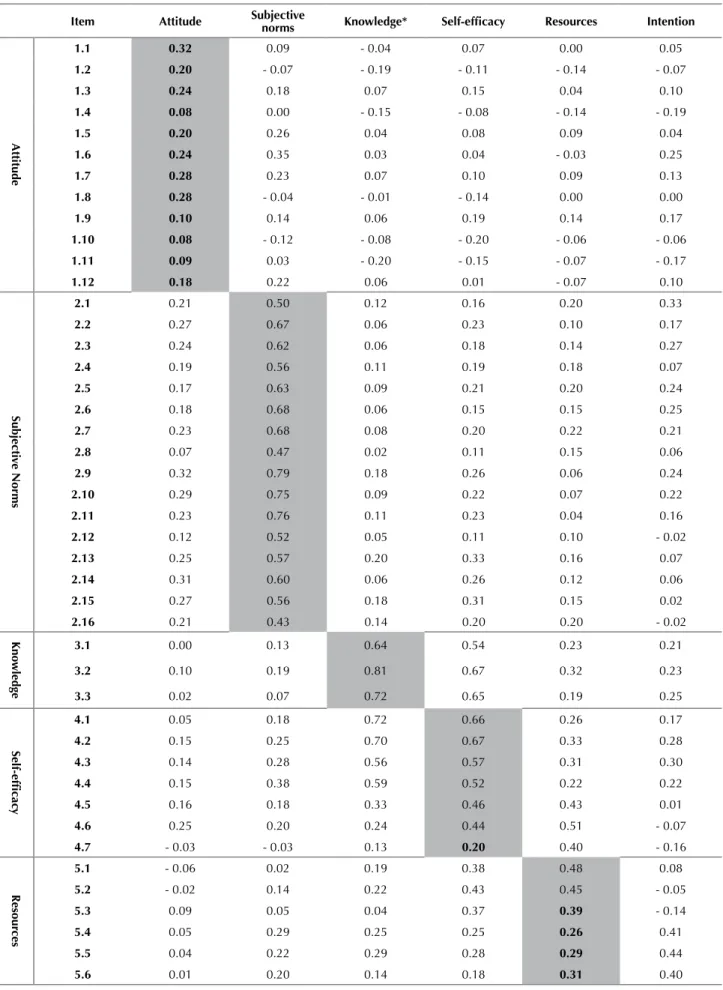
Pearson’s linear correlation coeicient values were cal-culated by the MTMM analysis between the items of the instrument and each of its subscales for analysis of the con-vergent construct validity, as described in Table 3.
Table 2 – Reliability analysis of the ACPETS tool through test-retest reproducibility – Uberlândia, MG, Brazil, 2014.
Subscale ICC p
Attitude 0.327 0.037*
Subjective norms 0.542 0.004**
Perceived behavioral control
Knowledge 0.504 0.001**
Self-eficacy 0.727 0.000**
Resources 0.382 0.016*
Intention 0.301 0.049*
Jansen AC, Marziale MHP, Santos CB, Dantas RAS, Santos DMSS
Table 3 – Pearson’s linear correlation coefficient between the items and the six subscales of the ACPETS tool obtained by MTMM – Uberlândia, MG, Brazil, 2014 analysis.
Item Attitude Subjective norms Knowledge* Self-eficacy Resources Intention
Attitude
1.1 0.32 0.09 - 0.04 0.07 0.00 0.05
1.2 0.20 - 0.07 - 0.19 - 0.11 - 0.14 - 0.07
1.3 0.24 0.18 0.07 0.15 0.04 0.10
1.4 0.08 0.00 - 0.15 - 0.08 - 0.14 - 0.19
1.5 0.20 0.26 0.04 0.08 0.09 0.04
1.6 0.24 0.35 0.03 0.04 - 0.03 0.25
1.7 0.28 0.23 0.07 0.10 0.09 0.13
1.8 0.28 - 0.04 - 0.01 - 0.14 0.00 0.00
1.9 0.10 0.14 0.06 0.19 0.14 0.17
1.10 0.08 - 0.12 - 0.08 - 0.20 - 0.06 - 0.06
1.11 0.09 0.03 - 0.20 - 0.15 - 0.07 - 0.17
1.12 0.18 0.22 0.06 0.01 - 0.07 0.10
Subjecti
ve Norms
2.1 0.21 0.50 0.12 0.16 0.20 0.33
2.2 0.27 0.67 0.06 0.23 0.10 0.17
2.3 0.24 0.62 0.06 0.18 0.14 0.27
2.4 0.19 0.56 0.11 0.19 0.18 0.07
2.5 0.17 0.63 0.09 0.21 0.20 0.24
2.6 0.18 0.68 0.06 0.15 0.15 0.25
2.7 0.23 0.68 0.08 0.20 0.22 0.21
2.8 0.07 0.47 0.02 0.11 0.15 0.06
2.9 0.32 0.79 0.18 0.26 0.06 0.24
2.10 0.29 0.75 0.09 0.22 0.07 0.22
2.11 0.23 0.76 0.11 0.23 0.04 0.16
2.12 0.12 0.52 0.05 0.11 0.10 - 0.02
2.13 0.25 0.57 0.20 0.33 0.16 0.07
2.14 0.31 0.60 0.06 0.26 0.12 0.06
2.15 0.27 0.56 0.18 0.31 0.15 0.02
2.16 0.21 0.43 0.14 0.20 0.20 - 0.02
Kno
wledge
3.1 0.00 0.13 0.64 0.54 0.23 0.21
3.2 0.10 0.19 0.81 0.67 0.32 0.23
3.3 0.02 0.07 0.72 0.65 0.19 0.25
Self-eficac
y
4.1 0.05 0.18 0.72 0.66 0.26 0.17
4.2 0.15 0.25 0.70 0.67 0.33 0.28
4.3 0.14 0.28 0.56 0.57 0.31 0.30
4.4 0.15 0.38 0.59 0.52 0.22 0.22
4.5 0.16 0.18 0.33 0.46 0.43 0.01
4.6 0.25 0.20 0.24 0.44 0.51 - 0.07
4.7 - 0.03 - 0.03 0.13 0.20 0.40 - 0.16
Resour
ces
5.1 - 0.06 0.02 0.19 0.38 0.48 0.08
5.2 - 0.02 0.14 0.22 0.43 0.45 - 0.05
5.3 0.09 0.05 0.04 0.37 0.39 - 0.14
5.4 0.05 0.29 0.25 0.25 0.26 0.41
5.5 0.04 0.22 0.29 0.28 0.29 0.44
Validation of the Comply with Post-Exposure Management Among Health Care Workers Instrument for Brazil
For analysis of the divergent construct validity accord-ing to the MTMM analysis, the percentage of times when the linear correlation between an item with the subscale to which it belongs is greater or statistically greater than its linear correlation with a subscale to which it does not belong was veriied and called “adjustment”. To verify the
validity of a divergent construct, we consider the concentra-tion of the percentages obtained with the sum of values 1 and 2, meaning the items that present signiicantly larger correlations, or only larger correlations with their subscale than with other dimensions. Table 4 presents the values for the divergent construct analysis obtained by the MTMM. ...continuation
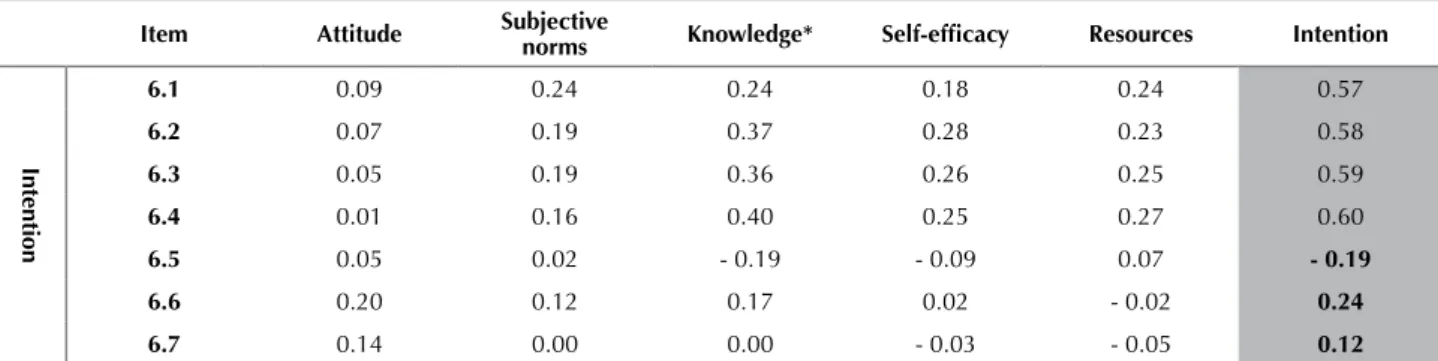
Item Attitude Subjective norms Knowledge* Self-eficacy Resources Intention
Intention
6.1 0.09 0.24 0.24 0.18 0.24 0.57
6.2 0.07 0.19 0.37 0.28 0.23 0.58
6.3 0.05 0.19 0.36 0.26 0.25 0.59
6.4 0.01 0.16 0.40 0.25 0.27 0.60
6.5 0.05 0.02 - 0.19 - 0.09 0.07 - 0.19 6.6 0.20 0.12 0.17 0.02 - 0.02 0.24 6.7 0.14 0.00 0.00 - 0.03 - 0.05 0.12
(*) he values are grouped in “item plots”, according to the description presented in the item Material and Methods.
Table 4 – Adjustment values resulting from the MTMM analysis for the ACPETS tool scores – Uberlândia, MG, Brazil, 2014
Attitude* Subjective norms Knowledge Self-eficacy Resources Intention nº** % nº* % nº* % nº* % nº* % nº* %
-2 0 0 0 0 0 0 1 2.9 0 0 5 14.3
-1 17 28.3 0 0 0 0 4 11.4 5 16.7 0 0
1 25 41.7 1 1.3 3 20 7 20.0 10 33.3 8 22.9
2 18 30.0 79 98.8 12 80 23 65.7 15 50.0 22 62.9
Adjustment 71.7 100 100 85.7 83.3 85.8
(*) Values obtained after recoding three items (1.8, 1.10 and 1.11). (**) Number of comparisons made.
DISCUSSION
he sociodemographic characteristics of the participants in this study are similar to those of the nursing workforce in Brazil,as disclosed by the Federal Nursing Council (COFEn)(18), in which the majority of the professionals are
female (87.2%), single (49.3%) or married (34.6%), with a large number of subjects concentrated in the 26-35 age group (36.0%) and from 36 to 45 years (27.2%). It should be noted that similar results were also obtained in other studies(6,19).
he predominance of technical level education is justi-ied by the large number of professionals in this category (52.6%) in the study. According to the data analyzed by the COFEn study(18), the category of nursing technicians is the
most prevalent among all professional nursing categories in all Brazilian geographic regions, accounting for 43.2% of the total number of nursing professionals in Brazil.
In a study that aimed to evaluate the conduct of nursing professionals who were exposed to biological material at a specialized hospital in the interior of São Paulo, 56.8% of the injured professionals had completed secondary education, 30.4% had completed post-secondary education and 8.4% were attending post-secondary education(9).
Concerning the results on the existence of loor and ceil-ing efects in each of the subscales in the present study, the ceiling efect was identiied in the Self-eicacy (31.4%) and in the Intention (39.4%) subscales, contributing to a
decrease in the instrument’s responsiveness, as study par-ticipants who opted for the higher values in these two sub-scales may not be diferentiated from each other, and changes over time may not be attributed to possible interventions, but rather to the presence of these efects. In addition, the presence of these efects indicates losses in the upper limits of these subscales, thus impairing the maintenance of the instrument’s content validity.
No studies related to instrument validation in the area of worker’s health were found which evaluated responsive-ness through loor and ceiling efects. he presence of these efects was also veriied in other instrument validation stud-ies for Brazil(20-23), using other thematic approaches related
to the health area and carried out using patient or health professional samples.
he obtained Cronbach’s alpha results indicated coef-icients above 0.70 for most subscales, with the exception of the Attitude subscale (0.50). We highlight that 0.70 is the reference value for internal consistency(14). he other
subscales presented Cronbach’s alpha values ranging from 0.81 to 0.91, indicating good internal consistency of the subscale items. Regarding the Knowledge subscale, the obtained Kuder-Richardson coeicient was 0.37, which is considered unsatisfactory.
Jansen AC, Marziale MHP, Santos CB, Dantas RAS, Santos DMSS
RESUMO
Objetivo: Validar para o Brasil o instrumento Comply with post-exposure management among health care workers para a enfermagem. Método:
Estudo metodológico realizado com 137 proissionais de enfermagem expostos a material biológico. Analisou-se a existência dos efeitos loor e ceiling e avaliou-se a idedignidade pela consistência interna dos itens e estabilidade da medida (teste-reteste). Analisou-se a validade de construto por meio da análise multitraço-multimétodo. Resultados: Veriicaram-seefeitos ceiling em duas subescalas. O resultado da consistência interna, de quatro subescalas, variou entre 0,81 e 0,91, resultados considerados satisfatórios, e duas subescalas apresentaram resultado insatisfatório (0,50 e 0,37). A avaliação da estabilidade da medida obteve resultados positivos em relação à signiicância estatística, com valores do Coeiciente de Correlação Intraclasse, entre as duas medidas, variando de 0,301 a 0,727; conirmou-se a validade de construto convergente e divergente por meio da análise multitraço-multimétodo, exceto a subescala Atitude, que apresentou valores insatisfatórios. Conclusão: Oinstrumento apresenta resultados satisfatórios de validade e idedignidade, excluindo-se a dimensão Atitude.
DESCRITORES
Exposição a Agentes Biológicos; Enfermagem; Intenção; Saúde do Trabalhador; Estudos de Validação.
RESUMEN
Objetivo: Validar en Brasil el instrumento Comply with post-exposure management among health care workers para la enfermería.
Método: Estudio metodológico realizado con 137 profesionales de enfermería expuestos a material biológico. Se analizó la existencia author states that even well-developed measures on attitude,
subjective norms, perceived behavioral control and intention in relation to a behavior of interest rarely have reliability values higher than 0.75 or 0.80.
he results obtained in verifying the instrument’s test-retest reproducibility were considered positive in relation to its statistical signiicance, since the agreement values between the two measures ranged from 0.301 to 0.727, and three subscales presented weak agreement values, two moderate agreement values and one substantial agreement value(15).
Considering that the assessment of an instrument’s sta-bility implies verifying similar responses in repeated mea-sures performed with the same subjects(14), we can infer that
changes in the responses obtained for the subscales which presented low concordance values (Attitude, Resources
and Intent) found in this study occurred due to the 30-day time interval adopted between the two collections, although higher values were also identiied.
he main problem of reliability testing through the test-retest approach is that many traits of interest, such as attitudes, mood, and knowledge, can be modiied by expe-riences between the two measures, regardless of instru-ment stability(25).
he results of the divergent and convergent construct validity, veriied by Pearson’s linear coeicient accord-ing to the MTMM analysis, were expressive. he authors of the original instrument validation study did not per-form this analysis.
In the convergent construct validity analysis through comparison of the linear correlations between an item and its subscale(17), we found that the results were
satisfac-tory for most subscales, except for the Attitude subscale (all items with lower values of 0.40), and some items of the Self-eicacy, Resources and Intention subscales. By grouping the items carried out in the Knowledge subscale, the convergent construct validity analysis was undertaken with 51 items; among these, coeicients were superior to 0.40 for 31, corresponding to 60.8% of the instrument. Of the total items, only one presented a negative correlation value (6.5), indicating inconsistency between this item and its subscale.
For the divergent construct validity analysis, the com-parison was made between the linear correlations between an item and the subscale to which it does not belong(17).
he percentages of items that showed higher correlations with their respective subscales and higher signiicance sur-passed the correlations of these items with other subscales of the adapted instrument, indicating that the instrument distinguishes the subjects according to the scores in the dimensions involved in TPB. he best results for construct validity occurred for the Subjective Norms and Knowledge
subscales with 100% adjustment, and four with adjustment values between 85.8 and 71.7%.
Results close to those reported in this study have also been found in instrument validation studies which also used MTMM analysis on samples of chronic patients(21, 26).
he sample size can be considered a limitation of this study, which despite including all the eligible target popula-tion did not allow for accomplishing a conirmatory factorial analysis, which is necessary to verify its dimensionality.
CONCLUSION
he ACPETS tool presents satisfactory validity and reli-ability results, apart from the Attitude dimension, which presented unsatisfactory results from the performed psy-chometric analyses.
Validation of the Comply with Post-Exposure Management Among Health Care Workers Instrument for Brazil
de los efectos loor y ceiling y se valoró la idedignidad por la consistencia interna de los ítems y la estabilidad de la medida (test-retest). Se analizó la validez de constructo por medio del análisis multibrazo-multimétodo. Resultados: Se veriicaronefectos ceiling en dos subescalas. El resultado de la consistencia interna, de cuatro subescalas, varió entre 0,81 y 0,91, resultados considerados satisfactorios, y dos subescalas presentaron resultado insatisfactorio (0,50 y 0,37). La evaluación de la estabilidad de la medida obtuvo resultados positivos con relación a la signiicación estadística, con valores del Coeiciente de Correlación Intraclase, entre ambas medidas, variando de 0,301 a 0,727; se conirmó la validez de constructo convergente y divergente mediante el análisis multibrazo-multimétodo, excepto la subescala Actitud, la que presentó valores insatisfactorios. Conclusión: Elinstrumento presenta resultados satisfactorios de validez y idedignidad, excluyéndose la dimensión Actitud.
DESCRIPTORES
Exposición a Agentes Biológicos; Enfermería; Intención; Salud Laboral; Estudios de Validación.
REFERENCES
1. Magagnini MAM, Rocha AS, Ayres JA. O signiicado do acidente de trabalho com material biológico para os proissionais de enfermagem. Rev Gaúcha Enferm. 2011;32(2):302-8. DOI: 10.1590/S1983-14472011000200013
2. Valim MD, Marziale MHP, Hayashida M, Richart-Martínez M. Occurrence of occupational accidents involving potentially contaminated biological material among nurses. Acta Paul Enferm. 2014;27(3):280-6. DOI: 10.1590/1982-0194201400047
3. Cavalcante CAA, Cavalcane EFO, Macêdo MLAF, Cavalcante ES, Medeiros SM. Acidentes com material biológico em trabalhadores. Rev Rene. 2013;14(5):971-9.
4. Engin DO, Inan A, Ceran N, Demir ZA, Dagli O, Karagul E, et al. Occupational exposures among healthcare workers: a teaching hospital sample. J Microbiol Infect Dis. 2014;4(2):64-68.
5. Markovic-Denic L, Maksimovic N, Marusic V, Vucicevic J, Ostric I, Djuric D. Occupational exposure among healhcare workers: a teaching hospital sample. Med Princ Pract. 2015; 24(1):36-41. DOI: 10.1159/000368234
6. Marziale MHP, Rocha FLR, Robazzi MLCC, Cenzi CM, Santos HEC, Trovó MEM. Organizational inluence on the occurrence of work accidents involving exposure to biological material. Rev Latino Am Enfermagem. 2013;21(n.spe):199-206. DOI: 10.1590/S0104-11692013000700025
7. Oliveira AC, Paiva MHRS. Analysis of occupational accidents with biological material among professionals in pre-hospital services.Rev Latino Am Enfermagem. 2013;21(1):309-15. DOI: 10.1590/S0104-11692013000100004
8. Paiva MHRS, Oliveira AC. Fatores determinantes e condutas pós-acidente com material biológico entre proissionais do atendimento pré-hospitalar.Rev Bras Enferm. 2011;64(2):268-73. DOI: 10.1590/S0034-71672011000200008
9. Pimenta FR, Ferreira MD, Gir E, Hayashida M, Canini SRMS. Care and specialized clinical follow-up of nursing professionals who have been victims of accidents with biological material. Rev Esc Enferm USP. 2013;47(1):194-200. DOI: 10.1590/S0080-62342013000100025
10. Amaral PM, Tavares-Neto J. Exposição ocupacional a material biológico por pessoal de saúde: construção e proposição de instrumentos avaliativos. Rev Bras Saúde Ocup. 2010;35(121):131-47. DOI: 10.1590/S0303-76572010000100015
11. Ko NY, Yeh SH, Tsay SL, Ma HJ, Chen CH, Pan SM, et al. Intention to comply with post-exposure management among nurses exposed to blood and body luids in Taiwan: application of the theory of planned behavior. J Hosp Infect. 2011;77(4):321-6. DOI: 10.1016/j. jhin.2010.09.025
12. Jansen AC, Marziale MHP, Santos CB, Dantas RAS, Ko NY. Assessment of adherence to post-exposure conducts among health workers: translation and cultural adaptation of an instrument. Texto Contexto Enferm. 2015;24(3):670-9. DOI: 10.1590/0104-07072015011010014
13. Laros JA. O uso de análise fatorial: algumas diretrizes para pesquisadores. In: Pasquali L, organizador. Análise fatorial para pesquisadores. Brasília: LabPAM; 2005. p. 163-84.
14. Terwee CB, Bot SD, de Boer MR, van der Windt DA, Knol DL, Dekker J, et al. Quality criteria were proposed for measurement properties of health status questionnaires. J Clin Epidemiol. 2007;60(1):34-42. DOI: 10.1016/j.jclinepi.2006.03.012
15. McDowell I, Newell C. Measuring health: a guide to rating scales and questionnaires. 2nd ed. New York: Oxford U Pr; 1996.
16. Hays RD, Hayashi T, Carson S, Ware JE Jr. User’s guide for the Multitrait Analysis Program (MAP) [Internet]. California: Rand Corporation; 1988 [cited 2016 Apr 12]. Available from: https://www.rand.org/content/dam/rand/pubs/notes/2007/N2786.pdf
17. Fayers PM, Machin D. Quality of life: the assessment, analysis and interpretation of patient-reported outcomes. Chichester, England: John Wiley & Sons; 2007.
18. Conselho Federal de Enfermagem (COFEn); Comissão de Business Intelligence. Produto 2: análise de dados dos proissionais de enfermagem existentes nos Conselhos Regionais [Internet]. Brasília; 2011 [citado 2016 mar. 30]. Disponível em: http://www.cofen.gov.br/wp-content/ uploads/2012/03/pesquisaproissionais.pdf
19. Beltrame V, Engel R, Comandulli VT, Steffani JA. Cuidado à saúde de quem cuida da saúde. Acidentes ocupacionais com exposição à material biológico ocorridos em municípios da região sul do Brasil e notiicados no SINAN nos anos de 2010 a 2012. Rev Bras Med [Internet]. 2015 [citado 2016 abr. 12];72(8). Disponível em: http://www.moreirajr.com.br/revistas.asp?id_materia=6204&fase=imprime
20. Santos DMSS, Deon KC, Fegadolli C, Reis RA, Torres LAGMM, Bullinger M, et al. Cultural adaptation and initial psychometric properties of the DISABKIDS® – Cystic Fibrosis Module – Brazilian version. Rev Esc Enferm USP. 2013;47(6):1311-7. DOI:
10.1590/S0080-623420130000600009
Jansen AC, Marziale MHP, Santos CB, Dantas RAS, Santos DMSS
22. Schmidt DRC, Dantas RAS. Analysis of validity and reliability of the adapted portuguese version of Antonovsky’s Sense of Coherence Questionnaire among nursing professionals. Rev Latino Am Enfermagem. 2011;19(1):42-9. DOI: 10.1590/S0104-11692011000100007
23. Xavier ATF, Foss MC, Marques Junior W, Santos CB, Onofre PTBN, Pace AE. Cultural adaptation and validation of the Neuropathy - and Foot Ulcer – Speciic Quality of Life instrument (NeuroQol) for Brazilian Portuguese - Phase 1. Rev Latino Am Enfermagem. 2011;19(6):1352-61. DOI: 10.1590/S0104-11692011000600011
24. Ajzen I. The theory of planned behaviour: reactions and reflections. Psychol Health. 2011;26(9):1113-27. DOI: 10.1080/08870446.2011.613995
25. Polit DF, Beck CT. Fundamentos de pesquisa em enfermagem: avaliação de evidências para a prática da enfermagem. 7ª ed. Porto Alegre: Artmed; 2011.
26. Deon KC, Santos DMSS, Bullinger M, Santos CB. Preliminary psycometric assessment of the Brazilian version of the DISABKIDS® Atopic Dermatitis Module. Rev Saúde Pública. 2011;45(6):1072-8. DOI: 10.1590/S0034-89102011005000067