www.bjorl.org
Brazilian
Journal
of
OTORHINOLARYNGOLOGY
ORIGINAL
ARTICLE
P300
in
individuals
with
sensorineural
hearing
loss
夽
Ana
Cláudia
Mirandola
Barbosa
Reis
a,∗,
Ana
Claudia
Figueiredo
Frizzo
b,
Myriam
de
Lima
Isaac
a,
Cristiane
Fregonesi
Dutra
Garcia
c,
Carolina
Araújo
Rodrigues
Funayama
a,
Maria
Cecília
Martinelli
Iório
daFaculdadedeMedicinadeRibeirãoPreto(FM-RP),UniversidadedeSãoPaulo(USP),SãoPaulo,SP,Brazil bUniversidadeEstadualPaulista(UNESP),SãoPaulo,SP,Brazil
cUniversidadeFederaldoRiodeJaneiro(UFRJ),RiodeJaneiro,RJ,Brazil
dEscolaPaulistadeMedicina(EPM),UniversidadeFederaldeSãoPaulo(UNIFESP),SãoPaulo,SP,Brazil
Received9October2013;accepted22March2014 Availableonline18October2014
KEYWORDS
Event-related potentials,P300; Electrophysiology; Auditoryevoked potentials; Hearingloss; Auditorycortex
Abstract
Introduction:Behavioralandelectrophysiologicalauditoryevaluationscontributetothe under-standingoftheauditorysystemandoftheprocessofintervention.
Objective:TostudyP300insubjectswithsevereorprofoundsensorineuralhearingloss.
Methods:Thiswasadescriptivecross-sectionalprospectivestudy.Itincluded29individualsof bothgenderswithsevereorprofoundsensorineuralhearinglosswithoutothertypeofdisorders, aged11to42years;allwereassessedbybehavioralaudiologicalevaluationandauditoryevoked potentials.
Results:A recordingoftheP3wavewasobtainedin17individuals, withameanlatencyof 326.97msandmeanamplitudeof3.76V.Thereweresignificantdifferencesinlatencyinrelation toageandinamplitudeaccordingtodegreeofhearingloss.Therewasastatisticallysignificant associationoftheP300resultswiththedegreesofhearingloss(p=0.04),withthepredominant auditorycommunicationchannels(p<0.0001),andwithtimeofhearingloss.
Conclusions:P300 canbe recorded inindividualswith severeand profoundcongenital sen-sorineuralhearingloss;itmaycontributetotheunderstandingofcorticaldevelopmentandis agoodpredictoroftheearlyinterventionoutcome.
© 2014Associac¸ãoBrasileira de Otorrinolaringologiae CirurgiaCérvico-Facial. Publishedby ElsevierEditoraLtda.Allrightsreserved.
夽
Pleasecitethisarticleas:ReisAC,FrizzoAC,IsaacML,GarciaCF,FunayamaCA,IórioMC.P300inindividualswithsensorineuralhearing loss.BrazJOtorhinolaryngol.2015;81:126---32.
∗Correspondingauthor.
E-mail:[email protected](A.C.M.B.Reis). http://dx.doi.org/10.1016/j.bjorl.2014.10.001
PALAVRAS-CHAVE
Potencialevocado P300;
Eletrofisiologia; Potenciaisevocados auditivos;
Perdaauditiva; Córtexauditivo
P300emindivíduoscomperdaauditivasensorioneural
Resumo
Introduc¸ão: Asavaliac¸ões comportamentais e eletrofisiológicasauditivas contribuem para o entendimentodosistemaauditivoedoprocessodeintervenc¸ão.
Objetivo: EstudarP300emindivíduoscomperdaauditivasensorioneuralseveraouprofunda.
Método: Estudoprospectivo transversaldescritivo. Participaram29 indivíduos,de ambosos sexos,comidadeentre18e45anoscomperdaauditivasensorioneural,congênitaseveraou profundaesemcomorbidades,avaliadospormeiodeavaliac¸ãoaudiológicacomportamentale potencialevocadoauditivodelongalatência.
Resultados: oregistrodaondaP3foiobtidoem17indivíduos,comlatênciaeamplitudemédia de326,97mse3,76V,respectivamente.Houvediferenc¸assignificativasdamedidadelatência emrelac¸ãoàidadeedaamplitudesegundoograudaperdaauditiva.Evidenciou-seassociac¸ão doresultadodoP300aosgrausdeperdaauditiva(p=0,04)eaocanaldecomunicac¸ãoauditiva predominante(p=0,0001)eaotempodeprivac¸ãoauditiva(testeexatodeFisher).
Conclusões: P300podeserregistradoem indivíduoscomperdaauditivasensorioneural con-gênitaecolaborarparaacompreensãododesenvolvimentocorticalauditivoeserpreditordo resultadodaintervenc¸ão.
©2014Associac¸ãoBrasileiradeOtorrinolaringologiaeCirurgiaCérvico-Facial.Publicado por ElsevierEditoraLtda.Todososdireitosreservados.
Introduction
Thereisalonghistoryofinvestigationofthefunctionofthe auditorysystem,thedisordersthataffectitandintervention strategiestomitigatetheilleffectsofthosedisorders.
Increasingly, investigators have studied the peripheral andcentralauditorysystemusingobjectiveandnon-invasive techniques, such as behavioral tests that assess auditory processing,aswellaselectrophysiologicalevaluation, prin-cipallyauditoryevokedpotentials(AEPs).1---10
The auditory event-related evoked potential (P300) provides an objective measure of central auditory func-tion,asitreflectsthecorticalelectrophysiologicalactivity involvedinattention,discrimination,memory,integration, anddecision-makingskills.11
The few reports in the literature that have recorded corticalauditoryevent-relatedevokedpotentials(P300)in individuals with hearing loss frequently consist of only a smallnumberofindividuals,andthesestudieshavereported divergentresults.
Peripheralhearinglosscanindirectlyaffectrecordingsof thelatencyoftheP3andtheN1---P2---N2complex.Another factorthatimpactstheresultsofP300recordingsisa dif-ferenceinhearingthresholdsattwofrequencies,commonly observedintheelderlyandinhearinglosswithadescending pattern.12
However, a peripheral hearing loss does not invalidate theuseofthismeasure,aslongastheindividualiscapable ofperceivingthestimulus.13
Latencymeasuresareknowntobesensitiveindicatorsin individualswithhearinglossandthedegreeofhearingloss can affect the amplitudes of the componentsof auditory evokedpotentials(AEPs)indifferentways.
Age can also influence latency measures, ascan other factors. Valuesclose to350ms areconsidered normal for the P300latency in adultsyounger than 45 yearsof age;
afterthatage,ithasbeenproposedtoadd10msforeach decadeoflife.14---16
The aim of this study was to investigate the auditory evokedpotentialP300inindividualswithseveretoprofound congenitalhearinglossandtocorrelatetheresultswithage, gender,degreeofhearingloss,timeofauditorydeprivation, andthepredominantcommunicationmodality(auditoryor visual).
Methods
Thiswasadescriptive,contemporary,cross-sectionalcohort study.Thestudywasapprovedbytheresearchethics com-mitteeofapublicuniversityinthestateofSãoPaulo---SP (protocol#1011/01).Allparticipantsorguardiansreceived an invitationletter withinformationabout the study and signedtheinformedconsent.
A total of 29 individuals (15 males and 14 females), betweenthe agesof 18and 45 years,participatedin the study.The inclusion criteria were: adult subjects of both genders, aged 18---45 years, with, bilateral, symmetric, prelingual, severe-to-profound sensorineural hearing loss, exhibitinghearingthresholdsbetween70and90dBHLinat leasttwofrequenciesinbothearsandwithnoother disor-dersorevidenceofcentralauditoryhearingimpairment.
Initially,areviewofthemedicalrecordsandastructured interviewwereperformedtoobtainpersonaldatarelatedto thesubject’shistoryandtypeofrehabilitation.Behavioral, audiological,and impedanceassessmentswere performed toensurethesubjects’eligibility.
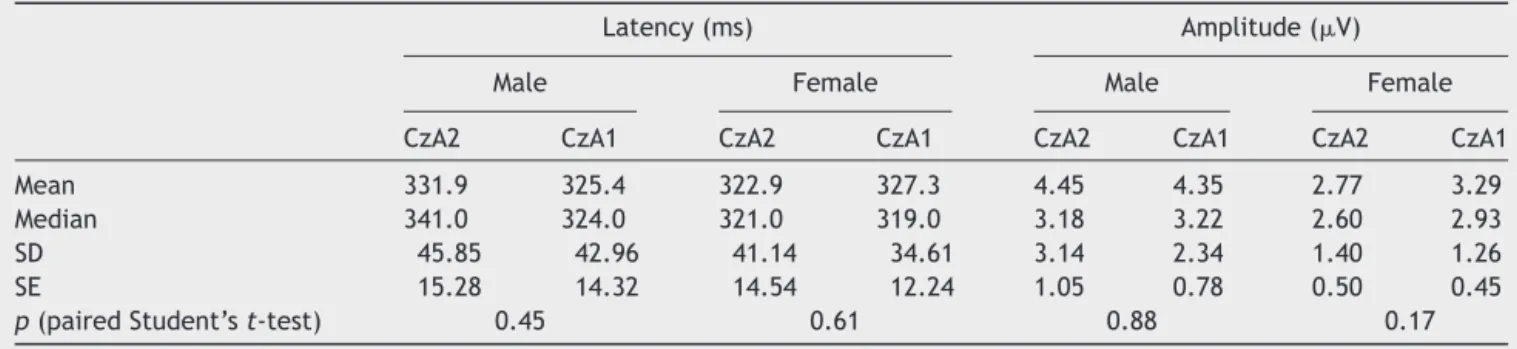
Table1 Descriptiveanalysisofamplitude(V)andlatency(ms)ofP300accordingtogender.
Latency(ms) Amplitude(V)
Male Female Male Female
CzA2 CzA1 CzA2 CzA1 CzA2 CzA1 CzA2 CzA1
Mean 331.9 325.4 322.9 327.3 4.45 4.35 2.77 3.29
Median 341.0 324.0 321.0 319.0 3.18 3.22 2.60 2.93
SD 45.85 42.96 41.14 34.61 3.14 2.34 1.40 1.26
SE 15.28 14.32 14.54 12.24 1.05 0.78 0.50 0.45
p(pairedStudent’st-test) 0.45 0.61 0.88 0.17
electrode),and theearlobes(referenceelectrode:A1=LE andA2=RE),accordingtotheInternational10-20System,17
andheadphoneswereused(TDH-39).
For the electrophysiological assessment, we required that each electrode have an impedance ≤3k and the
impedancebetweenelectrodepairswas<3k.The exami-nationwasperformedwiththevolunteerinsupineposition, in a quiet environment. The volunteer was instructed to remainas quiet aspossible, with eyesdirected at a spe-cificpoint in the room,and topay attention todifferent stimulithat occurred infrequently and randomly amonga seriesof similarand much morefrequent stimuli.At this stageoftheexamination,weverifiedthattheparticipants understoodthenatureofthetestinordertoavoiddegrading theresults.ForindividualswhousedBrazilianSignLanguage (LínguaBrasileiradeSinais[LIBRAS])andrequiredan inter-preter,thetestwasscheduledonaspecificdatetoensure thepresenceoftheinterpreterandcomprehensionofthe testbytheparticipant.
Allparticipantshadundergonechildhood phonoaudiolog-icalrehabilitation programsand thefitting of hearing aid amplificationbilaterally,duringtheprocessofintervention withoral method.ThesubjectswhousedLIBRAS acquired thislanguageskillinadulthood.
Each participantwas instructed regardingcare related tovariablesthatcouldhaveanimpactoncognitive poten-tialresults,18---21suchasavoidingmedications24hbeforethe
test,and,inthefourhourspriortotheexamination, avoid-ingstrenuousphysicalormentalactivity,smokingortheuse ofstimulantssuchastea,coffee,orchocolate,andtheuse offacialcreamorhairgel.
Each participant was asked to respond to the test by slightlyraisingtheindexfingerastheappropriateresponse tothe detection of the uncommon stimulus each time it appeared.
Beforeinitiating therecording,thesubjectwasgivena trainingsessionof stimuli,andcounseled thatthe uncom-monstimulicouldtaketimetoappear,orcouldappearafter onlyaverybrieftimeinterval.Aftertheexposureand train-ingtimetoensurethesubject’sunderstanding,thetestwas initiatedandtherecordingwasmade.
ThestimulusintensityfortheelicitationofP300ranged from20to25dBSL(decibelsensationlevel,i.e.,20---25dBSL abovetheauditorythresholdforthefrequencyused)forthe frequencies used in the frequent and uncommon stimuli, to facilitate detection of auditory stimuli by the study participant. If this level of stimulus presentation caused
discomfort, the highest level of comfort reportedby the patientatwhichheorshecoulddetectthesoundwasused. Thefollowingparameterswereusedfortheacquisitionof P300:binauralacousticstimuli(toneburstswith50ms dura-tion,withplateauof30msandarise/falltimeof10ms)of lowfrequency,presentintheassessedsubjectforthe fre-quentstimulus(probabilityof80%)andahigher,uncommon stimulus (probability of 20%). The frequency and inten-sity ofboth thefrequent andtheuncommon stimuliwere selectedbythepuretoneaudiometry,i.e.,frequencieswith detectable thresholds. The stimulus intensity also varied accordingtothefrequencyusedandthehearingthreshold, makingsurethatthestimuliwerealwayssuprathreshold.
Three-hundred artifact-free stimuli (approximately 60 uncommon and240 frequent stimuli)wereused toobtain thepotentials.Thefiringfrequencyorrateofpresentation wasonestimuluspersecond.
The N1,N2,and P2complexwasnot analyzed, asthe physical characteristics of the stimulus were adjusted to individual needs as described above. After ensuring the detectionofstimulibytheassessedindividuals,theN1,P2, andN2complexappearedinthe29studiedsubjects.
Themarkingsofthetracingusedtoobtaintheamplitude andlatencyofP300wereperformedbythreeprofessionals withexperienceinelectrophysiology.Whenthetracingwas considereddifficulttoanalyze,i.e.,therewasnoagreement concerningthemarking,itwasdiscussedbythe profession-alsuntilaconsensuswasattained.
The statistics used in the comparison of the groups formedduringthecourseofthepresentstudyfollowedthe literatureguidelines22,23 andthesignificancelevelwasset
at5%(p<0.05).Significantresultsareshowninbold.
Results
We were successful in recording the P300 component in 58.6%ofthesubjectsstudied(n=29).
Thecomparisonoftheamplitudeandlatencyvaluesof the P300component,withappropriate statistical descrip-tion for each study group considering gender, is shown in
Table1.Itcan beobservedthattherewasnostatistically significantdifferencebetweengenders.
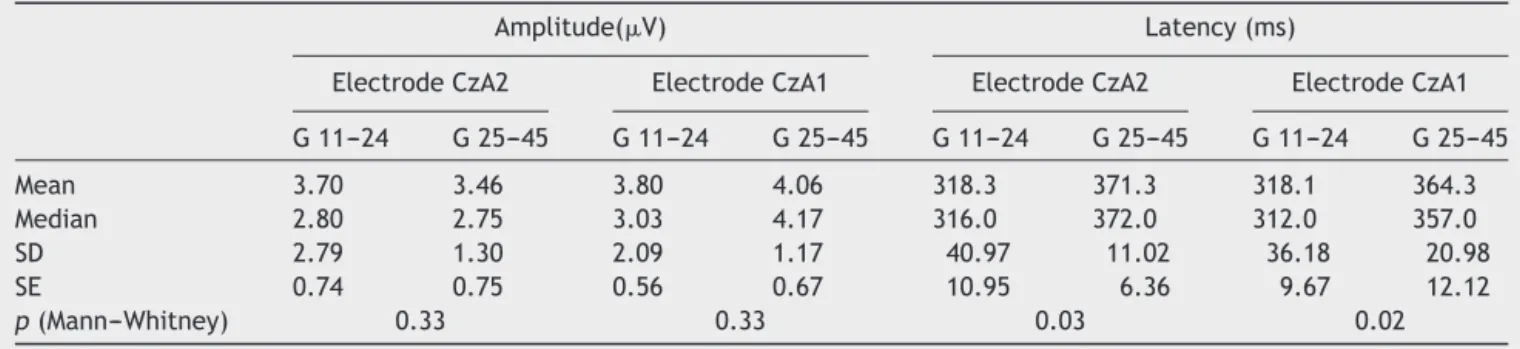
Table2 Amplitudevalues(V)andlatency(ms)fortheP300componentconsideringtwogroupsaccordingtotheagerange (11---24yearsand25---45years).
Amplitude(V) Latency(ms)
ElectrodeCzA2 ElectrodeCzA1 ElectrodeCzA2 ElectrodeCzA1
G11---24 G25---45 G11---24 G25---45 G11---24 G25---45 G11---24 G25---45
Mean 3.70 3.46 3.80 4.06 318.3 371.3 318.1 364.3
Median 2.80 2.75 3.03 4.17 316.0 372.0 312.0 357.0
SD 2.79 1.30 2.09 1.17 40.97 11.02 36.18 20.98
SE 0.74 0.75 0.56 0.67 10.95 6.36 9.67 12.12
p(Mann---Whitney) 0.33 0.33 0.03 0.02
Table3 Descriptivemeasuresoflatencies(ms)and ampli-tude (V) of P300, according to the variable degree of hearingloss.
Amplitude(V) Latency(ms)
Profound Severe Profound Severe
Mean 2.69 5.98 331.0 318.5
Median 2.80 5.24 322.0 322.0
SD 1.00 2.49 39.75 40.35
SE 0.21 0.75 8.29 12.17
p(Mann---Whitney) 0.0015 0.40
differencewasobservedinamplitudeforthedegreeof hear-ingloss,asshowninTable3.
Fisher’s exacttest showedan association between the presence or absenceof P300withtimeof auditory depri-vation (Fig. 1) and the periods of auditory stimulation initiation,i.e.,thecriticalperiodsforauditoryperception development, when comparing a group with intervention before5yearsofageandthegroupthatstartedthe inter-ventionafterthisage.
Thechi-squaredtestshowedanassociationoftheresult tothepredominantauditorycommunicationmodalitywith thepresenceofP3(p<0.0001)(Fig.2).
Present P300
≥ 5 years
0 5 10
< 5 years
Absent P300
Figure1 Associationbetween P300 andpatientage atthe timeofthebeginningoftherehabilitationprocess.
Predominant auditory channel 16
14
12
10
8
6
4
2
0
Predominant visual channel
Absent P300 Present P300
Figure2 Percentagedistributionoftheabsenceorpresence ofP300accordingtothevariablepredominantcommunication channel(auditoryorvisual).
Discussion
Nostatisticallysignificantdifferenceswereobservedforthe amplitudemeasurementsrelatedtogenderandage;norfor differencesin latencyrelated togender (Tables 1 and2). Whenlatency measurementswerecomparedin twostudy groups of different ages(Table 2), statistically significant differenceswereobserved,longerlatenciesintheagegroup of25---45yearsthaninthegroupof11---24years,consistent withotherreportsintheliterature.9
Many studies have reported differences in the P300 latency and amplitude among different age ranges.14---16
These studies suggest that maturation is reflected in a variation of the amplitude and latency of P1, N1, and P2components, withan increase in the amplitude and a decreaseinlatencyinyoungerchildren,thatchangeswith maturation. Despite the increasing number of studies on variables such asamplitude, latency, and age, normative dataontheP300responseinchildrenarestillscarce, espe-ciallyinyoungerchildrenandinfants.Forthesepopulations, studiesarebeingconductedwiththerecordingofP3a (pas-siveP300response)15andthelatencyofP1,consideredasa
biomarkerforcentralauditorydevelopmentinchildrenwith hearingimpairment.8
defined.14,24,25Thereisasignificantcorrelationbetweenage
andmaturationoftheauditorysystem,withapproximately a 20ms/year reductionin latency occurring up toage 15 years,26,27 andanincreaseinlatency withfurtheraging,a
findingalsoobservedinthestudiesofFrizzoandJunqueira fortheagegroupof8---36years.28
The effect of aging on P300 response is probably the mostextensivelystudiedvariableinthepastdecades.16,29,30
Thereis noconsensusin the literatureregarding thefact thatagingclearlyaffectsmeasuresoflatencyandamplitude ofP300,butitmustberememberedthatthereisalsogreat variability, both intrinsic (gender, intellectual level, task type,etc.) andextrinsic(stimulus parametersand poten-tial capture method, etc.). among the studies and these willbearupononthespecificconclusionsfordifferentage groupsinthevariousstudies.
Studies have suggested that there is an increase in latencyofapproximately1---2ms/year,adecreasein ampli-tudeinaccordancewithameanof0.2V/year,andalsoa
possibleassociation between age andscalp topographyin themeasurement of P300.31,32 The bestrecordingof
age-relatedchanges in latency and amplitude of P300 occurs whenelectrodesareplacedintheregionofthecentraland parietalgyri(CzandPz),ratherthanwhentheforehead(Fz) andalateralelectrodeareused.32
It should be emphasized that with increasing patient age,professionals shouldbemore carefulwhenrecording P300,asboththresholdsandtheindexofspeech recogni-tionarefactorsthatcommonlychangewithagingand,can bealteredbyimpairmentofeithertheauditoryperiphery orthecentralauditorypathways.Auditorysensitivitymay beadeterminantfactorinreducingtheoccurrenceofthe P300 response with age.16 Thus, these variables must be
controlledin clinical protocolsof evokedpotentials when evaluatingelderlyandyounger adults,andshouldinclude atleastpuretoneaudiometryandspeechaudiometryinthe tests.
Incontrasttoage,genderdidnotappeartobea signifi-cantvariableinthemeasurementsoflatencyandamplitude ofP300.16,33However,therearereportsofgreateramplitude
oftheP3waveandlowerlatencyforwomenover15years
ofage.14,19
Regardingthedegreeofhearingloss,nosignificant differ-encewasobservedinmeanlatencybetweenthetwogroups (severeandprofoundhearingloss).P300valuesweresimilar inbothgroups(Table3),suggestingthatperipheralhearing lossdidnotinvalidatetheuseofthismeasure,aspreviously theorizedintheliterature.1P300cannotberecordedifthe
thresholdsforboththeuncommonandthefrequentstimuli arebelowtheaudibilitythreshold.34P300canbecorrelated
withthedegreeofoverallcognitiveimpairmentratherthan withanyspecificdiagnosis, astheresponseisalteredbya widevarietyofdisordersthataffectcognition.35
One of the proposed uses of the P300 recording is to monitor the effects of an intervention, documented by a reductioninlatency withincreasedcognitivecapacity.36,37
Forthis,P300is useful becauseof oneof itsmore stable parameters,i.e., intra-subject measurement. Some stud-ieshave questioned the effect of peripheral hearing loss ontheseveralcomponentsofthecorticalauditoryevoked potentialassociated withauditory behavioral assessment, astheeffectsofhearinglossonspeechperceptioncapacity,
determinedbyauditorybehavioralassessment,are reason-ablywellknown.6
Whenwe comparedamplitudesin groupsof individuals withsevereandprofound hearingloss(Table3),wenoted a significant difference in the mean amplitude between thetwogroups(p=0.0015).Studieshaveshownthatwhen sensorineural hearing loss increases,thereis asignificant reductioninamplitudeandaprolongationoflatencyforall componentsoftheAEP.6
Wefoundasignificantassociationbetweenthepresence ofP300andtheearliertheageatwhichsubjectsbeganthe rehabilitationprocess(Fig.1),consistentwiththeliterature findings.6,8,38---40
A statistically significant P300 recording (p<0.0001) wasalsorelatedtothepredominantauditory communica-tionmodality (Fig.2).These resultsraise manyintriguing questions that have potential implications for effective adjustmentsinamplificationanddevelopmentof rehabilita-tionstrategiesforindividualswithsensorineurallossesthat stillneedtobeinvestigated.
Insubjectswhocanhear,functionalmagneticresonance imagingdemonstratesthatareasofsoundactivationare rep-resentedbyacomplexinteractivenetworkincludingregions oftheposteriorparietalcortex,dorsolateralprefrontal cor-tex,andinferiorfrontalcortex.
Temporalanalysis suggests that the spatial discrimina-tionof soundbegins in alefttoright direction in regions thatareadjacenttotheprimaryauditorycortex(superior temporalgyrus),whereashemispatialintegrationandthat oftheeccentricareasmayoccurlater.Activationshavebeen identifiedindorsalandventralauditorypathways,whichare presumedto bepreferentiallyrelated tospatial and non-spatial analysis of sound, respectively. Activation findings in the ventral pathways couldotherwise reflect the well-known functionalduality of spectralanalysis,that is, the concurrentextractionofinformationbasedonlocationdue tothespectrotemporaldistortionscausedbytheheadand auricle,aswellasthespectralcharacteristicsofthesound source.41,42
Consideringbrainfunctionsrelatedtosignlanguage,the presentstudyobservedgreateractivationintheleft supe-riortemporalsulcusandgyrus, extendingfurthertoareas ofthesupra-marginalgyrusin signlanguagereaders(both hearingandnon-hearing)thaninnon-readers(hearing).This wouldsuggest animportant roleoftheplanum temporale inanymodeofcommunication, sinceitrespondstovisual motion that occursin theperception of gestures, both in deafindividualsandthosewhocanhear.Itisimportantto remember that in congenital deafness, the role of visual processingismoreimportant.43
Duringtheassessmentofthemeaningofthesignsofhand gestures,theinferiorparietal,superiortemporal,and infe-rior occipito-temporal sulcus regions were simultaneously activatedwiththesametimecourseofelectricalactivityas measuredbymagnetoencephalography,suggesting integra-tionbetweenthedorsalandventralpathwaysofthesuperior temporalsulcus.Anotherfindingwasthemarked predom-inance of right hemisphere participation, suggesting that processingofmanualexpressionissimilartothatofsocial cues,suchasfacialexpression.44
visualcommunication(comparedtothosewhocouldhear), our failure to detect the P300 in subjects with a visual communication modality raises the question of the loca-tionoftheelectrodeonthescalp,whichseemstodeserve furtherinvestigation.The P300amplitudechanges accord-ingtotheplacementofelectrodesinthemidline,typically increasing fromthe frontaltoward theparietal regions.45
Thus, in subjects usingvisual communication, P300 could havehigheramplitude iftheelectrodewereplacedonPz ratherthanCz,astypicallyused.
The predominance of electrical activation in the right hemisphere44 suggests the inversion of the left/right
direction,41 andifthatoccurs,thereareconsequencesfor
thetracingoftheevokedpotentialonthescalp.
ItisnoteworthythattheprocessgeneratingtheP300is modulatedbythelevelofattentionavailableatthetimeof thetesting,andmoredifficulttasksrequiringmore atten-tion,tendtoreducetheamplitudeandincreaselatency.46In
thissense,itcanbespeculatedthatinpatientsusingmanual communication,whenmakingagreaterefforttodetectthe uncommon tone,evenifthe uncommontone isdetected, thepotentialisnotproducedatsufficientamplitudetobe measured.Otherfactorsthatcouldreducetheamplitudeof theP300include:thestimuluswasheardforthefirsttime,47
withoutpriortraining,which didnotoccurinthesubjects ofthisresearch;parietal-temporalintegrityfailure,48which
wasnotassessedhere,andashortintervalbetweenthe tar-get or uncommon stimuli,49 considering that in thisstudy
bothsubjectswithtrainingbyauditorypathwayaswellas visualpathwayhadthesametestpattern.
Conclusions
ThisstudyconcludedthattheP300canberecordedin indi-vidualswithsevereand profoundcongenitalsensorineural hearingloss.
MeasurementsofP300didnotshowanydifferenceswhen compared for age and gender.However, thereare differ-encesin thedegree ofhearingloss (severeandprofound) andthereisanassociationbetweentheabsentandpresent P300 and the subject’s age at the time of the start of the (re)habilitation process, as well as the predominant communicationmodality(auditory-present)oftheassessed subject.
Due to the non-detection of P300 in subjects who predominantly use a visual communication modality, the authorsemphasize theimportanceofresearchinauditory andvisualfunctionsoftheseindividualstoverifythe associ-ationbetweencommunicationdeficitsandthepossibilities ofinterventionrequiredinthispopulation.
Conflicts
of
interest
Theauthorsdeclarenoconflictsofinterest.
References
1.MusiekFE.Probingbrainfunctionwithacousticstimuli.ASHA. 1989;31:100---6.
2.Truy E, Deiber MP, Cinotti L, Mauguière F, Froment JC, Morgon A. Auditory cortex activity changes in long-term
sensorineuraldeprivationduringcrudecochlearelectrical stim-ulation:evaluationbypositronemissiontomography.HearRes. 1995;86:34---42.
3.Ponton C. Possible application of functional imaging of the humanauditorysysteminthestudyofacclimatizationandlate onsetdeprivation.EarHear.1996;17:78---86.
4.BerthezèneY,TruyE,MorgonA,GiardMH,HermierM,Franconi JM,et al.Auditory cortexactivationindeaf subjectsduring cochlearelectricalstimulation---evaluationbyfunctional mag-neticresonanceimaging.InvestRadiol.1997;32:297---301. 5.MiyamotoRT,WongD,PisoniDB, HutchinsG, SehgalM,Fain
R.Positronemissiontomographyincochlearandauditorybrain stemimplantrecipients.AmJOtol.1999;20:596---601. 6.Oates PA, Kurtzberg D, Stapells DR. Effects of
sensorineu-ral hearing loss on cortical event-related potential and behavioral measures of speech-sound processing. Ear Hear. 2002;23:399---415.
7.SchochatE,ScheuerCI,AndradeER.ABRandauditoryP300 find-ingsinchildrenwithADHD.ArqNeuropsiquiatr.2002;60:742---7. 8.SharmaA,MartinK,RolandP,BauerP,SweeneyMH,GilleyP, etal.P1latencyasabiomarkerforcentralauditory develop-mentenchildrenwithhearingimpairment.JAmAcadAudiol. 2005;16:564---73.
9.Sharma A, Gilley PM, Dorman MF, Baldwin R. Deprivation-induced cortical reorganization in children with cochlear implants.IntJAudiol.2007;46:494---9.
10.SharmaA,CardonG,HenionK,RolandP.Corticalmaturation andbehavioraloutcomesinchildrenwithauditoryneuropathy spectrumdisorder.IntJAudiol.2011;50:98---106.
11.KrausN,McGeeT.Potenciaisauditivosde longalatência.In: KatzJ,editor.Tratadodeaudiologiaclínica.SãoPaulo:Manole; 1999.p.403---20.
12.PollockVE,Schneider LS. Effectsoftone stimulus frequency onlatepositivecomponentactivity(P3)amongnormalelderly subjects.IntJNeurosci.1989;45:127---32.
13.McPhersonDL,BallachandaBB,KafW.Middleandlonglatency evokedpotentials.In:RoeserRJ,ValenteM,DunnHH,editors. Audiology:diagnosis.NewYork:Thieme;2008.p.443---77. 14.MartinLJ,BarajasJJ,FernandezR.AuditoryP300
developmen-talinchildhood.ScandAudiol.1989;30:105---9.
15.Polich J, McIsaac HK. Comparison of auditoryP300 habitua-tionfrom activeand passive conditions.IntJPsychophysiol. 1994;17:25---34.
16.StenklevNC,LaukliE.Corticalcognitivepotentialsinelderly persons.JAmAcadAudiol.2004;15:401---13.
17.Jasper HH.Report ofthe committee on methodsof clinical examinationinelectroencephalography.EletroencephalogrClin Neurophysiol.1958;10:370---5.
18.SpirdusoWW.Physicalfitness,agingandpsychomotorspeed:a review.JGerontol.1980;35:850---65.
19.Geisler M, Polich J. P300 and time of day: circadian rhythms, food intake, and body temperature. Biol Psychol. 1990;31:117---36.
20.Dustman RE,Emmerson R, Shearer D.Physicalactivity, age, and cognitive-neuropsychological function.J AgingPhys Act. 1994;2:143---81.
21.PolichJ,KokAB.CognitiveandbiologicaldeterminantsofP300: anintegrativereview.BiolPsychol.1995;41:103---46.
22.SiegelS.Estatísticanão-paramétrica---paraasciênciasdo com-portamento.2nded.SãoPaulo:MakronBooks;1982.
23.TriolaMF.Introduc¸ãoàestatística.9thed.RiodeJaneiro:LTC; 2005.
24.SquiresKC,HecoxKE.Electrophysiologicalevaluationofhigher levelauditoryprocessing.SeminHear.1983;4:415---33. 25.PolichJ,HowardL, StarrA. Agingeffects ontheP300
26.Pearce JW, Crowell DH, Tokioka A, Pacheco GP. Childhood developmentalchangesintheauditoryP300.JChild Neurol. 1989;4:100---6.
27.PictonTW,Durieux-SmithA.Thepracticeofevokedpotential audiometry.OtolaryngolClinNAm.1978;11:263---83.
28.Frizzo ACF, Junqueira CAO, Fellipe ACN, Colafêmina JF. Potenciais evocados auditivos de longa latência no processo maturacional.ActaAWHO.2001;20:74---80.
29.Pfefferbaum A, Ford JM, Roth WT, Kopell BS. Age-related changes in auditory event-related potentials. Eletroen-cephalogrClinNeurophysiol.1980;49:266---76.
30.Polich J. Meta-analysis of P3 normative aging studies. Psy-chophysiology.1996;33:334---53.
31.VescoKK,BoneRC,RyanJC,PolichJ.P300inyoungandelderly subjects:auditoryfrequencyandintensityeffects. Electroen-cephalogrClinNeurophysiol.1993;88:302---8.
32.Fjell AM, WalhovdKB. P300 and neuropsychological testsas measures of aging:scalp topography and cognitivechanges. BrainTopogr.2001;14:25---40.
33.MartinDA,TremblayKL,StapellsDR.Principlesandapplications ofcorticalauditoryevokedpotentials.In:BurkardRF,DonM, EggermontJJ,editors.Auditoryevokedpotentials:basic prin-ciplesandclinicalapplication.Baltimore:LippincottWilliams &Wilkins;2007.p.482---507.
34.HallJ.Handbookofauditoryevokedresponses.Boston:Allyn& Bacon;1992.
35.PictonTW,HillyardSA.Endogenousevent-relatedpotentials.In: PictonT,editor.Handbookofeletroencephalographyand clini-calneurophysiology,3.Amsterdam:Elsevier;1988.p.361---426. 36.GoodinD,SquiresK,StarrA.Variationsinearlyandlate event-relatedcomponentsoftheauditoryevokedpotentialwithtask difficulty.EletroencephalogrClinNeurophysiol.1983;55:680---6. 37.PolichJ,StarrA.Middle,lateandlonglatencyauditoryevoke potentials. In: Moore E, editor. Bases of auditory brainstem evokedresponses.NewYork:Grune&Stratton;1983.p.345---61.
38.Ito J, Sakakibara J, Iwasaki Y, Yonekura Y. Positron emis-sion tomography of auditory sensation in deaf patients and patients with cochlear implants. Ann Otol Rhinol Laryngol. 1993;102:797---801.
39.DémonetJF,PriceC,WiseR,FrackowiakRSJ.Differential acti-vationofrightand leftposteriorsylvian regionsbysemantic andphonologicaltasks:apositron-emissiontomographystudy innormalhumansubjects.NeurosciLett.1994;182:25---8. 40.NaitoY,OkazawaH,HonjoI,TakahashiH,KawanoM,IshizuK,
etal.Corticalactivationduringsoundstimulationincochlear implantusersdemonstratedbypositronemissiontomography. AnnOtolRhinolLaryngolSuppl.1995;166:60---4.
41.LewaldJ,RiedererKA,LentzT,MeisterIG.Processingofsound locationinhumancortex.EurJNeurosci.2008;27:1261---70. 42.HarrisonJ,BuchwaldJ,KagaK.CatP300presentafterprimary
auditorycortexablation.ElectroencephalogrClinNeurophysiol. 1986;63:180---7.
43.MacSweeneyM,CampbellR,WollB,GiampietroV,DavidAS, McGuirePK,etal.Dissociatinglinguisticandnonlinguistic gestu-ralcommunicationinthebrain.Neuroimage.2004;22:1605---18. 44.NakamuraA,MaessB,KnöscheTR,GunterTC,BachP,Friederici AD.Cooperationofdifferentneuronalsystemsduringhandsign recognition.Neuroimage.2004;23:25---34.
45.JohnsonR.OntheneuralgeneratorsoftheP300componentof theeventrelatedpotential.Psychophysiology.1993;30:90---7. 46.KahnemanD.Attentioneffort.EnglewoodCliffs,NJ:
Prentice-Hall;1973.
47.PolichJ.UpdatingP300:anintegrativetheoryofP3aandP3b. ClinNeurophysiol.2007;118:2128---48.
48.Verleger R, Heide W, Butt C, Kömpf D. Reduction of P3b in patients with temporo-parietal lesions. Cogn Brain Res. 1994;2:103---16.