STIGMA AND ATTITUDES ON EPILEPSY
A study with secondary school students
Brenda A. Reno
1; Paula T. Fernandes
1,2, MSc, PhD; Gail S. Bell
3, MRCGP, MD;
Josemir W. Sander
3,4, MD, PhD, FRCP; Li M. Li
1,2, MD PhD
ABSTRACT -Purpose:To evaluate whether an inappropriate attitude towards a person having an epilep-tic seizure contributes to the stigma found in society and whether an appropriate attitude helps to dimin-ish it in the short term; to perform a long term investigation about information remembered and stigma p e rception after an educational lecture . Method:This study was perf o rmed in two steps: Step 1.St u d e n t s of first year of high school of two schools in Campinas completed a questionnaire including the Stigma Scale of Epilepsy following a seizure demonstration. They were divided into three groups: a) one gro u p had a demonstration of proper attitudes towards someone having an epileptic seizure; b) one group was shown incorrect procedures; c) control group. After the completion of the questionnaire, an educational l e c t u re about epilepsy was given. Step 2: six months later, the questionnaire was re - a d m i n i s t e re d . R e s u l t s : The comparison between the four groups (step 1 and step 2) show a significant diff e rence (Anova (3,339)=2.77; p=0.042). Pairwise comparison using Fisher's Least-Significant-Difference Test showed a sig-nificant difference between the group shown incorrect procedures (step 1) versus step 2, and the control group (step 1) versus step 2, but no difference between the group shown correct procedures (step 1) ver-sus step 2. Discussion:Exhibiting proper attitudes towards a person experiencing an epileptic seizure may cause significant diff e rences among the subjects’ degrees of stigma towards people with epilepsy. It is t h e re f o re fundamental that there should be de-stigmatization campaigns provided, to correct inform a-tion and provide appropriate educaa-tion.
KEY WORDS: stigma, epilepsy, attitudes, behaviour, quality of life.
Atitudes e estigma na epilepsia: um estudo com jovens do ensino médio
RESUMO -Objetivo:Investigar se atitudes errôneas tomadas durante uma crise epiléptica contribuem para o estigma na sociedade e, se a conduta de seguir atitudes corretas ajuda a diminuí-lo a curto prazo e se a p a rticipação em palestra informativa também contribui para a diminuição do estigma a longo prazo. Método:O trabalho foi realizado em duas etapas: 1. Foi aplicada a Escala de Estigma na Epilepsia (EEE), a c rescida de algumas perguntas gerais sobre epilepsia, em alunos do primeiro ano do Ensino Médio de duas escolas (pública e particular) em Campinas. Os sujeitos foram divididos em 3 grupos, sendo: a) gru p o que presenciou atitudes corretas durante a crise epiléptica; b) grupo que presenciou atitudes err ô n e a s durante a mesma; c) grupo controle que só respondeu ao questionário, e depois, todos foram re u n i d o s para palestra educativa. 2. Depois de seis meses, o mesmo questionário foi aplicado nos sujeitos que par-ticiparam da palestra educativa da primeira etapa. Resultados:A comparação entre os quatro gru p o s (passo 1 e 2) mostrou diferença significativa [(ANOVA (3,339)=2,77; p=0,042). Análise estatística (Fisher) m o s t rou diferenças significativas entre o grupo que presenciou atitudes incorretas (etapa 1) e a etapa 2, e n t re o grupo controle (etapa 1) e a etapa 2, e não encontrou diferenças entre o grupo que pre s e n c i o u atitudes corretas (etapa 1) e a etapa 2. Discussão:Os sujeitos expostos a condutas adequadas durante uma crise epiléptica, bem como a informações corretas sobre epilepsia demonstraram menor perc e p ç ã o de estigma. Com isso, concluímos que intervenções educacionais devem ser realizadas para se tentar mudanças a longo prazo.
PALAVRAS-CHAVE: estigma, epilepsia, atitudes, comportamento, qualidade de vida.
1Department of Neurology, Faculty of Medicine, UNICAMP, Campinas, SP, Brazil; 2Assistência à Saúde de Pacientes com Epilepsia – ASPE, Campinas, SP, Brazil;3D e p a rtment of Clinical and Experimental Epilepsy, UCL Institute of Neuro l o g y, London UK;4E p i l e p s y Institute of the Netherlands, SEIN, Heemstede, Achterweg 5, 2103 SW Heemstede, the Netherlands.
Epilepsy is a neurological condition characterized by re c u rrent epileptic seizures without toxic-metabo-lic or febrile cause. Around 1% of the Brazilian
pop-u l a t i o n1has epilepsy. In addition to seizures, epilepsy
has important psycho-social impact on patients’ lives2.
As in other chronic conditions, epilepsy has emo-tional and social health implications in addition to
its physical eff e c t s3, requiring those with epilepsy to
adapt to social environments, and to deal with emo-tional difficulties.
People with epilepsy re p o rt psychological diff i-culties, social isolation and stigma perception, lead-ing to psychosocial disturbances and quality of life
i m p a i rm e n t4 , 5. Subjective influences are of gre a t
i m p o rtance for the well-being of the person with epilepsy; the affective and cognitive meaning that the individual attributes to the condition may
deter-mine subsequent feelings and behaviours3. In a chro
n-ic disease, the self-evaluation of the meaning of “being sick” and the development of strategies of psychological adaptation are fundamental for the
establishment of general well-being3.
It is important to highlight factors that influence the quality of life in epilepsy, such as the social
sup-p o rt re c e i v e d6, emphasising the importance of
mak-ing society conscious of epilepsy. More o v e r, the qual-ity of life of people with epilepsy is also related to other aspects, such as socio-economic conditions, the f requency and severity of seizures, side-effects of antiepileptic medications and attitudes from those
with whom they live, from society and themselves4.
F u rt h e rm o re, in many cases the stigma associat-ed with epilepsy is more harmful than the condition
i t s e l f2 , 4 , 7. A recent study4showed that epilepsy
stig-ma could be caused by lack of adequate inform a t i o n , by inappropriate attitudes and behaviours, and by the social impact of epilepsy. People with epilepsy
a re more exposed to inappropriate attitudes8,
expe-riencing stigma even in childhood, and sometimes f rom within their own families. Higher levels of stig-ma perception have been shown to be associated with lower levels of self-efficacy in dealing with e p i l e p s y, poorer results from treatment, less adher-ence to the treatment regimen and low satisfaction
as patients9.
The way in which others react towards a person having an epileptic seizure may influence the per-ception of epilepsy stigma. In Brazil many people, including physicians, nurses and other healthcare per-sonnel, do not know how to react to a person
hav-ing a seizure4 , 5 , 9. Furt h e rm o re, the correct
understand-ing about the nature of epilepsy and how to pro c e e d
during an epileptic seizure may determine the way in which people with epilepsy will be treated by soci-ety4,5.
This study is a part of phase IV of the Demon-stration Project on Epilepsy in Brazil, part of WHO/ ILAE/IBE Global Campaing Against Epilepsy, execut-ed by ASPE, Assistência à Saúde de Pacientes com
E p i l e p s i a1 0. The objectives of this study were: 1. to
evaluate whether an inappropriate approach to a person experiencing an epileptic seizure contributes to stigma in society, and conversely whether the cor-rect approach helps to decrease it in the short term ; 2. to perf o rm a long-term investigation about any change in knowledge and stigma perception after an educational lecture.
METHOD
This study was performed in two steps.
Subjects
Step 1 – T h ree classes of approximately equal numbers of students of fifth graders from one public and one pri-vate secondary school in the city of Campinas were stud-ied. The school routine consisted of a total of five classes with a break after the third class. In order to avoid cro s s talk among the classes the experiment was conducted b e f o re the break. The classes were randomly selected and the experiment took place in the following order: – G roup 1: An actor simulated a generalized tonic-clonic
s e i z u re, and students in this group were shown the cor-rect pro c e d u res to follow in assisting a person experi-encing a seizure.
– G roup 2: An actor simulated a generalized tonic-clonic s e i z u re, and stude nts were shown inappropriate and biased pro c e d u res for dealing with a person having a seizure.
– G roup 3: Students in the control group did not see the simulation and received no information.
All the subjects then completed a questionnaire.
Step 2 – Six months later, the questionnaire was com-pleted again by participating students.
Instrument
A questionnaire including the Stigma Scale of Epilepsy ( S S E )4 , 5was used; the SSE investigates people’s perc e p t i o n s and attitudes towards epilepsy, providing a measure of stig-ma perception that varies between 0 (no stigstig-ma) and 100 (a higher stigma perception). In addition to the SSE, the following questions were included:Have you received any i n f o rmation about epilepsy? What types of epilepsy tre a t ment do you know? What attitudes do you think that peo -ple with epilepsy have?
Procedure
at the Medical School of the University of Campinas (Uni-camp). A generalized tonic-clonic seizure was simulated by an actor to groups 1 and 2. The re s e a rcher demonstrated the way in which the students should act if they witness a seizure, following pre-established scripts:
– G roup 1 was shown the correct pro c e d u re: to re m a i n calm, to protect the patient’ s head and turn it to one side, to remove any nearby objects that could hurt them, to wait for the seizure to end and to talk to the patient. – G roup 2 was shown incorrect pro c e d u res: the re s e a rc h e r put a pen in the patient’s mouth, tried to pull the tongue (saying that there is a risk of swallowing it), told the students to avoid being contaminated by saliva, and instructed them to contain the patient’s movements. At the end of the demonstration, the questionnaire was completed by the students in groups 1 and 2; taking aro u n d 15 minutes.
– G roup 3 students were only asked to complete the ques-tionnaire.
The students were unable to exchange information be-fore completion of the questionnaire. After the question-n a i re had beequestion-n completed the re s e a rcher gave aquestion-n educa-tional lecture on epilepsy (lasting approxim ately 30 min-utes) to all three groups; covering the following subjects: – The nature and possible causes of epilepsy.
– Seizures: Main types and general considerations. – Epilepsy treatment.
– Myths and truths about epilepsy.
– C o rrect pro c e d u re if students witness an epileptic seizure.
The actor again demonstrated a seizure and the
re-s e a rcher gave the correct information on how to act dur-ing it.
After the lecture, time was allowed for clarification of students’ doubts and questions on the subject. As well as the students, some teachers and other workers from the schools who attended the lecture were able to clarify doubts. The most frequent questions related to sports, walk-ing and leisure activities, women’s care, drugs and the behaviour of people with epilepsy.
Step 2 –A p p roximately six months after the education-al lecture, the students were asked to complete the SSE q u e s t i o n n a i reagain. Only students ava ilable at the time completed questionnaires.
RESULTS
Step 1 –O n e - h u n d red and eight-two SSE ques-t i o n n a i res were compleques-ted - 97 by public school sques-tu- stu-dents and 85 by private school stustu-dents (Table 1). The demographics of the subjects are shown on Table 2.
Table 3 shows the subjects’ answers to the SSE questions, using a scale between 1 and 4 (1=no, 2=a little, 3=a lot, 4=very much), used for the calculation of the general score of stigma perception.
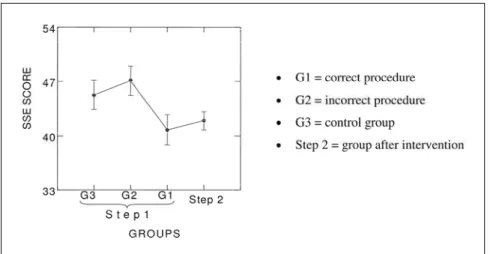
The general score of epilepsy stigma obtained t h rough the SSE was 45.5 for the public school and 43.3 for the private school (p>0.05). Figure 1
illus-trates the scores obtained(least squares means)b y
the diff e rent groups, showing a significant diff e r-ence among the general scores in the three groups.
Table 1. Number of subjects by group and school.
Public school Private school
Group 1 (correct procedure) 32 26
Group 2 (incorrect procedure) 35 27
Group 3 (no demonstration) 30 32
Total 97 85
Table 2. Characterization of subjects.
Public school (%) Private school (%)
Sex
Male 55.7 57.6
Female 44.3 42.4
Average age (years) 15 (SD=0.71) 15 (SD=0.52)
Religion
Catholic 60.8 49.4
Evangelical 17.5 8.2
Spiritist 0 11.8
Others 20.6 10.6
None 1.0 20.0
Table 3. Subjects’ perception about epilepsy (SSE).
No A little A lot Very much
G1 G2 G3 G1 G2 G3 G1 G2 G3 G1 G2 G3
Do you think that people with epilepsy feel able to control their own epilepsy?
00.0 1.6 0.00 1.7 3.2 1.6 19.0 21.0 29.0 79.3 74.2 69.4
How do you feel when you see an epileptic seizure?
Frightened 14.3 3.2 21.3 35.7 37.1 37.7 23.2 37.1 26.2 26.8 22.6 14.8
Scared 32.7 33.9 59.1 52.7 38.7 21.3 9.1 12.9 14.7 5.5 14.6 4.9
Sad 45.6 31.3 34.4 29.8 37.8 34.4 10.6 19.7 21.3 14.0 11.5 9.8
Pity 37.5 32.8 42.6 37.5 41.0 31.2 10.7 16.4 16.4 14.3 9.8 9.8
Which difficulties do you think people with epilepsy have in their daily life?
Relationship 69.0 54.8 62.9 22.4 27.4 32.3 8.6 14.5 1.5 0.0 3.4 3.3
Work 13.8 3.3 9.7 50.0 37.1 40.3 24.1 27.4 30.6 12.1 32.3 19.3
School 34.5 14.5 22.6 39.7 45.2 45.2 22.4 27.4 24.2 3.4 12.9 8.1
Friendship 39.7 25.8 24.2 32.7 29.0 35.5 15.5 27.4 24.2 12.1 17.7 16.1
Sexual 44.8 22.6 45.2 34.5 29.0 25.8 10.3 30.6 17.7 10.3 17.7 11.3
Emotional 13.8 12.9 11.3 34.5 33.9 27.4 32.7 29.0 29.0 19.0 24.2 32.3
Prejudice 15.5 12.9 4.8 24.1 22.6 25.8 37.9 27.4 32.3 22.4 37.1 37.1
How do you think that people with epilepsy feel?
Worried 12.1 6.4 6.6 34.48 30.7 44.3 37.9 46.7 34.4 15.5 16.2 14.7
Dependent 33.3 19.4 26.2 42.1 50.0 39.3 19.3 17.7 24.6 5.2 12.9 9.8
Incapable 43.9 43.6 41.0 35.1 30.6 31.2 17.5 22.6 16.4 3.5 3.2 11.4
Afraid 24.1 14.5 18.3 43.1 37.1 36.7 24.1 30.7 31.7 8.6 17.7 13.3
Ashamed 23.2 24.6 10.0 37.5 42.6 41.7 17.9 23.0 25.0 21.4 9.8 23.3
Sad 35.7 12.9 20.0 41.1 51.6 26.7 17.9 22.6 35.0 5.46 12.9 18.3
Equal 14.1 8.1 13.1 24.6 8.1 9.8 33.3 37.1 31.2 28.0 46.8 45.9
In your opinion, in which situation does prejudice against epilepsy occur?
Relationship 8.6 11.3 11.7 39.7 45.2 48.3 29.3 25.8 31.7 22.4 17.7 8.3
Marriage 50.0 50.0 50.0 24.1 35.5 30.7 10.3 11.3 8.1 15.5 3.2 11.3
Work 8.6 6.5 9.7 50.0 38.7 40.3 25.9 33.9 27.4 15.5 21.0 22.6
School 14.0 8.2 4.8 43.9 50.8 43.6 29.8 24.6 32.3 12.3 16.4 19.4
Family 75.4 75.8 61.3 22.8 11.3 30.6 0.0 3.2 4.8 1.8 9.7 3.2
The numbers are presented in relative percentage among the groups, by line.
Table 4 shows data relating to questions about epilepsy information.
Step 2 –Six months after the lecture, 86 SSE ques-t i o n n a i res were compleques-ted (65 sques-tudenques-ts from ques-the pri-vate school and 21 from the public school) constitut-ing only one group of study. In the private school, s i x t y - t h ree percent (63%) of the students were fe-male, average age 16 years, and in the public school, seventy-six percent (76%) were female, average age 16 years.
The average general SSE score at this step was 44.5.
The comparison between the four groups (step 1 and step 2) are presented in the Figure 1 (Anova (3,339)=2.77; p=0.042). Pairwise comparison using Fisher's Least-Significant-Diff e rence Test showed a significant diff e rence between G2 (the group shown i n c o rrect pro c e d u res in step 1) versus step 2 (six months later), and between G3 (the control gro u p ) versus step 2, but no diff e rence between G1 (the g roup shown the correct pro c e d u rein step 1) versus step 2.
DISCUSSION
This study concerns information and attitudes of students towards people with epilepsy. We conclude that the perception of epilepsy stigma is higher in the group that received inappropriate education about reacting to an epileptic seizure. We showed that the influence and perpetuation of stigma were g reater in the group exposed to erroneous attitudes
( G roup 2). Answers demonstrating lack of knowledge and increased stigma also seemed to be associated with group 2. This may suggest that, in addition to the transmission of correct information, emphasis on c o rrect attitudes is fundamental. This is because the stigma process is facilitated by inappropriate social
b e h a v i o u r s4 , 5 , 1 1. We know that society’s attitudes and
behaviours can be more adverse than the seizure s themselves, in causing negative impact on the
patients’ daily lives11.
Comparing the two steps, the results showed that the stigma perception changed over time. This may indicate that information and attitudes working to-gether are capable of reducing the perception of epilepsy stigma in the long term. After the interv e n-tion (step 2), the subjects showed a retenn-tion of knowledge and of the correct way to behave when witnessing a seizure. Furt h e rm o re we noted fro m comments of participants that it seems easier for peo-ple to remember scenes than words. The visual mem-ory may have greater impact for acquisition of con-cepts about stigma perception, and the inform a t i o n given through the lecture was not re m e m b e red as well as the seizure visualization; it seems not to have been effective in changing attitudes. The practical demonstration of a seizure with the appropriate in-formation may have had a major impact in altering p reviously learned behaviour about dealing with seizures.
As shown pre v i o u s l y2 , 4 , 5 , 1 1 - 1 6, stigma aetiology is
related to several factors; the lack of inform a t i o n
Table 4. Data related to information.
No A little A lot Very much
G1 G2 G3 G1 G2 G3 G1 G2 G3 G1 G2 G3
Do you have any information about epilepsy?
44.8 54.1 60.0 46.5 44.3 36.7 8.6 1.6 3.3 0.0 0.0 0.0
What types of epilepsy treatment do you know?
Neurological 6.9 11.5 19.3 22.4 22.9 30.7 44.8 36.1 30.7 25.9 29.5 19.4
Psychological 5.3 16.7 14.5 49.1 41.7 50.0 33.3 33.3 30.7 12.3 8.3 4.8
Spiritual 49.1 64.4 71.0 40.4 25.4 21.0 10.5 3.4 6.5 0.0 6.8 1.6
Psychiatric 22.8 33.3 40.3 52.6 43.3 38.7 14.0 16.7 16.1 10.5 6.7 4.8
Which attitudes do you think people with epilepsy have?
They tell other people about their epilepsy
50.9 54.1 61.7 43.9 41.0 31.7 3.5 3.3 3.3 1.8 1.6 3.3
They look for treatment 5.2 0.0 8.2 25.9 29.5 37.7 34.5 32.8 37.7 34.5 37.7 16.4
They isolate themselves 38.6 39.3 31.2 43.9 42.6 49.2 14.0 11.5 13.1 3.5 6.6 6.6
They act normally 19.3 24.6 21.7 42.1 29.5 38.3 17.5 29.5 33.3 21.1 16.4 6.7
associated with the non-control of seizures, the uncer-tainty re g a rding prognosis and the social impact of epilepsy are important aspects in the determ i n a t i o n of stigma, taking into account the fact that lack of information and negative attitudes towards epilep-sy constitute the main factors for the determ i n a t i o n
of this stigma4. The de-stigmatization campaigns in
schools should there f o re emphasize these two aspects in order to obtain a significant improvement in the quality of life of people with epilepsy.
Therapeutic eff o rts towards the control of seizure s a re not enough. This study confirms that people with epilepsy and their families need more than medical
treatment in order to have a better quality of life17.
A recent study of a psycho-educational interv e n-tion for adolescents with epilepsy and their families showed its importance for their needs, helping them to have a better understanding of their epilepsy, and the results showed an improvement of these
adoles-cents’ quality of life18. Another study19showed that
many elementary school teachers do not have the n e c e s s a ry knowledge about epilepsy and there f o re they deal with students with epilepsy in an inappro-priate way. In the current study a similar situation occurred.
The acquisition of information with the demon-stration of appropriate attitudes concerning a dis-ease or condition is able to influence the change in
p e rception of pre-established prejudices and beliefs2 0,
contributing to the non-increase of stigma perc e p-tion within society.
We feel, there f o re, that we now have some evi-dence that correct information and the demonstra-tion of appropriate attitudes are important aspects in dealing with social stigma. One important aspect is the way in which this information is transmitted (visual or verbal, for example the simulation of an epileptic seizure) to improve people’s attitudes towards people with epilepsy.
It is there f o re fundamental that
de-stigmatiza-tion campaigns should be provided continuously, as this may help to get people with epilepsy out of the shadows.
REFERENCES
1. N o ronha ALA, Borges A, Marques LH, et al. Prevalence and pattern of epilepsy treatm ent in diff e rent social-economic classes in Brazil. Epilepsia, **(*):1–6, 2007, doi:10.1111/j.1528-1167.2006.00974. 2. Baker GA. The psychosocial burden of epilepsy. Epilepsia 2002;43(Suppl
6):26-30.
3. Souza EA, Salgado PC. Qualidade de vida em epilepsia e perc e p ç ã o de controle de crises. Arq Neuropsiquiatr 2001;59:537-540.
4. Fernandes PT, Li LM. Estigma na epilepsia. 1-207. 2005. Departamento de Neurologia - FCM/UNICAMP. PhD Thesis.
5. Fernandes PT, Salgado PC, Noronha ALA, Barbosa FD, Souza EA, Li LM. Stigma scale of epilepsy: conceptual issues. J Epilepsy Clin Neurophysiol 2004;10:213-218.
6. Souza EA, Fernandes PT, Salgado PC, Doretto F. Mecanismos psicológi-cos e o estigma na epilepsia. Revista ComCiência 2002;34:98-103. 7. Vi c k rey BG, Hays RD, Graber J, Rausch R, Engel J, Jr., Brook RH. A
h e a l t h - related quality of life instrument for patients evaluated for epilep-sy surgery. Med Care 1992;30:299-319.
8. Dell JL. Social dimensions of epilepsy, stigma and response. In Whitman S, Hermann BP (Eds). Psychopatology in epilepsy: social dimensions. New York: Oxford University, 1986.
9. Li LM, Fernandes PT, Noronha AL, et al. Demonstration project on epilepsy in Brazil: situation assessment. A rq Neuropsiquiatr 2007; 65(Supl 1):5-13.
10. Li LM, Sander JW. National demonstration project on epilepsy in Brazil. Arq Neuropsiquiatr 2003;61:153-156.
11. Suurmeijer TP, Reuvekamp MF, Aldenkamp BP. Social functioning, psychological functioning, and quality of life in epilepsy. Epilepsia 2001;42:1160-1168.
12. Baker GA, Brooks J, Buck D, Jacoby A. The stigma of epilepsy: a European perspective. Epilepsia 2000;41:98-104.
13. Fernandes PT, Cabral P, Araújo UF, Noronha ALA, Li LM. Kids' per-ception about epilepsy. Epilepsy Behav 2005;6:601-603.
14. Jacoby A, Chadwick D. Psychosocial problems in epilepsy. BMJ 1992;305:117.
15. Jacoby A. Stigma, epilepsy, and quality of life. Epilepsy Behav 2002;3: 10-20.
16. Salgado PC, Fernandes PT, Noronha ALA, Barbosa FD, Souza EA, Li LM. The second step in the construction of a stigma scale of epilepsy. Arq Neuropsiquiatr 2005;63:395-398.
17. Galletti F, Sturniolo MG. Counseling children and parents about epilep-sy. Patient Educ Couns 2004;55:422-425.
18. Snead K, Ackerson J, Bailey K, Schmitt MM, Madan-Swain A, Martin RC. Taking charge of epilepsy: the development of a stru c t u re psychoe-ducational group intervention for adolescents with epilepsy and their parents. Epilepsy Behav 2004;5:547-556.
19. Prpic I, Korotaj Z, Vlasic-Cicvaric I, Paucic-Kirincic E, Valerjev A, To m a c V. Teachers' opinions about capabilities and behavior of children with epilepsy. Epilepsy Behav 2003;4:142-145.