*e-mail: [email protected]
Mathematical Model for Timber Decay in Contact with the
Ground Adjusted for the State of São Paulo, Brazil
Roberto Ramos de Freitas*, Julio Cesar Molina, Carlito Calil Júnior
School of Engineering of São Carlos, University of São Paulo – USP,
Av. Trabalhador Sãocarlense, 400, CEP 13566-590 São Carlos, SP, Brazil
Received: July 20, 2009; Revised: May 5, 2010
At this moment, the environmental sustainability has been incorporated to all branches of activity more and more; timber seems to be the best alternative in civil construction. Nevertheless, for a correct and better usage of timber as a structural material, it is necessary to have a higher degree of knowledge not only of the structural mechanical behavior, but also about its durability and service life. With help from mathematical models the
service life of the timber structures can be foreseen, by obtaining the “Climate Indices”, that show comparatively
among the studied regions, which ones have a higher or lesser propensity of being attacked by fungi. In this paper, utilizing climatologic data from several cities of the State of São Paulo - Brazil was determined through numerical analysis and statistics, the simplification of one aggressive model to timber in contact with the ground, being this model adjusted to the State of São Paulo. The simplified model of timber degradation can be used to quantity the effect of the environment in the process of decay for the regional climatic conditions.
Keywords: timber, decay model, durability
1. Introduction
There’s no doubt that wood is one of the most versatile materials that nature puts at the disposal of humankind. Wood has been used for millions of years to fulfill the needs that come from a society that is each time thirstier for new sources of energy and raw materials.
With many possibilities to utilize the wood, both in civil construction and in industry, round timbers and ties (stakes, shoring, poles and columns, etc.), represent some of the most efficient uses of our natural forest resources, demanding a minimum of processing between the harvesting of the tree and selling the structural commodity. Because these products are somewhat cheap to produce, compared to gluelam, steel and concrete articles, they are more often
than not used far and wide in the United States1.
No material is inherently durable due to the environmental and micro-structural interactions consequently, the material properties change as time passes by, admitting that the limit of use has been reached, when its properties decay, under certain conditions of usage, up to a point that to keep on using this material is considered unsafe
or anti-economical2.
Life service gives the measurement of time of a product and its materials, in which normal usage conditions (that is, if it’s not put into stressful conditions beyond acceptable limits) can last conserving its own capacities (service, output, etc) and its own behavior, in a
pre-established standard level3.
2. Decay
The biological nature of the wood makes it susceptible to the aggressions of fungi and insects, however the drying and the preservation of a side, and the association to other materials in the places of constructions that are more vulnerable to attacks than others, make the timber structures as durable as steel or concrete, since its
conception respects certain rules of protection of the material4.
The main groups of xylophagan organisms are the bacteria, fungi,
insects, clams, crustaceans5, being that the decay fungi are responsible
for deep alterations in the physical and mechanical properties of the wood, due to gradual destruction of the molecules that constitute its cellular walls5,6.
The decay affects initially the stiffness, the ability of the material to resist impacts generally, being followed by reduction of the resistance the static bending, and finally all the properties of resistance
of the wood seriously are reduced7.
After having established the layer of fungi, the speed of growth of these is dependant primarily of the humidity and temperature, Figure 1a. The conditions of growth of the fungi vary a lot from one species to another, but as a general rule, it has been observed that for temperatures below 5 °C the fungi had lived dormant, while for
temperatures above 65 °C these will be dead in a few hours8.
As for the humidity, the speed of growth of the fungi is extremely low for values of humidity below the fiber saturation point, Figure 1b, the lesser humidity in which the fungi grow that has been observed is 19%, and the superior limit corresponds to 80% humidity, where the cell cavities are saturated8.
3. Models of Decay
A model for the decay of parts in contact with the ground was proposed based in small monitored stakes for more than 30 years in
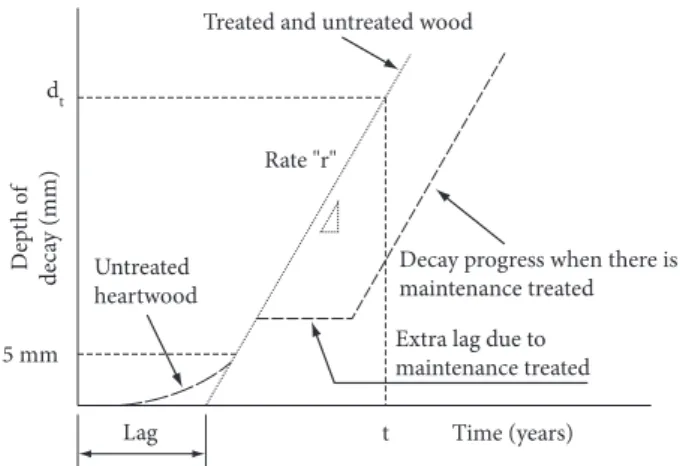
Australia9. Such model considers that a time (lag) for the beginning
of the decay process exists, which after the beginning evolves in a speed (reason “r”) constant, being able to occur a new initial time and stop the decay with maintenance accomplishment, Figure 2.
Figure 1. Functions idealized for two parameters of decay8.
Figure 2. Relationship of idealized decay9.
g T T se T C
T
mean mean mean
me
(
)
= − + × < ≤ °− + ×
1 0 2 5 20
25 1 4 ,
, aanseTmean> °C
20 (Equation 4)
As for the influence of the types of wood present in one pole, it is admitted the project considered in Figure 3, where the rates of
decay are shown schematically for the types of wood9. The list of
used abbreviations is presented in the Appendix 1.
To determine the initial time for the installation of the decay process (lag) and the decay rate (r), the following equations and the parameters of Table 1 are adopted.
• Outerheartwood
run heart stake, , = ×A Iig
(Equation 5)
• Corewood
lagun core stake, , =0 3, ×lagun heart stake, ,
(Equation 6)
run core stake, , = ×3 run heart stake, ,
(Equation 7)
• Sapwood
lagun sap stake, , =0 5, ×lagun heart dc, , 4,stake
(Equation 8)
run sap stake, , = ×2 run heart dc, , 4,stake (Equation 9)
3.1. Being
lagun, heart, dc4, stake: the initial time of decay for the external heartwood species of durability class 4;
run, heart, dc4, stake: decay rate for the external heartwood species of durability class 4;
4. Studied Region
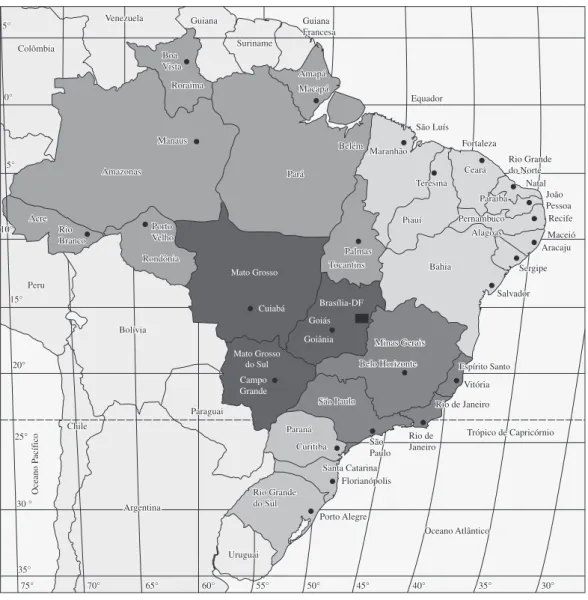
São Paulo is one of the states of Brazil, being located approximately between the longitudes 44° and 53° W and latitudes 20° and 25° S, a small part is below of the Capricorn Tropic (23° 27’ 09” S). Thus most of the State of São Paulo this located in a tropical region. Figure 4 shows the localization of the State of São Paulo in Brazil.
The State of São Paulo has a large extent of mountainous areas of altitude, where the rain is sufficiently mild and thus it can generally be classified as tropical of altitude, where the rain is abundant, over
all in the station stowage, making the climate humid tropical10.
According to the climatic classification of Koeppen, the State of São Paulo encloses six distinct climatic types, all corresponding to the humid climates. The type that corresponds to the biggest area is the
Table 1. Parameters of decay for external not treated heartwood9.
Durability class (AS 5604-2005)
A Initial time
lagun, heart, stake (years)
Class 1 0.20 6
Class 2 0.55 4
Class 3 0.80 2
Class 4 1.85 1
Figure 4. Localization of São Paulo State.
Table 2. Statistics of the climatic data.
Statistics Temperature
(°C)
Annual Precipitation (mm)
Ndm – dry months
Mean 22.6 1446 0.8
Minimum 15.1 1165 0.0
Maximum 25.7 2514 1.9
Amplitude 10.6 1349 1.9
Table 3. Statistics of the climatologic data.
Statistics Iig
Mean 2.48
Minimum 2.04
Maximum 2.5
Amplitude 0.81
Considering the classes of aggressiveness form the initial model17,
Table 4 shows the distribution of cities in relation to this classification.
Table 4. Representative climatic Index for four classes of aggressiveness.
Region of decay Representative Iig Number of cities
A 0.5 0
B 1.5 0
C 2.5 49
determination of the values of Iig and Iig; simplified was carried through only for the stations that possessed a minimum period of reading, until the moment of the attainment of the data, of at least 5 years, thus 11 weather forecast stations had been discarded of the study. This measurement contributes so that little representative values are not obtained, in function of annual variations of the climate. Table 2 shows the descriptive statistics of the climatic data of the studied cities.
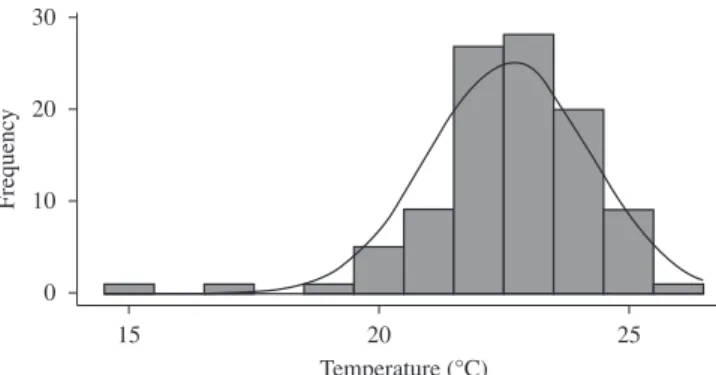
Figures 5 to 7 show the distributions of absolute frequency for the data of Temperature, Annual Precipitation and Dry Months. The normal distribution curve is shown next to the histogram.
5. Application of Leicester’s Model
Table 3 shows the descriptive statistics for the obtained values
with the application of the climatologic data to Leicester’s model9.
Considering the classes of aggressiveness form the initial
model17, Table 4 shows the distribution of cities in relation to this
classification.
Table 5 shows the descriptive statistics for the population variables of Iig < 2.50 e Iig > 2.50.
Intending to verify if the cities classified by the decay regions according to Table 5 have different temperature populations, precipitation and dry months, the F-test of variables is carried through (using Snedecor’s distribution), dividing them into two populations; cities with Iig smaller than 2.50 (Iig < 2.50) and cities with Iig greater than 2.50 (Iig > 2.50).
Adopting a significant level of 5% (α = 0.05) for the F-test we
have that:
• F-Testfortemperature
H0: the variance of temperatures for Iig < 2.50 and Iig > 2.50 are equal. H1: the variance of temperatures for Iig < 2.50 and Iig > 2.50 are not equal. Fobtained: 2.845 Fcritic: 1.596 P-Value: 0.0001
Conclusion: reject H0
• F-Testforprecipitation
H0: the variance of precipitations of Iig < 2.50 and Iig > 2.50 are equal. H1: the variance of precipitations of Iig < 2.50 and Iig > 2.50 are not equal. Fobtained: 3.307 Fcritic: 1.604 P-Value: 0.000025
Conclusion: reject H0 • F-Testfordrymonths
H0: the variance of dry months of I
ig < .2.50 and Iig > 2.50 are equal. H1: the variance of dry months of I
ig < 2.50 and Iig > 2.50 are not equal. Fobtained: 1.220 Fcritic: 1.604 P-Value: 0.244
Conclusion: not reject H0
Figure 5. Absolute frequency histogram of the average temperatures for the cities of São Paulo State.
Figure 6. Absolute frequency histogram of the annual precipitations for the cities of São Paulo State.
Figure 7. Absolute frequency histogram of the dry months for the cities of São Paulo State.
Table 5. Descriptive statistics for the population variables of Iig.
Statistics Temperature
(°C)
Precipitation (mm)
Ndm – dry months
– Iig < 2.50 Iig > 2.50 Iig < 2.50 Iig > 2.50 Iig < 2.50 Iig > 2.50
Mean 21.5 23.6 1405 1483 0.87 0.80
Minimum 15.1 21.5 1165 1174 0.25 0.00
It can be concluded that the variable Ndm (dry months) is not for this set of data in analysis, it isn’t a variable of significant contribution for determining Iig.
6. Proposition of Model
The simplification proposed is the withdrawal of the variable
“Ndm - dry months”, which is the hardest to attain. This proposal is
justified, since carrying through the F-test for this variable for the populations of Iig < 2.50 and Iig > 2.50, did not give statistical evidence of difference between this data set.
The simplification is initiated only with the withdrawal of the
variable Ndm of the model. The model to be used initially is given
bellow:
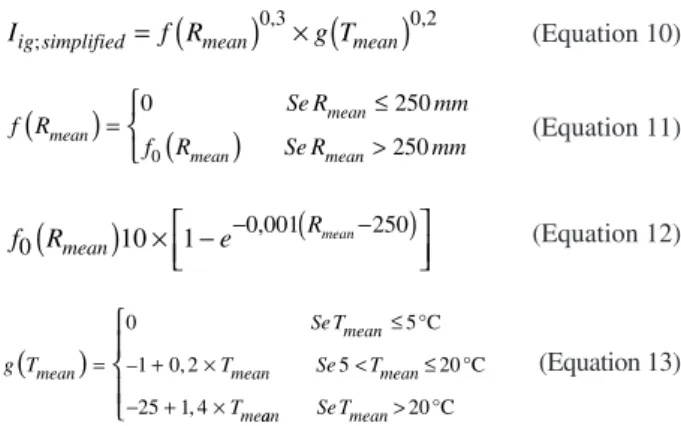
6.1. Leicester’s simplified model
Iig simplified; f Rmean g Tmean
, ,
=
(
)
0 3×(
)
0 2(Equation 10)
f R
Se R mm
f R Se R mm
mean mean mean mean
(
)
(
)
= ≤ > 0 250 250 0 (Equation 11)f Rmean e Rmean
0
(
)
10× −1 −0 001,(
−250)
(Equation 12)g T
Se T
T Se T
T mean mean mean mean me
(
)
= ≤+ × < ≤
− + ×
0 5
1 0 2 5 20
25 1 4
°C
°C – ,
, aan Se Tmean>
20 °C
(Equation 13)
Table 6 compares the descriptic statistics of Iig e Iig; simplified. Figure 8 compares the dispersion of the values of Iig and Iig; simplified. A positive displacement (increase of the values) of the population of data as well as of the average can be observed.
To verify proposal of the simplification done, it is necessary to observe if there is a correlation between the values of the current model and the simplified model. Figures 9 and 10 show the regression and the residues of the regression for Iig and Iig; simplified, respectively.
The value of r2 - coefficient of determination for this regression is
of 83.3%.
From Figure 10 it is observed that the correlation between Iig and Iig; simplified does not present independence of errors in function of Iig; simplified. This characteristic can be explained considering that for the
exact same value of the reduction factor (1 – Ndm/6), the difference
between the value of Iig and Iig; simplified increases proportionally to the second variable.
Adopting the same classification of aggressiveness already used9,
Table 7 shows the distribution of Iig; simplified.
Table 8 shows the descriptive statistics for the climatologic indices of the populations of Iig; simplified.
The F-test is carried through to identify if it is possible to consider that the two populations Iig and Iig; simplified are equal. Thus, for α = 0.5 we have:
• F-TestIig e Iig; simplified
H0: the variances of I
ig and Iig; simplified are equal. H1: the variances of Iig and Iig; simplified are not equal.
Fobtained: 1.087 Fcritic: 1.389 P-Value: 0.338
Conclusion: not reject H0
From the test above it is possible to verify statistical evidences that the populations of Iig and Iig; simplifiedare equal.
As previously, the F-test is carried through between the populations of temperature and precipitation, verifying if the populations of these parameters differ in Iig; simplified, dividing them again in two populations; cities with Iig; simplified smaller than 2.50 (Iig; simplified < 2.50) and cities with Iig; simplified greater than 2.50 (Iig; simplified > 2.50). This way, for a level of significance of 5% (= the 0.05) we have that:
• F-Testfortemperature
H0: the variance of temperatures of Iig; simplified < 2.50 and Iig; simplified > 2.50 are equal.
H1: the variance of temperatures of Iig; simplified < 2.50 and Iig; simplified > 2.50 are not equal.
Fobtained: 2.517 Fcritic: 1.639 P-Value: 0.0001
Conclusion: reject H0 • F-Testforprecipitation
H0: the variance of precipitations of I
ig; simplified < 2.50 and Iig; simplified > 2.50
are equal.
H1: the variance of precipitations of Iig; simplified < 2.50 and Iig; simplified > 2.50 are not equal.
Fobtained: 2.062 Fcritic: 1.766 P-Value: 0.019
Conclusion: reject H0
There are no statistical evidence that the temperature populations and precipitation are equal for the populations Iig; simplified < 2.50 and Iig; simplified > 2.50.
OneconcludesthatthewithdrawaloftheNdm variable of the model proposed by Leicester, did not influence the variables temperature and precipitation, in determination of the aggressiveness index, since the population of the values of these variables, are still distant for Iig; simplified < 2.50 and Iig; simplified > 2.50, for the studied data set.
6.2. Analysis of regressions
Completing a regression between the values of Iig and Iig; simplified
for the ten most aggressive cities according to Iig, a low value of the
determination coefficient, r2 = 36.6% is obtained, Figure 11.
However, the regression between the values of Iig and Iig; simplified for the ten less aggressive cites according to Iig, a high value of
determination coefficient, r2 = 95.5% is obtained, Figure 12.
The equation of the straight line it is given by:
y=ax+b (Equation 14)
So that the values of the x coordinate are equal to the ones of the y coordinate, it is necessary that the linear coefficient (a) be null, and that the value of angular coefficient (b) be equal to 1, as the Equation 15.
y= + ×0 1 x (Equation 15)
The greater the value of the linear coefficient (a) and that of the angular coefficient (b) in module, greater the distance the straight line is from the identity (y = x).
Table 9 compares the values of the linear and angular coefficients of the regression carried through previously. It is verified that the values of the coefficient is very close to the values for the identity
only for regression to the smaller Iig values.
Withdrawing the Ndm variable (dry months), the populations of
Table 9. Coeficient values of the regressions Iig × Iig; simplified.
Regression Coeficient r2
(%)
Linear (a) Angular (b)
Iig × Iig; simplified (Figure 9) 0.208034 0.874643 83.3
Iig × Iig; simplified (greater Iig) 1.73412 0.3621805 36.6
Iig × Iig; simplified (smallerIig) - 0.0849705 1.00447 95.5
Table 7. Representative climatic index for four classes of aggressiveness.
Decay region Representative Iig; simplified Number of cities
A 0.5 0
B 1.5 0
C 2.5 28
D 3.0 74
Table 8. Descriptive statistics of the parameters of the populations of Iig; simplified.
Statistics Temperature
(°C)
Precipitation (mm)
– Iig; simplified < 2.50 Iig; simplified > 2.50 Iig; simplified < 2.50 Iig; simplified > 2.50
Mean 20.8 23.3 1393 1465
Minimum 15.1 21.3 1167 1165
Maximum 22.2 25.7 1726 2514
Figure 11. Regression between Iig and Iig; simplified for the cities of the greatest values of Iig.
values of Iig.
Table 6. Descriptic statistics of Iig e Iig; simplified.
Statistics Iig Iig; simplified
Mean 2.48 2.60
Minimum 2.04 2.12
Maximum 2.85 2.86
Amplitude 0.81 0.74
Figure 9. Regression Iig × Iig; simplified.
Temperature, Precipitation and Dry Months, for the populations of Iig < 2.50 and Iig > 2.50, it was concluded that it does not exist statistical evidences of difference of these two populations for the variable Dry Months.
Carrying through the simplification of the initial model, and
determining the values of Iig, simplified, the population of these values
with the population of Iig can be compared, not getting statistical evidences that indicate difference in these two populations of climatic indices.
The best regression between Iig and Iig; simplified is the one carried through between the ten smaller values of Iig and its respective Iig; simplified, this being the closest to the straight line identity. Through this regression it was possible to propose an adjusted final model of
climatic index of timber decay in contact with the ground, the ILL-SP.
This model is adjusted to the data of the State of São Paulo, which does
not possess the necessity of the Ndm variable (dry months) with the
attainment of approximately the same obtained initial values through Leicester’s Model. Thus two alternative models to the initial one are possible, the one of Leicester: the Iig; simplified and the ILL-SP.
For the analyzed data the simplification of Leicester’s model can be considered as adequate.
Acknowledgements
We thank IAC - Agronomic Institute of Campinas, pertaining agency to the Secretary of Agriculture and Supplying of the State of São Paulo, for the supply of the climatic data.
References
1. Wolfe RW. Round timbers and ties. In: United States Department of Agriculture - USDA. Wood handbook: wood as an engineering material. Madison: USDA; 1999. p. 18.1-18.9. General technical report FPL - 113.
2. Mehta PK and Monteiro PJM. Estruturas de concreto. São Paulo: Pini; 1994.
3. ManzinEandVezzoliCO.Desenvolvimento de produtos sustentáveis.
São Paulo: Edusp; 2005.
4. FuscoPB.Oscaminhosdaevoluçãodaengenhariadasmadeiras.In:
Anais do 3º Encontro Brasileiro de Madeira e Estruturas de Madeira; 1989; São Carlos - SP, Brasil. São Carlos: LaMEM/EESC/USP; 1989. p. 7-18.
5. Cavalcante MS. Deterioração biológica e preservação de madeiras. São Paulo: IPT; 1982.
6. Instituto de Pesquisas Tecnológicas – IPT. Biodeterioração de madeiras em edificações. São Paulo; 2001.
7. Highley TL. Biodeterioration of wood. In: United States Department of Agriculture – USDA. Wood handbook. Madison: Forest Products Laboratory; 1999. p. 13.1-13.5.
8. Leicester RH. Engineered durability for timber construction. Highett:
CSIRO;2001.12p.
9. Leicester RH, Wang CH, Nguyen MN, Foliente GC and Mckenzie C. An engineering model for the decay of timber in ground contact. In:
Proceedings 34º Annual Meeting of The International Research Group On Wood Preservation; 2003; Brisbane-Austrália, Stockholm, Suécia; 2003. 21 p.
10. PaesA, Camargo DE, Pinto HS, Brunini O, Pedro Jr. MJ, Ortolani
AA, Alfonsi RR. Conceituação. [cited 2007 Jul. 24]. Available from: http://www.ciagro.sp.gov.br/clima. .
value the dispersion of data around the regression of the straight line t is high.
Appling Equation 16, which is the regression for the tem smallest values of Iig and its respective Iig; simplified, to all values of Iig; simplified, Iig’ for all the cities is obtained.
Iig’ =1 00447, ×Iig simplified; −0 0849705, (Equation 16)
Subtracting the value of Iig’ from Iig the Error (e) of the estimate is gotten, as Equation 17. Through these the value of the Mean Error
(Em) of the estimate is determined, Equation 18.
E=Iig−IIg’ (Equation 17)
E I I
n m ig Ig i l n =∑ − = ’ (Equation 18)
The value of the Mean Error (Em) is of -0.0438074. Adding this
value to the Equation 16, the final model adjusted is obtained to the data of the State of São Paulo, which will be called Climatic Index of the State of São Paulo for timber decay in contact with the ground.
ILL SP− =1 00447, ×Iig simplified; −0 0849705, −0 0438074, (Equation 19)
ILL SP− =1 00447, ×Iig simplified; −0 12878, (Equation 20)
Thus two models are proposed, the simplified model (Equation 21) which was shown to have small variation from the initial Leicester’s model, and the model adjusted for the State of São Paulo (Equation 22).
Iig simplified; =f R
(
mean)
0 3, ×g T(
mean)
0 2, (Equation 21)ILL =1 00447, ×f R
(
media)
0 3, ×g T(
media)
0 2, −0 12878, (Equation 22)f R
Se R mm
f R Se R mm
media mean media mean
(
)
(
)
= ≤ > 0 250 250 0 (Equation 23)f Rmedia e Rmedia
0
0 001 250
10 1
(
)
= × − −, ( − ) (Equation 24) gT SeT CT Se T C
media
media
media media
(
)
=≤ °
− + × < ≤ °
− +
0 5
1 0 2 5 20
25 1 4
,
, ×× > °
T SeT C
media media 20
(Equation 25)
7. Conclusions
The possibility of a greater and better rational use of the timber necessarily passes through the attainment of a better knowledge of how this material behaves with elapsing of the time.
The models of timber degradation represent a form to quantify the effect of the environment in the process of decay for the regional climatic conditions.
Appling the initial model of degradation of timber in contact
Iig < 2,50 Value de Iig smaller than 2,50 Iig > 2,50 Value de Iig greater than 2,50
Iig; simplified Simplified Climatic Index for timber decay in contact with the ground Iig; simplified < 2,50 Simplified Climatic Index smaller than 2,50
Iig; simplified > 2,50 Simplified Climatic Index greater than 2,50