www.jped.com.br
ORIGINAL ARTICLE
Neonatal sepsis as a risk factor for neurodevelopmental changes
in preterm infants with very low birth weight
夽
,
夽夽
Rachel C. Ferreira, Rosane R. Mello
∗, Kátia S. Silva
Instituto Fernandes Figueira, Fundac¸ão Oswaldo Cruz (FIOCRUZ), Rio de Janeiro, RJ, Brazil
Received 31 July 2013; accepted 12 September 2013 Available online 5 February 2014
KEYWORDS Psychomotor performance; Child development; Sepsis;
Premature; Risk factors; Infant; Follow-up
Abstract
Objective: to evaluate neonatal sepsis as a risk factor for abnormal neuromotor and cognitive development in very low birth weight preterm infants at 12 months of corrected age. Methods: this was a prospective cohort study that followed the neuromotor and cognitive devel-opment of 194 very low birth weight preterm infants discharged from a public neonatal intensive care unit. The Bayley Scale of Infant Development (second edition) at 12 months of corrected age was used. The outcomes were the results of the clinical/neurological evaluation and the scores of the psychomotor development index (PDI) and mental development index (MDI) of the Bayley Scale of Infant Development II. The association between neonatal sepsis and neuromotor development and between neonatal sepsis and cognitive development was verified by logistic regression analysis.
Results: mean birth weight was 1,119 g (SD: 247) and mean gestational age was 29 weeks and 6 days (SD: 2). Approximately 44.3%(n = 86) of the infants had neonatal sepsis and 40.7% (n = 79) had abnormal neuromotor development and/or abnormal psychomotor development index (PDI < 85) at 12 months of corrected age. On the mental scale, 76 (39.1%) children presented abnormal cognitive development (MDI < 85). Children with neonatal sepsis were 2.5 times more likely to develop changes in neuromotor development (OR: 2.50; CI: 1.23-5.10). There was no association between neonatal sepsis and cognitive development impairment.
Conclusion: neonatal sepsis was an independent risk factor for neuromotor development impairment at 12 months of corrected age, but not for mental development impairment. © 2014 Sociedade Brasileira de Pediatria. Published by Elsevier Editora Ltda. All rights reserved.
夽 Please cite this article as: Ferreira RC, Mello RR, Silva KS. Neonatal sepsis as a risk factor for neurodevelopmental changes in preterm
infants with very low birth weight. J Pediatr (Rio J). 2014;90:293---9.
夽夽Study performed at Instituto Fernandes Figueira, Fundac¸ão Oswaldo Cruz (FIOCRUZ), Avenida Rui Barbosa 716, Flamengo, Rio de Janeiro,
RJ, 22250-020, Brazil. ∗Corresponding author.
E-mail:[email protected] (R.R. Mello).
PALAVRAS-CHAVE Desempenho psicomotor; Desenvolvimento infantil;
Sepse; Prematuro; Fatores de risco; Lactente; Seguimento
A sepse neonatal como fator de risco para alterac¸ão no neurodesenvolvimento em prematuros de muito baixo peso ao nascer
Resumo
Objetivo: avaliar a sepse neonatal como fator de risco para alterac¸ões no desenvolvimento neuromotor e mental de prematuros de muito baixo peso aos 12 meses de idade corrigida. Métodos: estudo de coorte prospectivo que acompanhou o desenvolvimento neuromotor e men-tal de 194 prematuros de muito baixo peso oriundos de uma UTI neonamen-tal pública no Rio de Janeiro. Utilizou-se a Escala Bayley de Desenvolvimento Infantil (segunda edic¸ão) aos 12 meses de idade corrigida. Os desfechos foram o resultado da avaliac¸ão clínica/ neurológica e os resulta-dos da área motora da Escala Bayley e os resultaresulta-dos da área mental (cognitiva) da mesma escala. A associac¸ão entre sepse e o desenvolvimento neuromotor e entre sepse e o desenvolvimento mental foi verificada através de regressão logística.
Resultados: a média do peso ao nascer foi 1119 g (DP 247) e da idade gestacional 29 semanas e 6 dias (DP 2). Cerca de 44,3% (n = 86) das crianc¸as apresentaram sepse neonatal e 40,7% (n = 79) apresentaram alterac¸ão neuromotora e/ou no índice do desenvolvimento psicomotor (PDI<85) aos 12 meses de idade corrigida. Na escala mental, 76 (39,1%) crianc¸as apresentaram alterac¸ão (MDI < 85). As crianc¸as que apresentaram sepse neonatal tiveram 2,5 vezes mais chances de desenvolver alterac¸ão do desenvolvimento neuromotor do que as crianc¸as que não apresentaram sepse (OR: 2,50; IC 1,23-5,10). Porém, não houve associac¸ão entre sepse neonatal e alterac¸ão cognitiva.
Conclusão: a sepse neonatal foi um fator de risco independente para alterac¸ão do desenvolvi-mento neuromotor, mas não para alterac¸ão do desenvolvidesenvolvi-mento mental.
© 2014 Sociedade Brasileira de Pediatria. Publicado por Elsevier Editora Ltda. Todos os direitos reservados.
Introduction
Sepsis is characterized by systemic manifestations resulting from bacterial invasion and multiplication in the blood-stream, and can lead to high neonatal mortality and morbidity.1Preterm newborns are at increased risk of
devel-oping sepsis. There is evidence that perinatal and neonatal infections are associated with neurodevelopmental impair-ment in preterm infants.2---6
Some studies indicate sepsis as one of the major risk fac-tors for developmental delay and cerebral palsy, as well as neonatal mortality.7---11However, there are few studies that
assess the age range studied (12 months of corrected age) and, to date, only one Brazilian publication that investigated the association between sepsis and neurodevelopment was retrieved.12 Furthermore, it is necessary to use an
appro-priate methodology for the control of several confounding factors already established in the literature, such as low gestational age, male gender, bronchopulmonary dysplasia (BPD), and brain injuries that can influence neurodevelop-ment in this population.
The aim of this study was to evaluate neonatal sepsis as a risk factor for neurodevelopment impairment in preterm infants with very low birth weight at 12 months of corrected age.
Methods
This prospective cohort study was performed in a tertiary hospital, at a referral unit for high-risk newborns. Preterm infants (gestational age < 37 weeks) with birth weight less
than 1,500 g who were born from 2004 to 2010 were included in the cohort. Gestational age was estimated based on the date of the last menstrual period; when that date was uncer-tain, by early ultrasound and by the New Ballard Score.13
When birth weight was below the 10thpercentile for
gesta-tional age,14the infant was classified as small for gestational
age. The exclusion criteria were: infants with infection, con-genital malformations, genetic syndromes, or those born in other hospitals; neonatal and post-neonatal deaths were excluded. Children not assessed by the Bayley scale were excluded from the analysis and considered as study loss.
Neonatal sepsis was considered in the presence of a positive blood culture and/or clinical and laboratory signs suggestive of infection.11 Clinical signs included worsening
of respiratory distress: tachypnea, sternal and/or subcostal retraction, groaning and cyanosis, apnea, body tempera-ture instability, hyper- or hypoglycemia, poor peripheral perfusion, food intolerance, arterial hypotension, and underactive infants.11
Laboratory parameters included: complete blood count with three or more altered parameters according to Rodwell et al.15 and/or C-reactive protein > 0.5 mg/dL; negative or
not performed blood culture; no evidence of infection at another site; and established and maintained antimicrobial therapy. Rodwell et al.15 considered the following
(< 150,000 platelets). These data were collected from medi-cal records.
After being discharged from the neonatal intensive care unit (NICU), the newborns were followed-up at the outpa-tient clinic for at-risk newborns; a clinical and neurological assessment was performed by a pediatrician and a physi-cal therapist monthly until 12 months of age. This consisted of the observation of spontaneous movements and posture, muscle tone in several body segments (cervical, axial, limb, and shoulder girdle), asymmetries and reflexes according to the Amiel-Tison and Grenier protocol,16and motor
develop-ment milestones. Neuromotor impairdevelop-ment was considered when the child showed changes associated with one or more of several body segments at clinical/neurological evalua-tion, such as: change in muscle tone, abnormal posture, abnormal spontaneous movements, altered neurological examination, and motor developmental delay,17also
consid-ering whether the child reached the age-appropriate motor milestones.16-19
The second edition of the Bayley Scale of Infant Development20 was applied by trained psychologists at
12 months of corrected age. The infants were evaluated regarding the mental and psychomotor areas, and the respective development indices were obtained. According to the authors of the scale, the psychomotor development index (PDI) and the mental development index (MDI) are con-sidered normal when the scores are≥85; moderate delay, when the scores are between 70 and 84; significant delay, when the scores are < 70. PDI and MDI were considered to be altered when scores were < 85.
The outcomes of the study were: neuromotor devel-opment at 12 months (including clinical/neurological assessment and the motor area results of the Bayley Scale) and mental development. Neuromotor development was considered to be altered when there was a change in the clinical/neurological assessment and/or changes in the PDI. The neuromotor and mental development at 12 months in children with neonatal sepsis were compared to those with-out sepsis. The association between the exposure variable (sepsis) and the outcome variables (neuromotor develop-ment and develop-mental developdevelop-ment) was verified by multivariate analysis (logistic regression). The presence of potential con-founding factors was investigated based on the association of covariates with exposure and outcomes.
Demographic data, socioeconomic data, family data, aspects related to the perinatal period, interventions, and neonatal morbidities were considered as covariates. The post-neonatal information included daycare attendance and hospital admission in the first year of life.
Bronchopulmonary dysplasia (BPD) was defined as oxy-gen use for 28 days or more.21 Necrotizing enterocolitis
(NEC) was considered in cases of need for medical or surgi-cal treatment.22Patent ductus arteriosus (PDA) was defined
as the presence of heart murmur, tachycardia, hyperdy-namic precordium, and broad pulse,23 and was confirmed
by echocardiography. Serial brain ultrasound examinations were performed in the first two weeks of life and at discharge for brain injury investigation. Data collection was prospective. The information of interest regarding the peri- and neonatal periods was collected by one of the researchers in an appropriate file during the infant’s hos-pitalization; post-neonatal data were collected in the same
file at the time of consultations at the follow-up outpatient clinic.
Statistical analysis
Data analysis was performed using Epi Info, release 3.5.1 and the Statistical Package for Social Sciences (SPSS), sta-tistical analysis softwares. Stasta-tistical tests were used for differences between means (F-statistics or Kruskal-Wallis) and proportions (chi-squared), and the significance level was set at 0.05.
First, a descriptive analysis of data was performed to ver-ify the characteristics of children with and without sepsis. Descriptive analyses were performed separately on the char-acteristics of children with confirmed sepsis (positive blood culture) and children with clinical sepsis (clinical and lab-oratory signs of infection in the absence of positive blood culture). Frequencies of sepsis, alterations in PDI and MDI, and major alterations in the neurological examination at 12 months of corrected age were calculated. The association between exposure variables and outcomes was verified by calculating the odds ratio (OR).
To identify potential confounders, the variables associ-ated with both the main exposure - confirmed sepsis, clinical sepsis, and associated sepsis (confirmed and clinical) and the outcomes (neuromotor and mental development) with a significance level < 0.20 were selected. The variations in the magnitude of the association between sepsis and neuromotor development and between sepsis and mental development when adjusted for each of these variables in the study, defined as potential confounders in the previ-ous step, were investigated. Variables whose adjustment led to a change > 10% in the primary exposure variable risk (sepsis) were selected for the multivariate models (logistic regression),24 which were constructed separately for each
outcome. In the final model, variables with a significance level of 0.05 were considered.
This study was approved by the Ethics Committee in Research of the Instituto Fernandes Figueira (CAAE 0005.0.008.000-06). Children’s parents or guardians signed an informed consent for participation in the research.
Results
During the study period, 448 newborns with very low weight were admitted. A total of 105 infants were excluded; there were 86 deaths, and nine infants did not attend the first appointment after discharge. Therefore, 248 children began follow-up at the outpatient clinic. There were six deaths in the first year. The final study population comprised 194 children. The difference of 48 children between the number who started the study and the number who were evaluated through the Bayley scale at 12 months was due to missed appointments or inability of the child to perform the test in the scheduled period. Losses accounted for 19%. There was no statistically significant difference between neonatal characteristics of the study group and those of the losses.
Table 1 Characteristics of the population of 194 very low birth weight premature infants born between 2004 and 2010 and followed-up at the outpatient clinic for at-risk newborns.
Characteristics of population n %
Birth weight < 1,000 g 61 31.4
Gestational age < 28 weeks 41 21.1
Small for gestational age 86 44.3
Male gender 91 46.9
Hyaline membrane disease 146 75.3
Ventilatory assistance 111 57.2
Bronchopulmonary dysplasia 58 29.9
Neonatal pneumonia 19 9.8
Patent ductus arteriosus 81 41.8
Peri-intraventricular hemorrhage 46 23.7
Leukomalacia 6 3.1
Sepsis 86 44.3
population with high clinical severity, where nearly 50% had sepsis and about one-third developed BPD. The mean house-hold income was R$ 1,123 (median 800.00, SD = 1,210), and the mean maternal level of schooling was 8.9 years (median 8.9 years, SD = 3).
Of the studied population, 20% had neuromotor alter-ation in the clinical/neurological assessment at 12 months, and 37.6% had alterations in the PDI; the mean PDI was 86.6 (median 86, SD = 15.3). At 12 months of corrected age, 79 children (40.7%) presented neuromotor alteration at the clinical/neurological assessment and/or changes in PDI. Alterations in the mental development index (MDI) occurred
in 39.2% of children. The mean MDI was 86.4 (median 88, SD = 13.4).
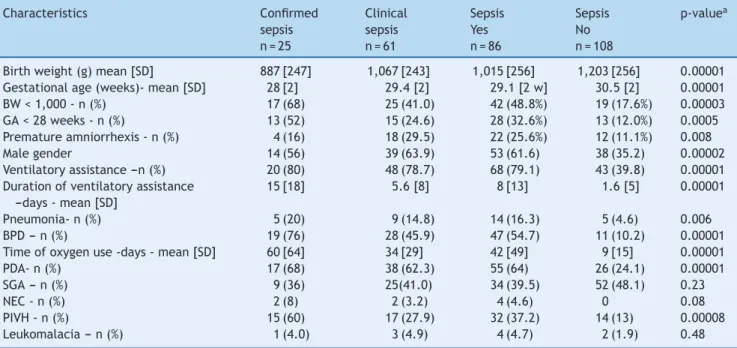
Of the 194 children, 86 (44.3%) developed sepsis, with 25 (12.9%) confirmed cases with positive blood cultures and 61 (31.4%) cases of clinical sepsis. The comparison of neonatal characteristics between the groups with and without sepsis is shown in Table 2. There was a higher frequency of birth weight < 1,000 g and gestational age < 28 weeks in patients with sepsis, when compared to those without sepsis (p < 0.00001). Regarding motor development, a two-fold higher frequency of PDI alterations (< 85) was observed in children with sepsis (55.8%) when compared to those without sep-sis (23.1%). There was a significant difference between the means of PDI in children with (81; SD = 15.4) and without sepsis (90.8; SD = 13.9), as well as a significant difference between the means of MDI in children with (83; SD = 14.3) and without sepsis (89.2; SD = 12). There was a statisti-cally significant difference between the groups regarding the occurrence of outcomes, with higher frequency in the sepsis group (Table 3).
In the bivariate analysis between the exposure variable (sepsis) and outcomes (neuromotor development and men-tal development), it was observed that children with sepsis were four times more likely to develop neuromotor devel-opment alterations at 12 months than those who did not have sepsis (OR: 4.16; CI: 2.26-7.65). When verifying the association between the variable confirmed sepsis and the neuromotor outcome, children with confirmed sepsis were approximately three times more likely to have neuromo-tor alterations at 12 months (OR: 2.99; CI: 1,25-7.17) than children without confirmed sepsis. In the bivariate analysis between the variable clinical sepsis and outcome, children
Table 2 Comparison of neonatal characteristics of preterm children with very low birth weight who developed sepsis in the neonatal period and those who did not; 2004-2010.
Characteristics Confirmed
sepsis n = 25
Clinical sepsis n = 61
Sepsis Yes n = 86
Sepsis No n = 108
p-valuea
Birth weight (g) mean [SD] 887 [247] 1,067 [243] 1,015 [256] 1,203 [256] 0.00001
Gestational age (weeks)- mean [SD] 28 [2] 29.4 [2] 29.1 [2 w] 30.5 [2] 0.00001
BW < 1,000 - n (%) 17 (68) 25 (41.0) 42 (48.8%) 19 (17.6%) 0.00003
GA < 28 weeks - n (%) 13 (52) 15 (24.6) 28 (32.6%) 13 (12.0%) 0.0005
Premature amniorrhexis - n (%) 4 (16) 18 (29.5) 22 (25.6%) 12 (11.1%) 0.008
Male gender 14 (56) 39 (63.9) 53 (61.6) 38 (35.2) 0.00002
Ventilatory assistance ---n (%) 20 (80) 48 (78.7) 68 (79.1) 43 (39.8) 0.00001
Duration of ventilatory assistance ---days - mean [SD]
15 [18] 5.6 [8] 8 [13] 1.6 [5] 0.00001
Pneumonia- n (%) 5 (20) 9 (14.8) 14 (16.3) 5 (4.6) 0.006
BPD --- n (%) 19 (76) 28 (45.9) 47 (54.7) 11 (10.2) 0.00001
Time of oxygen use -days - mean [SD] 60 [64] 34 [29] 42 [49] 9 [15] 0.00001
PDA- n (%) 17 (68) 38 (62.3) 55 (64) 26 (24.1) 0.00001
SGA --- n (%) 9 (36) 25(41.0) 34 (39.5) 52 (48.1) 0.23
NEC - n (%) 2 (8) 2 (3.2) 4 (4.6) 0 0.08
PIVH - n (%) 15 (60) 17 (27.9) 32 (37.2) 14 (13) 0.00008
Leukomalacia --- n (%) 1 (4.0) 3 (4.9) 4 (4.7) 2 (1.9) 0.48
BPD, bronchopulmonary dysplasia; BW, birth weight; GA, gestational age; NEC, necrotizing enterocolitis; PDA, patent ductus arteriosus; PIVH, peri-intraventricular hemorrhage; SD, standard deviation; SGA, small for gestational age.
Table 3 Comparison of the frequency of neurodevelopmental disorders in preterm infants with very low birth weight who developed sepsis in the neonatal period and those who did not; 2004-2010.
Characteristics Sepsis
yes (n = 86) n (%)
Sepsis no (n = 108) n (%)
p-value
Altered PDI at 12 months 48 (55.8) 25 (23.1) 0.000003
Neuromotor impairment at 12 months 29 (33.7) 10 (9.3%) 0.00002
Neuromotor impairment and/or altered PDI at 12 months 51 (59.3) 28 (25.9) 0.000003
Altered MDI at 12 months 41 (47.7) 35 (32.4) 0.003
Altered MDI, mental development index on the Bayley Scale < 85 at 12 months of corrected age. Altered PDI, psychomotor development index on the Bayley Scale < 85 at 12 months of corrected age.
who had clinical sepsis were 2.72 times more likely to develop neuromotor alteration (CI: 1.46-5.07).
When analyzing possible confounding factors in the asso-ciation of sepsis with neuromotor development, it was observed that the following variables were associated with both the exposure and the outcome: birth weight < 1,000 g, gestational age < 28 weeks, male gender, neonatal pneumonia, peri-intraventricular hemorrhage, ventilatory assistance, PDA, and BPD.
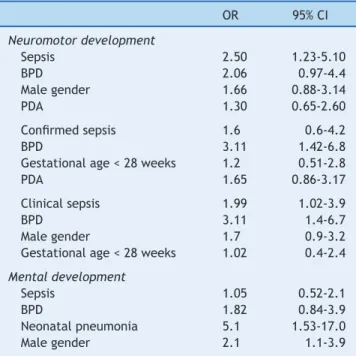
Table 4 shows that for neuromotor development, after adjusting for each of the possible confounding variables, the following variables were selected for the multivariate logistic model: BPD, PDA, and male gender. After controlling these risk factors, neonatal sepsis remained significantly associated with neuromotor development alterations at 12 months of corrected age. Children with sepsis were 2.5 times more likely to develop neuromotor developmental disorders when compared to those without sepsis (OR: 2.50; CI: 1.23-5.10).
Table 4 Association of neonatal sepsis with neuromotor andmentaldevelopment impairment at 12 months of cor-rected age, adjusted for selected variables.
OR 95% CI
Neuromotor development
Sepsis 2.50 1.23-5.10
BPD 2.06 0.97-4.4
Male gender 1.66 0.88-3.14
PDA 1.30 0.65-2.60
Confirmed sepsis 1.6 0.6-4.2
BPD 3.11 1.42-6.8
Gestational age < 28 weeks 1.2 0.51-2.8
PDA 1.65 0.86-3.17
Clinical sepsis 1.99 1.02-3.9
BPD 3.11 1.4-6.7
Male gender 1.7 0.9-3.2
Gestational age < 28 weeks 1.02 0.4-2.4
Mental development
Sepsis 1.05 0.52-2.1
BPD 1.82 0.84-3.9
Neonatal pneumonia 5.1 1.53-17.0
Male gender 2.1 1.1-3.9
BPD, bronchopulmonary dysplasia; OR, odds ratio; PDA, patent ductus arteriosus; 95% CI, 95% confidence interval.
It can be observed that BPD had borderline statistical sig-nificance for the association with neuromotor development alteration (OR: 2.06 CI: 0.97-4.4). When considering con-firmed sepsis as exposure separately, after adjustment for each of the possible confounding variables, the variables selected for the multivariate logistic model were BPD, PDA, and gestational age < 28 weeks. After controlling for these risk factors, confirmed sepsis was not associated with neu-romotor development alterations (OR: 1.6 CI: 0.86-3.17). Considering clinical sepsis as exposure, after controlling for risk factors, it remained significantly associated with neuro-motor development alterations (OR: 1.99; CI: 1.02-3.9).
In the bivariate analysis between the exposure variable (sepsis) and outcome (mental development), it was observed that children with sepsis were 1.9 times more likely to have MDI alterations than those without sepsis (CI: 1.05-3.40). In the bivariate analysis, the variables confirmed sepsis (OR: 1.82; CI: 0.78-4.24) and clinical sepsis (OR: 1.50; CI: 0.8-2.78) were not associated with the outcome of MDI alter-ation.
Regarding mental development, after adjusting for each of the possible confounding variables, the following varia-bles were selected for multivariate logistic model: BPD, neonatal pneumonia, and male gender. After controlling these risk factors, neonatal sepsis lost statistical significance and did not remain associated with mental development alterations at 12 months of corrected age (OR: 1.05; CI: 0.52-2.14) (Table 4). The presence of an interaction between the confounders was not identified (Table 4).
Discussion
This study observed that preterm infants with very low birth weight that had neonatal sepsis are 2.5 times more likely to have altered neuromotor development at 12 months of cor-rected age, regardless of other risk factors, which supports some results found in the current literature. When analyzing the confirmed sepsis subgroup as a risk factor for neuro-motor development alteration, after controlling for other confounding factors, the association lost statistical signifi-cance, perhaps due to the small number of confirmed cases. However, clinical sepsis showed to be an independent risk factor for neuromotor alteration.
sepsis had similar chances (OR: 1.6; CI: 1.3-2.0) to children with confirmed sepsis (OR: 1.5; CI: 1.2-1.9) of having severe neuromotor alteration between 18 and 22 months.6
Kohlendorfer et al.9 also investigated the association
of potential risk factors for neurodevelopmental disorders. Children who developed neonatal sepsis were three times more likely to have neuromotor and cognitive development alterations (PDI and MDI < 85) at 12 months of corrected age. Conversely, a recent study10on neurodevelopment
alter-ations in a cohort of preterm infants assessed at 24 months of corrected age included 136 children with confirmed sep-sis, 169 with suspected sepsep-sis, and 236 without infection. Children with confirmed sepsis were three times more likely to have cerebral palsy when compared with those without sepsis. It was observed that children with clinical infection were almost twice as likely to have cerebral palsy, but there was no statistical significance. Clinical sepsis and confirmed sepsis showed no association with cognitive delay.10
Although the blood culture is considered to be the gold standard for sepsis diagnosis, its sensitivity is less than 50%.25 In the present study, it was important to include
clinical sepsis, as due to the low sensitivity of blood cul-tures, children who had infection could fail to be included as exposed to sepsis, and thus underestimate its effects on neuromotor development. Several authors have considered clinical sepsis in their recently published articles, either alone or in combination26---28 with confirmed sepsis, and
employed similar criteria to those of the present study for the classification of clinical sepsis.6,10,28
Neuromotor alterations in preterm infants with neonatal infection may be mediated by white matter lesions.5,29
How-ever, it is not known which mechanism generates the white matter lesions. It appears that such lesions can be attributed to the susceptibility of oligodendrocyte precursors to inflam-mation, hypoxia, and ischemia.28 Helmes et al.30 observed
no association between late-onset sepsis and white matter lesions, and found no adverse effects on development at 15 months of age in preterm children.
It should be considered that part of the observed neu-romotor alterations may be due to transient neurological abnormalities observed in preterm infants up to 18 months of corrected age. Brandt et al.31observed abnormal
neuro-logical signs, mainly in the first year of life, and concluded that it is not possible to predict whether an early abnormal neurological sign is transient, and thus a longitudinal follow-up of these children is required, emphasizing the importance of follow-up in this population.
Gianní et al.32 emphasized the importance of early
stimulation and intervention in these children to pro-mote better neuropsychomotor development. In the present study, the families of children with any alteration were instructed to perform exercises at home and/or physical therapy.
The losses that occurred during the follow-up period can be considered as a study limitation; however, no significant difference was observed between the neonatal characteris-tics of the losses and the study group. It must be emphasized that the frequency of sepsis was similar between the two groups, indicating that the occurrence of bias is unlikely. It is important to mention that losses are frequent in cohort studies and that those in the present study were similar to the losses observed in others.9,10
The age chosen for the cutoff (12 months of corrected age) aimed at the early detection of neurodevelopmental alterations, and therefore, the earliest and most suitable therapeutic approach, in order to promote proper devel-opment. Another important aspect of the study was the systematic monitoring during 12 months in a cohort of 194 children from families of low socio-economic status, many of them residing in other municipalities. Studies have stressed the importance of long-term monitoring of this at-risk population.32 Another reason for the choice of
eval-uation at 12 months was the scarcity of reports in the literature of sepsis-related changes at this age range.
Conclusion
Neonatal sepsis was an independent risk factor for neuro-motor development impairment in premature infants in the studied age range, but there was no association with men-tal development. is the results suggest that children who develop either confirmed or clinical sepsis in the neonatal period have a differentiated follow-up of their neuromotor development.
Funding
PAPES IV- convênio FIOCRUZ/CNPq-Process number: 400115/2006-9.
Conflicts of interet
The authors declare no conflicts of interest.
Acknowledgements
The authors would like to thank Maria de Fátima Jun-queira, Juliana Verc¸osa Rocha Delamônica, and Ana Beatriz Rodrigues Reis for applying the Bayley Scale to the children participating in the study.
References
1. Miura E, Silveira RC, Procianoy RS. Sepse neonatal: diagnóstico e tratamento. J Pediatr (Rio J). 1999;75:S57---62.
2. Chapman A, Stoll BJ. Neonatal infection and long-term neurde-velopmental outcome in the preterm infant. Curr Opin Infect Dis. 2006;19:290---7.
3. Bassler D, Stoll BJ, Schimidt B, Asztalos EV, Roberts RS, Robert-son CM, et al. Using a count of neonatal morbities to predict poor outcome in extremely low birth infants: added role of neonatal infection. Pediatrics. 2009;123:313---8.
4. Martin CR, Dammann O, Allred EN, Patel S, O’Shea TM, Kuban KC, et al. Neurodevelopment of extremely preterm infants who had necrotizing enterocolitis with or without late bacteremia. J Pediatr. 2010;157:751---6.
5. Shah DK, Doyle LW, Anderson PJ, Bear M, Daley AJ, Hunt RW, et al. Adverse neurodevelopment in preterm infants with post-natal sepsis or necrotizing enterocolitis is mediated by white matter abnormalities on magnetic resonance imaging at term. J Pediatr. 2008;153:170---5.
extremely low-birth-weight infants with neonatal infection. JAMA. 2004;292:2357---65.
7. Han TR, Bang MS, Lim JY, Yoon BH, Kim IW. Risk factors cere-bral palsy in preterm infants. Am J Phy Med Rehabil. 2002;81: 297---303.
8. Wheater M, Rennie JM. Perinatal infection is an important risk factor for cerebral palsy in very-low-birthweight infants. Dev Med Child Neurol. 2000;42:364---7.
9. Kohlendorfer UK, Ralser E, Peglow UP, Reiter G, Trawöger R. Adverse neurodevelopmental outcomes in preterm infants: risk factor profiles for different gestacional ages. Acta Paediatr. 2009;98:792---6.
10. Schlapbach LJ, Aebischer M, Adams M, Natalucci G, Bonhoeffer J, Latzin P, et al. Impact of sepsis on neurodevelopmental out-come in a Swiss national cohort of extremely premature infants. Pediatrics. 2011;128:e349---57.
11. Agência Nacional de Vigilância Sanitária (ANVISA). Neonatolo-gia: critérios nacionais de infecc¸ões relacionadas à assistência à saúde. 2ndversion Brasília: ANVISA; 2010.
12. Hentges CR, Silveira RC, Procianoy RS, Carvalho CG, Filipouski GR, Fuentefria RN, et al. Association of late-onset neonatal sep-sis with late neurodevelopment in the first two years of life of preterm infants with very low birth weight. J Pediatr (Rio J). 2014;90:50---7.
13. Ballard JL, Khoury JC, Wedig K, Wang L, Eilers-Ealsman BL, Lipp R. New Ballard score, expanded to include extremely premature infants. J Pediatr. 1991;3:417---23.
14. Alexander GR, Himes JH, Kaufman RB, Mor J, Kogan M. A United States National Reference for fetal growth. Obstet Gynecol. 1996;87:163---8.
15. Rodwell RL, Leslie AL, Tudehope DT. Early diagnosis of neona-tal sepsis using a hematologic scoring system. J Pediatr. 1988;112:761---7.
16. Amiel Tyson C, Grenier A. Neurological assessment during the first year of life. New York: Oxford University Press; 1986. 17. Mello RR, Silva KS, Rodrigues MC, Chalfun G, Ferreira RC,
Delamônica JV. Predictive factors for neuromotor abnormali-ties at the corrected age of 12 months in very low birth weight premature infants. Arq Neuropsiquiatr. 2009;67:235---41. 18. Holt KS. Development in the first year. In: Holt KS, editor. Child
development - diagnosis and assessment. London: Butterworth-Heinemann; 1991. p. 70---102.
19. Frankenburg WK, Dodds JB, Archer P, Sharir H. Breusnich. The Denver II: a major revision and restandartization of the Denver developmental screening test. Pediatrics. 1992;89:91---7.
20. Bayley N. Bayley scales of infant development. 2nd ed. San Antonio: Harcourt; 1993.
21. Jobe AH, Bancalari E. Bronchopulmonary dysplasia. Am J Respir Crit Care Med. 2001;163:1723---9.
22. Bell MJ, Temberg JL, Feigin RD, Keating JP, Marshall R, Barton L, et al. Neonatal necrotizant enterocolitis: therapeutic decisions based on clinical stating. Ann Surg. 1978;187:1---7.
23. Miyague NI. Persistência do canal arterial em recém-nascidos prematuros. J Pediatr (Rio J). 2005;6:429---30.
24. Hosmer DW, Lemeshow S. Applied logistic regression. New York: Wiley-Interscience; 1989.
25. Haque KN. Neonatal sepsis in very low birth weight preterm infants: part 2: review of definition, diagnosis and management. J Med Sci. 2010;3:11---27.
26. Cchrag SJ, Cutland CL, Zell ER, Kuwanda L, Buchmann EJ, Velaphi SC, et al. Risk factors for neonatal sepsis and perinatal death among infants enrolled in the prevention of perina-tal sepsis trial, Soweto. South Africa Pediatr Infect Dis J. 2012;31:821---6.
27. Campos DP, Silva MV, Machado JR, Castellano LR, Rodrigues V, Barata CH. Early-onset neonatal sepsis: cord blood cytokine levels at diagnosis and during treatment. J Pediatr (Rio J). 2010;86:509---14.
28. Romanelli RM, Anchieta LM, Mourão MV, Campos FA, Loyola FC, Mourão PH, et al. Fatores de risco e letalidade de infecc¸ão da corrente sanguínea laboratorialmente confirmada, causada por patógenos não contaminantes da pele em recém-nascidos. J Pediatr (Rio J). 2013;89:189---96.
29. Glass HC, Bonifacio SL, Chau V, Glidden D, Poskitt K, Barkovich AJ, et al. Recurrent postnatal infections are associated with progressive white matter injury in preterm infants. Pediatrics. 2008;122:299---305.
30. Helmes MA, Nijman J, Leemans A, van Kooji BJ, van den Hoogen A, Benders MJ, et al. Cerebral white matter and neurodevelopment of preterm infants after coagulase-negative staphylococcal sepsis. Pediatr Crit Care Med. 2012;13: 678---84.
31. Brandt I, Sticker EJ, Höcky M, Lentze MJ. Transient abnor-mal neurologic signs (TANS) in a longitudinal study of very low birth weight preterm infants. Early Hum Dev. 2000;59: 107---26.