ORIGINAL ARTICLE
285 J Vasc Bras. 2014 Oct.-Dec.; 13(4):285-288 http://dx.doi.org/10.1590/1677-5449.0014
Impact of continuing education in vascular images
analysis for endovascular planning
Impacto da educação continuada na análise de imagens vasculares para
planejamento endovascular
Alexandre Campos Moraes Amato1,2, Daniel Augusto Benitti3
Abstract
Introduction: Manipulation of images using three-dimensional multiplanar reconstruction algorithms (3D MPR) and maximum intensity projection (MIP) is dependent on prior understanding of the method’s true validity and its superiority over traditional semi-digital or analog methods of measurement. Objective: To assess the understanding of doctors who attended the course of the methodology they routinely employed for planning endovascular surgery before taking the course and determine their choice of method after completion of the course. Methods: A survey was conducted with the students who took the course using an intranet questionnaire. Results: One hundred and sixty-one participants responded to the questionnaire. In relation to their prior knowledge, 38.8% reported no knowledge, 45.6% reported little knowledge, 15% reported basic knowledge and just 0.6% considered their prior knowledge was advanced. With respect to the measurement method used, 12.5% relied on the measurements in the radiologist’s report, 14% used printed plates and manual compasses, 36.8% used axial images to take measurements, 11.8% used axial images in OsiriX, 14% used the 3D MPR method and 11% used the 3D MPR method and 3D MPR combined with MIP. Additionally, 81.5% of the participants stated that they repeated measurements intraoperatively using a centimeter pigtail catheter, despite having taken measurements in advance using one of the methods listed above. Conclusion: he study showed that continuing education in specialized course was efective for imparting understanding of the importance of the three-dimensional multiplanar reconstruction image analysis method and of image optimization algorithms.
Keywords: diagnostic self evaluation; tomography; endovascular procedures; educational measurement.
Resumo
Introdução: A manipulação de imagens utilizando os algoritmos de reconstrução tridimensional multiplanares (3D MPR) e a intensidade de projeção máxima (MIP) demanda, inicialmente, a constatação da real validade do método e da sua superioridade sobre os métodos tradicionais analógicos ou semidigitais de mensuração. Objetivo: Avaliar a compreensão dos médicos que realizaram o curso da metodologia por eles aplicada anteriormente, para programação cirúrgica endovascular, e sua opção de método após realização do curso. Método: A pesquisa foi realizada entre os alunos que realizaram o curso, que responderam um questionário em intranet. Resultados: Um número de 161 participantes respondeu ao questionário proposto. Com relação a seu conhecimento prévio, 38,8% reportaram nenhum conhecimento, 45,6% reportaram pouco conhecimento, 15% responderam conhecimento básico e apenas 0,6% considerou seu conhecimento como avançado. Com relação ao método de mensuração utilizado, 12,5% coniavam nas medidas do laudo do Radiologista; 14% utilizavam as chapas impressas e usavam compasso; 36,8% utilizavam as imagens axiais para fazer as medidas; 11,8% utilizavam as imagens axiais no próprio OsiriX; 14% utilizavam o método 3D MPR, e 11% utilizavam o 3D MPR e o 3D MPR associado ao MIP. Dos participantes, 81,5% airmaram refazer as medidas no intraoperatório com o uso do cateter centimetrado, apesar de ter feito as medidas anteriormente por um dos métodos supracitados. Conclusão: A pesquisa revelou que a educação continuada, por meio de curso especializado, mostrou-se eicaz na compreensão da importância do método de análise de imagens por reconstrução tridimensional multiplanar e algoritmos de otimização de imagens.
Palavras-chave: processamento de imagem assistida por computador; tomograia; aneurisma; educação continuada.
1Amato Consultório Médico, São Paulo, SP, Brazil.
2Universidade de Santo Amaro – UNISA, Department of Vascular Surgery, São Paulo, SP, Brazil.
3Hospital Antonio Cândido de Camargo, Department of Vascular and Endovascular Surgery, São Paulo, SP, Brazil.
Financial support: None.
Conlicts of interest: No conlicts of interest declared concerning the publication of this article. Submitted: January 29, 2014. Accepted: May 06, 2014.
286 J Vasc Bras. 2014 Oct.-Dec.; 13(4):285-288 Vascular imaging for planning surgery
INTRODUCTION
Although we have left the analog era of medical
image analysis behind,1 adaptation to the new
digital methods does not only demand dedication to the technique, but also a good three-dimensional understanding of patient anatomy. Manipulation of images employing algorithms for three-dimensional multiplanar reconstruction (3D MPR) and maximum intensity projection (MIP) are primarily dependent on an understanding of the method’s true validity and superiority over traditional analog or semi-digital measurement methods. This understanding is often acquired in an introductory course on manipulation
of medical images using OsiriX software.2,3
This course is designed to introduce the methods to specialists who already have prior experience in vascular surgery, cardiovascular surgery or radiology, but do not have experience in image manipulation.
This study was conducted with the physicians who took the course with the objective of assessing their understanding of the methodology they had been using for planning endovascular procedures prior to attending the course and to document their preferred
method after completing the course.4
METHOD
This is a retrospective study using the data from questionnaires that were administered to physicians who took the OsiriX course between August 2011 and September 2013.
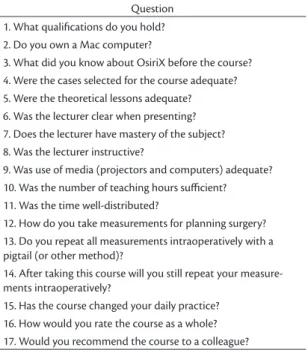
A questionnaire containing 17 items related to the course taken and to students’ prior knowledge was administered after completion of the course (Table 1). The questionnaires were completed using computers provided by the course, using an intranet, and the results were exported to a tabulated database in the
Excel ile format.
The results were analyzed using Wizard 1.3.13 software (Evan Miller). Characteristics were expressed as categorical data and analyzed as absolute frequencies and proportions. The chi-square test and the Shapiro-Wilk test were used to assess the distribution of responses and p<0.05 was adopted as
the cutoff for statistical signiicance.
RESULTS
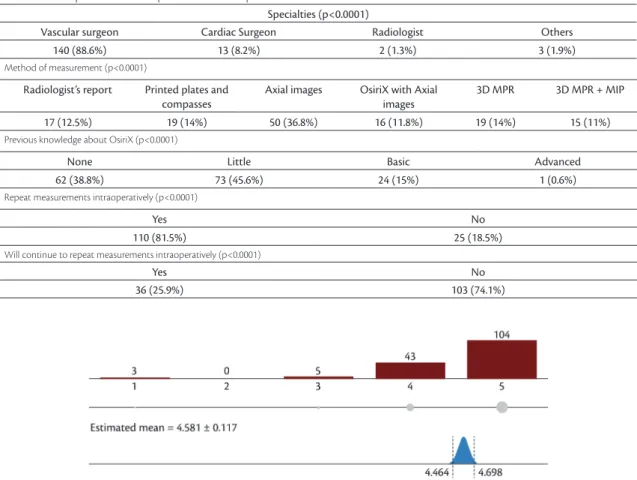
A total of 161 questionnaires were administered (Table 2) to physicians with the following specialties: Vascular Surgery - 140 (88.6%); Cardiac Surgery - 13 (8.2%); Radiology - 2 (1.3%), and other specialties - 3 (1.9%).
An Apple computer is required to run the OsiriX software and the results showed that 92 (57.5%) of the participants already had one.
The results for prior knowledge were: 62 (38.8%) stated they had no prior knowledge; 73 (45.6%) stated they had little prior knowledge; 24 (15%) stated they had basic prior knowledge, and just 1 (0.6%) participant stated that he had advanced prior knowledge.
In relation to the measurement methods employed by participants, 17 (12.5%) trusted the measurements on the radiologist’s report; 19 (14%) used compasses to take measurements on plates; 50 (36.8%) employed axial images to take measurements (irrespective of image viewing software employed); 16 (11.8%) used axial images in OsiriX itself; 19 (14%) used the 3D MPR method, and 15 (11%) used 3D MPR and 3D MPR combined with MIP.
Additionally, 120 participants (81.5%) stated that they repeated measurements intraoperatively using a centimeter pigtail catheter, despite having already taken the measurements with one of the methods listed above.
Of the 110 students who had stated they repeated measurements intraoperatively, 78 (70.9%) responded that after taking the course they would no longer repeat measurements during the procedure.
A majority of the participants (n=147, 94.8%) responded that the course changed their daily practice (Figure 1).
Table 1. Questions asked in the post-course online question-naire.
Question
1. What qualiications do you hold? 2. Do you own a Mac computer?
3. What did you know about OsiriX before the course? 4. Were the cases selected for the course adequate? 5. Were the theoretical lessons adequate? 6. Was the lecturer clear when presenting? 7. Does the lecturer have mastery of the subject? 8. Was the lecturer instructive?
9. Was use of media (projectors and computers) adequate? 10. Was the number of teaching hours suicient? 11. Was the time well-distributed?
12. How do you take measurements for planning surgery? 13. Do you repeat all measurements intraoperatively with a pigtail (or other method)?
14. After taking this course will you still repeat your measure-ments intraoperatively?
287 J Vasc Bras. 2014 Oct.-Dec.; 13(4):285-288 Alexandre Campos Moraes Amato, Daniel Augusto Benitti
DISCUSSION
Self-evaluation using online questionnaires has been shown to be effective for improving self-awareness.5 After the OsiriX course, self-evaluation
of participants’ own competencies was increased. As has been described elsewhere, short duration courses
can have a positive impact on self-evaluation.6
The course’s primary objective is to make students aware of the existence of better image assessment methods and the secondary objective is to teach them how to perform the technique. It is
more effective to allow physicians to relect on the
information acquired and take their own decisions
on which method to employ7 than to impose without
explanation a speciic method through exhaustive
repetitions of the technique.
Shockingly, a proportion of these physicians were still employing methods that are not considered
safe for endovascular planning,8,9 such as taking
measurements using compasses on printed plates
(14%) or blindly trusting the radiologist’s written report (12.5%). However, there was also evidence of progression to digital media, since the great majority were already using some type of computerized image assessment method. A total of 66 students (48.5%) were using axial images to take measurements, which is not considered ideal, but is at least conducted using a computer. Nineteen (14%) of the students were using the 3D MPR method, which is considered an ideal method for diameters and
lengths of non-tortuous vessels,8 and 15 (11%) were
using 3D MPR and 3D MPR combined with MIP, the second of which is considered an important tool for measurement of the length of tortuous vessels.
A total of 110 students (81.5%) stated they had been repeating measurements intraoperatively and 70.9% of them considered that after the course they would cease repeating measurements intraoperatively and trust in the angiotomography results, which is a method that is already considered adequate for
planning endovascular procedures.10
Table 2. Main questions and responses from the questionnaire administered.
Specialties (p<0.0001)
Vascular surgeon Cardiac Surgeon Radiologist Others
140 (88.6%) 13 (8.2%) 2 (1.3%) 3 (1.9%)
Method of measurement (p<0.0001)
Radiologist’s report Printed plates and
compasses
Axial images OsiriX with Axial
images
3D MPR 3D MPR + MIP
17 (12.5%) 19 (14%) 50 (36.8%) 16 (11.8%) 19 (14%) 15 (11%)
Previous knowledge about OsiriX (p<0.0001)
None Little Basic Advanced
62 (38.8%) 73 (45.6%) 24 (15%) 1 (0.6%)
Repeat measurements intraoperatively (p<0.0001)
Yes No
110 (81.5%) 25 (18.5%)
Will continue to repeat measurements intraoperatively (p<0.0001)
Yes No
36 (25.9%) 103 (74.1%)
288 J Vasc Bras. 2014 Oct.-Dec.; 13(4):285-288 Vascular imaging for planning surgery
CONCLUSIONS
Continuing education in a specialized course proved effective for imparting comprehension of the importance of the three-dimensional multiplanar reconstruction method and of image optimization algorithms.
REFERENCES
1. Amato ACM, Benitti DA. Nova era do planejamento cirúrgico endovascular. J Vasc Bras. 2011;10(4):279-81. http://dx.doi. org/10.1590/S1677-54492011000400002.
2. Ratib O, Rosset A. Open-source software in medical imaging: development of osirix. Int J CARS. 2006;1(4):187-96. http://dx.doi. org/10.1007/s11548-006-0056-2.
3. Melissano G, Civilini E, Bertoglio L. “Planning and sizing” della
patologia aortica con OsiriX. 1. ed. Milano: Arti Grafiche Colombo; 2010.
4. Amato ACM, Benitti DA. Curso de OsiriX [site na internet]. 2011.
[citado 2014 abr 23]. www.curso-osirix.com.br.
5. Amato ACM, Neves AAG, Marinho LS, Morillo MG, Amato MCM. The impact of online self-evaluation on self-awareness and lifestyle habits. J Health Inform. 2013;5(3):82-5.
6. Tiuraniemi J, Läärä R, Kyrö T, Lindeman S. Medical and psychology students’ self-assessed communication skills: a pilot study. Patient Educ Couns. 2011;83(2):152-7. http://dx.doi.org/10.1016/j. pec.2010.05.013. PMid:21459253
7. Lowe M, Rappolt S, Jaglal S, Macdonald G. The role of reflection in implementing learning from continuing education into practice. J Contin Educ Health Prof. 2007;27(3):143-8. http://dx.doi. org/10.1002/chp.117. PMid:17876839
8. Kritpracha B, Wolfe J, Beebe HG. CT artifacts of the proximal aortic neck: an important problem in endograft planning. J Endovasc Ther. 2002;9(1):103-10. http://dx.doi.org/10.1583/1545-1550(2002)009<0103:CAOTPA>2.0.CO;2. PMid:11958313
9. Beebe HG, Kritpracha B. Computed tomography scanning for endograft planning: evolving toward three-dimensional, single source imaging. Semin Vasc Surg. 2004;17(2):126-34. http://dx.doi. org/10.1053/j.semvascsurg.2004.03.007. PMid:15185178
10. Armon MP, Whitaker SC, Gregson RH, Wenham PW, Hopkinson BR. Spiral CT angiography versus aortography in the assessment of aortoiliac length in patients undergoing endovascular abdominal aortic aneurysm repair. J Endovasc Surg. 1998;5(3):222-7. http:// dx.doi.org/10.1583/1074-6218(1998)005<0222:SCAVAI>2.0.CO;2. PMid:9761573
Correspondence
Alexandre Campos Moraes Amato Avenida Juriti, 144 – Moema CEP 04520-000 – São Paulo (SP), Brazil Tel.: +55 (11) 50532222 E-mail: [email protected]
Author information
ACMA - Assistant professor of Vascular Surgery, Universidade de Santo Amaro (UNISA); Head of the Department of Vascular and Endovascular Surgery, Amato Consultório Médico; Vascular and endovascular surgeon from Sociedade Brasileira de Angiologia e Cirurgia Vascular. DAB - Full member, Department of Vascular and Endovascular Surgery, Hospital Antonio Cândido de Camargo; Head of the Department of Vascular and Endovascular Surgery, Hospital Metropolitano de Campinas.
Author contributions