NOVA School of Business and Economics and Insper
Instituto de Ensino e Pesquisa
Masters of Science in Economics
Thiago Gonzaga de Camargo Ferreira Prando
A DECISION-THEORETIC MODEL FOR M&A SALE
PROCESSES
2
Thiago Gonzaga de Camargo Ferreira Prando
A decision-theoretic model for M&A sale processes
A dissertation presented as part of the requirements for titles of Master of Science in Economics from NOVA – School of Business and Economics and Master in Economics from Insper Instituto de Ensino e Pesquisa
A Dissertation carried out under the supervision of: José Heleno Faro, Andrea Maria Accioly Fonseca Minardi and Steffen H. Hoernig
3
I authorize the total or partial disclosure of this dissertation, by any conventional or electronic means, for purposes of study and research, provided the source is cited
[Catalogação da Publicação] [Serviço de Documentação]
Insper Instituto de Ensino e Pesquisa
Prando, Thiago Gonzaga de Camargo Ferreira A decision-theoretic model for M&A sale processes
Thiago Gonzaga de Camargo Ferreira Prando – São Paulo, 2016
Dissertation (Master Degree) – NOVA School of Business and Economics and Insper Instituto de Ensino e Pesquisa.
Supervision: José Heleno Faro, Andrea Maria Accioly Fonseca Minardi and Steffen H. Hoernig
4
Thiago Gonzaga de Camargo Ferreira Prando
A decision-theoretic model for M&A sale processes
A Dissertation, presented as part of the requirements for titles of Master of Science in Economics from NOVA – School of Business and Economics and Master in Economics from Insper Instituto de Ensino e Pesquisa
Approved in:
Examining Board
Professor: Signature:
Institution:
Professor: Signature:
Institution:
Professor: Signature:
Institution:
Professor: Signature:
Institution:
Professor: Signature:
6
ACKNOWLEDGEMENTS
I am extremely grateful to my family that early in life awakened my interest for knowledge, let me free to make my choices and unconditionally provided support.
My sincere thanks to my girlfriend Paula who gave me courage to change my life and start this journey. You could not have been more caring and loving in the last two years. Thanks also for your revision. I will always be glad. I love you.
I thank my supervisor José Heleno Faro for providing unparalleled guidance with insightful ideas. I have really appreciated working with you and enjoyed our sessions.
I would like to thank my supervisor Stephen Hoernig. Thanks for leading me to the theoretical approach and providing an exceptional review of this study.
I would also like to express my gratitude to Andrea Minardi for your helpful comments and dedication.
I express my appreciation to Insper and NOVA’s faculty, especially to coordinator Ricardo Dias Brito who suggested my participation in the Double Degree program in Portugal. I am profoundly grateful for that.
My sincere thanks to my friends and former colleagues of the Bradesco BBI M&A team: Alessandro Farkuh, Rafael Beran, Mariana Nishimura and Daniel Hermann. You have inspired my career and the theme of this dissertation.
Thanks to my dear friend Edson who provide a careful revision of this material.
I sincerely thank my colleagues Pedro Nunes, Marcos Cassini, Ricardo Lins and Alexandre Fernandes. This journey was brighter and funnier because of you.
Muito obrigado Lisboa, do fundo do meu coração! Obrigado por me receber e me modificar tanto. Por favor, continue à esperar por mim.
7
ABSTRACT
PRANDO, Thiago Gonzaga de Camargo Ferreira Prando. A decision-theoretic model for M&A sale processes. Dissertation (Mastership) – NOVA School of Business and Economics and Insper Instituto de Ensino e Pesquisa, São Paulo, 2016.
When potential buyers receive invitations from target companies to engage in competitive M&A sale processes they face a challenging decision. Considering significant due diligence investments, target value uncertainty and unclear competitive environment, should they accept such invites? The main purpose of this study is to formulate a decision rule for prospective acquirers to enter takeover contests according to these relevant factors. In addition, this dissertation explores the formation of optimal bids in the decisive stage of controlled sales (sealed-bid
auctions) with uncertain presence of one competitor. A decision-theoretic model is designed where a potential buyer (Player A) is invited to participate in an M&A sale process. Its due diligence investments are modeled as the purchase of real options and the optimal bid value is calculated according to its expected payoff maximization. The participant has incomplete information regarding the existence of rivals and their strength and takes decisions that seek robustness with respect to misspecifications. Due diligence investments decision rules are established according to Player A’s capabilities to create value through the acquisition, its beliefs regarding the potential rivalry, and required spending to analyze the target. Optimal bidding strategies ultimately depend on our participant’s beliefs concerning the potential competition. Our findings show that an uncertain strong second bidder might prevent Player A to place a higher offer. This is an exciting result that prompts re-thinking on
competition’s threat. Sellers and their financial advisors should take these results into account when tailoring efficient sale processes, especially managing a proper perceived competitive environment.
8
LIST OF FIGURES AND TABLES
Figures
Figure 1 Description of M&A controlled sale process 13
Figure 2 Detailed steps of the M&A sale process model 17
Figure 3 First stage decision problem 19
Figure 4 Second stage decision problem 21
Figure 5 M&A controlled sale process decision problem 22
Figure 6 Optimal bidding functions given beliefs set 27
Figure 7 Optimal bid for increasing levels 28
Figure 8 Optimal bid for increasing levels 29
Figure 9 Expected payoff of the auction at 35
Figure 10 Solving an illustrative case 40
Tables
Table 1 Real options parameters 24
9
CONTENTS
1. INTRODUCTION ... 10
2. LITERATURE REVIEW ... 12
2.1.Description of M&A sale processes... 12
2.2.Real options and game-theoretic approach to mergers and acquisitions ... 13
3. A DECISION-THEORETIC MODEL FOR M&A CONTROLLED SALE PROCESSES ... 17
3.1.Designing the sequential due diligences stage ... 18
3.2.Designing the sealed-bid auction stage ... 19
3.3.Subgame perfection and optimal bid ... 22
3.4.Due diligence investments as the purchase of real options ... 24
4. FINDINGS AND RESULTS ... 26
4.1.Decision rules for due diligence investments ... 26
4.2.Analysis of the optimal bid ... 26
5. CONCLUSIONS ... 30
REFERENCES ... 32
APPENDIX A. Derivative of Player A’s expected payoff in relation to its optimal bid ... 34
APPENDIX B. Expected auction payoff before the second due diligence and second decision rule 36 APPENDIX C. First due diligence investment decision rule... 38
10 1. INTRODUCTION
Firms often face competition for acquiring a target company. Rivalry is particularly challenging when sellers initiate the transaction approaching a selected group of buyers (controlled sale process). Potential acquirers are invited to perform an investigation and retrieve information on the target value. On the one hand, conducting this due diligence demands from prospective acquirers substantial expenditures with advisors, consultants, lawyers, and involves opportunity costs. On the other hand, carrying it out enhances the amount and quality of information available which contributes considerably to a successful bid. After the analysis, bidders might submit a final offer in a sealed-bid auction with unknown number of competitors.
Taking into account considerable due diligence costs, uncertain target value and unclear competitive environment, buyers face a puzzling decision to accept the invite. The leading purpose of this dissertation is to examine the influence of these
factors on this decision. A second purpose is to explore the formation of optimal bids in sealed-bid auctions, the moment when due diligence investments are sunk costs, target value is known but competition uncertainty remains.
In this dissertation we analyze three research questions. Firstly, we examine whether a potential acquirer must enter into a bid contest investing in a superficial due diligence. Subsequently, we study if it should perform an in-depth examination on the target given the information revealed in the first inquiry. Finally, we investigate
buyers’ optimal bid value.
In an effort to explore these questions, we design a theoretical model where a potential buyer (Player A) is invited to an M&A sale process. Due diligence investments are evaluated as the purchase of real options whereas the bid value is treated in light of individual decision theory. Player A´s decisions are analyzed according to its beliefs regarding the likelihood of existence and strength of rival bids. These beliefs represent, in essence, the threat of competition.
The significance of this dissertation lies on its unparalleled contribution to competition preceding binding offers. Moreover, a unique aspect of this research is
11
decision-making tool. Ultimately, it also contributes valuable insights to vendors design more efficient controlled sales.
Regarding the organization of this study, Chapter 2 presents a review of the literature including a detailed explanation of M&A sale processes, a comprehensive description of the controlled sale - focus of our model - and a revision of previous studies that apply real options and game-theoretic approach to mergers and acquisitions.
Chapter 3 describes the theoretical methodology. The bidding contest is designed and solved through subgame perfection. We move backwards from the
decision of the bid value to the decision to enter the process. Decision rules are
established for each Player A’s due diligence investments and a function to the optimal bid value is settled.
Chapter 4 presents the study’s findings concerning the interpretation of the decision rules and competition impact on optimal bids. We interpret main results of our model in relation to the participant’s beliefs.
12 2. LITERATURE REVIEW
2.1. Description of M&A sale processes
The sale of a company is an event of ultimate importance for its shareholders and managers. It is a complex and time-consuming undertaking that require months of analysis and negotiations. For that reason, once the decision to put a firm up for sale is taken, its shareholders often retain an advisor such as an investment bank to conduct the M&A sales process. Together, they tailor a specific process to fit the optimal mix of value maximization, timing, confidentiality and other relevant issues for the sellers (ROSENBAUM; PEARL, 2013).
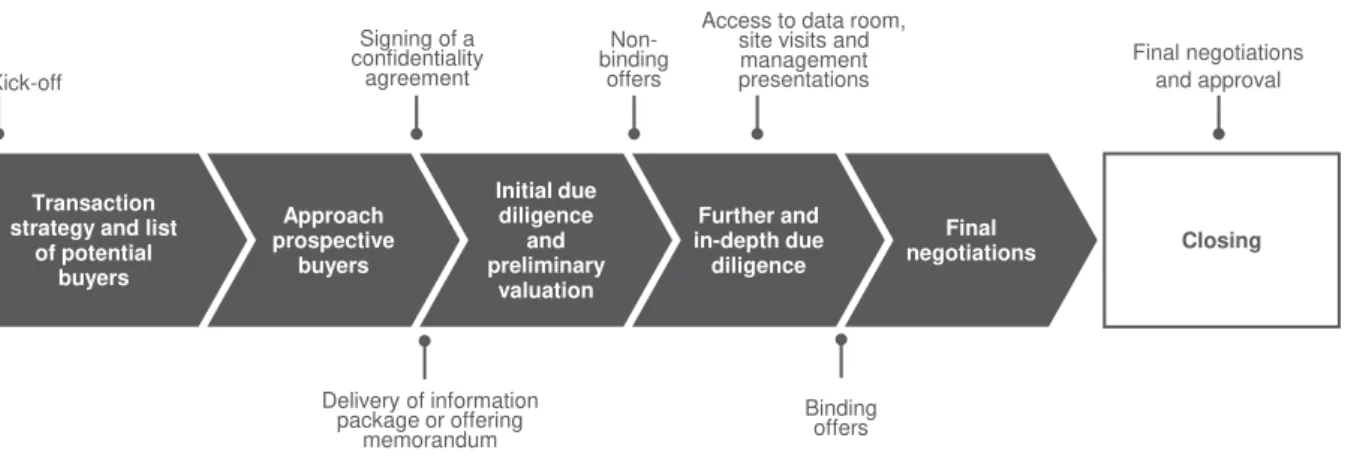
One possible way is to conduct the process is a negotiated sale, approaching a single buyer and negotiating the best possible terms. A second possibility is a controlled sale (or target auction) where only a select group of potential bidders are addressed. Finally, the parties may considerer a third method running a full-scale (broad) auction reaching out as many potential acquirers as possible (ROSENBAUM; PEARL, 2013; BOONE, MULHERIN, 2009). A typical standardized auction process follows detailed.
At the beginning advisor and target define a list of potential acquirers who are contacted by the advisor. A teaser, a document with a brief and no-name description
13
bidders must submit their offers which are again scrutinized by advisors and target. After this revision, the selling party and its advisor may negotiate with two interested parties and ask for best and final offers. Finally, they choose a winning bidder, usually the highest bid, and present it to the target´s board of directors and shareholders to final approval (BOONE, MULHERIN, 2009; HANSEN, 2001; ROSENBAUM; PEARL, 2013).
Figure 1. Detailed M&A controlled sale process
Source: Adapted from Rosembaum; Pearl (2013)
2.2. Real options and game-theoretic approach to mergers and acquisitions
An option is defined as the right, but not an obligation, to buy or sell a specific underlying asset by paying a prespecified price on or before a certain date. Its core value derives from the right to be exercised only if it is in the holder´s interest. It is appropriate for this dissertation to differ financial from real options: while the former defines rights on an underlying financial asset in a liquid market, the latter relates to business opportunities such as capital budgeting, investment decisions and transactions. Real options can be classified into three dimensions: proprietary or
shared according to the existence of competition or the firm’s capacity to fully appropriate the option value; single or compound in line with the connection with
other investment opportunities and; expiring or deferrable in relation to timing to decision. Incorporating the game theory framework allows for a competitive pricing perspective. An increasing number of researchers have demonstrated the importance of this combined structure to examine returns, occurrence and dynamics of mergers and acquisitions (TRIGEORDIS, 1996; BRACH, 2003).
Further and in-depth due diligence Transaction
strategy and list of potential buyers Initial due diligence and preliminary valuation Final negotiations Kick-off
Signing of a confidentiality
agreement
Delivery of information package or offering
memorandum Closing Final negotiations and approval Non-binding offers Binding offers Access to data room,
site visits and management presentations
Approach prospective
14
Smith and Triantis (1994) demonstrate that a merger or acquisition, besides the generated synergies, brings a new portfolio of strategic options for the resulting firm. The acquirer’s competitive position within its industry can be altered through growth, flexibility or divesture options created or facilitated by the transaction. Incorporating these options into valuation techniques of the target is crucially important for capturing strategic benefits and accurately assessing its value.
Lambrecht (2004) studies the procyclicality of friendly mergers and hostile
takeovers motivated by economics of scale through continuous-time real options techniques. The author models two companies with an option to merge whose payoff
depends on their current equity value, benefits from their synergies and one-off costs such as fees and restructuring expenses. The optimal timing to merger balances their stochastic equity value, positive incentives of synergistic advantages and negative incentives of the permanent nature of the deal. The results of the model indicate that companies have incentives to merger that are positively related with economic activity when transactions are driven by economies of scale. Another interesting finding for this dissertation is that in comparison to friendly mergers that seek a global optimization, hostile takeovers happen at a higher level of economic activity. This results from the fact that when target companies set the terms for the transaction it imposes an additional bid premium to potential acquirers.
Smit (2001) proposes a valuation methodology based on real options and
game theory frameworks to “buy and build” acquisition strategies. The “buy and build” strategy entails an equity investors acting as an industry consolidator that first acquires a platform company and then leverages its core competencies into add-on acquisitions. Therefore, managers should account for strategic and growth options embedded in earlier investments when valuing the target. They should also take competition into consideration, what can be done through game theory principles. In the real-options approach, acquisitions can be classified into two dimensions: simple or compound according its link with other synergistic deals and; proprietary or shared
according to its degree of competitiveness. In that context, competitive bidding and auctions are therefore examples of shared simple options.
15
acquirer. Competing players have the opportunity to buy a target company modeled as a real option acquired by the investment in due diligence (option premium) that reveals player´s private valuation about the target (underlying value) and can be exercised making a bid (exercise price). It is modeled a two-stage bidding game between two players. In the first stage, player A has identified, conducted a costly due diligence and placed a bid for the target. Player B, after observing the offer, decides to enter or not in the contest. In the second stage, if player B decides not to
enter, player A acquires the company with the opening bid whereas if player B enters, they compete through an English auction. The first insight of the model
concerns the initial bid: when player A bids, two contrary singling effects are sent. On the one hand, given their level of similarity player B can infer its own value of the target and one the other hand the potential competitiveness of the deal. Regarding their strategies, player A can seek a pre-emptive bid such that the value of the option for player B is smaller than its due diligence cost. On the contrary, an accommodating bid will lead player B to participate in the auction. The model provides an interesting finding that value appropriation follows a U-shaped curve with the degree of relatedness. For high very low degrees of similarity there is an increase in value appropriation since pre-emptive bids are made easier. For intermediate levels, accommodating bids usually leads to a contest and value appropriation decreases.
Other researchers have provided new insights into acquisition strategies of financial buyers such as private equity firms. While financial buyers acquire companies exclusively as an investment, strategic buyers are those who seek acquisitions that will provide synergies and fit into their business plans (e.g. operating companies). In his doctoral thesis Van den Berg (2007) brings Smit, van der Berg
and De Maeseneire (2005) model into the field of private equity firms’ competition
focusing on the degree of similarity between players. In line with the previous article,
Van den Berg (2007, p.126) demonstrates that “whether the first bidder is able to
offer the deterring opening bid or the lower accommodating bid depends on the
degree of relatedness of its resources with the opponent’s resources”.
16
Following the two-stage bidding game as in Smit, van der Berg and De Maeseneire (2005) and Van der Berg (2007) they examine the relationship between their level of similarity, likelihood of a multi-bidder process and expected final prices. Their innovative approach includes a laboratory experiment recreating the conditions of the game that provided three interesting results. First, multi-bidders contests are more likely between intermediately similar bidders while single-bidder contests are mostly a result of games with very similar and dissimilar players. Intermediately similar bidders
seemed unable to preempt competition whereas very similar and dissimilar bidders could preempt bidder due to potential competition and low information value,
17 3. A DECISION-THEORETIC MODEL FOR M&A CONTROLLED SALE
PROCESSES
In this section we design a decision-theoretic model in which a firm (“Player
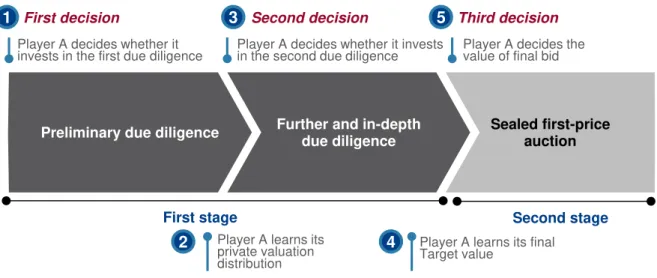
A”) is invited by the shareholders of a company for sale (“Target”) to engage in an M&A controlled sale. This process comprises two stages: (i) sequential due diligences (preliminary and in-depth) and; (ii) sealed-bid auction. In the first phase potential acquirers retrieve information on the Target value. This inquiry requires from prospective buyers substantial expenditures such as fees for financial advisors, auditors, lawyers, and consultants. In addition, they incur in opportunity costs since resources are allocated to accomplish this particular deal. In the second phase the Target manages a sealed-bid auction. At this point, Player A faces uncertainty regarding the number of competitors in the auction.
Figure 2. Detailed steps of the M&A sale process model
We assume that prior to the opening stage sellers disclose their reserve price and share a superficial information memorandum. An initial expenditure is obligatory to scrutinize the data which reveals the participant’s private Target valuation distribution. Subsequently, our player decides whether it withdraws from the contest or invests in a deep and expensive investigation. Through this second study Player A assesses its final Target value hence finishing the first stage and proceeding to the auction.
Player A decides whether it invests in the second due diligence Player A decides whether it
invests in the first due diligence
Preliminary due diligence Further and in-depth due diligence
Sealed first-price auction
First stage
Player A decides the value of final bid
Player A learns its private valuation distribution
Player A learns its final Target value
First decision Second decision Third decision
Second stage
1 3 5
18
Finally, Player A may submit a final offer in a sealed-bid auction. We assume that vendors seek to maximize their wealth and will opt for the highest bid conditioned on exceeding their reserve price. With support of game theory framework, we separately design each stage of the M&A process.
3.1. Designing the sequential due diligences stage
Following Smit and Moraitis (2014), we schematize the initial part of model in four dimensions: the players, the actions available to them, the timing of these
actions, and the payoff structure associated to each possible outcome. Our first step is to characterize players as Player A and Nature whose role is to reveal the parameters of the private valuation distribution.
Next we define available information and actions. Before investing in the first due diligence Player A knows that this spending reveals the mean, ̅ , of its private
Target valuation distribution, ( ) The mean will be either with probability ,
which means high potential of value creation, or with probability ,
representing low potential. We assume that a high potential of value creation leads our participant to proceed to the second due diligence whereas low potential leads it to withdraw from the contest. In addition, our player is informed about sellers’ reservation price the standard deviation of its valuation distribution and the
support of the distribution ̅ ̅ where is a defined as a spread. That is, beforehand our participant is not certain about its ability to profit from transaction.
The primary stage requires two actions regarding each investment on analyzing Target’s data. We denote the first action, decision to enter the first
diligence by { } where indicates that participant A does not invest and indicates that it enters and spends to accomplish the examination.
Thus, it learns the mean of its private valuation distribution, ̅ equal to with
probability or with probability and consequently the support of the distribution. Next, we represent the second action or decision to enter the deep investigation by { } where indicates that player A does not enter and
19
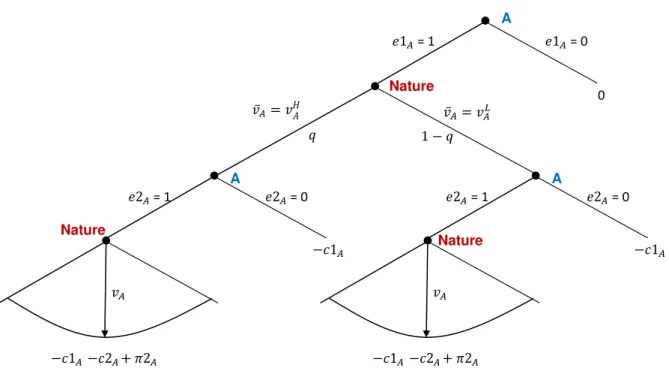
Our third step is defining the sequence of play as sequential movements. There are four sequential movements: Player A’s first decision, Nature stochastically draws the mean of ( ), Player A’s second decision, and Nature stochastically
draws from the support of ( ).
At last, we represent the payoff associated to each result to bidder A as . If the acquirer does not enter the process its payoff is null and the investment opportunity is lost. If it performs the early due diligence and decides to withdraw from the process after learning its private distribution its payoff is negative with the initial spending. If our participant invests twice performing the full scrutiny it profits the total
cost of the study augmented by the auction stage payoff, , which is detailed in the next section:
{
Figure 3. First stage decision problem
3.2. Designing the sealed-bid auction stage
Once again we design the process in four dimensions: players, actions, timing of actions, and payoff structure. Firstly, players continue to be Player A and Nature.
A A
Nature
= 0 = 1
Nature
= 0 = 1
Nature
= 0 = 1
0
20
Nature defines the existence of a second bidder B and, in that case, also generates its type. The choice for a single competitor is justified by the study of Boone and Mulherin (2011) which states that in 870 studied takeovers between 2003 and 2007 received on average 1.3 private binding offers. In essence, the second bid represents the threat of competition.
Secondly, we define our buyer third and conclusive action which is choosing
its final bid value, . Player A believes that there is a probability that another rival offer would be placed. It believes this offer is stochastically drawn from a uniform distribution of opponent types denoted by ( ) whose interval is
( ) . In other words, the minimum competing offer is, of course, seller’s reserve price whereas the maximum contestant bid is a convex combination between
and The coefficient represents the level of competitiveness or capacity of rivals to transfer synergy creation to sellers. Consequently, we can infer that there
is a probability of losing the auction given by ( )
( ) . It is important to
mention that all beliefs are formed prior to the first stage. The information set is constructed to indicate that firms are unsure about competitors’ existence, valuation and costs. Put differently, our model is constructed to reflect that information is incomplete in controlled sale processes.
Afterwards, we design the timing of actions. Player A’s third action is taken without knowledge about the results of Nature’s movements. Player A decides the value of its final proposal and Nature simultaneously draws competitors’ existence and type.
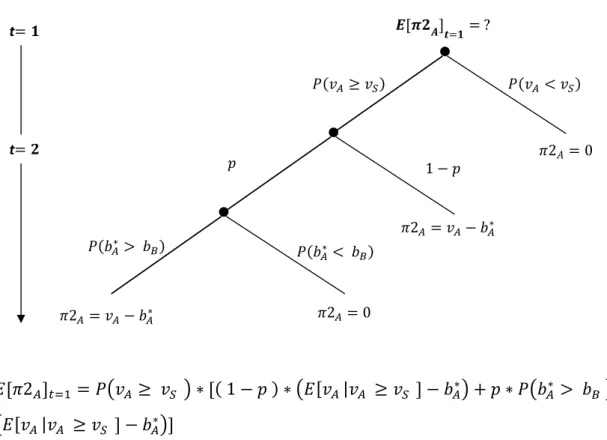
Lastly, we determine final payoffs given each possible outcome. Player A has joined a sealed-bid auction where the highest offer wins and pays the value of her bid. It means the value of proposals not only affects whether participants win or not but also how much they pay. At this point both investments in due diligence are sunk costs, private valuation is known and there is uncertainty respecting the rivalry. For this reasons our participant receives if it wins the auction and zero otherwise.
We neglect the scenario where because it is a zero-probability event.
21 Figure 4. Second stage decision problem
Finally, we outline total payoffs and the full representation of the process:
{
Nature A
0 if
if
Nature
0 if
0 if and
22 Figure 5. M&A controlled sale process decision problem
3.3. Subgame perfection and optimal bid
We proceed to solve our model by predicting Player A’s likely behavior according to its optimal decisions. Our examination begins looking forward and finding the subgame perfection at the auction. Thus, we reason backwards from our
participant’s last decision concerning the submission of an optimal offer at the sealed-bid auction.
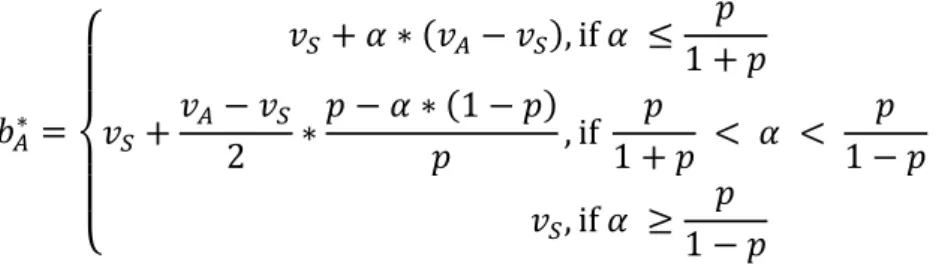
Proposition 1. Given a private Target valuation equal or higher than sellers’ reserve price, bidder A places an optimal bid ( ) that depends on the beliefs set and :
A A Nature = 0 = 1 Nature = 0 = 1 Nature = 0 = 1 0 A Nature A if if Nature if if Nature A Nature if if and
if and
if
if and
if and
t
t
23 {
( )
( )
Proof: Appendix A
Proposition 1 results from the analyses that follows. First of all, towards pursuing the best course of action we separate cases when the revealed private valuation falls behind sellers’ reserve price from cases when it surpasses. It is clear from that Player A is better off bidding below thus having a rejected offer,
instead of bidding above and reaping a negative profit. In contrast, if , our
participant reaches a greater outcome by bidding with some probability of winning rather than offering below resulting in a null payoff. Obviously, Player A is always better off bidding below its valuation oppositely to bidding equal or above it.
Therefore, given our player should bid . By now it has to choose an optimal value that counter-balances its absolute payoff and the probability of winning. That is, bidding incrementally below its private valuation increases Player
A’s net payoff margin when it wins which provides a marginal benefit. In contrast, at the same time it reduces the likelihood of having the highest offer which represents a marginal cost. With the purpose of calculating the optimal bid that counterweights these two effects we take the derivative of the auction expected payoff in relation to the bid value. We must remember that a second proposal occurs with probability
and non-competition happens with probability . We also impose lower and upper
bounds given by the interval of competing rival bidders types, ( ).
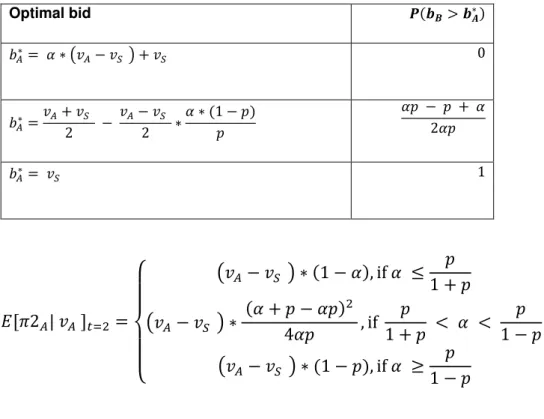
Finally, it is relevant to highlight that for a given we can estimate Player A’s payoff before the auction.
{
( ) ( )
( ) ( )
24
Proof: Appendix A
3.4. Due diligence investments as the purchase of real options
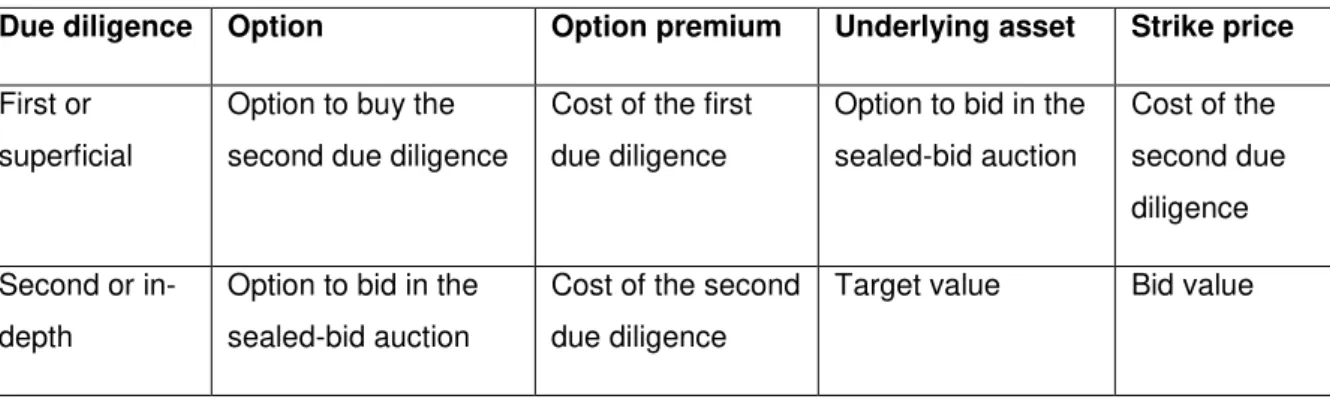
By now we analyze decisions referring whether or not our participant enters each due diligence. In addition to solve our model with standard decision theory we will show that due diligence investments are similar to the purchase of real options providing an additional tool for buy-side professionals.
Table 1. Real options parameters
Due diligence Option Option premium Underlying asset Strike price
First or superficial
Option to buy the second due diligence
Cost of the first due diligence
Option to bid in the sealed-bid auction
Cost of the second due diligence
Second or in-depth
Option to bid in the sealed-bid auction
Cost of the second due diligence
Target value Bid value
After computing the best course of action in the third decision node we move backwards analyzing the second node. At this point, Player A decides whether or not
invest in a second due diligence, { }. This decision resembles a real option with cost that is indispensable to compute the Target valuation That is to say,
acquirers buy the opportunity to place an offer exercising the option at the bid value. We seek to establish a decision rule for which happens if the expected
payoff of the auction surpasses the cost of proceeding to it, . This also means that Player A is exercising the first option at an underlying value greater than the strike price.
Proposition 2. The decision to enter the second due diligence depends on Player
25
{
( ̅ )
( ̅ ) ( )
( ̅ )
Where ( ̅ ) ∫ ̅ ( ) ∫ ̅ ( ) represents the
probability-adjusted value creation for Player A.
Proof: Appendix B
Lastly, we move to the first decision node where Player A decides whether or
not enter the first due diligence, { }. In other words, prospective buyers purchase the opportunity to perform the second due diligence at a cost .
Proposition 3. The decision to enter the first due diligence depends on Player A’s probability adjusted value creation, given ̅ , exceeding the total due diligence
investment adjusted by an optimal bidding factor
{
( ̅ ̅ ) ( )
( ̅ ̅ ) ( ( ) )
( ̅ ̅ ) ( )
26 4. FINDINGS AND RESULTS
4.1. Decision rules for due diligence investments
Analyzing Propositions 2 and 3, we notice that the left side of both decision rules - represented by ( ̅ ) - refers to the ability of Player A creating value through
the acquisition for any optimal bidding strategies. The function ( ̅ ) is composed
positively by Player A’s expected private Target valuation whereas sellers’ reservation price appears negatively impacting the term. According to the equation, both terms are adjusted by the probability of value creation, that is, possible Target
values above in the support of ( ). Altogether this is consistent with the fact that bidders only benefit from their valuation and make disbursements if the deal is worthy for them.
On the other hand, the right side of both decision rules depends on the cost of the due diligences adjusted by strategy-related factor. In the first rule, the primary due diligence investment is treated as an inherent cost of entering the M&A process while the second due diligence investment is adjusted by the probability of it being made. This happens when the second rule is satisfied. On the contrary, the second rule considers the first spending as a sunk cost and the subsequent as a necessary expenditure to move to the auction. Optimal bid factors that adjust the due diligence investments result from the substitution of the optimal bid function and the correspondent probability of winning in the expected payoff value as described in Appendix B. As expected, when the required investment increases firms are less likely to perform the study.
4.2. Analysis of the optimal bid
27 {
( )
( )
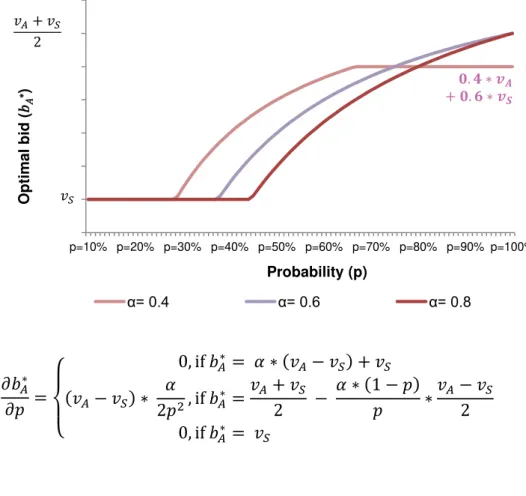
In the first case, sets of and below the lower band in Figure 6, the best game plan is seeking to outbid any potential rival offer To put it differently, our player
tries to reduce to zero the probability of losing the dispute. Notably for this case, if the belief of having an opponent increases then the participant uses this approach for greater intensities of rivalry as captured by a positive slope in the lower band line.
In regards to the second case, beliefs sets above the lower band and below the upper band, follows a specified equation. One of most significant discoveries is
that if then . These offer insight into the fact that participants will
utmost divide half of its value creation with the sellers. On the contrary, Player A
reduces the value creation it was willing to transfer, by the factor ( )
When it comes to the third case, sets above the upper band, equals the minimum value sellers will accept This conclusion implies that fierce competition
might motive Player A to bid as low as possible and benefit from cases where contest does not exist. This is an important issue to selling parties when designing a tailored M&A sale process.
Figure 6. Optimal bidding functions given beliefs set
0.0 0.4 0.8 1.2 1.6 2.0
10% 20% 30% 40% 50% 60% 70% 80% 90% 100%
A
lph
a
Probality (p)
28
Another striking conclusion lies in a mutable impact of alpha on the optimal bid. At first, as alpha increases the optimal bid also growths. However, as beating competitors reaches a certain level of difficulty alpha’s effect encounters an inflection point and bids move in the opposite direction In addition, the inflection point takes a
higher alpha to occur when the perceived probability of competition is greater. That is to say, if our participant is confident on the presence of a contest takeover then it continues increasing its proposal for higher expected levels of competition.
Figure 7. Optimal bid for increasing levels
{
( )
( ) ( )
We can also interpret our findings from the point of view of the presence of a second bidder. As expected, low degrees of lead to the best response of offering
the lowest possible value vendors will accept. Nonetheless, as rises Player A is encouraged to escalate its proposal. This is an exciting outcome which prompts re-thinking on competition’s threat leading to higher offers. In our study, because of competition uncertainty players only increase their offers at certain beliefs sets. Controversially, the capabilities of potential adversaries delay the moment when
0.1 0.2 0.3 0.4 0.5 0.6 0.7 0.8 0.9 1.0
O
p
timal
b
id
(
)
Alpha
p=40% p=60% p=80%
29
players start to increase their offers, but on the other hand, the proposal escalates quickly for higher levels of competition.
Figure 8. Optimal bid for increasing levels
{
( )
( ) ( )
p=10% p=20% p=30% p=40% p=50% p=60% p=70% p=80% p=90% p=100%
O
p
timal
b
id
(
)
Probability (p)
30 5. CONCLUSIONS
In the previous section, we have reported the main outcomes of our model. Chapter V summarizes our study, discusses main results and their implications for practice, recommends further research, and concludes the study.
This dissertation has developed a theoretical two-stage model in order to analyze potential acquirers’ participation in M&A sale processes. The first phase comprises two sequential investments in due diligence in order to assess the Target value whereas the second phase is a sealed-bid auction. We have studied the influence of significant due diligence investments, uncertainty regarding the target value during the due diligence stage and unclear competitive environment in their decision to engage in these auctions. In addition, with support of decision theory, we have also examined the formation of optimal bids in the last stage of model.
We have analyzed three research questions. First, we have studied whether a prospective buyer should enter into a bid contest financing a preliminary due
diligence. Then, we have examined if it should perform an in-depth scrutiny on the Target given the information revealed in the first inquiry. Lastly, we have investigated
buyers’ optimal bid value.
When it comes to the first two research questions, we have created decision rules for participants’ investments in each due diligence. Both decision rules depend
on Player A’s ability to create value compared to the required investments to assess
the Target value. They are also related to the optimal bidding strategy function that we calculated according to the expected sealed-bid auction payoff.
Regarding the third research question, we have found that the optimal bid lies
between sellers’ reserve price and the maximum potential rival offer. The optimal
value between these extremes depends on the beliefs concerning the probability of a rival bid and the strength of potential competitors. As expected, low expected probability levels of a second bid motivates Player A to offer sellers’ reservation price and, at a certain point as continues rises, Player A starts to escalate its proposal. In
addition, this moment occurs at higher levels of for higher levels of expected
31
Another finding concerns the variable impact of an increasing alpha coefficient on our participant’s bid. First, as alpha increases the optimal bid follows the same path. Nonetheless, as outbidding rivals becomes more difficulty alpha’s effect encounters an inflection point and the optimal bid starts to decrease. That is, the uncertainty regarding the existence of a rival bid might motivate Player A to decreases its offer if potential competitors are expected to have strong capabilities of value creation.
These results have far-reaching implications for M&A advisors interested in the dynamics between sellers and buyers. This study identified decision rules to
enter M&A sale process and proceed to in-depth due diligences that can provide a financial framework benefiting buy side professionals. For selling-parties, this study offers insight into creating an appropriate competitive environment especially when the process has only one interest potential buyer in the due diligence stage.
The findings of this study, although significant, have some limitations. The
main limitation is the assumption of a uniform distribution of competing bidders’ type.
The problem is that it strongly limits the robustness of your results. For example, we have calculated that participants will utmost divide half of its value creation with the sellers. This is not a robust finding if we do not assume uniform distributions for
competing bidders’ type. Another limitation is the focus on a situation of a single player against nature. One could argue that we should model an M&A sale processes as a game between participants. In that case we should compute Bayesian-Nash equilibrium for the game. Further research along these lines could use other distributions in order to calculate the optimal bid for Player A. Future research into this subject should also include the possibility of a second rival bid.
The findings of this dissertation expanded the literature of competition in mergers and acquisitions. Specifically, it focused on M&A sale processes when initiated by the selling party. This investigation modeled the formation of optimal bids in sealed-bid auction according to a bidder’s belief regarding the probability of
existence of a rival offer and its strength. It also computed two decision rules for
32 REFERENCES
BRACH, MARION A. Real options in practice. New Jersey: John Wiley & Sons, 2003.
BUSSAB, WILTON de O.; MORETTIN, PEDRO. Estatística Básica. São Paulo: Saraiva, 2006.
DAI, YUN et al. Similar bidders in takeover contests. Games and Economic Behavior, v. 82, p. 544–561, 2013.
HANSEN, ROBERT G., 2001, Auctions of companies, Economic Inquiry 39, 30–43.
LAMBRECHT, BART. The Timing and Terms of Mergers Motivated by Economies of Scale. Journal of Financial Economics. v. 72 (1), p. 41-62, 2004
ROSENBAUM, JOSHUA; PEARL, JOSHUA. Investment Banking: Valuation, Leverage buyouts and Mergers & Acquisitions. 2013
SMIT, H.T.J. Acquisition Strategies as Option Games. Journal of Applied Corporate Finance, vol. 14(2), p. 79-89, 2001.
SMIT, HAN T. J., MORAITIS, THRAS. Playing at acquisitions: behavioral option games. New Jersey: Princeton University Press, 2014.
SMIT, H.T.J., W.A. VAN DEN BERG AND W. DE MAESENEIRE. Acquisitions as a Real options Bidding Game. Tinbergen Institute Discussion Paper, TI 2004-084/2, 2005.
SMITH, K. AND A. TRIANTIS. The Value of Options in Strategic Acquisitions. In: Trigeorgis, L. (Ed.), Real Options in Capital Investment: Models, Strategies, and Applications. Praeger, New York, 1994.
33
34 APPENDIX A. Derivative of Player A’s expected payoff in relation to its optimal bid
Given a private valuation equal or higher than sellers’ reserve price, expected payoff of the auction at :
= ( ) ( ) ( ) ( )
= ( ) ( ( ))
= ( ) ( )
= ( ) ( ( ) )
We take the derivative of the expected payoff in relation to and equal it to zero in order to find the optimal bid, :
( )
The first thing we need to remember is the optimal bid has a lower bound given by the seller’s reserve price. Payoffs cannot be further maximized by bids
below . Thus, if then , which occurs when:
( )
On the other hand, the optimal bid has an upper bound given by the potential uppermost competing bid. Translating it to out model, the probability of winning,
( ) cannot be further increased by offers above the expected highest
possible rival bid If then , which happens when:
35
Finally, we rewrite ( ) for cases where
as ( )
Therefore, we can calculate auction’s expected payoff given a known private
valuation, . A key point to this analysis is inferring ( ). This probability does
not depend on and thus is not a random variable. It depends on the parameters
set composed by and that result in the bidding strategy. For example, when Player A opts for offering the expected highest competing bid the correspondent
probability of losing is null. On the other hand, when it bids sellers’ reserve price it
loses for any existing competitor.
Table 2. Probability of losing the auction with competition
Optimal bid ( )
( )
( )
{
( ) ( )
( ) ( )
36 APPENDIX B. Expected auction payoff before the second due diligence and second decision rule
Figure 9. Expected payoff of the auction at
( ) ( ) ( ) ( )
( )
( ) ( ) ( ( ))
A key point to this analysis is inferring ( ) that was calculated for each case
in Appendix A. Substituting ( ) and in the expected payoff equation:
{
(∫ ̅ ( ) ∫ ̅ ( ) ) ( )
(∫ ̅ ( ) ∫ ̅ ( ) ) ( )
(∫ ̅ ( ) ∫ ̅ ( ) ) ( )
If we defined ( ̅ ) ∫ ̅ ( ) ∫ ̅ ( ) we reach:
t
37
{
( ̅ ) ( )
( ̅ ) ( )
( ̅ ) ( )
Therefore, given that Player A decides by if :
{
( ̅ )
( ̅ ) ( )
38 APPENDIX C. First due diligence investment decision rule
Our assumptions in section 3.1 imply that ̅ and
̅ . Hence, Player A chooses if ̅ and
if ̅ . Thus, the expected payoff for is ( ̅
) ( ) ( ).
{
( ̅ ̅ ) ( )
( ̅ ̅ ) ( ( ) )
39 APPENDIX D. Illustrative case
The purpose of this section is to demonstrate the applicability of our model.
Player A is invited to participate in an M&A sale process whose sellers’ reservation
price . The first due diligence spending, , reveals a uniform private
Target valuation distribution, ( ), with: (i) mean, ̅ , equal either to with
probability or with probability ; (ii) spread and;
(iii) support ̅ ̅ . The second due diligence investment, ,
reveals Player A’s private Target value, , stochastically drawn from the support of
( ).
When it comes to the expected competition in the sealed-bid auction, Player A
believes that: (i) one rival bid will be submitted with probability and no bid will be placed with probability and; (ii) the competing bid will be
stochastically drawn from a uniform distribution of opponent types denoted by ( )
whose interval is given by ( ) with .
Proceeding backwards in order to find the most likely outcome we analyze Player A´s last decision choosing its bid value. As described in Section 4.2 the optimal course of action is to bid below if and to place and optimal bid,
according to the equation below as provided by Proposition 1 otherwise:
( )
As Player A is aware about its bidding strategy we move to its second decision regarding investing in the in-depth due diligence. Proposition 2 provides a decision rule (stated below) that allows us infer the outcome. Therefore, we conclude that
Player A invests in the second due diligence if the revealed ̅ equals and does
not if ̅ .
40
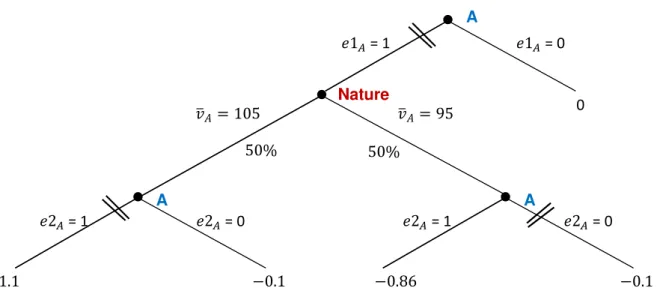
Finally, we analyze Player A´s entrance in the M&A process. According to Proposition 3 stated below, we conclude that Player A invests in the first due diligence.
( ̅ ̅ ) ( ( ) )
Figure 10. Solving an illustrative case
A A
Nature
= 0
= 1 = 1 = 0
= 0 = 1
0