Chromosome evolution in tiger beetles: Karyotypes and localization of 18S
rDNA loci in Neotropical Megacephalini (Coleoptera, Cicindelidae)
Sónia J.R. Proença, Maria João Collares-Pereira and Artur R.M. Serrano
Universidade de Lisboa, Faculdade de Ciências, Centro de Biologia Ambiental, Campo Grande, Lisboa, Portugal.
Abstract
Four Neotropical tiger beetle species, three from the genus Megacephalaand one from the genus Oxycheila, currently assigned to the tribe Megacephalini were examined cytogenetically. All three Megacephala species showed simple sex chromosome systems of the X0/XX type but different numbers of autosomal pairs (15 inM. cruciata, 14 in M. sobrina and 12 in M. rutilans), while Oxycheila tristis was inferred to have a multiple sex chromosome system with four X chromosomes (2n = 24 + X1X2X3X4Y/X1X1X2X2X3X3X4X4). Fluorescencein situ hybridization (FISH) using a PCR-amplified 18S rDNA fragment as a probe revealed the presence of rDNA clusters located exclusively on the autosomes in all theMegacephalaspecies (five clusters inM. cruciata, eight inM. sobrina and three inM. rutilans), indicating variability in the number of clusters and the presence of structural polymorphisms. The same methodology showed thatO. tristishad six rDNA clusters, apparently also located on the autosomes. Although our data also show cytogenetic variability within the genusMegacephala, our findings support the most accepted hypothesis for chromosome evolution in the family Cicindelidae. The description of multiple sex chromosomes inO. tristisalong with phylogenetic analyses and larval morphological characters may be assumed as an additional evidence for the exclusion of the genusOxycheilaand related taxa from the tribe Megacephalini.
Key words:chromosome evolution, Cicindelidae, Megacephalini,Oxycheila, rDNA localization, sex chromosome system. Received: January 28, 2005; Accepted: May 4, 2005.
Introduction
Over the last few years, cytogenetics placed in a phylogenetic context has become a useful tool to provide insights into chromosome evolution within the family Cicindelidae, a Coleopteran group with about 2300 de-scribed species distributed worldwide (Cassola and Pear-son, 2000; Cassola, 2001).
The most primitive Cicindelidae tribes are Manticorini, Omini and Megacephalini, all of which seem to be characterized by the presence of simple sex chromo-some mechanisms of the XY or X0 types (Pearson and Vogler, 2001; Galiánet al., 2002; Proençaet al., 2002b). On the other hand, Cicindelidae species belonging to the Collyrini, Ctenostomini and Cicindelini tribes have been described as having a diverse multiple sex chromosome system, XnY, where n varies from two to four (Serrano and Galián, 1998; Galián and Hudson, 1999; Proença et al., 1999a, b, 2002a, 2004; Galiánet al., 2002; Zacaroet al., 2004). These heterosomes form a characteristic rosette-like
multivalent during pairing at diakinesis and metaphase I, linked by telomeric connections without forming chiasmata between the various X chromosomes (Giers, 1977). This suggests an old and single origin for the multiple systems in an ancestor which was common to Collyrinae and Cicindelini before the splitting of these two groups (Galián et al., 2002). Phylogenetic studies have demonstrated a closer relationship between Collyrinae and Cicindelini (Vogler and Pearson, 1996; Galiánet al., 2002) than be-tween Cicindelini and Megacephalini as proposed by Rivalier (1971). Also the number of autosomal pairs in these groups ranging from 5 to 21, gradually decrease from the most plesiomorphic groups (Manticorini, Omini and Megacephalini) to the most derived ones (Cicindelini), with some stability in the species rich genus Cicindela (s.l.). Few exceptions have been reported to these patterns, although simple sex chromosome systems (X0 and XY) have been described in some Cicindelini species (Giers, 1977; Serranoet al., 1986; Galiánet al., 2002; Proençaet al., 2002a) but were hypothesized to represent independent secondary losses of the multiple systems. Conversely, the description of multiple sex chromosomes inMegacephala megacephalaas being n = 12 + X1X2Y may need to be
re-www.sbg.org.br
Send correspondence to M.J. Collares-Pereira. Universidade de Lisboa, Faculdade de Ciências, Centro de Biologia Ambiental, Campo Grande, Edifício C2 - 3° Piso, 1749-016 Lisboa, Portugal. E-mail: [email protected].
considered since the sex chromosomes in this species were characterized based only on the comparison of mitotic male and female chromosomes without analyses of meiotic fig-ures, a process which would have allowed accurate deter-mination of the sex chromosomes (Proençaet al., 1999a). Thus, the differences in size and shape observed in the three unpairedM. megacephalachromosomes, identified as sex chromosomes, could be the result of polymorphism be-tween homologous chromosomes, as has previously been reported in other cicindelid species. An alternative interpre-tation for theM. megacephalasex chromosomes would be a meioformula of n = 13 + X0/XX, fitting well with obser-vations made on males and females during mitosis as well as the fact that during metaphases II males have been ob-served with 13 and 14 chromosomes (Galiánet al., 2002).
Additional information regarding the genomic struc-ture of tiger beetles have been limited to the application of C-banding to a restrict number of species and to thein situ localization of the 18S-28S ribosomal gene clusters (rDNA) (Galiánet al., 1995; Galián and Hudson, 1999; Galiánet al., 2002; Proençaet al., 2002a, b, 2004; Proença and Galián, 2003; Zacaroet al., 2004). The number and dis-tribution of these highly repetitive and conserved rDNA clusters can be useful for the construction of physical maps for comparative genomics and phylogenetic and evolution-ary studies. These studies have revealed the presence of a high number of rDNA loci in representatives of the basal lineages Manticorini, Omini and Megacephalini, such loci being exclusively located on the autosomes (three and four pairs), with lower numbers in the most derived lineages
oc-curring on autosomes, heterosomes or on both. It thus ap-pears that there is a trend to even smaller numbers of rDNA loci in the Cicindelidae, which accompanied the reduction in the number of autosomes. One exception to this model is the description of only two autosomal clusters in Megacephala brasiliensis, attributable to the unusually small number of autosomal pairs (Proençaet al., 2002b). Recently, the localization of rDNA clusters inCicindela littoralisandCicindela flexuosarevealed the presence of interpopulation polymorphisms regarding the number of chromosomes with ribosomal genes and their localization within the genome (Proença and Galián, 2003). However, while the Cicindelini have been more or less well-studied, other tribes remain for which data are scarce because only a reduced number of species, mainly from basal groups, have been cytogenetically analyzed.
The aim of the work presented in this paper was to de-scribe the karyotypes, sex chromosome determination sys-tems and the localization of major rDNA clusters in four species of Neotropical Megacephalini, which allowed to detect variability not only within this tribe but also within the genusMegacephala.
Material and Methods
Biological material
Male and female tiger beetles were collected from natural populations in different locations of Brazil and Co-lombia (Table 1) and the specimens identified by one of the authors (A.R.M. Serrano) and deposited in the collection of
Table 1- Cytogenetic data and collecting sites of the cicindelid species studied.
Species Number of
specimens sampled
2n Meioformula rDNA
localization
Collection sites*
Megacephala (Phaeoxantha) cruciata
4 males 31 15 + X0 5, autosomes João Pessoa, Jacaré (PB, Brazil) and
Nisia Floresta, Lagoa do Bonfim (RN, Brazil)
8 females 32 15 + XX 5, autosomes João Pessoa, Jacaré (PB, Brazil) and
Nisia Floresta, Lagoa do Bonfim (RN, Brazil)
Megacephala (Tetracha) sobrina
8 males 29 14 + X0 8, autosomes Leticia (Colombia)
4 females 30 14 + XX 8, autosomes Leticia (Colombia)
Megacephala (Tetracha) rutilans
4 males 25 12 + X0 3, autosomes Conde (PB, Brazil)
1 male 23 11 + X0 3, autosomes Pitimbu, Barra Rio Mucatu (PB,
Brazil)
1 male 25 12 + X0 2, autosomes Nisia Floresta, Lagoa do Bonfim
(RN, Brazil)
3 females 26 12 + XX Jacumã, Tabatinga (PB, Brazil) and
Nisia Floresta, Lagoa do Bonfim (RN, Brazil)
Oxycheila (Oxycheila) tristis
4 males 29 12 + X1X2X3X4Y 6, autosomes# Araponga, Pico do Boné (MG, Brazil)
3 females 32 12 + X1X1X2X2X3X3X4X4 6, autosomes# Araponga, Pico do Boné (MG, Brazil)
*(Codes for Brazilian states: MG = Minas Gerais; PB = Paraíba; RN = Rio Grande do Norte).
the Department of Animal Biology of the Faculty of Sci-ences, University of Lisbon (Portugal). The species studied were:Megacephala (Phaeoxantha) cruciataBrulle, 1837; Megacephala (Tetracha) sobrina Dejean, 1831; Megacephala (Tetracha) rutilans Thompson, 1857; and Oxycheila (Oxycheila) tristis(Fabricius, 1775).
Chromosome preparations
Karyological analyses were carried out on gonads dissected from adult beetles anaesthetized with ethyl ace-tate. Testes and ovaries were treated hypotonically with distilled water, fixed in fresh 3:1 ethanol:acetic acid which was changed several times during the subsequent following 24 h, and stored at -20 °C until needed. Slide squashes were prepared in 70% (v/v) aqueous acetic acid, the coverslip re-moved after freezing in liquid nitrogen and the preparation allowed to dry. Slides containing well-spread mitotic and meiotic chromosomes were stained using 4% (v/v) Giemsa in phosphate buffer (pH = 6.8) for karyotype analysis, or aged at 37 °C in an incubator for at least 3 days before being subjected to FISH (Proençaet al., 2002a).
In situhybridization
The hybridization probe used was obtained by PCR amplification of an 18S rDNA 555 bp fragment as ex-plained in De la Rúaet al.(1996) and labeled with bio-tin-16-dUTP using a second PCR reaction. With minor modifications, FISH was performed according to Galiánet al.(1999) and Sánchez-Geaet al.(2000). Briefly, chromo-some spreads were pre-treated with DNAse-free RNAse in 2x SSC for 1 h at 37 °C and with 0.005% (w/v) pepsin in 0.01 M HCl for 10 min at 37 °C. After digestion the chro-mosomes were fixed with 4% (w/v) fresh paraformaldehyde in 0.1 N NaOH, dehydrated in a graded ethanol series and air dried. The hybridization mixture (containing 50% (v/v) deionized formamide, 2x SSC, 50 mM sodium phosphate (pH = 7.0), 10% (w/v) aqueous dex-tran sulfate and 4 ng/mL of biotin-labeled probe) was dena-tured at 100 °C for 3 min and placed on ice. The slides were heated on an 80 °C hot plate for 5 min after which 30mL of the denatured hybridization mixture was placed over the denatured slides and covered with a coverslip. For hybrid-ization, the slides were placed in a humid chamber at 80 °C and the temperature allowed to drop slowly to 37 °C over-night. After hybridization the coverslips were carefully re-moved and the slides washed three times for 5 min at 37 °C in 2x SSC containing 50% (v/v) formamide. Probe hybrid-ization sites were detected with avidin-fluorescein isothiocyanate (FITC) and the signal amplified twice using goat anti-avidin-biotin (Vector). Slides were counter-stained with propidium iodide, mounted using anti-fade so-lution and examined under epifluorescence microscopy, images being captured with an Olympus DP-50 digital camera.
Results
The threeMegacephalaspecies had karyotypes with single sex chromosome systems and a male meio-formula of n = 15+X0 forM. cruciata, n = 14+X0 forM. sobrina and n = 12+X0 forM. rutilans(Table 1). The autosomal pairs of the threeMegacephalaspecies gradually decreased in size and consisted of metacentrics and submetacentrics (Figures 1, 2 and 3). The second autosomal pair in both male and femaleM. rutilanshad a secondary constriction in one of the largest chromosomes (Figure 3a, b and c). The M. cruciataX chromosome was medium-sized and sub-metacentric, but was one of the smallest chromosomes, and clearly metacentric in M. sobrina and M. rutilans. Spermatocyte metaphase I cells showed autosomal biva-lents forming chiasmata plus a univalent identified as the X chromosome. Spermatocyte metaphase II cells in all the three species were of two types, with and without the X chromosome (Figures 1, 2 and 3).
One maleM. rutilans was aneuploid with only 23 chromosomes in all the 27 mitotic metaphases observed, the karyogram consisting of only 11 homomorphic pairs and one unpaired chromosome (Figure 3b) and the spermatocyte metaphase I figures consistently showed 11 bivalents plus one univalent (Figure 3g).
ForO. trististhe spermatogonial mitotic diploid num-ber was 29 and the oogonial mitotic diploid numnum-ber was 32, suggesting an X1X2X3X4Y/X1X1X2X2X3X3X4X4sex deter-mination system. Due to the similar size and shape of the chromosomes, identification of the sex elements was at-tempted after comparing male and female karyograms (Fig-ure 4a, b). TheO. tristisY chromosome appeared to be the second unpaired chromosome and the X1chromosome was the biggest chromosome of the complement. Spermatocyte metaphase I cells were made up of 12 bivalents plus a multivalent with apparently 5 elements (Figure 4c). Metaphase II cells were of two types, with 13 and 16 chro-mosomes (Figure 4d, e).
Figure 1- Mitotic and meiotic chromosomes ofMegacephala cruciata. (a) male karyogram, 2n= 30+X0, (b) female karyogram, 2n= 30+XX, (c) male metaphase I, (d) male metaphase II,n= 15+0 and (e) male metaphase II,n= 15+X. Arrow indicates the X chromosome. Bar = 8mm.
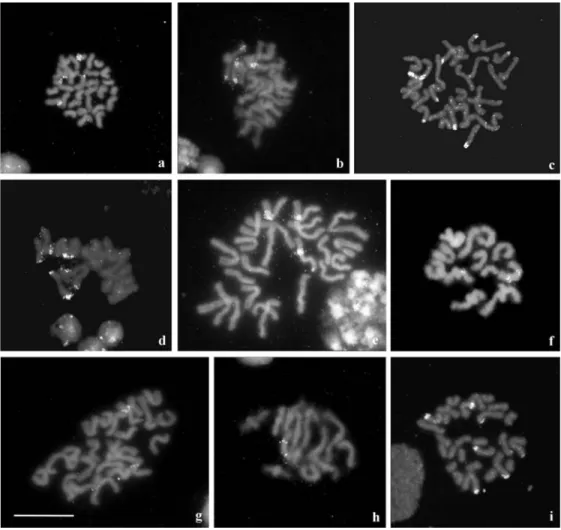
(Figure 5e). Hybridization ofM. rutilansduring metaphase I showed the presence of ribosomal clusters in two biva-lents, two signals in one bivalent and one signal in another bivalent (Figure 5f). Mitotic metaphases from the male from Lagoa do Bonfim had only two labeled medium-sized chromosomes (Figure 5g) and metaphases I showed signals in one medium-sized bivalent (Figure 5h). We also found thatOxycheila tristisshowed six signals in male mitotic metaphases (Figure 5i) that seemed to correspond to three autosomal pairs in meiotic metaphases (not shown).
Discussion
The single sex chromosome system (X0) found inM. cruciata,M. rutilansandM. sobrinaparallels that found in
otherMegacephalaspecies, albeit only a few species have so far been studied (Table 2). We found thatMegacephala species have higher and more variable number of autosomal pairs as compared to the Cicindelini with most Megacephala species having from 12 to 15 autosomal pairs, although Proençaet al.(2002b) found an unusually low number of 5 pairs forM. brasiliensiswhich, however, was attributed to multiple Robertsonian fusions between the autosomes that might have occurred secondarily in the evolutionary process. This variability in autosome numbers is also reflected by our observation of aneuploidy in M. rutilans. Analysis of the size and morphology of the re-mainingM. rutilanschromosomes and the observation of meiosis I with only 11 bivalents plus the X chromosome in-stead of the 12 found in the normal complement may
gest nullisomy of two homologous chromosomes (probably pair five).
In the threeMegacephalaspecies analyzed by us, the number of rDNA loci (representing gene clusters) also showed some variability and quite unique and interesting patterns. The autosomal localization of these gene clusters as well as the higher number of copies resemble other data for basal groups, such asAmblycheilaandManticora(eight rDNA loci) andOmusandMegacephala(six rDNA loci) (Galián and Hudson, 1999; Galián et al., 2002). In M. sobrinaandM. cruciata(with eight and five rDNA loci, re-spectively) the ribosomal clusters occupied a distal position as observed in other cicindelids (Galiánet al., 1995; Galián and Hudson, 1999; Proença et al., 2002a; Proença and Galián, 2003). Also, the size of the fluorescent region var-ied in the different chromosomes, with one signal being much larger than the others, covering almost all the short arm of the chromosome inM. sobrina. This suggests the ex-istence of a polymorphism for the number of copies of the ribosomal genes, as described by Sánchez-Geaet al.(2000) in the genusZabrusand by Martínez-Navarroet al.(2004) in the Harpalini. We found thatM. rutilansshowed a lower number of rDNA copies located in a different position, near the centromere and also the presence of polymorphism be-tween M. rutilans specimens, with one male from the Lagoa do Bonfim population showing only two hybridiza-tion signals instead of the three signals found in the other
M. rutilanspopulations. Whether these differences reveal intra or interpopulational polymorphisms is not clear be-cause of the small number of specimens analyzed. Another open question is whether these differences are a reflection of well differentiated phylogenetic entities or, more proba-bly, an on going differentiation mechanism. It should also be pointed out that there was a distance of about 200km between the collection sites of these specimens.
Differences at population level regarding the number and distribution of ribosomal genes have already been de-scribed for the Cicindela species C. littoralis and C. flexuosa(Proença and Galián, 2003). In our study, how-ever, an interesting aspect about the localization of ribo-somal clusters was the presence of odd numbers of autosomal copies (three in M. rutilans and five in M. cruciata) since the same number of rDNA clusters should be expected in both homologous chromosomes. This struc-tural polymorphism was even more accentuated in M. sobrina, with four bivalents in metaphase I with only one hybridization signal. Such patterns of rDNA localization suggest that the number and distribution of these gene clus-ters have undergone several chromosomal changes and gene silencing during the evolution of the Megacephalini. This diversity in the location of rDNA clusters could be the result of non-genetic transposition mechanisms, as has been proposed to explain numerical variation of rDNA clusters in several species ofCicindela(s.l.) (S. Proença
Figure 4- Mitotic and meiotic chromosomes ofOxycheila tristis. (a) male karyogram, 2n= 24 + X1X2X3X4Y, (b) female karyogram, 2n= 24 +
X1X1X2X2X3X3X4X4, (c) male metaphase I, (d) male metaphase II,n= 12 + Y and (e) male metaphase II,n= 12 + X1X2X3X4. Arrow indicates the sex
and J. Galián, unpublished results) and in some carabid beetles (Sánchez-Geaet al., 2000; Martínez-Navarroet al., 2004). The lower number of rDNA loci inM. rutilansas
compared to otherMegacephalaspecies could also be ex-plained as the result of Robertsonian fusions between autosomes, this hypothesis being corroborated by the low
Table 2- Cytogenetic data forMegacephalaspecies.
Species Meioformula rDNA localization References
M. megacephala 12 + X1X2Y* Unknown Proençaet al., 1999a
M. euphratica 15 + X0 6, autosomes Serranoet al., 1986; Galiánet al., 1995
M. whelani 12 + XY 6, autosomes Galián and Hudson, 1999
M. cruciata 15 + X0 5, autosomes Present report
M. sobrina 14 + X0 8, autosomes Present report
M. rutilans 12 + X0 2-3, autosomes Present report
M. brasiliensis 5 + XY 2, autosomes Proençaet al., 2002b
*Based only on data from mitotic metaphases.
number of autosomal pairs and the interstitial location of the rDNA loci in a region proximal to the centromere. A similar situation has also been described forM. brasiliensis (Proençaet al., 2002b).
RegardingO. tristis, the first everOxycheilaspecies cytogenetically analyzed, the presence of multiple sex chromosomes with 4Xs is remarkable. AlthoughO. tristis has a different chromosomal sex determination system, this species has the same number of autosomal pairs (12, as in someMegacephala) and a high number of rDNA clusters as other Megacephalini species. The apparent localization of rDNA clusters inO. tristisautosomes is a question which needs to be clarified in the future because our metaphase I figures were not very good.
Placing our results and available data in a phylogen-etic context there is apparently a trend towards the gradual reduction of the total number of autosomal pairs and the velopment of multiple sex chromosome systems in the de-rived lineages of Cicindelidae. Thus, the number of autosome pairs is highest in the basal taxaAmblycheila(21 pairs),Omus(17 pairs) andManticora(18 pairs), interme-diate inMegacephala(12 to 15 pairs) andNeocollyris(12 pairs), and lowest in Cicindelini (9 to 12 pairs). Also, multi-ple sex chromosome systems have been described only in Collyrinae and Cicindelini, favoring the hypothesis that such systems evolved before these groups split. The num-ber of rDNA loci in cicindelid species seems to follow the reduction in the number of autosomal pairs and the ten-dency of these housekeeping genes to be transferred from autosomes to heterosomes can be noticed from the most primitive to the derived cicindelid species with subsequent diversification in theCicindela (s.l.)(Galiánet al., 1995; Galián and Hudson, 1999; Galiánet al., 2002; Proençaet al., 2002a, b, 2004; Proença and Galián, 2003; Zacaroet al., 2004). These observations may suggest rearrangements be-tween heterosomes and autosomes which could be linked to changes in the number of the sex chromosomes and to the development of multiple sex chromosomes in the cicindelids.
The Cicindelidae phylogeny outlined by Vogler and Pearson (1996) shows major differences to the classifica-tion of the Cicindelidae first proposed by Rivalier (1971) and latter adapted by Wiesner (1992). In Vogler and Pearson’s work the Megacephalini is clearly separated into two clades,Megacephala-Aniaraand Oxycheila(and re-lated taxa), andOxycheilais nested within the Collyrinae and Cicindelini. The separation of the Megacephalini and the Cicindelini made by Rivalier (1971) using the size and shape of the head and the prothorax as the principal separa-tion criteria was already quessepara-tioned by Vogler and Pearson (1996) because several genera such as Oxycheila and Pometon could not be unequivocally assigned to the Megacephalini or Cicindelini. Considering such phylog-eny, the existence of multiple sex chromosomes in Oxycheilaspecies was to be expected and supports the need
to exclude Oxycheila and related taxa from the tribe Megacephalini and to place them closer to the Cicindelini. Thus, an up-dated classification of the Cicindelidae is also needed and this should be based on wider phylogenetic analyses and cytogenetic data in order to provide a more ac-curate assessment of the evolutionary relationships within the family.
Acknowledgments
This work was supported by Fundação para a Ciência e Tecnologia through the grant PRAXIS XXI/BD/ 15986/98 to SJRP and FSE (III Quadro Comunitário de Apoio). Thanks are due to José Galián for useful comments and discussion and to Deodália Dias for PCR andin situ hy-bridization facilities. We also thank Instituto Humbold (Colombia), Instituto de Ciencias Naturales, Universidad Nacional de Colombia and Universidade Federal de Viçosa (Minas Gerais, Brazil) for field assistance in Leticia and Araponga, respectively.
References
Cassola F (2001) Studies of tiger beetles. CXXIII. Preliminary ap-proach to the macrosystematics of the tiger beetles (Coleoptera, Cicindelidae). Russian Entomol J 10:265-272. Cassola F and Pearson DL (2000) Global patterns of tiger beetle species richness (Coleoptera, Cicindelidae): Their use in conservation planning. Biol Conserv 95:197-208.
De La Rúa P, Serrano J, Hewitt GM and Galián J (1996) Physical mapping of rDNA genes in the ground beetleCarabusand related genera (Coleoptera, Carabidae). J Zool Syst Evol Res 34:95-101.
Galián J, De la Rúa P, Serrano J, Juan C and Hewitt M (1999) Phylogenetic relationships in West Mediterranean Scaritina (Coleoptera, Carabidae) inferred from mitochondrial COI sequences and karyotype analysis. J Zool Syst Evol Res 37:85-92.
Galián J, Hogan JE and Vogler AP (2002) The origin of multiple sex chromosomes in tiger beetles. Mol Biol Evol 19:1792-1796.
Galián J and Hudson P (1999) Cytogenetic analysis of Australian tiger beetles (Coleoptera, Cicindelidae): Chromosome num-ber, sex-determining system and localisation of rDNA genes. J Zool Syst Evol Res 37:1-6.
Galián J, Serrano J, De la Rúa P, Petitpierre E and Juan C (1995) Localization and activity of rDNA genes in tiger beetles (Coleoptera, Cicindelinae). Heredity 74:524-530.
Giers E (1977) Die Nicht-Homologen-Assoziation multipler Geschlechtschromosomen in der Spermatogenese von
Cicindela hybrida(Coleoptera). PhD thesis, University of Münster, Germany.
Martínez-Navarro EM, Serrano J and Galián J (2004) Chromo-some evolution in ground beetles: Localization of the rDNA loci in the tribe Harpalini (Coleoptera, Carabidae). J Zool Syst Evol Res 42:38-43.
Proença SJR, Collares-Pereira MJ and Serrano ARM (1999a) Karyological study ofCicindelidia trifasciata(Coleoptera, Cicindelidae) from Cuba: Evidence of B chromosomes. Genet Mol Biol 22:45-48.
Proença SJR, Collares-Pereira MJ and Serrano ARM (2004) Cytogenetic variability in three species of the genus
Cicindela(s.l.) (Coleoptera, Cicindelidae): Karyotypes and localization of 18S rDNA genes. Genet Mol Biol 27:555-560.
Proença SJR and Galián J (2003) Chromosome evolution in the genusCicindela: Physical mapping and activity of rDNA loci in the tiger beetles speciesCicindela littoralisand C. flexuosa. J Zool Syst Evol Res 41:227-232.
Proença SJR, Serrano ARM and Collares-Pereira MJ (1999b) First record on the cytotaxonomy of cicindelids (Insecta, Coleoptera) from an Afrotropical region. Caryologia 52:37-47.
Proença SJR, Serrano ARM and Collares-Pereira MJ (2002a) Cytogenetic variability in genusOdontocheila(Coleoptera, Cicindelidae): Karyotypes, C-banding, NORs and localisa-tion of ribosomal genes ofO. confusaandO. nodicornis. Genetica 114:237-245.
Proença SJR, Serrano ARM and Collares-Pereira MJ (2002b) An unusual karyotype with low chromosome number in Megacephalini, a basal group of tiger beetles (Coleoptera, Cicindelidae): Cytogenetic characterisation by C-banding and location of rDNA genes. Hereditas 137:202-207.
Rivalier E (1971) Remarque sur la tribu des Cicindelini (Col. Cicindelidae) et sa subdivision en sous-tribus. Nouv Rev Entomol 1:135-143.
Sánchez-Gea JF, Serrano J and Galián J (2000) Variability in rDNA loci in Iberian species of the genus Zabrus
(Coleoptera, Carabidae) detected by fluorescencein situ hy-bridisation. Genome 43:22-28.
Serrano J and Galián J (1998) A review of karyotypic evolution and phylogeny of carabid beetles (Coleoptera, Carabidae). In: Ball GE, Casale A and Vigna Taglianti A (eds) Phylog-eny and Classification of Caraboidea. Mus Reg Sci Nat, Torino, pp 191-228.
Serrano J, Galián J and Ortiz A (1986) Cicindelid beetles without multiple sex chromosomes (Coleoptera, Caraboidea). Can J Genet Cytol 28:235-239.
Vogler AP and Pearson DL (1996) A molecular phylogeny of the tiger beetles (Cicindelidae): Congruence of mitochondrial and nuclear rDNA data sets. Mol Phylogenet Evol 6:321-338.
Wiesner J (1992) Verzeichnis der Sandlaufkafer der Welt. Check-list of the Tiger Beetles of the World (Coleoptera, Cicindelidae). Verlag Erna Bauer, Keltern, Germany. Zacaro AA, Proença SJR, Lopes-Andrade C and Serrano ARM
(2004) Cytogenetic analysis of Ctenostomini by C-banding and rDNA localization and its relevance to the knowledge of the evolution of tiger beetles (Coleoptera, Cicindelidae). Genetica 122:261-268.