Choice between Private and Public Providers in the Portuguese Health Care
System.
by
Filipa Monteiro Ferreira
Dissertation submitted in partial fulfillment of the requirements for the Degree of
Mestre em Estatística e Gestão de Informação (Master in Statistics and Information Management)
Instituto Superior de Estatística e Gestão de Informação
da
Choice between Private and Public Providers in the Portuguese Health Care
System.
by
Filipa Monteiro Ferreira
Dissertation submitted in partial fulfillment of the requirements for the Degree of
Mestre em Estatística e Gestão de Informação (Master in Statistics and Information Management)
Dissertation supervised by Professor Jörg Henseler
ACKNOWLEDGEMENTS
The development of this thesis was an intense and amazing journey that would have not been completed without the support and kindness of some individuals.
First, and most importantly, I would like to thank my supervisor Professor Jörg Henseler for his support and encouragement. I am extremely grateful for all his help, advice, suggestions and, very significant nowadays, his availability and quick
response.
I must thank Professor Pedro Simões Coelho for finding the time to receive me, for helping me with SAS and reviewing the Portuguese version of the questionnaire.
I want to express a special thanks to all respondents of the questionnaire, without their help this study would have not been possible.
I am very grateful to Sandra Câmara Pestana for all her support, encouragement and help.
I am thankful to Rebecca Lock for her kindness in volunteering to review the English of the thesis.
I would like to thank Gonçalo Baptista for helping me obtain health insurance data, Marina Fartaria for setting such a remarkable example to follow and Hélia Gaspar for her thoughtfulness. I am grateful to all my friends who supported me.
ABSTRACT
Purpose - The Portuguese health care system has been evolving throughout the last 35 years with two relevant facts: the public sector has progressed with improvement in all relevant OECD indicators; the private sector has been widened and reinforced.
In this framework, it is important to understand how patient’s intention and behavior are built, so health care organizations in both sectors (public and private) can improve their health care provision (particularly in health care marketing), invest and develop those areas that might become sustainable competitive advantages.
The most established theory of social psychology explaining human behavior will be applied: Theory of Planned Behavior (TPB). Within this conceptual approach, attitude toward the behavior, subjective norm, perceived behavior control, habit and past experience evaluation (satisfaction on the private and public sectors) will be analyzed in explaining the intention to go to the private sector.
As the health care system is not homogeneous across the private and public sectors, five models will be tested in the areas that have been identified with distinct supplies: general practice, specialist consultation, emergency, ambulatory surgery and
hospitalization.
Design/methodology/approach– 349 people completed a survey questionnaire that measured the constructs of the TPB. Factor analysis and hierarchical multiple linear regressions were used to test the model.
Findings– The results show that the models explained between 63% and 80% of the intention to go to the private sector. Attitude, subjective norm and habit were always significant predictors of intention in all models, past experiences evaluation
(satisfaction) in the private sector was not.
Originality/value –This study contributes to understand intentions and behavior of patients that chose the private sector, instead of the public. It is a new applicability and extension of the TPB.
Keywords– Health Care System; Theory of Planned Behavior; Private and Public Health Care Sectors; Health Care Satisfaction; Intention; Behavior; Attitude; Subjective Norm; Perceived Behavior Control; General Practice; Specialist Consultation;
RESUMO
Objectivo– O sistema de saúde português sofreu fortes transformações ao longo dos últimos 35 anos, destacando-se dois aspectos fundamentais: o sector público
evoluiu registando melhorias nos principais indicadores da OCDE; o sector privado foi reforçado e alargado. Neste contexto, é importante compreender como é que a intenção e comportamento do paciente é construído para que as organizações de saúde possam melhorar a sua oferta (em particular no marketing da saúde), investir e desenvolver as áreas que se possam tornar vantagens competitivas.
Ir-se-á aplicar a teoria de psicologia social mais reconhecida internacionalmente que explica o comportamento humano: Teoria do Comportamento Planeado (TCP). Nesta abordagem conceptual analisar-se-á a atitude relativa ao comportamento, norma subjectiva, controlo do comportamento percebido, hábito e a experiência passada (resultante da satisfação no sector privado e no sector público).
Como o sistema de saúde não é homogéneo quanto ao fornecimento de cuidados de saúde no sector privado e no sector público, testar-se-ão cinco modelos referentes a áreas cujos sectores têm ofertas distintas: consultas de clínica geral, consultas de especialidade, urgências, cirurgia em ambulatório e internamentos.
Metodologia/abordagem– 349 pessoas responderam a um questionário que media as variáveis da TCP. Análise factorial e regressões lineares hierárquicas foram utilizadas para conduzir a análise.
Resultados/conclusões– Os resultados dos modelos permitiram explicar entre 63% e 80% da intenção de escolha do sector privado. Atitude, norma subjectiva e hábito foram em todos os modelos variáveis preditivas da intenção, enquanto a avaliação da experiência passada (satisfação) no sector privado nunca foi uma variável preditiva.
Originalidade/valor– Este estudo contribui para compreender como é que a intenção e comportamento dos pacientes são construídos quando estes escolhem o sector privado. Esta análise traz uma nova aplicação e extensão à TCP.
CONTENTS
ABSTRACT ... iv
RESUMO ... v
CONTENTS ... vi
LIST OF TABLES ... viii
LIST OF FIGURES ... ix
LIST OF ABBREVIATIONS ... xii
1. INTRODUCTION TO THE RESEARCH PROBLEM ... 1
1.1. Illustration of the Research Problem ... 1
1.2. Goals of the Dissertation ... 1
1.3. Relevance of the Research ... 3
1.4. Dissertation Structure ... 4
2. LITERATURE REVIEW: THE PORTUGUESE HEALTH CARE SYSTEM ... 5
2.1. The Public Health Care Sector ... 5
2.2. The Private Health Care Sector ... 7
2.3. The Health Care System ... 9
2.4. Health Care Economic Market ... 11
3. CONCEPTUAL FRAMEWORK ... 15
3.1. Review of the Theory of Planned Behavior ... 15
3.2. Applications and Extensions of the Theory of Planned Behavior ... 18
3.3. Service Quality and Patient’s Satisfaction Framework ... 20
3.4. Hypothesis Development ... 28
4. RESEARCH METHODOLOGY ... 30
4.1. Outline of Methods and Justifications ... 30
4.2. Used Methodologies ... 31
4.3. Questionnaire Design ... 32
4.4. Data Analysis ... 37
4.4.1. Participants and procedures. ... 37
4.4.2. Data preparation. ... 38
4.4.3. Statistical methods. ... 39
5.1. General Practice Model ... 44
5.2. Specialist Consultation Model ... 48
5.3. Emergency Model ... 49
5.4. Ambulatory Surgery Model ... 52
5.5. Hospitalization Model ... 54
6. CONCLUSIONS ... 58
6.1. Findings ... 58
6.2. Research Implications ... 60
6.3. Limitations of the Research ... 61
6.4. Future Research ... 62
REFERENCES ... 63
APPENDIX 1 – HEALTH CARE INDICATORS ... 68
APPENDIX 2 – SURVEY PARTICIPANTS AND ANALYSIS ... 74
APPENDIX 3 – QUESTIONNAIRE (ORIGINAL VERSION) ... 77
APPENDIX 4 – QUESTIONNAIRE (TRANSLATED VERSION) ... 85
APPENDIX 5 – FACTOR ANALYSIS RESULTS ... 93
APPENDIX 6 – LINEAR REGRESSION RESULTS ... 102
LIST OF TABLES
Table 3.1 Camilleri and O'Callaghan constructs in comparing public and private
hospital care service quality (1998) ... 25
Table 3.2 Camilleri and O'Callaghan (1998) rank order of the different service quality indicator groups ... 26
Table 4.1 Data Preparation: Multiple Items Questions into Binary Variables (e.g. question 3) ... 39
Table 4.2 Behavior Variables ... 43
Table 5.1 General Practice Model Variables Results ... 44
Table 5.2 General Practice Model Variables Results – Final Model ... 46
Table 5.3 General Practice Model – Multiple Regressions ... 47
Table 5.4 Specialist Consultation Model Variables Results – Final Model ... 48
Table 5.5 Specialist Consultation Model – Multiple Regressions ... 49
Table 5.6 Emergency Model Variables Results – Model ... 50
Table 5.7 Emergency Model Variables Results – Final Model ... 51
Table 5.8 Emergency Model – Multiple Regressions ... 51
Table 5.9 Ambulatory Surgery Model Variables ... 52
Table 5.10 Ambulatory Surgery Model – Multiple Regressions ... 53
Table 5.11 Hospitalization Model Variables ... 54
Table 5.12 Hospitalization Model – Multiple Regressions ... 56
Table 6.1 Significant coefficients for all regression equation models. ... 58
Table AP1.1 Hospitals by Region 2008 ... 72
Table AP1.2 Health Indicators by Region 2008 and 2009 ... 73
Table AP6.1 General Practice Model – Individual Regressions ... 102
Table AP6.2 Specialist Consultation Model – Individual Regressions ... 104
Table AP6.3 Emergency Model – Individual Regressions ... 106
Table AP6.4 Ambulatory Surgery Model – Individual Regressions ... 108
LIST OF FIGURES
Figure 3.1 Theory of Planned Behavior. ... 16
Figure 3.2 Patient expectations for public and private care service quality. ... 27
Figure 3.3 Extension of the Theory of Planned Behavior (Ajzen, 1985). ... 29
Figure 4.1 Example of SEM methodology in the application of TPB. ... 32
Figure 4.2 Extension of the Theory of Planned Behavior (Ajzen 1985): number of questions. ... 40
Figure AP1.1 Total expenditure as % of gross domestic product. ... 68
Figure AP1.2 Total expenditure on health per capita. US$ purchasing power parity. ... 68
Figure AP1.3 Females life expectancy at birth years. ... 69
Figure AP1.4 Males life expectancy at birth years. ... 69
Figure AP1.5 Infant mortality. ... 70
Figure AP1.6 Females life expectancy at age 65 years. ... 70
Figure AP1.7 Males life expectancy at age 65 years. ... 71
Figure AP1.8 Immunization: measles % of children immunized. ... 71
Figure AP1.9 Immunization: diphtheria, tetanus and pertussis % of children immunized. ... 72
Figure AP2.1 Survey gender distribution. ... 74
Figure AP2.2 Survey age distribution. ... 74
Figure AP2.3 Survey civil status distribution. ... 74
Figure AP2.4 Survey education level distribution. ... 75
Figure AP2.5 Survey current labor situation distribution. ... 75
Figure AP2.6 Survey residence distribution. ... 75
Figure AP2.7 Survey questions 31 to 50: patients’ evaluations between the private sector and the public sector. ... 76
Figure AP5.1 Private sector FA. Means, standard deviations and correlations. ... 93
Figure AP5.2 Private sector FA. Kaiser’s measure of sampling adequacy. ... 93
Figure AP5.3 Private sector FA. Scree plot and variance explained. ... 94
Figure AP5.4 Private sector FA. Root mean square off-diagonal residuals. ... 94
Figure AP5.5 Public sector FA. Means, standard deviations and correlations. ... 94
Figure AP5.7 Public sector FA. Scree plot and variance explained. ... 95
Figure AP5.8 Public sector FA. Root mean square off-diagonal residuals. ... 95
Figure AP5.9 GPM: attitude FA. Means, standard deviations and correlations. ... 95
Figure AP5.10 GPM: attitude FA. Kaiser’s measure of sampling adequacy. ... 96
Figure AP5.11 GPM: attitude FA. Scree plot and variance explained. ... 96
Figure AP5.12 GPM: attitude FA. Root mean square off-diagonal residuals. ... 96
Figure AP5.13 SCM: attitude FA. Means, standard deviations and correlations. ... 97
Figure AP5.14 SCM: attitude FA. Kaiser’s measure of sampling adequacy. ... 97
Figure AP5.15 SCM: attitude FA. Scree plot and variance explained. ... 97
Figure AP5.16 SCM: attitude FA. Root mean square off-diagonal residuals. ... 98
Figure AP5.17 EM: attitude FA. Means, standard deviations and correlations. ... 98
Figure AP5.18 EM: attitude FA. Kaiser’s measure of sampling adequacy. ... 98
Figure AP5.19 EM: attitude FA. Scree plot and variance explained. ... 98
Figure AP5.20 EM: attitude FA. Root mean square off-diagonal residuals. ... 99
Figure AP5.21 ASM: attitude FA. Means, standard deviations and correlations. ... 99
Figure AP5.22 ASM: attitude FA. Kaiser’s measure of sampling adequacy. ... 99
Figure AP5.23 ASM: attitude FA. Scree plot and variance explained. ... 100
Figure AP5.24 ASM: attitude FA. Root mean square off-diagonal residuals. ... 100
Figure AP5.25 HM: attitude FA. Means, standard deviations and correlations. ... 100
Figure AP5.26 HM: attitude FA. Kaiser’s measure of sampling adequacy. ... 100
Figure AP5.27 HM: attitude FA. Scree plot and variance explained. ... 101
Figure AP5.28 HM: attitude FA. Root mean square off-diagonal residuals. ... 101
Figure AP6.1 General practice model results. Intention linear regression. ... 102
Figure AP6.2 General practice model: significant and nonsignificant variables. ... 103
Figure AP6.3 Specialist model results. Intention linear regression. ... 104
Figure AP6.4 Specialist model results: significant and nonsignificant variables. ... 105
Figure AP6.5 Emergency model results. Intention linear regression. ... 106
Figure AP6.6 Emergency model: significant and nonsignificant variables. ... 107
Figure AP6.7 Ambulatory surgery model results. Intention linear regression. ... 108
Figure AP6.8 Ambulatory surgery model: significant and nonsignificant variables. .. 109
Figure AP6.9 Hospitalization model results. Intention linear regression. ... 110
Figure AN.1 Overview of the health care system. ... 112
Figure AN.2 Private and public current health expenditure. ... 113
Figure AN.3 Health current expenditure by finance agent. ... 113
LIST OF ABBREVIATIONS
ADSE – Public Subsystem for Civil Servants APS – Portuguese Association of Insurers ASM – Ambulatory Surgery Model EM – Emergency Model
GP – General Practitioner GPM – General Practice Model HM – Hospitalization Model
INSA – National Institute of Health, Dr Ricardo Jorge ISP – Insurance and Pension funds Supervisor Authority NHS – National Health System
OECD – Organization for Economic and Co-Operation and Development PAI – Portuguese Association of Insurers
PBC – Perceived Behavior Control
SAMS – Private Banking and Associated Insurance Employees SCM – Specialist Consultation Model
1.
INTRODUCTION TO THE RESEARCH PROBLEM
1.1. Illustration of the Research Problem
The Portuguese health care system has suffered significant changes since the 1974 revolution. Within this more than 30 years period the health care system evolved
positively. The public sector was strengthened by a continuous government investment in health care that resulted in a considerable improvement in all relevant OECD
indicators. The private sector was widened and reinforced, in particular during the last decade, by the consolidation of major economic health care groups. The emergence of the health care insurance market also had a significant impact on the Portuguese health care system.
Before 1974, a person seeking medical assistance had very narrowed options, if any at all, mostly publicly provided. Nowadays, the health care supply is wide-raging with public health centers, public hospitals, private medical offices, private clinics, and private hospitals among others.
Within this raising market, patients have a diversity of choices they can make that lead to different behaviors. As in any other market, it is important to understand how
patient’s intention and behavior are built, so health care organizations in both sectors
(public and private) can improve their health care provision (particularly in health care marketing), invest and develop those areas that might become sustainable competitive advantages.
1.2. Goals of the Dissertation
Nearly twenty five percent of the Portuguese population benefit from an additional health care insurance coverage: health care subsystem and/or voluntary health insurance (Barros & Simões, 2007, p. xiii). Within this group of people, that have more than one health care insurance coverage, why do some people choose to go to public sector? Because they believe they will be better treated? Because they are not willing to pay more? Why do others choose the private? Because they believe that service quality is better? Not only is there a choice to be made, but the choice decision is about a very unique service: health care.
Publichealth care provision in Portugal has been improving; private health care has been growing. Is there competition between these two sectors? The introduction of private health care providers in the market is expected to induce a more
patient-responsive and quality-driven health care provision (Owusu-Frimpong, Nwakwo & Dason, 2010, p. 206). Private sector is traditionally driven by profit. The introduction of rankings and new management1 rules has shaken public sector conventional position.
The aim of this research is to understand how intention and behavior are constructed within health care provision in the private sector. By understanding what determines choice, both sectors will be able to invest and develop those areas that might become sustainable competitive advantages.
To conduct this analysis on human behavior and intention the most established theory of social psychology explaining the behavior of individuals will be used: The Theory of Planned Behavior (TPB) (Ajzen, 1985).
The application of the TPB will shed light on the impact of attitude-towards-the-private-sector, subjective norm and perceived behavior control, Ajzen’s main variables, on the intention to go to the private sector. Habit, demographic variables and other health related variables will be tested with the purpose to analyze their impact in the prediction of intention to go to the private sector.
Service quality and patient’s satisfaction will be added to the model as this conceptual approach has found support in the literature in predicting intention. The reasoning of this conceptual approach is that the happier patients are with their past experiences in the private sector the higher their intentions to go to the private sector.
1 Since the 1990s new private management rules have been implemented in some public hospitals
On the other hand, the less happy patients are with their past experiences in the public sector the higher their intention to go to the private sector.
The Portuguese health care system is not homogeneous due to historical reasons, its nature and the development of some health care markets. For this reason it is very likely that intention and behavior will be built differently across some health care areas. General practice, specialist consultation, emergency, ambulatory surgery2 and
hospitalization will be studied separately as it is expected that the variables used to predict intention and behavior will differ across these models.
1.3. Relevance of the Research
Although the international literature is filled with applications of the Theory of Planned Behavior (Ajzen, 1985) to health care behaviors, there is a gap in the use of this theory to private/public intention and behavior within the health care market. Therefore, this thesis will contribute to the scientific international research by introducing a new application of the TPB.
It will also have a significant contribution with the extension of the TPB by including past experiences evaluations as predictors to intention and behavior. This
extension aims to bring to the model the service quality and patient’s satisfaction
framework.
There are also several studies in the international literature that compare the private and the public provision of health care in terms of satisfaction, but none of these studies were done under the perspective of what determinates behavior and intention.
Naturally, this study was constructed under the Portuguese health care system, which has been evolving and suffered a significant transformation in the last 35 years. This study is relevant as there is not much research done in understanding behaviors in the Portuguese health care reality and might help to determinate strategies for the future
of each sector in the health care as this market continues to evolve and is very likely that will suffer severe changes in the near future.
This study also has international relevance as there are many other health care systems (mainly in Europe) that have similar structures and organizations, i.e. countries with national health systems (such as Spain and UK) and therefore might benefit and learn with the conclusions of this research project.
1.4. Dissertation Structure
This research project is structured in six chapters, six appendixes and one annex. Chapter I introduces the research problem, exposing the context, the purpose and relevance of the study.
Chapter II is an overview of the Portuguese health care market. The private and the public sector are analyzed separately and conjointly as integrating parts of the whole health care system. The specificities of the health care market are highlighted.
Chapter III reviews the conceptual framework. This chapter assesses two distinct behavior theories: the theory of planned behavior and the service quality and
patient’s satisfaction framework.
Chapter IV outlines the research methodology. It explains the research method (questionnaire), characterizes the participants and the procedures, identifies the variables that were measured and describes the data analysis steps.
Chapter V presents the results and discussion for each of the five models analyzed: general practice, specialist consultation, emergency, ambulatory surgery and hospitalization.
2.
LITERATURE REVIEW: THE PORTUGUESE HEALTH
CARE SYSTEM
2.1. The Public Health Care Sector
The Portuguese National Health Care System (NHS) was created in 1979, based on the 64º article of the 1976 Portuguese Constitution, following the 1974 carnation revolution. According to that law, the system was developed with the purpose to deliver universal, comprehensive and free access to health care (Barros, 2005, p. 29). Before this milestone, access to health care assistance was restricted and significantly low (Ribeiro, 2009, p. 21)
Since 1970, total expenditure on health care as a percentage of gross domestic product has been growing (graphic AP1.1, appendix 1). It increased about eight percentage points (from 2.5% in 1970 up to 10% in 2006), a figure higher than the OECD average, that reveals an increasing perception of importance of health care in the society. Total expenditure on health per capita (US$ purchasing power parity) has the same growing pattern, but more intense (graphic AP1.2, appendix 1). During the last 35 years the total expenditure per capita increased 44 times. In 2006, it reached $2,151 even though it was below the OECD average. These increments represented
investments in human, material and financial resources that together with a general improvement of the socio-economic conditions, contributed to an improvement of the health care system (Barros & Simões, 2007, p. 6).
All general health indicators show improvements regarding health quality of the Portuguese population: Life expectancy increased significantly for both men and women at birth and at age 65 years, coming very close to the average of OECD countries (graphics AP1.3, AP1.4, AP1.6 and AP1.7, appendix 1). Infant mortality, decreased significantly from 55 to approximately 3 infant deaths per 1000 live births (graphic AP1.5, appendix 1), a remarkable figure below the OECD average.
The government vaccination compulsory plan that generally covered all the population, and has been continuously widened, is a very important measure that
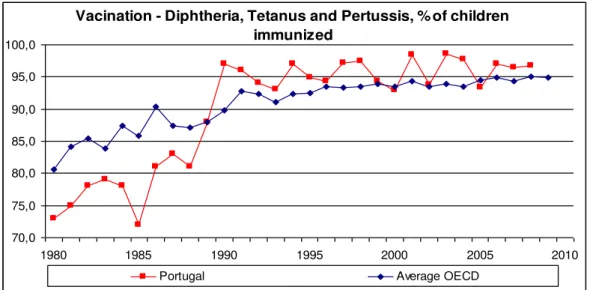
72). The percentage of children immunized increased significantly since the early 1980s (graph AP1.8 and AP1.9, appendix 1).
Naturally, behind the general improvement of health care indicators, there was an increase of the health care public activity. Ribeiro (2009, p. 84) highlighted that since the 1980s there was a significant increase in the number of hospitalizations, surgeries and childbirths in hospitals. Emergencies also grew considerably until the 1990s but have stabilized since then.
Health care public provision is particularly strong in primary care (general practice and mother and child care) and hospital care with a gate keeping system to access hospitals (Barros & Simões, 2007, p. xiii). Primary care gatekeepers (general practitioners – GP in health centers) refer patients to secondary care provided by medical specialists (in hospitals). Patients should choose their NHS GP from a list distributed by the Ministry of Health. However this is not a perfect system as access to emergency services has been mainly unrestricted with some people directly accessing public hospitals and due to the fact that some local supply of GPs restricted patients’ choice (Oliveira & Pinto, 2005, p. S204).
2.2. The Private Health Care Sector
Alongside the evolving public sector, the private sector has always existed in Portugal, mainly in ambulatory health care and in some hospitals. Some medical specializations had had significant private provision such as dentists, radiology and imaging. Laboratory tests and pharmaceutical products were also privately provided (Barros & Simões, 2007, p. 17).
The private health care demand in the past has been associated with the search for better comfort in hospitalization, quicker response to patients that needed surgery and more convenience to access quality laboratory test results (Ribeiro, 2009, p. 45).
The private sector started from one unstructured market with small individual medical offices to become an organized market controlled by the major economic powers that manage big medical facilities, where most workers are wage-earning employees (APS, 2009, p. 10).
During the last decade, private health care provision has been reinforced and widened due to the opening of some big private hospitals. Hospital da Luz in Lisbon of Espírito Santo Saúde (results of 220,000,000€ in 2009), currently the biggest
Portuguese private hospital, opened in April 2007. With 280 physicians and staff workers and 150 beds, made 70,000 emergencies, 5,000 surgeries and had 6,200 patients hospitalized in its first year of activity (Baptista, 2008); HPP Saúde (results of
150,000,000€ in 2009) other major healthcare group, that recently opened in May 2008 the Hospital dos Lusíadas in Lisbon (160 beds, 60 consult rooms, 8 operation theater and 3 delivery rooms), and in June 2008 the Hospital da Boavista (160 beds, 36 consult rooms, 7 operation theaters and 2 delivery rooms) in Porto; Mello Saúde has more than 65 years of history and is currently the biggest private healthcare group in Portugal in supplying and managing healthcare assistance (results of 265,000,000€ in 2009). It recently opened in June 2010 the biggest private hospital of the north of Portugal: HospitalCuf Porto which represented an investment of 90,000,000€. In the Lisbon area, Mello Saúde has three main hospitals: Hospital Cuf Infante Santo, Hospital Cuf
Mello Saúde, HPP Saúde and Espírito Santo Saúde are the three biggest healthcare group suppliers in Portugal and represent 70% of the private market. Trofa Saúde and
AMI – Assistência Médica Privada are also relevant (but in a smaller scale) healthcare providers in the private market. These five health care groups have 64 health facilities: hospitals, clinics, rest houses and laboratories. In total, the private sector holds 5,000 beds and 25% of the surgery capacity of the whole health system (Privados asseguram, 2010).
According to Barros and Simões (2007, p. 27) the private sector continued to prosper despite the establishment of the NHS. The private supply mostly provides diagnostic, therapy, dental care, a few ambulatory consultations, rehabilitation and psychiatric care services, but the strongest area of the private supply is the specialist consultation. Patients with not too serious conditions and/or financial appropriate resources may opt for private practice specialist in ambulatory care. The National Health Inquiry 2005/2006 (INSA, 2007) stated that 31% of all medical consultations in ambulatory care were privately supplied.
More recently, Jornal de Negócios (Privados asseguram, 2010), a local reference economic newspaper, published in September 2010 that according to the Portuguese Association of Private Hospitalization 40% of the healthcare market was privately supplied. The private healthcare market had 50% of specialist consultations, 25% of the hospitalizations, 5% of emergency assistance and 15% of beds.
Even though there are no exclusions to the NHS, the percentage of consultations supplied privately in each medical specialization area is very different: dentists 92.1%, gynecology 67.6%, ophthalmology 66.9%, cardiology 54.2%, orthopedics 45.5%, pediatrics 31.1% and general practice 17.1% (APS, 2009, p. 11).
The key agents in the private sector are the private practitioners, clinics,
2.3. The Health Care System
The Portuguese health care system is characterized by the co-existence of three systems: (a) the National Health System (NHS); (b) health subsystems, special social health insurance schemes for certain professions (both private and public); and (c) voluntary private health insurance (VHI) (Allin et al., 2004, p. 41).
Barros and Simões (2007, p. 13) acknowledged that the Portuguese Health System is a network of public and private health care providers that are linked with the Ministry of Health and to the patients in their own specific ways (figure AN.1, annex).
Besides the improvement of the public health system and the continuous increase of health care private supply, the development of health subsystems and the emergence of private health insurance companies contributed to the transformation of the
Portuguese health care system.
The majority of the health subsystems is associated with professional or
occupational category (Barros & Simões, 2007, p. 26) such as ADSE (public subsystem for civil servants), SAMS (private banking and associated insurance employees), PT-ACS (private telecommunications operator), among others. These are mainly funded by employee and employer contributions (including state contributions as an employer) and usually represent comprehensive or partial health care coverage (Barros & Simões, 2007, p. 35). The health subsystems provide protection mechanisms in sickness that are an extension of the NHS and currently protect 20% of the Portuguese population (APS, 2009, p. 9).
The National Health Inquiry 2005/2006 (INSA, 2007) reported that around 16% of the population was covered by health subsystems, 10% covered by Voluntary Health Insurance (VHI) and less than 2% had both covers: VHI and health subsystems.
VHI started in 1978 with group policies only. Later, in 1982 VHI individual policies were available. According to the Insurance and Pension Funds Supervisor Authority (ISP), in 2009 the number of individuals with health care insurance was 1,013,714 and the number of individuals with group health insurance was 1,051,010. Both figures have been increasing during the last years (ISP, 2009, p. 126), but
The private sector has an increasing interest in health insurances and work
accidents as they receive a significant number of patients from private health insurances such as Médis, Multicare or AdvanceCare. The private health sector and the private health insurances are natural business partners as the public sector does not allow access discrimination or differentiated treatment (Ribeiro, 2009, p. 182). It is very common that VHI policies are one year period contracts that tend to be selective and not
comprehensive. On one hand, companies can renew or cancel the policies at their own will and on the other hand, health insurances often try to exclude the elderly as this age group is associated with increasing health costs, higher risk and lower income (APS, 2009, p. 9).
Barros and Simões (2007, p. 28) argued that people could benefit from triple (or more) coverage: NHS, professional health subsystems, VHI and some other health
subsystems that was an extension of their spouse’s coverage.
The financing of each health cover type might be quite different:
1. NHS: Universal coverage. Government funding through general taxation. 2. Public health subsystems: Occupation-based health insurance. Individual
compulsory contribution based on income. Direct and indirect government funding.
3. Private health subsystems: Occupation-based health insurance. Individual compulsory contribution based on income. Company funding and direct and indirect government funding.
4. Voluntary private health insurance (VHI): Individual-based health insurance. Individual voluntary contribution based on the risk. Direct and indirect government funding.
The health care providers can be either public or private. Each one has its own agreement with respect with their financing flows, ranging from historically based budgets to purely prospective payments. Out-of-pocket (OOP) payments are a large part of the financial flows.
p. 27). For the same period, the total expenditure on health by source of revenue is led by the NHS that accounts for more than 50% of the expenditure, followed by families that are responsible by 26.8% (figure AN.3, annex). During this eight-year period
analysis the NHS as a source of revenue has been decreasing, and the families’
proportion has been increasing. 94% of the families’ expenditures are private health care suppliers: ambulatory health care (37.4%), pharmacies (32.4%), private hospitals (12.7%) and other retail of health goods and/or services (INE, 2010a, p. 28) (figure AN.4, annex).
In Portugal there are 189 hospitals, 92 of which are public and 97 are private (most of the private hospitals are profit-driven organizations). This is a recent change in the Portuguese health care system, as until now the public hospitals accounted for the biggest proportion (Ribeiro, 2009, p. 96). Lisbon and North are the regions where there is more concentration of hospitals and as a consequence, more equipment, in-patient flow and personnel employed (table AP1.1, appendix 1).
Barros and Simões (2007, p. 79) showed that the number of physicians and nurses has been increasing since 1990. Although the number of physicians is already above the EU average, the number of nurses is still below. Again, the number of physicians and nurses per 1000 inhabitants is higher in Lisbon and North regions (table AP1.2, appendix 1).
One relevant and interesting aspect of healthcare provision (in terms service quality of professional and technical care) is that it is conjectured that half of the salaried doctors of the public sector (NHS) also work in the private sector (Barros & Simões, 2007, p. 59) and it is not uncommon that nurses work in both sectors as a way to increase their income, but also due to scarcity of resources in both sectors (Barros & Simões, 2007, p. 60).
The health care market is very different than any other market in the economy due to its specificities. Medical care is a service and as such is often intangible, it involves the customer in the “production” process and it is simultaneously produced and consumed. It is the result of a direct provider-client interaction: physician – patient (Singh, 1991, p. 224).The provider is simultaneously the prescriber and against the reality of many other markets it is not the customer who makes the decisions (Ribeiro, 2009, p. 20).
Folland, Goodman and Stano (2010, p. 36) identified the critical factors that distinguished health care as a unique market: presence of uncertainty, prominence of
insurance, problems of information, the role of nonprofit companies, restrictions on
competition, role of equity and need and government subsidies and public provision.
Uncertainty is present in health care in many different ways. There is uncertainty to when health assistance will be needed; uncertainty of how much the health assistance will cost; uncertainty about the health condition; uncertainty on the adequate treatment; uncertainty about the effectiveness of the health treatment. Kenneth Arrow (1963) was the first to argue that the uncertainty of the health care market was such that naturally there would not exist a health insurance market that would cover all the health care risks. As a consequence of this high level of uncertainty, there is room for the appearance of insurances mechanisms (either public or private). The emergence of health insurance diminishes the uncertainty level of the individuals but also becomes an additional intervenient in this market (Barros, 2005, p. 25). The fact that there is a third-party involved (NHS, health subsystem or VHI) that pays partially (or completely) the health cost (Ribeiro, 2009, p. 20) is another specificity of this market.
Because of the uniqueness of health care as a service provision, understanding
patient’s behavior and choice might be very different from any other kind of service
provision. Taylor and Cronin Jr. (1994, p. 40) stated that health care is often
characterized by the fact that its consumers lack the capacity to adequately evaluate the performance of the providers. This is because, most times, patients do not have the level of knowledge nor the necessary information to make informed evaluations.
access to, understand, and use information in ways which promote and maintain good health”. According to Ishikawa and Yano (2008, p. 115) this is a broader definition that goes beyond the traditional general comprehension of health information to include social skills to interact with people and society (communication, negotiation and organization) that are required to make decisions and put them into practice.
This highlights another critical factor present in health care market that is a consequence of uncertainty: information asymmetry. It occurs when, in an economic relationship, one party has more or better information than the other (Barros, 2005, p. 25).
A consequence of information asymmetry is adverse selection. This problem was first identified by George Akerlof (1970). It generates inefficiencies and market
distortions. An example is the relationship between an insurance company and an individual, where the risk is the main reason for insurance. Naturally few people have knowledge of their future expenditures. If the lower risks are grouped with the higher risks and all individuals pay the same premium, the lower risks face unfavorable rates and will tend to underinsure. In this case, these individuals uphold a loss because they ought to pay a rate appropriated to their risk. On the other hand, the higher risks will be paying a very favorable premium and therefore over insure. This results in the insurance of risks that would never be insured in the first place (Folland, Goodman & Stano, 2010, p. 217).
Although the health care market deals with the presence of agents that do not have the goal of profit maximization, it is reasonable to accept that they are rational
economic agents that have their own goals. The economical analysis is perfectly compatible with the existence of these other goals (Barros, 2005, p. 26).
Some of the established practices of the health sector effectively restrict
competition: licensure requirements for providers, restrictions on provider advertising and standards of ethical behavior that instruct providers not to compete with each other (Folland, Goodman & Stano, 2010, p. 38).
In most countries the government plays a major role in the provision of health services. In Portugal the public provision is done through the NHS and, as it was stated above, it accounts for almost 70% of the total national health care spending.
3.
CONCEPTUAL FRAMEWORK
3.1. Review of the Theory of Planned Behavior
Consumer behavior was defined by Soloman, Bamossy, Askegaard and Hogg (2006, p. 6) as “the study of the processes involved when individuals or groups select, purchase, use or dispose of products, services, ideas or experiences to satisfy needs or
desires”. According to the authors, consumer behavior as a field of study progressed from a buyer behavior where the focus was on the interaction between consumers and producers at the moment of purchase to an ongoing process that goes beyond it,
affecting the entire consumption process including all that might influence the consumer before, during and after the purchase.
The Theory of Planned Behavior (TPB) (Ajzen, 1985) is the most established and extensively studied theory3 of social psychology explaining the behavior of individuals. It is extremely important to understand intention and behavior change (Hardeman, Johnston, Johnston, Bonetti, Wareham & Kinmonth, 2002, p. 124).
The TPB will be used in this study to understand consumer’s intention and behavior to go to the private sector in the health care system. As highlighted before, health care is quite a unique service that involves risk which makes health care decisions complex.
Ajzen’s Theory of Planned Behavior (1985) states that the intention to perform a specific behavior is the main determinant of that behavior. Intentions are assumed to aggregate the motivational factors that influence a behavior (Ajzen, 1991, p. 181). The theory identifies three major factors that predict intention:
1. Attitude-toward-the-behavior reflects the behavioral beliefs which are a favorable or unfavorable evaluation of the behavior.
2. Subjective norm, related with the normative beliefs, is the perceived social pressure to perform or not to perform the behavior.
3. Perceived behavior control (PBC), consequence of control beliefs is the perceived capability to perform the behavior.
This last factor is accepted to reflect previous experiences, obstacles and impediments that are expected to occur (Ajzen 1991, p. 188).
The source of the attitude, subjective norm and PBC are corresponding beliefs that translate the underlying cognitive structure (Armitage & Conner, 2001, p. 474), as it is depicted in the figure below.
Figure 3.1 Theory of Planned Behavior.
Source: From intentions to actions: A theory of planned behavior (Ajzen, 1985).
The relations between behavior beliefs and attitude-toward-the behavior, between normative beliefs and subjective norm and between control beliefs and
perceived behavior control are based on the expectancy-value models. The Fishbein and
Ajzen’s (cited in Ajzen, 1991, p. 191) expectancy model (1975) states that attitude is the result of the product between the strength of each salient belief and the subjective
evaluation of the belief’s attitude.
Forward (2009, p. 199) highlighted that Perceived Behavior Control is
determined by control beliefs that are a consequence of control beliefs strength, which are the perceived probability of a given factor being present and control belief power that measures the impact of the factors to facilitate or prevent the performance. These are called indirect measures of Perceived Behavior control and have not received much attention in the literature.
Behavioral Beliefs
Normative Beliefs
Control Beliefs
Attitude
Subjective Norm
Perceived Behavior
Control
Although the TPB focuses on the subjective psychological determinants, i.e. behavioral, normative and control beliefs, it does not exclude the impact of
demographic, environment and personal characteristics. These are considered background variables that can influence behavior through an indirect effect on the beliefs (Ajzen & Manstead, 2007, p. 47).
Ajzen and Cote (2008, p. 302) stated that the TPB considers human action to be reasoned or planned because people consider the behavior’s probable consequences, the normative expectations of key people and the easy or difficulty to perform a behavior, i.e. the beliefs. Behavior, normative and control beliefs are followed instinctively and reasonably to produce attitudes, subjective norm and PBC. In turn, these originate the behavioral intention that eventually conducts to the behavior.
The literature on the PBC construct is not consensual. Some authors (Armitage & Conner, 2001, p. 476) defended that PBC has two dimensions, one associated with self-efficacy and another related to perceived control. Jackson, Smith and Conner (2003, p. 120) described perceived control to occur when a behavior is considered to be
under the individual’s voluntary control. The authors stated that self-efficacy is the perceived difficulty or ease of performing the referred behavior. Although Ajzen (cited in Jackson, Smith and Conner, 2003, p. 120) recognized that perceived control and self-efficacy are two constructs of PBC, he did not agree that these two dimensions were independent.
The three constructs of the TPB predict with high accuracy intentions to perform behaviors of different natures. Ajzen (2002, p. 1) argued that in general, the more favorable the attitude and subjective norm and the greater the perceived control, the
stronger would be the person’s intention to perform a particular behavior. Besides intention, PBC can also predict behavior directly whenever perceived behavior control matches actual control.
The TPB is an extension of the Theory of Reasoned Action (TRA) that Ajzen and Fishbein developed in 1980. The TRA was mostly efficient explaining and
money) or skills that are presently deficient are behaviors where the individuals have lack of control (Godin, Valois, Lepage & Desharnais, 1992, p. 1336).
Intuitively, one can conclude that health care decision behavior is not completely under volitional control. It often involves the opportunity to have access to it (weather health care provision exists nearby or not), money resource (in particular for private health care), time resource (namely translated in waiting lists in the public sector but that can also occur to a lesser extent in the private sector) and skills that allow people to make the best informed health choice (which may be deficient in a market characterized by information asymmetry).
The TRA was broadened to the TPB by including the PBC construct that
allowed the prediction of behaviors that were not under complete volitional control. The PBC gives information about the potential constraints on action as perceived by the individual and is held to explain why intentions do not always predict behavior (Armitage & Conner, 2001, p. 472).
Ajzen argued (1991, p. 186) that when behaviors pose no serious problems of control, they can be predicted from intentions with considerable accuracy. Whereas when control decreases, the stronger is the impact of perceived behavior control.
The TPB model has been applied in a variety of studies. The results of meta-analysis studies found that attitude and subjective norm are held to predict between 33% and 50% of the intention. Adding PBC to the model leads to an improvement of 5% up to 12% in the explaining capacity of the model (Forward, 2009, p. 199).
Armitage and Conner (2001) found that across the 185 independent studies published until the end of 1997, intention and PBC accounted for 27% of the model’s explaining capacity of behavior.
3.2. Applications and Extensions of the Theory of Planned Behavior
with substantial conclusions for understanding behaviors in very different health related behaviors such as exercising, blood donation, adherence to low-fat diet, using condoms for AIDS prevention, using illegal drugs, wearing safety helmet and many more.
Hardeman, Johnston, Johnston, Bonetti, Wareham and Kinmonth (2002) have done an extensive review on the TPB applicability on health behaviors like smoking, sexual behavior, exercise and food choice. The authors argued that the goal of some studies was the identification of key beliefs that could be targeted through a persuasive message. This process would be three-fold (Hardeman, Johnston, Johnston, Bonetti, Wareham & Kinmonth, 2002, p. 124):
1. Identification of relevant beliefs from a sample of the target group; 2. Construction of a questionnaire to understand which beliefs differentiate intenders from non-intenders and to identify the relative contribution of the attitudinal or normative component;
3. Design intervention to change key beliefs identified.
Besides the various applications of this social psychology theory to many different research areas, several extensions of the theory have been tested.
Past behavior and habit have been widely used in the literature. This is because some studies showed that past behavior is the best predictor of future behavior (Conner & Armitage, 1998, p. 1436). Habit is a behavior that has been performed so many times that it becomes automatic, independent and difficult to change (Umeh & Patel, 2004, p. 28). Ajzen argued that both new behaviors and regular behaviors are a result of the TPB variables and model. Even though new behaviors are more deliberately built and regular behaviors more automatic, they are both the result of the theory of planned behavior constructs.
Literature supports the impact of habit and past behavior on intention. Godin, Valois, Lepage and Desharnais (1992, p. 1338) found that habit did not significantly increase the prediction of intention, but it was the predominant predictor of behavior in their study on predictors of smoking behavior. However, Forward’s (2009, p. 205)
study on predicting drivers intentions to violate, accomplished that past behavior significantly added explaining capacity to predict intention.
behavior. These two variables (motivation and behavior) could be the source to the construct of five stages in the process of adherence to exercise.
Conner and Armitage (1998, p. 1452) reviewed the studies that supported the extension of the TPB by the inclusion of new variables such as: belief salience, past behavior/habit, the structure of PBC construct, moral norms, self-identity and affective beliefs depending on the nature of the behavior and the purpose of the study.
The study of Jackson, Smith and Conner (2003, p. 131) supported the inclusion of moral norm, self-identity and past behaviors as predictors in physical activity intentions. This study supported the idea that once a behavior becomes usual, future
behavior will occur based on “automatic cognitive processes” instead of the “rational decision processes” of the TPB.
Forward (2009) extension of the TPB also tested descriptive norms. These
measure the individual’s beliefs about other people’s behavior. Opposed to subjective norms which are something that people ought to do, descriptive norms are something that was effectively done. The author proved this variable to be significant in the prediction of drivers’ intentions to violate.
Demographic variables have also been tested in the literature. Drug use studies found that age and gender were significant predictors (Umeh & Patel, 2004, p. 28). Forward (2009, p. 206) also proved that the addition of demographic variables increased
drivers’ intentions to violate rules.
3.3. Service Quality and Patient’s Satisfaction Framework
Determinants of health care choice, as any other consumer behavior, involves firstly the awareness of the need for the service, its availability and collecting
(public or private) might influence future decisions: a satisfied patient might go back, a dissatisfied patient might not. As so, it is relevant to understand what satisfaction is and how it is constructed in health care.
Kotler and Keller (2009, p. 164) used a general definition of satisfaction as “a person’s feelings of pleasure or disappointment that result from comparing a product’s perceived performance (or outcome) to their expectations”. Satisfaction would occur, therefore, when performance meets or exceeds expectations.
Singh (1991, p. 225) argued that consumer’s satisfaction in health care delivery may be conceptualized as a cognitive evaluation of a wide range of attributes of the care received, in addition to an overall emotional disposition, during a particular episode of health care services. The author (Singh, 1991, p. 227) identifiedthree entities that play a determinant role in patient satisfaction: physician (high contact), hospital (moderate contact) and insurance (low contact).
John (1992, p. 56) understood patient satisfaction more closely to the general
consumer’s satisfaction because he conceptualizes satisfaction as a variable that
depends on expectations. He argued that satisfaction in health care is an attitude, i.e., an emotional response that is the result of the disconfirmation or confirmation of the
patient’s expectations.
The role of expectations in patient’ satisfaction has conflicting evidence in the
literature.Taylor and Cronin Jr. (1994, p. 41) suggested that expectations failed to demonstrate a consistent direct relationship with either patient satisfaction or
disconfirmation. Nevertheless, these researchers argued that expectation should not be dropped off the decision model, because they might play an indirect role in the
consumer perception of service quality and satisfaction.
Service quality is closely related with satisfaction. Kotler and Keller (2009, p. 169) used the customer-centered definition of quality from the American Society for Quality Control: “quality is the totality of features and characteristics of a product or service that bear on its ability to satisfy stated or implied needs”.
Quality assessment in health care has different view points. Physicians may argue that patients are subjective or do not have the necessary knowledge to assess quality. But some authors as Kotler and Keller (cited in Owusu-Frimpong, Nwankwo & Dason, 2010, p. 204) argued that in a consumer-centered environment where health care organizations are patient-centered, the patients should be the judges of health quality assessment. If the heath care market is patient-centered, physicians and health care practices become commodified. Patients, as consumers in any other market that choose between goods and services, will choose between doctors and services
(Owusu-Frimpong, Nwankwo & Dason, 2010, p. 204).
As patients usually do not possess the necessary skills and knowledge to evaluate technical aspects of health care, they will focus on nontechnical process-related
dimensions such as patient-physician relationship and the environment where the service takes place (Choi, Cho, Lee, Lee & Kim, 2003, p. 914). Delivering high quality health care is becoming insufficient as patients desire courtesy, compassion, empathetic nurses comfortable rooms and choice of food (Angelopoulou, Kangis & Babis, 1998, p. 14).
Even though the choice reasoning for patients is the same as customers in other markets, the uncertainty characteristic of the health care market differentiates them. Patients are likely to be worried about the outcome of a treatment, the best treatment choice and even the seriousness of the underlying condition (Angelopoulou, Kangis & Babis, 1998, p. 14).
Service quality assessment has been widely studied in the literature. Donabedian (1980) suggested that satisfaction measurement should be a structure-process-outcome
model that would assess “good care” by evaluating components of health care such as
equipment, operation theaters, rooms, personnel, organization of care and technical health care delivery (Gupta, 2008, p. 20). Parasuraman et al’s SERVQUAL (1988) is a fundamental service quality measurement that has been frequently used in the literature. SERVQUAL is a generic multi-item measure that included tangibility, reliability, responsiveness, assurance and empathy dimensions (Owusu-Frimpong, Nwankwo & Dason, 2010, p. 206).
1. Tangibles (appearance, process, cleanliness) 2. Courtesy (attitude, privacy, professionalism)
3. Reliability (constancy – equal treatment, billing accuracy)
4. Communication (technical complexity explained, interaction, time spent) 5. Competence (education, expected good, continual improvement: measurable
and empowerment)
6. Understanding customer (patient, physician) 7. Access (visibility, convenience)
8. Responsiveness 9. Caring
10.Patient outcomes
11.Collaboration (teamwork, synergistic package, internal and external to hospital)
Gooding (1995, p. 26) studied the concept of sacrifice (together with quality and value) in the decision of hospital choice. The researcher argues that for major treatment, quality is more important however, in minor treatments sacrifice (monetary among others) assumes more importance. In this model, perceived quality and value choice are based on:
1. Level of technology 2. Ranges of services 3. Staff competence 4. Quality of medical care 5. Courtesy of staff 6. Price access 7. Reputation
15.Advertising
The perception of value in hospital choice uses the indicated constructs for quality perceptions between two alternative hospitals. The concept of sacrifice perceptions appears associated with travel time/ distance and out-of-pocket costs.
Sacrifice, in the patient’s perspective might result from two costs’ type (Choi, Cho, Lee,
Lee & Kim, 2004, p. 915): monetary costs (the price that the patient has to pay) and nonmonetary costs (time spent, mental and physical stress experienced in the health care episode).
Marketing in health care has the aim to achieve satisfied and loyal patients. The demand for a service, a product or an organization such as hospitals (private or public) is generated by three mechanisms (Fisk, Brown, Cannizzaro & Naftal, 1990, p. 5):
1. Repeat use by past clients.
2. Word-of-mouth recommendation from established users to new users. 3. Attraction of new users by marketing communications.
These mechanisms might influence health care choice in the sense that they might reflect partially the three components of the Ajzen’s Theory of Planned Behavior (1985). Attraction by marketing communications might influence behavioral beliefs and attitude. Word-of-mouth recommendations might be related to normative beliefs, in the sense to what extent do recommendations influence patient’s choice. Finally, repeat use by past clients might be linkedto control beliefs. Naturally this mechanism is strongly related to the previous satisfaction analysis (on the basis that a customer only repeats one experience based on its satisfaction and not otherwise).
Doctor-patient loyalty building process depends, on the patient side, on
commitment, trust and satisfaction with medical service provider. On the doctor’s side it depends on doctor’s reputation (Torres, Vasques-Parraga & Barra, 2009. p. 185).
Doctor reputation is based on other people’s experiences information with a doctor. In
fact, Mechanic and Meyer (cited in Torres, Vasquez-Parraga & Barra, 2009, p. 186) found that family and friends recommendations are often the starting point of medical relationships, strongly relating trust with reputation.
that uses patient survey methods, commitment to service, attention to complaints and formal guests’ relations programs. These tools alone have limited power.
There are several studies in the literature comparing public and private hospital care (Taner & Antony, 2006; Jabnoun & Chaker, 2003; Camilleri & O’Callaghan, 1998) in particular, in measuring service quality within both sectors. Although most studies are done for specific countries and their health care systems, it is worth analyzing them. Even though the aim of this study is to understand how choices are made between both sectors (to go to the private and therefore not going to the public sector), it is relevant to understand if there is a common background in the studies comparing public and private sector.
Camilleri and O’Callaghan (1998) developed a study in Malta, using
Donabedian’s framework to compare public and private hospital care service quality.
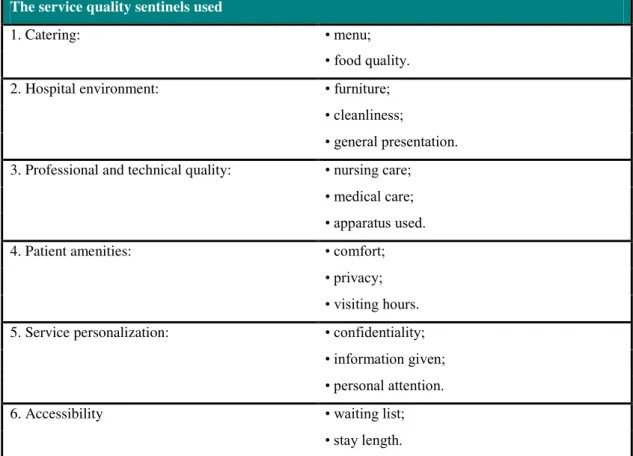
The constructs used in the study are listed on table 3.1.
Table 3.1 Camilleri and O'Callaghan constructs in comparing public and private hospital care service quality (1998)
The service quality sentinels used
1. Catering: • menu;
• food quality.
2. Hospital environment: • furniture;
• cleanliness;
• general presentation. 3. Professional and technical quality: • nursing care;
• medical care; • apparatus used.
4. Patient amenities: • comfort;
• privacy; • visiting hours. 5. Service personalization: • confidentiality;
• information given; • personal attention.
6. Accessibility • waiting list;
• stay length.
Results on table 3.2 are quite interesting. Patients consider in both sectors, professional and technical care followed by service personalization as the most
important aspects in health care service quality. In fact, the attribute that is clearly more divergent between public and private sector is price. Price assumes more importance in public sector than in private. One might think that people who have less money (use public sector) valuate it more than people who are wealthier and do not attribute such a high importance.
Table 3.2 Camilleri and O'Callaghan (1998) rank order of the different service quality indicator groups
Source: Camilleri & O'Callaghan (1998).
Figure 3.2 Patient expectations for public and private care service quality. Source: Camilleri & O'Callaghan (1998).
Jabnoun and Chaker (2003) did a similar study in the United Arab Emirates, comparing the quality of private and public hospitals for inpatients, applying
Parasumaran et al.’s SERVQUAL. What seems surprising in this study is that public sector has a higher overall service quality assessment than private sector. The authors argue that patients in public hospitals are generally more satisfied than patients in private. Is it because they are more demanding and have higher expectations? Public hospitals scored higher in Empathy, Tangibles, Reliability and Supporting Skills.
Private sector is particularly low in tangibles and reliability. Private hospitals should be more patient-oriented as patients have higher expectations. The private sector should therefore invest in training nurses, physicians and administrators to improve their reliability assessment.
Taner and Antony (2006) compared care service quality between public and private hospitals in Turkey. Using SERVQUAL scale they found that satisfaction with doctors and reasonable costs are the most important determinants of service quality in the public sector, while in the private sector the most important determinants are doctors, nurses and supportive services. On a similar basis, Angelopoulou, Kangis and Babis (1998, p. 18) found that patients in the private sector valorize more
communication skills and therefore have higher expectation on attention to their
Patients as customers assess their satisfaction based on structure and process. These evaluations influence satisfaction which has an impact on behavioral intentions. (Owusu-Frimpong, Nwankwo & Dason, 2010, p. 207). Some studies (Choi, Cho, Lee, Lee & Kim, 2004, p. 919; Taylor & Cronin, 1994, p. 36) supported evidence for the multi-attribute model framework in which cognition through the assessment of service quality and value affected satisfaction that has a conation to behavioral intention.
3.4. Hypothesis Development
It is within this framework that patient’s choice is constructed and made. The goal of this research project is to understand how behavior and intention are determined within health care. Particularly, if behaviors in medical care regarding the choice between the public and private sectors, result from the three well known factors of the TPB. The hypotheses of this study are the following:
H1.The higher the attitude toward the private sector, the higher a patient’s intention to go to the private sector.
H2. The higher the subjective norm toward the private sector, the higher a
patient’s intention to go to the private sector.
H3. The higher the Perceived Behavior Control toward the private sector, the
higher a patient’s intention to go to the private sector.
Service Quality and Patient’s Satisfaction Framework has proved to have an
impact on patient’s intentions and behaviors. Therefore, an extension of the TPB will be
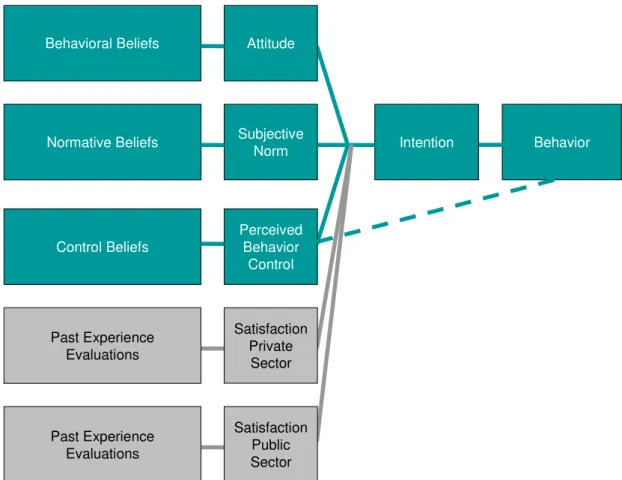
conducted to include these measures (figure 3.3):
H4.The better past experiences with the private sector, the higher a patient’s intention to go to the private sector.
H5. The worse past experiences with the public sector, the higher a patient’s intention to go to the private sector.
relevant predictors of intention and behavior. Therefore, the sixth hypothesis of this study is:
H6. Other behavior variables and non-behavior variables will influence intention to go to the private sector.
As described before in chapter 2.2 the health care market is not homogenous, with different supplies and demands within the public and the private sectors. The final hypothesis of this study is the following:
H7. The constructs used to predict intention and behavior will differ for general practice medical consultation, specialist medical consultation, emergency assistance, ambulatory surgery and hospitalization.
These hypotheses have to be analyzed within the Portuguese health care system and inside the Portuguese culture and socio-economic reality.
Figure 3.3 Extension of the Theory of Planned Behavior (Ajzen, 1985).
Behavioral Beliefs
Normative Beliefs
Control Beliefs
Attitude
Subjective Norm
Perceived Behavior
Control
Intention Behavior
Past Experience Evaluations
Satisfaction Private
Sector
Past Experience Evaluations
4.
RESEARCH METHODOLOGY
4.1. Outline of Methods and Justifications
To answer the research questions a positivist epistemology will be followed. To understand the applicability of the TPB to health care behavior and choice, statistical analysis will be conducted through quantitative research.
The use of the positivist approach is understood as a deductive process, to test a theory. In the present study, the deductive process will test the TPB in health care environment. This quantitative approach will use inquiring strategies based on
experiences. The method will be questionnaires, with closed questions to be statistically analyzed. Each of the three factors that are identified to influence human action in the theory of planned behavior will be tested as well as Intention.
Furthermore, the TPB will be extended to test if past experience, through satisfaction, can influence intention and /or behavior in the choice to go to the private sector.
Creswell (2003) identified investigation practices in the use of quantitative approaches: tests and verifies theories or explications; identifies variables to study; related variables in the study questions or hypotheses; uses validity patterns; observes and measures data, numerically; uses unbiased approaches; uses statistical procedures.
All these practices can be applied to the present study and justify the quantitative approach, opposed to the qualitative.
Methodologically, there will be four steps to take:
1. Design and development of the questionnaire based on previous studies in the international literature; Run a few pre-tests to analyze the questionnaire’s general comprehension and check any possible ambiguities; Re-design questionnaire.
2. Data collection, there will be a minimum of 200 questionnaires. Data
collection will be done through internet by a closed questions questionnaire. 3. Statistic analyses of questionnaires, using the SAS Enterprise Guide
software.