CYTOGENETIC DATA FOR Paspalum notatum
FLÜGGE ACCESSIONS
Nair Dahmer; Maria Teresa Schifino-Wittmann*; Miguel Dall'Agnol; Biane de Castro
UFRGS/FA Depto. de Plantas Forrageiras e Agrometeorologia, C.P. 15100 91501970 Porto Alegre, RS -Brasil.
*Corresponding author <[email protected]>
ABSTRACT: Several species of the genus Paspalum L. are important forages, due to quality,
productivity and tolerance to environmental stresses. Chromosome numbers, meiotic configurations and pollen fertility were evaluated in a collection of 85 accessions of Paspalum notatum Flügge and
in seven accessions of Pensacola (P.notatum var saurae). All P. notatum accessions were tetraploid,
with 2n = 4x = 40, except one diploid accession, considered as an escape of Pensacola. All Pensacola plants had 2n = 2x = 20. Meiotic configurations at diakinesis and metaphase I varied among tetraploid accessions, from plants with only bivalents to plants with high frequency of quadrivalents. Pollen fertility varied from 82.5 to 95.9% among diploid accessions and from 72.4 to 97.9% among the tetraploid. Due to the apomictic mode of reproduction of tetraploid P. notatum, meiotic irregularities can be
maintained by the plants without harming their propagation. At the same time, pollen fertility should be high enough to assure endosperm development, since the species is pseudogamous. Wild diploid
P. notatum populations, apart from the endemic P. notatum var saurae are very rare. From a plant
breeding point of view, all the examined tetraploid accessions are potentially male-fertile and could be used as males in crosses.
Key words: apomixis, chromosome numbers, meiotic configurations, plant breeding, pollen fertility
DADOS CITOGENÉTICOS PARA ACESSOS DE
Paspalum notatum
FLÜGGE
RESUMO: Muitas espécies do genus Paspalum L. são importantes forragens, devido à qualidade,
produtividade e tolerância para o stress ambiental.Númeroscromossômicos, configurações meióticas e fertilidade do pólen foram analisados em uma coleção de 85 acessos de Paspalum notatum Flügge
e sete acessos de Pensacola (P.notatum var saurae). Todos os acessos de P. notatum eram tetraplóides,
com 2n = 4x = 40, com exceção de um diplóide, considerado como escape de Pensacola. Todas as plantas de Pensacola examinadas tinham 2n = 2x = 20. Foi verificada variação entre os acessos tetraplóides quanto às configurações cromossômicas em diacinese e metáfase I, desde plantas com apenas bivalentes até aquelas com alta freqüência de quadrivalentes. A fertilidade do pólen variou de 82,5 a 95,9% entre os acessos diplóides e de 72,4 a 97,9% entre os tetraplóides. Devido ao modo de reprodução apomítico de P. notatum tetraplóide, irregularidades meióticas podem ser mantidas sem
prejuízo da propagação. Ao mesmo tempo, a fertilidade do pólen deve ser suficientemente alta para assegurar a formação do endosperma, já que a espécie é pseudogâmica. Diplóides silvestres de P. notatum, além do endêmico P. notatum var saurae são muito raros. Do ponto de vista do melhoramento,
todos os tetraplóides são potencialmente macho-férteis e poderiam ser utilizados como genitores masculinos em cruzamentos.
Palavras-chave: apomixia, números cromossômicos, configurações meióticas, melhoramento genético, fertilidade do pólen
INTRODUCTION
The genus Paspalum L. comprises around 400
species, most of them native to tropical and sub-tropical Americas (Moraes-Fernandes et al., 1968). Many of these species are important forages, due to quality, pro-ductivity and tolerance to environmental stresses (Valls, 2000). In Brazil, where 75% of Paspalum species
occur, they are part of several plant communities, in a broad range of ecological conditions (Barreto, 1974). Sexual reproduction and apomixis are common in the genus, generally related to the diploid and polyploid lev-els (Quarín & Norrmann, 1990).
P. notatum Flügge is an apomictic tetraploid
Mexico to Uruguay (Burton, 1948; Burton & Forbes, 1960; Quarín et al., 1984) and has been studied by botanists, geneticists, agronomists and plant breeders (Dahmer-Balbinot, 2007). P. notatum var. saurae is a
sexual diploid (2n = 2x = 20), native to northeastern and central-eastern Argentina, introduced around 1926 to the Pensacola Bay region of Florida and later re-leased as the Pensacola cultivar (Burton, 1967; 1974). It is widely cultivated in North and South America. Since the apomictic nature of P. notatum precludes its
use as female in crosses (but not as male given there is fertile pollen), the introduction of variability by sexual methods was possible by crossing the apomictic with artificially polyploidized P. notatum var. saurae
(Bur-ton & Forbes, 1960; Bur(Bur-ton et al., 1970). If other wild diploids were identified, they could have been used to introduce novel variation in P. notatum, but, until now,
no other diploids have been located outside the Argen-tinian region of P. notatum var. saurae (Pozzobon &
Valls, 1997; Daurelio et al., 2004). The objective of the present work was to determine chromosome numbers, chromosome associations at diakinesis and metaphase I, and pollen viability in accessions of P. notatum which
are part of a breeding project.
MATERIAL AND METHODS
The original plants (accessions) were col-lected as tillers (propagated later vegetatively in pots) from populations in the Rio Grande do Sul State, Bra-zil. A few accessions came from the Santa Catarina and Paraná States (Brazil), Uruguay and Argentina (Table 1). Plants are kept in pots as part of a germplasm collection. The accessions are identified in the collection by species name and a number, for working purposes. In the collection list all acces-sions are registered by this number plus the collector´s number and place of collection.
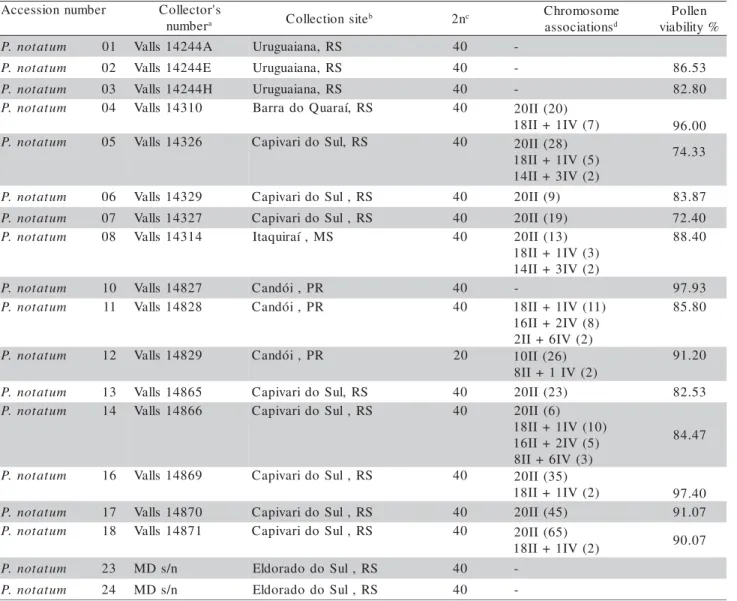
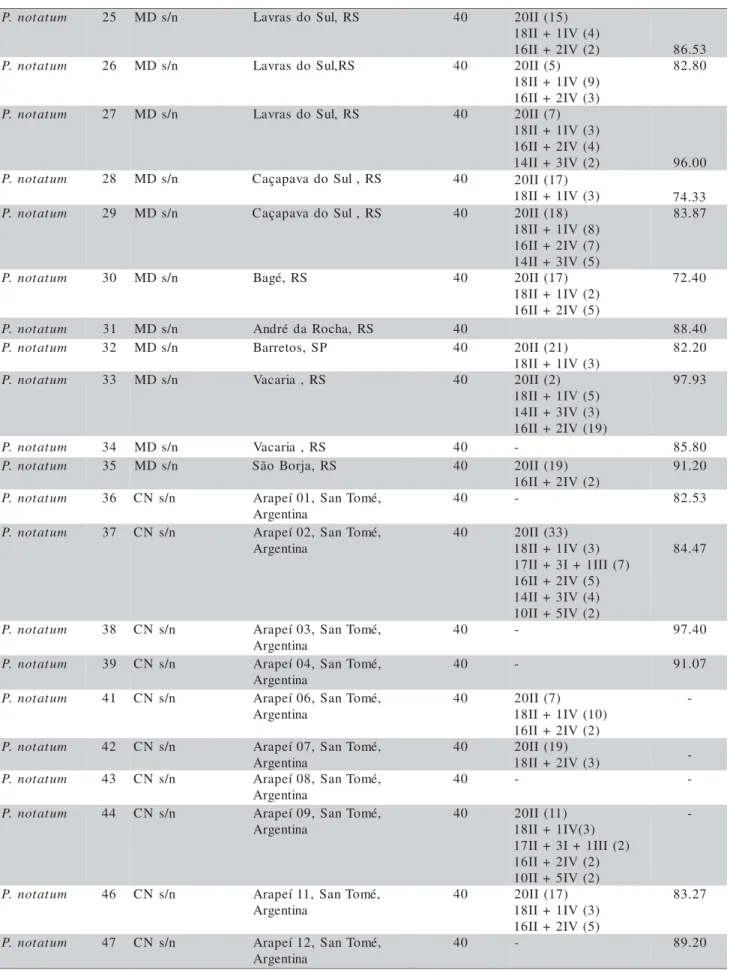
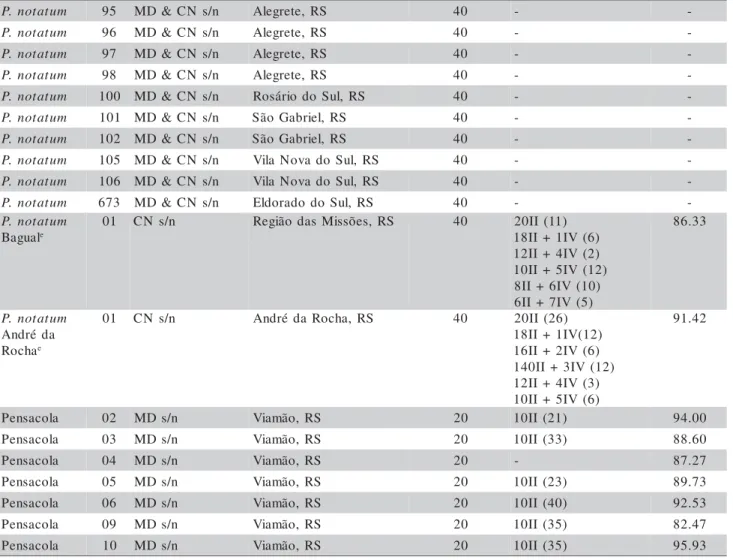
Table 1 - List of P. notatum accessions, chromosome number, chromosome associations and pollen viability.
Continue... r
e b m u n n o i s s e c c
A Collecto'rs
r e b m u
n a Collectionstieb 2nc Cashsroocmiaotsioonmsed
n e ll o P
% y ti li b a i v m
u t a t o n .
P 01 Valls14244A Uruguaiana, RS 40 -m
u t a t o n .
P 02 Valls14244E Uruguaiana, RS 40 - 86.53
m u t a t o n .
P 03 Valls14244H Uruguaiana, RS 40 - 82.80
m u t a t o n .
P 04 Valls14310 Barrado Quara,í RS 40 20II (20) ) 7 ( V I 1 + I I 8
1 96.00
m u t a t o n .
P 05 Valls14326 CapivaridoSu,l RS 40 20II (28) ) 5 ( V I 1 + I I 8 1
) 2 ( V I 3 + I I 4 1
3 3 . 4 7
m u t a t o n .
P 06 Valls14329 CapivaridoSul, RS 40 20II (9) 83.87 m
u t a t o n .
P 07 Valls14327 CapivaridoSul, RS 40 20II (19) 72.40 m
u t a t o n .
P 08 Valls14314 Itaquiraí, MS 40 20II (13) ) 3 ( V I 1 + I I 8 1
) 2 ( V I 3 + I I 4 1
0 4 . 8 8
m u t a t o n .
P 10 Valls14827 Candói, PR 40 - 97.93
m u t a t o n .
P 11 Valls14828 Candói, PR 40 18II+1IV(11) ) 8 ( V I 2 + I I 6 1
) 2 ( V I 6 + I I 2
0 8 . 5 8
m u t a t o n .
P 12 Valls14829 Candói, PR 20 10II(26) ) 2 ( V I 1 + I I 8
0 2 . 1 9
m u t a t o n .
P 13 Valls14865 CapivaridoSu,l RS 40 20II (23) 82.53 m
u t a t o n .
P 14 Valls14866 CapivaridoSul, RS 40 20II (6) ) 0 1 ( V I 1 + I I 8 1
) 5 ( V I 2 + I I 6 1
) 3 ( V I 6 + I I 8
7 4 . 4 8
m u t a t o n .
P 16 Valls14869 CapivaridoSul, RS 40 20II (35) ) 2 ( V I 1 + I I 8
1 97.40
m u t a t o n .
P 17 Valls14870 CapivaridoSul, RS 40 20II (45) 91.07 m
u t a t o n .
P 18 Valls14871 CapivaridoSul, RS 40 20II (65) ) 2 ( V I 1 + I I 8
1 90.07
m u t a t o n .
P 23 MDs/n Eldorado doSul, RS 40
-m u t a t o n .
-Table 1 - Continuation. Continue... m u t a t o n .
P 25 MDs/n Lavras doSul, RS 40 20II(15) ) 4 ( V I 1 + I I 8 1 ) 2 ( V I 2 + I I 6
1 86.53
m u t a t o n .
P 26 MDs/n Lavras doSul,RS 40 20II(5) ) 9 ( V I 1 + I I 8 1 ) 3 ( V I 2 + I I 6 1 0 8 . 2 8 m u t a t o n .
P 27 MDs/n Lavras doSul, RS 40 20II(7) ) 3 ( V I 1 + I I 8 1 ) 4 ( V I 2 + I I 6 1 ) 2 ( V I 3 + I I 4
1 96.00
m u t a t o n .
P 28 MDs/n CaçapavadoSul,RS 40 20II(17) ) 3 ( V I 1 + I I 8
1 74.33
m u t a t o n .
P 29 MDs/n CaçapavadoSul,RS 40 20II(18) ) 8 ( V I 1 + I I 8 1 ) 7 ( V I 2 + I I 6 1 ) 5 ( V I 3 + I I 4 1 7 8 . 3 8 m u t a t o n .
P 30 MDs/n Bagé, RS 40 20II(17) ) 2 ( V I 1 + I I 8 1 ) 5 ( V I 2 + I I 6 1 0 4 . 2 7 m u t a t o n .
P 31 MDs/n AndrédaRocha,RS 40 88.40 m u t a t o n .
P 32 MDs/n Barretos,SP 40 20II(21) ) 3 ( V I 1 + I I 8 1 0 2 . 2 8 m u t a t o n .
P 33 MDs/n Vacaria , RS 40 20II(2) ) 5 ( V I 1 + I I 8 1 ) 3 ( V I 3 + I I 4 1 ) 9 1 ( V I 2 + I I 6 1 3 9 . 7 9 m u t a t o n .
P 34 MDs/n Vacaria , RS 40 - 85.80 m u t a t o n .
P 35 MDs/n SãoBorja,RS 40 20II(19) ) 2 ( V I 2 + I I 6 1 0 2 . 1 9 m u t a t o n .
P 36 CNs/n Arapeí01,SanTomé, a n i t n e g r A 0
4 - 82.53
m u t a t o n .
P 37 CNs/n Arapeí02,SanTomé, a n i t n e g r A 0
4 20II(33) ) 3 ( V I 1 + I I 8 1 ) 7 ( I I I 1 + I 3 + I I 7 1 ) 5 ( V I 2 + I I 6 1 ) 4 ( V I 3 + I I 4 1 ) 2 ( V I 5 + I I 0 1 7 4 . 4 8 m u t a t o n .
P 38 CNs/n Arapeí03,SanTomé, a n i t n e g r A 0
4 - 97.40
m u t a t o n .
P 39 CNs/n Arapeí04,SanTomé, a n i t n e g r A 0
4 - 91.07
m u t a t o n .
P 41 CNs/n Arapeí06,SanTomé, a n i t n e g r A 0
4 20II(7) ) 0 1 ( V I 1 + I I 8 1 ) 2 ( V I 2 + I I 6 1 -m u t a t o n .
P 42 CNs/n Arapeí07,SanTomé, a n i t n e g r A 0
4 20II(19) ) 3 ( V I 2 + I I 8 1 -m u t a t o n .
P 43 CNs/n Arapeí08,SanTomé, a n i t n e g r A 0
4 -
-m u t a t o n .
P 44 CNs/n Arapeí09,SanTomé, a n i t n e g r A 0
4 20II(11) ) 3 ( V I 1 + I I 8 1 ) 2 ( I I I 1 + I 3 + I I 7 1 ) 2 ( V I 2 + I I 6 1 ) 2 ( V I 5 + I I 0 1 -m u t a t o n .
P 46 CNs/n Arapeí11,SanTomé, a n i t n e g r A 0
4 20II(17) ) 3 ( V I 1 + I I 8 1 ) 5 ( V I 2 + I I 6 1 7 2 . 3 8 m u t a t o n .
P 47 CNs/n Arapeí12,SanTomé, a n i t n e g r A 0
Table 1 - Continuation. Continue... m u t a t o n .
P 49 MDs/n Mostardas, RS 40 20II(42) 91.87
m u t a t o n .
P 50 CNs/n Piracicaba, SP 40 20II(16)
) 6 ( V I 1 + I I 8 1 ) 3 ( V I 4 + I I 2 1 0 0 . 0 9 m u t a t o n .
P 51 MDs/n Possadas ,Argentina 40 - 73.00
m u t a t o n .
P 52 Steiner s/n Santiago, RS 40 - 89.53
m u t a t o n .
P 53 MDs/n Água Doce, SC 40 -
-m u t a t o n .
P 54 MDs/n EldoradodoSu,l RS 40 20II(32) ) 2 ( V I 1 + I I 8 1 ) 0 1 ( V I 2 + I I 6 1 3 9 . 4 8 m u t a t o n .
P 55 Valls14921 Quara,i RS 40 20II(4)
) 2 ( V I 1 + I I 8 1 ) 4 ( V I 2 + I I 6 1 ) 0 1 ( V I 3 + I I 4 1 ) 4 ( V I 4 + I I 2 1 8 . 1 8 m u t a t o n .
P 56 Vallsw14931 Alegrete, RS 40 20II(12) ) 2 ( V I 1 + I I 8 1 ) 2 ( V I 2 + I I 6 1 ) 2 ( V I 3 + I I 4 1 ) 4 ( V I 5 + I I 0 1 -m u t a t o n .
P 66 MDs/n Uruguai 40 20II(15)
) 9 ( V I 2 + I I 6 1 3 9 . 8 8 m u t a t o n .
P 67 MDs/n Uruguai 40 20II(12)
) 2 2 ( V I + I I 8 1 ) 7 ( V I 2 + I I 6 1 3 7 . 9 8 m u t a t o n .
P 69 MDs/n São José doHortêncio, S
R
0
4 20II(12) ) 4 ( V I 1 + I I 8 1 ) 3 1 ( V I 2 + I I 6 1 3 9 . 6 7 m u t a t o n .
P 70 NDs/n PortoLucena, RS 40 - 91.00
m u t a t o n .
P 71 NDs/n Três de Maio, RS 40 -
-m u t a t o n .
P 72 NDs/n Três deMaio, RS 40 -
-m u t a t o n .
P 73 NDs/n CruzAtla, RS 40 -
-m u t a t o n .
P 74 MD&CN s/n Tapes, RS 40 -
-m u t a t o n .
P 75 MD&CN s/n Cristal, RS 40 -
-m u t a t o n .
P 76 MD&CN s/n São LourençodoSu,lRS 40 - -m u t a t o n .
P 77 MD&CN s/n CapãodoLeão, RS 40 -
-m u t a t o n .
P 78 MD&CN s/n CapãodoLeão, RS 40 -
-m u t a t o n .
P 79 MD&CN s/n PinheiroMachado,RS 40 - -m u t a t o n .
P 80 MD&CN s/n PinheiroMachado,RS 40 - -m u t a t o n .
P 81 MD&CN s/n PinheiroMachado,RS 40 - -m u t a t o n .
P 82 MD&CN s/n Candiota, RS 40 -
-m u t a t o n .
P 83 MD&CN s/n HulhaNegra, RS 40 -
-m u t a t o n .
P 84 MD&CN s/n Bexigoso, RS 40 -
-m u t a t o n .
P 85 MD&CN s/n DomPedrtio, RS 40 -
-m u t a t o n .
P 86 MD&CN s/n DomPedrtio, RS 40 -
-m u t a t o n .
P 87 MD&CN s/n DomPedrtio, RS 40 -
-m u t a t o n .
P 88 MD&CN s/n Livramento,RS 40 -
-m u t a t o n .
P 89 MD&CN s/n Livramento,RS 40 -
-m u t a t o n .
P 90 MD&CN s/n Livramento,RS 40 -
-m u t a t o n .
P 92 MD&CN s/n Areia,l RS 40 -
-m u t a t o n .
-Table 1 - Continuation.
m u t a t o n .
P 95 MD&CN s/n Alegrete,RS 40 - -m
u t a t o n .
P 96 MD&CN s/n Alegrete,RS 40 - -m
u t a t o n .
P 97 MD&CN s/n Alegrete,RS 40 - -m
u t a t o n .
P 98 MD&CN s/n Alegrete,RS 40 - -m
u t a t o n .
P 100 MD&CN s/n RosáriodoSul, RS 40 - -m
u t a t o n .
P 101 MD&CN s/n SãoGabriel, RS 40 - -m
u t a t o n .
P 102 MD&CN s/n SãoGabriel, RS 40 - -m
u t a t o n .
P 105 MD&CN s/n VilaNovadoSul, RS 40 - -m
u t a t o n .
P 106 MD&CN s/n VilaNovadoSul, RS 40 - -m
u t a t o n .
P 673 MD&CN s/n Eldorado doSul, RS 40 - -m
u t a t o n . P
l a u g a B e
1
0 CN s/n Regiãodas Missões, RS 40 20II (11) ) 6 ( V I 1 + I I 8 1
) 2 ( V I 4 + I I 2 1
) 2 1 ( V I 5 + I I 0 1
) 0 1 ( V I 6 + I I 8
) 5 ( V I 7 + I I 6
3 3 . 6 8
m u t a t o n . P
a d é r d n A
a h c o R e
1
0 CN s/n AndrédaRocha, RS 40 20II (26) ) 2 1 ( V I 1 + I I 8 1
) 6 ( V I 2 + I I 6 1
) 2 1 ( V I 3 + I I 0 4 1
) 3 ( V I 4 + I I 2 1
) 6 ( V I 5 + I I 0 1
2 4 . 1 9
a l o c a s n e
P 02 MDs/n Viamão, RS 20 10II(21) 94.00 a
l o c a s n e
P 03 MDs/n Viamão, RS 20 10II(33) 88.60 a
l o c a s n e
P 04 MDs/n Viamão, RS 20 - 87.27
a l o c a s n e
P 05 MDs/n Viamão, RS 20 10II(23) 89.73 a
l o c a s n e
P 06 MDs/n Viamão, RS 20 10II(40) 92.53 a
l o c a s n e
P 09 MDs/n Viamão, RS 20 10II(35) 82.47 a
l o c a s n e
P 10 MDs/n Viamão, RS 20 10II(35) 95.93
aValls: José Francisco M. Valls, EMBRAPA-CENARGEN, Brasília, DF; MD:- Miguel Dall'Agnol, UFRGS, Porto Alegre, RS; CN:
Carlos Nabinger, UFRGS, Porto Alegre, RS; Steiner: Marcelo Steiner, UFRGS, Porto Alegre, RS; ND: Nair Dahmer, UFRGS, Porto Alegre, RS; bRS: Rio Grande do Sul; PR: Paraná; SC: Santa Catarina; SP: São Paulo; MS: Mato Grosso do Sul; cTo standardize the
results, chromosome numbers are all represented as 2n; dBetween brackets is the number of analyzed cells; eBagual and André da Rocha
are informal denominations for two P. notatum populations with particular characteristics
Somatic chromosome numbers (2n) were de-termined in root-tip cells pre-treated with a saturated paradichlorobenzene solution for 24 h at 4°C, fixed in Carnoy 3:1 (ethanol:acetic acid) for 24 h at 4°C, hy-drolyzed with 1 mol L-1 HCl for 10 min at 60ºC, stained
with Feulgen and squashed in propionic carmine. At least ten cells with good spreading and no chromo-some overlapping were counted per plant. Gametic chromosome numbers (n) were determined in pollen-mother-cells undergoing meiosis, from young inflores-cences fixed in Carnoy 3:1 at room temperature and squashed in propionic carmine. Most of the gametic chromosome counts were performed in cells at diaki-nesis and metaphase I stages, since at these stages also chromosome pairing configurations may clearly be ob-served.
Pollen fertility was estimated by stainability (in 2% propionic carmine, following Simioni et al., 2006)
of 1500 mature pollen grains per plant. Full, well stained grains were classified as potentially viable and unstained or poorly stained as sterile.
RESULTS AND DISCUSSION
Chromosome numbers were determined in a total of 92 accessions (Table 1), and, 83 of them were tetraploid, with 2n = 4x = 40 (or n = 20) (Figures 1A, B, C). One accession, originally collected as P. notatum had 2n = 2x = 20 (P. notatum 12) (Table 1,
Figures 1G, H). The seven Pensacola accessions were diploid, with 2n = 2x = 20 (or n = 10), as expected (Table 1).
The P. notatum 12 accession with 2n = 20 is
probably some plants of the cultivated variety have in-vaded the natural fields.
Pozzobon & Valls (1997) reported 11 acces-sions with 2n = 20 among the 127 P. notatum
acces-sions and considered these plants to be escapes from Pensacola cultivation.Moraes-Fernandes et al. (1973)
found only the tetraploid level among the 16 Brazilian (Rio Grande do Sul) and one introduced accession from
P. notatum. Daurelio et al. (2004) reported that despite
a search in other regions of Argentina, the diploids are all botanically P. notatum var. saurae and restricted to
Northeastern and Central-Eastern Argentina. In this re-stricted region, but not further, these authors detected some triploid hybrids between P. notatum and P. notatum var. saurae.
Wild diploid cytotypes are most probably re-stricted to this specific Argentinian region. If “true” diploid P. notatum plants, apart from Pensacola and
its escapes exist in other geographical areas they are certainly extremely rare. To find other possible wild diploids in other regions would imply in collecting a high number of accessions along P. notatum
distribu-tion and would require other methods than tradidistribu-tional chromosome countings (that are laborious and time consuming) to estimate ploidy levels, such as flow cytometry that allows examination of a large number of plants in less time. However, once Pensacola is also widely cultivated, these studies should be coupled to a sound taxonomic determination, detailed morphologi-cal analysis and, if possible other approaches as mo-lecular markers profile, in other to avoid misidentifications and wrong assignments of Pensacola escapes as wild P. notatum.
Despite the absence of chromosome number variability among the P.notatum accessions, when
ex-amining meiotic configurations (Table 1), the 36 tet-raploid accessions presented several chromosome con-figurations, with the occurrence of univalents (I), bivalents (II), trivalents (III), and quadrivalents (IV) (Table 1, Figures 1E, F). The frequencies of different chromosome configurations varied widely among dif-ferent accessions. In P. notatum 06, P. notatum 07, P. notatum 13, P. notatum 17 and P. notatum 49 all
the cells presented only bivalents. On the other hand, in P. notatum 14, 75.00% of the cells analyzed
pre-sented other configurations than bivalents, and these percentages were 93.10% for P. notatum 33, 80.95%
for P. notatum Bagual and 85.00% for P. notatum
André da Rocha. In general, the most common con-figurations among cells were 20 II or 18 II and 1 IV (Table 1). Therefore, the absence of chromosome number variability is accompanied by the variability in meiotic configurations among the tetraploid accessions. Conversely, the diploid accessions presented always ten
bivalents at diakinesis and metaphase I (7% of the cells of accession 12) (Table 1, Figures 1H, I). Moraes-Fernandes et al. (1973) also found varying chromosome configurations among the examined ac-cessions of P. notatum, with predominance of
quadrivalents and bivalents, while trivalents and uni-valents were less frequent. One accession presented a predominance of cells with just bivalents (Moraes-Fernandes et al., 1973). Variability in chromosome configurations in other Paspalum species have been
reported by other authors such as Moraes-Fernandes et al. (1968), Pagliarini et al. (2001) and Adamowski et al. (2005).
Pollen viability was mostly over 80% in 48 accessions and ranged from 82.47 to 95.93% among diploid accessions and from 72.40 to 97.93% among tetraploids (Table 1). Moraes-Fernandes et al. (1973) reported pollen fertility (ascertained with acetic car-mine) ranging from 0 to 84.3% in tetraploid P. notatum.
The variability observed among the P. notatum accessions may be explained by the
polyp-loid nature of the species and by its mode of repro-duction. Tetraploid P. notatum is apomictic and also
propagates vegetatively, therefore the quadrivalents remaining from the polyploidization evolutionary pro-cess could be maintained (without need for chromo-some “diploidization”, a process known to occur widely among sexual tetraploids). Moreover, the even-tual chromosomal rearrangements that lead to quadrivalents, such as translocations, or other con-figurations like trivalents and unpaired chromosomes (univalents) could be maintained by the accessions without harming their assexual reproduction. At the same time, since P. notatum is a pseudogamous
apomictic, that is, needs pollination to form the en-dosperm, a certain degree of meiotic regularity lead-ing to at least some pollen fertility is necessary and that would explain the relatively high pollen fertility that was observed. It could be speculated that this kind of situation could represent a genetic and evo-lutionary conflict: apomictic reproduction with the possibility of accumulating meiotic irregularities ver-sus the need of fertile pollen.
From a plant breeding point of view, all the examined accessions are potentially male-fertile and could be used as male genitors in crosses. However, as no other diploids apart from the endemic P. notatum
var. saurae have been identified, improvement of
tet-raploid P. notatum should rely on the selection of well
adapted apomictic populations. To introduce variation through sexual crosses would imply in looking for wild
Pensacola plants. For this the plant breeder would however need to evaluate which new characteristics to be looking for and if these characteristics are found among the known diploid material.
CONCLUSIONS
Wild diploid cytotypes, apart from P. notatum
var. saurae are extremely rare. Despite no variability
was found in chromosome numbers among tetraploid
P. notatum, there is a variability in meiotic
chromo-some associations among accessions, explained by the apomictic kind of reproduction. Pollen fertility among apomicts is relatively high, assuring endosperm for-mation and allowing the potential use of these plants as males in crosses.
ACKNOWLEDGMENTS
To CNPq, FAPERGS and CAPES for financial support and fellowships. To Dr. José Francisco Montenegro Valls (EMBRAPA-CENARGEN), Dr. Carlos Nabinger and MSc Marcelo Steiner (UFRGS) for providing some of the accessions.
REFERENCES
ADAMOWSKI, E.V.; PAGLIARINI, M.S.; BONATO, A.B.; BATISTA, L.A.R.; VALLS, J.F.M. Chromosome numbers and meiotic behavior of some Paspalum accessions. Genetics and Molecular Biology, v.28, p.773-780, 2005.
BARRETO, I.L. O gênero Paspalum (Gramineae) no Rio Grande do Sul. Porto Alegre: UFRGS, 1974. 258 p. Tese (Livre Docência).
Figures 1 - (A) P. notatum André da Rocha, somatic metaphase (2n = 40); (B) P. notatum 87, somatic metaphase (2n = 40); (C) P. notatum 13, somatic metaphase (2n = 40); (D) P. notatum Bagual, metaphase I (6II + 7IV), arrows point to the quadrivalents; (E) P. notatum 05, metaphase I (2I + 17II + 1IV), small arrows point to the univalent, arrow head to secondary associations between two bivalents and the big arrow to the quadrivalent; (F) P. notatum 66, metaphase I (18II + 1IV), arrow point to the quadrivalent; (G) P. notatum 12, somatic metaphase (2n = 20), arrow points to overlapping of chromosomes; (H) P. notatum 12, metaphase I (10 II); (I) P. notatum 56, metaphase I (10II + 5IV), arrows point to the quadrivalents. Scale bar = 10 μm.
A
A
B
B
G
G
H
H
F
F
F
D
D
D
E
E
Economic Botany, v.21, p.319-328, 1967.
BURTON, G.W. Recurrent restricted phenotypic selection increases forage yield of Pensacola Bahiagrass. Crop Science, v.14, p.831-835, 1974.
BURTON, G.W. The method of reproduction of common Bahiagrass, Paspalum notatum. Journal of the American Society of Agronomy, v.40, p.443-452, 1948.
BURTON, G.W.; FORBES JR., I.; JACKSON, J. Effect of ploidy on fertility and heterosis in Pensacola Bahiagrass. Crop Science, v.10, p.63-65, 1970.
BURTON, G.W.; FORBES, I. Genetics and manipulation of obligate apomixis in common Bahia grass (Paspalum notatum Flügge). In: INTERNATIONAL GRASSLAND CONGRESS, 8., Reading, 1960. Proceedings. Reading: International Grassland Society, 1960. p.66-71.
DAHMER-BALBINOT, N. Variabilidade citogenética em uma coleção de acessos de Paspalum notatum Flügge. Porto Alegre: UFRGS, 2007. 71p. Dissertação (Mestrado).
DAURELIO, L.D.; ESPINOZA, F.; QUARÍN, C.L.; PESSINO, S.C. Genetic diversity in sexual diploid and apomictic tetraploid populations of Paspalum notatum situated in sympatry or
allopatry. Plant Systematics and Evolution, v.244, p.189-199, 2004.
MORAES-FERNANDES, M.I.B.; BARRETO, I.L.; SALZANO, F.M. Cytogenetic, ecologic and morphologic studies in Brazilian forms
of Paspalum dilatatum. Canadian Journal of Genetics and
Cytology, v.10, p.131-138, 1968.
Cytogenetic, ecologic and morphologic studies in Brazilian forms
of Paspalum notatum. Canadian Journal of Genetics and
Cytology, v.15, p.523-531, 1973.
PAGLIARINI, M.S.; CARRARO, L.R.; FREITAS, P.M.; ADAMOWSKI, E.V.; BATISTA, L.A.R.; VALLS, J.F.M. Cytogenetic characterization of Brazilian Paspalum accessions. Hereditas, v.135, p.27-34, 2001.
POZZOBON, M.T.; VALLS, J.F.M. Chromosome number in germplasm accessions of Paspalum notatum (Gramineae).
Brazilian Journal of Genetics, v.20, p.29-34, 1997. QUARÍN, C.L.; NORRMANN, G.A. Interspecific hybrids between
five Paspalum species. Botanical Gazette, v.151, p.366-369, 1990.
QUARÍN, C.L.; BURSON, B.L.; BURTON, G.W. Cytology of intra-and interspecific hybrids between two cytotypes of Paspalum
notatum and P. cromyor rhizon. Botanical Gazette, v.145,
p.420-426, 1984.
SIMIONI, C.; SCHIFINO-WITTMANN, M.T.; DALL´AGNOL, M. Sexual polyploidization in red clover. Scientia Agricola, v.63, p.26-31, 2006.
VALLS, J.F.M. Impacto do conhecimento citogenético na taxonomia
de Paspalum e Axonopus (Gramineae). In: CAVALCANTI, T.B.;
WALTER, B.M.T. (Ed.) Tópicos atuais em botânica. Brasília: EMBRAPA-CENARGEN, 2000. p.15-21.