ABSTRACT: Common pepper (Capsicum annuum L.) is one of the most important vegetables in the world, and extensive breeding efforts are being made to develop new improved strains of this species. In this regard, in vitro culture of immature embryos may help breeders accelerate breeding cycles and overcome interspecific barriers, among other applications. In this study, we have optimized a protocol for in vitro culture of immature embryos of C. annuum. Levels of in-dole-3-acetic acid (IAA) and zeatin have been tested to improve the efficiency (germination rates) of this technique in C. annuum embryos at the four main immature stages (i.e. globular, heart, torpedo, and early cotyledonary) from four varietal types of this species (California Wonder, Piquillo, Guindilla, and Bola). The effect of 5-day initial incubation in the dark was also tested on the most efficient hormone formulation. On average, relatively low levels of both IAA and zeatin (0.01 mg L−1 each) (M
1) provided the highest germination rates, particularly in the advanced stages (torpedo and cotyledonary). To a lesser extent, the lack of these growth regulators (M0) or high IAA (0.2 mg L−1)/low zeatin (0.01 mg L−1) (M
2) combination also had a positive response. On the contrary, high zeatin levels (0.2 mg L−1) produced very low germination rates or callus development (efficiency 0-7 %). Different responses were also found between genotypes. Thus, considering the best media (M0, M1, M2), Bola embryos had the highest rates. M1 plus 5-days of initial dark incubation (M1-D) improved the efficiency rates at all embryo stages, particularly in the earliest (globular) embryos which increased from 3 % to > 20 %.
Keywords: Capsicum peppers, embryo stage, genotypic diversity, indole-3-acetic acid, zeatin
Introduction
Peppers (Capsicum annuum L.) are cultivated throughout the world and are one of the most important vegetables (FAOSTAT, 2011). Because of that, this crop is subjected to huge breeding efforts to ensure yield stabil-ity and fruit qualstabil-ity (Blat et al., 2005; Crosby, 2008; de Sousa and Maluf, 2003). In this regard, in vitro culture of immature embryos can be useful for shortening gen-eration cycles, producing haploids and double haploids, or rescuing potentially abortive interspecific embryos, which enables the introgression of genes between re-lated species (Bhattarai et al., 2009; Guzzo et al., 2004; Hossain et al., 2003; Lotfi et al., 2003; Yoon et al., 2006).
Embryo culture efficiency depends mostly on: i) genotype: different accessions may show different re-sponses (Kothari et al., 2010), ii) embryo stage (Man-zur et al., 2013; Raghavan, 2003), iii) media formula-tion: mineral salts, carbohydrates, growth regulators, nitrogen compounds, vitamins, etc (Monnier, 1995), and; iv) incubation conditions (i.e. temperature, light/ dark conditions) (Razdan, 2003). However, knowledge of the response of Capsicum zygotic embryos to in vitro culture is still scarce, with few reports available. Hos-sain et al. (2003) found a positive effect of casein and coconut water and also that sucrose provides better re-sults than fructose or glucose. Yoon et al. (2006) rescued interspecific C. annuum × C. baccatum embryos, but at low rates and at the most advanced immature stages. Recently, we found that relatively low levels of sucrose
and Murashige-Skoog salts (MS) considerably increase the efficiency of embryo germination in most Capsicum genotypes and embryo stages, including globular embry-os (Manzur et al., 2010, 2013).
The role of factors like growth regulators or dark-ness has still not been studied. In this respect, low levels of gibberellic acid (GA3) promote embryo growth in sev-eral species (Moshkov et al., 2008) and replace the role of the suspensor, which is lost during excision (Haslam and Yeung, 2011; Monnier, 1995). Additionally, auxins (usu-ally indole-3-acetic acid, IAA) may promote the growth of primary roots, hypocotyls and cotyledons when adminis-tered in low doses (Machakova et al., 2008), while cyto-kinins usually show favorable effects on early stages at high levels (Raghavan, 2006). Furthermore, combinations of auxins and cytokinins have showed favorable effects on early embryos (Salamma and Ravi Prasad Rao, 2013). Moreover, initial dark incubation improved germination rates and embryo growth in several species (Razdan, 2003). The response to these factors is highly dependent on the species (Monnier, 1995) and, therefore, our main objective was to assess the effect of IAA, zeatin and dark incubation on C. annuum immature embryos. This study provides useful information for the optimization of in vitro culture protocols in immature embryos of peppers.
Materials and Methods
Plant material and growing conditions
A total of four accessions from C. annuum were Polytechnic University of Valencia/Institute for Conservation
& Improvement of Valentian Agrodiversity, Camino de Vera, s/n – 46022 – Valencia – Spain.
*Corresponding author <[email protected]>
Edited by: Antonio Costa de Oliveira
Growth regulators and darkness increase efficiency in
in vitro
culture of immature
Juan Pablo Manzur, María de las Nieves Calvache-Asensio, Adrian Rodriguez-Burruezo*
embryos from peppers
utilized (Table 1). Plants were transplanted to a glass-house in Valencia (39º29'00" N, 0º20'28" W) (Spain) in Feb 2011 and grown during the spring-summer sea-son. Natural illumination and a temperature range of 18/25 ºC were used for this experiment. Plants were drip irrigated every 8 h for 3 min. (4 L h−1) and fertil-izer was applied with irrigation water at a rate of 1 g L−1 in the form of the commercial fertilizer 15N-2.2P-24.9K
Evaluated media and conditions
To study the role of auxins and cytokinins a for-mulation previously optimized by Manzur et al. (2013), consisting of 1/
2MS dose (2.2 g L
−1 of commercial
for-mulation), sucrose at 40 g L−1, gibberellic acid (GA 3) at 0.01 mg L−1, agar at 7 g L−1, and pH 5.7 was utilized as control (M0). Then, on the basis of M0, relatively low (0.01 mg L−1) and/or high (0.2 mg L−1) levels of IAA and zeatin were combined to assess the effect of these growth regulators, while GA3 at 0.01 mg L−1 was kept in all formulations as we considered it essential for
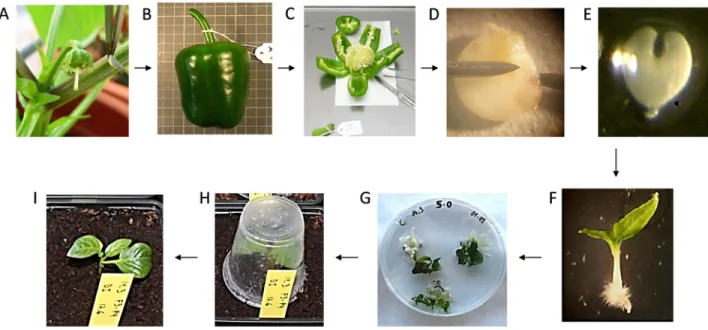
re-Figure 1 − Diagram of the in vitro culture technique in California Wonder embryos: A) self-pollination, B) immature fruit just harvested opening, C) fruit and seed sterilization, D-E) embryo excision, stage identification and in vitro sowing, F) embryo development and germination, G) plantlet evaluation and H-I) acclimation.
Table 1 − Origin and fruit traits of the accessions utilized in the present experiment.
Accession Abbreviation Origin Color Weight Length Width
g cm ---California Wonder California Breeding line. UPV-COMAV germplasm bank Pale red 90-150 8-11 6-10 Pimiento del Piquillo Piquillo Cons. Reg. IGP Piquillo Lodosa Navarra. Spain Red 20-33 7-9 4-6
Guindilla de Ibarra Guindilla Neiker. Ibarra. Spain Deep red 7-12 7-12 1-2
Pimiento de Bola Bola Cons. Reg. DOP Pimentón Murcia. Murcia. Spain Red 10-14 3-5 4-6 placing the suspensor (Kawashima and Goldberg, 2009; Moshkov et al., 2008). As a result, the formulations studied were as follows: M0 or control, which lacked both IAA and zeatin, M1 (0.01 mg L−1 IAA and 0.01 mg L−1 zeatin), M
2 (0.2 mg L
−1 IAA and 0.01 mg L−1 zeatin),
M3 (0.01 mg L−1 IAA and 0.2 mg L−1 zeatin) and M 4 (0.2 mg L−1 IAA and 0.2 mg L−1 zeatin). Finally, once the best IAA/zeatin combination had been established, the effect of darkness was tested on embryo cultures in ac-cordance with this formulation plus 5 days of initial in-cubation in darkness. The medium without hormones was sterilized by autoclave (121 ºC for 20 min), while hormones were sterilized separately by microfiltration (0.20 µm filters) to avoid denaturation and, then, added to the warm (35-40 ºC) autoclaved media before solidi-fying.
Isolation and in vitro culture of embryos
Subse-quently, fruits were harvested 15-30 days after polli-nation (DAP) (Figure 1B). Once in the lab, the whole fruit was surface-sterilized with ethanol (96 %) under laminar flow cabinet conditions. Then, immature seeds were removed (Figure 1C) anddissected under stereo-microscope (×24), using hypodermic sterilized needles (Figure 1D). Embryos were excised carefully, recording the embryo stage, and immediately cultured in 90 × 15 mm Petri dishes containing the corresponding medium (Figure 1E). These Petri dishes were then sealed with self-sealing film and incubated in a growth chamber (25 ± 1 ºC; 70 % HR; 16 h/8 h; light/dark). The only excep-tion corresponded to the dark-incubated embryos. In this case the Petri dishes were wrapped with aluminum foil for five days.
The efficiency of in vitro culture was evaluated in terms of the percentage of embryos which evolved to plantlets by showing an early development of root and shoot (Figure 1F-G) and, subsequently, a satisfactory re-sponse to acclimatization (Figure 1H-I), which has been found to be correlated with normal development in the adult stage (Manzur et al., 2013). Embryos or plantlets with abnormalities or callus development were consid-ered not germinated and/or not viable.
Experimental design and statistical analysis
The experimental design was set up as a complete factorial design (4 × 4 × 6) with five replicates, includ-ing four accessions, four embryo developmental stages (globular, heart, torpedo and cotyledonary), and six in vitro media/conditions (M0, M1, M2, M3, M4, and M1 plus 5 days of initial dark incubation = M1-D). Each replicate consisted of one Petri dish with three embryos each. Thus, 15 embryos were cultured for each accession × stage × media/condition combination and, therefore, the present experiment required the excision, in vitro culture, and evaluation of a total of 1,440 embryos. Data of in vitro culture efficiency (percentage) were subjected to analysis of variance to assess differences between means. Since original data were recorded as a percentage, they were transformed by arcsine square root. Transformed data were then tested, but differ-ences between the results obtained with transformed and non-transformed data were negligible. Therefore, the ANOVA presented in this work was performed on the original non-transformed data.
Results and Discussion
Effect of growth regulators
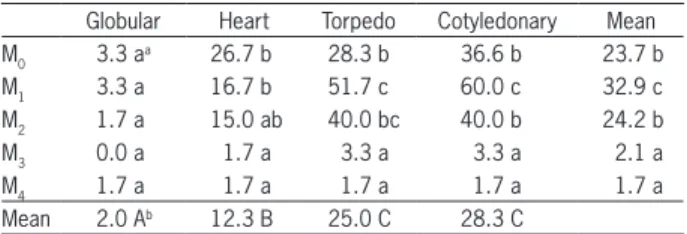
On average, the more advanced the embryo, the higher the germination rate. Mean germination rates ranged from 2 % in globular embryos to 28 % in cot-yledonary (Table 2). In this regard, embryos are high-ly dependent in terms of nutrition and draw upon the endosperm, the suspensor and the surrounding mater-nal tissues during the early development phases (het-erotrophic phase), while, later, they are metabolically
capable of synthesizing substances required for their growth (autotrophic phase) from mineral salts and car-bohydrates (Bhojwani and Razdan, 1996; Ramming, 1990), which explains the higher response observed in the advanced stages.
Considering the interaction between in vitro me-dia composition and the embryo stage, low levels (0.01 mg L−1) of both IAA and zeatin provided in the M
1 for-mulation improved (p < 0.05) the results observed in our previously optimized medium (M0). Thus, on av-erage M1 yielded the highest germination rates (32.9 % mean versus 23.7 % in M0) and at most stages, with the exception of the earliest embryos (Table 2). In com-parison, the lack of these growth regulators in M0 or the combination of high IAA levels and low zeatin in M2 provoked different responses. Thus, M0 allowed the highest rates in heart embryos, although no differences were found in comparison to M1 and M2. However, M0 efficiency barely increased in torpedo and cotyledonary embryos, being much lower than that of M1 (Table 2). In the case of M2, germination rates of the earliest em-bryos were similar to those observed in M1, although rates in the advanced stages were lower. These findings suggest that the lack of hormones may improve embryo germination at the earliest stages, while low levels of both IAA and zeatin provide better results in advanced immature embryos.
By contrast, M3 and M4 had the lowest ger-mination rates, which was mainly due to abnormal plantlets or callus development. Thus, regardless of the embryo stage, the efficiency of these culture media was lower than 5 % (Table 2). These findings and those observed in M2 indicate that high levels of zeatin dramatically decrease the survival rates of Capsicum embryos at all stages, while the detrimen-tal effect of similar levels of IAA (M2) is relatively low (compared to M1) and only noticeable in cotyle-donary embryos (Table 2).
Table 2 − Culture efficiency (% germination) of immature C. annuum
embryos depending on the in vitro medium (M0 (control): 0 mg L−1
IAA and 0 mg L−1 zeatin; M
1: 0.01 mg L
−1 IAA and 0.01 mg L−1
zeatin; M2: 0.2 mg L−1 IAA and 0.01 mg L−1 zeatin; M
3: 0.01 mg
L−1 IAA and 0.2 mg L−1 zeatin; M
4: 0.2 mg L
−1 IAA and 0.2 mg L−1
zeatin) and developmental stage. Each value represents the mean of the four accessions for each medium × stage combination.
Globular Heart Torpedo Cotyledonary Mean M0 3.3 a
a 26.7 b 28.3 b 36.6 b 23.7 b
M1 3.3 a 16.7 b 51.7 c 60.0 c 32.9 c
M2 1.7 a 15.0 ab 40.0 bc 40.0 b 24.2 b
M3 0.0 a 1.7 a 3.3 a 3.3 a 2.1 a
M4 1.7 a 1.7 a 1.7 a 1.7 a 1.7 a
Mean 2.0 Ab 12.3 B 25.0 C 28.3 C
Exogenously supplied hormones are not required in many cases for embryo culture as embryos can be considered as plants with their own endogenous hor-mones (Monnier, 1996). When growth substances are added to the medium, they can modify the ontogen-ic pattern of embryos, including suppression of root growth, precocious leaf expansion, and longer thinner embryos, among others. Nevertheless, there are some cases, in which low concentrations of hormones in the medium have facilitated embryo culture.
It seems that in certain species, natural en-dosperms contain hormones and, therefore, the culture medium may be supplemented with hormones at a very low level that will reproduce the conditions of the in ovulo environment (Monnier, 1995). In this regard, auxins have a key regulatory function and are essential to axis establishment at the proembryo stage (Hamann, 2001; Haslam and Yeung, 2011). In fact, alteration of auxin transport may change embryo symmetry from bi-lateral to radial or provoke the abortion of shoot apical meristem (Liu et al., 1993; Ramesar-Fortner and Yeung, 2006). Thus, exogenous auxins at low concentrations have favored normal embryo growth, while higher lev-els have either proved inhibitory or favored unorgan-ized callus growth. Moreover, cytokinins have usually resulted in growth inhibition, although low levels have been reported to stimulate embryo growth in some cas-es (Sharma et al., 1996).
The effect of the media composition on the re-sponse of the genotypes was quite similar to the find-ings for embryo stages. Thus, all the genotypes germi-nated at very low rates when cultured under M3 or M4 and, in fact, only California Wonder embryos cultured in M3, showed efficiency rates slightly higher than 5 %. Therefore, our zeatin at relatively high levels should be not used to germinate any kind of embryos in peppers, although other authors have reported that levels of zea-tin up to 0.2 mg L−1 may favor embryo growth, particu-larly at the earliest stages (Raghavan, 2006; Troncoso et al., 2003). By contrast, the rates observed in the media with low or zero levels of zeatin (M0, M1 and M2) were considerably higher (Table 3).
As observed at the embryo stage, M1 also pro-vided the highest germination rates in most genotypes
(Table 3), although some examples of genotype × me-dium composition interaction were also found. Guin-dilla embryos were the only exception for which M0 gave higher efficiency rates than M1, suggesting that some genotypes might prefer the lack of IAA and zea-tin rather than low/minimum levels of these regulators. Another example of this interaction can be found by comparing M0 and M2, as their rates were quite similar in California and Piquillo embryos, while M0 provided higher rates than M2 in Guindilla; the contrary being true in Bola (Table 3).
Although the effect of growth regulators in em-bryo culture is quite variable, depending on the spe-cies/genotype and embryo stage (Davey and Anthony, 2010; Sharma et al., 1996), we can conclude that, in the case of C. annuum immature embryos, a minimum con-tent (0.01 mg L−1) of IAA and zeatin provides the best results. These findings are in agreement with the re-ports of other authors in several species such as barley, Phaseolus coccineus or Capsella bursa-pastoris, among others (Monnier, 1995; Raghavan, 2003; Umbeck and Norstog, 1979) and, therefore, medium M1 was chosen to assess the effect of initial dark incubation on in vitro embryo germination.
Effect of initial dark incubation
The combination of M1 and darkness (M1-D) in the first five days of embryo culture increased consid-erably embryo germination in comparison to the appli-cation of M1 alone, suggesting a positive effect of this factor, although the highest differences were mainly found in the earliest stages (Figure 2). Thus, globular embryos showed a mean germination rate > 20 % un-der M1-D combination, which was considerably higher than the mean rate of M1 for these embryos, and even higher than the mean values reported by Manzur et al. (2013) in a wide collection of Capsicum spp. M1-D also provided higher germination rates in heart and torpedo
Table 3 − Culture efficiency (% germination) of immature C. annuum
embryos depending on the in vitro medium and accession utilized. Each value represents the mean of the four embryo stages for each medium × accession combination.
California Piquillo Guindilla Bola
M0 20.0 b
a 15.0 b 28.3 d 31.7 b
M1 38.3 c 28.3 c 16.7 cd 48.3 c
M2 18.3 b 20.0 bc 13.3 bc 45.0 bc
M3 6.7 ab 0.0 a 0.0 a 1.7 a
M4 0.0 a 1.7 a 1.7 ab 3.3 a
aDifferent lowercase letters within the same column indicates differences between medium at p < 0.05 (Fisher's least significant difference
Figure 2 − Culture efficiency (% germination, mean for all genotypes in each stage) of immature C. annuum embryos, under M1 medium (0.01 mg L−1 IAA and 0.01 mg L−1 zeatin) with (grey) or without
stages than M1, although differences were lower than those observed in globular embryos, particularly at the cotyledonary stage (Figure 2), which may be due to the strong autotrophic nature of these embryos, being less dependent on culture conditions. The action of cyto-kinins and auxins is light-dependent and they show remarkable degradation when exposed to the light, par-ticularly auxins (George et al., 2008; Neumann et al., 2009). Probably, this fact explains the higher response to dark incubation observed in globular embryos, which are more dependent on media components, including growth regulators and, consequently, their degradation.
Considering the genotypes, a positive effect was found for M1-D, which provided germination rates sim-ilar or higher than those of M1 (Figure 3). M1 plus in-itial cultivation under darkness improved the average efficiency in Guindilla, from < 20 % to > 50 %, and to a lesser extent in Piquillo, from <30 % to 40 %, while this strategy did not improve mean rates in California and Bola embryos (Figure 3). In this regard, the first studies on this subject suggested that light was not crit-ical for in vitro growth of immature embryos (Matsub-ara and Nakahira, 1965; N(Matsub-arayanaswamy and Norstog, 1964). However, more recent studies have revealed that a few days of incubation in darkness may favor subse-quent chlorophyll formation in the immature embryos of, among others, barley, flax, and Aegilops × Hordeum and interspecific Allium hybrids (Razdan, 2003).
Comparing M1-D rates to the values recorded for M0-M4 (Tables 2 and 3) we can conclude that, in gener-al, the former provides higher responses at any embryo stage and genotype, suggesting that low levels of IAA and zeatin (0.01 mg L−1) and relatively low levels of su-crose (40 g L−1) and MS salts (2.2 g L−1), combined with darkness during the first five days of embryo culture, is the best alternative for C. annuum embryos.
The protocol optimized in the present study can be directly applied to breeding programs to shorten the length of breeding cycles in Capsicum annuum as em-bryos can be germinated at very early stages, instead of using seeds from fully ripe fruits.
Acknowledgements
Juan P. Manzur thanks Polytechnic University of Valencia for a research grant (2011-S2-4264, research staff training program, FPI). This work has been co-fi-nanced by INIA projects RTA2010-00038-C03-03 and RF2010-00025-00-00, and FEDER fundings. The authors thank NEIKER and the Regulatory Boards of D.O.P. Pi-mentón de Murcia and D.O.P. Pimiento del Piquillo de Lodosa for providing us with seeds of Guindilla de Ibar-ra, Bola and Piquillo.
References
Bhattarai, S.P.; De La Pena, R.C.; Midmore, D.J.; Palchamy, K. 2009. In vitro culture of immature seed for rapid generation advancement in tomato. Euphytica 167: 23-30.
Bhojwani, S.S.; Razdan, M.K. 1996. Plant Tissue Culture: Theory and Practice. Elsevier, Amsterdam, The Netherlands. Blat, S.F.; Costa, C.P.; Vencovsky, R.; Sala, F.C. 2005. Inheritance
of reaction to Leveillula taurica (Lev.) Arn. in Capsicum annuum
L. Scientia Agricola 62: 40-44.
Crosby, K.M. 2008. Pepper. p. 221-248. In: Prohens, J.; Nuez, F., eds. Vegetables II. Springer, New York, NY, USA.
Davey, M.; Anthony, P. 2010. Plant Cell Culture: Essential Methods. Wiley-Blackwell, Chichester, West Sussex, UK. FAOSTAT. 2011. FAOSTAT Agriculture Data. FAO, Rome, Italy.
Available at: http://faostat.fao.org [Accessed Feb 1, 2013] George, E.F.; Hall, M.A.; De Klerk, G.J. 2008. Plant
Propagation by Tissue Culture. 3ed. Springer, Dordrecht, The Netherlands.
Guzzo, F.; Ceoldo, S.; Andreetta, F.; Levi, M. 2004. In vitro culture from mature seeds of Passiflora species. Scientia Agricola 61: 108-113.
Hamann, T. 2001. The role of auxin in apical-basal pattern formation during Arabidopsis embryogenesis. Journal of Plant Growth Regulation 20: 292-299.
Haslam, T.M.; Yeung, E.C. 2011. Zygotic embryo culture: an overview. p. 3-15. In: Thorpe, T.A.; Yeung, E.C., eds. Plant embryo culture: methods and protocols. Humana Press, New York, NY, USA.
Hossain, M.A.; Minami, M.; Nemoto, K. 2003. Immature embryo culture and interspecific hybridization between Capsicum annuum L. and C. frutescens L. via embryo rescue. Japan Journal of Tropical Agriculture 47: 9-16.
Kawashima, T.; Goldberg, R.B. 2009. The suspensor: not just suspending the embryo. Trends in Plant Science 15: 23-30.
Kothari, S.L.; Joshi, A.; Kachhwaha, S.; Ochoa-Alejo, N. 2010. Chili peppers: a review on tissue culture and transgenesis. Biotechnology Advances 28: 35-48.
Lotfi, M.; Alan, A.R.; Henning, M.J.; Jahn, M.M.; Earle, E.D. 2003. Production of haploid and doubled haploid plants of melon (Cucumis melo L.) for use in breeding for multiple virus resistance. Plant Cell Reports 21: 1121-1128.
Liu, C.M.; Xu, Z.H.; Chua, N.H. 1993. Auxin polar transport is essential for the establishment of bilateral symmetry during early plant embryogenesis. Plant Cell 5: 621-630.
Figure 3 − Culture efficiency (% germination) of immature C. annuum
Machakova, I.; Zazimalova, E.; George, E.F. 2008. Plant growth regulators. I. Introduction: auxins, their analogues and inhibitors. p. 175-204. In: George, E.F.; Hall, M.A.; De Klerk, G.J., eds. Plant propagation by tissue culture. 3ed. Springer, Dordrecht, The Netherlands.
Manzur, J.P.; Herraiz, J.; Rodríguez-Burruezo, A.; Nuez, F. 2010. Evaluation of response to in vitro embryo rescue in Capsicum spp. p. 397-402. In: Prohens, J.; Rodríguez-Burruezo, A., eds. Advances in genetics and breeding of Capsicum and eggplant. Editorial Universitat Politècnica de València, Valencia, Spain. Manzur, J.P.; Penella, C.; Rodríguez-Burruezo, A. 2013. Effect of
the genotype, developmental stage and medium composition on the in vitro culture efficiency of immature zygotic embryos from genus Capsicum. Scientia Horticulturae 161: 181-187. Matsubara, S.; Nakahira, R. 1965. Some factors affecting the
growth of young embryo in vitro. Science Reports Kyoto Prefectural University (Natural Science, Live Science & Welfare Science) Series A 16, 1.
Monnier, M. 1995. Culture of zygotic embryos. p. 117-153. In: Thorpe, T.A., ed. In vitro embryogenesis in plants. Kluwer Academic, Dordrecht, The Netherlands.
Moshkov, I.E.; Novikova, G.V.; Hall, M.A.; George, E.F. 2008. Plant growth regulators. III. Gibberellins, ethylene, abscisic acid, their analogues and inhibitors: miscellaneous compounds. p. 227-282. In: George, E.F.; Hall, M.A.; De Klerk, G.J., eds. Plant propagation by tissue culture. 3ed. Springer, Dordrecht, The Netherlands.
Narayanaswamy, S.; Norstog, K. 1964. Plant embryo culture. Botanical Review 30: 587-628.
Neumann, K.; Kumar, A.; Imani, J. 2009. Plant Cell and Tissue Culture: A Tool in Biotechnology Basics and Application. Springer, Berlin, Germany.
Raghavan, V. 2003. One hundred years of zygotic embryo culture investigations. Vitro Cellular & Developmental Biology-Plant 39: 437-442.
Raghavan, V. 2006. Double Fertilization. Embryo and Endosperm Development in Flowering Plants. Springer, Berlin, Germany. Ramesar-Fortner, N.S.; Yeung, E.C. 2006. Physiological influences
in the development and function of the shoot apical meristem of microspore-derived embryos of Brassica napus cv. Topas. Canadian Journal of Botany 84: 371-383.
Ramming, D.W. 1990. The use of embryo culture in fruit breeding. HortScience 25: 339-342.
Razdan, M.K. 2003. Plant Tissue Culture. 2ed. Science Publishers, Enfield, NH, USA.
Sharma, D.R.; Kaur, R.; Kumar, K. 1996. Embryo rescue in plants-a review. Euphytica 89: 325-337.
Salamma, S.; Ravi Prasad Rao, B. 2013. In vitro embryo culture of Croton scabiosus Bedd. (Euphorbiaceae), an endemic plant of Southern Andhra Pradesh. IOSR Journal of Pharmacy and Biological Sciences 5: 108-114.
Sousa, J.A.; Maluf, W.R. 2003. Diallel analyses and estimation of genetic parameters of hot pepper (Capsicum chinense Jacq.). Scientia Agricola 60: 105-113.
Troncoso, A.; Cantos, M.; Liñán, J.; Troncoso, J.; Rapoport, H.F. 2003. In vitro development and germination of immature olive embryos. Journal of Horticultural Science & Biotechnology 78: 728-733.
Umbeck, P.F.; Norstog, K. 1979. Effects of abscisic acid and ammonium ion on morphogenesis of cultured barley embryos. Bulletin of the Torrey Botanical Club 106: 110-116.