IMAGES AND REPRESENTATIONS OF THE FEMALE BODY IN BRAZILIAN MAGAZINES
a RN, currently wotking at the Gregório de Matos Center for Pyschosocial Care for users of Alcohol and other Substances (CAPSad) in Salvador-BA, Student of the Master’s in Nursing Program, School of Nursing, Federal da Bahia (EEUFBA), Salvador- BA, Brasil. b RN, Ph.D. in Collective Health, Adjunct Professor at EEUFBA, Salvador- BA, Brazil.
c RN, Ph.D. in Nursing, Associate Professor at EEUFBA, Salvador- BA, Brazil.
d RN, Ph.D. in Nursing, Adjunct Professora at Feira de Santana State Univesity (UEFS) Feira de Santana - BA, Brazil.
Márcia Rebeca Rocha de SOUZAa, Jeane Freitas de OLIVEIRAb,
Enilda Rosendo do NASCIMENTOc, Evanilda Souza de Santana CARVALHOd
ABSTRACT
This documentary, qualitative, descriptive study has the objective to analyze images and representations of the female body and their relation to drug use in the content of articles published in four magazines with national circulation (Veja, Isto É, Boa Forma, Claúdia). The articles selected were submitted to the technique of content analysis, with three thematic groups identified: the body as an incentive to use drugs; risks to the body resulting from drug use; and the search for the perfect body through drug use. The data showed that the media reproduces rigid aesthetic standards, exposing women to social and health offenses that stimulate drug use, either autonomously or by pre-scription. The search for beauty and the appeal to feminine eroticism, published through the communication chan-nels analyzed, limit the social importance of women by using images that link them to the status of sexual object.
Descriptors: Women. Drugs. Mass communication channels. Body image.
RESUMO
Estudo documental, qualitativo, descritivo, com objetivo de analisar imagens e representações do corpo da mulher e sua relação com o consumo de drogas nos conteúdos de reportagens publicadas em quatro revistas de circulação nacional (Veja, Isto É, Boa Forma, Cláudia). As reportagens selecionadas foram submetidas à técnica de análise de conteúdo, sendo identificados três grupos temáticos: O corpo como um estímulo para o consumo de drogas; Riscos para o corpo decorrentes do consumo de drogas; A busca do corpo ideal com a utilização de drogas. Os dados mostraram que a mídia reproduz padrões estéticos rígidos, expondo as mulheres a agravos sociais e de saúde que estimulam o consumo de drogas de forma autônoma e/ou por prescrição. A busca pela beleza e a apelação ao erotismo feminino, divulgados pelos meios de comunicação analisados, limitam a importância social das mulheres, ao atrelar imagens que lhes atribuem o status de objeto sexual.
Descritores: Mulheres. Preparações farmacêuticas. Meios de comunicação de massa. Imagem corporal.
Título: Droga de corpo! Imagens e representações do corpo feminino em revistas brasileiras.
RESUMEN
Estudio documental, cualitativo, descriptivo, con el objetivo de analizar imágenes y representaciones del cuerpo femenino y su relación con el consumo de drogas en los contenidos de reportajes publicados en cuatro revistas de circulación nacional. Los reportajes seleccionados fueron sometidos al análisis de contenido en los cuales se han identificado tres grupos temáticos: El cuerpo como estímulo para el consumo de drogas; Riesgos para el cuerpo debido al consumo de drogas; La búsqueda del cuerpo ideal a través de las drogas. Los datos mostraron que el promedio reproduce estándares estéticos rígidos, exponiendo a las mujeres a riesgos sociales y de salud que estimulan el consumo de drogas de forma autónoma y/o de prescripción. La búsqueda por la belleza y la apelación al erotismo femenino, divulgados por los medios analizados, limitan la importancia social de las mujeres al vincular imágenes que otorgan a las mismas el status de objeto sexual.
Descriptores: Mujeres. Preparaciones farmacéuticas. Medios de comunicación de masas. Imagen corporal.
INTRODUCTION
The concern of women with body aesthetics to attend to the socially established standard of beauty has been shown to be present in the majority of societies. However, the relationship of women with their bodies has changed through history. If historically women were concerned with their beauty, today to be beautiful is the responsibility of the woman imposed by society. The search for aesthetic standards ceased to be a social obligation that may or may not be attained, and came to be a moral obligation, for which the woman should make sufficient effort to achieve.
Channels of mass communication influence social behaviors, shaping the way in which people relate to one another, how they learn, shop, vote, seek out and use health services, have sex (1) and
take care of their bodies.
A mechanism for power at the service of com-munications based on market formulas, the media constantly updates coercive practices that explicitly work on the materiality of the body and appear to construct a mediatized body identity through the publication and capitalization of that called the “cult of the body.”(2)
The influence of the media in the construc-tion of the perfect body gained force and amplified the passion for style, expanded the consumption of products that guarantee a beautiful body, and made physical appearance an essential dimension of feminine identity, inaugurating a new moment in the history of beauty. The body stopped being thought of in its complexity and subjectivity, and came to be an object of consumption that generates more consumption (3).
The women that do not adapt to the social demands are viewed as failures and incapable(4). To
escape this social judgment, women resort to strate-gies for beautification and rejuvenation, such as often exhaustive/exaggerated physical exercise and diet-ing, plastic surgery and even indiscriminate use of medicines, alcohol and other drugs. Recipes and advice to attain and/or maintain a youthful and supposedly healthy body are published on a massive scale in print media, primarily those directed toward women.
Among the female population, the most con-sumed drugs are medicines for weight loss, benzo-diazepines, analgesics and stimulants(5). Changes in
the lifestyle of women, with their greater insertion into public spaces and desire to meet the current
standards for beauty and youth, reverberate in their lives, unleashing depressive states, self-image and self-esteem disorders, anxieties and the abusive use of controlled drugs, primarily medicines and alcohol. Considering that representations about drug use by women are crossed with questions of gender that, permeating all social relationships, establish differences between the subjects and are widespread in the media, this article discusses the images and representations of the female body and its rela-tionship with the phenomenon of drugs present in the content of articles published in Brazilian magazines, keeping in mind the social and health repercussions from drug use by this population.
METHODOLOGY
This article was written based on data from a larger research project developed with articles published in the newspaper A Folha de São Paulo
and the magazines Cláudia, Boa Forma, Veja e Isto É, during the period from September 2009 to March 2010. These communication channels were chosen due to their large national circulation and easy access. The research was approved by the Programa Institucional de Bolsas de Iniciação Científica [Institutional Grants Program for Scientific
Apprecnticeship] for the period 2009-2010, with a
grant from the Fundação de Amparo a Pesquisa e Extensão da Bahia [Bahia Foundation for Support
of Research and Extension] (FAPESB), and is part
of the project “Feminine protagonism in the phe-nomenon of drugs and impacts on the health of women,” approved by CNPq Proclamation MCT/ CNPq/SPM-PR/MDA Nº010/2010.
The analysis and organization of the data followed the phases of the technique for Thematic Content Analysis(6). The articles selected were
submitted to various readings to understand the content of the texts and the messages transmitted by the images, when present. The core meanings were identified, and later grouped according to similarity, keeping in mind the identification of the themes of analysis. Thus, it was possible to construct three categories of analysis: the body as a stimulus for drug use; risks of drug use to the body; and the search for the perfect body through the use of drugs.
RESULTS AND DISCUSSION
Generally, in the content of the reports analyzed, beauty, the thin body and young ap-pearance were treated as goals that not only need to be attained, but also maintained, by women through daily discipline. The magazine Boa Forma
frequently focuses on questions about healthy diet, losing weight, beauty, skincare, disease prevention and lifestyle.
In the three themes identified, the association between the female body and use of controlled drugs was clear, permeated by questions of gen-der imbricated in the relationships established in Brazilian society, imposing standards of beauty for women and reproducing the representation of the female body as object of pleasure.
The body as stimulus for use of controlled drugs
The articles that treat the feminine body as a stimulus for the consumption of controlled drugs use photographs of women as a visual resource for the advertisement of alcoholic beverages, aiming to stimulate the consumption of these substances by the male public. In this perspective, the use of images of the female body according to pre-estab-lished standards of beauty, in sensual positions, is common in publicity campaigns, despite critiques by feminist and social movements.
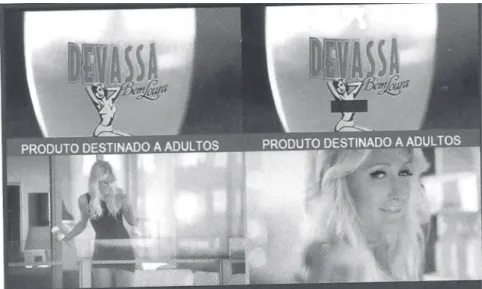
The use of photographs of young, thin, white women with a seminude body, exhibiting its curves, constitutes an advertising strategy for the promo-tion and sale of alcoholic beverages. Among the reports analyzed, one of them showed, through the images and text (Figure 1), the method adopted by a brewery in response to the censorship of one of its advertisements that used the seminude female body in a position suggestive of feminine sensuality, close to the name of the beer on a full cup of the beverage, followed by the image of a famous actress, with a body socially-recognized as beautiful and attractive. In re-sponse to the censorship, the company limited itself by placing a black strip over the breasts of the female figure, and, in place of the actress showing her entire body; only her face was shown, with a look and smile connoting provocation, seduction and availability.
By connecting the “young, white and thin,” seminude body of the woman with the consumption
Figure 1(7) – Use of the female image in advertisements for alcoholic
of beer, the media associates images that create ion the consumer the expectation of a sexual encounter with the female figure. In this sense, the female body is presented in a cosmeticized and fetishized manner, impregnated with erotic, seductive, sexual, sensory and sensual connotations. The desirable body is simultaneously a product and object of purchase and sale; that is, a body currency, and, in the same way, an instrument of production of feelings that is exposed as a movable display, instigating continuous reproduction in the other social subjects(8).
The media reinforces standards of beauty and disseminates the representation that confers vis-ibility to the woman based on her body, designed under the look of the other, that should be seduced and desired(9). Content with allusion to sexuality in
advertising are stimuli that capture the attention of the consumer. In this case, the drink and the woman are presented side by side as products to be equally consumed.
A study done on the representation of the female body in the media corroborates the idea that feminine seduction was transformed into a general process that tends to standardize consumption, with feminine beauty, sensuality and eroticism conceived of as infallible strategies for the conquest of the public’s attention (10). In this way, passivity,
sensual-ity, intellectual capacity and, above all, dependence on her body are the characteristics reaffirmed daily in the media as feminine(11).
Risks of consumption of controlled drugs for the body
In this category, the articles used photographs and texts that dealt with the negative effects caused by substances classified as controlled, specifically tobacco and alcohol.
On the issue of tobacco consumption, the ar-ticles covered the history of tobacco smoking, dam-ages to the beautiful and healthy body, prohibition of smoking in public places and tobacco use by famous people, who, conscious of the negative effects of this drug, try to hide their habit. Among the articles, one stood out that focused on how smoking is associated to the loss of beauty attributes, emphasizing that quitting smoking brings “[...] improved appearance of skin, hair, nails and teeth, the end of odor caused by tobacco, and favors closeness with people, includ-ing a partner, as well as protects against early aginclud-ing and the formation of wrinkles.”(12) In this report,
the cigarette was presented as a villain of feminine beauty, putting beauty before how its consumption negatively affects health, transmitting the idea that it is more important to have a beautiful body than a healthy one. Considered a huge public health prob-lem and the largest preventable cause of death in the world, smoking calls attention for the risks it poses to the health of first-hand and second-hand smokers, and is an important risk factor in the development of various diseases(13).
Although predominately consumed by men, studies point to the stabilization of smoking rates among this population, while smoking rates are growing among women, especially young women from low socioeconomic conditions. It is not by chance that the female population has been the preferential audience of smoking companies, which invest massive amounts of money into the produc-tion of brands that respond to the anxieties and social demands of the modern woman, associating cigarette smoking with concepts of independence, liberty, self-esteem and beauty, reinforcing aesthetic standards based on the slender body(14).
In light of the significant influence of smoking on public health, the need emerged for the creation of strategies to reduce and control tobacco consumption, such as the prohibition of advertisements and publicity by tobacco companies, restriction of consumption in public places such as bars and restaurants, and the spread of anti-smoking policies and strategies. Consequently, it is perceived that representation of the act of smoking has changed through time and in differ-ent societies. Before it was considered synonymous with elegance, status and power; today it is viewed as a bad habit that represents an aggression to the body, an imminent risk to health.
While social elements that reflect and influ-ence socially shared constructions and representa-tions, the mass communication channels exercise a persuasive role, spreading tendencies and strategies accepted in the social context of which they are a part. These days, the act of smoking is considered politically incorrect behavior, incompatible with feminine standards of beauty. In this perspective, the media constitutes an important vehicle in the dissemination of these new representations, using images from the female body.
among its repercussions, the occurrence of alco-holic anorexia.
The articles analyzed define alcoholic anorexia as a metabolic syndrome associated with extreme behaviors, which bring women to ingest alcohol as a substitute for daily meals. The development of this illness is pointed to as a consequence of frus-trations suffered, in addition to feelings of anxiety and inferiority due to the personal weakness of not being able to conform to the required aesthetic standards. In this way, the consumption of alcohol becomes an attempt to combat these symptoms and, at the same time, to attain the desired standards of beauty. This data signals the need to amplify investigations about the behavior of alcohol use and abuse among women.
A bibliographic study about chemical depen-dence – not only alcoholism – as comorbidity associ-ated with eating disorders, points to the existence of considerable variation in the results of the differ-ent research done on this theme. The authors bring studies that affirm that the simultaneous occurrence of these two disorders is very frequent in clinical practice, as much among young women dependent on alcohol and other drugs, as for young women with eating disorders, which causes the increased risk of clinical complications and even death(15).
The association between the abuse of alcohol and weight loss is possible(15). However, the
adop-tion of this practice may unleash alchol dependency, frequently associated with comorbidity in women, for example depression and other mental and eat-ing disorders(16).
The articles that discuss the risks of consum-ing alcoholic beverages, aimconsum-ing for weight loss, are based on testimonies by women that adopt such a technique and become alcoholic, and in a character from a soap opera aired by a television channel who experienced such a tragedy. Section and image from one of the articles are shown in Figure 2.
The adoption of apparently simple and acces-sible techniques produces a growing phenomenon of the cult of the body, in a way that there is no equivalence between body image spread by the media and the image of the majority of women.(18) The
dis-cordance between these images unleashes a cycle of eternal search for beauty, motivated by consumerism, so that it even directly affects the functioning of the body, causing physiological changes and even death. The social expectation that women are naturally docile, passive and fragile is associated to the
sociocul-tural role attributed to them of being mothers, wives, homemakers and family caregivers, contributing to the non-recognition of the possibility that this popula-tion group is involved with the phenomenon of drugs, and in this case, chemical dependency. Thus, women that join the universe of drugs constitute a socially occult group, and therefore are more vulnerable to social and health problems(15).
Further, physiological aspects presented in the scientific literature as feminine characteristics, for example the greater concentration of fat and lesser concentration of water in the body, determine a differentiated metabolism of the psychoactive substances in the female body. It is believed that these aspects make the female body more sensitive to the effects of psychoactive substances(16).
The search for the perfect body through controlled drugs
Contrary to the approach used for the con-sumption of alcoholic beverages and tobacco as a strategy for losing weight, the consumption of medicines was portrayed in the reports as a positive possibility for women unsatisfied with their weight and body image, highlighting the routine use of weight loss drugs.
The pretense of attaining the perfect body motivates women to write to the editors of the magazines in search of answers about the effects and results obtained with the use of medicines classified for weight loss. To respond to the ques-tions from the readers, the communication channels analyzed used interviews with health professionals in an attempt to raise awareness about the active ingredient and side effects from the weight loss drugs. These professionals also encourage the adoption of healthy lifestyle habits together with the use of medicines to attain the desired standard of beauty, as shown in Figure 3.
The idea of the perfect body touches upon the understanding of a “nonfat” body(8), apparently
health, voluntarily submitted to processes of disci-pline such as exercise, consumption of medicines and the adoption of treatments,(20) and even more
radical methods such as surgery(19).
monitoring by trained professionals. However, the approach adopted regarding the need for professional monitoring is weak, with the sensations being high-lighted of plenitude, happiness, pleasure, beauty, self-esteem, confidence and well being, that may be caused by the consumption of weight loss drugs.
The texts discretely highlight the adoption of continuous, healthy lifestyle habits for the mainte-nance of physical and mental well-being in conjunc-tion with the consumpconjunc-tion of medicines. The practice of physical exercise and consumption of healthy foods for daily meals are encouraged, including sug-gestions for recipes that favor the conquest of results considered to be correct. Therefore the possibility of efficient action by the medicine to attain the perfect body is emphasized, and can lead the reader to devalue the importance of adopting new habits.
Considering the attainment of the means of mass communication and access of women to spe-cialized services for monitoring the processes of weight loss, it may be affirmed that the approach used by the former stimulates the consumption of medicines by women in search of the perfect body. It can be assumed that there are many more women seeking to lose weight alone than those whose economic conditions permit access to a specialized health professional.
In this sense, we highlight the importance of nursing work in the scope of prevention of women’s’ health problems resulting from the abusive use of
drugs, primarily controlled ones. Educational inter-ventions should be valued in a way that permits the discussion of the influence of communication chan-nels in the reproduction of stereotypical standards of beauty that can be dangerous to the maintenance of the health of women. Additionally, the adoption of approaches to gender in the formation of nurses must be discussed in a way that attends to the speci-ficities of the attention to the health of the women.
This study will make it possible for health pro-fessionals, especially nurses, to critically reflect on the influence of the media in the construction and reproduction of trends, each of which model the social context, defining modes of living and influencing the process of health/disease in populations. To under-stand and critically reflect on the relationship between media and society will facilitate the reorientation of actions of health and the implementation of policies compatible with the needs of social groups.
CONCLUSIONS
The three themes identified highlight ques-tions about consumption of psychoactive sub-stances and their consequences for women in their attempt to attain the perfect body, and meet socially established standards.
and culturally-established standards of beauty. The data further shows the role of the media in the re-production and dissemination of information that establish standards of behavior, life and health of people, especially in the female population.
The content analyzed showed that the media encourages the consumption of weight loss sub-stances while denouncing alcoholic anorexia linked to feminine alcoholism, and incites the inhibition of tobacco use by women as a strategy to attain aesthetic standards. The image of young, white, thin women in sensual positions is used to awaken masculine sexuality and stimulate the consumption of alcoholic beverages by men. At the same time, the media criticizes the use of female images in advertisements developed by beer companies.
In light of the data presented, it is concluded that the media reproduces the idea that women should be beautiful and attractive, in order to be-come visible in the social context. To be beautiful means to be seen, recognized in the social setting, and this confers self-confidence, power and status to women. In the feminine universe, such sentiments constitute factors intimately related to health and well-being, thus determining social repercussions for the health of this population group.
Beauty is situated as a question of choice, will and personal effort, a criteria that needs to be attained by all, as an attribute of the modern, eman-cipated, independent woman. Women that do not meet such criteria are socially perceived as weak, which can lead to feelings of inferiority and inca-pacity, which are related to psychiatric morbidities.
Advertising exploits socially accepted con-cepts, which demarcate aesthetic differences be-tween men and women, in order to seek success of their brands by incentivizing consumption,
and consequently obtaining profits. Thus, the ap-pellation of the erotic imagination exists, with the reproduction of essentially sensual women, which should instigate in the man the desire for the consumption of alcoholic beverages, using the incentive of sexual desire for their bodies.
The magazines researched reproduce stereo-typed images about the woman and her body, limit her importance and social use to the functions of low recognition, restricted to the family environ-ment and sex. In opposition, the uniqueness and intellectual potentiality of women are unappreci-ated, leading people to adopt concepts that they equal in these functions and feed the existence of a necessary feminine subjection and supposed masculine superiority.
REFERENCES
1 França, FF, Felipe DA, Calsa GC. Gênero, sexualida-de e meios sexualida-de comunicação: uma abordagem crítica desses conceitos na educação. Rev Cesumar - Ciências Humanas e Sociais Aplicadas jan./jun.2008, v. 13, n. 1, p. 37-53. Disponível em: http://www.cesumar.br/ pesquisa/periodicos/index.php/revcesumar/article/ viewFile/681/549.
2 Siqueira DCO, Faria AA. Corpo, saúde e beleza: representações sociais nas revistas femininas. Rev Comunicação, Mídia e Consumo [Internet]. 2007 mar [citado 2012 Mai 12]; 4(9): 171-88. Dispo-nível em: http://www.revistas.univerciencia.org/ index.php/comunicacaomidiaeconsumo/article/ view/5032/4656.
3 Sauerbronn JFR, Tonini KAD, Lodi MDF. Um es-tudo sobre os significados de consumo associados ao corpo feminino em peças publicitárias de suple-Figure 3 (19) – Consumption of weight loss medicines.
mentos alimentares. Rev. eletrôn. adm. [Internet]. 2011 Jan-abr [citado 2012 nov 09]; 17(1): 01-25. Disponível em: http://dx.doi.org/10.1590/S1413-23112011000100001.
4 Novaes JV. Ser mulher, ser feia, ser excluída. Psico-logia Com Pt [Internet]. Lisboa –Portugal; 2005 [citado 2011 out 12]. Disponível em: http://www. psicologia.pt/artigos/textos/A0237.pdf.
5 United Nations Publication. World Drug Report [Inter-net]. 2007 [citado 2007 jul 27]. Disponível em: http:// www.unodc.org/unodc/ world drug report.html.
6 Bardin L. Análise de conteúdo. 5ª ed. Lisboa: Edições 70; 2009.
7 Cavalcanti B. Cerveja Devassa sob censura. Revista Isto É, A Semana. 2010 mar 10; ed 2104:27.
8 Fontes M. Os percursos do corpo na cultura contempo-rânea. In: Couto ES, Goellner SV, organizadores. Corpos mutantes: ensaios sobre novas (d)eficiências corporais. Porto Alegre: UFRGS Editora; 2007. p 73-87.
9 Matos AA, Lopes MF. Corpo e gênero: uma análise da revista TRIP para a mulher. Rev Estud Fem [In-ternet]. 2008 jan-abr [citado 2009 mar 18];16(1):61-76. Disponível em: http://www.scielo.br/pdf/ref/ v16n1/a05v16n1.pdf.
10 Samarão LA. O espetáculo da publicidade: a represen-tação do corpo feminino na mídia. Rev Contemporâ-nea [Internet]. 2007 [citado 2011 dez 01];(8):45-57. Disponível em: http://www.contemporanea.uerj.br/ pdf/ed_08/04LILIANY.pdf.
11 Melo CM, Oliveira DR. O uso de inibidores de apetite por mulheres: um olhar a partir da perspectiva de gênero. Ciênc Saúde Coletiva [Internet]. 2011 maio [citado 2011 dez 01]; 16(5):2523-32. Disponível em: http://www.scielo.br/pdf/csc/v16n5/a22v16n5.pdf.
12 Leal I, Rafanini AP. 8 motivos para você parar de fumar já sem engordar 1 grama. Rev Boa Forma, Saúde. 2010 mar;ed 277:100-2.
13 Öberg M, Jaakkola MS, Woodwardc A, Peruga A, Prüss-Ustün A. Worldwide burden of disease from exposure to second-hand smoke: a retros-pective analysis of data from 192 countries. The Lancet [Internet]. 2010 Nov 26 [cited 2011 jan 8]; 377:139-46. Available from: http://www.who.int/ quantifying_ehimpacts/publications/smoking.pdf.
14 Borges MTT, Barbosa RHS. As marcas de gênero no fumar feminino: uma aproximação sociológica do tabagismo em mulheres. Cienc Saude Coletiva [Internet]. 2009 jul-ago [citado 2011 nov 13]; 14(4):1129-39. Disponível em: http://www.scielosp. org/pdf/csc/v14n4/a14v14n4.pdf.
15 Brasiliano S, Hochgraf PB. Comorbidade com transtornos alimentares. In: Seibel SD, organizador. Dependência de drogas. 2ª ed. São Paulo (SP): Athe-neu; 2010. p. 727-47.
16 Elbreder MF, Laranjeira R, Siqueira MM, Barbosa DA. Perfil de mulheres usuárias de álcool em ambu-latório especializado em dependência química. J Bras Psiquiatr. 2008;57(1):9-15. Disponível em: http:// www.scielo.br/pdf/jbpsiq/v57n1/v57n1a03.pdf.
17 Di Domenico M. Fórmula mágica não existe. Rev Boa forma, Saúde. 2009 dez; ed 273:76-109.
18 Ribeiro RG, Silva KS, Kruse MHL. O corpo ideal: a pedagogia da mídia. Rev Gaucha Enferm [Internet]. 2009 mar [citado 2012 jan 7];30(1):71-6. Disponível em: http://www.lume.ufrgs.br/bitstream/hand-le/10183/23620/000702932.pdf ?sequence=1.
19 Souza MRR. O fenômeno das drogas e as repercus-sões sociais para a saúde das mulheres em revistas brasileiras. [trabalho de conclusão de curso] Salva-dor: Escola de Enfermagem da Universidade Federal da Bahia; 2010.
20 Goetz ER, Camargo BV, Bertoldo RB, Justo AM. Representação social do corpo na mídia impres-sa. Psicol Soc [Internet]. 2008 [acesso 2010 jun 20];20(2):226-36. Disponível em: http://www.scielo. br/pdf/psoc/v20n2/a10v20n2.pdf.
Author’s address / Endereço do autor / Dirección del autor
Márcia Rebeca Rocha de Souza
Ladeira do Campo Santo, 52, ap. 25, Federação 40210-320, Salvador, BA
E-mail: [email protected]