Corresponding Author: Adrián Poblano
Calzada México-Xochimilco 289. Col. Arenal Guadalupe.
Deleg. Tlalpan, cp 14389. Mexico City, Mexico E-mail: [email protected]
2010 Sept-Oct;18(5):998-1004
www.eerp.usp.br/rlae
Risk Factor Frequency for Learning Disabilities in Low Socioeconomic
Level Preschool Children in Mexico City
Elizabeth Zambrano-Sánchez
1María del Consuelo Martínez-Wbaldo
2Adrián Poblano
3The objective was to identify the frequency of risk factors for Learning Disabilities (LD) in
low socioeconomic level children in Mexico City. We studied children by means of: Wechsler,
Bender-Gestalt, and Human drawing tests. Average age of male subjects was 5.6±0.9
years, while that of the female group was 5.4±0.5 years. In male subjects, average Total
intelligence quotient (T-IQ) score was 98±12.2 while, in the female group, this was 99±12.2.
On the Bender-Gestalt test, male subjects had a mental and visual-motor average age of
<1 year under chronological age. Female subjects had a mental and visual-motor age 8-7
months under the norm. On the Human drawing test, in male and female subjects, the most
frequent at-risk features comprised: self-isolation in 25% of subjects, shyness in 22.4%,
and poor internal controls in 22%. In conclusion, we found a high at-risk factor frequency
for LD in children of low socioeconomic strata. We highlight the importance of screening
children before they attain school age.
Descriptors: Learning Disorders; Child, Preschool; Intelligence; Human Development; Risk
Factors.
1 BSc, Department of Epidemiology, National Institute of Rehabilitation (NIR), Mexico City OJO, Mexico. E-mail:
2 M.Sc., Department of Epidemiology, National Institute of Rehabilitation (NIR), Mexico City OJO, Mexico. E-mail:
3 DSc, Laboratory of Cognitive Neurophysiology, National Institute of Rehabilitation (NIR), Mexico City OJO, Mexico. School of Nurses,
Frequência de fatores de risco para diiculdade de aprendizagem em
pré-escolares com baixo nível socioeconômico, na Cidade do México
Este estudo objetivou identiicar a frequência de fatores de risco para diiculdade de aprendizagem (DA) em crianças com baixo nível socioeconômico, na Cidade do México. A escala de inteligência Wechsler, desenho da igura humana e o teste gestáltico visomotor de Bender foram utilizados. A idade média do grupo masculino foi de 5,6±0,9 anos
e do grupo feminino 5,4±0,5 anos. O quociente intelectual total (QI-T) foi de 98±12
no grupo masculino e 99±12,2 no grupo feminino. No teste de Bender, os meninos
apresentaram idade mental e visomotora um ano abaixo da idade cronológica, enquanto
que as meninas apresentaram idade mental e visomotora 7-8 meses abaixo do normal. As características de alto risco que apresentaram maior frequência, tanto nos meninos como nas meninas, no teste do desenho de igura humana, foram: autoisolamento 25%, timidez 22,4 e controle interno deiciente 22%. Concluindo, alta frequência de fatores de risco para DA foi encontrada em crianças de baixo nível socioeconômico. É importante destacar a importância de se identiicar pré-escolares em risco de DA.
Descritores: Transtornos de Aprendizagem; Pré-escolar; Inteligência; Desenvolvimento Humano; Fatores de Risco.
Frecuencia de factores de riesgo para problemas de aprendizaje en preescolares de bajo nivel socioeconómico en la Ciudad de México
Nuestro objetivo fue identiicar la frecuencia de factores de riesgo para problemas de aprendizaje (PA) en niños de bajo nivel socioeconómico de la Ciudad de México. Se
utilizaron las pruebas de inteligencia de Wechsler, Gestáltica Visuomotora de Bender y del Dibujo de la igura humana. La edad promedio en el grupo masculino fue 5,6±0,9 años, del femenino fue 5,4±0,5. En los hombres, el cociente intelectual total (CI-T) fue
98±12,2, en mujeres fue 99±12,2. En la prueba de Bender, los hombres mostraron
una edad mental y visuomotora un año menor que la cronológica, las mujeres tuvieron
una edad mental y visuomotora 7-8 meses por debajo de la norma. En la Prueba de la igura humana, los hombres y mujeres mostraron mayor frecuencia de: auto-aislamiento 25%, timidez 22,4% y controles internos pobres 22%. En conclusión encontramos una
alta frecuencia de factores de riesgo en preescolares de bajo nivel socioeconómico, destacamos la importancia de identiicar a los preescolares propensos a tener problemas de aprendizaje (PA).
Descriptores: Trastornos del Aprendizaje; Preescolar; Inteligencia; Desarrollo Humano;
Factores de Riesgo.
Introduction
The age between 4 and 6 years is a critical period
for emotional and cognitive development in children(1).
The families of these children push them to establish
more social contacts with their peers. In Mexico, it is
mandatory for children at these ages to attend
pre-school education.
Many papers highlight the importance of early
detection of risk factors for Learning disabilities (LD), such
as emotional and cognitive alterations during this period
in the life of the child. One useful strategy is to screen
neuropsychological performance in order to identify the
children’s abilities and reinforce their weaknesses so as
to ensure better academic performance(2-3).
Different investigations emphasize the importance of
language acquisition as one of the main factors for reading
identify children with reading disability with antecedents
of language delay during their development. On the
other hand, children with a language disorder frequently
develop a reading alteration later, when they reach
school age(5-6). In a previous paper, we identiied the main
risk factors for LD in an outpatient population seeking
consultation at the National Institute of Communication
Disorders in Mexico City, in which we observed that
malnutrition, antecedents of language disorder, perinatal
risk factors and presence of neurologic soft signs were
the main variables associated with reading disability(6).
Early detection of children with LD enables
health professionals, including nurses, to identify and
refer these groups of at-risk children to intervention
programs. To accomplish this objective, we are able to
utilize standardized psychometric examinations, such as
the Wechsler intelligence scale for pre-school and school
children (WIPPSI), the Bender visual-motor Gestalt test, and the Human igure drawing examination.
At present, there are few studies on early detection
of LD in preschool children in Mexico. LD prevalence in
Mexican children is unknown(7). Lower socioeconomic
groups may have a higher prevalence of mental
alterations and their risk factors may be more frequently
observed than in higher socioeconomic groups. Thus,
early detection of LD emerges as a rational strategy
for rapid attention to academic problems in lower
socioeconomic level groups.
This research aimed to identify the frequency of
emotional risk factors for LD in a representative sample
of children from the lower socioeconomic strata at Infant
Developmental Centers in Mexico City. In addition, we
studied emotional and cognitive features examined
by means of WPPSI, Bender visual-motor Gestalt and
Human drawing tests.
Materials and Methods
Subjects
We designed a cross-sectional study to detect
frequency of risk factors for LD in a sample of preschool
children in Mexico City. Children were selected from
populations attending eight Centers of Development
for Infants (CENDI) funded by the Federal District
Government; the children were representative of the low
socioeconomic strata. One hundred sixty-two children
were selected at random from a generated list, using
statistical software. Inclusion criteria were as follows:
subjects of both genders; ages between 4 and 6 years;
regular attendance of a CENDI, and with adequate
hearing and collaborative behavior. Exclusion criteria
comprised: external congenital malformations, genetic diseases, severe chronic diseases, cerebral palsy,
deafness, blindness and epilepsy. Parents and children were informed about the purposes and beneits of the research and the importance of their child’s participation.
Informed and signed consent was required according to the Institute’s Research Committee and the Helsinki
Declaration(8). Approval of the protocol was obtained
from the Institute’s Research Committee.
Procedures
We performed individual examinations and
tested three subjects per day at CENDI installations in a separate noise-isolated room. We employed three
psychometric tests: 1. Wechsler intelligence scale reviewed for preschool children (WPPSI); 2. Bender visual-motor Gestalt test, and 3. Human igure drawing test. Examination of each subject was performed during two two-hour sessions. In the irst session, Human igure drawing and Bender visual-motor Gestalt tests were applied, while the WPPSI was conducted during a second appointment.
The WPPSI-Spanish version consists of a test of two
sub-scales that can be combined to determine a total Intelligence Quotient (IQ) score that measures general
intelligence performance. The two sub-scales include the following: verbal, and performance intelligence sections.
The verbal intelligence quotient (V-IQ) scale was divided into: information management, vocabulary, arithmetic,
resemblances and comprehension. The performance intelligence quotient (P-IQ) scale was divided into: animal house, incomplete igures, labyrinths, geometric designs and prism designs. Each sub-scale was considered independent and data from each sub-scale
was compared with data from the reference table for each V-IQ, for each P-IQ score calculation, and for total IQ score calculation. Total IQ scores were classiied in the following seven levels: ≥130, very superior; 120-129, superior; 110-119, normal-brilliant; 90-109, normal; 80-89, normal-awkward; 70-79, borderline; and ≤69, mental retardation.
The Bender visual-motor Gestalt test permitted us
to examine visual-motor performance in order to detect
dysfunction in both areas. This test was used because there is a close relationship between visual-motor performance
and other functions, such as spatial memory, visual perception, motor coordination and the need to learn to
read. Visual-motor performance results from integrative brain activity with regard to the input-output of the brain
Zambrano-Sánchez E, Martínez-Wbaldo MC, Poblano A.
The Human igure drawing test was employed to measure mental maturation and certain personality
features. In this test, the structure and design of the
children’s drawing are determined by age and maturation
level. When a drawing’s features were examined, we
weighed the value of association of functions, analytic
observation, discrimination, memory for details, spatial
reasoning, judgment, abstraction and visual-motor
coordination. This test was also employed to ascertain
emotional personality features.
Data analysis
Total child population of the eight CENDIs was
933 subjects; we chose 162 children of both genders
at random, as previously described. Sample size was
calculated with 95% statistical power to observe the
independent variable, with 5% of error, by means of
the STAT® software program. We measured mean and
standard deviation (SD) of continuous variables and
percentages in binomial variables. Continuous variable
differences were compared by Student’s t test, and
differences in binomial variables were compared by the
X2 test. Afterwards, we calculated correlation coeficients
among psychometric data by means of Spearman’s
method. The a-priori accepted alpha was ≤0.05(9).
Results
Average age was 5.9 ± 0.5 years. Gender distribution
of the sample was as follows: 54% males and 46% females.
Average age of male subjects was 5.6 ± 0.9 years, and
average age in the female group was 5.4 ± 0.5 years. Age
distribution was as follows: 30.7% were 4 years; 32.6%
were 5 years, and 36.3% were 6 years of age. Distribution
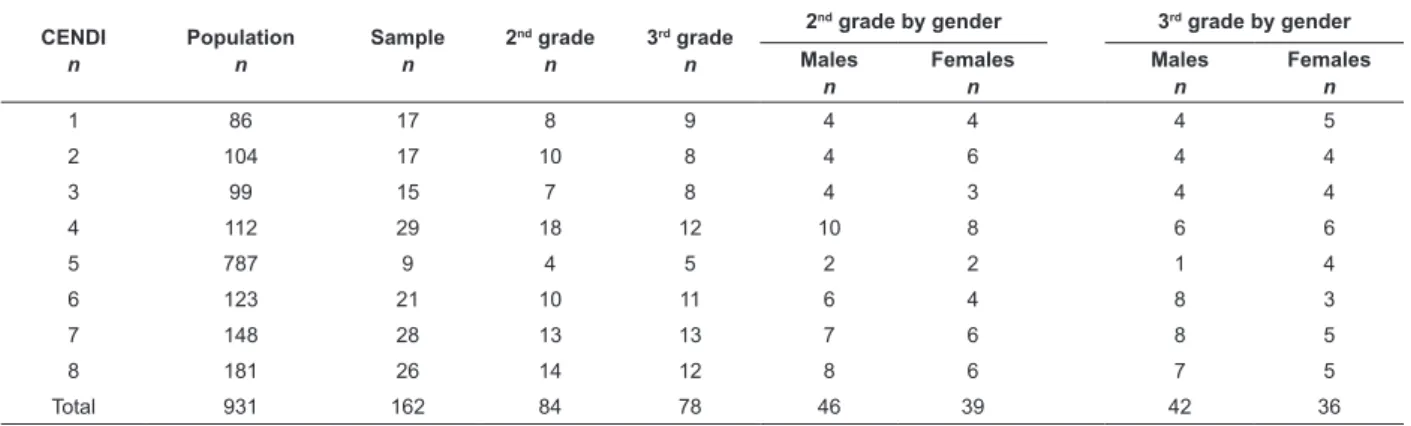
by CENDI and age are shown in Table 1.
Table 1 - Sample distribution by school, grade and gender
CENDI
n
Population
n
Sample
n
2nd grade n
3rd grade n
2nd grade by gender 3rd grade by gender
Males
n
Females
n
Males
n
Females
n
1 86 17 8 9 4 4 4 5
2 104 17 10 8 4 6 4 4
3 99 15 7 8 4 3 4 4
4 112 29 18 12 10 8 6 6
5 787 9 4 5 2 2 1 4
6 123 21 10 11 6 4 8 3
7 148 28 13 13 7 6 8 5
8 181 26 14 12 8 6 7 5
Total 931 162 84 78 46 39 42 36
Federal District (Mexico City)-run Infant Development Center (CENDI). Columns 4-9 indicate the preschool grade in which children were studied
WPPSI
In both genders, we observed a major percentage
of normal results (56% in males and 60% in females,
respectively). In the normal-brilliant group, 18.7%
subjects were male and 10% female while, in the
normal-awkward group, 14.06 % were male and 20%
female.
Average total IQ score in the entire sample was
99±12.9, average P-IQ score was 99±14.9, and average
V-IQ score 93±11.7, all of which correspond to normal
average intelligence. In the group of male subjects,
average total IQ score was 98±12.2, average P-IQ score
was 94±12.4, and average V-IQ score was 99±15.7,
corresponding to normal intelligence. In the group of
female subjects, average total IQ score was 99±12.2,
average P-IQ score was 106±14.6, and average V-IQ
score was 101±15.7, also corresponding to normal
intelligence (see Table 2).
Table 2 - Distribution of Intelligence quotient (IQ) and
gender
IQ score Classification % males % females
≥130 Very superior 0 0
120-129 Superior 4.6 2.5
110-119 Normal-brilliant 18.7 10
90-109 Normal 56.2 60
80-89 Normal-awkward 14.06 20
70-79 Borderline 4.6 5
≤78 Mental retardation 1.5 2.5
IQ = Intelligence quotient range ; % = percentage
Bender Visual-motor Gestalt Test
Average mental age for both genders was 5.0±0.5
years, 9 months under the chronological age norm.
Average visual-motor age was 4.8±0.5 years, 11 months
analyses showed that male subjects had a mental age
average of 4.9±0.5 years, 1 year under chronologic
age, and that average visual-motor age was 4.6±0.5
years, 1 year and 3 months less than that expected by
chronological age. Female subjects had a mental age
average of 5.1±0.5 years, 8 months under that expected
by the norm, and the female subjects’ visual-motor age
average was 5.2±0.4 years, 7 months under the norm
(see Table 3).
Table 3 - Results of the Bender-Gestalt test across the
sample
Age type (years) X SD
Chronological 5.9 0.6
Mental 5.0 0.5
Visual-motor 4.8 0.5
X=average; SD=Standard deviation
Human Figure Drawing Test
The features most frequently associated with risk
factors for LD in male subjects were the following:
self-isolation, 25%; shyness, 22.4%; poor internal control,
22%; feelings of non-adaptation, 17.6%; poor
self-concept, 16.5%; insecurity, 15.3%, and impulsivity,
14.1%.
In female subjects, the most frequent LD-associated
risk factors comprised: self-isolation in 36%; shyness
in 29.8%; poor internal control in 27.2%; insecurity
in 18.5%; feelings of non-adaptation in 14.2%, and
impulsivity in 12.9% (see Figure 1).
0 5 10 15 20 25 30 35 40 S e lf-is o la tio n S h y n e s s P o o r in te rn a l c o n tr o l F e lli n g o f n o n -a d a p ta tio n In s e c u ri ty Im p u ls iv ity P o o r s e lf-c o n c e p t Males Females
Figure 1 - Frequency of emotional risk factors in
asymptomatic and healthy preschool children in the
sample
Signiicant correlations
We found signiicant correlations in male subjects between total IQ and V-IQ (0.65, p=0.05) and with P-IQ
(0.65, p=0.05). In female subjects, we found a signiicant
correlation between total IQ and V-IQ (0.77, p=0.04).
In the entire sample (male and female subjects), we found a signiicant correlation between mental age and visual-motor age on the Bender visual-motor Gestalt
test (0.89, p=0.02).
Discussion
Through this investigation, we found that a signiicant percentage of asymptomatic and intelligent preschool-aged children from low socioeconomic strata
are at risk for LD. The more frequent risk factors detected
in this study were the following: visual-motor immaturity,
shyness and poor internal controls. These data support
the idea that a large percentage of preschool children
in Mexico City (12-36%) have cognitive and emotional
sub-clinical alterations, which can disturb their academic
performance later(10). The majority of these children are
not detected previously as having these troubles; thus,
they do not receive treatment and special care at school
or in extra-curricular sessions; the at-risk condition
is worse in children from a poor and non-stimulating
socioeconomic stratum(11-12).
There are several investigations that emphasize the
role of intelligence in the acquisition of complex cognitive
abilities like reading and writing(13-14). Resolution of
complex problems requires learning to read and write,
which demand a high degree of intellectual work.
Therefore, IQ score results falling within adequate
ranges promote good academic learning. Fortunately,
we did not observe a high frequency of low IQ scores; this inding can be explained by the fact that the number of cases studied is low, and that CENDI school principals
and teachers preferably recruit children without
developmental abnormalities.
Visual perception disorders comprise another
chapter of primary importance in LD research. In a
classical study performed by the team of Maslow and Frostig in preschool and children in their irst year at elementary school, the authors found a signiicant correlation between visual perception deicits and the presence of learning and behavioral disorders(15).
Recently, researchers found that students with emotional
disorders in elementary school exhibited increased
Zambrano-Sánchez E, Martínez-Wbaldo MC, Poblano A.
cognitive deicits in memory, language, attention, social relationships, and in emotional disorders(16). Our data
are in agreement with these, because we found a high
frequency of visual-motor alterations, which placed our
preschool children at high risk for academic failure. The frequency of ine motor and motor coordination alterations has been mentioned as a possible cause of speciic learning disabilities(17). Many investigators have
found that children with reading disorders possess deicits when facing ine motor and bimanual coordination tasks and when these results are compared with those of a
control group(18-19), as we observed in our sample.
Recently, certain researchers have cited the role
of inter-callosum transference in the visual-spatial
information processing of children with dyslexia, which
is an interesting hypothesis and deserves additional
attention(20). This observation could support our inding
that the high frequency of visual-spatial alterations in
our preschool children is due to transient trans-callosal
dysfunction, and continued follow-up is needed in
children to weigh the role of the Corpus callosum in the
development of LD in reading and writing.
Mental disorders display an increased frequency
in children with LD. In Mexico, authors found a high
prevalence of mental disorders (13%) among children
from elementary schools in Mexico City who were tested
by the Reporting Questionnaire for Children(21). The results
of these authors are in partial agreement with our results,
but we found a lower frequency of mental disorders
than their observations. Possible explanations for these
differences could be that our children were examined at a
younger age, when mental disorder prevalence is lower,
and that different test instruments were used.
With respect to the literature on the previously
referred subject, we are able to state that
preschool-aged children are at a good age to be screened for
mental and cognitive disorders, which can alter learning
to read and write. The majority of children who exhibited
cognitive and emotional disorders in our sample had
mild alterations, and cannot be assigned a diagnosis
of a mental disorder, such as mental retardation, Attention deicit-hyperactivity disorder (ADHD), autism or language disorders. However, our data suggest that a
high percentage of preschool children are at high risk of
developing a learning disability later. Thus, we recommend
universal screening for mental and cognitive disorders at
preschool age, prior to the time when children suffer
academic failure in elementary school, so as to prevent
and treat children before they enter primary school and
to ensure their academic development.
References
1. Poblano A, Fukumoto-Okamoto LE, Silva-Valencia MJ, Martínez-Wbaldo MC. Graphems development in preschool children (in Spanish). Pedagogia. 1996;11(6):36-41.
2. Sprafkin J, Volpe RJ, Gadow KD, Nolan EE, Kelly K. A DSM-IV-referenced screening instrument for preschool children: the early childhood inventory-4. J Am Acad Child Adolesc Psychiatry. 2002;41(5):604-12.
3. Poblano A, Romero E. ECI-4 screening of attention deficit-hyperactivity disorder and co-morbidity in Mexican preschool children. Preliminary results. Arq Neuropsiquiatr. 2006;64(4):932-6.
4. Rosselli M, Matute E, Ardila A. Neuropsychological predictors of reading ability in Spanish (in Spanish). Rev Neurol. 2006(4);42:202-10.
5. Poblano A, Valadez-Tepec T, Arias ML, García-Pedroza F. Phonological and visuo-spatial working memory alterations in dyslexic children. Arch Med Res. 2000;31(5):493-6.
6. Poblano A, Borja S, Elías Y, García-Pedroza F, Arias ML. Characteristics of specific reading disability in children from a neuropsychological clinic in Mexico City. Salud Publica Mex. 2002;44(4):323-7.
7. Fletcher TV, López-Klinger KC. A Mexican perspective on learning disabilities. J Learn Disab. 1995;28(Special issue):530-4,544.
8. World Medical Association Inc. Declaration of Helsinki. Ethical principles for medical research involving human subjects. J Indian Med Assoc. 2009;107(6):403-5.
9. Fuentes M. Statistical issues in health impact assessment at the state and local levels. Air Qual Atmos Health. 2009:2(1):47-55.
10. de la Peña F, Estrada A, Almeida L, Páez F. Prevalence of depressive disorders and their relationship with low academic performance in students of secondary school (in Spanish). Salud Mental (Mexico). 1999;22(4):9-13.
11. Braga MR, Avila LA. Detection of pervasive disorders in the child: a maternal perspective (in Portugues). Rev. Latino-Am. Enfermagem. 2004; 12(6):884-9.
12. Santa Maria-Menger MR, Martins Linhares MB. Risk factors for infant developmental problemas. Rev. Latino-Am. Enfermagem. 2007;15(Special issue ):837-42.
13. Sastre-Riba S. High-ability children and their differential cognitive functioning (in Spanish). Rev Neurol. 2008;46(Suppl 1): s11-s16.
14. Lundberg I. Early precursors and enabling skills of reading acquisition. Scand J Psychol. 2009; 50(6):611-6.
16. Bögels SM, Zigterman D. Disfunctional cognition in children with social phobia, separation anxiety disorder, and generalized anxiety disorder. J Abnorm Child Psychol. 2000;28(2):205-11. 17. Nicolson RI, Fawcett AJ, Berry EL, Jenkins H, Dean P, Brooks DJ. Association of abnormal cerebellar activation with motor learning difficulties in dyslexic adults. Lancet. 1999; 353(9165):1662-7.
18. Poblano A, Ishiwara K, Arias ML, García-Pedroza F, Marín H, Trujillo M. Motor control alteration in posturography in learning disabled children. Arch Med Res. 2002;33(5):485-8.
19. Crawford SG, Dewey D. Co-occurring disorders: a possible key to visual perceptual deficits in children with developmental coordination disorder? Hum Mov Sci. 2008;27(1):154-69. 20. Babzakova-Trajkov G, Hamm JP, Waldie KE. The effects of redundant stimuli on visuo-spatial processing in developmental dyslexia. Neuropsychologia. 2005;43(3):473-8.
21. Rico H, Magis C, Guerrero MG, Gómez M, Ruiz CT, Vargas O, Silva JS. Frequency of mental disorders in first year of primary school children (in Spanish). Salud Mental (Mexico). 1998; 21(4):12-8.
Received: Jun. 3rd 2009