(1) Faculdade de Filoso ia e Ciências da Universidade Estadual Paulista, UNESP, Marília, SP, Brasil.
Source of assistance: Capes
This work was presented in poster format at the 6º “Encontro Multidisciplinar dos Transtornos da Aprendizagem e Transtornos da Atenção” – Marília – SP, and received award of best work in this category.
Conlict of interest: non-existent
Comparison of reading of school-age children who stutter
in two listening situations: usual and delayed
Comparação da leitura de escolares com gagueira
em duas condições de escuta: habitual e atrasada
Paula Bianca Meireles de Moura Buzzeti(1) Michele Fiorin(1) Natália Lira Martinelli(1) Ana Cláudia Vieira Cardoso(1) Cristiane Moço Canhetti de Oliveira(1)
Received on: September 14, 2015 Accepted on: October 29, 2015
Mailing address:
Cristiane Moço Canhetti de Oliveira Av. Hygino Muzzi Filho, 737, Vila Universitária
Marília – SP – Brasil CEP: 17525-000
E-mail: [email protected]
doi: 10.1590/1982-0216201618114015
ABSTRACT
Purpose: to compare the immediate effects of delayed auditory feedback in the oral reading task in
school-age children with persistent developmental stuttering.
Methods: this study was approved by the Institutional Ethics Committee (n° 0714/2013). Participated 16
school-children aged 8-17 years, 11 males and 5 females, divided into two experimental groups (EG1 and EG2) of 8 participants each; the EG1 composed of participants with moderate stuttering and EG2 with severe or very severe stuttering. The procedures used were audiologic evaluation, luency assessment in spontaneous speech and evaluation of oral reading luency in two listening situations: with Normal Auditory Feedback - NAF and Delayed - DAF. The Fono Tools software along with Andrea PureAudio USB -AS adapter and headset microphone Karsect HT- 2 were used to cause the effect of the DAF and record speech.
Results: the effect of delayed auditory feedback led to reduction of stuttering-like disluencies in both
groups, but the frequency of other disluencies increased in moderate stuttering group and decreased in the group with severe / very severe stuttering and thus, total disluencies showed a more signiicant decre-ase in EG2. There were statistically signiicant differences for the oral reading only in intergroup compa-rison for the stuttering-like disluencies, at usual auditory feedback situation. Conclusions: the delayed
auditory feedback did not cause signiicant effects during the oral reading in both groups, however there is a tendency of the effect be considered positive for the group with severe / very severe stuttering.
Keywords: Speech, Language and Hearing Sciences; Speech Disorders; Reading; Stuttering; Feedback
RESUMO
Objetivo: comparar os efeitos imediatos do atraso na retroalimentação auditiva na tarefa de leitura oral
em escolares com gagueira do desenvolvimento persistente.
Métodos: estudo aprovado pelo Comitê de Ética da Instituição (n°0714/2013). Participaram 16
esco-lares, com idade de 8 a 17 anos, sendo 11 do gênero masculino e 5 do feminino, separados em dois Grupos Experimentais (GE1 e GE2) de 8 participantes cada; o GE1 composto de participantes com gagueira moderada e o GE2 com gagueira grave ou muito grave. Os procedimentos utilizados foram: avaliação audiológica, avaliação da luência na fala espontânea e avaliação da luência na leitura oral em duas condições de escuta: com Retroalimentação Auditiva Habitual – RAH e atrasada – RAA. O software
Fono Tools junto com o Adaptador Andrea PureAudio USB-AS e microfone auricular Karsect HT-2 foram
utilizados para provocar o efeito da RAA e gravar a fala.
Resultados: o efeito da retroalimentação auditiva atrasada ocasionou redução das disluências típicas
da gagueira em ambos os grupos, porém a frequência de outras disluências aumentou no grupo de gagueira moderada e diminuiu no grupo com gagueira grave/muito grave e, desta forma, o total de dislu-ências apresentou uma diminuição mais signiicativa no GE2. A diferença foi estatisticamente signiicante apenas na comparação intergrupos das disluências típicas da gagueira, na situação de retroalimentação auditiva habitual. Conclusões: o atraso na retroalimentação auditiva não ocasionou efeitos signiicantes
na leitura em ambos os grupos, entretanto há uma tendência do efeito ser considerado positivo para o grupo com gagueira grave/muito grave.
Descritores: Fonoaudiologia; Distúrbios da Fala; Leitura; Gagueira; Retroalimentação
Original articles
INTRODUCTION
Stuttering is a complex luency disorder charac-terized by excessive interruptions during linguistic
formulation1-3. Muscle tension4 during speech
production, affects smoothness5 and speech rate6. Stuttering often begins in childhood (developmental
stuttering) and can persist into adulthood7. The
presence of stuttering-like disluencies1,2 is the main manifestation of the disorder. The main types of stuttering-like disluences comprise word repetition - more than 3, part of word repetition, sound repetition, block, prolongation, pauses and intrusions.
Reading luency is related to decoding and under-standing, in a way that the slower word processing interferes on reading automaticity, and hence on the comprehension8. Therefore, the luent reader is more likely to achieve better performance in understanding a text9, while miscommunication might inluence negative attitudes of students towards their own speech10 and as a result, reducing participation in oral reading activities, impairing the development of this skill.
An important tool used by speakers to maintain luency during oral task is the auditory feedback of the continuous low of speech11. The advent of technology has promoted an increase in researches that can help the intervention in stuttering therapy, for example, the use the altered auditory feedback12.
The positive effects in the speech of people who stutter in different auditory feedback conditions suggested the possibility of a signiicant auditory component in the complex manifestation of stuttering13. Fluency in people who stutter can be improved by changing the auditory feedback14.
One of the altered auditory feedback that led to an increase in luency of people who stutter, is the Delayed Auditory Feedback (DAF)15-17. The speaker hears his own voice with chorus effect with this device17.
Recent investigations have shown interesting results of DAF in the speech of people who stutter. The irst study used the delayed auditory feedback for people who stutter and found that the immediate effect of DAF has improved the luency of the partici-pants without affecting speech naturalness18. The other study compared the results in luency of two groups of stutterers - one submitted only to speech therapy and another which received, associated with the therapy, the delay in auditory feedback - and found that the group which used the delay showed greater reduction of speech disruptions and higher gain in speech rate
and production of information, compared to the group that did not use this device19.
Although some studies have analyzed the immediate effects of DAF in promoting luency3,16-20, and others the effectiveness of the results obtained from using DAF for people who stutter, in long-term studies15,20-23, few have dedicated to analyze the effect of delayed auditory feedback during oral reading task.
Considering all the above information, and the hypothesis that delayed auditory feedback can reduce the manifestations of stuttering during oral reading, this study aims to compare the immediate effects of delayed auditory feedback concerning oral reading tasks of school-children with persistent developmental stuttering.
METHODS
This research is an experimental, cross-sectional, descriptive and prospective study, involving measures of quantitative and qualitative analysis, a comparison of speech samples from the same subject in different listening conditions. It was approved by the Ethics Committee of the Faculty of Philosophy and Sciences, Universidade Estadual Paulista - CEP / FFC / UNESP under Protocol n ° 0714/2013.
Participants
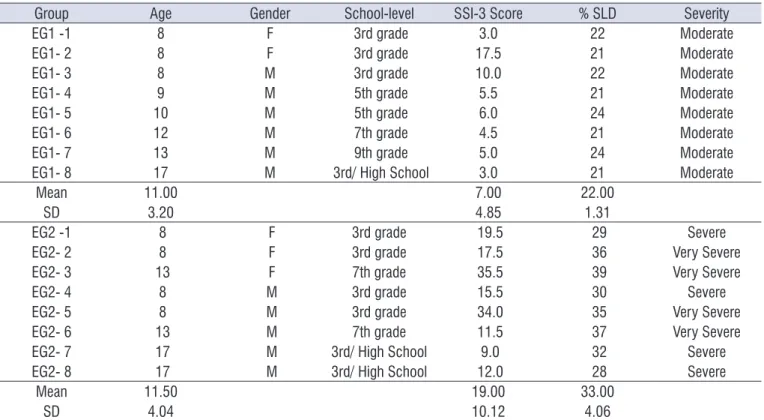
A group of 16 school-children who stutter (11 males and 5 females) participated in this study. They were divided in two groups: Experimental Group 1 (EG1): school-age children between 8 and 17 years old (mean 11 years old; SD=3.20) diagnosed with moderate stuttering, and Experimental Group 2 (EG2): school-age children between 8 and 17 years old (mean 11.5 years old; SD=4.04) diagnosed with severe or very severe stuttering.
The diagnosis of persistent developmental stuttering of participants was carried out at the Laboratório de Estudos da Fluência [Fluency Study Laboratory] -
LAEF of the Centro de Estudos de Educação e Saúde
[Education and Health Study Center] - CEES of the Universidade Estadual Paulista – FFC - Marilia.
Inclusion criteria
the laboratory, namely: stuttering complaint; persistent developmental stuttering diagnosed by a specialist professional; onset of stuttering in childhood (devel-opmental); presenting minimum of 3% of stuttering-like disluencies; minimum duration of 12 months of disluency (persistent), and stuttering, classiied at least as moderate, according to the Stuttering Severity Instrument - SSI-324.
Exclusion criteria
Exclusion criteria for participants were: neurological disorders, genetic syndromes, mental retardation, conductive or sensorineural hearing loss, attention-deicit hyperactivity disorder (ADHD) or psychiatric conditions.
Procedures
Initially, those responsible for the school-children were informed about the objectives of the study, received explanation about the procedures to be performed and provided written consent for partici-pation in the research. The following procedures were performed: 1) Basic audiological evaluation; 2) Fluency assessment; 3) Stuttering severity assessment; 4) Oral reading evaluation in two different conditions of auditory feedback: usual (nonaltered) and delayed.
Audiologic assessment consisted of clinical history, otoscopic exam, pure tone audiometry, speech audiometry and acoustic immittance assessment (tympanometry and acoustic relex).
The luency assessment of spontaneous speech was performed to conirm the stuttering diagnosis. The stuttering severity assessment was held to compose the two groups. The Stuttering Severity Instrument (SSI-3) was used to classify stuttering as mild, moderate, severe or very severe, by evaluating the frequency and duration of stuttering-like disluencies and presence of physical concomitants associated with disluencies24.
For the oral reading tasks, narrative texts and serials proposed by a speciic reading material evalu-ation, according to school level, were employed25. Two different sections of texts were used, one for each
auditory feedback condition to remove the effect of the adaptation.
To offer delayed auditory stimulus in listening situation with delayed auditory feedback, a software (Fono Tools) was employed. A digital camcorder Sony (Digital HDR-CX350 – 7.1 Mega Pixels) and a tripod (Atek – ômega) were used too.
After collecting the spontaneous speech samples (to diagnose stuttering) and the readings tasks of the participants, they were transcribed (of 200 luent syllables each sample), considering the luent and not luent syllables according to the following description26-28.
• Stuttering-like Disluencies (SLD): words repetition
– more than 3, part of word repetition, sound repetition, block, prolongation, pause, intrusion, and;
• Other Disluencies (OD): interjection, hesitation,
revision, uninished word, phrase repetition, word repetition - until 2.
Data analysis
Statistical analysis was performed using Statistical Package for Social Sciences (SPSS) version 21.0. The Wilcoxon Signed Posts Test was used for the intragroup analysis and the Mann-Whitney test to compare the results between the groups. Values were considered signiicant at p lower than 0.05 (p <0.05), with a 95% conidence interval. Signiicant p values were highlighted with the asterisk (*) symbol.
RESULTS
In regards to the statistical values of the percentage of stuttering-like disluencies (SLD), other disluencies (OD) and total disluencies (TD) during oral reading for EG1 and EG2 it is possible to afirm that in the analysis related to SLD frequency intra and intergroups, the only statistically signiicant difference (p= 0.035) was observed in the intergroup comparison, concerning the nonaltered auditory feedback (NAF) situation, in which EG2 presented a higher frequency of these disluencies in relation to EG1. Regarding the comparison of OD
and TD frequency, inter and intragroups in EG1 and EG2, there were no statistically signiicant differences between the conditions of nonaltered auditory feedback (NAF) and delayed auditory feedback (DAF) (Table 2).
Table 3 shows the statistical values of syllables and words per minute (SPM and WPM) concerning oral reading for EG1 and EG2. The results indicate a reduced low of syllables and words per minute (SPM and PPM) in EG1, and increase on these lows for EG2 in DAF condition.
Table 1. Description of the study participants
Group Age Gender School-level SSI-3 Score % SLD Severity
EG1 -1 8 F 3rd grade 3.0 22 Moderate
EG1- 2 8 F 3rd grade 17.5 21 Moderate
EG1- 3 8 M 3rd grade 10.0 22 Moderate
EG1- 4 9 M 5th grade 5.5 21 Moderate
EG1- 5 10 M 5th grade 6.0 24 Moderate
EG1- 6 12 M 7th grade 4.5 21 Moderate
EG1- 7 13 M 9th grade 5.0 24 Moderate
EG1- 8 17 M 3rd/ High School 3.0 21 Moderate
Mean 11.00 7.00 22.00
SD 3.20 4.85 1.31
EG2 -1 8 F 3rd grade 19.5 29 Severe
EG2- 2 8 F 3rd grade 17.5 36 Very Severe
EG2- 3 13 F 7th grade 35.5 39 Very Severe
EG2- 4 8 M 3rd grade 15.5 30 Severe
EG2- 5 8 M 3rd grade 34.0 35 Very Severe
EG2- 6 13 M 7th grade 11.5 37 Very Severe
EG2- 7 17 M 3rd/ High School 9.0 32 Severe
EG2- 8 17 M 3rd/ High School 12.0 28 Severe
Mean 11.50 19.00 33.00
SD 4.04 10.12 4.06
devices, but also for understanding the theory, research and therapy, for and about stuttering28.
Data obtained from the oral reading permitted to conirm that the intragroup analysis in DAF condition did not cause signiicant effects in the two groups, either in disluencies frequency as in speech rate. However, it was observed that there was a decrease of stuttering-like disluencies (SLD) in the moderate stuttering group (34.87%) and severe / very severe stuttering (22.27%). Therefore, the results suggest that there was a tendency to decrease the main manifestation of the disorder, which are the SLD1,2. These data corroborate to the results obtained from an investigation of motor skills of people who stutter under the effect of DAF18.
DISCUSSION
Contemporary literature has shown the importance of delayed auditory feedback studies on stuttering using various devices. However, few studies have used an easily accessible technology for both, either the speech therapist as for the people who stutter. Thus, this study examined the effect of delayed auditory feedback in oral reading of school-children who stutter regarding speech disruptions frequency and speech rate, using a speciic software.
A better comprehension about the effects of altered auditory feedback (AAF) in luency of the people who stutter is fundamental, not only for indicating the use of
Table 2. Analyses between the groups and Intragroup REGARDING THE percentual of Stuttering-like Disluencies, Other Disluencies and Total Disluencies during reading in different listening conditions
Disluencies in reading in different listening conditions
Type Listening Conditions
EG1 EG2
Mean Md. Min. Max. SD Mean Md. Min Max. SD P
SLD NAFDAF 4.132.69 3.002.50 1.001.50 10.505.00 1.032.99 7.009.06 4.259.00 0.502.50 115.5018.50 5.835.05 0.035*0.078
P 0.440 0.233
OD NAFDAF 6.456.50 5.255.50 2.002.00 17.0012.00 3.595.01 7.946.19 6.508.75 0.500.50 13.0016.50 4.40 >0.9995.35 0.599
P 0.723 0.310
TD NAFDAF 10.639.44 10.008.00 3.004.50 20.0015.00 3.916.59 14.9415.25 13.5017.75 1.004.00 29.5027.00 10.217.95 0.3140.292
P 0.293 0.888
* Statistical signiicance (p≤0.05) – Mann-Whitney Test – Test for the comparison between the groups - and Wilcoxon Signed Posts Test for the intragroup reading comparisons.
Note: GE1= Experimental Group 1; EG2= Experimental Group 2; SLD = Stuttering-like Disluencies; OD= Other Disluencies; TD= Total Disluencies; NAF= Nonaltered Auditory Feedback; DAF= Delayed Auditory feedback; Md= Median; Min.= Minimum; Max.= Maximum; SD= Standard Deviation; P= p-value.
Table 3. Analyses between the groups and Intragroup regarding the syllabes and words per minute during oral reading in different listening conditions
Speech rate in Reading
SR Listening Conditions
EG1 EG2
Mean Md Min. Max. SD Mean Md Min. Max. SD P
SPM NAFDAF 146.50 158.50 60.00 206.00 51.16 134.25 148.00 41.00 240.00 67.20118.63 106.50 53.00 214.00 49.25 136.75 130.50 43.00 279.00 79.16 0.5290.793
P 0.123 0.889
WPM NAFDAF 69.6359.13 73.5053.50 27.0031.00 103.00 23.1498.00 25.14 63.2567.00 67.5070.50 22.00 128.00 36.5924.00 104.00 27.07 0.6000.674
P 0.889 0.889
* Statistical signiicance (p≤0.05) – Mann-Whitney Test – Test for the comparison between the groups - and Wilcoxon Signed Posts Test for the intragroup comparisons.
In regards to the analysis of the main luency parameters, speech rate and continuity, the results suggest that the effect seemed to be considered more positive for the severe / very severe stuttering group. Participants in this group showed, under the effect of delayed auditory feedback, besides improvement in oral reading luency, increased low of luent syllables and words per minute. However, the moderate stuttering group showed susceptibility to reduced low of syllables and words per minute, under the effect of delayed auditory feedback.
ACKNOWLEDGMENT
Special thanks to the Coordenação de Aperfeiçoamento de Pessoal de Nível Superior, for the support with the development of this research (under protocol number 0714/2013).
REFERENCES
1. Bleek B, Reuter M, Yaruss JS, Cook S, Faber J, Montag C. Relationship between personality characteristics of people who stutter and the impact of stuttering on everyday life. J Fluency Disord. 2012;37(4):325-33.
2. Civier O, Bullock D, Max L, Guenther FH. Computational modeling of stuttering caused by impairments in a basal ganglia thalamo-cortical circuit involved in syllable selection and initiation. Brain Lang. 2013;126(3):263-78.
3. Foundas AL, Mock JR, Corey DM, Golob EJ, Conture EG. The SpeechEasy device in stuttering and nonstuttering adults: Fluency effects while speaking and reading. Brain Lang. 2013;126(2):141-50.
4. Hudock D, Kalinowski J. Stuttering inhibition via altered auditory feedback during scripted telephone conversations. Int J Lang Commun Disord. 2014;49(1):139-47.
5. Sasisekaran J. Nonword repetition and nonword reading abilities in adults who do and do not stutter. J Fluency Disord. 2013;38(3):275-89.
6. Liu J, Wang Z, Huo Y, Davidson SM, Klahr K, Herder CL et al. Functional imaging study of self-regulatory capacities in persons who stutter. PLoS One. 2014;27(2):898-910.
7. Chang SE, Synnestvedt A, Ostuni J, Ludlow CL. Similarities in speech and white matter characteristics in idiopathic developmental The response of the groups was different regarding
the effects of delayed auditory feedback (DAF) in frequency of other disluencies (OD), decreased 0.8% in the EG1 and increased 28.27% in EG2. In both groups, the total disluencies (TD) showed a reduction in DAF condition (11.2% in EG1 and 2.04% in EG2) when compared with NAF condition. TD is the sum of SLD and OD. Therefore, the EG1, which decreased the SLD and OD, also declined the TD. However, EG2 which decreased the SLD and increased OD, showed less reduction of TD.
Regarding speech rate, there was a tendency to decrease the low of syllables and words per minute (SPM and WPM) of EG1, while EG2 showed a tendency to increase these lows under the DAF. Therefore, the data suggest that the effect of the delay is more positive for the severe / very severe stuttering group, since one of the manifestations of stuttering consists on the reduction low of luent syllables and words per minute. The analysis of the two major luency parameters, continuity and speech rate, showed a tendency to a positive effect in the severe / very severe group because it caused reduction of SLD and TD, and increased the low of SPM and WPM. However, despite the decline of SLD and TD in the moderate stuttering group, participants showed a tendency to decrease speech rate, considering that this is not a desirable effect. This result reinforces the previously idea observed in other studies, stating that auditory strategies should not be used in absolute way for all individuals who stutter, because not everyone is beneited, requiring, therefore, individualized tests15,17,19,20,23.
The intergroup analysis showed signiicant differ-ences in Nonaltered Auditory Feedback (NAF) concerning SLD. This result was expected because stuttering severity was determined by the percentage and duration of SLD and physical concomitants24.
Both groups showed similarities in all variables under DAF condition, even in SLD analysis, which EG2 had presented higher amount, compared to EG1 in NAF. This result reinforces the suggestion of a positive effect of DAF during oral reading in the group of people with severe / very severe stuttering.
CONCLUSION
auditivo para a redução da gagueira. J Soc Bras Fonoaudiol. 2011;23(2):187-91.
21. Toyomura A, Fujii T, Kuriki S. Effect of external auditory pacing on the neural activity of stuttering speakers. Neuroimage. 2011;57(4):1507-16.
22. Carrasco ER. O efeito do feedback auditivo atrasado e da alteração da frequência na severidade da gagueira. [dissertação] São Paulo (SP): Universidade Federal de São Paulo; 2013. 23. Gallop RF, Runnyan CM. Long-term effectiveness of
the SpeechEasy luency- enhancement. J Fluency Disord. 2012;37(4):334-43.
24. Riley GD. Stuttering severity instrument for young children (SSI-3) 3r ed. Austin, TX: Pro-Ed; 1994. 25. Saraiva RA, Moojen SPM, Munarski R. Avaliação
da compreensão leitora de textos expositivos para fonoaudiólogos e psicopedagogos. Casa do Psicólogo, 1° ed. 2006.
26. Yairi E, Ambrose N. Onset of stuttering in preschool children: select factors. J Speech Lang Hear Res. 1992;35(4):783-8.
27. Pinto JCBR, Schiefer AM, Ávila CRB. Disluências e velocidade de fala em produção espontânea e em leitura oral em indivíduos gagos e não gagos. Audiol Commun Res. 2013;18(2):63-70.
28. Ingham RJ, Bothe AK, Wang Y, Purkhiser K, New A. Phonation interval modiication and speech performance quality during luency - inducing conditions by adults who stutter. J Commun Disord. 2012:45(3):189-211.
stuttering and adult-onset stuttering. J Neurolinguistics. 2009;23(5):455-69.
8. Kawano CE, Kida ASB, Carvalho CAF, Ávila CRB. Parâmetros de luência e tipos de erros na leitura de escolares com indicação de diiculdades para ler e escrever. Rev Soc Bras Fonoaudiol. 2011;16(1):9-18.
9. Cunha VLO, Silvia C, Capellini SA. Correlação entre habilidades básicas de leitura e compreensão de leitura. Estud Psicol. 2012;29(1):799-807.
10. Erickson S, Block S. The social and communication impact of stuttering on adolescents and their families. J Fluency Disord. 2013;38(4):311-24. 11. Chesters J, Baghai-Ravary L, Möttönen R. The
effects of delayed auditory and visual feedback on speech Production. J Acoust Soc Am. 2012;137(2):873-83.
12. Howell P, Williams S. Development of auditory sensitivity in children who stutter and luent children. Ear and Hear. 2004;25(3):265-74.
13. Lincoln M, Packman A, Onslow M. Altered auditory feedback and the treatment of stuttering; A review. J Fluency Disord. 2006;31(2):71-89.
14. Neef NE, Sommer M, Neef A, Paulus W, Von Gudenberg AW, Jung K et al. Reduced Speech Perceptual Acuity for Stop Consonants in Individuals Who Stutter. J Speech Lang Hear Res. 2012;55(1):276-89.
15. O’Donnell JJ, Armson J, Kiefte M. The effectiveness of SpeechEasy during situations of daily living. J Fluency Disord. 2008;33(2):99-119.
16. Ratyńska J, Szkiełkowska A, Markowska R, Kurkowski M, Mularzuk M, Skarżyński H. Immediate speech luency improvement after application of the Digital Speech Aid in stuttering patients. Med Sci Monit. 2012;18(1):9-12.
17. Unger JP, Gluck CW, Cholewa J. Immediate effects of AAF devices on the characteristics of stuttering: A Clinical analysis. J Fluency Disord. 2012;37(2):22-34.
18. Ritto AP, Juste FS, Andrade CRF. Impacto do uso do SpeechEasy® nos parâmetros acústicos e motores da fala de indivíduos com gagueira. Audiol Commun Res. 2015;20(1):1-9.
19. Carrasco ER, Schiefer AM, Azevedo MF. O efeito do feedback auditivo atrasado na gagueira. Audiol Commun Res. 2015;20(2):116-22.