
ABSTRACT
Objective: To assess and compare the prevalence of comorbidities and risk factors for cardiovascular disease (CVD) in COPD patients according to disease severity. Methods: The study included 25 patients with mild-to-moderate COPD (68% male; mean age, 65 ± 8 years; mean FEV1, 73 ± 15% of predicted) and 25 with severe-to-very severe COPD (males, 56%; mean age, 69 ± 9 years; mean FEV1, 40 ± 18% of predicted). Comorbidities were recorded on the basis of data obtained from medical charts and clinical evaluations. Comorbidities were registered on the basis of data obtained from medical charts and clinical evaluations. The Charlson comorbidity index was calculated, and the Hospital Anxiety and Depression Scale (HADS) score was determined. Results: Of the 50 patients evaluated, 38 (76%) had been diagnosed with at least one comorbidity, 21 (42%) having been diagnosed with at least one CVD. Twenty-four patients (48%) had more than one CVD. Eighteen (36%) of the patients were current smokers, 10 (20%) had depression, 7 (14%) had dyslipidemia, and 7 (14%) had diabetes mellitus. Current smoking, depression, and dyslipidemia were more prevalent among the patients with mild-to-moderate COPD than among those with severe-to-very severe COPD (p < 0.001, p = 0.008, and p = 0.02, respectively). The prevalence of high blood pressure, diabetes mellitus, alcoholism, ischemic heart disease, and chronic heart failure was comparable between the two groups. The Charlson comorbidity index and HADS scores did not differ between the groups. Conclusions: Comorbidities are highly prevalent in COPD, regardless of its severity. Certain risk factors for CVD, themselves classiied as diseases (including smoking, dyslipidemia, and depression), appear to be more prevalent in patients with mild-to-moderate COPD.
Keywords: Pulmonary disease, chronic obstructive; Spirometry; Cardiovascular diseases; Risk factors.
Risk factors for cardiovascular disease
in patients with COPD: mild-to-moderate
COPD versus severe-to-very severe COPD
Laura Miranda de Oliveira Caram1, Renata Ferrari1, Cristiane Roberta Naves1,
Liana Sousa Coelho1, Simone Alves do Vale1, Suzana Erico Tanni1, Irma Godoy1
Correspondence to:
Laura Miranda de Oliveira Caram. Departamento de Medicina Interna, Área de Pneumologia, Faculdade de Medicina de Botucatu, Universidade Estadual Paulista, Distrito de Rubião Junior, s/n, CEP 18618-970, Botucatu, SP, Brasil.
Tel.: 55 14 3880-1171. Fax: 55 14 3882-2238. E-mail: [email protected]
Financial support: This study received inancial support from the Fundação de Amparo à Pesquisa do Estado de São Paulo (FAPESP, São Paulo Research Foundation, grant no. 2010/10312-1). Laura Miranda de Oliveira Caram is the recipient of a research grant from the Brazilian Coordenação de Aperfeiçoamento de Pessoal de Nível Superior (CAPES, Ofice for the Advancement of Higher Education).
INTRODUCTION
COPD is characterized by chronic airlow limitation, a range of pathological changes in the lungs, signiicant extrapulmonary effects, and major comorbidities that can contribute to increasing the severity of the disease. (1) Common comorbidities in patients with COPD include cardiovascular disease (CVD), anemia, lung cancer, diabetes, osteoporosis, anxiety, and depression.(2) Among COPD patients, CVDs are responsible for approximately 50% of all hospitalizations and 20% of all deaths.(3)
The majority (94%) of all COPD patients have at least
one comorbidity and up to 46% have three or more,(4)
the most prevalent being high blood pressure (HBP), coronary artery disease (CAD), congestive heart failure (CHF), dyslipidemia, and diabetes mellitus (DM).(2,5) Two
previous studies evaluated the prevalence of comorbid
-ities according to COPD severity,(5,6) although neither
evaluated all of the risk factors for CVD. Therefore, the aim of the present study was to assess the prevalence of
comorbidities and risk factors for CVD in COPD patients, comparing them by COPD severity—mild-to-moderate versus severe-to-very severe.
METHODS
Seventy patients with COPD were recruited from the Pulmonary Outpatient Unit at the Botucatu Hospital das Clínicas of the São Paulo State University Botucatu School
of Medicine. Patients were included if they met the Global Initiative for Chronic Obstructive Lung Disease (GOLD)
criteria for a diagnosis of COPD(1): a post-bronchodilator FEV1/FVC ratio < 0.70 and a < 15% or 200-mL increase in FEV1 following inhalation of a β2 agonist; age ≥ 40 years; and a ≥ 10 pack-year smoking history. Patients with a primary diagnosis of another respiratory disease, such as asthma, a restrictive disorder (tuberculosis sequelae or interstitial ibrosis), obstructive sleep apnea-hypopnea syndrome, and lung cancer, were excluded, as were those with a primary diagnosis of unstable angina, CHF (New
1. Departamento de Medicina Interna, Área de Pneumologia, Faculdade de Medicina de Botucatu, Universidade Estadual Paulista, Botucatu (SP) Brasil.
Submitted: 20 May 2015. Accepted: 3 January 2016.
York Heart Association functional class III or IV), or any other chronic disease, such as uncontrolled DM, kidney failure, liver failure, and cancer. We took into consideration the post-bronchodilator values of FEV1 (% of the predicted value) and arterial blood gas parameters. We categorized the severity of COPD according to the GOLD stages,(1) as mild-to-moderate (GOLD stage I or II) or severe-to-very severe (GOLD stage III or IV).
The study was approved by the Research Ethics Committee of the Botucatu Hospital das Clínicas. All
participating patients gave written informed consent.
Laboratory tests, pulmonary function tests, and pulse oximetry
Laboratory tests included complete blood counts, as well as determination of the following: lipid proile; total and fractional protein levels; fasting glucose level; hepatic function; and renal function. The biochemical tests were performed according to the methods applied by the Clinical Analysis Laboratory of the institution.
Pre- and post-bronchodilator spirometry were performed with a portable spirometer (Koko; Ferraris Respiratory, Louisville, CO, USA), in accordance with the American Thoracic Society criteria.(7) Values of
FEV1 were expressed in liters, as percentages of the FVC, and as percentages of the reference values.(8)
The SpO2 was assessed with an oximeter (Onyx 9500;
Nonin Medical Inc., Plymouth, MN, USA) while the patients were breathing room air.
Comorbidities
Comorbidities were identiied in medical records and conirmed at clinical evaluation. Current smoking was considered a comorbidity, in accordance with the International Statistical Classiication of Diseases, 10th Revision, in which nicotine dependence is coded as F17. The smoking status was conirmed by measuring carbon monoxide (CO) in exhaled air with a CO analyzer (Micro CO Meter, Cardinal Health, Chatham, UK). An exhaled CO level > 6.0 ppm was considered indicative of current smoking.(9)
For each patient, we calculated the Charlson comor
-bidity index.(10) The Hospital Anxiety and Depression Scale (HADS), which has been translated to Portuguese and validated for use in Brazil,(11) was used in order to evaluate symptoms related to anxiety and depression.
Nutritional assessment
We determined body weight and height using a calibrated platform scale with a stadiometer (Filizola, São Paulo, Brazil). The body mass index (BMI) was calculated as weight in kilograms divided by height
in meters squared (kg/m2). Body composition was
evaluated by bioelectrical impedance (BIA 101A; RJL Systems Inc., Clinton Township, MI, USA), in accordance with the guidelines established by the European Society for Parenteral and Enteral Nutrition.(12) Fat-free mass (FFM, in kg) was calculated through the use of a group-speciic regression equation developed by Kyle
et al.(13) We also calculated the FFM index (FFMI), using the following equation:
FFMI = FFM/height2
Statistical analyses
Descriptive statistics were calculated for the features of all participants. Data are expressed as mean ± standard deviation or as median and interquartile range (25-75%), depending on their distribution. Categorical variables are expressed as absolute and relative frequency. The chi-square test and Fisher’s exact test were used in order to compare categorical variables. For comparisons between the two groups, an unpaired t-test was used for continuous variables and the Mann-Whitney test was used for ordinal variables. The level of signiicance was set at 5%. All analyses were performed with the SigmaStat program, version 3.2 (Systat Software Inc., San Jose, CA, USA).
RESULTS
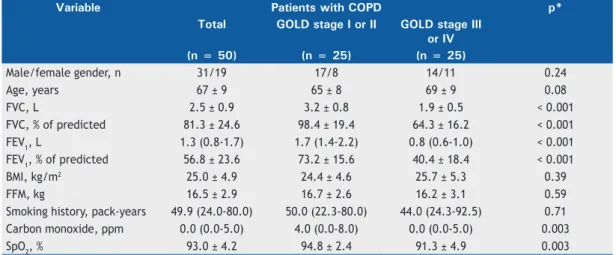
Twenty patients were excluded from the final analysis, 15 because their primary diagnosis was not COPD and 5 because they did not complete the protocol. Therefore, 50 patients were included in the inal analysis: 25 with mild-to-moderate COPD and 25 with severe-to-very severe COPD. Age, gender, smoking history (pack-years), BMI, and FFMI were not statistically different between the groups (Table 1). Of the 50 patients evaluated, 9 (18%) were obese (BMI
≥ 30 kg/m2), 3 in the mild-to-moderate COPD group
and 6 in the severe-to-very severe COPD group (p = 0.39).(14) Five patients had very severe COPD and
were on long-term oxygen therapy. Figure 1 shows the maintenance medications used by the patients.
Thirty-eight patients (76%) presented with at least one comorbidity, 21 (42%) presenting with at least one cardiovascular comorbidity: HBP, in 40% of the sample; CAD, in 10%; or New York Heart Association functional class I CHF, in 6%. Twenty-four patients (48%) presented more than one CVD. Of the 50 patients evaluated, 18 (36%) were classiied as active smokers, 10 (20%) were diagnosed with depression, 7 (14%) were diagnosed with dyslipidemia, 7 (14%) were diagnosed with DM, and 4 (8%) were diagnosed with alcoholism.
Of the 25 patients in the mild-to-moderate COPD group, 14 (56%) were classiied as current smokers, 5 (20%) had been diagnosed with dyslipidemia, and 7 (28%) had been diagnosed with depression. Of the 25 patients in the severe-to-very severe COPD group, only 4 (16%) were classiied as current smokers, only 2 (8%) had been diagnosed with dyslipidemia, and only 3 (12%) had been diagnosed with depression.
prevalence of depression was signiicantly higher in the mild-to-moderate COPD group (p=0.008), the HADS scores were not signiicantly different between the groups (p = 0.93 and p = 0.89 for anxiety and depression, respectively). All 7 of the patients who had previously been diagnosed with depression were receiving pharmacological treatment.
In the majority of the patients diagnosed with dyslipidemia, the concentrations of lipids (total cholesterol, HDL, LDL, and triglycerides) were within normal values, and the lipid proile, according to the Brazilian Society of Cardiology IV Brazilian Guidelines on Dyslipidemia and Prevention of Atherosclerosis,(15) was similar between the two groups. All 7 of the patients who had previously been diagnosed with dyslipidemia were receiving pharmacological treatment.
The Charlson comorbidity index did not differ between the mild-to-moderate COPD and severe-to-very severe COPD groups. For the sample as a whole, the mean Charlson comorbidity index was 3.5 ± 1.3.
DISCUSSION
The main inding of the present study is that risk fac
-tors for CVD, including smoking and dyslipidemia, were more prevalent among patients with mild-to-moderate COPD than among those with severe-to-very severe COPD. The prevalence of depression was also higher in the former group.
The prevalence of current smoking in our sample
was 36%. Shahab et al.(16) evaluated 1,093 COPD
patients and found a similar (34.9%) prevalence of Table 1. Demographic and clinical characteristics of the sample as a whole, of the patients with mild-to-moderate COPD,
and of the patients with severe-to-very severe COPD.a
Variable Patients with COPD p*
Total GOLD stage I or II GOLD stage III or IV
(n = 50) (n = 25) (n = 25)
Male/female gender, n 31/19 17/8 14/11 0.24
Age, years 67 ± 9 65 ± 8 69 ± 9 0.08
FVC, L 2.5 ± 0.9 3.2 ± 0.8 1.9 ± 0.5 < 0.001 FVC, % of predicted 81.3 ± 24.6 98.4 ± 19.4 64.3 ± 16.2 < 0.001 FEV1, L 1.3 (0.8-1.7) 1.7 (1.4-2.2) 0.8 (0.6-1.0) < 0.001 FEV1, % of predicted 56.8 ± 23.6 73.2 ± 15.6 40.4 ± 18.4 < 0.001 BMI, kg/m2 25.0 ± 4.9 24.4 ± 4.6 25.7 ± 5.3 0.39
FFM, kg 16.5 ± 2.9 16.7 ± 2.6 16.2 ± 3.1 0.59 Smoking history, pack-years 49.9 (24.0-80.0) 50.0 (22.3-80.0) 44.0 (24.3-92.5) 0.71 Carbon monoxide, ppm 0.0 (0.0-5.0) 4.0 (0.0-8.0) 0.0 (0.0-5.0) 0.003 SpO2, % 93.0 ± 4.2 94.8 ± 2.4 91.3 ± 4.9 0.003
GOLD: Global Initiative for Chronic Obstructive Lung Disease; GOLD stage I or II: mild-to-moderate COPD; GOLD stage III or IV: severe-to-very severe COPD; BMI: body mass index; and FFM: fat-free mass. aExcept where
otherwise indicated, data are reported as mean ± SD or as median (25-75% interquartile range). *GOLD stage I or II versus GOLD stage III or IV (unpaired t-test, Mann-Whitney test, or chi-square test).
Figure 1. Medications used by the COPD patients in the study sample (n = 50). SAMA: short-acting muscarinic
antagonist; LABA: long-acting β2 agonist; IC: inhaled corticosteroid; LAMA: long-acting muscarinic antagonist; and
SABA: short-acting β2 agonist.
4
6
8
14
16 16
18 18
40
52
0 10 20 30 40 50 60
SAMA + LABA
SAMA
IC
Antidepressant
LAMA
SABA
LABA + IC
Hypoglycemic agent
Antihypertensive agent
LABA
current smoking. In the Projeto Latino-Americano de Investigação em Obstrução Pulmonar (PLATINO, Latin
American Project for the Investigation of Obstructive Lung Disease) study,(17) the observed prevalence of
smoking among patients with COPD categorized as GOLD stage II-IV was 26.2%, which, albeit high, is lower than that identiied in our sample. That can be explained, at least in part, by the fact that the PLATINO study sample included subjects who lived in the greater metropolitan area of the city of São Paulo, whereas our sample was composed of subjects living in small towns or rural areas of the state.(17) Black-Shinn et al.(18) also showed that the prevalence of current smoking was higher among patients in the early stages of COPD than among those with severe COPD, which is in line with the indings of another study, which reported a positive association between being a former smoker and having severe airlow limitation.(19) Similarly, in the
Evaluation of COPD Longitudinally to Identify Predictive Surrogate Endpoints (ECLIPSE) study, patients with GOLD stage II, III, and IV COPD were compared, and the proportion of current smokers decreased in parallel with increased disease severity.(5) However, there are some data showing that the rates of current smoking
actually increase as COPD becomes more severe.(16)
Dyslipidemia was present in 14% of the patients in our sample. This is considerably lower than the 40% prevalence of dyslipidemia (38% among males and 42% among females) reported for the general population of Brazil(15) and the 39% reported in an international study.(20) Two previous studies reported the prevalence of dyslipidemia among COPD patients to be 26.5% and 28.0%, respectively.(21,22) In our study, a diagnosis of
dyslipidemia was more prevalent among the patients with mild-to-moderate COPD than among those with severe-to-very severe COPD. That inding could be attributable to the fact that the number of current smokers is usually higher among the patients with mild-to-moderate COPD.(23) To our knowledge, there have been no previous studies comparing the prevalence of dyslipidemia among the stages of COPD severity. Our indings regarding dyslipidemia merit attention,
especially in view of the fact that one cross-sectional study of COPD patients showed that the rate of irst cardiovascular event (myocardial infarction and stroke), which is usually associated with dyslipidemia, was higher among younger subjects than among those of more advanced age.(24) The authors of that study
suggested that the risk of cardiovascular mortality is higher in patients with mild-to-moderate COPD than in those with severe-to-very severe COPD. It has also been demonstrated that lung cancer and cardiovascular comorbidities constitute the leading cause of death in patients with mild-to-moderate COPD, accounting for up to two thirds of all deaths among such patients, whereas respiratory failure is the predominant cause of death in patients with advanced COPD.(4)
Depression was diagnosed in 20% of our patients. That is in agreement with the findings of two previous studies, in which the reported prevalence of depression among COPD patients was 23.1% and 35.0%, respectively.(25,26) In the ECLIPSE study, the
overall prevalence of depression in COPD patients was 17%, and there was a statistically signiicant difference between GOLD stages among females.(5) In another study of COPD patients, Echave-Sustaeta et al.(27) reported that the prevalence of depression was
11.1% and found no association between depression and COPD severity. The higher number of current smokers among patients with mild-to-moderate COPD is a possible explanation for the higher prevalence of depression in such patients. In fact, it has previously been shown that anxiety and depression scores are associated with current smoking.(28,29)
In the present study, the mean Charlson comorbidity index did not differ between the mild-to-moderate COPD and severe-to-very severe COPD groups. For
the sample as a whole, the mean Charlson comor
-bidity index was 3.5, similar to the 3.9 reported by Díez-Manglano et al.,(22) although higher than the 2.5 reported by Echave-Sustaeta et al.(27) and the
2.7 reported by Almagro et al.(2) Although COPD, myocardial infarction, CHF, and DM are included in the Charlson comorbidity index, other highly Table 2. Comorbidities in the sample as a whole, among the patients with mild-to-moderate COPD, and among the
patients with severe-to-very severe COPD.a
Variable Patients with COPD p*
Total GOLD stage I or II GOLD stage III or IV
(n = 50) (n = 25) (n = 25)
Smoking 18 (36) 14 (56) 4 (16) < 0.001
High blood pressure 20 (40) 9 (36) 11 (44) 0.31
Depression 10 (20) 7 (28) 3 (12) 0.008
Dyslipidemia 7 (14) 5 (20) 2 (8) 0.02
Diabetes mellitus 7 (14) 3 (12) 4 (16) 0.54 Coronary artery disease 5 (10) 2 (8) 3 (12) 0.48
Alcoholism 4 (8) 3 (12) 1 (4) 0.06
Congestive heart failure 3 (6) 1 (4) 2 (8) 0.37 Charlson comorbidity index 3.5 ± 1.3 3.2 ± 1.1 3.9 ± 1.3 0.06
GOLD: Global Initiative for Chronic Obstructive Lung Disease; GOLD stage I or II: mild-to-moderate COPD; and GOLD stage III or IV: severe-to-very severe COPD. aData are reported as n (%) or as mean ± SD. *GOLD stage I
prevalent diseases observed in our study, including current smoking, HBP, dyslipidemia, alcoholism, and depression, are not. Therefore, the exclusive use of the Charlson comorbidity index could result in an underestimation of the prevalence of comorbidities and of their inluence on the prognosis of COPD patients. After age and chronic symptoms, comorbidities are the most important predictive factors of the future health care costs and direct costs of COPD.(4) In addition, our
indings underscore the need for a new comorbidity index to be applied in patients with COPD, given that some highly prevalent comorbidities are not included in the index currently available.
Our study has certain limitations. Although the comorbidities observed in our study are similar to those
identiied in the current literature, the prospective design and characteristics of the patient sample could explain some of our indings. In addition, the small size of our sample might impose some limitations on the interpretation of our data.
In conclusion, the prevalence of comorbidities is high among patients with COPD, regardless of disease severity. In addition, smoking and dyslipidemia appear to be more prevalent in mild-to-moderate COPD. Therefore, controlling these comorbidities might be a key measure in the early phases of the disease, in order to decrease mortality due to cardiovascular events. Our indings show the importance of therapeutic measures to promote smoking cessation and of early diagnosis to prevent the progression of airlow obstruction.
REFERENCES
1. Global Initiative for Chronic Obstructive Lung Disease [homepage on the Internet]. Bethesda: Global Initiative for Chronic Obstructive Lung Disease. [cited 2014 Oct 1]. Global strategy for the diagnosis, management, and prevention of chronic obstructive pulmonary disease: GOLD Executive Summary, update 2014. Available from: http://www.goldcopd.org/
2. Almagro P, López García F, Cabrera F, Montero L, Morchón D, Díez J, et al. Comorbidity and gender-related differences in patients hospitalized for COPD. The ECCO study. Respir Med. 2010;104(2):253-9. http://dx.doi.org/10.1016/j.rmed.2009.09.019
3. Sin DD, Man SF. Impact of cancers and cardiovascular disease in chronic obstructive pulmonary disease. Curr Opin Pulm Med. 2008;14(2):115-21. http://dx.doi.org/10.1097/ MCP.0b013e3282f45ffb
4. Hillas G, Perlikos F, Tsiligianni I, Tzanakis N. Managing comorbidities in COPD. Int J Chron Obstruct Pulmon Dis. 2015;10:95-109. http:// dx.doi.org/10.2147/COPD.S54473
5. Agusti A, Calverley PM, Celli B, Coxson HO, Edwards LD, Lomas DA, et al. Characterisation of COPD heterogeneity in the ECLIPSE cohort. Respir Res. 2010;11:122. http://dx.doi.org/10.1186/1465-9921-11-122
6. Pedone C, Scarlata S, Sorino C, Forastiere F, Bellia V, Antonelli Incalzi R. Does mild COPD affect prognosis in the elderly? BMC Pulm Med. 2010;10:35. http://dx.doi.org/10.1186/1471-2466-10-35
7. Standardization of spirometry--1987 update. Statement of the American Thoracic Society. Am Rev Respir Dis. 1987;136(5):1285-98. http://dx.doi.org/10.1164/ajrccm/136.5.1285
8. Pereira CA, Barreto SP, Simões JG, Pereira FW, Gerstler JG, Nakatani J. Valores de referência para a espirometria em uma amostra da população brasileira adulta. J Pneumol. 1992;18(1):10-22.
9. Middleton ET, Morice AH. Breath carbon monoxide as an indication of smoking habit. Chest. 2000;117(3):758-63. http://dx.doi.org/10.1378/ chest.117.3.758
10. Charlson M, Szatrowski TP, Peterson J, Gold J. Validation of a combined comorbidity index. J Clin Epidemiol. 1994;47(11):1245-51. http://dx.doi.org/10.1016/0895-4356(94)90129-5
11. Botega NJ, Bio MR, Zomignani MA, Garcia C Jr, Pereira WA. Mood disorders among medical in-patients: a validation study of the hospital anxiety and depression scale (HAD) [Article in Portuguese]. Rev Saude Publica. 1995;29(5):359-63.
12. Kyle UG, Bosaeus I, De Lorenzo AD, Deurenberg P, Elia M, Gómez JM, et al. Bioelectrical impedance analysis--part I: review of principles and methods. Clin Nutr. 2004;23(5):1226-43. http://dx.doi. org/10.1016/j.clnu.2004.06.004
13. Kyle UG, Pichard C, Rochat T, Slosman DO, Fitting JW, Thiebaud D. New bioelectrical impedance formula for patients with respiratory insuficiency: comparison to dual-energy X-ray absorptiometry. Eur Respir J. 1998;12(4):960-6. http://dx.doi.org/10.1183/09031936.98.1 2040960
14. World Health Organization [homepage on the Internet]. Geneva: World Health Organization; c2015 [cited 2015 May 10]. Overweight and obesity fact sheet 2015. Available from: http://www.searo.who. int/linkiles/non_communicable_diseases_obesety-fs
15. Sposito AC, Caramelli B, Fonseca FA, Bertolami MC, Aiune Neto A, Souza AD, et al. IV Brazilian Guideline for Dyslipidemia and Atherosclerosis prevention: Department of Atherosclerosis of Brazilian Society of Cardiology [Article in Portuguese]. Arq Bras Cardiol. 2007;88 Suppl 1:2-19. http://dx.doi.org/10.1590/S0066-782X2007000700002
16. Shahab L, Jarvis MJ, Britton J, West R. Prevalence, diagnosis and relation to tobacco dependence of chronic obstructive pulmonary disease in a nationally representative sample. Thorax. 2006;61(12):1043-47. http://dx.doi.org/10.1136/thx.2006.064410
17. Menezes AM, Jardim JR, Pérez-Padilla R, Camelier A, Rosa F, Nascimento O, et al. Prevalence of chronic obstructive pulmonary disease and associated factors: the PLATINO Study in São Paulo, Brazil. Cad Saude Publica. 2005;21(5):1565-73. http://dx.doi. org/10.1590/S0102-311X2005000500030
18. Black-Shinn JL, Kinney GL, Wise AL, Regan EA, Make B, Krantz MJ, et al. Cardiovascular disease is associated with COPD severity and reduced functional status and quality of life. COPD. 2014;11(5):546-51. http://dx.doi.org/10.3109/15412555.2014.898029
19. Mitsiki E, Bania E, Varounis C, Gourgoulianis KI, Alexopoulos EC. Characteristics of prevalent and new COPD cases in Greece: the GOLDEN study. Int J Chron Obstruct Pulmon Dis. 2015;10:1371-82. http://dx.doi.org/10.2147/COPD.S81468
20. Leiter LA, Lundman P, da Silva PM, Drexel H, Jünger C, Gitt AK, et al. Persistent lipid abnormalities in statin-treated patients with diabetes mellitus in Europe and Canada: results of the Dyslipidemia International Study. Diabet Med. 2011;28(11):1343-51. http://dx.doi. org/10.1111/j.1464-5491.2011.03360.x
21. Nagorni-Obradovic LM, Vukovic DS. The prevalence of COPD co-morbidities in Serbia: results of a national survey. NPJ Prim Care Respir Med. 2014;24:14008. http://dx.doi.org/10.1038/ npjpcrm.2014.8
22. Díez-Manglano J, Bernabeu-Wittel M, Escalera-Zalvide A, Sánchez-Ledesma M, Mora-Rufeti A, Nieto-Martín D, et al. Comorbidity discapacity and mortality in patients with multiple conditions and chronic obstructive pulmonary disease [Article in Spanish]. Rev Clin Esp. 2011;211(10):504-10. http://dx.doi.org/10.1016/j. rce.2011.04.006
23. Forti N, Diament J. High-density lipoproteins: metabolic, clinical, epidemiological and therapeutic intervention aspects. An update for clinicians. Arq Bras Cardiol. 2006;87(5):671-9. http://dx.doi. org/10.1590/S0066-782X2006001800019
24. Feary JR, Rodrigues LC, Smith CJ, Hubbard RB, Gibson JE. Prevalence of major comorbidities in subjects with COPD and incidence of myocardial infarction and stroke: a comprehensive analysis using data from primary care. Thorax. 2010;65(11):956-62. http://dx.doi.org/10.1136/thx.2009.128082
25. Schneider C, Jick SS, Bothner U, Meier CR. COPD and the risk of depression. Chest. 2010;137(2):341-7. http://dx.doi.org/10.1378/ chest.09-0614
27. Echave-Sustaeta JM, Comeche Casanova L, Cosio BG, Soler-Cataluña JJ, Garcia-Lujan R, Ribera X. Comorbidity in chronic obstructive pulmonary disease. Related to disease severity? Int J Chron Obstruct Pulmon Dis. 2014;9:1307-14. http://dx.doi. org/10.2147/COPD.S71849
28. Northrop-Clewes CA, Thurnham DI. Monitoring micronutrients in
cigarette smokers. Clin Chim Acta. 2007;377(1-2):14-38. http:// dx.doi.org/10.1016/j.cca.2006.08.028
![The Effect of Drought Stress on the Essential Oil Content and Some of the Biochemical Characteristics of Anise Hyssop (Agastache foeniculum [Pursh] Kuntze)](data:image/gif;base64,R0lGODlhAQABAIAAAP///wAAACH5BAEAAAAALAAAAAABAAEAAAICRAEAOw==)