Cognitive training in older adults with
Mild Cognitive Impairment
Impact on cognitive and functional performance
Paula Schimidt Brum
1, Orestes Vicente Forlenza
2, Mônica Sanches Yassuda
3Abstract – Aging is associated with cognitive decline, yet this does not prevent older adults from finding ways to compensate for age-related deficits. Earlier studies have shown that cognitively unimpaired older adults can benefit from training programs. The efficacy of cognitive interventions among older adults without dementia but with cognitive decline (mild cognitive impairment, MCI) has not yet been widely tested. Objectives: To evaluate the impact of 8-session cognitive training on the cognitive and functional performance of older adults with MCI. Methods: 16 older adults diagnosed with MCI received cognitive training (18 participated as controls). All participants were assessed pre and post intervention using the Short Cognitive Test (SKT), Direct Assessment of Functional Scale Revised (DAFS-R), Geriatric Depression Scale (GDS), and Clock Drawing Test (CDT). Results:
A significant improvement was observed in the study group between pre and post-test in attention (SKT), time orientation, shopping skills and dealing with finances (DAFS-R) along with reduced depressive symptoms (GDS).
Conclusion: These results indicate the importance of non-pharmacological interventions for older adults with MCI to help compensate for cognitive decline.
Key words: Mild Cognitive Impairment, cognitive training, aging, cognition, functionality.
Treino cognitivo em idosos com Comprometimento Cognitivo Leve: impacto no desempenho cognitivo e funcional
Resumo – O envelhecimento está associado ao declínio de algumas funções cognitivas, entretanto, este fato não impede que a pessoa idosa encontre formas de compensar déficits. Estudos anteriores documentaram que a pessoa idosa sem declínio cognitivo pode beneficiar-se de programas de treino. A eficácia de intervenções cognitivas junto à população idosa sem demência mas com alterações cognitivas (comprometimento cognitivo leve, CCL) ainda não foi testada amplamente. Objetivos: Avaliar o impacto de treino cognitivo de 8 sessões na funcionalidade e desempenho cognitivo em idosos com CCL. Métodos: 16 idosos com CCL receberam treino cognitivo e 18 participaram como grupo controle; pacientes e controles foram avaliados antes e depois da intervenção com o Short Cognitive Test (SKT), Direct Assessment of Funcional Scale Revised (DAFS-R), Escala de Depressão Geriátrica (GDS) e o Teste do Desenho do Relógio (TDR). Resultados: Foi observada melhora significante no grupo experimental do pré para o pós-teste no desempenho em atenção (SKT), orientação temporal, habilidade para fazer compras e lidar com dinheiro (DAFS-R) e diminuição nos sintomas depressivos (GDS). Conclusões:
Estes resultados destacam a importância da intervenção não-farmacológica em idosos com CCL para compensar déficits cognitivos.
Palavras-chave: Comprometimento Cognitivo Leve, treino cognitivo, envelhecimento, cognição, funcionalidade.
1Bachelor in Gerontology EACH-USP, São Paulo, SP, Brazil. 2MD, Psychiatrist. Collaborating Professor and PhD in Medicine from the Department of
Psychiatry of the Faculty of Medicine of the University of São Paulo, São Paulo, SP, Brazil. 3PhD, Assistant Professor of the Gerontology EACH-USP.
Researcher at the Psychogeriatric Outpatient Unit, LIM-27, IPq FMUSP, São Paulo, SP, Brazil.
Mônica Sanches Yassuda – Department and Institute of Psychiatry - Rua Dr. Ovídio Pires de Campos, 785 / 3rd floor - 05403-010 São Paulo SP - Brazil.
E-mail: [email protected]
Disclosure: The authors report no conflicts of interest.
Amid the global phenomenon of aging, the volume of research dedicated to investigating the peculiarities of old age has risen significantly.1 At the same time, there has been
growing interest in cognitive aging. For decades, scientific studies have described frequent changes in cognition of the elderly. Most common of these changes affect episodic memory and executive functions.2,3
Researchers now recognize 4,5 that older adults may
present a range of different cognitive profiles, such as: 1) stability in activities of daily living (ADLs) and on neu-ropsychological tests; 2) preserved activities of daily living (ADLs) but performance deficit on cognitive tests; or even, 3) compromised ADLs and performance deficit on cogni-tive tests. The first profile indicates senescence, the second Mild Cognitive Impairment (MCI), and the third demen-tias. MCI is considered by many scholars as an intermediate stage between normal and pathologic cognitive aging.4-6
It is known that older adults diagnosed with MCI pres-ent a higher risk of developing dempres-entias than healthy elderly.4,5,7 Studies have shown pharmacologic intervention
with cholinesterase inhibitors to be largely ineffective in delaying progression to dementias.8,9
The MCI concept has led to debate regarding the value of non-pharmacologic interventions in pre-clinical stages of dementias. The impact of cognitive training in elderly with MCI has yet to be elucidated. It has been proposed that this group should benefit most from cognitive interventions be-cause this population presents greater cognitive decline than healthy elderly and therefore should show a more marked improvement in pre and post intervention scores upon returning to normal cognitive levels. On the other hand, a lesser degree of plasticity or gain following intervention may be expected since this group of elderly can present with a pathologic process characterized by neuronal death.
According to a review carried out by Belleville,10
cog-nitive training appeared to optimize cogcog-nitive functions in elderly diagnosed with MCI. The results of the review showed that training in elderly with MCI had greater effect in the younger old and more cognitively preserved individ-uals, and it may have the potential to slow the rate of cogni-tive and functional decline. Belleville10 also highlighted the
need for further controlled studies on the topic and the need to toward devise effective intervention protocols and efficacy measures for these interventions.
In a Brazilian review article, Miotto and colleagues11
reported that studies available in the literature on MCI training showed significant improvement in cognitive test performance after non-pharmacologic intervention in this population. Olchik12 conducted the first Brazilian study on
cognitive training in MCI involving 112 elderly. Although the cognitive enhancement following training proved
mod-est, the outcomes showed that, as a group, performance was restored to levels comparable to those of preserved elderly. Olchik12 stated that persons with MCI exhibited
neural plasticity, making cognitive training a viable form of non-pharmacologic treatment.
Controlled studies on training should be performed in older adults with cognitive deficits to further investigate neural plasticity in this population.10 The effects of training
on ADLs among MCI patients remain unknown.
The aim of the present study was to assess the effects of cognitive training in older adults diagnosed with MCI. Cognitive and functional variables were used as a measure of intervention efficacy.
Methods
Materials and methods
This study was part of a larger project conducted on the neuroprotective effects of lithium. In the main re-search, older adults diagnosed with MCI by a multi-disci-plinary team were randomized to receive lithium or pla-cebo for a one-year period. In parallel with the main study period, all participants followed the non-pharmacologic intervention program described in this study. Thirty-four participants from the Lithium study who had completed 12 months of follow up by September 2008, were invited to take part in this intervention and were randomly as-signed to a study group (SG, i.e. cognitive training) or a control group (CG). The researchers involved in the training study were blinded to the assigned group of the participants in the lithium study protocol until the end of the data collection phase.
The participants of both studies were recruited from the Psychogeriatrics Outpatient Unit of LIM-27, IPq, FMUSP, where they were assessed by a multi-disciplinary team comprising psychiatrists, neuropsychologists, geri-atricians, and diagnoses were reached through consensus discussions. DSM-IV criteria were used to rate dementias, while the criteria of Petersen and colleagues13 were
em-ployed for MCI. The elderly visiting this outpatient unit regularly undergo a vast battery of psychometric instru-ments which assess cognitive and functional skills. The test battery applied includes the Cambridge Examination for Mental Disorders of the Elderly (CAMCOG)14 and the
Informant Questionnaire on Cognitive Decline in the El-derly (IQCODE),15 Rivermead Behavioral Memory Test
(RBMT),16 Fuld Object–Memory Evaluation (FOME),17
Short Cognitive Test (SKT),18,19 Nelson’s Modified Cards
Sorting Test,20 Trail-making tests A and B21 and the
Vocabu-lary and Block design subtests of the WAIS-R battery.22
decline. Neuroimaging exams were performed when the team deemed necessary.
In terms of medications used by the study participants, both groups were on similar drug regimens. Many subjects were taking medications for hypertension (10 in the CG and 12 in the SG), and others for diabetes (2 in the CG and 4 in the SG). Seven individuals in the CG and 4 in the SG were taking anti-depressants. Three participants in the CG and 4 in the SG were also in use of cholinesterase inhibi-tors. The use of other drugs was reported less frequently: for dyslipidemia (3 in CG and 4 SG), osteoporosis (1 in CG and 1 SG), rheumatism (1 in CG and 1 SG), arthrosis (1 SG), gastritis (3 SG), and insomnia (3 SG).
Materials
The following instruments were used to assess the ef-ficacy of the cognitive treatment given in this study: the DAFS-R functional assessment battery, Direct Assessment of Functional Status,23,24 the SKT (Short Cognitive Test)18,19
the 15-item Geriatric Depression Scale,25 the Clock
Draw-ing Test.26,27
The DAFS-R is a functional performance measure de-veloped to assess functionality in older adults and indi-cate their capacity to perform activities of daily living. It is made up of several sub-tests which elicit the elderly subject to perform tasks such as making a telephone call, simulated supermarket shopping, filling out a check, etc. The value of this battery is that it does not depend on reports from the interviewee or family members regarding the patient’s functional status but instead relies on empirical perfor-mance observed on simulated tasks.23
This instrument has been adapted to Portuguese,24 and
is in the process of validation and reliability testing. The following domains of the DAFS-R were applied in the cur-rent study: Time orientation (0 to 16), Communication (0 to 15), Dealing with finances (0 to 32), Shopping skills (0 to 20), yielding a total possible score of 83 points. The higher the score on the DAFS-R, the better the functional performance of the individual. Getting dressed and Feed-ing were not included in this study because ceilFeed-ing effect was observed for these domains in the study by Pereira and colleagues,24 and they proved unable to differentiate
between the three diagnostic groups (controls, MCI, and Alzheimer’s disease).
The SKT is commonly used to identify and monitor cognitive decline. The test consists of 9 sub-items, 3 of which are related to memory and 6 to attention. Scores on the attention domain range from 0 to 18 points and on the memory domain from 0 to 9 points. The total SKT score therefore ranges from 0 to 27 points with lower scores being suggestive of cognitive preservation. There are 5
dif-ferent versions of this scale and versions A and E were used in this study (in a bid to avoid the retest effect). The test lasts 15 minutes on average and the participant’s age and intelligence-score (estimated IQ) is needed in order to carry out the analysis. The latter data was obtained from the data base of the Psychogeriatrics Outpatient Unit. The SKT has been previously validated for use in the Brazilian aged population.19
The short version of the Geriatric Depression Scale (GDS) (containing 15 questions) was applied in order to identify participants with depression and exclude them from the analysis, and also to verify whether training exerted any effect on the mood of participants. A cut-off of six points or more was adopted as being suggestive of depression.25
The Clock Drawing Test was used (CDT) to assess the visuo-constructional capacity of participants. This test en-tails asking older adults to draw a clock face and mark 10 minutes past eleven. The criteria by Sunderland and col-leagues28 were used to score the test on a scale of 0 to 10 points.
Procedures
All participants signed a free and informed consent term previously approved by the institution’s ethics com-mittee overseeing the study, on entry to the main study on the neuroprotective effect of lithium. The cognitive inter-vention study was a sub-project of this main research.
The training protocol applied to SG patients involved an educational component on memory and aging, and a practical component on cognitive tasks. The aim of the protocol was to implement the compensatory strategy (cat-egorization) for episodic memory tasks through ecologic activities which simulated activities of daily living. The training also included tasks involving executive functions by means of simulated tasks of giving and cheking change. Each training session comprised the following elements:
1. Orientation in time and space – performed using external aids such as a calendar and the day’s newspaper, whereby participants determined the current day, month and year;
2. Presentation of the names of participants and the researcher. Verbal associations were elicited between the person’s name and their appearance.
categoriza-tion strategy with ecological tasks was used, i.e. simulated activities of daily living, graded from simple to more com-plex. Grocery items were used in the early stages of training progressing to supermarket item lists only, by the end of training.
5. Transfer task – practical tasks from activities of daily living were used, such as simulating a to the supermarket, giving and checking change, etc. The older adults were ex-pected to calculate the total cost of the purchase and offer change or check the change received.
The training sessions in the Study Group (16 partici-pants) lasted two hours each, and were run twice weekly over a one-month period, in a total of 8 sessions. For ethi-cal reasons, the control group (18 participants) was given 4 training sessions at study endpoint.
Data analysis
In order to ascertain whether the variables had a normal distribution, Kolmogorov Smirnov tests were performed. The majority of variables presented a normal distribution except for Memory on the SKT, and Time Orientation and Communication on the DAFS-R tests. Parametric tests were applied first and analyses were then repeated using non-parametric tests for the above-mentioned variables. Student’s t test for independent samples was employed to compare the two groups at pre-test. This test was also used to compare the deltas (post-test minus pre-test perfor-mance) between the two groups for the variables analyzed. Student’s t test for paired samples was used to compare pre and post test performance for each group separately. The data were analyzed using the SPSS statistical programme for Windows version 9.0, and the level of significance ad-opted for the statistical tests was 5%.
Results
The gender distribution for the 34 participants was 25 women versus 9 men. The study group comprised 16 subjects, 2 men and 14 women, while the control group contained 18 subjects, 7 men and 11 women.
The study group (SG) denotes the group of older adults who were submitted to initial assessment, received the intervention, i.e. took part in the 8 cognitive training
sessions, and then underwent reassessment. The control group (CG) refers to participants who underwent initial assessment, did not take part in the training sessions, and were then reassessed. For ethical reasons, the CG received cognitive training after the final reassessment.
Regarding socio-demographic data, Table 1 shows means, standard deviations, and p-value for the variables age and schooling, the Geriatric Depression Scale and SKT in both SG and CG on the pre-test. These data showed groups were similar at baseline for age, schooling, depres-sive symptoms and cognitive performance.
This study sought to determine which MCI subtypes were present in the sample and to identify any differences in distribution of these subtypes between the SG and CG. Table 2 shows the distribution of MCI subtype diagnosed for participants in the CG and SG. The results show that participants were evenly distributed in terms of MCI sub-types, where amnestic MCI was the most frequent for both groups.
Out of the 34 older adults who took part in this study, 9 were receiving Lithium. Of this nine, 7 were randomly assigned to the CG and 2 to the SG. Table 3 shows the number of participants who received lithium in the CG and SG together with those who did not receive the medi-cation. The effect of lithium on cognition in this study was assessed using two methods. First, pre-test performance of participants who took lithium (n=9) was compared to those who had not taken lithium (n=25), revealing no significant differences in cognitive and functional perfor-mance or mood between the two groups. Second, the
del-Table 1. Means and standard deviations (in parenthesis) for socio-demographic and cognitive data.
Study group n=16
Control group
n=18 p value
Age 73.3 (5.8) 74 (5.1) 0.58 Schooling 9.4 (6.0) 9.5 (5.1) 0.64 GDS 2.8 (2.0) 2.6 (2.4) 0.26 SKT total 4.7 (2.8) 4.1 (2.4) 0.33
p value refers to Student’s t test for independent samples.
Table 2. Number of participants by MCI type and group – raw data and percentage (in parenthesis).
Amnestic MCI
Multiple Domain MCI with no memory deficit
Amnestic Multiple Domain MCI
Study group 7 (43.7%) 3 (18.7%) 6 (37.5%) Control group 6 (33.3%) 7 (38.8%) 5 (27.7%)
tas of these variables were compared for participants who took lithium (n=2) against the deltas of those who did not (n=14) in the SG (trained group). No significant differenc-es from pre to post tdifferenc-est performance for the variabldifferenc-es were found. Based on these results, the lithium versus no lithium condition was excluded from subsequent analyses.
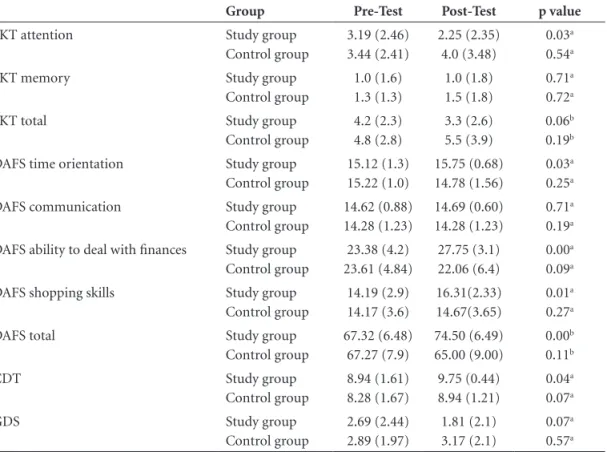
Table 4 depicts the means and respective standard de-viations of scores on the SKT, DAFS-R, CDT and GDS in-struments for the SG and CG on pre and post tests. Statisti-cal significance (p value) refers to Student’s t test for paired samples, which compared pre and post test performance for each group separately, or to the value obtained from the Wilcoxon’s non-parametric test.
Although data for both groups appeared similar at baseline assessment, significant changes were observed between initial and final assessments in the SG. Specifi-cally, significant improvements were observed in the SG
for attention (SKT), time orientation (DAFS-R), dealing with finances (DAFS-R), shopping skills (DAFS-R) and visuo-construction (CDT). Also in the SG, a reduction in reported depressive symptoms (GDS) and SKT test total was seen which approached statistical significance.
To verify whether groups evolved differently between pre and post test, delta values were calculated for each vari-able by subtracting the pre-test score from the post test score. The delta value is a measure of gain or benefit from training. Table 5 shows the means and standard devia-tions for the delta values on the SKT, DAFS-R, CDT and GDS. Analyses of deltas confirmed that the SG had sig-nificant improvements compared to the CG on attention (SKT), time orientation and ability to deal with finances (DAFS-R). The improvement in shopping skills, which em-ploy memory, approached a statistically significant level.
Discussion
Several recent studies have shown cognitive training to be an effective form of intervention in older adults with MCI.29,30 However, results have been mixed regarding the
ex-tent of the impact of such interventions on this population, and their capacity to prevent or delay conversion to dementia. In the present study, 34 older adults, previously diag-Table 3. Description of participants treated with lithium.
Lithium received Lithium not received
Study group 2 14
Control group 7 11
Study group n=16 and Control group n=18.
Table 4. Means and Standard Deviations (in parenthesis) for the cognitive variables and depressive symp-toms at pre and post test.
Group Pre-Test Post-Test p value
SKT attention Study group Control group
3.19 (2.46) 3.44 (2.41)
2.25 (2.35) 4.0 (3.48)
0.03a
0.54a
SKT memory Study group
Control group
1.0 (1.6) 1.3 (1.3)
1.0 (1.8) 1.5 (1.8)
0.71a
0.72a
SKT total Study group
Control group
4.2 (2.3) 4.8 (2.8)
3.3 (2.6) 5.5 (3.9)
0.06b
0.19b
DAFS time orientation Study group Control group
15.12 (1.3) 15.22 (1.0)
15.75 (0.68) 14.78 (1.56)
0.03a
0.25a
DAFS communication Study group Control group
14.62 (0.88) 14.28 (1.23)
14.69 (0.60) 14.28 (1.23)
0.71a
0.19a
DAFS ability to deal with finances Study group Control group
23.38 (4.2) 23.61 (4.84)
27.75 (3.1) 22.06 (6.4)
0.00a
0.09a
DAFS shopping skills Study group Control group
14.19 (2.9) 14.17 (3.6)
16.31(2.33) 14.67(3.65)
0.01a
0.27a
DAFS total Study group
Control group
67.32 (6.48) 67.27 (7.9)
74.50 (6.49) 65.00 (9.00)
0.00b
0.11b
CDT Study group
Control group
8.94 (1.61) 8.28 (1.67)
9.75 (0.44) 8.94 (1.21)
0.04a
0.07a
GDS Study group
Control group
2.69 (2.44) 2.89 (1.97)
1.81 (2.1) 3.17 (2.1)
0.07a
0.57a
nosed with MCI, were invited to take part in an 8-session cognitive intervention. Significant changes were found among SG subjects in time orientation, attention, memory and in some aspects of daily functioning, such as the ability to deal with finances.
Few studies on the effect of cognitive interventions in elderly with MCI are available in the literature. The outcomes of these interventions are controversial, where earlier studies have pointed to efficacy of this mode of intervention2,30-37 while others have shown no response or
only non-significant mild improvement in performance fol-lowing intervention programs.28,30,35 These discrepancies are
largely associated to the different methodologies adopted by each study, both in the approach used to assess interven-tion efficacy as well as the training protocol employed. The study samples are also heterogeneous among investigations. The intervention used in this study focused on ecologi-cal activities, i.e. activities simulating those of daily living among elderly. Research has highlighted the importance of this type of methodology in assessing the impact of train-ing on participants’ daily lives.10-12,32,34,36.
The memory exercises contained in the training pro-tocol were based on concrete objects (product packs aging purchased from the supermarket), used in the shopping simulations. These tasks were repetead several times at in-creasing levels of difficulty. Results showed no significant changes on the memory subtest of the SKT, which entails memorizing 12 color figures. However, a significant im-provement was observed in the shopping subtest of the DAFS-R which involves making a supermarket purchase. Thus, the efficacy of the intervention on similar tasks to those trained was observed, while a lack of transfer to other memory tasks was evident (memorizing figures). Previous
studies on training in healthy elderly have also shown that the effects of the interventions tend to be seen in similar tasks to those trained in the intervention.10,38-41
Notably, the most marked effects of this intervention were seen in subtests which recruit attention (SKT atten-tion score) and executive funcatten-tions (DAFS-R - dealing with finances). The training offered numerous opportunities of practice with mental calculations (summing the value of simulated purchases), and checking change, when partici-pants role-played the customer or checkout operator at a supermarket. These findings again suggest intervention effectiveness in cognitive tests which are similar to the ac-tivities trained, but also suggest possibly a higher degree of plasticity in executive functions.12,30,42,43
These differential findings between memory and atten-tion and executive funcatten-tions can perhaps be explained by the high number of individuals with amnestic MCI in our sample. It may be harder to change previously compro-mised functions than preserved functions in elderly with this profile.
Time orientation on the DAFS-R also showed substan-tial change between pre and post test in the SG. This en-hancement may have stemmed from the time orientation tasks performed at the beginning of each session and the activities which involved the use of a clock, in which each participant stated the time displayed, again showing greater effects on similar tasks to the trained ones.10,39,40
Changes in pre and post test performance also occurred for the Clock Drawing Test in the SG. These changes may have arisen from the contact with the clock in time orien-tation tasks, evidencing some degree of transfer between the skills trained (clock use) and those assessed (build-ing a clock). It should be noted that the CDT involves Table 5. Means and standard deviations (in parenthesis) for the Deltas of the cognitive variables
and depressive symptoms.
Study group Control group p value
SKT attention –0.94 (1.53) 0.55 (2.38) 0.04b
SKT memory –0.06 (0.68) 0.17 (1.39) 0.57ª SKT total –0.88 (1.71) 0.72 (2.23) 0.03b
DAFS orientation 0.63 (0.96) –0.44 (1.62) 0.05ª DAFS communication –0.06 (0.68) –0.78 (2.49) 0.53ª DAFS finances 4.37 (3.21) –1.56 (3.87) 0.00a
DAFS shopping 2.13 (2.95) 0.5 (2.03) 0.06ª DAFS total 7.19 (5.3) –2.28 (5.63) 0.00b
GDS –0.87 (1.82) 0.28 (1.5) 0.12ª
CDT 0.81 (1.64) 0.67 (1.5) 0.75ª
SG n=16, CG n =18.; aRefers to p value according to test for independent samples.; bRefers to the p value according to the
visuo-constructive skills which were not trained in the intervention.12,30,42,43
Interestingly, a reduction (of marginal significance) in depressive symptoms of SG subjects was observed after the intervention. This finding may be explained by the creation of new friendship ties and exposure to others facing similar cognitive problems. The opportunity to do the training and improve performance may also have had a positive impact on depressive symptoms.12,32
The current study suggests that cognitive training in older adults with MCI may represent a therapeutic option able to prevent or delay cognitive or functional decline.10
According to Ramos,44 cognitive performance and
depen-dence are modifiable factors associated to risk of death. In sum, cognitive interventions akin to the one applied in this study can contribute toward promoting health and independence among the elderly. Further investigations in larger samples are now warranted to verify the findings of the present study.
Grant supports – This study was supported by a grant by FAPESP process number 2007/03241-8.
References
1. Camarano A. Envelhecimento da população brasileira: uma contribuição demográfica. In: Freitas EV, Py L, Cançado FAX, Gorzoni ML (Eds). Tratado de geriatria e gerontologia (Rio de Janeiro): Guanabara Koogan, 2 edição; 2006:88-102 2. Salthouse TA. Theoretical perspectives on cognitive aging.
Hillsdale, NJ: Erlbaum; 1991
3. West RL. An application of prefrontal cortex function theory to cognitive aging. Psychol Bull 1996;120:272-292
4. Morris JC, Storandt M, Miller JP, Mckeel DW, Price JL, Ru-bin EH. Mild cognitive impairment represents early-stage Alzheimer disease. Arch Neurol 2001; 58:397-405
5. Hansson O, Zetterberg H, Buchhave P, Londos E, Blennow K, Minthon L. Association between CSF biomarkers and incipi-ent Alzheimer’s disease in patiincipi-ents with mild cognitive im-pairment: a follow-up study. Lancet Neurol 2006;5:228-234 6. Petersen RC, Doody R, Kurz A, Mohs RC, Morris JC, Rabins
PV. Current concepts in mild cognitive impairment. Arch Neurol 2001;58:1985-1992
7. Petersen RC, Stevens JC, Ganguli M, Tangalos EG, Cummings JL, Dekosky ST. Practice parameter: early detection of demen-tia: mild cognitive impairment (an evidence-based review). Report of the Quality Standards Subcommittee of the Ameri-can Academy of. Neurology. Neurology 2001;56:1133-1142. Comment in: Neurology 2001;56:1131-1132
8. Raschetti R, Albanese E, Vanacore N, Maggini M. Cholinest-erase inhibitors in mild cognitive impairment: a systematic review of randomised trials. PLoS Med. 2007; 27;4:e338
9. Diniz BS, Pinto JA, Gonzaga MLC, Guimarães FM, Gattaz WF, Forlenza OV. ‘To treat or not to treat’? A meta-analysis of the use of cholinesterase inhibitors in mild cognitive impairment for delaying progression to Alzheimer’s disease. European Eur Arch Psychiatry Clin Neurosci 2009 ;259:248-256.
10. Belleville S. Cognitive training for persons with mild cognitive impairment. Int psychogeriatr 2008;20:57-66.
11. Miotto EC, Serrão VT, Guerra GB, Lúcia MCS, Scaff M. Re-abilitação neuropsicológica de deficits cognitivos e transtorno cognitivo leve. Uma revisão da literatura. Dement Neuropsy-chol 2008;2:139-145
12. Olchik MR. Treino de memória: um novo aprender no envel-hecimento. Tese. Universidade Federal do Rio Grande do Sul. Porto Alegre. 2008;14-130.
13. Petersen RC, Smith GE, Waring SC, Ivnik RJ, Tangalos EG, Kokmen E. Mild cognitive impairment : clinical characteriza-tion and outcome. Arch Neurol 1999;56: 303-308.
14. Bottino CM, Almeida OP, Tamai S, Forlenza OV, Scalco MZ, Carvalho IAM. CAMDEX The Cambridge Examination for Mental Disorders of the Elderly: tradução e adaptação para o português. Projeto Terceira Idade (PROTER). 1999; São Paulo: Instituto e Departamento de Psiquiatria do Hospital das Clíni-cas da Faculdade de Medicina da Universidade de São Paulo. 15. Jorn AF, Korten AE. Assessment of cognitive decline in the el-derly by informant interview. Br J Psychiatry1988;152:209-213 16. Wilson BA, Baddeley AD, Cockburn JM. The Rivermead
Be-havioural Memory Test. 2.Ed. Tradução Oliveira RM, Schmidt SL. Suffolk: Thames Valley Company, 1991.
17. Fuld P. Guaranteed stimulus processing in the evaluation of memory and learning. Cortex 1980;16:255-271.
18. Flaks MK, Yassuda MS, Regina ACB, Cid CG, Camargo CHP, Gattaz WF, Forlenza OV. The Short Cognitive Performance Test (SKT): a preliminary study of its psychometric properties in Brazil. Int Psychogeriatr2006;18:121-133.
19. Hartmut L, Hellmut, E. The SKT. A Short Cognitive Perfor-mance Test for Assessing Deficits of Memory and Attention. Int Psychogeriatr 1997;9:115-121.
20. Zubicaray G, Ashton R. Nelson’s Modified Cards Sorting Test: a review. Clin Neuropsychol1996;10:245-254.
21. Army individual test battery. Manual of directions and scor-ing. Washington, DC: War Department, Adjunt General’s Office;1944.
22. Wechsler DI. Examiner’s Manual: Wechsler Adult Intelligence Scale-Revised. New York: Psychological Corporation;1981. 23. Loewenstein AD, Amigo E, Duara R, et al. A new scale for
the assessment of functional status in Alzheimer Disease and related disorders. J Gerontol 1989; 4:114-121.
25. Almeida OP, Almeida SA. Confiabilidade da versão brasileira da escala de depressão em geriatria (GDS) versão reduzida, Arq Neuropsiquiatr 1999;57:421-426.
26. Aprahamian I, Martinelli JE, Yassuda MS. O teste do desenho do relógio: revisão critica de seu valor na triagem de demên-cias iniciais em idosos. Rev Soc Bras Clín Méd 2008;6:130-134. 27. Fuzikawa C, Lima-Costa MF, Uchoa E, Barreto SM, Shulman
K. Bambuí Health and Ageing Study. A population based study on the intra and inter-rater reliability of the clock draw-ing test in Brazil: the Bambuí Health and Agedraw-ing Study. Int J Geriatr Psychiatry. 2003;18:450-456.
28. Sunderland T, Hill JL, Mellow AM, et al. Clock Drawing in Alzheimer’s disease: a novel measure of dementia severity. J Am Geriatr Soc 1989;37:725-729.
29. Rapp S, Brenes G, Marsh AP. Memory enhancement training for older adults with mild cognitive impairment: a prelimi-nary study. Aging Ment Health 2002;6:5-11.
30. Belleville S, Chetrkow H, Gauthier S. Working memory and control of attention in person with Alzheimer’s disease and mild cognitive impairment. Neuropsychology 2007;21:456-469. 31. Winocur G, Craik FIM, Levine B, et al. Cognitive rehabili-tation in the elderly: Overview and future directions. J Int Neuropsychol Society 2007;13:166-171.
32. Talassi E, Guerrecshi M, Feriani M, Fedi V, Bianchetti A, Trabucci M. Effectiveness of a cognitive rehabilitation pro-gram in mild dementia (MD) and mild cognitive impairment (MCI): a case control study. Arch Gerontol Geriatr 2007; 44 (Suppl 1):391-399.
33. Cipriani G, Bianchetti A, Trabucchi M. Outcomes of a com-puter-based cognitive rehabilitation program on Alzheimer’s disease patients compared with those on patients affected by mild cognitive impairment. Arch Gerontol Geriatr 2006; 43:327-335.
34. Akhtar S, Moulin CJA, Bowie PCW. Are people with mild cognitive impairment aware of the benefits of errorless learn-ing? Neuropsychol Rehabil 2006;16:329-346.
35. Levine B, Stuss DT, Winocur W, et al. Cognitive rehabilitation in the elderly: Effects on strategic behavior in relation to goal management. J Int Neuropsychol Society. 2007; 13:143-152 36. Rozzini L, Costardi D, Vicini CB, Franzoni, S, Trabucchi M,
Padovani A. Efficacy of cognitive rehabilitation in patients with mild cognitive impairment treated with cholinesterase inhibitors. Int J Geriatr psychiatry 2007;22:356-360. 37. Belleville S, Gilbert B, Fontaine F, Gagnon L, Menard E,
Gau-thier S. Improvement of episodic memory in persons with mild cognitive impairment and healthy older adults: evidence from a cognitive intervention program. Dement Geriatr Cogn Disord 2006;22:486-499.
38. Troyer AK, Graves RE, Cullum CM. Executive functioning as a mediator of the relationship between age and episodic memo-ry in healthy aging. Aging Neuropsychol Cog 1994;1:45- 53. 39. Willis SL, Tennstedt SL, Marsiske M, et al. Long term effects of
cognitive training on everyday functional outcomes in older adults. JAMA 2006;296):2805-2814.
40. Yassuda MS. Memória e envelhecimento saudável. In: Freitas EV, Py L, Cançado FAX, Gorzoni ML (Eds). Tratado de geria-tria e gerontologia (Rio de Janeiro): Guanabara Koogan, 2 edição; 2006:1245-1251.
41. Yassuda MS, Abreu, VPS. Avaliação cognitiva. In: Freitas EV, Py L, Cançado FAX, Gorzoni ML (Eds). Tratado de geriatria e gerontologia (Rio de Janeiro): Guanabara Koogan, 2 edição; 2006:1252-1259.
42. Hampstead BM, Sathian K, Moore AB, Nalisnick C, Stringer AY. Explicit memory training leads to improved memory for face-name pairs in patients with mild cognitive impairment: results of a pilot investigation. J Int Neuropsychol Soc 2008; 14:883-889. 43. Kurz A, Pohl C, Ramsenthaler M, Sorg C. Cognitive reha-bilitation in patients with mild cognitive impairment. Int J Geriatr Psychiatry 2009; 24:163-168.