FREE THEMES
1 Departamento de Medicina Preventiva, Universidade Federal de São Paulo. R. Botucatu 740, Vila Clementino. 04023-062 São Paulo SP Brasil. consuelosampaiomeneses@ gmail.com
2 Instituto Superior de Ciências do Trabalho e da Empresa, Instituto Universitário de Lisboa. Lisboa Portugal. 3 Departamento de Saúde Coletiva, Faculdade de Ciências Médicas, Universidade Estadual de Campinas. Campinas SP Brasil.
Lay agency and the generation of public-private
mix health care maps
Abstract This paper discusses part of the results obtained from a study carried out in two cities of the so-called ABCD Paulista Region in the peri-od 2010-2012, in an attempt to spot the existence of non-state regulatory rationale towards access and consumption of health care services. The first stage includes interviews carried out with strate-gic stakeholders (managers and politicians) and key workers players. The second stage collected the stories of 18 very frequent users of health care ser-vices. This study revealed the leading role played by users to produce “health care maps”, with em-phasis on the frequent use of public and private resources in their itineraries, circumventing or merging with government regulation to obtain the care they need. The different formats of pub-lic-private mix transcend the still prevailing “offi-cial” concepts about the clear distinction between the two systems, which reveals the importance of this theme to public health management.
Key words Health policy, Health care delivery, Health administration, Unified Health System, Prepaid health plans
Consuelo Sampaio Meneses 1
Luiz Carlos de Oliveira Cecilio 1
Rosemarie Andreazza 1
Graça Carapinheiro 2
Maria da Graça Garcia Andrade 3
Sílvia Maria Santiago 3
Eliane Cardoso Araújo 1
Ana Lúcia Medeiros Souza 1
Denizi Oliveira Reis 1
Nicanor Rodrigues da Silva Pinto 1
M
eneses CS Introduction
Qualitative studies conducted from the users’ perspective point to their ability to produce strategies to overcome the obstacles found in the intricate formal flows of the health system, evidencing their leading role in obtaining care
and their importance as subjects of knowledge1-4.
Investigations show that they are carriers of a “lay rationality” and, therefore, do not act, in the search for care, in a “wild” or irrational way, due to lack of knowledge, intentionality or
direction-ality1-4, as also pointed out in the research that
provided the empirical data for this paper1.
The original research was developed as a PPSUS project in two municipalities of the so-called ABCD Paulista Region, in the period 2010-2012 and sought to investigate the rationale of regulating access and use of health services, both in their formal dimension, under the govern-ment’s responsibility and the informal, as a result of the work of health professionals and various social stakeholders, among which are users. It was possible to observe that users construct true “healthcare maps” from a practical knowledge coming from their own experimentation and ob-servation of how to obtain access to the care that
they deem necessary, making use of the public or
private medical-hospital-ambulatory apparatus in creative and combined fashion, according to their possibilities and/or controls of resources, such as having a health plan or personal contacts and knowledge, for example.
The remarkable performance of users, called in the study “lay agency”, expresses their actions in search of solutions to their health problems through strategies to increase access to resourc-es both “outside” the official flows and arrange-ments planned by managers and within them, which includes seeking private services.
Thus, service flows and service networks designed at the government level are reinter-preted and experienced by users in the form of
maps, with references and configurations
differ-ent from those advocated by formal regulation, including the mentioned combination of public and private services. Interpenetration of pub-lic-private relations observed in users’ experienc-es transcends the current conceptions about the
clear distinction between the two health systems. This is the central point that we intend to discuss in this paper.
Therefore, in addition to an administrative arrangement intended by governmental regu-lation, guided by directives that mark the SUS,
more complex regulatory processes, which in-volve different, constantly establishing rational-ities are being outlined.
In the supplementary sector, the regulatory apparatus of operators places great emphasis on the regulation of access (or micro-regulation), subordinated to the primary purpose of capi-tal accumulation, and directing to preferential providers is the guideline governing this whole
process5,6. Later studies have already drawn the
attention to the role of users in the strategies of resistance to such mechanisms, producing their own regulation, which clashed with the
regula-tion of the operators7,8.
The role of users in the active construction of the public-private mix in the therapeutic itin-eraries, actively operating various arrangements to overcome access and comprehensive care gaps
had also been pointed out by other authors9,10.
When it comes to studies on the public-private health services mix, several study approach-es have been used, such as unequal supply and use of services for the population with a health
plan11; the inevitable public-private mix even for
the feasibility of PHC12; the difficult equilibrium
point in the public-private equation in countries with well-established national health systems when one considers the equity of access to and
consumption of health services13; and the
possi-ble negative impact on public sector goals due to the simultaneous use of public and private
ser-vices14,15. This study aims to give visibility to the
public-private mix based on people’s itineraries through their “lay agency” to try to address their health problems.
The methodological path
The study was carried out in two large munic-ipalities (called A and B) in the ABCD Paulista Region, São Paulo, Brazil, which, despite living distinct stories of SUS construction, currently have a structured, specialized and hospital PHC network, with urgent and emergency services, and others with greater regional technological density. Despite socioeconomic and demograph-ic distinctions, they have similar epidemiologdemograph-ical
profiles1.
In order to know the different paths of users seeking care, a qualitative investigation was cho-sen that privileged the inductive approach of
re-ality16,17 so that, from the empirical viewpoint, it
understand-e C
ole
tiv
a,
22(6):2013-2024,
2017
ing of the existing mismatch between users and
health services1.
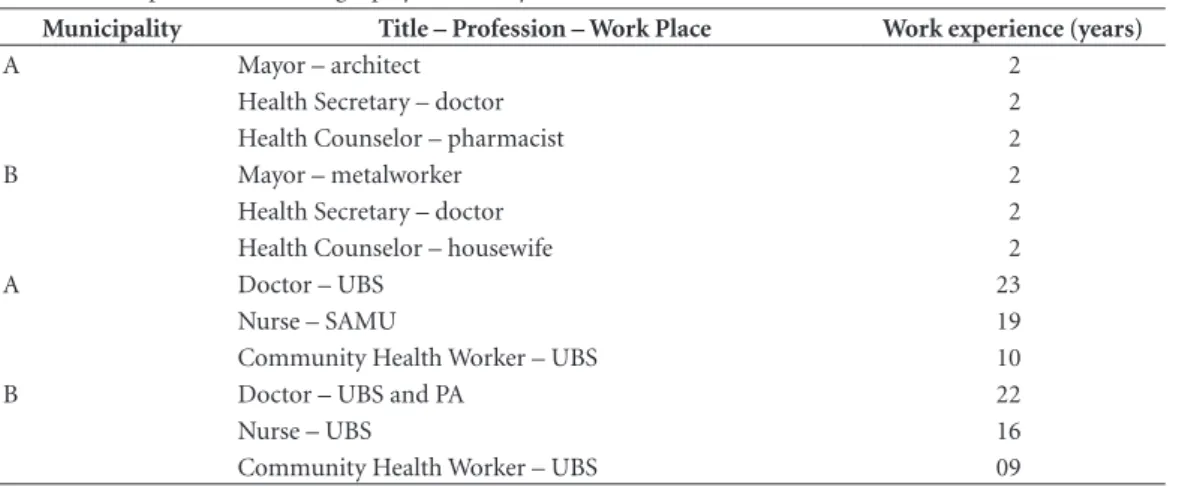
The sources of information in the study were in-depth thematic interviews with strategic play-ers (mayor, health secretary and municipal health counselors), active producers of policy defini-tions and government regulation decisions, as well as semi-structured interviews with other key informants (health counselors, nurse, and doc-tor), according to Table 1.
The biographical method was used18-22 from
the collection of 18 life stories of frequent users of health services and indicated by community health workers (CHW) through the following question: “Could you point out local dwellers that draw your attention with the way they seek to solve their health problems?” All users received a flower codename and their main characteristics are described in Table 2.
The biographical approach, as some authors
prefer19,22, makes it possible to produce scientific
knowledge based on human experience and, al-though reports are individual, they admit access
to a social practice22. A life story allows subjects
to express the contents of a dimension of their
lived experience in relation to a given situation20.
In this research, interest was in episodes of illness and in the search for and use of health services.
Life story collection is based on an invitation to the respondent to speak freely about how he/
she experienced a given life situation20. From the
very first moments of the interview, people began to talk about their health and their diseases, often giving opinions or making judgments about the health services used. This flow of memory and emphases built up the material valued by the
re-searcher who established the dialogue at the time of writing the narrative of that person’s life.
There was no prearranged script of questions. As there were no specific questions to ask wheth-er the respondent was using private swheth-ervices or not, the previous or current use of health plans, the desire to have a health plan, or even the pay-ment of a private consultation to obtain a “sec-ond opinion” were elements that arose in the course of collecting these stories. In other words, the research had no prior intention to character-ize the public-private mix. Having or not a health plan was not used as a criterion for the inclusion of users for the collection of life stories, which makes results found during the investigation more expressive.
Life story collection was performed at the household, and recording was done digitally, with the consent of the respondent, who signed the Informed Consent Form (as approved by the Research Ethics Committee of Unifesp). There were no refusals from the people indicated to participate in the interviews, which lasted around 60 to 120 minutes.
The services will be referred to as in the orig-inal survey. Interviewers were the researchers themselves, eleven in total, who collected one to three life stories. All were health professionals or health managers, with different higher education backgrounds.
With the address and phone number, re-searchers themselves contacted people, so no third parties were recruited to conduct views. Thus, the same team that conducted inter-views took responsibility for the analysis of the material collected.
Table 1. Description of the strategic players and key informants interviewed.
Municipality Title – Profession – Work Place Work experience (years)
A Mayor – architect 2
Health Secretary – doctor 2
Health Counselor – pharmacist 2
B Mayor – metalworker 2
Health Secretary – doctor 2
Health Counselor – housewife 2
A Doctor – UBS 23
Nurse – SAMU 19
Community Health Worker – UBS 10
B Doctor – UBS and PA 22
Nurse – UBS 16
M
eneses CS Table 2. Main characteristics of users interviewed.
Respondent Gender Age
(years) Family status Work status Main health problems
Érica Female 44 Married, 3 sons Retired, she was a
Community Health Worker (CHW)
Postpartum depression and panic syndrome
Tulipa Female 47 Married, 1 son and a
granddaughter. The son is a nurse.
Housewife – she owned a restaurant.
Diabetes Mellitus (DM), heart disease and gynecological hemorrhage - anemia.
Lírio e Acácia
Male 64 Married, 3 daughters,
of which one is already deceased.
Retired. He was an automobile worker.
Systemic Arterial Hypertension (SAH), MD and heart disease
Miosótis Female 35 Married, 3 sons. They all
live together.
Housewife. She worked with transport.
Hypoglycemia and headache.
Hortência Female 72 Separated, 3 sons. One of
the daughters is a CHW in a UBS.
Retired. She was a housekeeper.
Arthrosis, asthma, hernia, SAH, DM and hearing difficulty
Orquídea Female 39 Married, 7 sons. They all
live together.
Housewife. She sold candies at traffic lights.
Special son: neurological and motor sequelae due to meningitis.
Manacá Male 57 Married. 4 sons, 2
grandsons.
Retired. He was an automobile worker.
Accident at work, herniated disc, alcoholism, SAH
Jasmim Male 47 Married, 1 daughter. Retired. He was an
automobile worker.
Accident at work - injury to the spine and severe hand injury.
Rosa Female 48 Lives with the second
husband and son of the first marriage.
Self-employed, she sells cleaning products. She was a food-manufacturing worker.
Breast cancer.
Margarida Female 52 Married, 4 sons, 8
grandsons.
Day-worker. She has been unemployed for three years.
Rheumatoid arthritis, SAH and DM
Magnólia Female 57 Married Housewife. Morbid obesity with gait
problems Flor de
Bambu
Male 73 Married, 6 sons. Retired. He was a
metalworker.
SAH, chronic obstructive pulmonary disease (COPD), and heart disease
Cravo Male 54 Married, 2 sons, lives with
spouse and one son.
Retired. He was a metalworker.
SAH, Congestive Heart Failure (CHF) and cataract
Amarílis Female 70 Widow, one daughter and
3 grandsons. Lives alone in a home adjacent to that of her sister.
Retired, she was a housekeeper and artisan (she sold at home).
SAH, DM and heart disease
Violeta Female 70 Single, 2 children.
Lives with the son, the daughter, the son-in-law and two grandsons.
Retired, general cleaning services worker at the local SUS services.
Currently, breast cancer
Camélia Female 52 Widow, one son. Lives
with the mother and the son.
Retired, she was a tailor and baby-sitter.
SAH, nephropathy and kidney transplantation
Jacinto Male 60 Married, lives with spouse
and a granddaughter they raise.
Retired for invalidity, he was security guard for a metalworking factory.
Has been a paraplegic for 17 years (he was shot at work while working as security guard)
Dália Female 57 Lives with husband, a
retired metalworker.
Housewife, but works as a tailor outside.
e C
ole
tiv
a,
22(6):2013-2024,
2017
The number of life stories were deemed suf-ficient in view of the great extent and richness of the material, including the very expressive emer-gence of contents related to the public-private mix, which surfaced spontaneously from respon-dents, and became the object of this study.
Priority will be given to users’ comments on
the identification of the public-private mix in their itineraries reconstructed based on their life stories (8 residents of municipality A and 7 of municipality B), except for the three who never had contact with private services and only used the SUS.
“Public” and “private” were considered ac-cording to the legal nature of healthcare services. In the first case, those directly managed by the State or convened and/or contracted by the State, but guarantors of free access according to the principles of SUS. In the second, in the case of the study, private health plans were considered, and, in a less expressive way, out-of-pocket pay-ment to the provider.
The analysis of the material was done simul-taneously to the process of collecting users’ life stories in the regular seminars of the research group.
After several analytical movements, which included the interviewers’ oral accounts of the life stories’ collection (their impressions, hard-ships and perceptions) and the reading of the full transcription of each account by all researchers, given the extensive material produced, we opted for the methodological strategy of transforming
the contents of the interviews into life narratives,
organized in three blocks of themes that facilitat-ed the interpretation of the experience that was being produced in the field, as per Chart 1. These narratives were read and discussed collectively, which allowed for the progressive appropriation of the complex articulation between public and private services produced by users, with their lay agency. Again, it is precisely in the
sponta-neous nature and richness of references to the public-private mix that lies the importance of research findings.
The analysis of users’ life narratives evidenced the marked presence of the public-private mix in their “healthcare maps”, which will be shown below. Such “maps” revealing a certain arrange-ment of a set of services and/or professionals that may be triggered by their needs, have given visibility to alternative circuits of care, such as “health systems” that are being produced, some-times surprisingly, in the interstices of the formal health system. They thus synthesize the dynamics of users’ pathways and their lay agency to pro-duce stable and reliable schemes, not outlining a design that is logical and necessarily consistent with the hierarchical pyramid of services.
Results and discussion
In the two municipalities studied, with an eminent urban and industrial profile, most re-spondents had or had in the past a private health plan, which resulted in a construction of “short circuits” within the very health system. Chart 2 shows a summary description of the cases ac-cording to the use of public and private services in the two municipalities (A and B):
Of the eighteen users surveyed, thirteen re-ported current or previous experience with pri-vate health plans market, four of which currently have them and nine have had them at some point in their lives, and the global use of these resources in each narrative is shown here. Of the five that never had health insurance plans, two reported occasional experiences with the private sector through out-of-pocket disbursement.
While not defined as inclusion criterion, hav-ing a health plan made data more surprishav-ing, as was not only considering the concomitant use of the public and private services, since the refer-ence to current or past plans, or the desire to have
Chart 1. Guiding scheme of life narratives
The social portrait of respondents. Their living conditions. Insertion in the world of work. The family care
network. Diseases impacts on patients’ autonomy and lifestyles.
The social experience of the disease: the reconstruction of health services use. Professional contacts: the main
references. Absences and attendance. Itineraries made. Hurdles and facilitation, the “short-circuits”.
The analytical elements in the biographical history. The existing regulatory regimens, their intensities and
M
eneses CS or have again a plan became a relevant element
of the study.
The main points observed and analyzed are highlighted below.
Public-private composition as a strategy for access to healthcare
The public-private mix contributes with el-ements to the understanding of the SUS itself in the two selected municipalities, highlighting re-current themes such as access to medium-com-plexity services and the role of PHC, whose diffi-culties in the coordination of care can influence the configuration of the healthcare maps by
users21. Thus, system’s interstices gain visibility
through the unveiling of other logics, especially by the public-private connections, which express disagreements especially between PHC and spe-cialized care.
Thus, the main argument to seek a health plan or the desire to have it is delayed schedul-ing procedures, examinations, consultations with specialists, scheduling returns in specialty out-patient clinics and hospitalizations, exposing the aforementioned medium-complexity services is-sues in the SUS:
PHC, for example, checking high blood pres-sure, a child’s fever, a flu or something like that is extremely well serviced. However, it is very hard to schedule an appointment with a specialist. (Érica)
Some frequent configurations
of the public-private mosaic in the maps studied - an exercise to systematize observed regularities
The life narratives allowed to identify some regularities in the public-private combinations of the maps produced by users, revealing emphases in the perceptions of the value of using SUS and Supplementary Health, although configurations are very dynamic and some users experience var-ious situations over time:
Uses the SUS because he/she lost the health plan, but he/she regrets its loss or is envisaging to have a private one (Jasmim, Érica, Margarida, Lírio)
Private-public movement direction occurred most often after the loss of health plan after leaving the job, increased charges of the plan or through retirement (in this case, generally coex-isting with chronic pathologies), as well as for the realization of high complexity procedures not covered by the plans (hemodialysis, transplanta-tion, oncological treatment, etc.).
We worked at the company and did not need the health system, because we had a covenant. From 2000 on, I suffered the accident. Unfortu-nately, I have a sequel in my left hand; I cannot open my hand... I fractured 2 vertebrae from the spine... Then, I retired and they stopped the cove-nant. [...] It was when I needed the Unified Health
Chart 2. Use of Services.
1. Flor de Bambu (A) SUS + covenant (73 years)
2. Jacinto (A) SUS + covenant (59 years)
3. Manacá (B) SUS + covenant (57 years)
4. Rosa (B) SUS + covenant (48 years)
5. Camélia (A) SUS – had covenant (52 years)
6. Cravo (A) SUS – had covenant (54 years)
7. Dália (A) SUS – had covenant (57 years)
8. Érica (B) SUS – had covenant (44 years)
9. Jasmim (B) SUS – had covenant (47 years)
10. Lírio (B) SUS – had covenant (64 years)
11. Magnólia (A) SUS – had covenant (57 years)
12. Margarida (A) SUS – had covenant (52 years)
13. Tulipa (B) SUS – had covenant (47 years)
14. Amarílis (A) SUS + occasional out-of-pocket expenses (70 years)
15. Orquídea (B) SUS + occasional out-of-pocket expenses (39 years
16. Hortênsia (B) SUS exclusively (72 years)
17. Miosótis (B) SUS exclusively (35 years)
e C
ole
tiv
a,
22(6):2013-2024,
2017
System; there, I was practically never attended...
[...] I heard them say, I don’t know for sure, that
the matter is in Court. They said they’ll try to see if they can reinstate the covenant. (Jasmim)
[In the private sector] I could do everything,
everything. I was monitored very closely by the car-diologist and very well followed-up by the psychi-atrist. [...] However, apparently, I will have to pay an appointment with a cardiologist. Because if you pay the consultation, you go and are attended, he evaluates your condition and you are entitled to a return. That is what I want, that is what I am up
to. (Érica)
Then he [the husband] discontinued because he said it was expensive, so he took and stopped the covenant and left me without it. He deceived me!
[...] Now it has to be this, because I have no
cove-nant, it has to be this. Just like when I was hospital-ized, everyone was terrified, and my children said: ‘Oh, you have to make a covenant for our mother, stuff like that, whatever…’ (Margarida)
After I left the firm, I still spent three months in the car manufacturing plant’s covenant. [...] Then we retire with a miserable salary, there was no way I could pay the covenant anymore. ‘But so far so good, when I get older...’ (Lírio)
The above quotes reveal the expectation of recouping the private health plan, not only be-cause of the difficulties faced in the SUS to access medium complexity services, but also as an aspi-ration to a supposedly more stable and guaran-teed healthcare map.
However, the following was also observed:
He/she started using the SUS because he/she lost his/her private health plan, but he/she likes the
SUS (Tulipa, Cravo, Dália, and Magnólia)
The statements of Tulipa, Cravo and Dália al-ready show a real appreciation of the SUS among former plans users (for the use value and ad-vantages found there that may even surpass the private sector) and also a gradually more critical view of the market (as is the case of Cravo):
Look, I think I would continue in the UBS, mainly because of the diabetes problem, right?... So, I would not despise the UBS, no... Because the little dextro needle is expensive, right? The little device as well: the simplest is 100 reals... Friendship too... Because depending on the situation you are in, they will do whatever they can to help you. (Tulipa)
Covenants are no longer what they used to be... SUS was better than the covenant. Because… look at me now! This is with the SUS doctor. I’m great!... I was impressed with how the Specialty Service treated me so well when I had a surgery there, it seemed as if I was paying... (Cravo)
There are people who say, ‘Oh, I don’t know this or that, I pay the covenant.’ Not me! At the hospital that I’m going to, I get along well at the hospital and stuff. Do I pay the covenant if don’t have the means? (Dália)
Ensured access to SUS high complexity ser-vices, given its greater technological density, can relieve the difficult access to medium complexity services and the alleged need to have health plans arising from it, which is another factor that may confer greater use value to the SUS:
[I used] the covenant regularly, for everything,
for the children, for my husband, for me. But I had to pay. Then, I couldn’t do it anymore. So, you know how it is, if I did not have the Hospital das Clínicas card, what would I do with my life now? Because neither at the ‘Saúde em Casa’, nor in any other place is there… The medicine that I take, what was I going to do? It is too expensive! (Magnólia)
Uses the SUS due to the lack of coverage for high complexity procedures by the private health plan (Camélia, Rosa)
Camélia was being monitored for hyperten-sion at the UBS, migrated to the private service
(because doing tests at the Health Post was very
time consuming, and that ended up harming me
more) and then returned to the public service
(in a clinic that had a covenant with the SUS) to perform hemodialysis not covered by the health plan, establishing a public-private-public route:
Then I started doing hemodialysis there... Until then, the covenant paid. Then, the covenant didn’t want to pay anymore... It left me there without pay-ing and people there said to me they I could not do hemodialysis anymore; if the covenant did not pay, I could not come back the other week. (Camélia)
Rosa had to resort to the SUS to complete the cancer treatment (chemotherapy and follow-up with the SUS oncologist, after radiotherapy made by the health plan), and this private-public artic-ulation was operated through professional con-tact of the operator’s oncologist with the Univer-sity Hospital.
Because I went to the covenant’s oncologist, and he said that I could not be doing the chemo there because the covenant did not cover it. So he wrote a letter and referred me to the University Hospital...
(Rosa)
M
eneses CS The Metalworkers’ Union negotiates in all the
agreements to have a medical covenant. Now, it’s that thirty reals-a-month medical covenant that puts an outpatient service in the city, you go to the outpatient service and then you have to seek the public network to get the solution. (Mayor A)
He/she uses the private service and the SUS because he/she needs both for the payment of his/ her care, because the SUS is good or better than the private health plan or the covenants are worse than the SUS (Manacá, Flor-de-Bambu, Rosa, Jacinto)
Plans’ users that use the SUS concomitant-ly appreciate it and do not give it up due to the use value found. Manacá began the outpatient treatment for alcoholism via the SUS, opted for hospitalization under the health plan, continuing post-hospitalization follow-up at the UBS and taking medication at the UBS and the CAPS.
I became an alcoholic after I stopped working; I don´t know if it was depression... Then I did treat-ment at the Post... I was hospitalized via the cov-enant. I was hospitalized for five days and I went back and continued the treatment in the SUS... So, since I was treated very well there, I think that due to their treatment there, I did not want to go back to the addiction.(Manacá)
Flor-de-Bambu illustrates how the pub-lic-private mix can result in a quite complete “health system” from the perspective of the pa-tient, where SUS paradoxically assumes the com-plementary role:
I had a pacemaker evaluation there [at the
University Hospital]. Through the covenant... It
was the only place that evaluated the pacemaker... I use the municipality’s transport... Because we had transport difficulties through the covenant... Now, at the UBS, not anymore... It is more practical, be-cause the covenant is full of bureaucracy. [Receives
the high-cost drug] from the General Regional
State Hospital... And the antidepressant, at the Municipal Hospital... We get the anti-inflammato-ry at the UBS. Transport, medicine, they provide them. [...] Fluoxetine is provided by the Municipal Hospital... Moreover, since the [high-cost] med-icine is expensive, then I go there at the General Regional State Hospital to get it. (Flor-de-Bambu)
For Rosa, PHC is satisfactory and is some-times even more advantageous than the health plan, in addition to having mediation done by the CHW to enable the scheduling of consulta-tions:
[In the private service] I go to my mastologist
every 6 months. I go to the gynecologist, gastroen-terologist and dermatologist. [In the SUS] I use the gynecology and the dentist... [...] so when it is
something I need very fast, I use it here[UBS]. If it is something I cannot wait for, I talk to the health worker. Then she talks there and gets it, and she gets a doctor for me. (Rosa)
When I do not do it via the covenant, I also do with them my blood test... I spend more time here than at the covenant itself. (Jacinto)
Predominant use of the SUS, using the private services for specific situations (Amarílis, Orquídea)
Users without financial conditions to cov-er the fixed costs of health insurance plans will eventually use out-of-pocket disbursement ser-vices. Amaryllis makes private tests and consul-tations when returns in this service are time con-suming:
Did you tell her why you did it in the private services? It was going to take three more months for her cardiologist to see her at the Public Hospital. Because she goes, she schedules the return, which is, normally, in 2 or 3 months time. She was not feeling very well, so I advised her to go to the cardi-ologist, until it was time to see her own cardiologist at the Public Hospital. (Amarílis’ sister)
Orquídea chose to perform the physiotherapy of the son in a private clinic linked to a university by indication of the neurologist who follows-up the child.
He is doing it [physiotherapy] because I man-age to get it, it is private, I am paying for it... Be-cause the municipality waitlisted him to do physio-therapy once a month. However, his case is getting worse. Once a month is maintenance, which I can do at home. (Orquídea)
Doctors’ transit across both systems
The transit of doctors across the two systems is another factor that reinforces the public-pri-vate mosaic, as seen in the case of transplanted Camélia, who recognizes the same physicians working in the private hemodialysis clinic cove-nanted with the SUS and in the public hospital, where she had the transplant. Margarida has se-vere rheumatoid arthritis and follows a complex itinerary between the two health systems, whose doors are being opened by the doctor:
It was here, but they work there too... And doc-tors are from here, from the Dialysis Service and from the University Hospital. (Camélia)
e C
ole
tiv
a,
22(6):2013-2024,
2017
she worked for the covenant. I am very well attend-ed!... I paid nothing. Then I only got the medicine at the Regional General State Hospital and collect-ed the mcollect-edicine there. (Margarida)
Doctors’ cross work may be synergistic in ad-dressing patients’ needs by being in a privileged position in the health system to make technical choices for patients and enhance the quality of care by making single-handedly a public-private interface.
The gradual change of expectations regarding the SUS and the perception of market failures
Despite the difficulties in the public and the historical and cultural valuation of the private sector, the narratives also show a recognition of the use value of the SUS by users in the programs of hypertension, diabetes and alcohol abuse con-trol; in home care, transportation to other ser-vices (including private ones), vaccination and medication in general. The link with the doctor and the team is also recognized in several mo-ments as an important gain, and it is possible to perceive a recognition of the quality of care pro-vided in the SUS.
Research findings showed that users (or for-mer users) of private health plans, after overcom-ing resistance to the public sector (after losovercom-ing plans or receive treatment for some needs in the SUS that plans do not cover), “discover” the SUS and start to value it, expressing how their person-al experience relativizes preconceived ideas about the SUS, which sometimes comes to be consid-ered, in some ways, better than private health plans:
He did something that I thought was excellent, and I did not even think that through the State, the SUS, he did this service. I took everything here... everything at the Post and CAPS... The treat-ment was very good, excellent... Look at me here!
(Manacá)
However, the doctor said, ‘He’s going to be dis-charged... But he needs a doctor at home. You need to have home care’. Then, they said that at the UBS, they could come to the home. In addition, since I had never used it, I did not know I had this facili-ty. I just needed to ask and the doctor would come and see me. They sent the medicines home. We are satisfied with the UBS. I think they are excellent!
(Flor-de-Bambu)
Rosa is a good example of discretionary use of the SUS for herself, using the public-private mix, and for her mother, who has disabling
ar-ticular problems and hypertension, who is exclu-sively using the SUS:
As I said, before there was no family doctor, none of this was there, she had to walk from here to there... Now, with the family doctor, she comes here, once a week, we schedule with her... [If I
could get a health plan for my mother] it would
not add much, because the covenant would not send a doctor here... Yeah, she would not be with a doctor here, available to be coming here to do the service that the doctor is doing here. (Rosa)
In short, although the private sector’s de-mand for map composition is not only explained by the inadequacies of the SUS, the problems in access to medium complexity services reduce public service expectations, mobilizing users to seek some reduced time for access to some more specialized services. The delay in care by special-ists seems to be one of the main reasons people want to have, maintain or have again a health plan, even when SUS use value is recognized.
On the other hand, when they are exposed to the SUS, Supplementary Health users have other evaluation parameters and recognize the mar-ket’s deficiencies, such as the decreased quality of care, plans’ access micro-regulation mechanisms and shortcomings of the network of accredited operators. This fact results in the increased use of the public network by the health plan-holders users, who start to compete with SUS exclusive users for treatment vacancies and resources, as seen below:
But this draws a lot of attention, the fact that the private network and hospitals are going bankrupt, they are barely standing on their feet, and there is an invasion... a very important occupation of users who have health plans using the public network of services...Several of them claim problems of health plan quality or difficulties due to micro-regulation access mechanisms, which are very evident in the conversation with these users, or because the net-work offered is far away, it is very distant. (Health Secretary B)
Final considerations
M
eneses CS the unilateral legitimacy of scientific or
profes-sional specialized knowledge.
Routes designed by users showed that the possibilities of public-private connection are countless. Each user is able to construct from
sin-gular nexuses his “health system” or “healthcare
maps”. Users believe the two systems work, in fact, as communicating vessels, or as a true mo-saic, a fact not yet properly recognized by public management.
Private plan holders say SUS universality facilitates the composition of more complete “maps” than for those who depend totally on public services. It is undeniable that those who have a health plan are more likely going to pro-duce a more complete and stable “healthcare map” than those who only rely on public services.
While there is still a social imaginary that as-signs to the private sector virtues that would be lacking in the public sector, the growing issues with private health plans seem to contribute, ap-parently, as shown by some findings of the study, to modify the value judgment attributed to the SUS. Significant statements by some users reveal a growing demystification regarding the quality of care received in the private sector, and a higher recognition of SUS, at least in the two munici-palities studied. The emblematic declarations of Rosa capture a snapshot of this reality, which is an unprecedented and expressive data of a reality that is emerging.
The fact that the research was carried out in typically urban and industrial municipalities may have influenced the results found: first, be-cause the historical construction of expectations regarding the consumption of health plans cor-responds to a labor gain in these places. The in-terviewed managers also point out a movement of inflection of health plans due to their own growth, and the greater rigor of their micro-reg-ulatory rationale, which among other things tightens their network’s access and consumption control mechanisms, which was perceived by users. The structural and functional shortcom-ings of the service network made available by the plans makes its limitations and contradictions even more evident, more so when compared with the significant strengthened and expanded SUS supply in the municipalities studied.
e C
ole
tiv
a,
22(6):2013-2024,
2017
Collaborations
CS Meneses is responsible for the design of the paper and worked on the collection and analy-sis of the empirical material, the writing of the paper and the approval of the final version. LCO Cecilio worked on the design and coordination of research, methodology, empirical materi-al anmateri-alysis, criticmateri-al review of the paper and ap-proved the final version. R Andreazza worked on the design and co-coordination of research, col-lection and analysis of empirical material, critical review and approval of the final version. G Car-apinheiro worked on the design and co-coordi-nation of the research, the critical review and the approval of the final version. MGG Andrade and SM Santiago worked on the collection and anal-ysis of the empirical material, the writing of the paper and the approval of the final version. EC Araújo, ALM Souza, DO Reis, NRS Pinto and SM Spedo worked on the collection and analysis of empirical material, critical review and approval of the final version.
References
1. Cecilio LCO, Carapinheiro G, Andreazza R, Souza ALM, Andrade MGG, Santiago SM, Meneses CS, Reis DO, Araújo EC, Pinto NRS, Spedo SM. O agir leigo e o cuidado em saúde: a produção de mapas de cuidado.
Cad Saude Publica 2014; 30(7):1502-1514.
2. Carapinheiro G. Inventar percursos, reinventar reali-dades: doentes, trajetórias sociais e realidades formais.
Etnográfica [periódico na Internet]. 2001 Nov [acessada
em 2015 maio 16]; 5(2):[cerca de 23 p.]. Disponível em: http://ceas.iscte.pt/etnografica/docs/vol_05/N2/Vol_ v_N2_335-358.pdf
3. Andreazza R, Carapinheiro G, Teixeira L, Cecilio LCO. Do Centro de Saúde à Unidade de Saúde Familiar: nar-rativas de ausência e intermitências. Saude soc 2011; 20(Supl. 1):S200-201.
4. Andreazza R. Narrativas dos caminhos dos cidadãos portugueses no Serviço nacional de Saúde. Circulação de saberes leigos. In: Carapinheiro G, Correia T. Novos
temas de saúde, novas questões sociais. Lisboa: Mundos
Sociais; 2015. p. 99-104.
5. Malta DC, Cecilio LCO, Jorge AO, Aciole GG, organi-zadores. Duas faces da mesma moeda: Microrregulação
e Modelos Assistenciais na Saúde Suplementar. Rio de
Janeiro: ANS, MS; 2005.
6. Meneses CS. Mercado de saúde no Brasil, qualificação assistencial e transição tecnológica: um desafio
regulató-rio para o Estado [tese]. Campinas:Universidade
Esta-dual de Campinas; 2004.
7. Meneses CS, Cecilio LCO, Andreazza R, Araújo EC, Cuginotti AP, Reis AAC. Os usuários e a transição tec-nológica no setor de saúde suplementar: estudo de caso de uma operadora de plano de saúde. Cien Saude Colet
2013; 18(1):57-66.
8. Cuginotti AP. Transição tecnológica em uma ope-radora de plano de saúde: o olhar do usuário. Physis
[periódico na Internet] 2011 [acessado 2015 Mai 16]; 21(1):[cerca de 18 p.]. Disponível em: http://dx.doi. org/10.1590/S0103-73312011000100010
9. Conill EM, Pires D, Sisson MC, Oliveira MC, Boing AF, Fertonani HP. O mix público-privado na utilização de serviços de saúde: um estudo dos itinerários terapêuti-cos de beneficiários do segmento de saúde suplementar brasileiro. Cien Saude Colet 2008; 13(5):1501-1510. 10. Gerhardt TE, Rotoli A, Riquinho DL. Itinerários
te-rapêuticos de pacientes com câncer: encontros e de-sencontros da atenção básica a alta complexidade nas redes de cuidado. In: Pinheiro R, Mattos RA, organiza-dores. Atenção Básica e integralidade: contribuições para estudos das práticas avaliativas em saúde. Rio de Janeiro: CEPESC-IMS/UERJ, Abrasco; 2008. p. 197-214. 11. Santos IS, Ugá MAD, Porto SM. O mix público-privado
no Sistema de Saúde Brasileiro: financiamento, oferta e utilização de serviços de saúde. Cien Saude Colet 2008; 13(5):1431-1440.
12. Berman PA. Rethinking health care systems: Private health care provision in India World Development, 1998: 26(8):1463-1479
13. Maynard A, editor. The public-private mix for Health.
M
eneses CS 14. Sisson MC, Oliveira MC, Conill EM, Pires D, Boing AF, Fertonani HP. Satisfação dos usuários na utilização de serviços públicos e privados de saúde em itinerários te-rapêuticos no sul do Brasil. Interface (Botucatu) 2011; 15(36):123-136.
15. Chernichovsky D. The public-private mix in the modern Helth care system- concepts, issues, and policy options
revisited. Cambridge: National Bureau of Economic
Researchs; 2000.
16. Melucci A. Por uma sociologia reflexiva: pesquisa quali-tativa e cultura. Petrópolis: Vozes; 2005.
17. Denman CA, Haro JA. Trayectoria, y desvairíos de los métodos qualitativos em la investigación social. In: Mercado F, Gastaldo D, Calderon C, compiladores.
Paradigmas y diseños de la investigación cualitativa em
salud. Jalisco: Universidade de Guadalajara,
Coordiná-cion Editorial; 2002. p. 202-240.
18. AA.VV. Biographical sociology. Qualitative Sociology
Review [journal on the Internet] 2006 Apr [accessed
2015 May 16]; II(1):[about 92 p.]. Available at: http:// www.qualitativesociologyreview.org/ENG/volume3. php
19. Arfuch L. O espaço biográfico:dilemas da subjetividade
contemporânea. Rio de Janeiro: UERJ; 2010.
20. Bertaux D. Narrativas de vida, a pesquisa e seus métodos. São Paulo, Natal: Paulus, EDUFRN; 2010.
21. Cecilio LCO, Andreazza R, Carapinheiro G, Araújo EC, Oliveira LA, Andrade MGG, Meneses CS, Pinto NRS, Reis DO, Santiago SM, Souza ALM, Spedo SM. A Aten-ção Básica à Saúde e a construAten-ção das redes temáticas de saúde: qual pode ser o seu papel? Cien Saude Colet
2012; 17(11):2893-2902.
22. Houle G. A sociologia como ciência da vida: a aborda-gem biográfica. In: Poupart J, Deslauries JP, Groulx AL, Mayer R, Pires A, organizadores. A pesquisa qualitativa:
enfoques epistemológicos e metodológicos. Petrópolis:
Vozes; 2008. p. 317-334.
Article submitted 11/10/2015 Approved 19/07/2016