Renal Function Outcome in Acute Myocardial
Infarction as a Prognostic Factor of In-hospital
Events and at One-year Follow-up
Eduardo Pimenta, Rui Fernando Ramos, Carlos Gun, Elizabeth S. Santos,
Ari Timerman, Leopoldo S. Piegas
Instituto Dante Pazzanese de Cardiologia - São Paulo, SP - BrazilM a i l i n g A d d r e s s : E d u a r d o P i m e n t a • R u a d a s C a m é l i a s , 3 5 7 - 0 4 0 4 8 - 0 6 0 – S ã o P a u l o , S P - B r a z i l
E-mail: [email protected] Received on 11/21/04 • Accepted on 08/22/05
O
BJECTIVETo analyze the role of renal dysfunction at admission or during hospitalization in patients with acute myocardial infarction (AMI).
M
ETHODSTwo hundred and seventy-four patients with AMI were assessed between January 2000 and December 2001. Renal function was monitored by serum creatinine (Cr) measurement at admission and peak level during hospitalization. Creatinine clearance (CrCl) was estimated by the Cockcroft-Gault formula. In-hospital and one-year morbidity and mortality were evaluated.
R
ESULTSMean age of the population studied was 62.2 ± 13.5, and 73% of the patients were male. Renal function was more reduced in male patients and in those with systemic arterial hypertension and prior CABG. Multivariate analysis showed higher hospital mortality rates associated with increased peak serum Cr levels (OR: 1.18 95% CI:1.18-2.77 p = 0.006), decreased baseline CrCl (OR:0.96 95% CI:0.93-0.99 p = 0.025) and peak CrCl (OR:0.96 95% CI:0.92-0.99 p = 0.023). Percent difference between baseline CrCl and the lowest CrCl obtained during hospitalization also indicated higher mortality rates (OR: 1.04 95% CI: 1.00-1.07 p = 0.033). No change was observed in the one-year morbidity and mortality from worsening of renal function.
C
ONCLUSIONRenal dysfunction at admission and its deterioration during hospitalization have proved to be a major prognostic marker for immediate poor outcome.
K
EY WORDSCurrently, acute coronary syndromes (ACS) are the leading cause of mortality in developed countries, and the risk of adverse events is greater in some subgroups that should be identifi ed and properly treated.1,2 There
are several prognostic markers, and renal function deterioration increases the risk of cardiovascular diseases,3,4 particularly stroke5 and ACS.6 Chronic renal
failure patients undergoing dialysis are known to have worse prognosis following acute myocardial infarction (AMI) than individuals with normal renal function.7-9
Few papers, however, have analyzed the role of mild or moderate renal dysfunction in the outcome of patients with acute myocardial infarction.
Previous studies such as GUSTO I, GUSTO II, and In TIME-2, involving a large number of AMI patients, failed to evaluate renal failure as marker of morbidity and mortality.10-12 In 1999, an investigation aimed at
formulating a risk score for long-term prognosis identifi ed moderate increase in urea levels as the mortality marker in a two-year follow-up.13 Recently, serum creatinine level
at admission has proved to be one of the most important markers of hospital mortality in the GRACE registry.14 No
other study analyzed renal function clinical course during hospitalization as marker for worse outcome.
This study was intended to evaluate renal function at admission and its clinical course during hospitalization as prognostic marker for 30-day outcome and at one-year follow-up in patients with ST-segment elevation and non-ST-segment elevation acute myocardial infarction.
M
ETHODS
Study population: Three hundred and thirteen patients consecutively admitted to the coronary care unit with a diagnosis of AMI with and without ST-segment elevation between January 2000 and December 2000 were retrospectively evaluated.
Diagnostic criteria: Diagnosis of AMI was based on the WorldHealth Organization criteria and confi rmed by the presence of two or three of the following features: chest pain typical of acute coronary insuffi ciency lasting for at least twenty minutes, electrocardiographic changes consistent with myocardial ischemia and the development of new pathologic Q waves, serial CK-MB levels equal to or greater than twice the upper reference limit. Electrocardiograms performed on admission allowed distinguishing between AMI with and without ST-segment elevation, as well as its location.
Demographic data such as gender, age, and body weight were assessed. The presence of diabetes mellitus (DM) was considered if the patient was previously on oral hypoglycemic agents, insulin or showed fasting plasma glucose > 126 mg/dL or > 200 mg/dL at any time during hospitalization, making repeat testing necessary. Diagnosis of dyslipidemia (DLP) and systemic arterial hypertension (SAH) was obtained from past history
and/or treatment prior to admission and recorded in the medical chart. History of smoking and previous AMI was taken through a medical questionnaire and data from the medical chart.
Renal function assessment: Renal function was assessed by serum creatinine (Cr) measurement at admission (baseline Cr) and during hospitalization. During hospital stay, the highest Cr value was used (peak Cr). Creatinine clearance (CrCl) was calculated using the Cockcroft-Gault equation.15
CrCl = (140 – age) x body weight (kg) (x 0.85 for females) 72 x serum Cr
Renal function outcome was also evaluated, comparing the coeffi cient of variation between CrCl at admission (baseline CrCl) and the lowest CrCl (lowest CrCl) obtained during hospitalization.
Renal disease patients undergoing dialysis were excluded.
Outcomes during hospitalization and after discharge The following events were assessed during hospital stay: systolic hypotension (< 90 mm Hg), reinfarction, cardiogenic shock, and death within thirty days. During the one-year follow-up, the presence of one of the following was considered a combined event: reinfarction, CABG, percutaneous coronary intervention (PCI), readmission for unstable angina, and death.
Data were obtained from information included in the medical chart, routine clinical evaluation, or phone calls to patients with no follow-up at the institution.
Statistical analysis: Statistical analysis involved two steps. As the fi rst step, univariate analysis was performed to evaluate the relationship between every potential risk factor or protective factor and death within thirty days and combined events within a year. A statistical signifi cance level of 0.10 was set for the fi rst selection of variables that would be considered for logistic regression models. Fisher’s exact test, Student’s t test and Mann-Whitney test were used.
As the second step, two logistic regression models were selected, one for the dependent variable 30-day mortality and the other for the dependent variable one-year combined events.
R
ESULTS
were male. In 35 (12.8%) patients, only baseline Cr was measured. Most patients (> 95%) underwent coronary angiography, and only parenteral hydration was provided before and after the procedure. No difference was found in worsening of renal function among patients who underwent coronary angiography or not.
Thirty-day mortality was 6.93% (n = 19), and one-year combined events was 29.0% (n = 74). No patient was lost to follow-up in thirty days nor in a year.
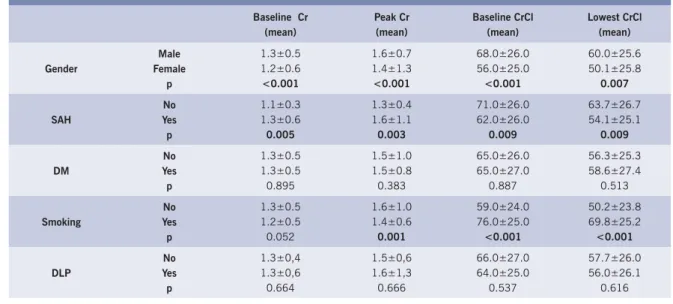
Male patients showed better renal function both at admission and during hospital stay (Table 1); mean age for men was 62.5 and for women, 66.0. History of systemic arterial hypertension was correlated with worse renal function at admission and also during hospital stay. Smokers were found to have higher levels of CrCl at baseline as well as higher levels of the lowest CrCl obtained during hospitalization; however, no signifi cant change in renal function was observed in the presence of diabetes mellitus (Table 1).
Mean age of the 19 patients who died within thirty days was signifi cantly higher (70.95 ± 2.38 vs. 62.64 ± 0.85, p = 0.007), and 16 (84.2%) were male (Table 2). No signifi cant difference was observed regarding patients with SAH, DM, DLP, smoking status, and previous AMI. As far as AMI location is concerned, no difference was found between anterior and inferior wall myocardial infarction. Among patients who died within thirty days, 36.8% (p = 0.002) had hypotension and 63.2% (p < 0,001) had cardiogenic shock during hospitalization.
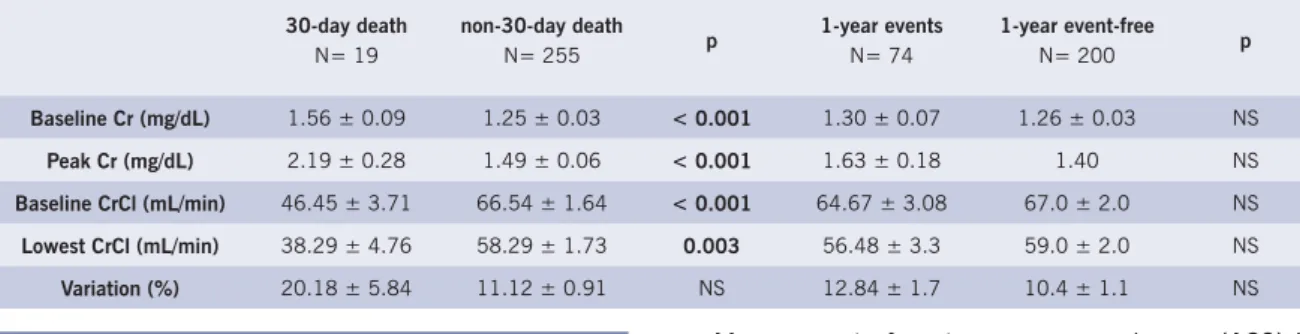
Renal function at admission was reduced in patients that died within thirty days, with higher levels of baseline Cr and lower levels of baseline CrCl (Table 3). In addition, these patients experienced a signifi cant decline in renal function during their hospital stay. No signifi cant difference however was found in creatinine variation percentage.
The logistic regression model using those variables classifi ed in the univariate analysis showed that higher levels of the lowest CrCl obtained during hospitalization have protective value against cardiogenic shock (Table 4), demonstrating that the greater the lowest level of CrCl the lower the mortality rate (OR = 0.97, IC 95% 0.94-0.99, p = 0.036).
In the univariate analysis, male patients and smokers were less prevalent among those who had combined event within a year when compared with event-free patients (64.9% vs. 75.1%; p = 0.065 e 27.0% vs. 41.4%; p = 0.031).
In addition, renal function variables showed no signifi cant difference with respect to combined event incidence within a year. Therefore, logistic regression of these factors was not studied.
D
ISCUSSION
Risk factors for developing coronary artery disease also appear as markers of poor renal function. Male gender and history of SAH, congestive heart failure, previous AMI, and myocardial revascularization are associated with renal dysfunction in several studies.16-21 Likewise,
data from literature consistently demonstrate that smokers have better renal function than non-smokers, but with no plausible explanations.16-21 Our study showed no
signifi cant decline in renal function in DM patients, probably because the sample of patients with DM was small compared to other populations studied.
Patients undergoing dialysis after AMI have higher mortality rates in follow-ups ranging from 30 days to 27 months.16-18 McCullough et al. analyzed 817 patients with
AMI and demonstrated that non-dialysis patients with CrCl < 47 mL/min at admission had worse in-hospital outcomes with regard to events such as left ventricular
Table 1 – Analysis of renal function variables according to gender and past history, represented by mean + standard error
failure, ventricular arrhythmias, reinfarction and death, when compared to dialysis patients.17
Possible explanations for worse outcomes following AMI in patients with mild-to-moderate renal function deterioration suggest that endothelial dysfunction, increased oxidative stress, and high levels of homocysteine are early seen in renal disease.22
Table 2 – Univariate analysis of demographic data, past history, and post-infarction clinical course with 30-day death and one-year combined events. Age is represented by mean ± standard error
30-day death
(N= 19)
non-30-day death
(N= 255) p
1-year events
(N= 74)
1-year event-free
(N= 200) p
Age (years) 70.95 ± 2.38 62.64 ± 0.85 0.007 64.39 ± 1.39 62.78 ± 1.00 NS
Gender (%)
Male 84.2 72.2
NS
64.9 75.1
0.065
Female 15.8 27.8 35.1 24.9
Past history (%)
DM 36.8 31.4 NS 33.8 30.4 NS
SAH 68.4 68.6 NS 74.3 66.3 NS
Smoking 15.8 37.3 NS 27.0 41.4 0,031
DLP 26.3 40.0 NS 39.2 40.3 NS
Previous AMI 47.4 37.3 NS 43.2 34.8 NS
Changes in ECG (%)
Anterior ST-elevation 36.8 29.0 NS 29.7 28.7 NS
Inferior ST- elevation 42.1 39.6 NS 44.6 37.6 NS
No- ST- elevation 21.1 31.0 NS 25.7 33.1 NS
Post-infarction in-hospital outcome (%)
Reinfarction 0 3.1 NS - -
-Hypotension 36.8 9.4 0.002 - -
-Cardiogenic shock 63.2 4.7 < 0.001 - -
-Table 3 – Univariate analysis of renal function variables with 30-day death and one-year combined events, represented by mean ± standard error
30-day death
N= 19
non-30-day death
N= 255 p
1-year events
N= 74
1-year event-free
N= 200 p
Baseline Cr (mg/dL) 1.56 ± 0.09 1.25 ± 0.03 < 0.001 1.30 ± 0.07 1.26 ± 0.03 NS
Peak Cr (mg/dL) 2.19 ± 0.28 1.49 ± 0.06 < 0.001 1.63 ± 0.18 1.40 NS
Baseline CrCl (mL/min) 46.45 ± 3.71 66.54 ± 1.64 < 0.001 64.67 ± 3.08 67.0 ± 2.0 NS
Lowest CrCl (mL/min) 38.29 ± 4.76 58.29 ± 1.73 0.003 56.48 ± 3.3 59.0 ± 2.0 NS
Variation (%) 20.18 ± 5.84 11.12 ± 0.91 NS 12.84 ± 1.7 10.4 ± 1.1 NS
Table 4 – Logistic regression model for 30-day death variable
OR 95% CI p
Lowest CrCl 0.97 0.93-0.99 0.036
Cardiogenic shock 15.2 4.57-50.4 0.024
Management of acute coronary syndromes (ACS) in patients with renal dysfunction should be better observed, offering them the best therapeutic options available. Previous studies analyzed the usefulness of treatments known to improve patient outcome after AMI, such as beta-blockers, antiplatelet agents, statins, glycoprotein IIb/IIIa inhibitors, thrombolytics, and angioplasty in renal dysfunction patients. It has been proved that patients with deteriorated renal function receive optimal treatment less frequently than those with normal renal function.4,16,20, 23,24
shown to have higher prognostic value than cardiac enzyme levels at admission, since at present markers of myocardial necrosis are given more importance than renal function.
In another GRACE registry publication, using the adapted classification of the National and Kidney Foundation recommendations, in-hospital mortality was greater among patients with moderately or severely decreased baseline CrCl.25 Patients with baseline CrCl
between 30-60 mL/min had a two-fold higher mortality rate, and patients with baseline CrCl < 30 mL/min, a four-fold higher mortality rate than patients with CrCl > 60 mL/min21.
Papers available in the literature used only renal function at admission, failing to analyze its outcome during hospitalization. In our sample, patients with improved CrCl levels during hospitalization had lower 30-day mortality, with a decline of 3% in mortality for every one-unit increase in the lower CrCl. In like manner, worsening of renal function in patients who progressed to death within thirty days may be related to greater
incidence of cardiogenic shock; however, no difference was found regarding incidence of anterior wall AMI with ST-segment elevation, a fact that denotes higher severity, demonstrating the important role of renal function outcome in acute myocardial infarction.
Thus, careful renal function monitoring, as well as elimination or correction of factors that decrease glomerular fi ltration rate during hospitalization, such as dehydration and use of nephrotoxic substances, may reduce morbidity and mortality in AMI patients.
C
ONCLUSION
Renal function deterioration during hospitalization in the acute phase of myocardial infarction was found to be a major marker of 30-day mortality. This suggests that proper monitoring of renal function with serial serum Cr measurement and CrCl calculation may be relevant in the treatment of patients with AMI to reduce short-term morbidity and mortality.
R
EFERENCES
1. American Heart Association Heart Disease and Stroke Statistics – 2004 Update. Dallas, Tex.: American Heart Association; 2003. Disponível em: http://americanheart.org/statistics.
2. Murray CJ, Lopez AD. Mortality by cause for eight regions of the world: Global Burden of Disease Study. Lancet 1997; 349: 1269-76.
3. Mann JF, Gerstein HC, Pague J, et al. Renal insuffi ciency as a predictor of cardiovascular outcomes and the impact of ramipril: the HOPE randomized trial. Ann Intern Med 2001; 134: 629-36.
4. Shlipak MG, Simon JA, Grady D, Lin F, Wenger NK, Furberg CD. Renal insuffi ciency and cardiovascular events in postmenopausal women with coronary heart disease. J Am Coll Cardiol 2001; 38: 705-11.
5. Wannamethee SG, Shaper AG, Perry IJ. Serum creatinine concentration and risk of cardiovascular disease: a possible marker for increased risk of stroke. Stroke 1997; 28: 557-63.
6. Baigent C, Burbury K, Wheeler D. Premature cardiovascular disease in chronic renal failure. Lancet 2000; 356: 147-52.
7. Foley RN, Parfrey PS, Sarnak MJ. Clinical epidemiology of cardiovascular disease in chronic renal disease. Am J Kidney Dis 1998; 32 (suppl 3): S112-9.
8. Herzog CA, Ma JZ, Collins AJ. Poor long-term survival after acute myocardial infarction among patients on long-term dialysis. New Engl J Med 1998; 339: 799-805.
9. Herzog CA, Ma JZ, Collins AJ. Long-term outcome of dyalisis patients in the United States with coronary revascularization procedures. Kidney Int 1999; 56: 324-32.
10. Lee KL, Woodlief LH, Topol EJ, et al, for the GUSTO-I Investigators. Predictors of 30-day mortality in the era of reperfusion for acute myocardial infarction: results from an international trial of 41021 patients. Circulation 1995; 91: 1659-68.
11. The Global Use of Strategies to Open Ocludded Coronary Arteries (GUSTO) IIb Investigators. A comparison of recombinant hirudin with heparin for the treatment of acute coronary syndromes. N Engl J Med 1996; 335: 775-82.
12. Morrow DA, Antman EM, Charlesworth A, et al. TIMI risk score for ST-elevation myocardial infarction: a convenient, bedside, clinical score for risk assessment at presentation an intravenous nPA for Treatment
of Infarcting Myocardial Early II Trial substudy. Circulation 2000; 102: 2031-7.
13. Jacobs Jr DR, Kroenke C, Crow R, et al. PREDICT: A simple risk score for clinical severity and long-term prognosis after hospitalization for acute myocardial infarction or unstable angina: the Minnesota Heart Survey. Circulation 1999; 100: 599-607.
14. Granger CB, Goldberg RJ, Dabbous O, et al. Predictors of hospital mortality in the global registry of acute coronary events. Arch Intern Med 2003; 163: 2345-53.
15. Cockcroft DW, Gault MH. Prediction of creatinine clearance from serum creatinine. Nephron 1976; 16: 31-41.
16. Walsh CR, O’Donnell CJ, Camargo Jr CA, Giugliano RP, Lloyd-Jones, DM. Elevated serum creatinine is associated with 1-year mortality after acute myocardial infarction. Am Heart J 2002; 144: 1003-11.
17. McCullough PA, Nowak R, Foreback C, et al. Emergency evaluation of chest pain in patients with advanced kidney disease. Arch Intern Med 2002; 162: 2464-8.
18. McCullough PA, Soman SS, Shah SS, et al. Risks associated with renal dysfunction in patients in the coronary care unit. J Am Coll Cardiol 2000; 36: 679-84.
19. Wison S, Foo K, Cunningham J, et al. Renal function and risk stratifi cation in acute coronary syndromes. Am J Cardiol 2003; 91: 1051-4.
20. Shlipak MG, Heidenreich PA, Noguchi H, et al. Association of renal insuffi ciency with treatment and outcomes after myocardial infarction in elderly patients. Ann Intern Med 2002; 137: 555-62.
21. Santopinto JJ, Fox KAA, Goldberg RJ, et al. Creatinine clearance and adverse hospital outcomes in patients with acute coronary syndromes: fi ndings from the global registry of acute coronary events (GRACE). Heart 2003; 89: 1003-8.
22. Wheeler DC. Cardiovascular disease in patients with chronic renal failure. Lancet 1996; 348: 1673-4.
24. Ezekowitz J, McAlister FA, Humphries KH, et al. The association among renal insuffi ciency, pharmacotherapy, and outcomes in 6427 patients with heart failure and coronary artery disease. J Am Coll Cardiol 2004; 44: 1587-92.