Radiol Bras. 2016 Mar/Abr;49(2):92–97 92
Balloon-based adjuvant radiotherapy in breast cancer:
comparison between
99m
Tc and HDR
192
Ir
*
Radioterapia adjuvante em câncer de mama com balão de 99m
Tc comparativo ao balão HDR 192 Ir
Campos TPR, Lima CF, Cuperschmid EM. Balloon-based adjuvant radiotherapy in breast cancer: comparison between 99mTc and HDR 192Ir. Radiol Bras.
2016 Mar/Abr;49(2):92–97.
Abstract
R e s u m o
Objective: To perform a comparative dosimetric analysis, based on computer simulations, of temporary balloon implants with 99mTc and
balloon brachytherapy with high-dose-rate (HDR) 192Ir, as boosts to radiotherapy. We hypothesized that the two techniques would produce
equivalent doses under pre-established conditions of activity and exposure time.
Materials and Methods: Simulations of implants with 99mTc-filled and HDR 192Ir-filled balloons were performed with the Siscodes/MCNP5,
modeling in voxels a magnetic resonance imaging set related to a young female. Spatial dose rate distributions were determined. In the dosimetric analysis of the protocols, the exposure time and the level of activity required were specified.
Results: The 99mTc balloon presented a weighted dose rate in the tumor bed of 0.428 cGy.h–1.mCi–1 and 0.190 cGyh–1.mCi–1 at the
balloon surface and at 8–10 mm from the surface, respectively, compared with 0.499 and 0.150 cGyh–1.mCi–1, respectively, for the HDR 192Ir balloon. An exposure time of 24 hours was required for the 99mTc balloon to produce a boost of 10.14 Gy with 1.0 Ci, whereas only
24 minutes with 10.0 Ci segments were required for the HDR 192Ir balloon to produce a boost of 5.14 Gy at the same reference point,
or 10.28 Gy in two 24-minutes fractions.
Conclusion: Temporary 99mTc balloon implantation is an attractive option for adjuvant radiotherapy in breast cancer, because of its availability,
economic viability, and similar dosimetry in comparison with the use of HDR 192Ir balloon implantation, which is the current standard in
clinical practice.
Keywords: Breast brachytherapy; Balloon; Radiotherapy dosage; Radiotherapy, adjuvant; 99mTc; 192Ir; Monte Carlo method.
Objetivo: Análise dosimétrica comparativa entre técnicas de implantes temporários de reforço por meio de balões de 99mTc e de 192Ir de
alta taxa de dose (high dose rate – HDR) mediante simulação computacional. A hipótese é que ambos produzem dosimetria equivalente em condições pré-estabelecidas de atividade e exposição.
Materiais e Métodos: Simulações de implantes com balão preenchido com 99mTc e balão HDR-192Ir foram elaboradas no Siscodes/
MCNP5, modelando em voxels um tórax feminino reproduzido de ressonância magnética de mama jovem. Distribuições espaciais de taxas de dose absorvidas foram geradas. Análises dosimétricas dos protocolos foram apresentadas especificando tempo acumulado e atividade requerida.
Resultados: Implante temporário com balão-99mTc apresentou taxa de dose ponderada no leito do tumor, na adjacência do balão, de
0,428 cGyh–1.mCi–1, e a 8–10 mm distante, de 0,190 cGyh–1.mCi–1, enquanto o implante de balão com 192Ir apresentou 0,499 e
0,150 cGyh–1.mCi–1, respectivamente. A exposição de 24 horas para balão-99mTc foi necessária para produzir o reforço de 10,14 Gy
com 1,0 Ci, ao passo que para balão HDR-192Ir foram necessários 24 minutos com segmentos de 10,0 Ci para gerar 5,14 Gy no mesmo
ponto de referência, ou 10,28 Gy em duas frações de 24 minutos.
Conclusão: Implante temporário com balão-99mTc é atrativo para a radioterapia adjuvante do câncer de mama, devido a disponibilidade,
viabilidade econômica e equivalência radiodosimétrica ao balão HDR-192Ir, protocolo presente na prática clínica.
Unitermos:Braquiterapia de mama; Balão; Reforço de dose; Radioterapia adjuvante; 99mTc; 192Ir; Método Monte Carlo.
* Study conducted in the Department of Nuclear Engineering, Universidade Fe-deral de Minas Gerais (UFMG), Belo Horizonte, MG, Brazil.
1. Postdoctoral Fellow, Professor in the Department of Nuclear Engineering, Universidade Federal de Minas Gerais (UFMG), Belo Horizonte, MG, Brazil.
2. MD, Nuclear Medicine Physician, Doctoral Student in the Graduate Program in Nuclear Sciences and Techniques, Núcleo de Radiações Ionizantes (NRI) at the Uni-versidade Federal de Minas Gerais (UFMG), Belo Horizonte, MG, Brazil.
3. PhD, Docent at the Center for the History of Medicine, Universidade Federal de Minas Gerais (UFMG), Belo Horizonte, MG, Brazil.
Mailing address: Dr. Tarcísio Passos Ribeiro de Campos. Departamento de Enge-nharia Nuclear, Universidade Federal de Minas Gerais. Avenida Antônio Carlos, 6627, Campus UFMG, PCA 1 – Anexo Engenharia. Belo Horizonte, MG, Brazil, 31270-010. E-mail: [email protected].
Received January 27, 2015. Accepted after revision May 26, 2015.
INTRODUCTION
Worldwide, breast cancer caused 521,000 deaths in 2012(1). In Brazil, the incidence of breast cancer has risen significantly in the last ten years, increasing the number of deaths. The disease is a consequence of genetic factors in combination with social factors, environmental factors, and life habits(2). The factors that favor carcinogenesis and can cause breast cancer include the following(3,4): exposure to
car-cinogens, such as chemical products and ionizing radiation; parasitic and viral infections; inherited genetic mutations; hormonal and metabolic changes; and immunodeficiency.
Campos TPR et al. /
Treatment involves surgery, locoregional radiotherapy, chemotherapy, and hormone therapy for systemic control(5,6). Surgical resection margins are defined as a broad margin of possible cancer cell infiltration. The surgical procedure can be conservative or radical(7). Non-conservative surgery
in-volves subcutaneous glandular mastectomy or subcutaneous mastectomy, preserving only the skin and the nipple-areola complex. In contrast, simple or total mastectomy involves removal of the breast including the skin and nipple-areola complex. Modified radical surgery involves mastectomy with partial preservation of the chest muscles and axillary lym-phadenectomy, whereas radical surgery involves the complete removal of the chest muscles with axillary lymphadenectomy. Breast conserving surgery includes excision of the tumor with no margin (lumpectomy) or with a margin (segmentectomy or segmental resection). Tumors smaller than 2.0 cm with tumor-free surgical margins can be treated with segmental resection followed by complementary radiotherapy. However, for tumors smaller than 4 cm with tumor-free resection margins, up to 10% of cases treated with conservative treat-ment involving radiotherapy have been reported to show local recurrence(8–10), leading to psychological trauma and having negative repercussions for the cancer prognosis. Lo-cal recurrence depends on the level of aggressiveness and diameter of the tumor, as well as on microscopic involve-ment of the margins. In breast conserving surgery, comple-mentary (boost) radiotherapy in the tumor area is recom-mended(8,11,12).
Regardless of the histological type of the tumor, age of the patient, chemotherapy, or hormone therapy, and even with surgical resection margins free of cancer cells, breast conserving surgery is followed by breast irradiation(7). A
ra-diotherapy boost in the area is indicated when patients are below 50 years of age, specimens show more than 25% duc-tal carcinoma in situ, exiguous margins are less than 1 cm (whether free of cancer cells or not), and the tumor shows a high degree of local aggressiveness(8–10). Postoperative
ra-diotherapy is necessary when treating in situ ductal carci-noma with breast conserving surgery(8,10). Such surgery is
considered the standard for the initial stages (I and II). A meta-analysis of clinical trials of breast cancer in the initial stages, conducted by the Early Breast Cancer Trialists’ Col-laborative Group, revealed the importance of radiotherapy after lumpectomy, showing that irradiation reduced the five-year local recurrence rate from 26% to 7%(13). The
meta-analysis also suggested that, for every four local recurrences, one death could be avoided(14–16).
Radiotherapy has evolved in the sense that it offers lower morbidity and greater efficiency in localized control. The treatment arsenal includes partial radiotherapy, intraopera-tive radiation therapy, the balloon technique, and intensity modulated radiation therapy. High-dose-rate (HDR) 192
Ir brachytherapy with a balloon implant is frequently applied in partial radiotherapy, using the MammoSite®
Radiation Therapy System. The MammoSite system consists of a
cath-eter attached to an inflatable balloon measuring 4–6 cm in diameter, with a 192
Ir source that provides, for example, 34 Gy in two daily fractions of 3.4 Gy each over five consecu-tive days(17,18). The balloon may be inserted in the surgical
cavity during or after the breast conserving procedure. The balloons come in two sizes, 4–5 cm and 5–6 cm in diameter, and are inflated with saline solution. The balloon should be carefully adapted to the surgical cavity, considering the dis-tance to the skin surface to ensure adequate coverage and dose homogeneity, as well as to lower the risk of complications(18). The temporary interstitial implant technique with a
99mTc-filled balloon, supplied with 99
Mo/99m
Tc generators, was proposed by the Núcleo de Radiações Ionizantes (NRI, Center for the Study of Ionizing Radiation) at the sidade Federal de Minas Gerais (UFMG, Federal Univer-sity of Minas Gerais). This technique is justified by the avail-ability of soluble 99mTc supplied with 2.0 Ci generators, for
example. Elution can generate 2.0–3.0 mL of an aqueous solution of sodium pertechnetate [Na(TcO4)
–
], with sufficient activity for treatment. Furthermore, it allows for successive fractional applications until the established reference doses are achieved. This procedure may be associated with the breast conserving surgery with exposure taking place in the post-operative phase, before radiotherapy. Studies with 99m
Tc balloons were carried out together with the NRI brachytherapy research using 166
Ho radioactive seed implants(19–24). A three-dimensional simulation of nuclear particle trans-portation aims to eliminate the deficiencies in two-dimen-sional planning by means of an analytical method in homo-geneous medium, and is an important tool in improving the quality of radiotherapy procedures in oncology(25–27).
Com-putational methods have been highly relevant for dosimet-ric evaluation using heterogeneous models(26,27). The
Siscodes (a computational system for neutron/photon dosim-etry based on stochastic methods) is a tool used for the con-struction of computational models and simulation in radio-therapy using stochastic codes, such as the Monte Carlo N-Particle Code (MCNP)(27–29). This system allows the con-version of computed tomography images to a voxel model. Using a database with chemical composition of tissues and nuclear data, the Siscodes associates nuclear and chemical data to the model voxels, by selecting the tissue of each voxel, as well as positioning the teletherapy and brachytherapy sources. The system uses the MCNP for simulating nuclear particle transport in the model. The resulting dosimetric data are presented in the form of spatial distribution of doses and dose-volume histograms(27).
Dosimetric intercomparison is possible when similar ex-posure conditions are used. This objective of this article was to create such conditions, using computational methods, in order to compare and analyze two protocols—a preclinical protocol, without clinical experimentation; and a clinical practice protocol—a comparison that could not be reproduced in real-life clinical situations. This was a dosimetric inter-comparison of HDR 192
Ir-filled balloons and 99m
balloons in temporary breast implants for brachytherapy, simulated under similar conditions and generating dose rate spatial distributions normalized by the source activity and accumulated dose at equivalent reference points. The hypoth-esis of this study was that both protocols would produce equivalent doses under pre-established conditions of activ-ity and exposure.
MATERIALS AND METHODS HDR 192Ir-filled balloon protocol
A MammoSite-type applicator and centered catheter, lo-cated in the upper outer quadrant of the breast, was simu-lated. The study considered a 4 cm-diameter saline-filled balloon and a 5 mm-long, 1 mm-diameter metallic cylindri-cal linear segment, filled with 192
Ir, in the (1,0,0) direction.
99mTc-filled balloon protocol
A 99m
Tc-filled balloon implant was simulated. The source was defined as a 1.6 cm-diameter sphere, with cen-ters coinciding with a balloon located 3.0 cm from the skin. The emissions were considered uniformly distributed throughout the volume of the balloon.
Radioactive sources
The characteristics of the nuclear emissions of the radionuclides 192
Ir and 99m
Tc, in terms of activity and emis-sion percentages, were adopted according to the Evaluated Nuclear Structure Data Files of the Medical Internal Radia-tion Dose Committee(30–32).
Simulator
Twenty-three sequential magnetic resonance imaging (MRI) scans (morphology phase) of the breast of a young patient were selected, comprising 146 slices of 4 mm each. The images were digitalized and combined to form a gray-scale voxel data model. With the Siscodes(27-29), a 2 × 2 × 2
mm3
voxel model of the breast was created. The anatomical structures were identified in each of the 23 planes, creating a three-dimensional voxel structure. From each image plane, a two-dimensional matrix was created in shades of gray, and the various matrices were combined to form the three-dimensional voxel model. One voxel, volumetrically equivalent to a tissue and identified by a specific color, was associated with each cubic element of the matrix. The chemical composition and density of the tissues were in accordance with the ICRU-44(33).
Computational codes
The Siscodes was used in order to generate a file con-taining all of the information of the computational model, in a format accepted by the MCNP5 program (version 5.2). The energy deposition in the voxels was evaluated in MeV.g–1
per transition (t). The energy deposition units (MeV.g–1
.t–1
) were transformed into absorbed dose rates based on the ac-tivity (cGy.h–1
.mCi–1
) present in the balloon (99m
Tc) or in the source segment (192
Ir), with a conversion factor of
2133.86. After simulations, the results were incorporated into the Siscodes, generating the spatial distributions of dose. The initial seed activity was calculated in order to generate the target dose in the tumor bed.
Uncertainties
The computational uncertainties were analyzed for each voxel by using the MCNP5, depending on the number of executed particles. The uncertainties were less than 5% in the breast tissue and were even lower in the voxels closer to the radiation source.
RESULTS
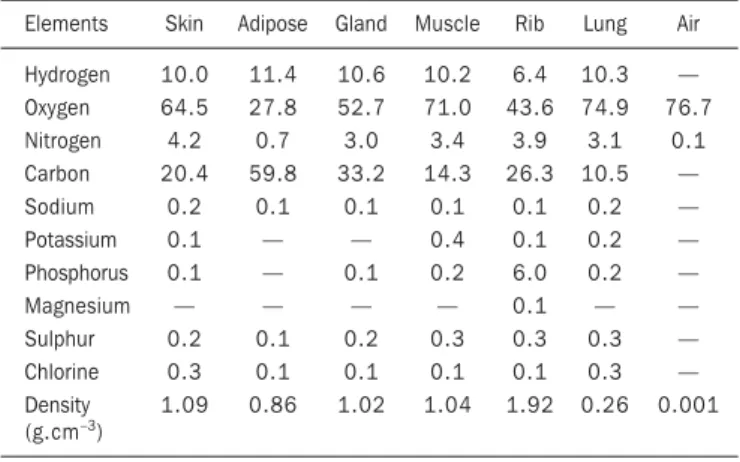
The model was produced from 23 MRI slices of the mam-mary gland. A 21 × 60 × 23 element matrix, totaling 28,980 cubic elements or voxels, was generated. The tissue voxel model allowed a three-dimensional structure of the breast to be designed. The chemical composition of the tissues is shown in Table 1.
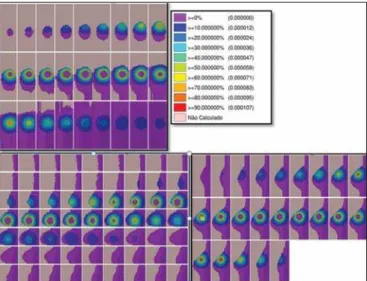
Figures 1 and 2 show the results of the temporary im-plant protocol simulations with a 99m
Tc-filled interstitial balloon and with a 192
Ir-filled segment, mimicking a bal-loon brachytherapy booster.
HDR 192Ir-filled temporary balloon implant
Figure 1 illustrates the spatial distribution of a normal-ized dose in relation to the total activity of the 192
Ir-filled balloon. Combined lateral, sagittal, and axial sections with dose values higher than 10% are shown. The dose was admin-istered by the discrete 192
Ir source, inserted in the intracavi-tary balloon. In the simulation conditions imposed, the maxi-mum normalized dose rate reached 0.499 cGy.h–1
.mCi–1
. According to the distribution of doses in Figure 1, it is pos-sible to predict the dose away from the balloon surface.
99m
Tc-filled temporary balloon implant
Figure 2 illustrates the spatial distribution of a normal-ized dose in relation to the total activity of the 99m
Tc-filled balloon. Combined lateral, sagittal, and axial sections with Table 1—Chemical constitutions of tissues and air in a weight-proportional frac-tion. Elements Hydrogen Oxygen Nitrogen Carbon Sodium Potassium Phosphorus Magnesium Sulphur Chlorine Density (g.cm–3)
Campos TPR et al. /
dose values higher than 10% are shown. The dose was ad-ministered from an aqueous solution-distributed, homoge-neous Na(TcO4)
–
source. The simulated balloon measured 16 mm in diameter. In this case, the maximum normalized dose rate reached 0.428 cGy.h–1
.mCi–1
.
Table 2 shows the dosimetric values in the simulations of both protocols. The maximum dose rate (MDR) was mul-tiplied by the dose percentage (DF) factor in relation to the reference point (RP), that is, at 8–10 mm from the balloon surface; then by the total activity at the source and by the accumulation factor (AF) of the exposure time (T), thus producing the accumulated dose at the RP. With the defini-tion of the number of fracdefini-tions (FR), the accumulated dose for the protocol at the RP was found.
The 99m
Tc-filled balloon had 1 Ci of Na(TcO4) –
and an RP at a distance of 10 mm from the balloon surface, within 25% of the MDR. For a T of 24 hours, the AF was 0.812. The HDR 192
Ir-filled balloon, on the other hand, had 10 Ci of 192
Ir, at the same RP, and the DF was therefore 30% of the MDR. A T of 0.4 hours produced an AF of 0.4. Under these conditions, the accumulated doses at the RP were 10.14 Gy for the 99m
Tc-filled balloon and 5.14 Gy for a single frac-tion of the HDR 192
Ir-filled balloon, which will produce an equivalent dose of 10.28 Gy in two sections.
DISCUSSION
In this study, we have shown that a boost of 10 Gy, complementary to teletherapy, can be produced in both pro-tocols, at the chosen reference positions. There were no sta-tistical differences between the 99m
Tc-filled and 192
Ir-filled balloons, in terms of the accumulated doses, considering the 5% variation given by the simulation. In this case, 99m
Tc-filled and 192
Ir-filled balloons, in the target conditions of activity and exposure, produced equivalent absorbed doses, under the proposed conditions.
The dosimetric intercomparison between the techniques was differentiated by the spatial distribution of the source and by the diameter of the balloon. This simulated condi-tion refers to resected, in situ tumors in the initial stages. Therefore, the partial volume of the resected tumor is filled by the balloon, which may be inflated, occupying the cavity and expanding the adjacent tissue. The dose in the tumor bed, in this case, was represented by the dose in the voxels at the edges of the balloon.
The 99m
Tc-filled balloon implant may be recommended for stage T1 and T2 tumors with a 1 cm margin, in the usual post-lumpectomy cavity(7–12). Radiation attenuation due to the radial distance is greater for the 99m
Tc-filled balloon than Figure 1. Spatial distribution of normalized dose rate in relation to the activity,
shown in lateral, sagittal, and axial slices, induced by brachytherapy with a 192
Ir-filled balloon.
Figure 2. Spatial distribution of normalized dose rate in relation to the activity, shown in lateral, sagittal, and axial slices, induced by implantation of a balloon with a homogeneously distributed source of 99mTc.
Table 2—Dosimetric intercomparison of radiotherapy boost in the breast, in situations of increased complementary dose in the tumor bed.
Balloon brachytherapy protocol
99mTc solution*
HDR 192Ir†
DR100
0.428 0.499
DF at the RP(%)
25 30
Activity (mCi)
1000 10000
T(FR)(h)
24 0.4 (2)
Nuclide
99mTc 192Ir
Half-life (h)
6.01 1771.92
AF
8.126 0.400
(DF)DT (Gy)
10.14 5.14 (10.28)
* Interstitial balloon, measuring 16 mm in diameter, implanted postoperatively in the tumor resection cavity, with external catheter. Balloon filled with homogeneous Na(TcO4)– radioactive solution.
† Afterloading interstitial brachytherapy using positioned catheters, insertion of HDR Ir192 linear metallic cylindrical segment measuring 1 × 5 mm at the center of the
40-mm diameter water-filled balloon.
DR100, dose rate (in cGy.h–1.mCi–1) at 100%, obtained in the simulation investigated in all voxels; RP, reference point for comparative evaluation of the absorbed
for the 192
Ir-filled balloon, because 99m
Tc has lower energy emissions than does 192
Ir(30,32). Consequently, the radial dose profile will become more restricted towards the surgical cavity, as may be observed in Figure 2 (99m
Tc), in compari-son to Figure 1 (192
Ir). Therefore, the lungs and heart are expected to receive smaller doses with the 99m
Tc-filled bal-loon than with the 192
Ir-filled balloon, thus exerting fewer deleterious effects on those healthy organs. At the tumor bed, the spatial distribution of the dose from the HDR 192
Ir-filled balloon showed a MDR per unit of activity equivalent to that of interstitial brachytherapy with the 99m
Tc-filled balloon. The MDR per unit of activity are comparable. However, because the HDR maintains the 192
Ir activity at a level 3.5– 5.0 times greater than that of the 99m
Tc, the dose rate will increase in the same proportion. Therefore, at 8 mm from the balloon, the dose rate for 1.0 Ci of 99m
Tc will be 1.07 Gy.h–1
, reaching 0.13 Gy.h–1
in 18 hours, whereas the dose rate for 10.0 Ci of 192
Ir remains practically constant for a period of 25 minutes, equal to 12.83 Gy.h–1
(12 times greater than the initial dose rate for the 99m
Tc-filled balloon). The lower rate, however, may reduce the deleterious effects on healthy tissues, offering better repair of the inherent sub-lethal damage to normal cells.
Generators of 99
Mo/99m
Tc are normally distributed with 2.0 Ci. Therefore, the 99m
Tc-filled balloon implant technique could be immediately incorporated without additional costs, with the support from nuclear medicine facilities. The nec-essary radiation safety procedures for the use of high activ-ity (7–10 Ci) 192
Ir sources, which have a half-life of 73.8 days, should be stricter than those employed for 99m
Tc gen-erators. Consequently, greater management complexity is expected from the use of 192
Ir, considering acquisition, trans-portation, and substitution of the cylindrical radiation source every three months at the centers that offer HDR brachy-therapy, particularly due to the need to import the devices and employ specialized teams to replace their sources.
A normal protocol for conventional radiotherapy involves the application of 25 sessions of 1.8–2.0 Gy per day, with two parallel opposed fields of 6 MV, for example, 5 days a week, for 45–60 days, with accumulated doses of 50 Gy covering the mammary gland tissue(5). For boosts in HDR 192
Ir brachytherapy, maximum exposure is achieved in ses-sions of 20–25 minutes, compared with 24 hours for the
99m
Tc-filled balloon technique. Longer periods of exposure translate to greater patient discomfort. A 10-Gy boost dose at the tumor bed using the 99m
Tc-filled balloon technique requires 24 hours of exposure, plausibly generating such discomfort. The technique, however, may be applied post-operatively in a single fraction, the balloon being implanted immediately after local excision and exposure taking place during the recovery period. If the activity injected is doubled, the exposure time is reduced by half, or a multifraction pro-tocol involving 4–6 hours of exposure per day, for 3 to 4 days, may be implemented, in which the radioactive liquid is replaced with water during the periods between exposures,
and the radioactive solution is injected with constant activ-ity at every application. The prescribed dose for the tumor bed should be previously defined, in order to establish the levels of activity and exposure.
In well-established studies, with long-term follow-up, conducted in Europe and the United States, brachytherapy with a HDR 192
Ir-filled balloon has been proven to be a safe and efficient method, with low rates of local recurrence(13– 17). However, its application is limited because of the
com-plexity of the procedure and the long (73.8 day) half-life of high-activity 192
Ir sources. In addition, there are contraindi-cations that can interfere with dosage planning(34):
insuffi-cient distance between the tumor and the skin; and an exten-sive cavity. Its use is not indicated when the tumor cavity is in an area of tissue that cannot be sufficiently covered(35).
Undesirable anatomic surgical conditions and ineligible histological conditions can also preclude the application of the balloon technique(17). With a smaller balloon and a nu-clide that provides greater dose attenuation, ineligible clini-cal conditions, due to inappropriate or compromised anatomy with reduced coverage tissue mass, may become less relevant.
In general, the 99m
Tc-filled balloon technique is acces-sible, has a shorter learning curve, presents less complex do-simetry, and is widely available, considering the 99
Mo/99m
Tc generators at nuclear medicine facilities in Brazil.
CONCLUSION Temporary 99m
Tc-filled balloon implants could repre-sent an attractive option for adjuvant radiotherapy in breast cancer. The technique supplies an adequate boost dose, with spatial dose distribution contained within the tumor bed sur-roundings, and its use is justified by its availability and eco-nomic viability.
Acknowledgments
We are grateful to the Conselho Nacional de Desenvolvi-mento Científico e Tecnológico (CNPq), the Fundação de Amparo à Pesquisa do Estado de Minas Gerais (Fapemig), and the Coordenação de Aperfeiçoamento de Pessoal de Nível Superior (Capes), for providing masters and doctoral re-search grants, as well as rere-search grants to the Center for the Study of Ionizing Radiation at the Universidade Federal de Minas Gerais.
REFERENCES
1. IARC. Estimated cancer incidence, mortality and prevalence world-wide in 2012. International Agency for Research on Cancer, World Health Organization. [cited 2014 June 12]. Available from: globocan. iarc.fr.
2. Brasil. Ministério da Saúde. Instituto Nacional de Câncer José Alencar Gomes da Silva (INCA). Estatísticas do câncer: vigilância do câncer e fatores de risco. [cited 2014 June 12]. Available from: http://www.inca.gov.br.
3. GodinhoI ER, Koch HA. Rastreamento do câncer de mama: aspectos relacionados ao médico. Radiol Bras. 2004;37:91–9.
Campos TPR et al. /
malignancies following radiotherapy for breast cancer. Br J Cancer. 2004;91:868–72.
5. Purdy JA. Three dimensional physics and treatment planning. In: Perez CA, Brady LW, editors. Principles and practice of radiation oncology. 3rd ed. Philadelphia, PA: Lippincott-Raven; 1998. p. 343–70.
6. Emami B, Graham MV, Michalski JM, et al. Three dimensional con-formal radiation therapy: clinical aspects. In: Perez CA, Brady LW, editors. Principles and practice of radiation oncology. 3rd ed. Phila-delphia, PA: Lippincott-Raven; 1998. p. 371–86.
7. Tiezzi DG. Cirurgia conservadora no câncer de mama. Rev Bras Ginecol Obstet. 2007;29:428–34.
8. Fisher B, Costantino J, Redmond C, et al. Lumpectomy compared with lumpectomy and radiation therapy for the treatment of intra-ductal breast cancer. N Engl J Med. 1993;328:1581–6.
9. Glinski B, Zabek M, Mitus M. Brachytherapy boost in women with early stage breast cancer treated with breast conserving therapy. Rep Pract Oncol Radiother. 2007;12:47–51.
10. Barroso ACSD, Barbosa EM, Gebrim LH, et al. Diagnóstico e tratamento do câncer de mama. In: Projeto Diretrizes. Brasília, DF: Associação Médica Brasileira, Conselho Federal de Medicina; 2001. [cited 2014 June 12]. Available from: www.projetodiretrizes.org.br/ projeto_diretrizes/024.pdf.
11. Schwartz GF, Solin LJ, Olivotto IA, et al. The consensus confer-ence on the treatment of in situ ductal carcinoma of the breast. Breast J. 2000;6:4–13.
12. Veronesi U, Salvadori B, Luini A, et al. Breast conservation is a safe method in patients with small cancer of the breast. Long-term re-sults three randomized trials on 1973 patients. Eur J Cancer. 1995; 31A:1567–9.
13. EBCTCG (Early Breast Cancer Trialists’ Collaborative Group), McGale P, Taylor C, et al. Effect of radiotherapy after mastectomy and axillary surgery on 10-year recurrence and 20-year breast can-cer mortality: meta-analysis of individual patient data for 8135 women in 22 randomised trials. Lancet. 2014;383:2127–35. 14. Clarke M, Collins R, Darby S, et al. Effects of radiotherapy and of
differences in the extent of surgery for early breast cancer on local recurrence and 15-year survival: an overview of the randomised trial. Lancet. 2005;366:2087–106.
15. Early Breast Cancer Trialists’ Collaborative Group (EBCTCG), Darby S, McGale P, et al. Effect of radiotherapy after breast-con-serving surgery on 10-year recurrence and 15-year breast cancer death: meta-analysis of individual patient data for 10,801 women in 17 randomised trials. Lancet. 2011;378:1707–16.
16. Early Breast Cancer Trialists’ Collaborative Group (EBCTCG). EBCTCG Secretariat. Clinical Trial Service Unit (CTSU). Rich-ard Doll Building. Oxford OX3 7LF. UK. 2014.
17. Dickler A, Kirk MC, Chu J, et al. The MammoSite breast brachy-therapy applicator: a review of technique and outcomes. Brachy-therapy. 2005;4:130–6.
18. Douglas A. Accelerated partial breast irradiation: a change in treat-ment paradigm for early stage breast cancer. J Surg Oncol. 2003;84: 185–91.
19. Valente ES, Campos TPR. Gamma spectrometry and chemical
char-acterization of ceramic seeds with samarium-153 and holmium-166 for brachytherapy proposal. Appl Radiat Isot. 2010;68:2157–62. 20. Valente ES, Cuperschmid EM, Campos TPR. Evaluation of HeLa
cell lineage response to beta radiation from holmium-166 embed-ded in ceramic seeds. Braz Arch Biol Technol. 2011;54:957–64. 21. Nogueira LB, Campos TPR. Nuclear characterization and
inves-tigation of radioactive bioglass seed surfaces for brachytherapy via scanning electron microscopy. J Sol-Gel Sci Technol. 2011;58: 251–8.
22. Nogueira LB, Campos TPR. Radiological response of ceramics and polymeric devices for breast brachytherapy. Int J Appl Radiat Isot. 2012;70:663–9.
23. Nogueira LB, Silva HLL, Campos TPR. Experimental dosimetry in conformal breast teletherapy compared with the planning sys-tem. Appl Radiat Isot. 2015;97:93–100.
24. Campos TPR, Andrade JPL, Costa IT, et al. A radioactive seed im-plant on a rabbit’s liver following a voxel model representation for dosimetric proposals. In: 2005 International Atlantic Conference -INAC 2005. Santos, SP; 2005.
25. MCNP5. Monte Carlo Team. MCNP – A General Monte Carlo N-Particle Transport Code, Version 5. Volume I: Overview and theory. Los Alamos: Los Alamos National Laboratory; 2003. 26. Kalos MH, Whitlock PA. Monte Carlo methods. Vol. I: basics. New
York: Wiley; 1986.
27. Campos TPR. Computational simulations in medical radiation: a new approach to improve therapy. [cited 2016 Jan 15]. Available from: http://www.sbmac.org.br/bol/boletim_2002/campos-4emc.pdf. 28. Trindade BM, Campos TPR. Stochastic method-based
computa-tional system for neutron/photon dosimetry applied to radiotherapy and radiology. Radiol Bras. 2011;44:109–16.
29. Trindade BM, Christóvão MT, Trindade DFM, et al. Comparative dosimetry of prostate brachytherapy with I-125 and Pd-103 seeds via SISCODES/MCNP. Radiol Bras. 2012;45:267–72.
30. International Atomic Energy Agency. Nuclear Data Services. Medical Application and Nuclear Data Section – MIRD. [cited 2015 Jan 15]. Available from: http://www.nndc.bnl.gov/mird/.
31. ENDF/BVI Decay Data. Evaluated Nuclear Data File (ENDF) ENDF/B-VII.1 Nuclear Data for Science and Technology: Cross Sections, Covariances, Fission Product Yields and Decay Data, re-leased December 22, 2011. [cited 2013 Nov 15]. Available from: http://t2.lanl.gov/data/decayd.html.
32. Korea Atomic Energy Research Institute. Electron and photon at-tenuation. [cited 2012 Nov 19]. Available from: http://atom.kaeri. re.kr:8080/ex.html.
33. International Commission on Radiation Units and Measurements. ICRU Report 44. Tissue substitutes in radiation dosimetry and measurement. Bethesda, MD: ICRU; 1989.
34. Tuschy B, Berlit S, Romero S, et al. Clinical aspects of intraopera-tive radiotherapy in early breast cancer: short-term complications after IORT in women treated with low energy x-rays. Radiat Oncol. 2013;8:95.