Radiol Bras. 2016 Mar/Abr;49(2):79–85 79
Dosimetric evaluation of X-ray examinations of paranasal
sinuses in pediatric patients
*
Avaliação dosimétrica de pacientes pediátricos submetidos a exames radiográficos de seios paranasais
Cantalupo BLVC, Xavier ACS, Silva CML, Andrade MEA, Barros VSM, Khoury HJ. Dosimetric evaluation of X-ray examinations of paranasal sinuses in pediatric patien. Radiol Bras. 2016 Mar/Abr;49(2):79–85.
Abstract
R e s u m o
Objective: To estimate the entrance surface air kerma (Ka,e) and air kerma in the region of radiosensitive organs in radiographs of pediatric
paranasal sinuses.
Materials and Methods: Patient data and irradiation parameters were collected in examinations of the paranasal sinuses in children from 0 to 15 years of age at two children’s hospitals in the city of Recife, PE, Brazil. We estimated the Ka,e using the X-ray tube outputs
and selected parameters. To estimate the air kerma values in the regions of the eyes and thyroid, we used thermoluminescent dosim-eters.
Results: The Ka,e values ranged from 0.065 to 1.446 mGy in cavum radiographs, from 0.104 to 7.298 mGy in Caldwell views, and from
0.113 to 7.824 mGy in Waters views. Air kerma values in the region of the eyes ranged from 0.001 to 0.968 mGy in cavum radiographs and from 0.011 to 0.422 mGy in Caldwell and Waters views . In the thyroid region, air kerma values ranged from 0.005 to 0.932 mGy in cavum radiographs and from 0.002 to 0.972 mGy in Caldwell and Waters views.
Conclusion: The radiation levels used at the institutions under study were higher than those recommended in international protocols. We recommend that interventions be initiated in order to reduce patient exposure to radiation and therefore the risks associated with radiological examination of the paranasal sinuses.
Keywords: Radiometry; Radiography; Paranasal sinuses; Pediatrics; Thermoluminescent dosimetry.
Objetivo: Estimar o kerma no ar na superfície de entrada (Ka,e) e o kerma no ar na região de órgãos radiossensíveis em radiografias
pediátricas dos seios paranasais.
Materiais e Métodos: Foram coletados os dados dos pacientes e parâmetros de irradiação em exames de seios paranasais de crianças com 0 a 15 anos, em dois hospitais infantis na cidade do Recife, PE. O Ka,e foi estimado utilizando os rendimentos dos tubos de raios
X e os parâmetros selecionados. Os valores de kerma no ar nas regiões dos olhos e tireoide foram estimados utilizando dosímetros termoluminescentes.
Resultados: Os valores de Ka,e variaram de 0,065 a 1,446 mGy para radiografias cavum, 0,104 a 7,298 mGy para Caldwell e 0,113
a 7,824 mGy para Waters. Os valores de kerma no ar na região dos olhos variaram de 0,001 a 0,968 mGy para cavum e 0,011 a 0,422 mGy para Caldwell e Waters. Na região tireóidea, os valores de kerma no ar variaram de 0,005 a 0,932 mGy para cavum e 0,002 a 0,972 mGy para Caldwell e Waters.
Conclusão: Os parâmetros de irradiação utilizados pelas instituições foram mais elevados do que os recomendados em protocolos britânicos. Ações de otimização são recomendadas de modo a contribuir para a redução da radiação nos pacientes e, portanto, os riscos.
Unitermos: Dosimetria; Radiografia; Seios paranasais; Pediatria; Dosimetria termoluminescente.
* Study conducted at the Universidade Federal de Pernambuco (UFPE), Recife, PE, Brazil.
1. MSc, Dentist, Doctoral Student in Applied Health Sciences in the Keizo Asami Laboratory of Immunopathology at the Universidade Federal de Pernambuco (UFPE), Recife, PE, Brazil.
2. MSc, Biomedical Engineer, Doctoral Student in Engineering Sciences at the Santiago Center, Pontificia Universidad Católica de Chile, Santiago, Chile.
3. PhD, Biomedical Physician, Full Professor at the Faculdade Integrada de Per-nambuco (Facipe), Recife, PE, Brazil.
4. Radiology Technologist, Laboratory Technician in the Ionizing Radiation Metrol-ogy Laboratory, Department of Nuclear Energy, Universidade Federal de Pernambuco (UFPE), Recife, PE, Brazil.
5. PhD, Physicist, Adjunct Professor in the Department of Nuclear Energy, Univer-sidade Federal de Pernambuco (UFPE), Recife, PE, Brazil.
6. PhD, Physicist, Full Professor in the Department of Nuclear Energy, Universi-dade Federal de Pernambuco (UFPE), Recife, PE, Brazil.
INTRODUCTION
In radiological examinations of the face, radiosensitive anatomical structures, such as the eyes and thyroid, are ex-posed to ionizing radiation, representing a risk to the pa-tient, due to the possibility of producing biological effects induced by the interaction of the radiation with the tissue. Special attention should be given to radiological examinations performed in pediatric patients, because, in comparison with Beatriz de Lucena Villa-Chan Cantalupo1, Aline Carvalho da Silva Xavier2, Clemanzy Mariano Leandro da Silva3, Marcos Ely Almeida Andrade4, Vinícius Saito Monteiro de Barros5, Helen Jamil Khoury6
Mailing address: Beatriz de Lucena Villa-Chan Cantalupo. UFPE – Departamento de Engenharia Nuclear. Avenida Luiz Freire, 1000, Cidade Universitária. Recife, PE, Brazil, 50740-545. E-mail: [email protected].
those of adults, their cells are more radiosensitive and have a longer life expectancy, which increases the risk of stochas-tic effects(1).
Clinical requests for X-ray examinations of the sinuses are quite common in children(2,3), in order to investigate
diseases of the upper respiratory tract, such as hypertrophy of the adenoids, inflammatory diseases of the sinus cavities, sinus infections, tumors, and facial fractures(4.5). Conventional
radiography for the radiological study of the sinuses can be performed as follows(6,7): lateral X-rays (cavum radiographs); posteroanterior occipitomental X-rays (Waters view); and posteroanterior occipitofrontal X-rays (Caldwell view).
The objective of this study was to evaluate the entrance surface air kerma (Ka,e) for pediatric patients undergoing
radiological examinations of the sinuses at two hospitals in Recife, PE, Brazil. We also estimated the air kerma values in the thyroid region and around the eyes.
MATERIALS AND METHODS
The study was conducted at two public hospitals (here-after referred to as hospital A and hospital B), both of which specialized in the care of pediatric patients. Hospital A has approximately 112 beds, distributed among various clinical areas. Hospital B is a referral center for maternal and child health, with 714 beds and more than 600,000 annual visits to its various clinics. Both hospitals are philanthropic and provide services via the Brazilian Unified Health Care Sys-tem. Hospital B has two rooms for performing X-ray exami-nations, both equipped with Philips Bucky Diagnost X-ray equipment, whereas hospital A has only one X-ray examina-tion room, which is equipped with a Shimadzu R 20 X-ray system. None of the X-ray machines evaluated are equipped with automatic exposure control, and the image acquisition system is based on radiographic films at both institutions.
We created a form designed to collect data related to anthropometric characteristics of the patient (gender, weight and height), the type of examination/projection, and the ir-radiation parameters employed (kV, mAs, focus-to-skin dis-tance, focus-to-film disdis-tance, and exposure time). Data were collected by the authors of the study, and neither institution maintains nested records of such information. We monitored the radiological examinations of patients ≤ 15 years of age. For data analysis, patients were divided into the following age groups: 0–1 year; 1–5 years; 5–10 years; and 10–15 years.
Determination of the Ka,e
The Ka,e was determined on the basis of the yield of the
X-ray tube and the irradiation parameters (indirect method). For that purpose, we used a Radcal ionization chamber, model 20X6-6, positioned in the center of the radiation field, 100 cm from the focal spot and 30 cm from the surface of the table. We measured the air kerma for different values of tube voltage (kV), using a fixed value for the current-time product (mAs). For each kV value, we made three measure-ments. The mean value obtained was corrected for the
pres-sure-temperature factor and for the calibration factor of the ionization chamber. The calibrations were performed at the Laboratório de Metrologia das Radiações Ionizantes, Depar-tamento de Energia Nuclear da Universidade Federal de Pernambuco (LMRI/DEN-UFPE, Ionizing Radiation Me-trology Laboratory, Department of Nuclear Energy at the Federal University of Pernambuco), which follows the stan-dards set by the National Laboratory for the Metrology of Ionizing Radiation at the Radioprotection and Dosimetry Institute of the Brazilian National Nuclear Energy Commis-sion. The yield of X-ray equipment corresponds to the air kerma value (in mGy) per mAs, at a distance of 1 m from the focal spot. A curve for the yields of the different voltage values was constructed and used for determining the yield under the irradiation conditions employed in each of the ex-aminations evaluated. For each patient, the Ka,e was
deter-mined by the following equation(8):
Ka,e = Ri.Q.(Dref/DFP).BSF
where Ri is the yield of the X-ray tube for radiographic
tech-nique employed in the examination, interpolated from the yield curve in function of the voltage, of the Ri = a.(kV)b
type, a and b being curve fitting parameters; Q is the prod-uct of tube current by exposure time (mAs) used in the ex-amination; Dref is a distance of 1 m for which the yield has
been adjusted; DFP is the distance between the focal point and the skin of the patient; and BSF is the backscatter fac-tor, which is a function of the size of the field, the filtration of the equipment and the radiographic technique used in the examination. A fixed BSF value of 1.30 was adopted(9).
Estimation of doses near radiosensitive organs using thermoluminescent dosimeters
Pairs of LiF:Mg,Ti (TLD-100) thermoluminescent do-simeters were encapsulated in thin plastic casings (one pair per casing) and placed on the skin of the patient around the eyes and thyroid. The dosimeter pair taken to each institu-tion was always accompanied by another pair of dosimeters that were not irradiated. The reading from those dosimeters (in a white casing) was subtracted from the reading from the irradiated dosimeters. The mean reading of the two dosim-eters contained in each casing was converted into air kerma using the calibration curve obtained with diagnostic quality X-ray beams at the LMRI/DEN-UFPE(10).
RESULTS
Characteristics of the radiological examinations
Approximately 60% of the patients undergoing radiologi-cal examination of the sinuses at either hospital were male. At hospital A, 72.8% of the patients in whom lateral X-rays were obtained were male, compared with 62.5% of those in whom posteroanterior (occipitofrontal and occipitomental) X-rays were obtained. At hospital B, males accounted for 50.0% of the patients undergoing radiological examination of the sinuses, in either view. Therefore, the gender distri-bution was much more balanced among the patients seen at hospital B.
Irradiation parameters
The minimum, mean, and maximum voltage used in lateral and posteroanterior (occipitofrontal and occipitomen-tal) X-ray examinations of the sinuses are shown in Table 1. The accuracy and reproducibility of voltage (kV) values pro-vided by the X-ray machines employed were previously evalu-ated using quality protocols devised by the Brazilian National
Ministry of Health(11,12). The variation in the
reproducibil-ity of the voltage value was 0.1% for the equipment at both hospitals. However, in tests of the variance between the volt-age supplied to the X-ray tube and the value indicated on the panel, the equipment employed at hospital A showed a vari-ance of 2.2%, whereas the equipment employed in the two separate X-ray examination rooms at hospital B showed vari-ances of 2.0% and 4.0%, respectively. The minimum, mean, and maximum current-time product (mAs) of the X-ray tubes used in the radiological examinations of the sinuses (in lat-eral, occipitofrontal, or occipitomental X-rays) are shown in Table 2.
Ka,e measured from the X-ray tube yield
The distribution of the estimated Ka,e values in
radio-logical examinations of the sinuses of pediatric patients is shown, by age group, in box and whisker plots in Figures 2A and 2B for lateral and posteroanterior (occipitofrontal
Table 1—Voltages used in examinations of the sinuses.
Type of examination Lateral Occipitofrontal Occipitomental Age group 0–1 year 1–5 years 5–10 years 10–15 years 0–1 year 1–5 years 5–10 years 10–15 years 0–1 year 1–5 years 5–10 years 10–15 years Voltage (kV)
Hospital A Hospital B
Min — 61 60 69 — 55 60 60 — 63 63 65 Mean — 68.82 69.44 74.08 — 58.33 60.33 60.57 — 65.33 64.66 65.28 Max — 72 74 91 — 60 62 63 — 68 65 66 Min 70 70 66 70 — 70 70 — — 73 70 — Mean 70 71.1 71.71 71.8 — 75.33 73.5 — — 76.11 73.33 — Max 70 73 77 73 — 81 77 — — 77 77 —
Min, minimum; Max, maximum.
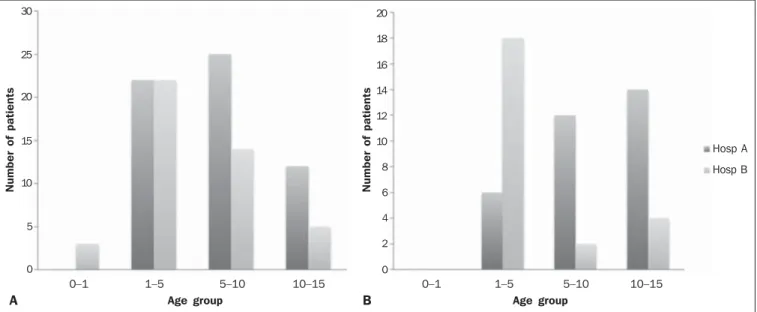
Figure 1. Distribution of patients undergoing radiological examination of the sinuses with lateral X-rays (A) and posteroanterior X-rays (B), by age group.
A B N u m b e r o f p a ti e n ts
Age group Age group
N u m b e r o f p a ti e n ts 30 25 20 15 10 5 0 20 18 16 14 12 10 8 6 4 2 0
0–1 1–5 5–10 10–15 0–1 1–5 5–10 10–15
Hosp A
Hosp B
Table 2—Current-time products used in examinations of the sinuses.
Type of examination Lateral Occipitofrontal Occipitomental Age group 0–1 year 1–5 years 5–10 years 10–15 years 0–1 year 1–5 years 5–10 years 10–15 years 0–1 year 1–5 years 5–10 years 10–15 years
Current-time product (mAs)
Hospital A Hospital B
Min — 2.88 2.88 3.24 — 20.16 43.2 50.4 — 18.0 43.2 50.4 Mean — 3.37 3.74 3.51 — 37.92 45.6 50.4 — 37.2 46.8 50.4 Max — 5.76 5.76 5.04 — 50.4 50.4 50.4 — 50.4 50.4 50.4 Min 4.0 4.0 4.0 5.0 — 5.0 5.0 20.0 — 6.3 5.0 20.0 Mean 4.67 4.95 5.15 5.0 — 9.65 5.0 20.0 — 10.25 5.0 20.0 Max 5.0 5.0 6.5 5.0 — 12.5 5.0 20.0 — 12.5 5.0 20.0
or occipitomental) X-rays, respectively. In this distribution, the upper and lower borders of the rectangle correspond to the first and third quartiles (25% and 75% of the data, re-spectively). Therefore, the rectangle itself contains 50% of the data. The line inside the rectangle indicates the median and the rectangle indicates the mean. The whiskers indicate the maximum and minimum value of the data. Values out-side the distribution (outliers) are indicated by asterisks. Pos-teroanterior X-rays of the sinuses are taken from two views— occipitofrontal and occipitomental—and the values shown
correspond to the sum of the Ka,e for the two views in each
patient. For better visualization, the distributions of the Ka,e
values estimated for the lateral and posteroanterior X-rays of the sinuses obtained at hospital B are shown in Figures 3A and 3B, respectively.
Doses near radiosensitive organs, as determined with thermoluminescent dosimeters
Figures 4A and 4B show the entrance and exit Ka,e
val-ues, respectively, for the area around the eyes of the patients
Figure 4. Distribution of Ka,e
val-ues (in mGy) estimated for the area around the eyes, in relation to the primary X-ray beam entrance (A) and exit (B), in lateral X-rays of the sinuses.
A 0–1 year 1–5 years 5–10 years 10–15 years B 0–1 year 1–5 years 5–10 years 10–15 years
Ai
r
k
e
rm
a
(
m
Gy
)
Ai
r
k
e
rm
a
(
m
Gy
)
Figure 3. Distribution of Ka,e
val-ues (in mGy) estimated for radio-logical examinations of the sinuses in lateral (A) and posteroanterior (occipitofrontal and occipitomental) X-rays (B), by age group, for hospi-tal B.
B 1–5 years 5–10 years 10–15 years
A 0–1 year 1–5 years 5–10 years 10–15 years
Ka
,e
(
m
Gy
)
Ka
,e
(
m
Gy
)
Figure 2. Distribution of Ka,e
val-ues (in mGy) estimated for radio-logical examinations of the sinuses with lateral X-rays (A) and poster-oanterior (occipitofrontal and occipitomental) X-rays (B), by age group, for the two hospitals partici-pating in the study.
B 1–5 years 5–10 years 10–15 years
A 0–1 year 1–5 years 5–10 years 10–15 years
Ka
,e
(
m
Gy
)
Ka
,e
(
m
Gy
in lateral (paranasal sinus) X-rays. Figures 5A and 5B show the estimated Ka,e values for the left and right eyes,
respec-tively, in posteroanterior (occipitofrontal and occipitomental) X-rays. The distributions of the Ka,e values estimated for the
thyroid region of pediatric patients submitted to lateral and posteroanterior (occipitofrontal and occipitomental) X-ray examinations of the sinuses are presented in Figures 6A and 6B, respectively.
DISCUSSION
For the sinus examinations evaluated, the irradiation parameters shown in Tables 1 and 2 were compared with the data presented in best practice guidelines developed in England(13), which established quality criteria for such
pro-cedures. According to those guidelines, the voltage used for posteroanterior X-rays obtained in the occipitomental view should be 65 kV in patients 5–10 years of age and 78 kV for those 10–15 years of age, the use of such examinations not being recommended in patients under 5 years of age. The analysis of the results obtained in the present study showed that 25% of the posteroanterior X-rays obtained in the occipitomental view in patients 5–10 years of age, at both hospitals, were carried out at voltages higher than that rec-ommended in the guidelines cited.
For lateral X-rays of the sinuses, the best practice guide-lines advise the use of 62 kV for patients 1–5 years of age,
65 kV for those 5–10 years of age, and 70 kV for those 10– 15 years of age. The results of the present study show that the voltages employed were higher than the recommended values in over 80% of the examinations carried out at the two hospitals evaluated. That is attributable to the use of an antiscatter grid, which is not recommended for this age group, because there is no significant radiation scattering is such small patients. The use of an antiscatter grid requires the use of higher tube voltages to increase the penetrating power of the X-ray beam in order to achieve the same image quality.
Analyzing the Ka,e values estimated for lateral X-rays
(Figure 2A), we observed that nearly all of the radiological examinations performed at hospital B were in accordance with the recommendations of the previously cited best practice guidelines, which recommends Ka,e values of 0 11 mGy, 0.16
mGy, and 0.37 mGy for patients 1–5 years of age, 5–10 years of age, and 10–15 years of age, respectively. Only 2% of the estimated Ka,e values for examinations performed at that
hospital were above the recommended value, and all of those were in patients 1–5 years of age. However, all of the Ka,e
values estimated for the radiological examinations performed at hospital A were above reference values specified in the best practice guidelines, up to 8 times higher in some cases.
For radiological examinations of the sinuses involving posteroanterior (occipitofrontal and occipitomental) X-rays
A B
Figure 5. Distribution of Ka,e
val-ues (in mGy) estimated for the area around the left eye (A) and the area around the right eye (B), in radio-logical examinations of the sinuses with posteroanterior (occipitofron-tal and occipitomen(occipitofron-tal) X-rays.
Ai
r
k
er
m
a
(
m
Gy
)
Ai
r
k
er
m
a
(
m
Gy
)
1–5 years 5–10 years 10–15 years 1–5 years 5–10 years 10–15 years
A
Figure 6. Distribution of Ka,e
val-ues (in mGy) estimated for the re-gion of the thyroid in radiological examinations of the sinuses with lateral X-rays (A) and posteroante-rior (occipitofrontal and
occipito-mental) X-rays (B). B
Ai
r
k
er
m
a
(
m
Gy
)
Ai
r
k
er
m
a
(
m
Gy
)
1–5 years 5–10 years 10–15 years
(Figures 2B and 3B), we also found the Ka,e values to be
higher in the examinations performed at hospital A than in those performed at hospital B, and all of the values for the examinations performed at hospital A were higher than those recommended in the best practice guidelines, which suggest values of 0.34 mGy and 1.07 mGy for patients 5–10 years of age and 10–15 years of age, respectively.
The excessively high Ka,e values at hospital A, which
were, in some cases, approximately 10 times higher than those observed for hospital B, are attributable to a number of fac-tors. One such factor is the use of an antiscatter grid, which is not recommended for pediatric patients because it requires increases in voltage and current-time product, which can result in higher Ka,e values.
For every lateral X-ray of the sinuses requested at hos-pital A, the X-ray technicians obtained images of the patient in two conditions: with the mouth closed and with the mouth open. To our knowledge, there is no mention in the litera-ture of any difference or benefit related to performing the examination with an open or closed mouth in terms of the visualization of structures or the facility of making a clinical diagnosis. The practice serves only to double the Ka,e.
It was noted also that the focus-to-skin distances em-ployed were smaller at hospital A than at hospital B, which also contributed to the higher Ka,e values at the former. In
the radiological examinations of the sinuses involving lat-eral X-rays in patients between 1 and 5 years of age, the mean focus-to-skin distance was 73.4 cm at hospital A, compared with 97.0 cm at hospital B.
Given that hospital A utilizes cylindrical collimators in examinations of the sinuses, we expected the air kerma val-ues near the eyes to be lower at hospital A than at hospital B (Figures 4 and 5). However, our results show that, exclud-ing the lateral X-rays in patients 10–15 years of age and posteroanterior X-rays in patients 1–5 years of age, the air kerma values near the eyes were actually higher at hospital A than at hospital B. That difference can be explained by the data in Table 2, which shows that, for posteroanterior (occipitomental and occipitofrontal) X-rays, the mAs values used at hospital A were approximately three times higher than those used at hospital B. We also found that, at hospital A, lateral X-rays of the sinuses were obtained in two conditions (open-mouth and closed-mouth).
Recent epidemiological studies of the effects of ioniz-ing radiation have considered the occurrence of late, non-carcinogenic effects related to tissue changes. Consequently, the International Commission on Radiological Protection (ICRP) has issued new recommendations based on the lat-est knowledge on the biological effects of radiation(14),
no-table among which is the new limit for the lens of the eye— 0.5 Gy. Therefore, even though the air kerma values found in the present study were below the new limits established by the ICRP, it is always important to optimize the radio-graphic procedure in order to reduce the dose around the eyes, because of the high radiosensitivity of these organs.
Among the radiological examinations of the sinuses performed at hospital A, the air kerma values in the thyroid region were higher during lateral X-ray examinations (Figure 6A) than during posteroanterior X-ray examinations (Figure 6B). That is attributable to the fact that the location of the thyroid puts it directly in the path of the primary X-ray beam when the head of the patient is in profile.
As for the area around the eyes, air kerma values in the thyroid region during lateral X-rays were higher at hospital A than at hospital B, with the exception of those obtained for examinations performed in patients 10–15 years of age. This again contraindicates the use of cylindrical collimators (as were used at hospital A), for the reasons set forth above. There has been little research on the risk of thyroid can-cer due to radiological examinations. Most studies of thy-roid cancer risk related to radiation exposure have dealt with the accidents at Chernobyl and Fukushima or with survivors of the atomic bombings of Hiroshima and Nagasaki(15–17). Studies on the effects that exposure to low doses of radia-tion has on the thyroid have dealt with changes in its func-tioning, such as the onset of autoimmune diseases and cysts, especially in female patients(18).
CONCLUSION
The results of the present study allow us to conclude that, at the two hospitals under study, the irradiation parameters, especially kV and mAs, are higher than those recommended in best practice guidelines. The high values of these param-eters are associated with the unnecessary use of antiscatter grids, which are not recommended for examinations in pa-tients under 10 years of age. Cylindrical collimators (for restricting the irradiation field size), the use of which is rec-ommended for radiological examination of the sinuses, were used only by the staff at hospital A. Despite this protection, the Ka,e values obtained for the examinations performed at
that hospital were well above the value suggested in the best practice guidelines, up to eight times higher in some cases. At both hospitals, optimization strategies are called for, in order to minimize patient exposure to radiation and thus reduce the risk of deleterious effects.
Acknowledgments
The authors thank the physicians, radiology technicians, nurses, directors, and other professionals at the hospitals evalu-ated. This study received financial support in the form of gradu-ate research grants from the Coordenação de Aperfeiçoamento de Pessoal de Nível Superior (Capes) (Brazilian Office for the Advancement of Higher Education) and from the Fundação de Amparo à Ciência e Tecnologia do Estado de Pernambuco (Facepe) (Foundation for the Support of Scientific and Tech-nological Development in the state of Pernambuco).
REFERENCES
2. Tagaya M, Nakata S, Yasuma F, et al. Relationship between ad-enoid size and severity of obstructive sleep apnea in preschool chil-dren. Int J Pediatr Otorhinolaryngol. 2012;76:1827–30. 3. Feres MF, Hermann JS, Sallum AC, et al. Radiographic adenoid
evaluation – suggestion of referral parameters. J Pediatr (Rio J). 2014;90:279–85.
4. T-Ping C, Weckx LLM. ENT care of children and adolescents in the Brazilian public healthy system in three different municipalities. Braz J Otorhinolaryngol. 2008;74:571–8.
5. Vogler RC, Ii FJ, Pilgram TK. Age-specific size of the normal ad-enoid pad on magnetic resonance imaging. Clin Otolaryngol Allied Sci. 2000;25:392–5.
6. Jacomelli M, Souza R, Pedreira Júnior WL. Abordagem diagnóstica da tosse crônica em pacientes não-tabagistas. J Bras Pneumol. 2003;29:413–20.
7. Bontrager KL. Tratado de técnica radiológica e base anatômica. 4ª ed. Rio de Janeiro, RJ: Guanabara Koogan; 1999.
8. Davies M, McCallum H, Whiter G, et al. Patient dose audit in di-agnostic radiography using custom designed software. Radiography. 1997;3:17–25.
9. Petoussi-Henss N, Zankl M, Drexler G, et al. Calculation of back-scatter factors for diagnostic radiology using Monte Carlo meth-ods. Phys Med Biol. 1998;43:2237–50.
10. Associação Brasileira de Normas Técnicas. ABNT NBR ISO/IEC 17025:2005 – Requisitos gerais para a competência de laboratórios de ensaio e calibração. ABNT; 2005.
11. Brasil. Ministério da Saúde. Diretrizes de proteção radiológica em radiodiagnóstico médico e odontológico. Portaria nº 453-98. Bra-sília, DF: D.O.U. 02/06/1998.
12. Brasil. Ministério da Saúde. Agência Nacional de Vigilância Sanitá-ria. Radiodiagnóstico médico: desempenho de equipamentos e se-gurança. Brasília, DF: Editora Anvisa; 2005.
13. Cook JV, Pettett A, Shah K, et al. Melhor prática em radiologia pediátrica: um manual para todos os serviços de radiologia. Rio de Janeiro, RJ: Editora Fiocruz; 2006.
14. International Commission on Radiological Protection. ICRP ref 4825-3093-1464. Statement on tissue reactions. Approved by the Commission on April 21, 2011.
15. Yamashita S, Suzuki S. Risk of thyroid cancer after the Fukushima nuclear power plant accident. Respiratory Investigation. 2013;51: 128–33.
16. Leung AM. The dose of ionizing radiation during childhood is asso-ciated with the prevalence of thyroid nodules even nearly 60 years later. Clinical Thyroidology. 2015;27:37–9.
17. Sinnott B, Ron E, Schneider AB. Exposing the thyroid to radia-tion: a review of its current extent, risks, and implications. Endocr Rev. 2010;31:756–73.