238 Radiol Bras. 2011 Jul/Ago;44(4):238–243
The Brazilian profile of intellectual property in radiology
and imaging diagnosis in an international context in the years
2000 to 2009
*
O perfil brasileiro de propriedade intelectual em radiologia e diagnóstico por imagem em um contexto internacional, nos anos 2000–2009
Paulo Roberto Barbosa Serapião1, Eduardo Alvarez Ribeiro2, Geciane Silveira Porto3, Simone Vasconcellos Ribeiro Galina4, Paulo Mazzoncini de Azevedo Marques5
Objective: To analyze the Brazilian technological innovation in the field of radiology and imaging diagnosis, in terms of patent indicators. Materials and Methods: Exploratory analytical study of information retrieved through cross queries in databases of intellectual property offices in Brazil (State Industrial Property Office [Instituto Nacional da Propriedade Industrial – INPI]), United States (United States Patent and Trademark Office – USPTO) and Europe (European Patent Office – EPO). Results: There were 277,057 patents in the field of radiology and imaging diagnosis. Of this total, 7,800 were registered at INPI (3%), 65,428 (24%) registered at the EPO and 203,829 (73%) issued by USPTO. Brazil is a signatory to 1,732 patents published by the INPI, 80 by the EPO and 26 by the USPTO. Overall, 219,993 (79%) patents were related to electronic devices strongly linked to information technology in health care, ultrasonography, tomography, magnetic resonance imaging procedures as well as to images generation, communication and archiving, and 57,064 patents (21%) dealt with technologies related to radiation protection and dosimetry, nuclear physics, electrotherapy, magnetic therapy and radiotherapy. Conclusion: The results indicate the weakness of the domestic production of patented technological innovation in the field of radiology and imaging diagnosis.
Keywords: Medical education; Science and technology; Technological innovation; Intellectual property; Research.
Objetivo: Analisar a inovação tecnológica brasileira na área de radiologia e diagnóstico por imagem, em termos de indicadores de patentes. Materiais e Métodos: Este é um estudo analítico-exploratório de informações recuperadas por meio de consultas cruzadas nas bases de dados dos escritórios de propriedade intelectual do Brasil (Instituto Nacional da Propriedade Industrial – INPI), dos Estados Unidos (United States Patent and Trademark Office – USPTO) e da Eu-ropa (European Patent Office – EPO). Resultados: Foram encontradas 277.057 patentes. Desse total, 7.800 foram registradas no INPI (3%), 65.428 (24%) registradas no EPO e 203.829 (73%) emitidas no USPTO. O Brasil é o país signatário em 1.732 patentes publicadas no INPI, 80 no EPO e 26 no escritório USPTO. Globalmente, 219.993 (79%) patentes referiam-se a dispositivos eletrônicos ligados a informática em saúde, ultrassonografia, ressonância magné-tica, tomografia computadorizada e procedimentos de geração, comunicação e arquivamento de imagens, e 57.064 (21%) das patentes tratavam das tecnologias relacionadas a radioproteção e dosimetria, física nuclear, eletroterapia, terapia magnética e radioterapia. Conclusão: Os resultados obtidos apontam para a fragilidade da produção nacional de inovação tecnológica registrada em patentes, no campo de radiologia e diagnóstico por Imagem.
Unitermos: Educação médica; Ciência e tecnologia; Inovação tecnológica; Propriedade intelectual; Pesquisa. Abstract
Resumo
* Study developed at Faculdade de Medicina de Ribeirão Preto da Universidade de São Paulo (FMRP-USP), Ribeirão Preto, SP, Brazil.
1. Fellow PhD degree, Program of Post-Graduation in Medical Practice, Faculdade de Medicina de Ribeirão Preto da Universi-dade de São Paulo (FMRP-USP), Ribeirão Preto, SP, Brazil.
2. Fellow Master degree, Program of Post-Graduation in Med-ical Practice, Faculdade de Medicina de Ribeirão Preto da Uni-versidade de São Paulo (FMRP-USP), Ribeirão Preto, SP, Brazil. 3. PhD of Administration, Associate Professor, Department of Administration, Faculdade de Economia, Administração e Con-tabilidade de Ribeirão Preto da Universidade de São Paulo (FEA-RP/USP), Ribeirão Preto, SP, Brazil.
4. PhD of Production Engineering, Assistant Professor,
Depart-Serapião PRB, Ribeiro EA, Porto GS, Galina SVR, Azevedo-Marques PM. The Brazilian profile of intellectual property in radiology and imaging diagnosis in an international context in the years 2000 to 2009. Radiol Bras. 2011 Jul/Ago;44(4):238–243.
INTRODUCTION
An aspect of important repercussion for the current scientific-technological debate is the subject of academic research focused on technological innovation, with the pos-sibility of registration and licensing of in-tellectual property (IP), usually done by means of patents. The discussion on the theme of technological innovation is present in the management of public
poli-ment of Administration, Faculdade de Economia, Administração e Contabilidade de Ribeirão Preto da Universidade de São Paulo (FEA-RP/USP), Ribeirão Preto, SP, Brazil.
5. PhD of Physics, Associate Professor, Department of In-ternal Medicine, Faculdade de Medicina de Ribeirão Preto da Universidade de São Paulo (FMRP-USP), Ribeirão Preto, SP, Brazil.
Mailing Address: Dr. Paulo Mazzoncini de Azevedo Marques. Faculdade de Medicina de Ribeirão Preto – Universidade de São Paulo, Departamento de Clínica Médica. Avenida dos Bandeiran-tes, 3900, Monte Alegre. Ribeirão Preto, SP, Brazil, 14049-900. E-mail: [email protected]
cies by means of economic forums, cre-ation and validcre-ation of innovcre-ation incen-tive regulations and research funding pro-grams that result in production of IP and, moreover, as a form of putting the knowl-edge produced in universities into use to solve actual society’s problems.
The speciality of radiology and imaging diagnosis are not distant from such a con-text, and is certainly one of the most sensi-tive areas of the medical knowledge as far as technological innovation is concerned(1).
This is a consequence of the very configu-ration of the professional practice in such a speciality, considering that its complex clinical-diagnostic method strongly relies on equipment and modern technological solutions(2). In the field of health, the
utili-zation of advanced imaging equipment, computational apparatuses capable of cap-turing, manipulating and interpreting signs, and even procedures for exchange of elec-tronic data are all originated from techno-logical innovation activities(3,4).
Every development and creation of IP originates from an innovation process, ei-ther formal or informal. The search for in-novation occurs at any social segment, from the public sector and its basic services (education and health, for example) to, and principally, the private sector, in companies and industries(5). The most recognized
in-novation model is the creation of a new product, totally and sufficiently differenti-ated from others available in the market. Other forms of innovation also occur in industrial processes of products and ser-vices. Such innovation model is focused on modifications in the processes of produc-ing goods(6). These two forms of innovation
are jointly denominated as technological innovation.
The innovation process usually com-prises three phases: the conception of an idea, decision making on the adoption of the innovation, and implementation. If the idea is totally new and needs to be oped from an initial concept, such devel-opment process is called “creation”. How-ever, if the idea already exists and is clearly defined when the innovation process is started, then such a model is called “diffu-sion”(7).
Such innovation process is divided into two distinctive innovation categories as
follows: disruptive and incremental. Dis-ruptive innovation occurs as an invention abruptly changes the state of the practice of the current and future technology in the market. On the contrary, incremental inno-vation only brings specific modifications in the current technological platform of the market.
The technological innovation protection model resulting from the creation of IP is that of international coverage, based on the 1969 Stockholm Convention, which led to the creation of the World Intellectual Prop-erty Organization (WIPO)(8) which
estab-lishes, for all signatory countries, the rules for registration, patentability and licensing of intellectual property(9). Brazil is a
mem-ber of WIPO and the agency responsible for the registration of intellectual property in the country is Instituto Nacional da Pro-priedade Industrial (INPI) (National Insti-tute of Industrial Property). In the European Union, the responsible agency is the Euro-pean Patent Office (EPO)(10), and in the
United States of America, the responsible agency is the United States Patent and Trademark Office (USPTO)(11).
The present study is aimed at present-ing and reviewpresent-ing the Brazilian IP indica-tors in the fields of radiology and imaging diagnosis both retrieved, at the domestic level, from INPI patent databases, and, at international level, from EPO and USPTO databases by means of the Espacenet re-pository, over a period of ten years.
MATERIALS AND METHODS
The method utilized in the present study was based on the analytical-explor-atory search model in the fields of “radi-ology and imaging diagnosis” and “intel-lectual property and technological innova-tion”. In order to organize the search for data on the production of IP, a search pro-cedure was undertaken over Brazilian (INPI) and international (Espacenet and USPTO) databases. The search over all the databases covered the period from Jan 1st, 2000 to Dec 31, 2009. The search was carried out directly over the Espacenet database. Such a repository provides ac-cess to updated European databases, and so do the Brazilian INPI and the North American USPTO databases, besides
those of 90 other countries. Additionally, its search engine allows searches with a complexity level compatible with the method utilized in the present study and with data exportation to the researcher’s own databases in a simple manner and at no cost. The search procedure itself con-sists of the development of a structured method comprising four successive work phases, as described below.
First phase (planning) – Definition of the most representative search terms in the field of radiology and imaging diagnosis. The terms were selected according to the most utilized term “filter” in the list of pa-pers retrieved from the PubMed database (PubMed Clinical Queries) within the theme of radiology and imaging diagnosis, and subsequently such terms were stan-dardized for the present study, according to the index of basic concepts developed by Bushberg et al.(12), thus favoring the
speci-ficity of retrieved data to be analyzed in the present study.
The most representative terms in the field of radiology and imaging diagnosis considered for searches are the following: radiology (radiologia), medical imaging science (imagens médicas), X-ray (raios X), tomography (tomografia), ultrasonog-raphy (ultrassonografia), magnetic
reso-nance imaging (ressonância magnética),
nuclear physics (física nuclear), electro-therapy (eletroterapia), magnetic therapy (terapia magnética), radiotherapy ( radio-terapia), picture archiving and communi-cation system – PACS (sistema de comuni-cação e arquivamento de imagens) com-puter-aided diagnosis – CAD (diagnóstico assistido por computador), content-based
image retrieval (recuperação de imagem
baseada em conteúdo), digital imaging communications in medicine –DICOM (comunicação de imagens digitais em medicina), health level 7 (HL7)* and health
information system – HIS (sistema de
informação em saúde).
Second phase (search) – For extraction and construction of a centralized data re-pository capable of meeting all objectives and expectations of the present study, three search procedures over the Espacenet were developed. The first procedure defines the office (Brazilian, European or North Ameri-can) the information will be extracted from. The second procedure refers to the search keywords and their correlation for the in-ternational patents classification. Lastly, the third procedure which defines the timeline for the data search.
The first procedure, regarding the data search region, requires that the search field “Select patent database” at the Espacenet platform be defined according to the exact search region. For the search in the Euro-pean office, the selected field was “EP – complete collection including full text of European published applications”, which represents the database of all European patents. On the other hand, for the search in the Brazilian and North American patent offices, the selected field was “Worldwide – full collection of published patent appli-cations from 80+ countries”, but with a detail: in order to allow that the search is effectively performed in each of the offices, the field “Publication number” must be filled out with the acronym of the country, namely, BR and US for searches over INPI and USPTO databases, respectively.
Once the search standard was defined at each one of the patent offices, the next phase consisted of constructing the search procedure with keywords. Such a proce-dure was based on the correlation of the keywords in the first phase of the present study method, with the categorization con-tained on the table of international patents classification(14,15). With the search of
combined keywords and classification cat-egories, it was possible to safely define the parity and the correlation of the search terms in the study with the international coding, thus avoiding, for example, results duplicity or false-negative results in the targeted data retrieval. So, the correlations of keywords and international patents cat-egories were the following: A61M repre-senting the terms ultrasonography, MRI, medical image science, X-ray,
tomogra-phy, radiology; A61N representing the
terms electrotherapy, magnetic therapy,
ra-diotherapy; G21F representing the terms radioprotection, dosimetry; G21H
repre-senting the term nuclear physics; G21K
representing the terms X-ray, tomography, radiology, medical image science; and
G06K representing CBIR, DICOM, HL7, IHS.
Finally, the searches over all the data-bases were performed covering the period from Jan 1st, 2000 to Dec 31, 2009. For this purpose, the field “Publication date” was filled out with the values 2000, 2001, 2002, 2003, 2004, 2005, 2006, 2007, 2008 and 2009. All the results from each search were exported in a comma-separated format (*csv) and imported into a database specifi-cally created for the present study.
Third phase (compilation) – The files exported from the Espacenet database, con-taining the relevant data for the search, were imported into a MySQL(16) database
specifically created for the present study. The fields included on the database were: ID, Office, Title, Publication number, Pub-lication date, Applicant(s), Inventor(s), European Classification (ECLA), Inter-nation Patent Classification (IPC), applica-tion number and abstract.
Fourth phase (search) –The compos-ite terms were searched at the third phase, by utilizing the Boolean(17) search language
for composite terms and also for their re-spective acronyms, which in the totality of the cases are the same in Portuguese and English. The searches based on terms oc-curred in the options “title” and “title and abstract” of the queried databases. A list of SQL query commands was elaborated with the objective of avoiding the data retrieval with high sensitivity and low specificity during the third and fourth phases.
The comparative analysis of the ob-tained results was based on a literature re-view in the same areas focused by the present study. The patents filed regarding development of pharmaceuticals for use in the field of radiology and imaging diagno-sis were not considered in the present study. The searches on the international Espace-net database were performed considering the global production of filed patents (search option Wordwide) with the objec-tive of obtaining the thematic coverage (scope) of the present study.
RESULTS
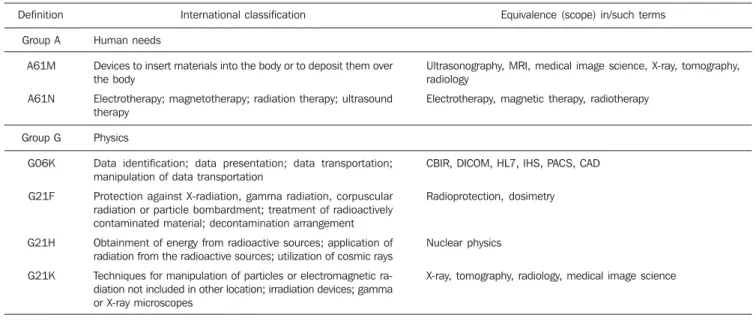
The data retrieved from the domestic and international databases, considering all the keywords indistinctively for all the da-tabases, comprised 277,057 patents filed at the three patent offices (EPO, INPI, USPTO), in the scenario researched by the present study (100%). From those, 4,544 patents were filed at INPI (2.4%). The query in SQL on database retrieved and developed in the search scope has allowed the configuration and grouping of the 277,057 patents into categories represen-tative of the international classification (nomenclature) of patents (Table 1), so it was possible to establish that the regional office with the highest number of filed patents in the area of interest is the USPTO (Table 2). However, the European Office is the international office most utilized by Brazilian patent authors for the filing of such patents, with 80 patents (Table 3).
DISCUSSION
As a whole, the results obtained by the search procedure allowed the current over-view on the Brazilian production of tech-nology in the field of radiology and imag-ing diagnosis as well as in its correlates, developed by their several agents along the 2000–2009 decade. Such data confirm a significant variation between domestic and international productions (Tables 2 and 3). The number of foreign patent applications filed at INPI is much higher than the num-ber of domestic patents filed at the same office. As expected, the regional office holding the highest number of patent appli-cations is the USPTO, either for represent-ing the largest economy in the global sce-nario, or for the fact that the USA promotes the creation of new products and services by means of important programs for financ-ing research and development targeted to small and medium sized companies(12) and
even for adopting a more permissive regu-lation in terms of what is eligible for filing as IP (for example, a software IP can be protected by means of patent in the USA, but not in Brazil).
dem-onstrates a concentration of innovation in radiological apparatuses and related tech-niques in the “A” definition group (Table 1) and a large number of IP filings in the area of information technology in health and medical physics applied to radiology and imaging diagnosis in the definition group “G” (Table 1). On the author’s opin-ion, the G06K category (Table 1), is a sui generis classification for comprising char-acteristics of both groups, as the innovation products filed in that category are related to the procedures of generation, archiving and transmission of radiologic images, with repercussions both on equipment and hardware/software platform for operation
of health apparatuses. By first considering the patent filings by Brazilians at the USPTO with respect to the “G” definition group (Table 1), and the classification G21F and G21H, no patent filing was found (Table 3). The G21F classification (Table 1) only received publication of pat-ents by Brazilians in the European office (2) and in the Brazilian Office (24) (Table 3). Such a classification, by its own scription, points towards products and de-vices in the area of radioprotection. Over the last decade, radiation protection and dosimetric control have received increas-ing attention in what regards medical ap-plications and clinical investigation
under-taken in universities(18). In this scenario,
one highlights the development of new technologies and applications that rely on high intensity and high accuracy radiation fields with short duration and high repeti-tion rates at shorter time intervals. Such new technologies comprise aspects tar-geted at imaging diagnosis, particularly in the field of nuclear medicine and treatment, with focus on radiotherapy, involving from X-ray accelerators to neutron sources(19).
Such new technologies have the potential of minimizing the deleterious effects and risks for patients exposed to ionizing radia-tion, allowing the disposal of nuclear ma-terials in a more appropriate and controlled manners by the institutions, and possibly lowering the costs associated with safety apparatuses required in health care pro-cesses. Therefore, it is a constitutive ele-ment of the radiology clinical practice, with a considerable impact on the professional daily activities. The category G21H (Table 1) concerns the obtainment and application of nuclear energy for radiology and general health devices. Such a classification is the only among all categories in the present study for which no Brazilian patent filing was detected at any of the patent offices (Table 3). Such a situation is added to the fact that all the 23 patents found at INPI (Table 2) belong to foreign applicants with some kind of commercial/licensing and product protection interest in the Brazilian territory. Additionally, such category is also
Table 1 Organization of the results found in groups, utilizing the classes and categories of the international classification of intellectual property(15).
Definition
Group A
A61M
A61N
Group G
G06K
G21F
G21H
G21K
International classification
Human needs
Devices to insert materials into the body or to deposit them over the body
Electrotherapy; magnetotherapy; radiation therapy; ultrasound therapy
Physics
Data identification; data presentation; data transportation; manipulation of data transportation
Protection against X-radiation, gamma radiation, corpuscular radiation or particle bombardment; treatment of radioactively contaminated material; decontamination arrangement
Obtainment of energy from radioactive sources; application of radiation from the radioactive sources; utilization of cosmic rays
Techniques for manipulation of particles or electromagnetic ra-diation not included in other location; irrara-diation devices; gamma or X-ray microscopes
Equivalence (scope) in/such terms
Ultrasonography, MRI, medical image science, X-ray, tomography, radiology
Electrotherapy, magnetic therapy, radiotherapy
CBIR, DICOM, HL7, IHS, PACS, CAD
Radioprotection, dosimetry
Nuclear physics
X-ray, tomography, radiology, medical image science
Table 3 Records retrieved by the study, at each researched (domestic and international) database, comprising all filed patents, exclusively by Brazilians, in the classes covered by the study.
EPO
USPTO
INPI
G21F
2
0
24
G21H
0
0
0
G21K
6
1
15
A61M
34
16
1,075
A61N
13
2
313
G06K
25
7
305
EPO, European Patent Office; USPTO, United States Patent and Trademark Office; INPI, Instituto Nacional da Propriedade Industrial.
Table 2 Records retrieved by the study, at each researched (domestic and international) database, comprising all patents filed in the classifications covered by the study.
EPO
USPTO
INPI
G21F
2,203
5,370
346
G21H
117
993
23
G21K
2,740
10,383
94
A61M
32,507
80,514
4,822
A61N
12,415
34,530
1,067
G06K
15,446
72,039
1,448
the smallest in number of publications, among all others in the studied spectrum (Table 2). The reason for such a small num-ber of IP publications, even in a global context, remains unknown to the present study authors. By utilizing only the study method, it is not possible to qualitatively determine whether the filed patents indi-cate a frontier of innovation in radiology and imaging diagnosis or an area that is already well developed (comparison, for example, with the previous decade and/or complete reading of each patent. Some studies fragments(4,6,13) indicate that it is a
problem related to the type of research (ra-dioactive energy) and political/legal prohi-bitions (even in the USA), besides the high cost and poor results in the state of current practice. It is also possible to speculate on the number of researchers involved with projects on this theme. The G21H class (Table 1) is a nomenclature applied to de-vices that utilize direct manipulation of radioactive residues in nuclear reactors uti-lized in health care. Among all the strands of innovation covered by the present study, such particular category, on account of its characteristics respecting the manipulation and use of strictly controlled materials, is the one with smaller number of publica-tions in all international offices, even con-sidering the authors from other foreign communities.
On the other hand, the G21K category (Table 1), received publications from all international offices approached by the present study. Among all the investigated categories, G21K was the one with the most even distribution of domestic and international patents, 7 and 15 patents re-spectively (Table 3). Such category com-prises products related to the utilization of electromagnetic radiation (with emphasis on ionizing radiation) in medical imaging apparatuses, such as X-ray and computed tomography equipment, and is particularly related to devices aimed at optimizing the images acquisition process.
Such a small number of patents under the classification scope related to the defi-nition group “G” (Table 1), with the excep-tion of category G06K, which will be ana-lyzed together with group “A” (Table 1) for their thematic proximity, suggests three different possible scenarios. The first one
is that the academic community and the Brazilian technological base do not pro-duce sufficiently relevant products eligible for patent applications in large interna-tional markets. The second possible sce-nario is that in which Brazil develops do-mestic solutions, particularly those avail-able at public hospitals and with the utili-zation of open source technologies and/or use of open knowledge (scientific articles and papers, etc.). The third scenario is that in which Brazil is a large importer of tech-nology and products related to the types of patents with small number of publications. Also, there is the strong possibility that these three scenarios are actually co-exist-ing, thus determining the small number of patents in the area. This may demonstrate an inexpressive dynamics between theo-retical knowledge produced by the Brazil-ian universities and the application of such knowledge in the resolution of actual prob-lems in the practice of, in such case, a clini-cal speciality.
The definition group “A” (Table 1), on its turn, presents the highest number of patent filings found in the present study. Category A61M, specifically, respecting the clinical practice of radiology and imag-ing diagnosis by means of technological devices related to ultrasonography, mag-netic resonance imaging, radiography and medical radiology. It was the category with the highest number of patent filings in all the investigated scenarios (Table 2), also comprising the highest number of inven-tion applicainven-tions filed by Brazilians in Bra-zil and, in its totality, also abroad. Category A61N (Table 1), on its turn, comprises the highest number of instruments related to radiotherapy, electrotherapy and magnetic therapy. Finally, category G06K (Table 1) comprises identification, manipulation, transmission and archiving of recorded data. With the technological advances in the acquisition and utilization of medical images, radiology has presented intellec-tual and financial developments(20,21). The
improvements in the offer of information technology, particularly in procedures con-nected with transmission of medical data, such as HL7 and DICOM itself, allow an easier and dynamic development of the diagnosis by the radiologist and by the area that requested the examinations. Together,
such characteristics encourage investments in academic and entrepreneurial research with strong possibilities of generating in-novation and IP, even when competing for space, and as a matter of fact, increasingly so, with freeware and user friendly solu-tions available for radiologists(22,23).
The number of patents filed in a coun-try demonstrates the relevance and the level of development which such target-country represents for the object of the patent(24).
Thus, it is assumed that as Brazil is chosen as a protected place for one´s invention, the author does not only wish to market his invention locally, but also to protect his product from any potential competitor in that country. Thus, considering the fact that most patents filed at the international of-fices are not filed at INPI (Table 2) one may conclude that there is neither commercial interest nor interest in the development of protection of such intellectual property in Brazil, for most patents found in the present study (Table 3). This is equivalent to mention that the country is not only eco-nomically not viable for the licensing of technology or industrialization of medical radiological equipment based on techno-logical innovation, mainly those related to nuclear materials in the “G” definition group (Table 1), but also that the country’s research & development platform is still producing innovation at a very slow pace in all investigated categories. Considering the theme investigated in the present study, this is rather worrisome, as more people will have access or will demand access to more expensive and complex imaging stud-ies(25). Additionally, modern
evidence-based medicine increasingly demands ex-aminations with more reliable results, with lower risk both to patients and the special-ist and at accessible operational cost(26),
which can only be attained with a research & development platform strongly focused on science, technology and innovation(27).
CONCLUSION
the weakness of the Brazilian IP production in the fields of radiology and imaging di-agnosis, in what respects the filing of such IP at domestic and international offices. As a future prospect to widen the discussion on the Brazilian situation with respect the theme presented in this study, there is the possibility of a new study with a explor-atory-comparative bias on the situation of Brazil with those of other emerging coun-tries (China, India and Russia) and even of other regions not covered by the method in the present study (Asia and Oceania).
Acknowledgements
To Fundação de Amparo à Pesquisa do Estado de São Paulo (Fapesp), to Fundação de Apoio ao Ensino, Pesquisa e Assistência (Faepa) of Hospital das Clínicas da Fa-culdade de Medicina de Ribeirão Preto (HCFMRP), and to Conselho Nacional de Desenvolvimento Científico e Tecnológico (CNPq), for the financial support.
REFERENCES
1. Rosenberg N. Some critical episodes in the progress of medical innovation: An Anglo-Ameri-can perspective. Research Policy. 2009;38:234– 42.
2. Dunnick NR. Supporting the academic mission. J Am Coll Radiol. 2010;7:211–5.
3. Skipper JK Jr, Pratto DJ, Philip JR, et al. Benefits of hindsight: design problems in evaluating inno-vation in medical education. Evaluation Practice. 1989;10:7–11.
4. Steele JR, Schomer DF. Continuous quality im-provement programs provide new opportunities
to drive value innovation initiatives in hospital-based radiology practices. J Am Coll Radiol. 2009;6:491–9.
5. OECD. Manual de Oslo. Diretrizes para coleta e interpretação de dados sobre inovação. [acessado em 19 de março de 2011]. Disponível em: http:// www.oei.es/salactsi/oslo2.pdf
6. Chan S. Strategy development for anticipating and handling a disruptive technology. J Am Coll Radiol. 2006;3:778–86.
7. George JF, Nunamaker JF Jr, Valacich JS. Elec-tronic meeting systems as innovation : a study of the innovation process. Information & Manage-ment. 1992;22:187–95.
8. Herce JL. WIPO patent information services for developing countries. World Patent Information. 2001;23:295–308.
9. Hanel P. Intellectual property rights business man-agement practices: a survey of the literature. Technovation. 2006;26:895–931.
10. Deng Y. The effects of patent regime changes: a case study of the European patent office. Interna-tional Journal of Industrial Organization. 2007; 25:121–38.
11. Brown WH. Trends in patent renewals at the United States Patent and Trademark Office. World Patent Information. 1995;17:225–34.
12. Bushberg JT, Seibert JA, Leidholdt EM Jr. et al. The essential physics of medical imaging. Phila-delphia, PA: Lippincott Williams & Wilkins; 2002.
13. Blazona B, Koncar M. HL7 and DICOM based integration of radiology departments with health-care enterprise information systems. Int J Med Inform. 2007;76 Suppl 3:S425–32.
14. Makarov M. The process of reforming the Inter-national Patent Classification. World Patent Infor-mation. 2004;26:137–41.
15. WIPO. The International Patent Classification. [acessado em 8 de julho de 2011]. Disponível em: http://www.wipo.int/ipcpub/#lang=en&refresh= page
16. Harrington JL. Installing and running MySQL. In:
Harrington JL, editor. SQL clearly explained. 2nd ed. San Francisco, CA: Morgan Kaufmann Pub-lishers; 2003. p. 3–8.
17. Desjardins B, Hamilton RC. A practical approach for inexpensive searches of radiology report da-tabases. Acad Radiol. 2007;14:749–56. 18. Dalmazo J, Elias Jr J, Brocchi MAC, et al.
Oti-mização da dose em exames de rotina em tomo-grafia computadorizada: estudo de viabilidade em um hospital universitário. Radiol Bras. 2010; 43:241–8.
19. Larsson CM. Waste disposal and the recommen-dations of the International Commission on Ra-diological Protection – challenges for radioecol-ogy and environmental radiation protection. J Environ Radioact. 2009;100:1053–7. 20. Merenstein D, Daumit GL, Powe NR. Use and
costs of nonrecommended tests during routine preventive health exams. J Am Prev Med. 2006; 30:521–7.
21. Rinck PA. Radiología: investigación y futuro. Radiología. 2006;48:8–13.
22. Barra FR, Barra RR, Barra Sobrinho A. Visuali-zadores de imagens médicas gratuitos: é possível trabalhar apenas com eles? Radiol Bras. 2010;43: 313–8.
23. Nobre LF, von Wangenheim A. Software gratuito: uma opção para o radiologista? Radiol Bras. 2010;43(5):ix–x.
24. Gómez LP, Martínez AA. Investigación en bio-tecnología y generación de patentes de interés sanitario. Medicina Clínica. 2008;131:55–9. 25. Hillman BJ. The diffusion of new imaging
tech-nologies: a molecular imaging prospective. J Am Coll Radiol. 2006;3:33–7.
26. Gill IE, Ondategui-Parra S, Nathanson E, et al. Strategic planning in radiology. J Am Coll Radiol. 2005;2:348–57.