Revista Brasileira de Hematologia e Hemoterapia
Brazilian Journal of Hematology and Hemotherapy
www.rbhh.org
A B S T R A C T
Background: Dengue is an infectious disease with a recurring incidence, especially in developing countries. Despite recent economic growth, success in disease control has not been achieved, and dengue has evolved from cyclic epidemic outbreaks to a lack of seasonality. The lack of scientific basis for the proper management of cases with hemorrhagic manifestations, especially regarding transfusion procedures, might contribute to the high death rate in potentially avoidable cases.
Objective: The aim of the study was to identify the clinical and laboratory manifestations in hemorrhagic dengue fever treated at the emergency services in Rio Branco, AC, Brazil, as well as to describe transfusion characteristics of patients and identify possible prognostic factors.
Methods: A retrospective descriptive study was performed to analyze the distribution of relative frequencies of clinical and laboratory variables. The study was carried out in Rio Branco with confirmed dengue fever cases. Secondary data were obtained by Acre Epidemiological Surveillance teams of cases with bleeding or platelet counts under 100.0 × 10⁹/L. The patients’ clinical, laboratory and transfusion data were obtained from hospital records.
Results: A total of 90,553 dengue cases were reported of which 7,447 had serologic confirmation; 267 cases had hemorrhagic manifestations and 193 patients were located. Nearly half of the patients had anemia and the mean of the lowest platelet count of these patients was 26.4 × 10⁹/L. Platelet concentrate was transfused in 22.3% of cases with a mean of 7.5 IU/patient, fresh frozen plasma in 21.2% with a mean of 5.2 IU/patient and just 2.6% of patients received concentrated red blood cells with a mean of 3.2 IU/patient. Bleeding led to transfusions. Signs of plasma leakage and cardiopulmonary dysfunction were correlated to unfavorable outcomes.
Conclusion: The pattern of clinical and laboratory criteria observed in this investigation does not differ from the literature. Transfusions were used as part of the treatment of dengue hemorrhagic fever manifestations. Some of the clinical manifestations may be related to unfavorable outcomes.
© 2014 Associação Brasileira de Hematologia, Hemoterapia e Terapia Celular. All rights reserved.
*Corresponding author at: Universidade Federal do Acre, Pró-Reitoria de Pós-Graduação, Programa de Pós-Graduação em Saúde Cole-tiva, BR 364, Km 04, Distrito Industrial, 69915-900, Rio Branco, AC, Brazil.
E-mail address: [email protected] (D.E. Fujimoto).
1516-8484/$ - see front matter © 2014 Associação Brasileira de Hematologia, Hemoterapia e Terapia Celular. Published by Elsevier Edi-tora Ltda. All rights reserved.
DOI: 10.5581/1516-8484.20140027
Original article
Clinical and laboratory characteristics of patients with
dengue hemorrhagic fever manifestations and their
transfusion profile
Denys Eiti Fujimoto
a,*, Sergio Koifman
ba Universidade Federal do Acre (UFAC), Rio Branco, AC, Brazil b Fundação Oswaldo Cruz (Fiocruz), Rio de Janeiro, RJ, Brazil
A R T I C L E I N F O
Article history:
Received 6 July 2013 Accepted 18 December 2013
Keywords:
Dengue hemorrhagic fever Blood transfusion
Introduction
Dengue virus belongs to the genus Flavivirus (group B arbovirus, RNA virus) and comprises structural and non-structural proteins.1 The classic clinical presentation is
characterized by the abrupt onset of headache, myalgia and high fever, in addition to arthralgia, retro-orbital pain and hemorrhagic manifestations. The classical presentation differs from dengue hemorrhagic fever, which is characterized by luid leakage into the interstitium.2 Halstead states that
in Latin American countries including Brazil, mosquito eradication was achieved in large urban centers after World War II, however, almost 20 years after, there was a resurgence of Aedes populations in Brazil. This allowed the irst dengue outbreak with viral isolation in 1981 in Boa Vista, state of Roraima, along with the identiication of DEN-1 virus and later of DEN-4 virus in 2007.3 DEN-1 and DEN-2 were found
in Rio de Janeiro in 1987 and DEN-3 in 2002. Between 2000 and 2005, Brazilian cases represented more than 60% of those registered by the World Health Organization (WHO) and almost 80% of all cases in the Americas.4 This increase
was identiied in reports from the Brazilian Communicable Disease Information System.5
A quick dengue infection conirmation test is not available, and a complete blood count (CBC) might show characteristics such as leukopenia and thrombocytopenia.6 These indings
can be explained by peripheral platelet destruction mechanisms in the liver and spleen via the action of immunocomplexes or the complement system, in addition to the inhibition of medullary hematopoiesis7 and disseminated
intravascular coagulation.8 A coagulogram might also indicate
changes such as prolonged prothrombin and activated partial thromboplastin times, in addition to decreased serum ibrinogen concentration without increased levels of ibrinogen degradation products; these signs occur mainly with the hemorrhagic form of dengue fever.9 According to
Lupi, “[...] Increased aspartate aminotransferase (AST) can be observed in 30%-90% of classic dengue cases”;8 this increase
might correlate with thrombocytopenia, and thus, the Sri Lanka Medical Association considers a normal AST level to be a strong negative predictor of dengue hemorrhagic fever and its complications.10
The Ministry of Health recommends platelet transfusion when platelet levels are less than 20 × 109/L with signiicant
bleeding or when platelet counts range from 20-50 × 109/L with
suspected central nervous system (CNS) bleeding.2 Singhi et
al. recommends platelet concentrate transfusions at lower platelet counts (10 x 109/L).1 The authors of a
population-based study conducted in India mentioned that 42.6% of the patients with conirmed dengue and thrombocytopenia (platelet count < 40 × 109/L) received platelet concentrate
transfusions.11 In Singapore, platelet transfusion was
performed in approximately 12% (249 patients) of 1,973 cases with a mean platelet count of 15 × 109/L.12
The infusion of fresh frozen plasma (FFP) at a dose of 10 mL/kg given every 8 or 12 hours according to changes in the coagulogram, is also recommended.2 However, a prospective,
randomized, double-blind study was conducted to evaluate the
eficacy of FFP versus isotonic saline solution infusions, and a signiicant increase in the platelet count was observed during the irst 12 hours after infusion only in the FFP receiving group.1
The municipality of Rio Branco, located in the western Amazon region, has shown a marked annual increase in the incidence of dengue infections, especially since 2009,5 and
also an increase in the incidence of dengue hemorrhagic fever. Patients rely on emergency and urgent care services in two emergency healthcare units. The most serious cases and those that require transfusion are transferred to the Hospital de Urgência e Emergência de Rio Branco (HUERB).
Platelet concentrate and FFP transfusions have been used as a measure to prevent the increasing clinical evolution of dengue hemorrhagic fever, thus preventing evolution of the disease towards death. Nevertheless, the criteria for making a decision regarding the implementation of transfusion are not clearly deined, and therefore such decisions are made relatively empirically, based on the experience of emergency center health professionals.
Objective
This study sought to determine the clinical and laboratory characteristics, transfusion aspects and mortality of patients with dengue hemorrhagic fever treated by emergency services in the city of Rio Branco, Acre.
Methods
This retrospective descriptive study employed secondary data on dengue cases conirmed via serology by the State Epidemiological Surveillance Service. Only cases with bleeding or platelet counts less than 100 × 109/L from January 3rd, 2007
to June 14th, 2011 were included. Additional information was
obtained from the medical records of the health services. Anemia was deined as hemoglobin levels less than 13.0 g/dL or hematocrit less than 40% for males, and a hemoglobin level less than 11.5 g/dL or hematocrit less than 36% for females at any point during hospitalization. Eosinophilia was deined as an eosinophil count above the normal range (0.04-0.4 × 10⁹/L)
at any point during hospitalization. This project was approved by the Research Ethics Committee of the Universidade Federal do Acre (UFAC; number 23107.011739/2011-15). A relative frequencies analysis of clinical and laboratory variables and transfusion aspects was performed, and the distribution of parameters was determined with 95% conidence intervals. Additionally, the possible effect on mortality was compared between groups that did or did not receive platelet concentrate or FFP transfusions, according to the chi-squared method with the level of signiicance being set at 5%.
Results
16.5% (14,985 cases) cases, 7,447 serologically conirmed (49.7%; Figure 1). Among the conirmed cases, 7,144 (99.6%) were classiied as classic dengue, whereas 267 cases with hemorrhagic manifestations were identiied as hemorrhagic dengue according to criteria set by this study. A subsequent survey identiied the location of 193 of the latter cases (72.3%) in the medical records. A predominance of female patients was observed (57.0% of the hemorrhagic manifestation cases). The mean and median patient ages were 38.2 and 35 years, respectively (95% conidence interval [95% CI]: 35.3-41.2 years).
The most frequently reported signs and symptoms, listed in order of incidence, were fever, headache and myalgia (Table 1). Bleeding occurred in 35.8% of the cases (95% CI: 29.0-43.0) and was mainly distributed as petechiae (14.0%), gingival bleeding (13.0%) and epistaxis (10.9%).
Plasma leakage was observed in 10.4% of the cases (95% CI: 6.4-15.6) and hypotension and hemodynamic instability occurred in 65.0% and 20.0% of these cases, respectively.
Fourteen cases (7.3%) evolved to death and 15 cases (7.8%) required intensive care. Among the observed complications, cardiorespiratory dysfunction was the most common affecting 5.7% of the cases, followed by ascites (4.7%) and pleural effusion (3.6%; Table 2).
Signs and symptoms n % 95% CI
Fever 154 79.8 73.4-85.2
Headache 112 58.0 50.7-65.1
Myalgia 108 56.0 48.7-63.1
Abdominal pain 79 40.9 33.9-48.2
Arthralgia 68 35.2 28.5-42.4
Vomiting 56 29.0 22.7-36.0
Retro-orbital pain 31 16.1 11.2-22.0
Skin rash 27 14.0 9.4-19.7
Lethargy 21 10.9 6.9-16.2
Itching 17 8.8 5.2-13.7
Respiratory distress 12 6.2 3.3-10.6 Painful hepatomegaly 2 1.0 0.1-3.7
95% CI: 95% confidence interval.
Table 1 - Clinical characteristics in patients with dengue hemorrhagic fever admitted to emergency care services in Rio Branco, Acre from January 2007 to May 2011.
n % 95% CI
Complications
Cardiorespiratory dysfunction 11 5.7 2.9-10.0
Ascites 9 4.7 2.2-8.7
Pleural effusion 7 3.6 1.5-7.3
Central nervous system 5 2.6 0.8-5.9
Others 4 2.1
Evolution
ICU transfer 15 7.8 4.4-12.5
Death 14 7.3 4.0-11.9
95% CI: 95% confidence interval; ICU: intensive care unit.
Table 2 - Clinical complications of patients with dengue hemorrhagic fever admitted to the emergency care services in Rio Branco, Acre from January 2007 to May 2011.
Figure 1 – Hierarchical scheme of the first analysis of dengue cases in the city of Rio Branco, in the period 2007-2011.
,
, ,
Table 1 shows the frequency distributions of the clinical characteristics at diagnosis and the pattern of clinical evolution observed in this study. Of the 193 medical records, 29 patients (15.0%; 95% CI: 10.3-20.9) reported some type of comorbidity. The most frequently reported comorbidity, in
41.4% (95% CI: 23.5-61.1) of the reports, was hypertension. Regarding the CBC, anemia was observed in 45.0% of the cases (95% CI: 37.8-52.4), and the mean lowest hemoglobin level of all patients who received any type of transfusion during hospitalization was 9.0 g/dL. Eosinophilia was observed in 17.6% of the cases (95% CI: 12.5-23.9).
Several platelet counts were performed for each patient during hospitalization. A mean platelet count of 26.4 x 10⁹/L
(95% CI: 23.7-29.1 × 10⁹/L), with a minimum value < 1 × 10⁹/L of
blood was observed when the lowest values for each patient were considered. The mean platelet count upon hospital discharge was 111.2 × 10⁹/L (95% CI: 97.8-124.7 × 10⁹/L). The
mean lowest leukocyte count was 4.6 × 10⁹/L (95% CI: 3.8-5.3 ×
109/L), with a minimum value of 0.7 x 10⁹/L and a maximum
value of 57.0 × 10⁹/L (Table 3).
The mean AST level was 309.7 IU/L (95% CI: 140.7-478.7 IU/L), with minimum and maximum values of 18 and 6,390 IU/L, respectively. For alanine aminotransferase (ALT), the mean value was 167.6 IU/L (95% CI: 105.6-229.7 IU/L), with minimum and maximum values of 21 and 2,296 IU/L, respectively (Table 3).
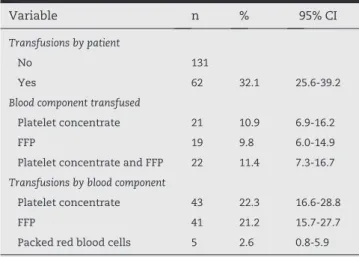
Of the 43 patients who received platelet concentrate, a mean of 7.5 IU of platelet concentrate was infused per patient with a median of 6 IU per patient. Of the 41 patients who received FFP, a mean of 5.2 IU were infused per patient with a median of 4 IU per patient. Only ive patients received packed red blood cells, with an infusion mean of 3.2 IU per patient and a median of 3 IU per patient.
Additionally, 12.9% (8/62) of the patients who received FFP and/or platelet transfusions evolved to death, compared with 4.6% (6/131) of those who did not receive transfusions. This high mortality rate associated with transfusion was statistically signiicant (p-value = 0.037).
Discussion
Dengue is an infectious disease with persistent occurrence, especially in developing countries.Despite recent economic growth, success in controlling this disease has not been achieved, and dengue has evolved from cyclic epidemic outbreaks to a lack of seasonality, given the increase in new and relapsed cases. All of these factors have contributed to the rise in frequency of complications and the development of severe disease forms. The lack of technical support and scientiic basis for the proper management of cases with hemorrhagic manifestations, especially regarding transfusion procedures, might contribute to the occurrence of death in potentially avoidable cases.
Females were predominant in this study, accounting for 57% cases in comparison to the 48% reported in Indonesia.13
The mean patient age in our study was 38.2 years (95% CI: 35.3-41.2 years), higher than that reported by Brito14 in 2007
for a 13-year period in Brazil and for a 25-year period in India.15 These differences in age groups can be attributed to
the case selection criteria and the types of existing coverage in the hospitals where the studies were conducted.
On assessing the distributions of observed clinical manifestations, fever and headache were the most frequent, results that are in agreement with several studies in the literature.
The analysis of bleeding manifestations in this sample, the magnitude of its occurrence was higher compared to that reported in the literature. In this study, bleeding occurred in 35.8% of cases most commonly displayed as petechiae, gingival bleeding and epistaxis. In Thailand, the occurrence of hemorrhagic manifestations was reported in 50.2% of 175 pediatric patients, and these cases included hematemesis in addition to petechiae and epistaxis.16 In Indonesia, bleeding
occurred in 6% of the cases with gastrointestinal sites being the most common.13 Another study from India reported that
15.1% of patients exhibited bleeding, with petechiae (9.3%) and epistaxis (2.7%).11 Despite the concern of hemorrhagic
manifestations, Chaudhary et al. concluded that there was no correlation between hemorrhagic manifestations and serum platelet counts.15 These data from the literature hinder a
better comparison of results, mainly due to differences in the patient selection criteria.
The occurrence of hematocrit changes in this study also differed from those reported in the literature. In the Regarding transfusions in reference to the type of blood
component and transfusion reaction, the following results were observed: platelet concentrate was administered to 22.3% of the patients with 7.1% exhibiting transfusion reactions, and FFP was administered to 21.2% with 2.5% exhibiting transfusion reactions. Only 2.6% of the patients received packed red blood cells, and none reported transfusion reactions (Table 4). Of the four patients who received platelets or FFP and exhibited transfusion reactions, two had allergic reactions; the types of transfusion reactions were not described for the other patients.
Variable n % 95% CI
Anemiaa 86 45.0 37.8-52.4
Eosinophiliab 33 17.6 12.5-23.9
Mean SD Median (95% CI)
Platelets (×109/L)
At discharge 111.2 82.8 88.0 97.8-124.7
Lowest 26.4 17.4 21.8 23.7-29.1
Leucocytes (×109/L)
Lowest count 4.6 5.0 3.5 3.8-5.3
Transaminases
AST (IU/L) 309.7 788.2 174 140.7-478.7 ALT (IU/L) 167.6 287.7 99 105.6-229.7
95% CI: 95% confidence interval; AST: aspartate transaminase; ALT: alanine aminotransferase.
a There was no erythrogram value for one patient. b There were no eosinophil values for eight patients.
Table 3 - Description of hematic characteristics of patients with dengue hemorrhagic fever in the city of Rio Branco, Acre from January 2007 to May 2011.
Variable n % 95% CI
Transfusions by patient
No 131
Yes 62 32.1 25.6-39.2
Blood component transfused
Platelet concentrate 21 10.9 6.9-16.2
FFP 19 9.8 6.0-14.9
Platelet concentrate and FFP 22 11.4 7.3-16.7
Transfusions by blood component
Platelet concentrate 43 22.3 16.6-28.8
FFP 41 21.2 15.7-27.7
Packed red blood cells 5 2.6 0.8-5.9
present study, 45% of patients had anemia at some point during hospitalization. In 2006, Chaudhary et al. reported a mean hematocrit of 35.4%.15 Collection of the mean
erythrocyte parameters only upon admission is insuficient since hematocrit variations can occur as a result of the hydroelectrolytic status during patient hospitalization or because of bleeding that can lead to a reduced hematocrit.
In Brazil, changes in transaminases have been described in more than 80% of the cases,14 a rate similar to that observed
in this study, in which 95% of the cases had AST levels ranging from 140.7-478.7 IU/L and ALT levels ranging from 105.6-229.7 IU/L. These results demonstrate the importance of laboratory assessment upon admission and during hospitalization. Additionally, there is evidence of a correlation between the increase in these parameters and mortality. An association of these test results with liver dysfunction and acquired coagulopathy should be considered as an indication of the need to monitor the coagulation status and FFP transfusions.
In Thailand, 10.6% of patients with dengue hemorrhagic fever received some form of transfusion, and 6.9% of these received platelet concentrate, 5% received FFP and 3.1% received packed red blood cells.16 In India, a group of patients received
platelet concentrate; among these cases, 31.8% were considered inappropriate transfusions and 26.9% received FFP.15
In Singapore, 12.6% of patients received platelet transfusions.12 In India, 42.6% of patients received platelet
concentrates, 5% received plasma and 2.2% received packed red blood cells.11 In Indonesia, platelet concentrate transfusions
were performed in 12% of cases, with no signiicant difference in the incidence of hemorrhagic manifestations when compared with the group that did not receive platelet transfusions, even in patients with platelet counts < 25.0 × 10⁹/L.13 However, this study also showed that 56.5% of patients
who received platelet concentrate transfusions had platelet counts higher than 100.0 × 10⁹/L and 1.4% presented some
type of bleeding.
In the present study, 32.1% of patients received some form of transfusion; 22.3% of those patients received platelet concentrate, 21.2% received FFP and only 2.6% received packed red blood cells.
In an observational study of dengue patients in Martinique, several received platelet concentrate transfusions. Of the 350 evaluated cases, 9 (2.6%) received platelet transfusions, with a mean of 3.66 IU per patient (range: 2.8-13.2 IU), 3 (8.6%) received packed red blood cells and 2 (0.6%) received FFP.17 In
India, 3.4 IU of platelet concentrate were infused per patient,15
a substantially smaller volume than that documented in our study (7.5 IU per patient).
The reported mortality in a study from Thailand was 1.14%,16 while mortality rates in Martinique and India were
less than 1%17 and 2%, respectively;14 all of these rates were
lower than the 7.3%, observed in this study. The presence of bleeding or clinical severity increases the indication for transfusions, and the indicators of plasma leakage and elevated transaminase levels might be related to increased mortality.
The apparent association of plasma and platelet concentrate transfusions with death requires a better evaluation because
there is a possibility that these patients evolved with more severe clinical conditions that might explain the higher mortality in this group and why transfusion could not change the outcome.
Conclusion
The distribution patterns of clinical and laboratory criteria observed did not differ substantially from those described in the literature, despite the differences in sample selection criteria between studies. The clinical proile of the patients in our study can be characterized by the presence of fever, headache and myalgia; with petechiae, gingival bleeding and epistaxis as the most frequent sites of bleeding. Regarding the erythrocyte parameters, anemia was a frequent inding and the mean of the lowest platelet count for each patient upon admission was 26.4 × 10⁹/L. Transaminases were elevated in
most patients. Cardiorespiratory dysfunction was the most frequently observed complication.
Transfusion was used as part of the treatment regimen for dengue hemorrhagic fever in one-third of the cases, with a mixed platelet concentrate and plasma transfusion applied in approximately 10% of the cases. In our study, the use of transfusion therapy did not reduce mortality with death occurring in 7.3% of the cases. The results of this study suggest the need for more appropriate studies to assess survival in a cohort of patients with severe dengue and hemorrhagic manifestations.
Conflicts of interest
The authors declare no conflicts of interest.
R E F E R E N C E S
1. Singhi S, Kissoon N, Bansal A. Dengue and dengue
hemorrhagic fever: management issues in an intensive care unit. J Pediatr (Rio J). 2007;83(2 Suppl):S22-35.
2. Brasil - Dengue: diagnóstico e manejo clínico – Adulto e Criança. 3rd ed. - Brasília: Séria A. Normas e Manuais Técnicos; 2007.
3. Halstead SB. Dengue in the Americas and Southeast Asia: Do they differ? Rev Panam Salud Publica. 2006;20:407-15. 4. Nogueira RM, Araujo JM, Schatzmayr HG. Dengue viruses in
Brazil, 1986-2006. Rev Panam Salud Publica. 2007;22:358-63. 5. Sistema de Informação de Agravos de Notificação – Sinan
/ Datasus / Ministério da Saúde – avaliable from: http:// dtr2004.saude.gov.br/sinanweb/tabnet/tabnet?sinannet/ dengue/ bases/denguebrnet.def.
6. Lupi, O, Carneiro CG, Coelho IC. Manifestações mucocutâneas da dengue. An Bras Dermatol. 2007;82:291-305.
8. Kabra SK, Madhulika YJ, Tripathi P, Singhal T, Broor S, Dar L, et al. Role of platelet transfusion in dengue hemorrhagic fever. Indian Pediatr. 1998;35:452-5.
9. Wills BA, Oragui EE, Stephens AC, Daramola OA, Dung NM, Loan HT, et al. Coagulation abnormalities in dengue hemorrhagic fever: serial investigations in 167 Vietnamese children with dengue shock syndrome. Clin Infect Dis. 2002;35:277-85.
10. Sellahewa KH. Dengue fever – predictors of disease severity and their influence on management. Ceylon Med J. 2008;53:75-8.
11. Makroo RN, Vaina V, Kumar P, Kanth RK. Role of platelet transfusion in the management of dengue patients in a tertiary care hospital. Asian J Transfus Sci. 2007;1:4-7. 12. Lye DC, Lee VJ, Sun Y, Leo YS. Lack of efficacy of prophylactic
platelet transfusion for severe thrombocytopenia in adults with acute uncomplicated dengue infection. Clin Infect Dis. 2009;48:1262-5.
13. Chairulfatah A, Setiabudi D, Agoes R, Colebunders R. Thrombocytopenia and Platelet Transfusions in Dengue
Haemorrhagic Fever and Dengue Shock Syndrome. Dengue Bulletin. 2003;27:138-43.
14. Brito CA. Dengue: perfil clínicoepidemiológico, laboratorial e avaliação de fatores de risco em uma coorte prospectiva entre pacientes adultos em Recife, Nordeste do Brasil. [thesis]. Recife: Fundação Oswaldo Cruz; 2007.
15. Chaudhary R, Khetan D, Sinha S, Sinha P, Sonker A, Pandey P, et al. Transfusion support to Dengue patients in a Hospital based blood transfusion service in north India. Transfus Apher Sci. 2006;35:239-44.
16. Chuansumrit A, Phimolthares V, Tardtong P, Tapaneya-Olarn C, Tapaneya-Tapaneya-Olarn W, Kowsathit P, et al. Transfusion requirements in patients with dengue hemorrhagic fever. Southeast Asian J Trop Med Public Health. 2000;31:10-4. 17. Thomas L, Kaidomar S, Kerob-Bauchet B, Moravie V, Brouste