Fiabilitate si Durabilitate - Fiability & Durability nr.1/2010 Editura “Academica Brâncuşi” , Târgu Jiu, ISSN 1844 – 640X
1
ON THE REAL LOADING MODELING OF THE MECHANICAL
SYSTEMS
Prof. Dr. George DOBRE, University POLITEHNICA of Bucharest, Romania, Assoc. Prof. Dr. Florin MIRICA, University POLITEHNICA of Bucharest, Romania Assoc. Prof. Dr. Sorin CANANAU, University POLITEHNICA of Bucharest, Romania
Abstract. The real loading is generally constituted only by the outside forces and torques acting on a system, neglecting other influences. An important problem is the including the aleatory real loading in the strength and reliability estimation. The analysis of the actual state of researches in field promotes an interesting observation: there are not proposed even clear methods and principles in literature regarding the establishment of the model of real loading; these are presented relatively vague omitting essential details for their applying. The strength calculation is based by the correction of the nominal load through factors including the exterior influences. Papers published in Romania in the field of real modeling are also mentioned. Considerations on real loading in the strength and reliability estimation for specific models are presented. There are two models of real loading much used that are discussed in the paper: loading spectra and loading sequences. Final conclusions emphasize the main points of the paper. In this way, the paper offers an up-to-date image on the real loading modeling of the mechanical systems and the new problems that could be focused in future research started at the University POLITEHNICA of Bucharest.
Keywords: flexion torque, strength calculation, matrix
1. Introduction. Importance and relevance of scientific research field. State of the art The real loading is generally constituted by outside forces and torques acting on a system, neglecting other factors. It is variable in time (fig. 1) generally in a random way, in the sense that its values cannot be exactly determined over time. It is determined by the working processes or by the surrounding environment, such as wind blasts in the case of airplane, road waves in the case of the motor vehicle etc. The random variation of the real loading is characteristic for numerous functional working fields, for example: aviation, automotive, drilling platforms, wind turbines, reversible acting systems for mills etc. (Buxbaum et al, 1992 [2]; Schütz, Klätschke, Heuler, 1994 [25]).
Importance and relevance of scientific research field. The consideration of the real loading in the strength calculation and reliability estimation gives the following distinct advantages: 1. the more accurate strength calculation of mechanical components (fatigue calculation); 2. the estimation of the working life and of the provisional reliability of a mechanical system, which is an aspect of interest specially for those systems having a high reliability (the fields of the air frames, automotives etc.); 3. the reduction of the system dimensions, with advantages in terms of: a) lower price; b) reduction of energy use.
State of the art. The inclusion of the random real loading in the strength calculation and reliability estimation of a mechanical system could be made if there are clear experimental data on loading in time and under given working conditions. A very interesting research problem is to do this inclusion in the absence of reliable and adequate experimental data. These aspects are covered only by disparate research reports. Thus, the literature offers references to the loading processes as (Buxbaum et al, 1992 [2]): stress on the automotive back axle; stress on the axle pin of automotive wheel; driving torque al mill; flexion torque of the automotive axle neck; acceleration of the centre of gravity of the aircraft; pressure from pipe tube etc.
Fig. 1. Measured (random) variation of the real loading
t – time; T – torque; F – force.
T F
Fiabilitate si Durabilitate - Fiability & Durability nr.1/2010 Editura “Academica Brâncuşi” , Târgu Jiu, ISSN 1844 – 640X
2
But the literature does not give well defined methods and principles to consider the real loading in the strength analysis or the processing and interpretation of the results of the processing of the loading models (Buck, 1973 [1]; Günther et al, 1973 [7]; Haibach, 1989 [8]; Heinisch, 1985 [9], 1986 a [10] and 1986 b [11]; Schütz Klätschke, Heuler, 1994 [25]; Seifried, Müller, 1982 [26]; NF A03-406 [23]; DIN 45667 [5]). Thus:
1. the effect of the measurement time on the precision of the real loading model is not clearly presented;
2. methodologies have not been formulated to separately record real loading during different
operating steps, to produce real loading models for each step, to combine them into a global model and to compare the model obtained in this way with that obtained directly; 3. a comparative analysis of different counting-classification procedures is not carried out;
4. there is an insufficient number of studies linked to the extrapolation to the whole life of
the different types of loading models.
The present strength analysis is based as a rule on the use of the so called nominal loads corrected by factors including external influences (of the motor machine and of driving system) (ISO 6336-1:2006 [12] gives the application factor for gears).
In Romania, interesting considerations about the use of the real loading were developed by Cioclov (1975) [4], Buzdugan & Blumenfeld (1979) [3] and Rusu & Teodeorescu (1992) [24]. At the University POLITEHNICA of Bucharest a large team carried out research (mentioned partially in the list of references) on models for real loading. These papers have applications to gears (Dobre, Radulescu Mirica, 1994 [6]; Mirica, Dobre, Cananau, 2000 [19]; Mirica, Dobre, 2000 [14], 2002 [15], 2005 [16], 2006 [17]), other
machine elements (Mirica, Dobre, Dascaliuc, Ignat, 2006 [20]; Mirică, Dobre, Miloiu,
Dascaliuc, 2006 [21]) or mechanical systems (Mirica, Dobre, 2007 [18]; Mirica, Dobre, Itu, Dumitrescu, 2009 [22]).
2. Models of real loading
Real loading in strength calculation and reliability estimation is considered for specific models. There are two models of real loading frequently used: 1. loading spectra; 2. loading sequences.
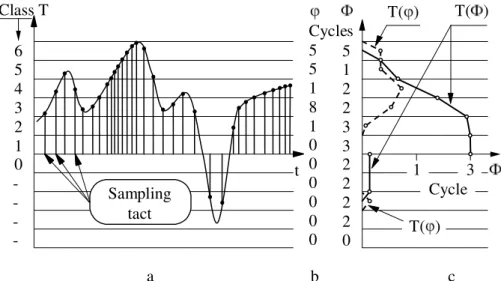
Loading spectrum. An example of the significance of this concept is given further down. The real loading (fig. 1) is replaced, using a procedure for counting – classification (there are many such procedures, of which one is given succinctly in fig. 2, a, b), by so-called loading spectrum (fig. 2, c).
This loading spectrum represents the amplitude, Mt( ) of the system loading as a
function of the cumulated frequency of occurrence (dimensionless or terms of cycles in fig. 2, c). The loading spectrum characteristic for the whole life of the system is obtained from a set of partial spectra (for short measurement times) extrapolated for this duration by a statistical process (Heinisch, 1985 [9]). An example of this spectrum discretized in steps (to make the calculation simpler) is given in fig. 3.
The spectrum shown in this figure represents the loading modulated in amplitude (the torque on a shaft) serving, for example, to establish the modulated force on a wheel tooth in the case of gear transmission etc.
Fiabilitate si Durabilitate - Fiability & Durability nr.1/2010 Editura “Academica Brâncuşi” , Târgu Jiu, ISSN 1844 – 640X
3
Even though the spectra do not contain information about the succession of the numbered cycles, these represent today the main way to characterize real loading, due to the following advantages:
1. the spectra are easily determined through general
purpose data acquisition equipment configured accordingly;
2. they could be extrapolated to the whole life of the studied system;
3. they could be often approximated by unitary spectra idealized approximately by continuous curves;
4. they permit the transposition of experimental results
of “operating strength” (accomplished on the test rig)
to other similar systems.
Loading sequence. The second model for
replacing time-varying loading is the so called
loading sequence with the characteristics listed below.
1. The sequence variation form is obtained by the statistical procedure of the time-varying real loading.
2. As in the case of the loading spectrum, this variation of the loading in model (sequence) can represent the modulated loading as in fig. 4 (for example, the torque on a shaft in the case of gear transmissions) on the sequence duration; and if the loading is non-modulated, as in the case of a airplane wing, then the sequence consists of two curves or graphics in steps, delimiting the minimal and maximal
Fig. 3. Loading spectrum discredited in steps T 1
T 2
T i
1
n n 2 n i
Cycle s T
Fig. 4. Loading sequence in steps Time (number of cycles)
Loa
di
ng
Fig. 2. Method to count the loading (torque) in classes to establish the loading spectra, Mt ( ), adequate for the modulated loading
a) Principle of sampling the torque; b) table of results; c) graphical representation of classing result.
t - time; Mt(t) - function of time of the torque; - relative frequency of occurrence in classes of the discrete values of torque; - cumulated
frequency of occurrence of the same discrete values. 5 5 1 1 8 1 0 0 0 0 0 0 5 1 0 2 1 2 9 3 0 3 0 2 2 2 2 0 Cycles b ) c ) T( ) T( ) 3 0 1 5 T( ) Cycle s Class T a ) 6 5 4 3 2 1 0 -1 -2 -3 -4
Sampling tact
Fiabilitate si Durabilitate - Fiability & Durability nr.1/2010 Editura “Academica Brâncuşi” , Târgu Jiu, ISSN 1844 – 640X
4
values of the loading cycles.
3. The sequence duration is established in the idea of the repeatability of its cycle by a given number time on the product life, so that this sequence characterizes discretely sufficiently exact the random variable loading of the product under the stress aspect and of its life duration.
4. The are two types of loading sequences: bloc-programs and sequences with cycles
combined quasi-randomly.
5. Case of program-block sequences. The random character of the real loading is simulated by the sequence order of blocks which constitute sequences that need to be repeated a large number of times until a defect appears.
The block lengths are
determined arbitrarily by keeping the proportion from the spectrum frame and steps with a low frequency
of occurrence can be
missing from some
programs and can be
cumulated in others.
Consequently, for a given spectrum a number of types of different sequences can be realized through the inclusion (or not) of those blocks of large amplitude and low frequency. Usual variants of ordering the blocks in the frame of loading sequences are given in fig. 5.
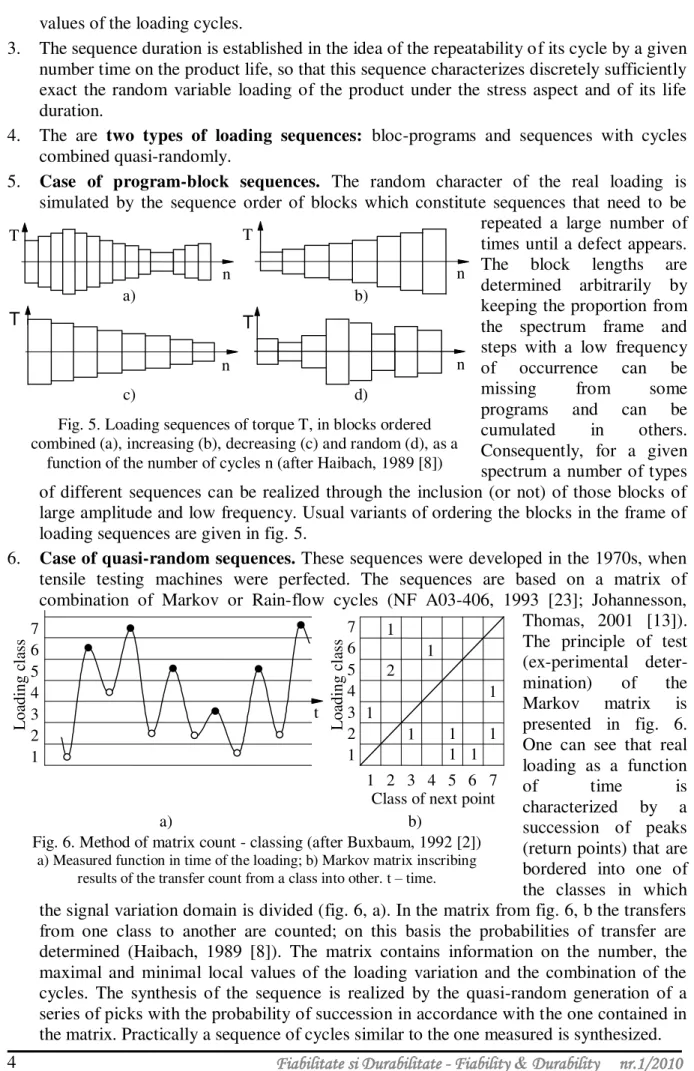
6. Case of quasi-random sequences. These sequences were developed in the 1970s, when tensile testing machines were perfected. The sequences are based on a matrix of combination of Markov or Rain-flow cycles (NF A03-406, 1993 [23]; Johannesson, Thomas, 2001 [13]). The principle of test (ex-perimental
deter-mination) of the
Markov matrix is
presented in fig. 6. One can see that real loading as a function
of time is
characterized by a
succession of peaks (return points) that are bordered into one of the classes in which the signal variation domain is divided (fig. 6, a). In the matrix from fig. 6, b the transfers from one class to another are counted; on this basis the probabilities of transfer are determined (Haibach, 1989 [8]). The matrix contains information on the number, the maximal and minimal local values of the loading variation and the combination of the cycles. The synthesis of the sequence is realized by the quasi-random generation of a series of picks with the probability of succession in accordance with the one contained in the matrix. Practically a sequence of cycles similar to the one measured is synthesized. T a) n c) n T d) n T b) n T
Fig. 5. Loading sequences of torque T, in blocks ordered combined (a), increasing (b), decreasing (c) and random (d), as a
function of the number of cycles n (after Haibach, 1989 [8])
Fig. 6. Method of matrix count - classing (after Buxbaum, 1992 [2]) a) Measured function in time of the loading; b) Markov matrix inscribing
results of the transfer count from a class into other. t – time. b) Loa di ng cl ass
Class of next point 1 2 3 4 7 6 5
1 2 3 4 5 6 7 1
1 2 1
1
1 1 1
1
1 1
Fiabilitate si Durabilitate - Fiability & Durability nr.1/2010 Editura “Academica Brâncuşi” , Târgu Jiu, ISSN 1844 – 640X
5
3. Conclusions
a) The real loading, which is variable in time, has to be modeled statistically and included in reliability estimation (instead of classical strength calculation), for important advantages. b) The engineering fields of application of this aspect are large and diverse: aviation,
automotive, drilling platforms, wind turbines, reversible acting systems for mills etc. c) Existing literature does not give well defined methods and principles for the modeling,
processing and interpretation of results for real loading and for the consideration of the loading model in calculation.
d) Some contributions to the real modeling process were developed at the University
POLITEHNICA of Bucharest.
References
[1] Buck, G. Probleme bei der Berchnung von Fahrzenggetrieben mit Lastkollectiven. VDI-Berichte, Nr.195, 1973, pp.37-46.
[2] Buxbaum, O. et all. Betriebsfestigkeit. Sichere und wirtschaftliche Bemessung schwingbeanspruchgefährdeter Bauteile. Verlag Stahleisen, Düsseldorf, 1992.
[3] Buzdugan, G., Blumenfeld, M. Calculul de rezistenţă a pieselor de maşini. Editura
Tehnică, Bucureşti, 1979.
[4] Cioclov, D. Rezistenţă şi fiabilitate la solicitări variabile. Facla, Timişoara, 1975. [5] DIN 45667:1969-10. Klassierverfahren für das Erfassen regelloser Schwingungen. [6] Dobre, G., Rădulescu, G., Mirică, R. F. Principles regarding the consideration of the
real loading in the gear calculus. Supliment la "Bulletin of the TRANSILVANIA
University of Braşov”, 1994, Vol. "Transmisii mecanice", pp. 69-80.
[7] Günther, W. et all. Schwingfestigkeit. B Deutcher Verlag für Grundstoffindustrie, Leipzig, 1973.
[8] Haibach, E.Betriebsfeste Bauteile. Springer-Verlag, Berlin, 1989.
[9] Heinisch, D. Lebensdauerorientierte Getriebedimensionierung mit Hilfe von Lastkollectiven. Antriebstechnik, Nr.6, 1985, pp. 47-51.
[10] Heinisch, D. Meßtechnische Untersuchungen zur Ermittlung der Lastverteilung in
Planetengetrieben. Antriebstechnik, Nr.7, 1986 a, pp. 35-38.
[11] Heinisch, D. Ein Verfahren zur lebensdauerorientierten Dimensionierung von
Zahnradgetrieben mit Hilfe von Lastkollektiven. Konstruktion, Nr.11, 1986 b, pp. 417-422.
[12] ISO 6336-1:2006.Calculation of load capacity of spur and helical gears -- Part 1: Basic
principles, introduction and general influence factors
[13] Johannesson, P., Thomas, J. J. Extrapolation of Rainflow Matrices. Extremes, Vol. 4,
No. 3, 2001, pp. 241-262.
[14] Mirică, R. F., Dobre, G. Sur la modélisation de la fiabilité des transmissions mécaniques. Tehnologii, Calitate, Maşini, Materiale, nr. 41, Editura Tehnică, Bucureşti, 2000, pp. 377-382, ISBN 973-31-1492-8, ISBN 973-31-1493-6.
Fiabilitate si Durabilitate - Fiability & Durability nr.1/2010 Editura “Academica Brâncuşi” , Târgu Jiu, ISSN 1844 – 640X
6
[16] Mirică, R. F., Dobre, G. Sur la modélisation du chargement des transmissions a roues
dentées. The Ninth IFToMM International Symposium on Theory of Machines and Mechanisms SYROM 2005, Vol. 2, pp 363-368. ISBN 973-718-289-8.
[17] Mirică, R. F., Dobre, G. On the calculus of the gear shaft under variable loading. The
2nd International Conference “POWER TRANSMISSIONS „06”, Novi Sad, Serbia &
Montenegro, 2006, pp. 195-202, ISBN 86-85211-78-6.
[18] Mirică, R. F., Dobre, G. On the Previsional Reliability of Mechanical Systems. Journal
of Mechanical Engineering Design, Vol. 10, No. 1, 2007, Serbia, pp. 6-14, ISSN 1450-5401.
[19] Mirică, R. F., Dobre, G., Cănănău, S. Sur la modélisation de la famille des courbes de
Wöhler pour la sollicitation du pied de la dent. The 8-th Symposium on Mechanisms and Mechanical Transmissions with International Participation, Timişoara, 2000, Vol. II, pp. 217-222, ISBN 973-585-179-2, ISBN 973-585-181-4.
[20] Mirica, R. F., Dobre, G., Dascaliuc, M., Ignat, C. I. On the reliability calculus of a crankshaft. PRASIC ‟06, Brasov, 2006, pp. 181-186, ISBN (10) 973-635-825-9; ISBN (13) 978-973-635-825-8.
[21] Mirică, R. F., Dobre, G., Miloiu, G., Dascaliuc, M. On the calculation of the safety factor for machine elements subjected to variable loading. The 12th International Conference on Machine Design and Production, Kuşadası, Turkey, 2006, vol. II, pp. 987-999, ISBN 975-429-251-5.
[22] Mirică, R. F., Dobre, G., Itu, V., Dumitrescu, I. On the Theoretical-Experimental Modeling of Loading of the Mechanical Transmissions. Proceedings of 3rd International
Conference on Power Transmissions, 1-2 October 2009, Kallithea – Chalkidiki, Greece,
2009, pp. 291-296, ISBN ISBN 978-960-242-662-2.
[23] NF A03-406. Produits métalliques. Fatigue sous sollicitations d’amplitude variable. Méthode Rainflow de comptage des cycles. 1993.
[24] Rusu, O., Teodorescu, M. Oboseala metalelor, Aplicaţii inginereşti. Vol. 2. Editura
Tehnică, Bucureşti, 1992.
[25] Schütz, D., Klätschke, H., Heuler, P. Standardisierte mehraxiale Lastabläufe für
Bauteile von PKW Radaufhängungen. Bericht Nr. FB-201, Fraunhofer-Institut für Betriebsfestigkeit, Darmstadt, 1994.
[26] Seifried, A., Müller, P. Wechselnde Betriebsbelastungen, ihre rechnerunterstützte
Bestimmung, Auswertung und Berücksichtigung in der Konstruktion von