EMPREENDEDORISMO
STUDENT’S ENTREPRENEURIAL INTENTION: ESCE AND FEA
COMPARISON
Pedro Mares, [email protected], Escola Superior de Ciências Empresariais, Instituto Politécnico de Setúbal
Teresa Costa, [email protected], Escola Superior de Ciências Empresariais, Instituto Politécnico de Setúbal
Simone Galina, [email protected], Faculdade de Economia e Administração, USP/FEA-RP (Brasil)
ABSTRACT
The decision to become an entrepreneur involves an elaborate mental process. Understand this process during the formation of possible entrepreneurs that means during its educational process is important since entrepreneurship is actually a possible career for an increase number of students. The present study tries to understand the mental process related to students become an entrepreneur following the cognitive approach through the application of Entrepreneurial Intentions Questionnaire (EIQ) to students from College of Business and Administration (ESCE), Polytechnic Institute of Setubal (IPS) and students from Economics and Management College (FEA), University of São Paulo (USP). Consequently the aim of the study is to understand the student’s entrepreneurial intention, considering the influence of social and skills perceptions in determining entrepreneurial intentions.
This study allowed the confirmation of the findings of previous studies concerning the relationship between the entrepreneurial intention and the attitudes towards entrepreneurship and perceived behavioural control.
KEY WORDS: Entrepreneurship, education, entrepreneurial intention, theory of planned behavior
1. INTRODUCTION
However, there is a lack of agreement on the variables that influence the individual’s decision to start a venture. Cognitive approaches have involved considerable interest (Baron, 2004; Krueger, 2003). In fact, several studies refer the importance of the entrepreneurial intentions concerning the decision to start a new firm and cognitive variables are considered crucial for the understanding of personal decision related with the creation of enterprises (Baron, 2004; Shaver and Scott, 1991). According with these authors this cognitive focus offers further insights that can help understanding the complex process of entrepreneurship.
This study follows the cognitive approach through the application of an entrepreneurial intention model. The main purpose of this study is to understand the student’s entrepreneurial intention. Specifically the study tries to understand the influence of social and skills perceptions in determining entrepreneurial intentions according with the entrepreneurial intention model of Liñán (2004).
The present study is divided into two parts. On the first part, after the introduction of the subject is presented a brief literature review concerning entrepreneurial intentions. On the second part, after the explanation of the methodology, and the presentation of the hypotheses, the results are discussed and conclusions presented.
2. Literature Review and Hypotheses
2.1. Entrepreneurial Intentions
In the entrepreneurship literature, many studies have focused on intentions (Bird, 1988; Krueger, Reilly and Carsrud, 2000). Intentions have been proved to be the best predictors of individual behaviors when the behavior is rare, hard to observe or involves unpredictable time lags (Krueger and Brazeal, 1994).
Bird (1988) identifies two dimensions responsible for the formation of entrepreneurial intentions: individual domains (e.g. personality, motivation and prior experience) and contextual variables (e.g. social context and economics). Concerning the first dimension, Zhao, Seibert and Hills (2005) show that psychological characteristics together with developed skills and abilities influence entrepreneurial intentions. Regarding the contextual variables, other authors demonstrate that environmental influences and environmental support have impact on entrepreneurial intentions.
In the psychological literature exist a different approach to entrepreneurial intentions where the intentions have been studied in terms of process models (intentions models). Among these models, the most popular are the Entrepreneurial Event Theory (Shapero and Sokol, 1982) and the Theory of Planned Behavior (Ajzen, 1991).
and feasibility, that depends on the financial support and potential partners of the entrepreneur. This model was empirically applied and developed later on by Krueger et al. (2000), Peterman and Kennedy (2003).
The Ajzen’s model (1991) tries to explain the influence of cultural and social environment in human behavior. This model is based on the individual’s intention, which is the result of three factors (Ajzen, 1991): 1) the attitude towards entrepreneurship, 2) the subjective norms and 3) perceived control over the firm-creation behavior. Also this model was adopted by several authors in their studies (Kolvereid, 1996a; Kolvereid, 1996b; Tkachev and Kolvereid, 1999; Krueger et al., 2000; Liñán, 2004; Fayolle and Gailly, 2005; Veciana et al., 2005; Fayolle and DeGeorge, 2006; Krueger, 2007; Engle et al., 2010).
Both models have been extensively used to study entrepreneurship. Results have always been consistent with the applicability of the theory of planned behavior (TPB). However, some authors refer some difficulties related to differences in measures used, since there are not standard measurement instruments for entrepreneurial intention and its antecedents (Armitage and Conner, 2001; Liñán and Chen, 2009).
Also Krueger (2000) considered that demographic variables operate indirectly on intentions, only if they change the decision-maker’s attitudes. Consequently, for this author some models did not include these type of variables. For other authors (Gnyawali and Fogel, 1994; Davidsson and Henkson, 2002) these models disregard some combinations of environmental factors relevant in entrepreneurship, such as legal, institutional and socioeconomic conditions, entrepreneurial and business skills, financial or non-financial assistance.
Consequently Liñán (2004), supported on Ajzen’s model (1991) proposed an entrepreneurial intentional model in order to understand the influence of social and skills perceptions in determining entrepreneurial intentions. Also according with this author the decision of creating an enterprise depends on three motivational factors: 1) the personal preference of the entrepreneur or its attraction towards entrepreneurship (that means the positive or negative personal valuation about being an entrepreneur), 2) the perceived behavioral control of the entrepreneur (that means the perceived acceptance or difficulty of becoming an entrepreneur), and 3) the perceived subjective norms of the entrepreneur (that means the perceived social pressure from family, friends or other “relevant people” and their perception concern the approve or not approve of the decision to become an entrepreneur).
Over the last years some entrepreneurship researchers have empirically applied the TPB to students’ entrepreneurial intentions and confirmed the theory’s predictions regarding the impact of attitude, subjective norm, and perceived behavioral control on their intentions (e.g. Kolvereid, 1996a; Krueger et al., 2000; Autio
2.2. ENTREPRENEURSHIP EDUCATION AND ENTREPRENEURIAL INTENTIONS
Actually, entrepreneurship has become one of the main options for students when they conclude their courses (Peterman and Kennedy, 2003). Being an entrepreneur offers several advantages, such as creating their own business and being able to have more significant financial rewards, self-fulfilment, independence and other desirable outcomes (Segal et al., 2005).
Several researches in entrepreneurship area have focused on students intentions to become entrepreneurs, and the intent is the key word for understanding the students' entrepreneurial spirit. Thus, it seems consensual the determinant role that education system plays in entrepreneurial cause (Lundström and Stevenson, 2002). Some authors (Bai, Qian, Miao, and Field, 2014; Martin, McNally and Kay, 2013) have proven the existence of a, albeit small, positive relation between entrepreneurial education and entrepreneurial intentions.
It has been argued that entrepreneurship education should start as early as possible (Birdthistle et al., 2007; Cheung, 2008). One of the arguments put forward to justify this view is related to the fact that the sooner you begin to incite in young people the values and entrepreneurial thinking, the results will be more effective.
The positive role of Higher Education Institutions (HEIs) in the development of entrepreneurial intention and the existence of important factors that influence students' entrepreneurial behavior are confirmed by a number of studies (Fayolle et al., 2005, Lüthje and Franke, 2003).
These studies help to explain the emergence of entrepreneurial intention among target groups, as well as the stimulation of entrepreneurship education that can influence students' attitudes and intentions towards entrepreneurship.
Concerning entrepreneurial intention Packham et.al (2010) and Mushtaq et.al (2011) also reported that several variables, including education are significantly correlated to intention to create new venture.
2.3. PERSONAL FACTORS AND ENTREPRENEURIAL INTENTIONS
Concerning personal traits, some authors argued that optimism (Cooper, Woo and Dunkelberg, 1988), tenacity (Gartner, Gatewood and Shaver, 1991), overconfidence (Busenitz, 1999) and passion (Locke, 1993) may have an impact on entrepreneurial intention.
In addition to personality traits, several additional individual difference variables have been found to predict entrepreneurship. Demographic factors affecting entrepreneurial behaviours are age, ethnicity, education level, gender, labor experience, previous experience in self-employment, etc. (Reynolds et al., 1994; Storey, 1994; Delmar and Davidsson, 2000; Grilo and Thurik, 2005; Hatak, Harms and Fink, 2015). Dealing with age, Boyd (1990) shows that it is positively correlated to entrepreneurial intention. This can be explained by the fact that young people are less likely to engage in enterprising (Kalantadiris and Labrianidis, 2004). Previous studies have also shown that the probability of an individual becoming an entrepreneur increases with age to a certain point (between 35 and 44 years), and decreases thereafter (Bates, 1995; Lévesque and Minniti, 2006). Hatak, Harms and Fink (2015) have conducted a study with Austrian adult workforce that reveal that as employees age they are less inclined to act entrepreneurially and that their entrepreneurial intention is lower the more they identify with their job.
Concerning gender, several studies supported the argument that males had significantly higher entrepreneurial intention than females (e.g., Kolvereid, 1996b; Mazzarol et al., 1999; Reynolds et al., 2002). Reynolds et al. (2002) show that adult man in the U.S. are twice as likely as women to be in the process of starting a new business. Furthermore, marital status has been study as an antecedent of entrepreneurial intention.
Kolvereid (1996b) states that those with prior experience in entrepreneurial activities have higher entrepreneurial intention compared to those with no prior experience. Furthermore, Mazzarol et al., (1999) report that previous working experience was also found to affect entrepreneurial intention. Kolvereid (1996b) also reports that the types of experience also affect entrepreneurial intention. He found that respondents with entrepreneurial experience have higher entrepreneurial intention than those without such experience. Employment status is another characteristic that affect entrepreneurial intention. According to Ritsila and Tervo (2002) there is a positive effect of personal unemployment on the intention of an individual to get engaged in entrepreneurial activities.
The literature review presented allowed the formulation of the following hypotheses:
H1: The entrepreneurial intentions depends on three motivational factors
H1a: Attitude towards entrepreneurship are positively related to ESCE and FEA students’ entrepreneurial intentions.
H1c: Perceived behavioural control with respect to entrepreneurship, are positively related to ESCE and FEA students’ entrepreneurial intentions
3. METHODOLOGY
3.1. DATA
The research holds a quantitative method to empirical support for the hypotheses.
The empirical analysis was carried out with a survey on data collected through 379 completed questionnaires from business undergraduate students of two Higher Education Institutions (HEIs) from two different regions: College of Business Administration (ESCE), Polytechnic Institute of Setubal (Portugal) and Economics and Management College (FEA), University of São Paulo (Brazil). The absolute sample includes 379 cases: 95 students from ESCE and 284 students from FEA. The sample are made up of students who attended the subject of entrepreneurship in the academic year 2014-2015.
Student samples are very common in entrepreneurship research (Liñán and Chen, 2009) especially given evidence that university graduates between 25 and 34 years of age show the highest propensity toward starting up a firm (Reynolds et al., 2004).
To collect data, the research used the Entrepreneurial Intentions Questionnaire (EIQ) designed and validated by Liñán and Chen (2009) with additional demographic questions.
3.2. QUESTIONNAIRE AND MEASURES
This research uses the part of the questions developed in Entrepreneurial Intentions Questionnaire (EIQ), designed by Liñán and Chen (2009), to collect the data from the students who attended the subject of entrepreneurship in ESCE and FEA. The EIQ is an instrument to measure entrepreneurship intentions (EI) and other variables such as attitude towards entrepreneurship (ATE), subjective norm (SN), and perceived behavioural control (PBC).
to measure, through a 7 Likert-type scale, the different constructs of the entrepreneurial intention model (ATE, SN, PBC and EI).
3.3. SAMPLE CHARACTERIZATION
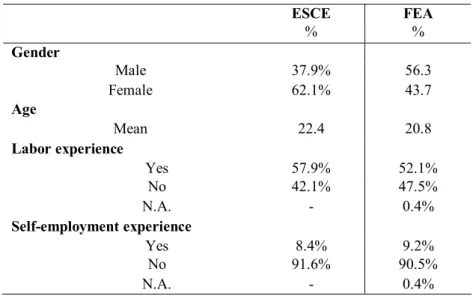
Concerning the sample characterization, table 1 presents the differences between ESCE and FEA sample. As shown in table 1, in the ESCE sample the percentage of females is higher than in FEA (62.1% vs. 43.7%) and students are older.
Table 1 – Students’ profile
ESCE FEA
% %
Gender
Male 37.9% 56.3
Female 62.1% 43.7
Age
Mean 22.4 20.8
Labor experience
Yes 57.9% 52.1%
No 42.1% 47.5%
N.A. - 0.4%
Self-employment experience
Yes 8.4% 9.2%
No 91.6% 90.5%
N.A. - 0.4%
With regard to labor experience, both in the ESCE and FEA samples the majority reported having experience (57.9% and 52.1%, respectively), however in the two samples a small percentage of students claimed to have self-employment experience (8.4% and 9.2%, respectively).
4. RESULTS AND DISCUSSION
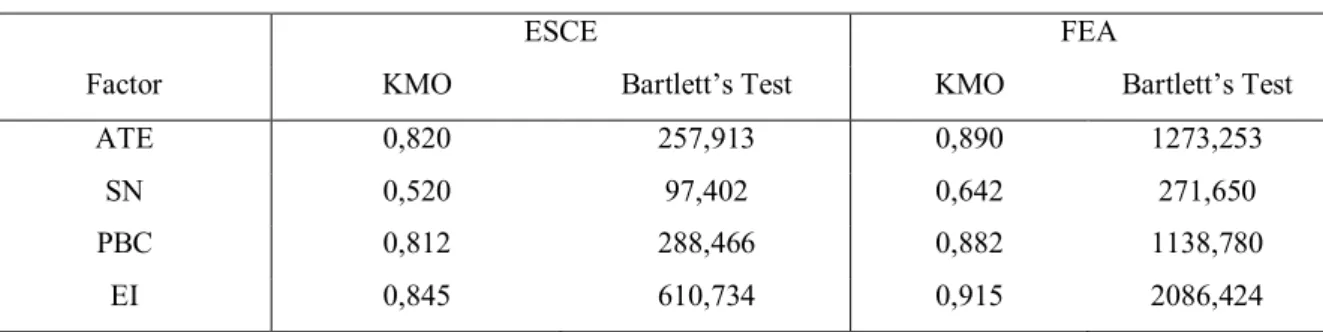
For the purpose of testing the presented hypothesis, a factor analysis was performed for each set of questions in order to obtain a latent variable.
factor analysis can be applied to the data set since it is unlikely that the correlation matrix of the variables is an identity.
Table 2 – Kaiser-Meyer-Olkin (KMO) Measure and Bartlett’s Test
ESCE FEA
Factor KMO Bartlett’s Test KMO Bartlett’s Test
ATE 0,820 257,913 0,890 1273,253
SN 0,520 97,402 0,642 271,650
PBC 0,812 288,466 0,882 1138,780
EI 0,845 610,734 0,915 2086,424
It was employed the orthogonal method with Varimax rotation to ensure that the factors extracted are independent and unrelated to each other. The objective of factor analysis is to group variables having large loadings (correlations) for the same factor. A variable with a high communality (loading) of 0.8, for example, indicates a high correlation between that variable and other variables sharing a common factor. Following Kaiser’s criterion only factors having eigenvalues greater than 1 are considered significant in this study.
Construct reliability is assessed using the Cronbach’s Alpha. As we can see in Table 7, in both samples the factors have a Cronbach’s Alpha higher than 0.7, showing internal consistency.
Table 3 – Reliability Coefficients
Alpha Scores
Factor
ESCE FEA Number of Items
ATE 0.871 0,937 5
SN 0.727 0,768 3
PBC 0.875 0,912 6
EI 0.934 0,960 6
For the purpose of testing the relationships between entrepreneurial intentions and its antecedents (Hypothesis 1a, 1b and 1c), we used a correlation analysis for each sample, as summarized in tables 8 and 9.
Table 4 – Bivariate Pearson correlation – ESCE students
Variable ATE SN PBC
Pearson Correlation ,634** ,293** ,529**
Sig. (2-tailed) ,000 ,004 ,000
EI
N 95 95 95
Table 5 – Bivariate Pearson correlation – FEA students
Variable ATE SN PBC
Pearson Correlation ,834** ,098 ,528**
Sig. (2-tailed) ,000 ,100 ,000
EI
N 281 281 279
**. Correlation is significant at the 0.01 level (2-tailed).
The results revealed that in both samples students’ entrepreneurial intention (EI) was significantly influenced by attitudes towards entrepreneurship (ATE) and perceived behavioural control (PBC). Therefore, Hypothesis 1a and 1c were accepted for the two samples with a significance level of p<0.01.
In the ESCE sample the subjective norm have a lower correlation with entrepreneurial intention. On the other hand, in the FEA sample don’t verified the correlation between these two variables. This is not a surprising finding, once several studies demonstrate that subjective norms often fail to predict intentions (Armitage and Conner, 2001).
Therefore, for ESCE students, Hypothesis 1a, 1b and 1c were accepted with a significance level of p<0.01. For FEA students, Hypothesis 1a and 1c were accepted with a significance level of p<0.01. This findings are consistent with the findings of previous studies referred in literature review (Kolvereid 1996A; Kolvereid, 1996b; Tkachev and Kolvereid, 1999; Krueger et al., 2000; Liñán, 2004; Fayolle and Gailly, 2005; Veciana
et al., 2005; Fayolle and DeGeorge, 2006; Krueger, 2007; Engle et al., 2010).
Bellows (Table 10) it’s possible to see the resume of the confirmation or not confirmation of the hypotheses previously formulated.
Table 6 – Hypotheses confirmation
Confirmation Hypotheses
Portugal Brazil
H1: The entrepreneurial intentions depends on three motivational factors:
H1a: Attitude towards entrepreneurship are positively related to ESCE and FEA
students’ entrepreneurial intentions. Yes Yes
H1b: Subjective norms are positively related to ESCE and FEA students’
entrepreneurial intentions Yes No
H1c: Perceived behavioural control with respect to entrepreneurship, are
5. CONCLUSIONS
The present study offers a literature review concerning the phenomenon of the entrepreneurial intentions with reference to several models. Also emphasises the importance of entrepreneurship as a career option for students.
This study aimed to analyse the relationship between student’s entrepreneurial intentions and its antecedents (attitudes toward entrepreneurship, subjective norms and perceived behavioural control) in two different cultures.
Using the EIQ, designed by Liñán and Chen (2009), this study allowed the confirmation of the findings of previous studies that have demonstrated that entrepreneurial intention is predicted by attitudes toward entrepreneurship, subjective norms, and perceived behavioural control. The results achieved contribute to reinforce the application of the theory of planned behavior (Ajzen, 1991) and confirm the influence of cultural and social environment in human behavior.
These results related with ESCE confirm the findings of previous studies that have demonstrated that entrepreneurial intention is predicted by attitudes towards entrepreneurship, subjective norms and perceived behavioural control. The results concerning FEA demonstrated that entrepreneurial intention is predicted by attitudes toward entrepreneurship, and perceived behavioural control, but not by subjective norms.
There are some limitations in this study. First, the study did not apply a random sampling technique. Study participants were students from two different HEIs, but not randomly chosen. Second, cultural and demographic variables might be considered in a future research to have a broader view of the different determinants influencing the entrepreneurial intention.
References
Ajzen, I. (1991): “The theory of planned behaviour”. Organizational Behavior and Human Decision Processes, v. 50, p. 179-211. Armitage, C. J.; Conner, M. (2001): “Efficacy of the theory of planned behavior: A meta-analytic review”. British Journal of Social Psychology, v. 40, p. 471–499.
Autio, E.; Keeley, R. H.; Klofsten, M.; Parker, G.; Hay, M. (2001): “Entrepreneurial intent among students in Scandinavia and in the USA”. Enterprise and Innovation Management Studies, v. 2, n. 2, p. 145-60.
Baron, R. A. (2004): “The cognitive perspective: a valuable tool for answering entrepreneurship’s basic “why” questions”. Journal of Business Venturing, v. 19, n. 2, p. 221–239.
Bates, T. (1995): “Self-employment entry across industry groups”. Journal of Business Venturing, v. 12, n. 2, p. 109–124.
Bird, B. (1988): “Implementing Entrepreneurial Ideas: The Case for Intention”. The Academy of Management Review, v. 13, n. 3, p. 442–453.
Birdthistle, N.; Hynes, B.; Fleming, P. (2007): “Enterprise education programmes in secondary schools in Ireland - A multi-stakeholder perspective”. Education + Training, v. 49, n. 4, p. 265-276.
Boyd, R. (1990): “Black and Asian self–employment in large metropolitan areas: A comparative analysis”. Social Problems, v. 37, n. 2, p. 258–274.
Busenitz, L. (1999): “Entrepreneurial risk and strategic decision making”. Journal of Applied Behavioural Science, v. 35, n. 3, p. 325– 340.
Cooper, A.; Woo, C.; Dunkelberg, W. (1988): “Entrepreneurs’ perceived chances for success”. Journal of Business Venturing, v. 3, n. 2, p. 97–108.
Davidsson, P.; Henkson, M. (2002): “Determinants of the prevalence of start-ups and high-growth firms”. Small Business Economics, v. 19, n. 2, p. 81–104, 2002.
Delmar, F.; Davidsson, P. (2000): “Where do they come from? Prevalence and characteristics of nascent entrepreneurs”.
Entrepreneurship and Regional Development, v. 12, p. 1-23.
Engle, R. L.; Dimitriadi, N.; Gavidia, J. V.; Schlaegel, C.; Delanoe, S.; Alvarado, I.; He, X.; Buame, S.; Wolff, B. (2010): “Entrepreneurial intent: A twelve-country evaluation of Ajzen's model of planned behaviour”. International Journal of Entrepreneurial Behaviour and Research, v. 16, n. 1, p. 35-57.
Fayolle, A.; DeGeorge, J. M. (2006): Attitudes, intentions, and behaviour: New approaches to evaluating entrepreneurship education. In A. Fayolle, & H. Klandt (Eds.) International entrepreneurship education. Issues and Newness. Cheltenham (UK): Edward Elgar. Fayolle, A.; Gailly, B. (2005): “Using the theory of planned behaviour to assess entrepreneurship teaching programmes”. Center for Research in Change, Innovation and Strategy of Louvain School of Management, Working Paper 05.
Fayolle, A.; Gailly, B.; Lassas-Clerk, N. (2005): “Capturing Variations in Attitude and Intentions: A Longitudinal Study to Assess the Pedagogical Effectiveness of Entrepreneurship Teaching Programmes”. Working Paper of EMLYON of the European Institution for Life Long Learning.
Gartner, W. B.; Gatewood, E.; Shaver, K. G. (1991): Reasons for starting a business: Not-so-simple answers to simple questions. In G. E. Hills & R. W. LaForge (Eds.), Research at the marketing/entrepreneurship interface, p. 90–101. Chicago: University of Illinois at Chicago.
Gnyawali, D. R.; Fogel, D. S. (1994): “Environments for entrepreneurship development: Key dimensions and research implications”.
Entrepreneurship Theory and Practice, v. 18, n. 4, p. 43–62.
Grilo, I.; Thurik, A. R. (2005): “Latent and actual entrepreneurship in the Europe and the US: some recent developments”. International Entrepreneurship and Management Journal, p. 441-459.
Hatak, S.; Harms, R.; Fink, M. (2015): “Age, job identification, and entrepreneurial intention”. Journal of Managerial Psychology, v.20, p. 38-53.
Kalantaridis, C.; Labrianidis, L. (2004): “Rural entrepreneurs in Russia and the Ukraine: origins, motivations, and institutional change”.
Journal of Economic Issues, v. 38, n. 3, p. 659-81.
Kolvereid, L. (1996a): “Organizational employment versus self-employment: reasons for career choice intentions”. Entrepreneurship Theory and Practice, (20)3: 23-31.
Kolvereid, L. (1996b): “Prediction of employment status choice intention”. Entrepreneurship Theory and Practice, v. 21, n. 1, p. 47-57. Krueger, N. (2000): “The Cognitive Infrastructure of Opportunity Emergence”. Entrepreneurship Theory & Practice, v. 24, n. 3, p. 5-23. Krueger, N. (2007): “What lies beneath? The experiential essence of entrepreneurial thinking”. Entrepreneurship Theory and Practice, v. 31, n. 1, p. 123–138.
Krueger, N. F.; Brazeal, D. V. (1994): “Entrepreneurial potential and potential entrepreneurs. Entrepreneurship”. Theory and Practice, v. 18, n. 3, p. 91–104.
Krueger, N. Jr; Reilly, M.; Carsrud, A. (2000): “Competing models of entrepreneurial intentions”. Journal of Business Venturing, v.15, p. 411-32.
Lee, S. H.; Wong, P. K. (2004): “An exploratory study of technopreneurial intentions: A career anchor perspective”. Journal of Business Venturing. v. 19, n. 1, p. 7-28.
Lévesque, M.; Minniti, M. (2006): “The effect of aging on entrepreneurial behaviour”. Journal of Business Venturing, v. 21, n. 2, p. 177–194.
Liñán, F. (2004): “Intention-based models of entrepreneurship education”. Piccola Impresa/Small Business, v. 3, p. 11–35.
Liñán, F.; Chen, Y. (2009): “Development and Cross-Cultural Application of a Specific Instrument to Measure Entrepreneurial Intentions”. Entrepreneurship Theory and Practice, v. 33, n. 3, p. 593-617.
Locke, E. A. (1993): The traits of American business heroes. Manuscript in preparation, University of Maryland.
Lundström, A.; Stevenson, L. (2002): On the road to entrepreneurship policy. Stockholm: Swedish Foundation for Small Business Research.
Luthje, C.; Franke, N. (2003): “The ‘making’ of an entrepreneur: testing a model of entrepreneurial intent among engineering students at MIT”. R&D Management, v. 33, n. 2, p. 135–147.
Mazzarol, T.; Volery, T.; Doss, N.; Thein, V. (1999): “Factors influencing small business start-ups”. International Journal of Entrepreneurial Behavior and Research, v. 5, n. 2, p. 48-63.
Mushtaq, H. A.; Niazi, C. S. K.; Hunjra, A, I;, Rehman, K. U. (2011): “Planned behavior entrepreneurship and intention to create a new venture among young graduates”. Management & Marketing Challenges for the Knowledge Society. v. 6, n. 3, p. 437-456.
Packham, G.; Jones, P.; Miller, C.; Pickernell, D.; Thomas, B. (2010) “Attitudes towards Entrepreneurship education: A comparative analysis”. Education + Training, v. 52, n. 8/9, p. 568-586.
Peterman, N. E.; Kennedy, J. (2003): “Enterprise education: Influencing students’ perceptions of entrepreneurship”. Entrepreneurship Theory and Practice, v. 28, n. 2, p. 129–144.
Reynolds, P.; Bygrave, W.; Autio, E. (2004): Global Entrepreneurship Monitor 2003 -Global Executive Report. Babson College. Reynolds, P.; Storey, D.; Westhead, P. (1994): Cross-national comparison of the variation in new firm rates. Regional Studies, v. 28, p. 443–456.
Reynolds, P.; Carter, N.; Gartner, W.; Greene, P.; Cox, L. (2002): The entrepreneur next door, characteristics of individuals starting companies in America. Kansas City, MO: Ewing Marion Kauffman Foundation.
Ritsila, J.; Tervo, H. (2002): “Effects of unemployment on new firm formation: Micro-level panel data evidence from Finland”. Small Business Economics, v. 19, p. 31–40, 2002.
Shapero, A.; Sokol, L. (1982): Social dimensions of entrepreneurship. In C. A. Kent, D. L. Sexton, & K. H. Vesper (Eds.) Encyclopedia of entrepreneurship. Englewood Cliffs (NJ): Prentice Hall.
Segal, G.; Borgia, D.; Schoenfeld, J. (2005): The motivation to become an entrepreneur. International Journal of Entrepreneurial Behaviour & Research, v. 11, n. 1, p. 42-57.
Shaver, K.G.; Scott, L.R. (1991): “Person, process, choice: The psychology of new venture creation”. Entrepreneurship Theory and Practice, v. 16, n. 2, p. 23–45.
Storey, D. J. (1994): Understanding the small business sector. London: Routledge.
Tkachev, A.; Kolvereid, L. (1999): “Self-employment intentions among Russian students”. Entrepreneurship and Regional Development, v. 11, n. 3, p. 269–280.
Veciana, J. M.; Aponte, M.; Urbano, D. (2005): “University students’ attitudes towards entrepreneurship: A two countries comparison”.
International Entrepreneurship and Management Journal, v. 1, n. 2, p. 165–182.
Wu, S.; Wu, L. (2008): “The impact of higher education on entrepreneurial intentions of university students in China”. Journal of Small Business and Enterprise Development. v. 15, n. 4, p. 752-774.