Neotropical Entomology
journal homepage: www.scielo.br/ne ISSN: 1519-566X
SyStEmatIcS, morphology aNd phySIology
New mariner Elements in
Anastrepha
Species (Diptera: Tephritidae)
HS Marcon
1, DS Domingues
2, VE Coscrato
1, D Selivon
3, ALP Perondini
3, CL Marino
1 1Depto de Genética, Instituto de Biociências, Univ Estadual Paulista Júlio de Mesquita Filho, Botucatu, SP, Brasil2Lab de Biotecnologia Vegetal, Instituto Agronômico do Paraná, Londrina, PR, Brasil
3Depto de Genética e Biologia Evolutiva, Instituto de Biociências, Univ de São Paulo, São Paulo, SP, Brasil
Keywords
Fruit fly, mellifera, tephritid, transposon, rosa
Correspondence
Helena S Marcon, Instituto de Biociências, Departamento de Genética, Botucatu – UNESP, Distrito de Rubião Junior, s/n, 18618-970; [email protected]
Edited by Fernando B Noll – UNESP
Received 19 November 2010 and accepted 29 March 2011
Abstract
Mariner-like elements (MLE) are members from class II of trans-posable elements also known as DNA transposons. These elements
have a wide distribution among different groups of organisms, in
-cluding insects, which can be explained by horizontal and vertical gene-transfer. MLE families have been described in tephritid flies
and other genera. During screening for Wolbachia bacteria in fruit
flies of the genus Anastrepha, we discovered two sequences related
to mariner-like elements. Based on these sequences, we designed primers that allowed us to isolate and characterize two new mari-ner-like elements (Anmar1 and Anmar2) in Anastrepha flies. These elements, which belong to the mellifera and rosa subfamilies have a
low nucleotide diversity, and are probably inactive and acquired by vertical transfer. This is the first report of mariner-like transposons
in flies found in South America.
Introduction
Transposable elements are repetitive DNA segments that can change position within the genome and account
for a large portion of the genetic material of eukaryotes (Bowen & Jordan 2002), e.g., 45% of the genome in hu
-mans and 50-80% of the genome in plants (as reviewed by Feschotte et al 2002). Traditionally, transposable ele
-ments have been classified into two classes: retrotrans -posons (class I) and DNA trans-posons (class II). Class I
elements (or retrotransposons) are widely distributed among eukaryotes and their transposition involve a RNA intermediate, in a “copy and paste” transposition. Class II transposable elements occur in prokaryotes and in al
-most all eukaryotes as segments inserted in the genome or as part of complex structures (Wicker et al 2007).
DNA transposons usually transpose through a “ cut-and-paste” mechanism, i.e., under normal conditions the copy number of these elements does not increase expo
-nentially. Based on the classification proposed by Wick -er et al (2007), mariner-like elements (MLE) are DNA transposons belonging to subclass I that have terminal inverted repeats and a transposition mechanism that
in-volves a “classic” transposase with a DDE motif (Silva et al 2005). Mariner-like elements are divided into 15 sub
-families that have been classified phylogenetically based on their sequence similarity (Rouault et al 2009).
The first MLE was identified in Drosophila mauriti-ana (Tsacas & David), where it occurred as an insertion
within a gene (Jacobson & Hartl 1985). Mariner-like
ele-ments have since been described in plants, fungi, verte
-brates and prokaryotes (Bigot et al 1994, Auge-Gouillou et al 1995, Robertson 1995, Plasterk et al 1999, Feschotte & Wessler 2002). The distribution of mariner-like
Neotrop Entomol 40(5): 568-574 © 2011 Sociedade Entomológica do Brasil
(reviewed by Sperb et al 2009).
Among insects, mariner-like elements have been
described in tephritid flies (Torti et al 1997, Gomulski et al 2001). Anastrepha are considered pests because
of the damage they cause to commercially important
fruits. Anastrepha is endemic to the Americas, and 103 species are reported to occur in Brazil (Zucchi 2008). Anastrepha species from different localities in Brazil are usually positive for the presence of the bacterial endo
-symbiont Wolbachia (Mascarenhas 2007, Coscrato et al 2009, Marcon 2009), which is known to transfer DNA segments into eukaryotic hosts (Kondo et al 2002, Ho -topp et al 2007).
In a manner analogous to Carr (2008), who accidentally identified mariner transposable elements in stalk-eyed flies during screening for the sex determination gene dsx, we also serendipitously discovered mariner-like elements during screening for Wolbachia in Anastrepha fruit flies. Based on the sequences obtained, we designed specific primers to investigate the occurrence and diversity of mariner-like elements in Wolbachia-infected fruit flies.In
this report, we describe the isolation and characterization
of two mariner-like elements families (Anmar1 e Anmar2) in three subspecies of Anastrepha that belong to the
A. fraterculus complex of cryptic species (Selivon et al 2004, 2005), and analyze their diversity and phylogenetic
relationship to other mariner-like elements.
Material and Methods
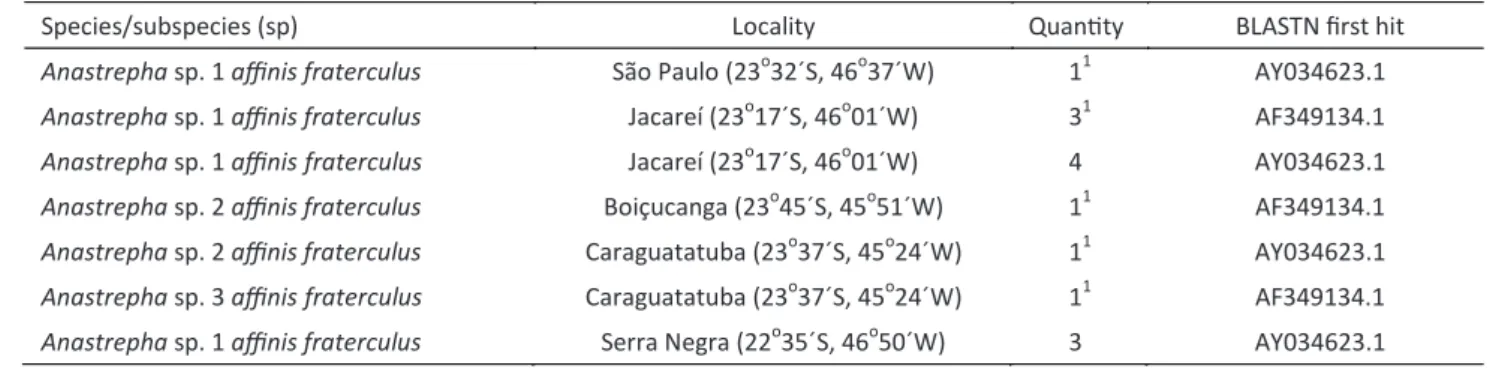
Fly samples and mariner-like elements isolation Samplesof Anastrepha sp.1 affinis fraterculus, Anastrepha sp.2 aff. fraterculus and Anastrepha sp.3 aff. fraterculus were collected in five regions of São Paulo state, south
-eastern Brazil (Table 1). Genomic DNA was extracted from the abdomen of individual adult flies according to the protocol of Jowett (1998). Wolbachia were detected
using the wsp primers (F1: 5’TGAAATTTTACCTCTTTTC 3’ and R1: 5´AAAAATTAAACGCTACTCCA 3’; and F2: 5’TGGTCCAATAAGTGATGAAGAAAAC 3’ and R2: 5´ACCAGCTTTTGCTTGATA 3´), as proposed by Zhou et al (1998). Polymerase chain reactions (PCRs) followed
the conditions described in Coscrato et al (2009). The ~600 bp amplicons obtained were cloned into the
pGEM®-T Easy Vector (Promega) and plasmids obtained
from positive clones were subjected to bidirectional
se-quencing in order to obtain consensus sequences. Using this approach we identified two sequences related to mariner-like elements (see Results) that were amplified
using the wsp primers indicated above.
Based on the sequences of the two mariner-like
ele-ments identified, we designed the following specific prim
-ers: Anmar1 forward (5’ CCTGCTCGAACGACTGATTT 3’) and Anmar1 reverse (5’ CCACGATTTATTGGGTGGTC 3’), Anmar2 forward (5’ AGGCGGAAAAGCTGAAGAGT 3’) and Anmar2 reverse (5’ AAGCCGGCCAAACATTAAC 3’). These primers were subsequently used to identify An-mar1 and Anmar2 elements, respectively, in 11samples from the three Anastrepha fraterculus (Wiedemann) subspecies. The amplification reaction followed Coscra -to et al (2009), with some adaptations in annealing tem
-perature. It consisted of an initial cycle at 94oC for 4 min,
55oC for 1 min and 72oC for 2 min, followed by 37 cycles
of denaturation at 94o C for 15 s, annealing at 55oC for 1
min and extension at 72oC for 2 min, a further cycle of
95oC for 15 s and 58oC for 1 min and a final extension at
72oC for 7 min. PCR products were analyzed in 1% aga
-rose gels and PCR products were purified with Exosap enzyme mixture (GE), according to the manufacturer´s protocol. The purified products were sequenced in a Genetic Analyzer 3100 sequencer (Applied Biosystems) and the similarity of the mariner-like elements was
con-firmed by BLAST (Altschul et al 1997). All sequences obtained were deposited in GenBank with accession numbers HM773359 to HM773366 and HM775148 to HM775156.
Table 1 Sample collection locality and number and identification of mariner transposons Anastrepha flies from five regions
in São Paulo state, southeastern Brazil. The GenBank accession numbers correspond to the first hit obtained in BLASTN sequence analyses.
1: Anmar1 and Anmar2 were initially idetified using the wsp primer.
Species/subspecies (sp) locality Quantity BlaStN first hit
Neotrop Entomol 40(5): 568-574 © 2011 Sociedade Entomológica do Brasil
Phylogenetic analyses
For phylogenetic analyses, we compared the sequences
of Anmar1 and Anmar2 with previously reported se
-quences for mariner-like elements from the subfami-lies mauritiana, cecropia, mellifera and rosa (Torti et al 1997, Gomulski et al 2001, Sinzelle et al 2006, Bui et al 2008, Rouault et al 2009). Thirty-two sequences were aligned using the MUSCLE alignment tool (Edgar 2004) and cured by Gblocks (Castresana 2000), using the site www.phylogeny.fr (Dereeper et al 2008). The result
-ing alignment was used to draw a Maximum Likelihood tree with Kimura-2-parameters distance and based on 10,000 bootstrap replicates using MEGA 5.0 software
(Tamura et al in press).
The sequences related to the MLE mellifera subfamily were aligned with the GenBank sequence corresponding to accession number AAO12862 and those related to
the MLE rosa subfamily were aligned with the GenBank sequence corresponding to accession number AAK61417 using blast2seq (Tatusova & Madden 1999) in both cases. Based on this alignment, regions shared by the sequences
and the two accession numbers indicated above were
selected manually. From this selection, we calculated the mean diversity (Pi) using the software DnaSP 5.00.05 (Librado & Rozas 2009) and the pairwise distance (p) using MEGA 5.0 software (Tamura et al in press), after gap exclusion.
Results
anmar1 and anmar2 identification
In a BLASTN analysis of sequences obtained using wsp primers, we identified one sequence with similarity to a mariner transposase from Bactrocera tryoni (Froggatt) (GenBank accession number AF349134.1) and another sequence similar to a Ceratitis rosa (Karsch) mariner transposase (GenBank accession number AY426626.1). Since these samples were positive for Wolbachia,specific
primers for the Anastrepha Internal Transcribed Spacer (ITS) region (Prezotto 2008) were used to confirm the
presence of Anastrepha DNA in these preparations. The
resulting PCR products confirmed the presence of Anas-trepha DNA in all samples, as expected (data not shown), once it is impossible to dissociate bacterial cells from fly tissue in DNA extraction.
These sequences, designated as Anmar1 (similar
to AF349134.1) and Anmar2 (similar to AY426626.1), were used to design specific primers for each new mariner element. The new primers were then used in
PCR reactions with the MLE clones obtained in wsp amplification, which allowed confirmation of the primer specificity. We subsequently screened other
Wolbachia-positive Anastrepha samples with the Anmar1 and
Anmar2 primersand obtained 13 samples that yielded
PCR fragments (Table 1). The sequences of these purified PCR products were similar to the mariner-like elements
originally observed with wsp primers. All analyzed sequences were obtained using Anmar1 and Anmar2 specific primers.
anmar1 and anmar2 characterization and phylogenetic analysis
Initial BLAST results suggested that the Anmar1 and
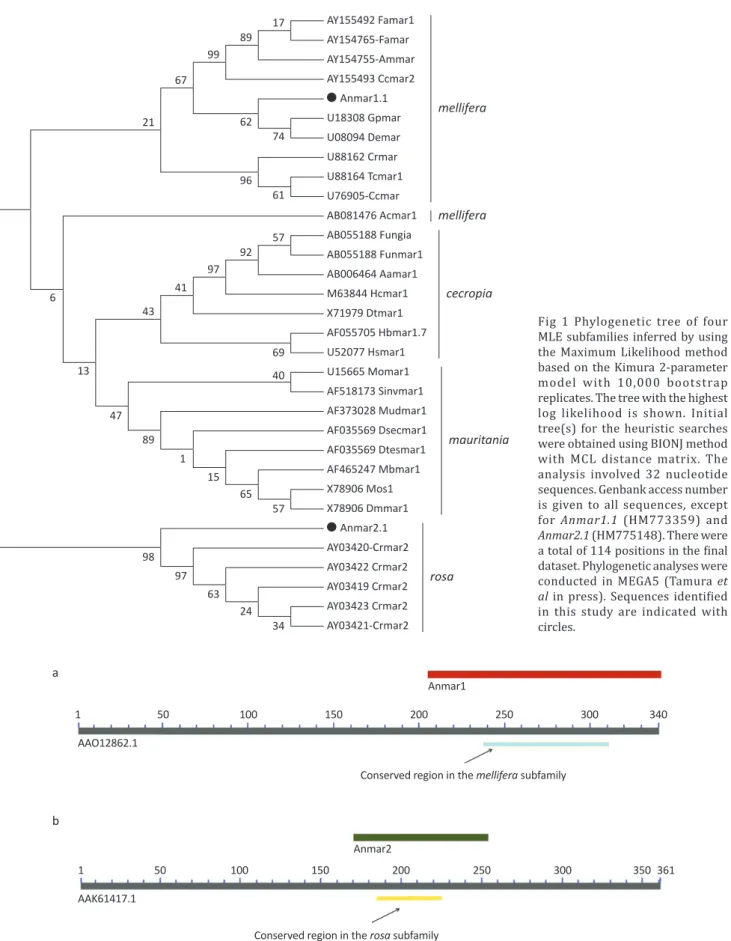
Anmar2 elements belonged to the mellifera and rosa subfamilies, respectively. To confirm this, we generated a phylogenetic tree with the Anmar1 and Anmar2
se-quences and the sese-quences from four mariner subfami-lies (mauritiana, cecropia, mellifera and rosa). The clade
distribution and bootstrap values in the phylogenetic analysis confirmed that these elements belonged to the mellifera and rosa subfamilies (Fig 1).
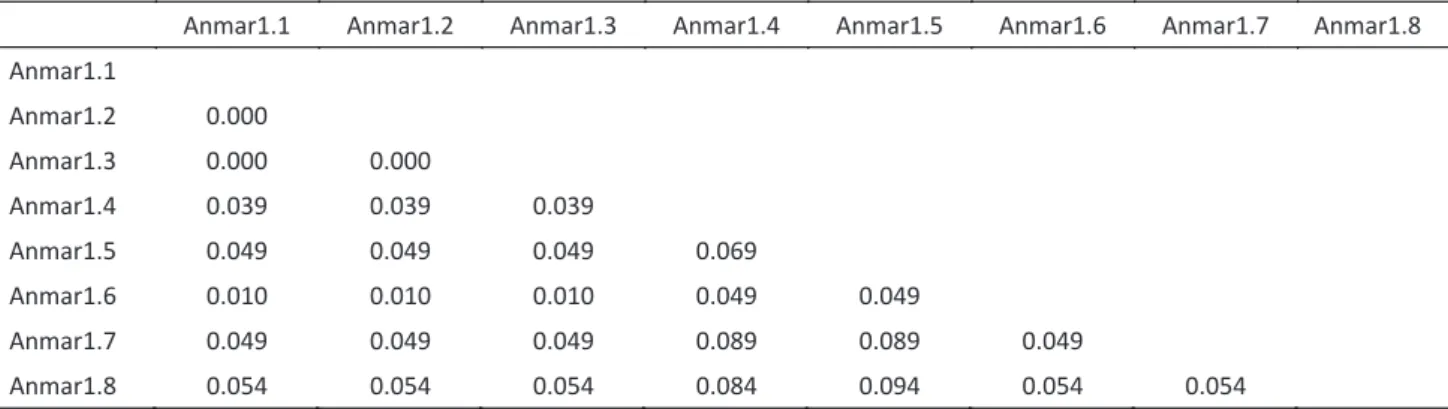
Eight and nine sequences were obtained for the Anmar1 (mellifera) and Anmar2 (rosa) elements, respectively. Both Anmar1 and Anmar2 sequences had stop codons in their coding region, and manual analysis of these two sequences detected common regions of 201 (Fig 2a) and 115 nucleotides (Fig 2b), respectively; these regions were further used to analyze nucleotide diversity. Anmar1 (Anmar1.1 to Anmar1.8) sequences had a Pi diversity of 0.045 ± 0.01 and those for Anmar2 (Anmar2.1
to Anmar2.9) had a Pi of 0.068 ± 0.02, indicating a higher diversity in the Anmar2 element than in the Anmar1. P
distances among the Anmar1 and Anmar2 sequences indicated that both families had three identical sequences (Tables 2 and 3), although distinct distance values were observed: P distances in the Anmar1 sequences ranged from 0.010 to 0.094 (Table 2), but were higher
in Anmar2, ranging from 0.010 to 0.173 (Table 3). The
p distance between Anmar1.1 and Anmar2.1 was 0.51 (Online Supplementary Material 1). Higher distances in Anmar2.1 were also observed comparing this element to
other sequences used for phylogenetic characterization (Fig 1, Online Supplementary Material 1): Anmar1.1 distances ranged from 0.18 to 0.59 and from 0.48 to 0.62
in Anmar2.1.
Discussion
Mariner-like elements are widely distributed among tephritids, and Ccmar1 and Tcmar1 elements have dis-tinct distributions among related tephritids species due
to their relatively recent transmission between species
(Torti et al 1997, Green & Frommer 2001). Our find -ings therefore agree with these and other investigations
(Robertson 1993, Robertson & MacLeod 1993) showing
Neotrop Entomol 40(5): 568-574 © 2011 Sociedade Entomológica do Brasil
ay155492 Famar1
ay154765-Famar
ay154755-ammar
ay155493 ccmar2
anmar1.1
U18308 gpmar
U08094 demar
U88162 crmar
U88164 tcmar1
U76905-ccmar
mellifera
mellifera aB081476 acmar1
aB055188 Fungia
aB055188 Funmar1
aB006464 aamar1
m63844 hcmar1
X71979 dtmar1
aF055705 hbmar1.7
U52077 hsmar1
cecropia
U15665 momar1
aF518173 Sinvmar1
aF373028 mudmar1
aF035569 dsecmar1
aF035569 dtesmar1
aF465247 mbmar1
X78906 mos1
X78906 dmmar1
mauritania
anmar2.1
ay03420-crmar2
ay03422 crmar2
ay03419 crmar2
ay03423 crmar2
ay03421-crmar2 rosa
34 63
97
24 98
57 92 89
17
99
97
61 96
74
69 41
62 67
43 21
6
40 13
47
1 89
15
57 65
Fig 1 Phylogenetic tree of four MLE subfamilies inferred by using the Maximum Likelihood method based on the Kimura 2-parameter model with 10,000 bootstrap replicates. The tree with the highest log likelihood is shown. Initial tree(s) for the heuristic searches were obtained using BIONJ method with MCL distance matrix. The analysis involved 32 nucleotide sequences. Genbank access number is given to all sequences, except for Anmar1.1 (HM773359) and Anmar2.1 (HM775148). There were
a total of 114 positions in the final dataset. Phylogenetic analyses were conducted in MEGA5 (Tamura et al in press). Sequences identified
in this study are indicated with circles.
Fig 2 Shared sequence region among members of Anmar1 (a. in red) and Anmar2 (b. in green) mariner-like elements and conserved regions of the mellifera (in blue) and rosa (in yellow) subfamilies. The GenBank reference sequences used for comparison were from accession
numbers AAO12862.1 in (a) and AAK61417.1 in (b).
Conserved region in the rosa subfamily
a
b
Conserved region in the mellifera subfamily
anmar2
anmar1
AAO12862.1 1
1
50
50
100
100
150
150
200
200
250
250
300
300
340
350 361
Neotrop Entomol 40(5): 568-574 © 2011 Sociedade Entomológica do Brasil
Sequence comparisons and phylogenetic analyses have classified mariner-like elements into various
sub-families. In the present work, we first describe mariner -like elements of the rosa and mellifera subfamilies in subspecies of A. fraterculus. The Anmar2 element was
classified as a member of the rosa subfamily, which also
contains Crmar2, Asmar1 and Almar1 (Gomulski et al
2001). The Anmar1 element is a member of the mellifera subfamily (Fig 2).
BLASTN analyses indicated that the Anastrepha sp.
mariner-like elements shared similarity with transpos -ases from Bactrocera tryoni and C. rosa,thus reinforcing the suggestion that mariner transposases have spread
among tephritids over a long period of time; this finding
also suggested that dispersal of the Anmar1 and Anmar2 elements did not involve horizontal gene transfer. Rath
-er, these elements were probably present in an ancestral Anastrepha lineage that gave rise to the species analyzed
here.
Although the mellifera and rosa subfamilies have
been identified in other tephritids (Gomulski et al 2001, Green & Frommer 2001), the Anmar1 and An-mar2 elements are distinct from the other members of
these subfamilies (Fig 2). This analysis indicated that Anmar1 occurs in the same clade as Demar1 and
Gp-mar1 from the Drosophilidae and tsetse flies, respec
-tively (Lohe et al 1995, Blanchetot & Gooding 1995). In contrast, Anmar2 clustered with members of the rosa subfamily, all of which were originally identified in dip
-teran flies. Our data indicate that similar mariner-like
elements identified here also occur in other genera of the same family, suggesting an acquisition by vertical
transmission.
The Anmar1 and Anmar2 sequences showed a low level of diversity (4.5% and 6.8%, respectively) that
has also been observed in mariner elements of B. tryoni (Green & Frommer 2001) and other insects (Carr 2008),
which suggests that insect mariner-like elements have not been under pressure to diverge. The presence of a
stop codon in all sequences suggested that they were
inactive.
In conclusion, we have identified two new mariner -like elements in A. fraterculus subspecies that share similarities with other dipteran mariner-like elements.
This finding indicates that the Anmar1 and Anmar2 families are present in a common ancestor of many dipterans and that there is no horizontal transfer. These
results provide new perspectives for future studies on
the distribution, transcription and functional character
of these elements in Anastrepha sp. and other flies. Table 2 Distance values among sequences of Anmar1 elements identified in this study.
anmar1.1 anmar1.2 anmar1.3 anmar1.4 anmar1.5 anmar1.6 anmar1.7 anmar1.8
anmar1.1
anmar1.2 0.000
anmar1.3 0.000 0.000
anmar1.4 0.039 0.039 0.039
anmar1.5 0.049 0.049 0.049 0.069
anmar1.6 0.010 0.010 0.010 0.049 0.049
anmar1.7 0.049 0.049 0.049 0.089 0.089 0.049
anmar1.8 0.054 0.054 0.054 0.084 0.094 0.054 0.054
Table 3 Distance values among sequences of Anmar2 elements identified in this study.
anmar2.1 anmar2.2 anmar2.3 anmar2.4 anmar2.5 anmar2.6 anmar2.7 anmar2.8 anmar2.9
anmar2.1
anmar2.2 0.010
anmar2.3 0.010 0.000
anmar2.4 0.010 0.000 0.000
anmar2.5 0.019 0.010 0.010 0.010
anmar2.6 0.029 0.019 0.019 0.019 0.010
anmar2.7 0.115 0.106 0.106 0.106 0.115 0.125
anmar2.8 0.077 0.067 0.067 0.067 0.077 0.087 0.125
Neotrop Entomol 40(5): 568-574 © 2011 Sociedade Entomológica do Brasil Acknowledgments
This research was supported by a grant from FAPESP (03/02698-3) to DS, ALPP, and CLM. HSM had fellowships from CAPES / FAPESP and VEC from FAPESP. DS is a fellow of CNPq.
References
Altschul SF, Gish W, Miller W, Myers EW, Lipman DJ (1990) Basic local alignment search tool. J Mol Biol 215: 403-410.
Auge-Gouillou C, Bigot Y, Pollet N, Hamelin M-H, Meunier-Rotival M, Perique G (1995) Human and other mammalian genomes contain transposons of the mariner family. FEBS Letters 68:
541-546.
Bigot Y, Hamelin MH, Capy P, Periquet G (1994) Mariner-like el-ements in hymenopteran species: insertion site and distribu -tion. Proc Natl Acad Sci USA 91: 3408-3412.
Blanchetot A, Gooding RH (1995)Identification of a mariner ele-ment from the tsetse fly, Glossina palpalis palpalis. Insect Mol Biol 4: 89-96.
Bowen NJ, Jordan IK (2002) Transposable elements and the evo-lution of eukaryotic complexity. Curr Issues Mol Biol4: 65-76.
Bui Q-T, Casse N, Leignel V, Nicolas V, Chénais B (2008) Widespread occurrence of mariner transposons in coastal crabs. Mol Phylo -genet Evol 47: 1181-1189.
Carr M (2008) Multiple subfamilies of mariner transposable ele-ments are present in stalk-eyed flies (Diptera: Diopsidae). Ge -netica 132: 113-122.
Castresana J (2000) Selection of conserved blocks from multiple alignments for their use in phylogenetic analysis. Mol Biol Evol 17: 540-552.
Coscrato VE, Braz ASK, Perondini ALP, Selivon D, Marino CL (2009)
Wolbachia in Anastrepha fruit flies (Diptera: Tephritidae). Curr
Microbiol59: 291-301.
Dereeper A, Guignon V, Blanc G, Audic S, Buffet S, Chevenet F, Du -fayard JF, Guindon S, Lefort V, Lescot M, Claverie JM, Gascuel O (2008) Phylogeny.fr: robust phylogenetic analysis for the non-specialist. Nucleic acids res 1: 465-469.
Edgar RC (2004) MUSCLE: multiple sequence alignment with high accuracy and high throughput. Nucleic acids res 32: 1792-1797.
Feschotte C, Jiang N, Wessler SR (2002) Plant transposable ele -ments: where genetics meets genomics. Nat Rev Genet 3: 329-341.
Feschotte C, Wessler SR (2002) Mariner-like transposases are widespread and diverse in flowering plants. Proc Natl Acad Sci USA 99: 1280-1285.
Green CL, Frommer M (2001) The genome of the Queensland fruit fly Bactrocera tryoni contains multiple representatives of the
mariner family of the transposable elements. Insect Mol Biol
10: 371-386.
Gomulski LM, Torti C, Bonizzoni M, Moralli D, Raimondi E, Capy P, Gasperi G, Malacrida AR (2001) A new basal subfamily of mari-ner elements in Ceratitis rosa and other tephritid flies. J Mol
Evol 53: 597-606.
Hotopp JCD, Clark ME, Oliveira DCSG, Foster JM, Fischer P, Torres MCM, Giebel JD, Kumar N, Ishmael N, Wang S, Ingram J, Nene RV, Shepard J, Tomkins J, Richards S, Spiro DJ, Ghedin E, S lat-ko BE, Tettelin H, Werren JH (2007) Widespread lateral gene transfer from intracellular bacteria to multicellular eukaryotes. Science317: 1753-1756.
Jacobson JW, Hartl DL (1985) Coupled instability of two X-linked genes in Drosophila mauritiana: germinal and somatic mutabil -ity. Genetics 111: 57-65.
Jowett T (1998) Preparation of nucleic acids, p.347-372. In Rob -erts DB (ed) Drosophila: a pratical approach 2nd edn. Oxford,
Oxford University Press, 389p.
Kidwell MG (1994) The evolutionary history of the P family of
transposable elements. J Heredity85: 339-346.
Kondo N, Nikoh N, Ijichi N, Shimada N, Fukatsu T (2002) Genome fragment of Wolbachia endosymbiont transferred to X chromo -some of host insect. Proc Natl Acad Sci USA 99: 14280-14285. Librado P, Rozas J (2009) DnaSP v5: a software for comprehensive
analysis of DNA polymorphism data. Bioinformatics 25: 1451-1452.
Lohe AR, Moriyama EN, Lidholm D-A, Hartl DL (1995) Horizontal transmission, vertical inactivation, and stochastic loss of mari-ner-like transposable elements. Mol Biol Evol 12: 62-72. Marcon HS (2009) Identificação da bactéria endossimbionte
Wolbachia em populações de moscas-das-frutas do complexo Anastrepha fraterculus (Diptera: Tephritidae). M. Sc. Disserta -tion, Botucatu, Instituto de Biociências – UNESP, 110p. Mascarenhas RO (2007) Endossimbionte Wolbachia em
moscas-das-frutas do gênero Anastrepha (Tephritidae) e em vespas parasitóides (Braconidae) associadas. M. Sc. Dissertation, São Paulo, Instituto de Biociências - USP, 80p.
Plasterk RHA, Izsvák Z, Ivics Z (1999) Resident aliens: the Tc1/ mariner superfamily of transposable elements. Trends Genet 15: 326-332.
Prezotto LF (2008) Análise de ITS1 do DNA do ribossômico em es -pécies do complexo Anastrepha frarterculus (Diptera: Tephri -tidae). M. Sc. Dissertation, São Paulo, Instituto de Biociências - USP, 52p.
Robertson HM (1993) The mariner transposable element is wide-spread in insects. Nature 38: 241-245.
Robertson HM (1995) The Tcl-mariner superfamily of transpo -sons in animals. J Insect Physiol 41: 99-105.
Robertson HM, MacLeod EG (1993) Five major subfamilies of
Neotrop Entomol 40(5): 568-574 © 2011 Sociedade Entomológica do Brasil Rouault J-D, Casse N, Chénais B, Hua-Van A, Filée J, Capy P (2009)
Automatic classification within families of transposable ele -ments: application to the mariner family. Gene 448: 227-232.
Selivon D, Perondini ALP, Morgante JS (2005) A genetic-morpho -logical characterization of two cryptic species of the Anastrepha fraterculus complex (Diptera:Tephritidae). Ann Entomol Soc
Am 98: 367-381.
Selivon D, Vretos C, Fontes L, Perondini ALP (2004) New variant forms in the Anastrepha complex (Diptera: Tephritidae),
p.253-258. In Barnes BN (ed) Proceedings 6th International Sympo -sium on Fruit Flies of Economic Importance. Isteg Scientific Publication, Irene, South Africa.
Silva JC, Bastida F, Bidwell SL, Johnson PJ, Carlton JM (2005) A po -tentially functional mariner transposable element in the pro-tist Trichomonas vaginalis. Mol Biol Evol 22: 126-134.
Sinzelle L, Chesneau A, Bigot Y, Mazabraud A, Pollet N (2006) The
mariner transposons belonging to the irritans subfamily were
maintained in chordate genomes by vertical transmission. J Mol Evol 62: 53-65.
Sperb F, Schuck DC, Rodrigues JJS (2009) Occurrence and abun -dance of a mariner-like element in freshwater and terrestrial planarians (Platyhelminthes, Tricladida) from southern Brazil. Genet Mol Biol 32: 731-739.
Tamura K, Peterson D, Peterson N, Stecher G, Nei M, Kumar S (in press) MEGA5: Molecular evolutionary genetics analysis using maximum likelihood, evolutionary distance, and maximum parsimony methods. Mol Biol Evol doi: 10.1093/molbev/ msr121.
Tatusova TA, Madden TL (1999) BLAST 2 Sequences, a new tool for comparing protein and nucleotide sequences. FEMS Micro -biol Lett 174: 247-250.
Torti C, Gomulski LM, Malacrida AR, Capy P, Gasperi G (1997) Char -acterization and evolution of mariner elements from closely re -lated species of fruit flies (Diptera: Tephritidae). J Mol Evol 46: 288-298.
Wicker T, Sabot F, Hua-Van A, Bennetzen JL, Capy P, Chalhoub B, Flavell A, Leroy P, Morgante M, Panaud O, Paux E, San Miguel P, Schulman AH (2007) A unified classification system for eukaryotic transposable elements. Nat Rev Genet 8: 973-982. Zhou W, Rousset F, O’Neill SL (1998) Phylogeny and PCR based
classification of Wolbachia strains using wsp gene sequences.
Proc R Soc Lond Ser B 265: 509-515.
1 2 3 4 5 6 7 8 9 10 11 12 13 14 15 16 17 18 19 20 21 22 23 24 25 26 27 28 29 30 31 32 33 34
1- hbmar1.7
2- dtmar1 0.37
3- hsmar1 0.40 0.13
4- aamar1 0.35 0.16 0.18
5- Funmar1 0.35 0.16 0.18 0.00
6- hcmar1 0.43 0.27 0.24 0.13 0.13 7- crmar 0.51 0.24 0.18 0.24 0.24 0.21
8- ccmar 0.54 0.27 0.21 0.27 0.27 0.24 0.02
9- Famar 0.59 0.32 0.32 0.29 0.29 0.29 0.24 0.24
10- ammar 0.62 0.29 0.35 0.32 0.32 0.32 0.27 0.27 0.02
11- gpmar 0.54 0.37 0.35 0.35 0.35 0.32 0.29 0.32 0.27 0.29 12- demar 0.64 0.35 0.37 0.32 0.32 0.35 0.35 0.37 0.29 0.29 0.27
13- Sinvmar1 0.56 0.40 0.43 0.43 0.43 0.37 0.43 0.45 0.45 0.43 0.37 0.40
14- momar1 0.56 0.48 0.43 0.43 0.43 0.43 0.32 0.32 0.35 0.37 0.35 0.48 0.40
15- mbmar1 0.40 0.35 0.37 0.37 0.37 0.37 0.40 0.43 0.48 0.45 0.35 0.40 0.35 0.40
16- dtesmar1.1 0.40 0.35 0.37 0.37 0.37 0.37 0.40 0.43 0.48 0.45 0.32 0.37 0.32 0.40 0.02
17- dsecmar1 0.40 0.35 0.37 0.37 0.37 0.37 0.40 0.43 0.48 0.45 0.35 0.40 0.35 0.40 0.00 0.02 18- mudmar1 0.40 0.35 0.37 0.37 0.37 0.37 0.40 0.43 0.48 0.45 0.35 0.40 0.35 0.40 0.00 0.02 0.00
19- dmmar1 0.40 0.35 0.37 0.37 0.37 0.37 0.40 0.43 0.48 0.45 0.35 0.40 0.35 0.40 0.00 0.02 0.00 0.00
20- hsmar1.1 0.40 0.13 0.00 0.18 0.18 0.24 0.18 0.21 0.32 0.35 0.35 0.37 0.43 0.43 0.37 0.37 0.37 0.37 0.37
21- Fungia 0.35 0.16 0.18 0.00 0.00 0.13 0.24 0.27 0.29 0.32 0.35 0.32 0.43 0.43 0.37 0.37 0.37 0.37 0.37 0.18
22- acmar1 0.45 0.24 0.24 0.21 0.21 0.21 0.21 0.24 0.21 0.24 0.24 0.29 0.37 0.35 0.32 0.32 0.32 0.32 0.32 0.24 0.21
23- Famar1 0.59 0.32 0.32 0.29 0.29 0.29 0.24 0.24 0.00 0.02 0.27 0.29 0.45 0.35 0.48 0.48 0.48 0.48 0.48 0.32 0.29 0.21 24- ccmar2 0.59 0.32 0.32 0.29 0.29 0.29 0.21 0.21 0.02 0.05 0.27 0.27 0.45 0.35 0.51 0.51 0.51 0.51 0.51 0.32 0.29 0.24 0.02
25- mos1 0.40 0.35 0.37 0.37 0.37 0.37 0.40 0.43 0.48 0.45 0.35 0.40 0.35 0.40 0.00 0.02 0.00 0.00 0.00 0.37 0.37 0.32 0.48 0.51
26- dtesmar1 0.40 0.35 0.37 0.37 0.37 0.37 0.40 0.43 0.48 0.45 0.32 0.37 0.32 0.40 0.02 0.00 0.02 0.02 0.02 0.37 0.37 0.32 0.48 0.51 0.02
27- crmar2.1 0.59 0.51 0.43 0.54 0.54 0.54 0.37 0.37 0.48 0.51 0.51 0.67 0.54 0.43 0.56 0.56 0.56 0.56 0.56 0.43 0.54 0.51 0.48 0.48 0.56 0.56
28- crmar2.2 0.59 0.51 0.43 0.54 0.54 0.54 0.37 0.37 0.48 0.51 0.51 0.67 0.54 0.43 0.56 0.56 0.56 0.56 0.56 0.43 0.54 0.51 0.48 0.48 0.56 0.56 0.00
29- crmar2.3 0.59 0.51 0.43 0.54 0.54 0.54 0.37 0.37 0.48 0.51 0.51 0.67 0.54 0.43 0.56 0.56 0.56 0.56 0.56 0.43 0.54 0.51 0.48 0.48 0.56 0.56 0.00 0.00 30- crmar2.4 0.59 0.51 0.43 0.54 0.54 0.54 0.37 0.37 0.48 0.51 0.51 0.67 0.54 0.43 0.56 0.56 0.56 0.56 0.56 0.43 0.54 0.51 0.48 0.48 0.56 0.56 0.00 0.00 0.00
31- crmar2.5 0.59 0.51 0.43 0.54 0.54 0.54 0.37 0.37 0.48 0.51 0.51 0.67 0.54 0.43 0.56 0.56 0.56 0.56 0.56 0.43 0.54 0.51 0.48 0.48 0.56 0.56 0.00 0.00 0.00 0.00
32- anmar1. 1 0.59 0.32 0.29 0.35 0.35 0.29 0.24 0.27 0.21 0.24 0.29 0.18 0.37 0.45 0.51 0.48 0.51 0.51 0.51 0.29 0.35 0.29 0.21 0.18 0.51 0.48 0.56 0.56 0.56 0.56 0.56
33- anmar2.1 0.62 0.54 0.54 0.54 0.54 0.56 0.48 0.51 0.59 0.62 0.51 0.51 0.45 0.45 0.48 0.45 0.48 0.48 0.48 0.54 0.54 0.45 0.59 0.59 0.48 0.45 0.54 0.54 0.54 0.54 0.54 0.51
34- tcmar1 0.51 0.24 0.24 0.24 0.24 0.27 0.05 0.08 0.27 0.29 0.32 0.37 0.45 0.35 0.40 0.40 0.40 0.40 0.40 0.24 0.24 0.24 0.27 0.24 0.40 0.40 0.43 0.43 0.43 0.43 0.43 0.29 0.48
Overall distance values among MLEs used for phylogenetic classification of Anmar1 and Anmar2 (Fig 1).