* Extracted from the thesis “Violência no Trabalho em Pronto Socorro: implicações para a saúde mental dos trabalhadores,” Post-graduation Program in Nursing, Universidade Federal do Rio Grande do Sul, 2011.
1 Adjunct Professor, Department of Medical Surgery Nursing, Universidade Federal do Rio Grande do Sul, Porto Alegre, RS, Brazil. 2 Tenured Professor, Department of Medical Surgery Nursing, Universidade Federal do Rio Grande do Sul, Porto Alegre, RS, Brazil. 3 Associate Professor, Department of Medical Surgery Nursing, Universidade Federal do Rio Grande do Sul, Porto Alegre, RS, Brazil. 4 Tenured Professor, Department of General and Specialized Nursing, Ribeirão Preto School of Nursing, Universidade de São Paulo, Ribeirão Preto, SP, Brazil.
5 Professor, Nursing Program, Centro Universitário Metodista IPA, Porto Alegre, RS, Brazil.
ABSTRACT
Objective: Identifying the violence sufered by the health team workers and their association with Burnout and minor psychiatric disorders. Methods:Cross-sectional study with 269 health team professionals of a public hospital in southern Brazil. Data were collected through the use of the Survey Questionnaire: Workplace Violence in the Health Sector, Maslach Inventory Burnout and Self-Report Questionnaire.Results: Workplace violence struck 63.2% of workers, prevailing mostly in women (p = 0.001), among nursing auxiliaries/technicians (p=0.014) and was associated with minor psychiatric disorders (p<0.05), as exposure to diferent forms of violence increased the chances of these disorders by 60% (CI 95%: 1.2-2.1). he three Burnout dimensions were also associated to violence at work (p<0.05). Conclusion: Health workers experience violence in the workplace and this exposure is associated with Burnout symptoms and minor psychiatric disorders.
DeSCRipToRS
Workplace Violence; Occupational Health; Health Manpower; Nursing Staf.
Violence,
burnout
and minor psychiatric disorders in hospital work
*Violência, burnout e transtornos psíquicos menores no trabalho hospitalar
Violencia, burnout y trastornos psíquicos menores en el trabajo hospitalario
Daiane Dal Pai1, Liana Lautert2, Sônia Beatriz Cocaro de Souza3, Maria Helena Palucci Marziale4, Juliana Petri Tavares5
Received: 11/28/2014 Approved: 02/10/2015
oRiginAl ARTiCle DOI: 10.1590/S0080-623420150000300014
Corresponding author:
Daiane Dal Pai
Violence, and minor psychiatric disorders in hospital work
INTRODUCTION
Workplace violence is considered a growing phenom-enon in the world and a major public health problem, and has been appointed by the health sector as a prevalent ield
for the occurrence of attacks on workers(1-2). herefore,
violence at work has gained international prominence in discussions on the challenges related to human resources
for health(3-5). Prevalence rates show that the problem of
violence in health services range from 17 to 94%, and
fre-quently exceeds 50% of workers(2-6).
he potential for this exposure can be attributed to the characteristics of performed activities by health profession-als, which involves constant physical contact and intense interaction with people who receive their care, as well as
their families and caregivers(3,6). Still, the unfavorable
con-ditions for the provision of care can be understood as dis-agreements which generate barriers that can easily evolve into assaults between patients and health professionals, or among the professionals themselves, since both have
in-fringed on their expectations and desires(7-8). In this context,
it is understood that workplace violence is in the form of aggression stemming from labor relations and is presented
in the form of threats, abuse or attacks(1), having its origins
directly related to the conditions and organization of work. In the international scenario, studies have revealed
concern about violence in health services(2,5-6). However,
in Brazil the problem still needs to be studied further(8-10),
since the invisibility of its occurrence and consequences contributing to the attacks are treated as "natural" in many work environments and the magnitude of the problem is underestimated.
he negative consequences of violence on the health of workers and the assistance provided have been evidenced by symptoms of stress, low self-esteem and the
demoti-vation of the victims(5,10-12). hese symptoms, which have
been linked to the exposure of workers to violence and are
characteristic of Burnout, a prevalent syndrome in health
workers and characterized by high levels of emotional
ex-haustion, depersonalization, and low job satisfaction(13).
In addition, minor psychiatric disorders have also been
linked to the victims of violence at work(9), which are
de-scribed as non-psychotic psychiatric symptoms(14), such as
anxiety, insomnia, sadness, fatigue, forgetfulness, diiculty in concentrating, irritability, somatic complaints and neur-asthenia. hus, in addition to the interest in identifying the violence sufered by workers of the health team, this
study questioned its association with Burnout and minor
psychiatric disorders. Given the above, the objective was to identify the violence sufered by the health team
work-ers and its association with Burnout and minor psychiatric
disorders.
METHOD
his is a cross-sectional study in a public referral hos-pital for trauma care in southern Brazil. his service has 139 beds and provides more than 900 daily visits, start-ing at emergency rooms with inpatient units, surgery and
intensive care. he professionals work in the position of efective provision and are governed by municipal statute.
he study sample consisted of 269 subjects, deined ac-cording to sample calculation on the population of 1,025 health team professionals. he sample size calculation was
performed with the aid of software WinPepi version 9.4,
assuming a conidence level of 95%, 5% error estimate, 80% power and prevalence of 50%.
he random selection of subjects was performed by a draw, stratiied according to the proportion of professional categories over the whole of 349 doctors, 103 nurses, 482 nursing auxiliaries/technicians and 91 professionals from other health team categories (social workers, psycholo-gists, physiotherapists, dentists, nutritionists and radiology technicians), regardless of shift or sector. We selected the subjects from a list of employees provided by the hospital's human resources sector, and we set a year of service in the hospital as the minimum time for inclusion criteria and that they had to be active in the period of data collection, which occurred during the months of June-August 2011. In the case where someone refused to participate in the study (n=7), they were replaced by people from within the same category and following the same type of draw.
For the data collection, participants answered ques-tions that veriied demographic and labor information. To evaluate the occurrence of violence in the last 12 months,
we used the Survey Questionnaire Workplace Violence in the
Health Sector(15), proposed by the World Health tion, International Labour and Public Services Organiza-tion, and International Council of Nurses, and it was
trans-lated and adapted to Portuguese(16). For professionals who
also worked at other institutions, the focus of the research was clariied as the episodes of violence that only occurred at this study site.
Burnout was assessed by the Maslach Burnout
Inven-tory (MBI)(17), which detects a syndrome characterized by
high emotional exhaustion, depersonalization, and low professional eicacy. hese dimensions make up the scale
of 22 questions used to identify Burnout. he MBI was
translated into Portuguese and validated in Brazil, with a Cronbach's alpha of 0.86 in the subscale of emotional exhaustion, 0.69 for depersonalization and 0.76 in
profes-sional eicacy(13).
To track Minor Psychiatric Disorders, we used the Self-Report Questionnaire (SRQ-20) recommended by the World Health Organization and validated for the Brazilian population in 1986 with 83% sensitivity and 80%
speciic-ity(14). he SRQ has 20 questions that assess non-psychotic
psychiatric symptoms.
We coded and tabulated data with the aid of Microsoft
Windows Excel, and performed statistical analysis using the
of perpetration of physical, verbal, moral, racial and/or sex-ual violence as a continuous variable.
We treated the SRQ-20 scores and MBI dimensions as scalar variables, obtaining a mean and standard deviation. he cutof point in the SRQ-20 scale was seven positive responses for both genders, thereby constituting the groups
with and without Minor Psychiatric Disorders(14). To
iden-tify levels (high, moderate and low) of Burnout dimensions,
we selected the higher or equal scores to the 75th percentile on the subscales of emotional exhaustion and depersonal-ization, and up to 25th percentile in the professional eicacy
subscale. he categorical variable of Burnout (yes or no) was
observed in subjects with high emotional exhaustion and
depersonalization, and low professional eicacy(13).
We found associations between the groups using the chi-square test. he diferences between mean scores of
MBI and SRQ-20 were then analyzed using the t-test (for
variables with normal distribution) and Mann-Whitney test (for variables with asymmetric distribution). he cor-relations with exposure to diferent forms of violence were carried out using Spearman and Kruskal-Wallis tests.
In multiple logistic regression analysis, the
inlu-ence of independent variables on the outcomes (
Burn-out and Minor Psychiatric Disorders) were veriied irst,
in order to select variables with p<0.15 to be included in the analytical model. We considered the results sta-tistically signiicant if p≤0.05 values in Poisson mul-tiple regression analyzes (Minor Psychiatric Disorders)
and multiple linear regression (Burnout dimensions).
he study met the ethical prerequisites of research in-volving human beings, according to Resolution 196 of 1996 of the National Health Council and was approved by the Re-search Ethics Committee, under number 001.014667.11.8. All subjects signed a two-way Consent Form.
RESULTS
he study was conducted with 269 health workers, of which 157 (58.4%) were female, with an average of 49 (+7.4) years of age, who had companions (63.9%, n = 172), median of two (1-2) children, education median of 17 (14-21) years of education, average professional experience of 24.8 (+7.8) years of experience in health and 16.2 (+7.7) years at the institution.
Regarding the professional category, the sample consist-ed of 122 (45.4%) nursing auxiliaries/technicians, 27 (10%) nurses, 90 (33.5%) physicians and 30 (11.1%) other health professionals. Most worked in critical care units (44.2%, n = 119), such as intensive care units and an operating room, followed by emergency rooms (21.9%, n = 59), inpatient units (17.8%, n = 48) and other sectors (16%, n = 43), which included the blood bank units, radiology, physiotherapy, psychology and social work.
Sample distribution into work shifts revealed that 39.4% (n = 106) of participants worked during the day and 27.9% (n = 75) at night. Long shifts (with periods including day and night) were reported by 32.7% (n = 88) of the sample. he weekly workload of workers had a median of 40 (30-40) hours per week. Most subjects (63.2%, n = 170) reported not working at other institutions and 8.9% (n = 24) of the workers had some kind of leading responsibility.
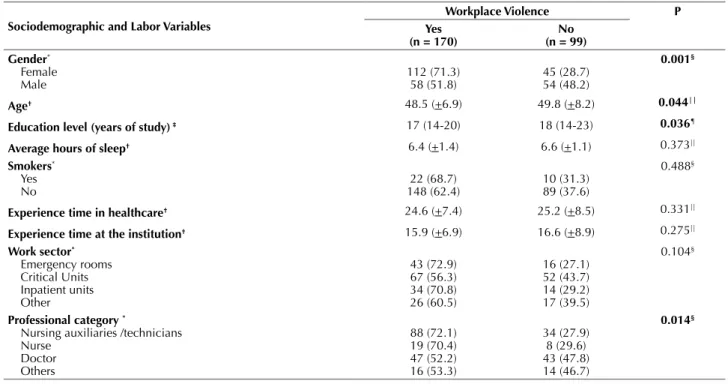
In the sample, 63.2% (n = 170) of the subjects were exposed to violence, with a prevalence of female victims (p = 0.001), younger (p = 0.044), lower education (p = 0.036) and belonging to the professional category of nursing auxil-iaries/technicians (p = 0.014) (Table 1). Among the victims, we found that 35% (n = 94) experienced one type of vio-lence, while 28.2% (n = 76) of the sample had been exposed to two or more forms of violence perpetrated at work.
Table 1– Distribution of workers exposed and not exposed to violence at work, according to sociodemographic and labor character-istics - Porto Alegre, RS, Brazil, 2011.
Sociodemographic and labor Variables
Workplace Violence p Yes
(n = 170)
no (n = 99) gender*
Female Male
112 (71.3) 58 (51.8)
45 (28.7) 54 (48.2)
0.001§
Age† 48.5 (+6.9) 49.8 (+8.2) 0.044||
education level (years of study) ‡ 17 (14-20) 18 (14-23) 0.036¶
Average hours of sleep† 6.4 (+1.4) 6.6 (+1.1) 0.373||
Smokers* Yes No
22 (68.7) 148 (62.4)
10 (31.3) 89 (37.6)
0.488§
experience time in healthcare† 24.6 (+7.4) 25.2 (+8.5) 0.331||
experience time at the institution† 15.9 (+6.9) 16.6 (+8.9) 0.275||
Work sector* Emergency rooms Critical Units Inpatient units Other
43 (72.9) 67 (56.3) 34 (70.8) 26 (60.5)
16 (27.1) 52 (43.7) 14 (29.2) 17 (39.5)
0.104§
professional category *
Nursing auxiliaries /technicians Nurse
Doctor Others
88 (72.1) 19 (70.4) 47 (52.2) 16 (53.3)
34 (27.9) 8 (29.6) 43 (47.8) 14 (46.7)
0.014§
Violence, and minor psychiatric disorders in hospital work
We identiied 46 (17.1%) workers with Minor Psychi-atric Disorders (MPD), of which 38 (82.6%) reported ex-posure to violence (p = 0.003) (Table 2).
In the same table signiicant correlation between MPD and exposure to multiple forms of violence can be seen. From the selection of labor and sociodemographic variables
Sociodemographic and labor Variables
Workplace Violence p Yes
(n = 170)
no (n = 99) Work shift*
Day time Night time On shift
70 (66.0) 52 (69.3) 48 (54.5)
36 (34.0) 23 (30.7) 40 (45.5)
0.110§
Week workload‡ 40 (30-40) 36 (30-40) 0.012¶
Working at another institution* Yes
No
57 (57.6) 113 (66.5)
42 (42.4) 57 (33.5)
0.145§
Work accidents* Yes
No
96 (69.1) 74 (56.9)
43 (30.9) 56 (43.1)
0.009‡
nº of Accidents† 1 (0-2) 0 (0-1) 0.045§
Days missed from work last year† 0 (0-10) 0 (0-3) 0.018§
Satisied with their work* Yes
No 92 (58.2)78 (71.6) 66 (41.8)31 (28.4)
0.026‡
interpersonal relationships review† 4 (4-4) 4 (4-4) 0.058§
Job recognition* Yes
No
82 (54.3) 87 (74.4)
69 (45.7) 30 (25.6)
0.001‡
Concern about violence† 4 (3-5) 2 (1-3) <0.001§ *n (%); †Average (+Standard Deviation); ‡Medium (interquartile intervals); §Chi-square; ||t-Student; ¶Mann-Whitney.
Note: Work accidents included typical accidents, the most reported were biological and ergonomic accidents, human aggressions were not included in this variable. Interpersonal relationships review was assessed on a 5 point scale: (1) very bad; (2) bad; (3) regular; (4) good; (5) great. Concern about violence was assessed on a 5 point scale: (1) not worried; (2) slightly worried; (3) moderate concern; (4) concerned; (5) very concerned
...continuation
Table 2– Distribution of workers according to the presence of Minor Psychiatric Disorders and scores of the SRQ-20 according to total sample, victims of violence and exposure to different forms of violence suffered at work - Porto Alegre, RS, Brazil, 2011.
Total sample (n = 269)
Violence
p
Different forms of violence (n = 269)
p Yes
(n = 170)
no (n = 99) MpD*†
Yes
No 223 (82.9)46 (17.1) 132 (59.2)38 (82.6) 91 (40.8)8 (17.4)
0.003§
2 (1-2) 1 (0-1)
<0.001||
MpD scores‡ 2 (1-5) 3 (1-6) 2 (0-4) <0.001|| 0.330 <0.001¶ *n (%); † Medium (interquartile intervals); ‡ Correlation coeicient; §Chi-square; ||Mann-Whitney. ¶Spearman.
Legend: MPD – Minor Psychiatric Disorders
Table 3– Poisson Regression Model for variables associated with Minor Psychiatric Disorders - Porto Alegre, RS, Brazil, 2011.
Variables pR (95% Ci) p
nº of children 0.7 (0.5-0.9) 0.016
Years of experience in healthcare (every 5 years) 1.3 (1.1-1.6) 0.015
professional Category
Nursing auxiliaries /technicians Nurse
Doctor Other
3.5 (0.8-15.3) 2.5 (0.4-13.8) 2.9 (0.6-13.8)
1.0
0.095 0.303 0.165
nº of professionals present 1.0 (0.9-1.1) 0.064
Satisfaction with work place
Yes No
0.6 (0.3-0.9)
1.0 0.032
nº of work Accidents 1.2 (0.9-1.4) 0.100
associated with MPD, the strength of association was ana-lyzed using Poisson regression model (Table 3).
From the prevalence ratio, it was possible to establish that exposure to diferent forms of perpetrated violence compounded the chances of these disorders by 60% (95% CI: 1.2-2.1).
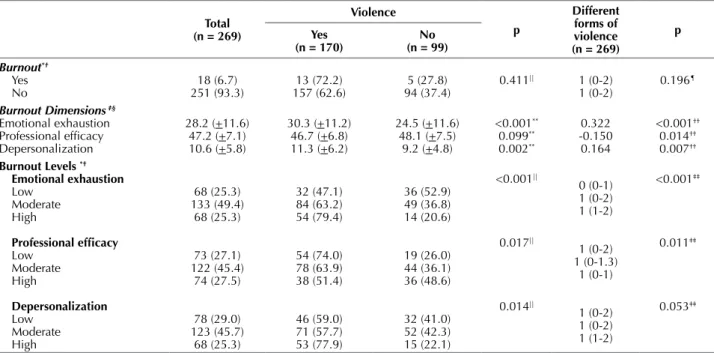
he application of MBI conirmed Burnout in 18 (6.7%) workers, among which 13 had experienced violence at work (p=0.411). he high levels of emotional exhaustion and de-personalization, and low professional eicacy were
associ-Variables pR (95% Ci) p
Days missed from work
None
≤1 week
1 week to 2 months
≥2 months
1.0 1.6 (0.8-3.4) 1.8 (0.9-3.4) 3.5 (1.5-8.1) 0.205 0.087 0.004
exposure to different forms of violence 1.6 (1.2-2.1) 0.001
Legend: PR = Prevalence Ratio; CI = Conidence Interval.
...continuation
ated with violence (Table 4).
Linear regression was conducted from the selection of demographic and labor variables associated with each of
the dimensions that make up Burnout (Table 5).
Table 4 – Distribution of means and levels of Burnout dimensions and Burnout syndrome, according to the exposure of workers to
violence and the different forms of violence. Porto Alegre, RS, Brazil, 2011.
Total (n = 269)
Violence
p
Different forms of violence (n = 269)
p Yes
(n = 170) (n = 99)no
Burnout*† Yes No 18 (6.7) 251 (93.3) 13 (72.2) 157 (62.6) 5 (27.8) 94 (37.4)
0.411|| 1 (0-2) 1 (0-2)
0.196¶
Burnout Dimensions ‡§
Emotional exhaustion Professional eficacy Depersonalization 28.2 (+11.6) 47.2 (+7.1) 10.6 (+5.8) 30.3 (+11.2) 46.7 (+6.8) 11.3 (+6.2) 24.5 (+11.6) 48.1 (+7.5) 9.2 (+4.8) <0.001** 0.099** 0.002** 0.322 -0.150 0.164 <0.001†† 0.014†† 0.007††
Burnout levels *†
emotional exhaustion Low Moderate High Professional eficacy Low Moderate High Depersonalization Low Moderate High 68 (25.3) 133 (49.4) 68 (25.3) 73 (27.1) 122 (45.4) 74 (27.5) 78 (29.0) 123 (45.7) 68 (25.3) 32 (47.1) 84 (63.2) 54 (79.4) 54 (74.0) 78 (63.9) 38 (51.4) 46 (59.0) 71 (57.7) 53 (77.9) 36 (52.9) 49 (36.8) 14 (20.6) 19 (26.0) 44 (36.1) 36 (48.6) 32 (41.0) 52 (42.3) 15 (22.1) <0.001|| 0.017|| 0.014|| 0 (0-1) 1 (0-2) 1 (1-2) 1 (0-2) 1 (0-1.3) 1 (0-1) 1 (0-2) 1 (0-2) 1 (1-2) <0.001‡‡ 0.011‡‡ 0.053‡‡
*n (%); †Medium (interquartile intervals); ‡Average (+Standard Deviation); §Correlation coeicient; ||Chi-square; ¶Mann-Whitney. **t-Student; ††Spearman; ‡‡Kruskal-Wallis.
Table 5– Multiple linear regression model to the dimensions of Burnout - Porto Alegre, RS, Brazil, 2011.
Dimensions Variables B p r2
emotional exhaustion White -2.574 0.081 0.306
Number of children -0.961 0.055
Interpersonal relationships review -1.513 0.084
Job satisfaction -5.502 <0.001
Recognition at work -5.432 <0.001
Concern about violence 0.924 0.048
Different forms of violence 2.019 0.003
Professional eficacy Age 0.124 0.028 0.157
Number of children 0.763 0.029
Professional Category Nursing auxiliaries/technicians Nurse Doctor Other 1.805 1.154 2.901 0.193 0.512 0.043
Hours of sleep -0.598 0.056
Interpersonal relationships review 1.137 0.053
Job recognition 3.388 <0.001
Violence, and minor psychiatric disorders in hospital work
On the variables of inluence on the dimensions of
Burnout, there is a correlation between increased exposure to diferent forms of perpetrated violence and Emotional Exhaustion (p = 0.003), as for every increase in violence that the worker sufered, there was an average increase of two points in that dimension. Workplace violence re-mained in the inal regression model of professional ei-cacy. Increased exposure to diferent forms of perpetrated violence at work was correlated with depersonalization (p = 0.003).
DISCUSSION
he percentage of victims of violence at work (63.2%) exceeds the statistical studies that used the same
investiga-tion strategy in the health services of Bahia(18), of Rio de
Janeiro (46.7%) and in countries such as Portugal (37%),
hailand (54%) and South Africa (61%)(15). However, it was
lower than the prevalence in Australia (67.2%) and Bulgaria
(75.8%)(15).
In Australia, another study found that 52% of health professionals were victims of some form of violence at work
in the last four weeks(4). Similar indings were seen in a
Swiss university hospital, with 50% of violence in the last
12 months and 11% in the last week(6). hese data reveal the
prevalence of victims in a recent period, featuring workplace violence as a phenomenon occurring in labor every day. Bra-zilian studies have identiied a prevalence of 25-65% for
some kind of violence in the last 12 months(9,18).
he prevalence of the auxiliary/practical nurse category among the victims of violence in the study setting, as well as workers with less education was also predominant among the victims, reinforcing the higher exposure of nursing pro-fessionals with a medium level in this study. Brazilian
stud-ies have highlighted the exposure of these professionals(16,18).
Some authors state that nursing is more exposed to violence from both the proile of their direct care activities
to the patient(5-6,11) and the predominance of female
work-ers(5), placing particular emphasis on the implications of
gender being aggravating. A longitudinal study pointed to the exposure of nurses to gender violence, inding that in this class there was an increased risk of violence due to the overlap of labor abuse to domestic violence, and an increase
in the chances of stress and depression(19). he implication
of gender on the understanding of violence should con-sider the historical cultural and economic inequality be-tween genders, for which women have been in unfavorable
Dimensions Variables B p r2
Depersonalization Number of children -0.684 0.012 0.122 Work sector
Urgency or Emergency rooms Critical Units
Inpatient units Other
-1.572 -2.909 -2.866
0.159 0.003 0.014
Working at another institution 1.574 0.025
Job recognition -2.054 0.003
Different forms of violence 0.930 0.010
Legend: B – angular regression coeicient; r2 – determination coeicient. ...continuation
conditions. Females having the largest distribution in the group of workers exposed to occupational violence has been
recurrent in the health sector(5,9,12).
Victims of violence at work in the past year had lower average age than those not exposed to violence in the last
year, reinforcing indings of other studies(5,9,12,18,20-21). his
re-sult can be explained from the perspective of young profes-sionals who have less expertise in the development of their work activities and thus would have less ability to prevent attacks. However, the diferences related to professional practice time do not reinforce this fact.
he exposure of health workers to violence at work has
been linked to higher workloads in labor(12,20), according to
results of this study. In addition to concluding that the in-crease of the incidents stems from the inin-crease in exposure time to the phenomenon, it is considering the possibility that overload is relected in behaviors that add risk, such as less attention to detail or greater irritability. Other
Brazil-ian studies(9,16) describe the precariousness of employment
contracts as an aspect that focuses on the vulnerability of workers.
he shift of the victims had no signiicant prevalence.
hese indings difer from other studies(5,12,16,20), which
indi-cated increased exposure for professionals who work at night. Workplace violence may relect on diferent aspects of working life; in this study we highlight the negative re-lationship on satisfaction and recognition at work. Other
studies showed association to employee dissatisfaction(9-10),
demotivation to work(10), decreased professional
commit-ment(5), damage to teamwork, experiences working under
pressure and physical overload(12).
A study also found that violence interferes on adverse
events in nursing care(22). However, we found no studies to
conirm the data from this research on the prevalence of occupational accidents among workers exposed to violence, but it is understood that accidents are representations of emotional and cognitive impairments brought about by the experience of violence. Workplace violence was associated with worker's absences, complementing indings in the literature that indicate this phenomenon as the cause of
absence(3,9). However, we note that in addition to the
un-derreporting of violence in health services(8), it has not been
registered as cause of removal, which may result in the same occurring in health services.
Victims of workplace violence have been concerned
their experiences and to consequences of worker safety. Vic-tims of workplace violence have experienced feelings of fear
and insecurity(10), suggesting damage to workers' health.
In this sense, the results of this study show the associa-tion between the experience of violence and the prevalence
of MPD, conirming other indings(9). Regression analysis
has highlighted that exposure to diferent forms of perpe-trated violence is a high probability factor for developing MPD, conirming data from other studies about the nega-tive inluence of exposure to more types of violence on the
mental health of workers(19,23).
he association between violence at work and depres-sion, anxiety and post-traumatic stress disorders has already
been discussed(24). In these conditions, feelings such as
sad-ness, anger, shock, confusion and shame were associated
with violence at work(5).
A longitudinal study of 176 nurses from two American hospitals revealed the efects of exposure to physical violence on health in the form of somatic symptoms and
musculoskel-etal injury(25). Another pointed out that the violence sufered
by hospital workers can lead to increased use of
psychotro-pic drugs, particularly antidepressants, but also anxiolytic(26).
Regarding Burnout measured by the MBI, data from
this study demonstrated that emotional exhaustion and depersonalization were higher for the victims of violence, therefore the dimensions of the scale were associated with workplace violence. Corroborating these data, a study of nurses from 11 public hospitals in Spain found that in-creased exposure to violence at work is associated with greater emotional exhaustion and depersonalization, and a
lower level of psychological well-being(27). Another Spanish
study conirms the association of violence with the
dimen-sions of emotional exhaustion and depersonalization(23).
Research conducted with nurses from 10 European
coun-tries showed that the highest frequencies of violence were
associated with higher levels of Burnout(12), which was also
concluded from a systematic review(5).
CONCLUSION
Health workers experience violence in the workplace
and this exposure is associated to symptoms of Burnout and
MPD. Workers subjected to diferent forms of perpetrated violence experience these conditions even more.
he victims were predominantly women, younger work-ers, working more hours and having less education, and working as auxiliary/practical nurses. In addition to the
Burnout symptoms and minor psychiatric disorders, the cruelties of violence proved to be linked to typical complica-tions of labor, such as accidents and absenteeism, relecting the complexity of the elements involved in the sufering and illness of workers. Exposure to violence also has a negative impact on job satisfaction and worker recognition.
hese results have implications for the ield of study and practice in occupational health, revealing the need for protective measures on the occurrence of violence and harm to the mental health of health care professionals, especially nursing. We must invest in monitoring systems for the in-cidents in order to identify measures that contain aggressors and to track the victims, thereby minimizing the damage of violence. his issue needs to have institutional guidelines, seeking to understand its origins and invest in a zero toler-ance culture of violence at work.
Regarding the limitations of the study, the bias of re-verse causality between the variables studied factor and outcomes should be considered. Given these speculations, we see the need for further studies, and recommend longi-tudinal designs seeking more evidence related to health and worker safety and the impact on patient care.
ReSuMo
Objetivo: Identiicar a violência sofrida pelos trabalhadores da equipe de saúde e a sua associação com burnout e transtornos psíquicos menores. Método: Estudo transversal, realizado com 269 proissionais da equipe de saúde em hospital público da região sul do Brasil. Na coleta de dados foram utilizados o Survey Questionnaire Workplace Violence in the Health Sector, Maslach Inventory Burnout e o Self-Report Questionaire. Resultados: A violência no trabalho acometeu 63,2% dos trabalhadores, prevaleceu no sexo feminino (p=0,001), entre auxiliares/técnicos de enfermagem (p=0,014) e foi associada aos transtornos psíquicos menores (p<0,05), sendo que a exposição a diferentes formas de violência acresceu em 60% as chances desses transtornos (IC95%:1,2-2,1). As três dimensões do burnout também se associaram à violência no trabalho (p<0,05). Conclusão: Os trabalhadores de saúde sofrem violência em seu ambiente de trabalho e a essa exposição associam-se os sintomas de burnout e transtornos psíquicos menores.
DeSCRiToReS
Violência no Trabalho; Saúde do Trabalhador; Recursos Humanos em Saúde; Recursos Humanos de Enfermagem.
ReSuMen
Objetivo:Identiicar la violencia sufrida por los trabajadores del equipo de salud y su asociación con burnout y trastornos psíquicos menores.Método:Estudio transversal, realizado con 269 profesionales del equipo de salud en hospital público de la región sur de Brasil. En la recolección de datos se utilizaron el Survey Questionnaire Workplace Violence in the Health Sector, el Maslach Inventory Burnout y el Self-Report Questionaire.Resultados:La violencia laboral comprometió al 63,2% de los trabajadores, fue prevalente en el sexo femenino (p=0,001), entre auxiliares/técnicos de enfermería (p=0,014) y estuvo asociada con los trastornos psíquicos menores (p<0,05), siendo que la exposición a distintas formas de violencia añadió en el 60% la probabilidad de ocurrir dichos trastornos (IC95%:1,2-2,1). Las tres dimensiones del burnout también se asociaron con la violencia laboral (p<0,05). Conclusión: Los trabajadores de salud sufren violencia en su ambiente laboral y con esa exposición se asocian los síntomas de burnout y trastornos psíquicos menores.
DeSCRipToReS
Violence, and minor psychiatric disorders in hospital work
REFERENCES
1. Organización Internacional del Trabajo; Consejo Internacional de Enfermeras; Organización Mundial de la Salud; Internacional de Ser-vicios Públicos. Directrices marco para afrontar la violencia laboral en el Sector de la Salud [Internet] Ginebra: OIT; 2002 [citado 2014 jun. 27]. Disponíbel en: http://www.ilo.org/wcmsp5/groups/public/---ed_dialogue/---sector/documents/publication/wcms_160911.pdf
2. Spector PE, Zhou ZE, Che XX. Nurse exposure to physical and nonphysical violence, bullying, and sexual harassment: a quantitative review. Int J Nurs Stud. 2014;51(1):72-84.
3. Campos AC, Pierantoni CR. Violência no trabalho em saúde: um tema para a cooperação internacional em recursos humanos para a saúde. R Eletr Com Inf Inov Saúde. 2010;4(1):86-92.
4. Farrell GA, Shaiei T. Workplace aggression, including bullying in nursing and midwifery: a descriptive survey: the SWAB study. Int J Nurs
Stud. 2012;49(11):1423-31.
5. Edward KL, Ousey K, Warelow P, Lui S. Nursing and aggression in the workplace: a systematic review. Br J Nurs. 2014;23(12):653-4.
6. Hahn S, Hantikainen V, Needham I, Kok G, Dassen T, Halfens RJG. Patient and visitor violence in the general hospital, occurrence, staff interventions and consequences: a cross-sectional survey. J Adv Nurs. 2012;68(12):2685-99.
7. Dal Pai D, Lautert L. Work under urgency and emergency and its relation with the health of nursing professionals. Rev Latino Am Enfer-magem. 2008;16(3):439-44.
8. Vasconcellos IRR, Abreu AMM, Maia EL. Violência ocupacional sofrida pelos proissionais de enfermagem do serviço de pronto atendi -mento hospitalar. Rev Gaúcha Enferm. 2012;33(2):167-75.
9. Vasconcellos IRR, Griep RH, Lisboa MTL, Rotenberg L. Violence in daily hospital nursing work. Acta Paul Enferm. 2012;25(n.spe2):40-7.
10. Batista CB, Campos AS, Reis JC, Schall VT. Violência no trabalho em saúde: análise em unidades básicas de saúde de Belo Horizonte,
Minas Gerais. Trab Educ Saúde. 2011;9(2):295-317.
11. Santos AMR, Soares JCN, Nogueira LF, Araújo NA, Mesquita GV, Leal CFS. Violência institucional: vivências no cotidiano da equipe de
enfermagem. Rev Bras Enferm. 2011;64(1):84-90.
12. Estryn-Behar M, Heijden B, Camerino D, Fry C, Nezet OL, Conway PM, Hasselhorn HM. Violence risks in nursing: esults from the European
‘NEXT’ Study. Occup Med. 2008;58(2):107-14.
13. Lautert L. O desgaste proissional: estudo empírico com enfermeiras que trabalham em hospitais. Rev Gaúcha Enferm. 1997;18(2):133-44.
14. 14 Mari JJ, Williams P. A validity study of a psychiatric screening questionnaire (SRQ-20) in primary care in the city of São Paulo. Br
J Psychiatry [Internet]. 1986 [cited 2014 July 12];148:23-6. Available from: http://bjp.rcpsych.org/content/bjprcpsych/148/1/23.full.pdf
15. Di Martino V. Workplace violence in the health sector - country case studies: Brazil, Bulgarian, Lebanon, Portugal, South Africa, Thailand,
plus an additional Australian study: synthesis report [Internet]. Geneva: WHO; 2003 [cited 2014 Oct 22]. Available from: http://www.who. int/violence_injury_prevention/injury/en/WVsynthesisreport.pdf
16. Palácios M. Relatório Preliminar de Pesquisa. Violência no trabalho no Setor Saúde – Rio de Janeiro – Brasil [Internet]. Rio de Janeiro:
Universidade Federal do Rio de Janeiro; 2002 [citado 2014 set. 03]. Disponível em: http://www.assediomoral.org/IMG/pdf/pesquisa_so-bre_Violencia_no_trabalho_Universidade_Federal_RJ.pdf
17. Maslach C, Jackson S. The measurement of experienced Burnout. J Occup Behav. 1981;2(1):99-113.
18. Silva IV, Aquino EML, Pinto ICM.Violência no trabalho em saúde: a experiência de servidores estaduais da saúde no Estado da Bahia, Brasil. Cad Saúde Pública. 2014;30(10):2112-22.
19. Cavanaugh C, Campbell J, Messing JT. A longitudinal study of the impact of cumulative violence victimization on comorbid posttraumatic stress and depression among female nurses and nursing personnel. Workplace Health Saf. 2014;62(6):224-32.
20. Gillespie GL, Gates DM, Miller M, Howard PH. Workplace violence in healthcare settings: risk factors and protective strategies. Rehabil Nurs. 2010;35(5):177-84.
21. Pai HC, Lee S. Risk factors for workplace violence in clinical registered nurses in Taiwan. J Clin Nurs. 2011;20(9-10):1405-12.
22. Roche M, Diers D, Dufield C, Catling-Paull C. Violence toward nurses, the work environment, and patient outcomes. J Nurs Scholarsh.
2010;42(1):13-22.
23. Bernaldo-De-Quirós M, Piccini AT, Gómez MM, Cerdeira JC. Psychological consequences of aggression in pre-hospital emergency care:
cross sectional survey. Int J Nurs Stud. 2015;52(1):260-70.
24. Gates DM, Gillespie GL, Succop P. Violence against nurses and its impact on stress and productivity. Nurs Econ. 2011;29(2):59-66.
25. Yang LQ, Spector PE, Chang CH, Gallant-Roman M, Powell J. Psychosocial precursors and physical consequences of workplace violence towards nurses: a longitudinal examination with naturally occurring groups in hospital settings. Int J Nurs Stud. 2012;49(9):1091-102.
26. Dement JM, Lipscomb HJ, Schoenisch AL, Pompeii LA. Impact of hospital type II violent events: use of psychotropic drugs and mental
health services. Am J Ind Med. 2014;57(6):627-39.
27. Waschgler K, Ruiz-Hernández JA, Llor-Esteban B, García-Izquierdo M. Patients' aggressive behaviours towards nurses: development and